
Fasti;
Read Fasti; by Ovid, 43 B.C.-17 or 18 A.D; Hallam, G. H, a public-domain latin edition published in 1882, sourced from the cited historical archive.
By Ovid, 43 B.C.-17 or 18 A.D; Hallam, G. H
Source and rights: Internet Archive historical scan, published 1882. The source text below is imported without translation or rewriting.
Digitized by tiie Internet Arciiive
in 2011 with funding from
University of Toronto
http://www.arcliive.org/details/fastioviOOovid
THE
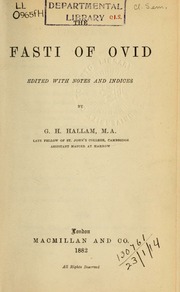
FASTI OF OVID
LL iDEPARTMENTAL! c^.^x/w^ 0965fH^ LIBSARY ci.s.
FASTI OF OVID
EDITED WITH NOTES AND INDICES
BY
G. H. HALLAM, M.A.
LATE FELLOW OF ST. JOHN'3 COLLEQE, CAHBRIDOE A3SISTANT MASTER AT HARROW
MACMILLAN AND CO. ^\\
All Rights Rtscrvsd f ^
LONDON :
R. CLAY, SONS, AND TAYLOR,
BREAD STREET HILL, E.C.
CONTENTS.
PAGE
Preface vii
Intkoductions : —
§ 1. Ovid’s Life and Works xiii
§ 2. The Fasti^ and its Revision xvii
§ 3. Authorities and Models xx
§ 4. Ovid’s Astronomy : tlie Zodiac xxii
§ 5. The Roman Calendar : — Year, Months, Days :
Dates in Latin xxii
§ 6. Modern Parallels to Roman Usages …. xxv
§ 7. Comparative Philology : Latin and Greek . . xxvi
§ 8. Genealogies xxix
Text 1
NoTEs 183
Grammatical Appendices 327
General Index to the Notes 337
Index of Proper Names 344
MAPS.
I. — Central Rome as it Appears in the Fasti {fron-
tispiece).
II. — The Rome of Ovid’s Fasti (Supplementary) {to face p. 1).
PREFACE
TO THE SECOND EDITION.
SiNCE the First Edition was published, a year ago, I have compared my text with that of Kiese, and have had by me the usef ul commentary of Hermann Peter. I have also tried to profit by the sugges- tions of friends who have used the book, and of other friendly critics. As to the philological matter in particular, I was conscious when the notes were ^^ritten, that much of it would have been better for fuller explanation, of which the limits of my task hardly admitted. In a few cases it has now seemed best to expunge a note which it was not possible conveniently to amplify. I trust that the slight changes which T have been able to introduce will render the book more complete both to others and to those who, I am glad to know, have found it useful during the past year.
The pagination has in no case been disturbed.
viii PREFACE TO THE SECOND EDITION.
For the convenience of those who possess the First Edition, a list is given below of the principal alterations which have been made in the text, gene- rally in agreement with Kiese. (The list includes the corrections of a few misprints which had escaped notice.)
G. H. H.
January 16, 1882.
BooK I. — 288, Read deserat ; 296, dicere ; 315, Institerint Nonae : missi tibi nubibus atris Signa dabunt imbres ; 336, hostibus ; 351, novo ; 552, titulos ; 661, perennet.
BooK II, — 1, crescit ; 206, sibi cur ; 342, his; 409, placare… ferre ; 597, intentaque.
BooK III. — 221, Inde mei primas mensis ; 282, erudit; 372, DiflBcile est, ilhid, dicere, clausitopus ; 411, veteris ; 429, altius ; 505, ac ; 674, spretus inermis erat ; 730, Lucifero…tuo.
BooK IV. — 153 Da, dea, quem sciter, Doctas C. neptes Vidit ; 442, hoc.
BooK V. — 86, grata fuisse lovi ; 199, vere est nitidissimus ; 354, vana ; 426, nostro ; 601, me in Tiberim ; 628, praeteritae ; 654, illo (nomen Aphidna) loco.
BooK VI. — 35, Maia levis potuit ; 73, socio ; 120, horren- dura ; 265, inde precando Affamur Vestam, quae j 476, vestris ; 500, eum ; 657, augur ; 658, anguis.
PREFACE.
This book owes its birth to the suggestion of colleagues at Harrow, where the Fasti has long been used in all the middle part of the school, though it has been felt that no existing edition, whatever its merits, quite met our requirements. In spite of this draw- back the Fasti has held its place both here and at my own old school, Shrewsbury, and in my opinion there are f ew books more usef ul f or a young scholar ; it has so many pegs on which teaching of all kinds may be hung. For while it is true that a learner may have too much done for him, and while it is often best that he should work his way, without help (except that of his dictionary or vocabulary) through construing which is well within his reach, still he should have one or two books also of another kind, which require getting up, and from which he may gain information as well as mental training. I hope and believe that I have not made the way too easy, though much annotation was necessary. If I have failed to hit the mark, it is not for want of experience, both as a boy at school, who struggled
X PREFAGE.
unassisted with the Fasti years ago, and as a teacher of it for the last ten years at Harrow.
Grammatical difficulties I have never slurred over, remembering one golden rule of my own school days, " Never dare to paraphrase unless you are dble to give a literal construe." At the same time I have aimed at making the notes interesting from various points of view. Wherever it could be done with advantage, references have been given to the little pictures, as well as to the text, of Dr. Smith’s small Roman History, sometimes to Dean LiddelFs Studenfs Rome. The two maps, especially the larger one, will I hope be very useful. Kecognising the growing importance of the subject, I have given in a short Introduction (§ 7) and in the Notes, a good deal of philological matter. Mythology and antiquities of course hold an important place.
One f urther difficulty to be faced was the question of expurgation. Taking the bull by the horns, I have cut out all passages unfit for a boy to read, and renumbered all the lines in text and references, and it seemed best not to put the old numbering side by side with the new, except in the Grammatical Appendices.^ It has been necessary to alter the text, though very slightly, in about six places. Some difficulties which might have arisen from the new numbering will perhaps be met by the copious Index, and by the headings introduced into the text, — which latter will
^ The ordinary numbering is indicated hy square brackets
PREFACE. xi
also be found convenient by versifiers as making fountains of inspiration more accessible.
Though the book is primarily written for rather young boys, it will also I think be found serviceable by older readers. Acting on a hint of Professor J. E. B. Mayor’s, I have brought together in the Appendices a number of passages from the Fasti which illustrate some of the less common construc- tions and grammatical usages occurring in it. The Index will supply many more.
The book has no pretensions to the higher scholar- ship and criticism. I have collated no MSS., nor have I gone minutely into the question of texts, being content, except here and there, to follow Merkel, whose mine of learning I have explored and worked. I have also had at hand Gierig’s, Keightley’s, and Pro- fessor Paley’s editions, as well as Professor E,amsay’s Selections from Ovid. In the matter of topography I have followed Mr. Burn.
It is a pleasant duty to pay my best thanks to an old friend and schoolfellow, the Kev. G. T. Hall, Second Master of Shrewsbury School, who with a disinterestedness which is characteristic of him, put at my service a careful and well arranged commentary which he had already written to several of the books, and by the help of which my labours have been light- ened ; to my colleague, Mr. H. O. D. Davidson, who helped me to correct the proofs, and to prepare the Index; to the Pev. Dr. Butler, Head Master of Harrow, for one piece of research, as well as generaJ
xii PREFACE.
encouragement ; not least to my old master, Professor Kennedy, for indirect help, of which he himself has been unconscious. I have habitually used his Latin Grammar and Primer, besides making frequent refer- ences to the latter throughout the Notes. And may I add that the grateful remembrance of his teaching has been very often present to me in preparing this edition, as it is in my daily work as a schoolmaster, at a place which is not quite unknown to him 1
G. H. HALLAM.
Byeon House, Hareow.
lanuary 13, 1881.
INTRODUCTIONS.
§ 1.— OVID: HIS LIFE AND WORKS.
There are few poets whose life lies open to ns more plainly in their works than that of Ovid ; and we have besides one elegy {Tristia IV. 10) which is a model of concise autobiography.
Publius Ovidius Naso was born B.c. 43, at Sulmo, among the hills of the Peligni, about 90 miles from Rome, the second son of a wealthy family. He and his brother, a year older Birtli than himself, were strongly attached to each other, and were both destined by their parents for the honourable and lucrative profession of the law. With this view the two boys were sent to Rome to learn and practise rhetoric in the school of one Arellius Fuscus. Se- Education neca says of the poet that at this time he was reckoned a good declaimer, nice in his choice of words, and winning in his address and style, but showing no fancy for knotty points of law. The vain attempt to force nature was soon given up. " Poetry would come to my lips," ^ says Ovid. “His prose was poetry unversified,” says his critic^ He
1 7>. IV. 10, 26, and Fasti II. 6.
^ * Carmen solutum ’ Sen. Conirov. II. 10.
xiv OVIDII FASTI. [§ i
abandoned the regular practice of tlie law, and gave
the rein to his poetic fancy. After his brother’s death
at the age of twenty, he travelled with
Travels his friend and fellow poet Macer, visiting
Asia ^ and Sicily, and Athens,’* then miich
frequented by the wealthy Koman youth, as the
fountain of art and culture.
After returning to E,ome he held some minor
judicial offices, becoming, as he tells us, one of tlie
Triumviri Capitales, and again a Decemvir
liife at litibus iudicandis,^ sitting in the Ccntum-
Rome viral Court, and sometimes acting as
arbitrator in private suits. He was,
however, too indolent to be a candidate for any of
the high offices of state, and never cared to rise from
the Equestrian order to the Senate.
As a very young man he formed two successive
marriages, which were unhappy and did not last long.
To his third wife, Marcia, who was relatod
Marriage by marriage to Fabius Maximus, and a
personal friend of Livia, he was fondly
attached, and remained so to his death. By her .q
had one daughter, Perilla, to whose wedding he
alludes in the Fasti^ and who appears to have written
poetry.’^ His father and mother, of whom he speaks
with affection, lived to a good old age, dying not long
before his banishment.
His literary tastes showed themselves again in his
choice of friends. He did not beloug to the literary
clique who clustered round Maecenas, but was
„ . ^ intimate with Ponticus and Bassus, tho X rieixus . .
former famous for his heroic verse, the
latter for his iambics ; the two Macri, one of whom,
3 Fasti VI. 355, and Pont. 11. 10, 21.
^ Tr. I. 2, 77. 5 Fasti IV. 317.
6 Fasti VI. 199. ‘^ 7r. III. 7, 11.
§ i] INTRODUCTIONS. xv
his travelling companion, was the composer of an epic on the story of Troy ; Sabinus, the author of a work resembling the Fasti ; Tuticanus, a trans- lator of the Odyssey ; Cornelius Severiis, who de- scribed in elegant verse the Bellum Siculum of Sex. Pompeius ; Pedo Albinovanus, the author of a Theseid and another epic on contemporary events, as well as a brilliant wit and conversationalist. Virgil, he tells us, he had only seen ; his ears had been enchained by the tuneful Horace ; Propertius was his boon companion, to the recitation of whose love-poems he was often a listener. He lived in the heart of Pome, near the Capitol.^
But this pleasant life was not to last. In a.d. 9 he was banished from Bome to Tomi, among the Getae, on the western shore of the Black Sea. The reasons for his banishment are Exile mysterious : the poet only hints at them.^ In the poem about his life {Tristia IV. 10) quoted above, he says that the cause was *’ errorem non scelus." This much is clear from his words, that he had given some personal offence to Augustus, and in Tristia II. 103, he speaks of his *’ eyes " as having been in fault. The most probable theory is that he had been a consenting witness of some disgraceful act of the emperor’s profligate grand-daughter, the younger Julia.^^ Augustus was the more inclined to deal severely with him on account of the corrupt nature of the poems which he had published some years before.
The sentence was one of relegatio, not exilium, and Ovid accordingly did not lose his property ; but the punishment was nevertheless crushing. At the age of fifty, or rather more, this -town-bred man of
8 Fasti VI. 327. ^ Tr. II. 207. ^" Cf. Introd. § 8.
xvi OVIDII FASTI. [§ i
pleasure, with his cultivated tastes and luxurious habits, is driven from wife and home, and from the literary friends whose society and approbation were the very breath of his nostrils, to the cold and distant Euxine, and the companionship of outer barbarians. He felt the change as Dr. Johnson might have felt a sentence of perpetual banishment from Fleet Street to the farthest Hebrides. Little wonder if the poet, here as elsewhere incapable of self-control,
pours out his heart in ceaseless wailings His la- and petitions, grovelling in the very dust ments before Augustus and Tiberius and their
imperial house, in the vain hope of par- don. It was with this motive that he dedicated to Tiberius’s heir Germanicus the revised edition of his Fasti}^ Yet even in exile his amiable disposition won him friends among his rough neighbours, and the poefs thoughts still found their utterance io verse, so that he even wrote a poem in the Getic
language. ^^ Death He died at Tomi a.d. 18.
Poems His poems may be placed in three
classes : (1) those of early life ; (2) thoso of middle age, written before his banishment ; and (3) those written at Tomi.
(1) Love poems (written partly in imitation of tho Alexandrine poets, and of his predecessors at Rome, Gallus, TibuUus, Propertius), the Heroides, and a tragedy, the Medea.
(2) The Fasti (suggested perhaps by the last book of Propertius), and the Metamorphoses.
(3) Five books of Tristia, and four of Fpistles from Pontus, Ibis (a lampoon), Halieutica (on the fish
of the Black Sea).
i^ Cf. Introd. § 2.
12 Font. ly. 13, 19, and III. 2, 40.
§ 2] INTRODUCTIONS. xvii
We have seen that Ovid possessed a great natural taste and aptitude for poetry ; he wrote with perfect ease and fluency, and was a master of the technicalities of his art, though he shrank Poetical from the ’’ limae labor ; " indeed Seneca powers says of him, " that he lacked not critical acumen, but the inclination to prune ; he sometimes used to say that a mole or two made a comely face more comely." In disposition he was joyous and light-hearted, incapable of seriousness or self-disci- pline. Even in his graver work, such as the Fasti, he plays lightly with his task, and finds food for merriment in the exploits of gods and goddesses. We may suppose that his choice of the elegiac as his favourite metre was determined by its fitness for neat and witty turns, without the necessity for sustained effort, and by his fondness for rhetorical expression, which must have been fostered by his early training. The poetical rhetoric of his schoolboy-days finds its counterpart in the somewhat rhetorical poetry of his later years. Both Seneca and Quintilian show their high appreciation of him by the frequency with which they quote his works, and the latter ^^ says that the Medea shows what he could have done if he had chosen to exercise self-restraint in using his poetic ability. Tacitus bears testimony to the same effect, but the poem, except a few lines quoted by Quintilian, is lost to us.
§ 2.-C0MP0SITI0N AND REVISION OF THE FASTI.
The Fasti, as we possess it, is only a fragment of the work which Ovid certainly sketched out,
" Quint. X. 1, 98.
xviii OVIDII FASTI. [§ 2
and of which he probably wrote at least his
rough copy. The latter part, even of
piete poem Book VI,, is little more than this, show-
ing many signs of haste and incomplete-
ness. It ends with June, but there are several
references to later parts of the poem which have
not come down to us, e.g. III. 49 [57] ’ cum Laren-
talia dicam ’ : the Larentalia was in December. III.
192 [200] ’ Consus tibi cetera dicet …. cum sua
sacra canes . ’ the festival of Consus was in August.
V. 147, ’ Quo feror? Augustus mensis mihi carminis
huius lus habet,’
Furthermore, Ovid himself says {Tristia II. 549) —
Scx ego fastoruru scripsi totidemque libellos, Cumque suo finem mense Hbellus habet :
Idque tuo nuper scriptum sub nomine, Caesar, Et tibi sacratum sors mea rupit opus.
Gronovius, quoted by Merkel in his critical notes p. 303, repeats the statement made in an ancient edition, that the last six books were in existence :
- servantur apud presbyterum in pago prope Ulmam ’ : and a first couplet is quoted, which differs however from another version of the couplet preserved in two or three of the MSS.
Leaving the doubtful question of the last six books,
and confining our attention to the six
Dedication -which are now extant, we find indica-
vision tions of a first copy, and of a subsequent revision.
The book was dedicated in the first instance to Augustus, and Merkel thinks the first lines were written about 1 or 2 b.c. When Ovid was banished, A.D, 9, the work seems to have been laid on the shelf and to have remained there until Augustus’s death, in A.D. 14. Then it was revised as far as the end of
INTROB UCTIONS.
XIX
§2]
Book I., and re-dedicated to Tiberms’s adoptcd son and heir, the learned young Germanicus, himself a poet, through whose favour Ovid vainly hoped to gain his recall.
Book I. — Theii were added
I, 1 — 26 (except verses 1, 2> 7, 8, 13, 14), the new dedication to Germanicus, addressed hy name in 1. 3.
I. 63, wMch probably alludes to Germanicus’s consulship.
I. 223 — 6, in which a temple of Janus, restared by Tiberius, is alluded to (cf. Tac. Ann. 11. 49).
I. 281 — 8, where Tiberius and Germanicus are spoken o£ as well as the triumph decreed to Germanicus, a.d, 15, for victordes over the Catti.
I. 481—484 [531—5341. Here Tiberius is mentioned as Em- peror, and is called ’nepos natusque dei.'
I. 486 [536] The title of * Augusta luha ’ was not given to Livia nntil after Augustus’s death, by his will.
I. 540 [590] ’ Et tuus Augusto nomine dictus avus ’ is again addressed to Germanicus.
I. 579—590 [639—650]. Ovid here speaks of the Temple of Concord restored a.d. 10 by Tiberius and Livia : and to the conquest of the Sigambri by Tiberius about the same time.
L 389, 431—434 [481—484], 490 [540] were added at the same tirae, as they contain allusions to the poefs exile.
Book II. — VI. — From the beginning of Book IL to the end of YI. with the exception of one or possibly two passages, no event is spoken of which occurred later than Ovid’s banish- ment in a.d. 9. The lines IV. 81 — 84 refer to the exile and wei’e of course inserted afterwards, and it is possible that VI. 574 was similarly inspired, though Merkel does not think so. Otherwise the whole of this part of the poem is left as the poet originally wrote it before his exile, and the unfinished state of the end of Book VI. is shown hy various instances of repetition and loose grammar.
h 2
XX OVIDII FASTI. [§ 3
§ 3.— AUTHORITIES AND MODELS.
There existed in Ovid’s time, and in a Latin
translation, a poem called the alria of Callimachus,
describing the origin of various customs
Greek. and legends of the Greeks ; it is clearly
modeis alluded to in the first line of the Fasti
(’ tempora cum ca^6s^5 ‘). If we go back
to earlier Greek poetry, we come to the tpya koi
rj/j.ipaL of Hesiod, a sort of Farmer’s Calendar, from
which Ovid takes a direct suggestion at the beginning
of Book YI. (1. 13).
The more direct inspiration, however, came from
Propertius, who in his last book treats of Cacus and
Hercules, Vertumnus and Tarpeia. It is
Propertius clear that Ovid, before he wrote the Fasti,
had seen these poems, since many lines in
the Fasti are copied from them ; but as the merit of
originality seems to be claimed for Ovid’s work (in
Book II. 3), it is probable that Propertius had not
yet published them.
Ovid speaks of hi§ materials as ‘unearthed from ancient chronicles ’ (Fasti I. 7) : these were twofold, public and private.
(1) The public annals consisted of the Annales Maximi, compiled and kept from early times by the
PubiieAn- Pontifex Maximus : the Lihri Poniijicales, “*a.is and or Pontijicii, bearing on the ritual of
public worship. There were also the acta, ’ Daily IsTews,’ published and sold daily from the year 69 b.c. onwards, com- prising the acta diurna, of ordinary events, and the acta senatus.
(2) In his ela,borate preface Merkel shows how
§ 3l INTROBTJGTIONS. xxi
Ovid is indebted to the various annalists, or chron- iclers, a short account of whom is given below.^^
M. Fulvius Nobilior, Consul B.c. 189, was one of the earliest annalists, and set up a Tabula Fastorum in the Temple Hercules Musarum (Cf. VI. 705).
Jiinius Gracchanus, contemporary with Fulvius.
The poet Ennius wrote his Annales, a work known to Ovid.
[The elder Scipio Africanus, and Scipio Nasica also wrote historical works.]
Fabius Pictor.
M. Porcius Cato, b. 243, d. 149 b.c. wi’ote Origines : the first attempt to write regular history in Latin, as distinct from ’ annales,’
L. Calpurnius Piso, Consul 133 b.c.
Valerius Antias wrote at least seventy-fi.ve books of Historiae.
L. Cincius came a little before Varro.
M. Terentius Varro, b. 116, d. 26 B.c. A genuine Roman of the old type but with a tincture of the new Greek culture : omnivorous and omniscient, with popular sympathies and a rough humour which delighted in the grotesque : a strong politician as well as a man of letters : he wrote 620 books, comprising seventy-four different works. Merkel [Fasti CVI.) has collected all the extant fragments of his Antiquitates rerum divin. et huniana^-um. Part of his grammatical treatise de lingua Latina also survives.
M. Verrius Flaccus, contemporary of Augustus, and, Merkel thinks, of Tiberius ; a libertinus who wrote Fasti and a dic- tionary of antiquities : quotes and epitomises Varro (Merkel XCV.).
Festus^lw^^ century a.d.) shouldbe mentioned here, as having in turn epitomised Verrius, while Festus had the same kind ofiice performed for him by Paul the Deacon in the age o Charlemagne.
Hyginus, the freedman and librarian of Augustus, and Ovid’s very intimate friend, was an antiquarian.
^^ For many of my facts I am here indebted to Teuffers History of Rom. Lit. (Deighton, 1873).
xxii OVIDII FASTI. [§§ 4, 5
§ 4.— OYID^S ASTROISrOMY : ZODIACAL SIGNS.
Ovid’s astronomy^^ is vague and inaccurate, Like other E-oman poets he only takes it at second hand
from the Greeks, not allowing for differ-
His ences of time or place, and confusing the
authorities yqq\ and apparent risings and settings at
sunrise and at sunset.^*^ With a view to the Fasti his friend Clodius Tuscus wrote for him an astronomical calendar, which we still possess in the Greek translation of Laurentius Lydus. He seems also to have consulted the work of P. Nigidius Figulus, a contemporary of Yarro’s, and the $atvd- fxeva of Aratus,
Zodiac. — For the use of younger boys are added some rhymes wJnch give the Zodiacai signs in order.
- The vernal signs the Ram begins : Then comes the Bull, and then the Twins, The Crab in June, then Leo shines, And Virgo ends the Northern Signs.
The Balance brings Autumnal fruits, Then Scorpio stings, the Archer shoots, Next comes the Goat with wintry blast, Aquarius next, the Fishes last.’
§ 5.— THE ROMAN YEAR,i7 mONTH, DAYS.
Year. — (1) The year of Romulus consisted of 10 lunar months^^ (304 days), beginning with March, as is shown by the names Quintilis ..September, &c.
i^ See p. 338 of Professor Ramsay’s Selections from Ovid, 16 Cf. IV. 141.
i^ See Prof. Ramsay’s Append. to Ovid (Clarendon Press, 1877).
18 Cf. III. 112, 113.
§ 5] INTRODUGTIONS. xxiii
(2) Numa added Jan. and Feb., making a year of 12 lunar months (355 days). For the position of Jan. and Feb. see Note on II. 47 — 54. Intercalary months were added when required.
(3) The Decemviri introduced further changes, intercalations being still made by the Pontifices, to suit their own interest or caprice. (See II. 47.)
(4) In 46 B.C., which was called the ’ Year of Confusion,’ as it consisted of 445 days, Julius Caeaar reformed the Calendar giving 365^ days to the year. (See III. 158.)
(5) In 1582 Pope Gregory III. made a final adjustment. England adopted the ‘New Style’ in 1752, when eleven days were dropped between the 2nd and 14th of September. Russia still retains the ’ Old Style,’ and is therefore twelve days behind the rest of Europe.
Date A.X7.C. {anno urbis conditae.) — Rome was founded 753- B.c. Accordingly A.u.c. 1 = 753 b.c. ; A.u.c. 2 = 752 b.c. ;. etc.
Rule. — To convert a date B.C. to A.u.c, subtract the number from (753 + 1), i.e. from 754.
To convert A.D. to A.u.c, add the number to 753.
e.g. 146 B.c (754-146 = 608) = DCVIII. a.u.c
1882 A.D. (753 + 1882 = 2635) = MMDCXXXV. a.u.c
Months. — Three days in a Roman month had distinctive names : the Calends, Nones, and Ides. \Kalendae fr. okl verb calare = koXClv, because on the first of the month the pontifex
- called ’ the people, to hear the calendar for the month pix)- claimed. Idus, fem., fr. iduare = dividere, because the Ides came half way through the month ; others say from a word im- plying the bright full moon. Nonae, fr. novem, because, by Eoman reckoning, which was inchisive of the day fro??i and to which they reckoned, the Nones came nine days before the Ides]. See Lat. Primer, p. 131.
Dates : Calends, Nones, Ides. — I. Tlie Calends were the Ist of the month.
II. * In March, July, October, May,
The Nones were on the seventh day,’
aiid on the fifth of every othcr month.
xxiv OVIDII FASTI. [§ 5
III. Tlie Ides were always eight days after the Nones.
e.g. I. *on the Ist of Jan., Dec.,’ &c. = Kalendis Januariis, Decembribus (adj.), &c. (Kal. Jan. or Dec.)
II. ‘on the 5th of Nov.’ = Nonis Novembribus (Non. Nov.)
III. ’ on the 15th of March = Idibus Martiis (Id. Mart).
Other days. — To express other days of the month they counted back from the next succeeding Calends, Nones, or Ides.
The day before one of these was called Pridie Kalendas, Nonas, or Idus.
To express ’ two days before ’ they said * ante diem tertium (not secundum) Kalendas, Nonas, or Idus.’ . (Notice the confused grammar of the expression : we should expect — tertio die ante Kalendas, but ante being placed at the beginning, tertio die was changed to tertium dieni, as if govemed by the preposition.)
Rule for Dates. — If you have a date to put into Latin, think first if it is a Calends, Ides, or Nones.
If it is not, think which of these comes next.
e.g. Take the 9th of September.
We say here — the Nones are past : the Ides come next, i.e. on the 13th. 13-9 = 4, add 1 for the Eoman way of counting, i.e. 5. Sept. 9th = ante diem quintum Idus Septembres (a. d. V. Id. Sept.).
Take another example : June 24th.
“We want to know how many days there are before the Calends of July. There are 30 days in June. 30 - 24 = 6, i.e. 7 before the Ist of July. Add 1 more for the Roman way of counting, i.e. 8. June 24th = a. d. VIII. Kal. Julias or Quintilesv
In Iieap Year a. d. VI. Kal. Mart. (23rd Feb.) was counted twice over, the 2nd being ealled dies bissextus. Leap Year = Annus BissextUs,
- From ’ and ^ to^ ^ date. — Such a date sometimes has a pre- position put before it, as if it were one indeclinable word.
e.g. From June 24 th to Sept. 9th = ex ante diem VIII. Kal. Quint. in ante diem V. Id. Sept.
Hours of the Day. — * To modern hour but add a six,
And that the llomali hour will fix.’
§ 6] INTRODUCTIONS. xxv
Tabula Maifeana. — Au old Eoman Calendar, dating from A.D. 3 or 5, called Tabula Maffeana, from the palace of the Maphaei at Rome, where the marble slab was discovered, is printed by Merkel and again by Mr. Paley, p. xx.
Notae dierum. The days are divided into periods of 8 (I. 54), from one market-day (Nnndinae) to another, and are dis- tinguished in the Calendar by various marks (Notae), which are usually interpreted thus : F = Fastus. N = Nefastus (I. 47, 48). ISIP = Nefastus Prior or Principio or Parte (L 50). EN = ENdo-ter-cisus (= intercisus [endo or indu old form of ut]. C = Comitialis (L 53). Mommsen rejects this inter- pretation of IsP, which he makes another form of N. Others think it = Nefastus Purus (as the symbol of an ordinary dies NefasHis,) as contrasted with N (= dies ater).
§ 6.— MODERN PARALLELS TO ROMAN RITES AND CUSTOMS.
We may in the Fasti trace back many modern observances and superstitions to a Homan source. We too, like the E-omans, have our ’ rubrics.’ The presents and the mirth of the Saturnalia (F. III. 50) have their counterpart in our Christmas-boxes and Christmas merriment : as a day of family gathering and reconciliation we find a precursor of Christmas in the Caristia (II. 459). The ‘caryota’ of the January Calends (I. 185) is reproduced in our New Year’s gifts and cards. A Koman schoolboy no less than an English boy had his holidays at Easter (Quinquatrus III. 768). The bonfires of the Celt have a parallel in the rites of the Palilia (IV. 655), while Candlemas is a relic of Februatio. If we have a May Queen and May Day, they too had Flora and her Floralia (V. 181). We say ’ there’s luck in odd numbers ’ : so did the Romans. Our witches fly on broomsticks; Italian witches also flew, but in the forms of birds (VI. 121). Our brides, on leaving the
xxvi OVIDII FASTI. [§ 7
paternal roof and control, are saluted with a shower of rice ; at E-ome, as in Greece, a similar shower accompanied a transfer of property or of person (V. 624). The taper lighted in token of thanksgiving was carried to a E-oman shrine, and the votive picture was hung on the wall of a Koman temple as such offerings are still carried or hung by Christian pilgrims (III. 256—8). The praetors rod (VI. 584) which gave the slave his freodom, has a direct de- scendant, though an ennobled one, in the sovereign:’s sword of knighthood.^^
§ 7.— CONISrEXION OF LATIN WITH GREEK.
It will probably strike the young scholar as pre- sumption that Englishmen should call in question the derivations of Latin words given by a Roman writer. He must, however, remember that Com- parative Philology, the science which treats of the origin and growth and laws of language, is entirely modern. It only came into existence when Sanskrit began to be studied, after the English conquest of India, in the early part of this century. It was then found that Sanskrit, Greek, and Latin, as well as inost of the other languages of Europe, sprang from one common source, and by comparing them together we can reconstruct many of the words of that simple primeval tongue, and trace out various rules, in obedience to which its divergencies have been de- veloped. We must therefore be careful not to talk, as Ovid does [e.g. on Flora, lY. 197], of Latin words being derived from the Greek.
22 For other instances see Mr. Paley’s ?reface p. xvi,
§ 7] INTRODUCTIONS. xxvii
Table of tbe iNDO-EuRomAN Family of Speech.
Sclavonic (Russian). Teutonic (German and Eng.). The Original _.,—^:===^^^^ -— — — — Celtic (Gaelic and Cymric),
- E. -” -=:^ZZIII^_____^ Italian ^s (Latin).
Language, " " -—____ — — Hellenic (Greek).
Iraniam (Persian). Indian (Sanskrit).
The connexion between kindred words will often be more easily observed if they are pronounced as » Koman pronounced them : A = ah, E = a in gate, E = e in get, I = e, TJ like oo, but a lighter sound. V probably = w. C always hard like k, and G like g in go. J or consonantal I like y in you. T always bard {e.g. in natio as in natus),
It will easily be understood how, in very early days, when there was no writing or literature to fix the forms of words, changes were always going on — some from a tendency to make words easie^- to pro- nounce, others from the contrary eifort to keep words distinct.
Thus letters dropped oft* at the beginning [I. 107, III. 564], in the middle [I. 260, II. 459], and at the end of words [e,g. -ere for -erunt of perf.].
Euphonic vowels [II. 117] and consonants [YL 516] crept in.
The word Assimilation is a standing instance of the process it describes \ad-similo becoming assimilo\
Dissimilation gives us popularis and australis [Y. 434] and claustrum for claudtrum, &c.
Liquid letters like L and E are often interchanged [V. 434].
^^ The modern fbrms of old Italian are the Romance lan- guages : Mod. Italian, French, [Proven^al], Spanish, Portuguese, and some smaller dialects.
xxviii OVIDII FASTI. [§ 7
Gutturals are softened to labials [K to P : II. 328].
Aspirated consonants retained in Greek, ;^, 0, ^, have sunk in Latin to mere breathings, F or H [II. 629, V. 193, 201].
Then we have " Grinim’s Law " — that one set of languages (Sanskrit, Greek, and Latin) keeps an aspirated consonant, or its equivalent, where English has a corresponding soft consonant, German a hard one. Again, where Sanskrit, &c., have a soft, English has a hard, German an aspirated letter. Where Sanskrit, &c,, have a hard, English has an aspirate, German a soft letter.^^ ASH (Asp., Soft, Hard) is a useful memoria technica for the order of these [see Y. 201].
Cases, like the locative [III. 15], although used, dropped out of the grammars.
Almost all traces disappeared of some parts of speech, such as the pres. part. pass. [I. 644, IV. 173].
Terminations, which were originally words, became mere symbols of case, person, voice, &c.
(Many other instances of the laws of change mentioned above will be found in the Notes. See the Index.)
^^ This law does not hold good throughout, in some of the last-mentioned cases.
§ 8] INTRODUCTIONS. xxix
§ 8.— GENEALOGICAL TABLES. I, Julius Caesar m. 1. Comelia, m. 2. Pompeia, m. 3. Calpumia.
Ct^. Pompeins m. Julla (by adoption)
C. Octavius, afterwards C. Julius Caesar Octavianus Augustus,
n. Augustus m. 1. Claudia, m. 2. Scribonia, m. 3. Ziwa Drusilla.
Julia m. 1. M. Marcellus,
m. 2. M. Agrippa, m. 3. Tib. Nero.
Gaius. Lucius. Agrippa Julia. Agrippina m. Germanicus. Postunius. maj.
III. Tib. Claudius Nero m. lAvia (who afterwards m. Augustus).
Tiberius m. Vipsania Agrippina. Drnsus Claud. Nero m. Antonia
Dnmis. Germanicis. Livilla. Claudii\s
(adopted by Tib.).
THE
FASTI OF OYID
l|’%^^’'
•^^
Ar
THE
FASTI OF OVID.
BooK l.—JANUAET.
Dedication qf the poem after its revision, to Germanicus, the soldier, ■ orator and poet-prince.
Tempora cum causis Latium digesta per annum,
Lapsaque sub terras ortaque signa canam. Excipe pacato, Caesar Germanice, vultu
Hoc opus, et timidae dirige navis iter ; Officioque, levem non aversatus honorem, s
Huic tibi devoto numine dexter ades. Sacra recognosces annalibus eruta priscis,
Et quo sit merito quaeque notata dies. Invenies illic et festa domestica vobis ;
Saepe tibi pater est, saepe legendus avus. lo
Quaeque ferunt illi, pictos signantia fastos,
Tu quoque cum Druso praemia fratre feres. Caesaris arma canant alii, nos Caesaris aras,
Et quoscumque sacris addidit ille dies. Annue conanti per laudes ire tuorum, 15
Deque meo pavidos excute corde metus ; Da mihi te placidum, dederis in carmina vires ; S ^ B
2 OYIDII FASTI. [lib.
Ingenium viiltu statque caditque tuo. Pagina iudicium docti subitura movetur 2o Principis, ut Clario missa legenda deo. Quae sit enim culti facundia sensimus oris,
Civica pro trepidis cum tulit arma reis. Scimus et ad nostras cum se tulit impetus artes, Ingenii currant iiumina quanta tui. 25 Si licet et fas est, vates rege vatis habenas, Auspicio felix totus ut annus eat.
Eomulus erroneously allowed only ten montJis to the year^ bui Numa added January and Fehruary.
Tempora digereret cum conditor urbis, in anno
Constituit menses quinque bis esse suo. Scilicet arma magis quam sidera, Romule, noras, 30 Curaque finitimos vincere maior erat.
Est tamen et ratio, Caesar, quae moverit illum,
Erroremque suum quo tueatur habet. Quod satis est, puer in lucem dum prodeat infans,
Hoc anno statuit temporis esse satis ; 35 Per totidem menses a funere coniugis uxor
Sustinet in vidua tristia signa domo. Haec igitur vidit trabeati cura Quirini
Cum rudibus populis annua iura daret. Martis erat primus mensis, Yenerisque secundus; 40 Haec generis princeps, ipsius ille pater. Tertius a senibus ; iuvenum de nomine quartus
Quae sequitur numero turba notata fuit. At Numa nec lanum nec avitas praeterit umbras
Mensibus antiquis praeposuitque duos.
I.] JANUARY. 3
Of ’ lawful ’ and ’ unlawfid ’ days, JioUdays and half’holidays, days lucJcy and unlucky,
Ne tamen ignores variorum iura dierum, 4S
Non habet officii lucifer omnis idem. Ille Nefastus erit, per quem tria verba silentur ;
Fastus erit, per quem lege licebit agi. Neu toto perstare die sua iura putaris ;
Qui iam Fastus erit, mane Nefastus erat. so
Nam simul exta deo data sunt, licet omnia fari,
Verbaque honoratus libera praetor habet. Est quoque, quo populum ius est includere saeptis ;
Est quoque, qui nono semper ab orbe redit. Vindicat Ausonias lunonis cura Kalendas ; 55
Idibus alba lovi grandior agna cadit ; Nonarum tutela deo caret. Omnibus istis,
(Ne fallare cave,) proximus ater erit. Omen ab eventu est ; illis nam Roma diebus
Damna sub adverso tristia Marte tulit. 60
Haec mihi dicta semel totis haerentia fastis,
Ne seriem rerum scindere cogar, erunt.
January Ist, Kal. Jan.—Janus and Jiis festival.
Ecce tibi faustum, Germanice, nuntiat annum, Inque meo primus carmine lanus adest.
lane biceps, anni tacite labentis origo, ^5
Solus de superis qui tua terga vides,
Dexter ades diicibus, quorum secura labore Otia terra ferax, otia pontus agit.
Dexter ades patribusque tuis populoque Quirini,
B 2
4 OVIDII FASTI. [lib.
70 Et resera nutu candida templa tuo.
Prospera lux oritur ; linguis animisque favete :
Nunc dicenda bono sunt bona verba die. Lite vacent aures, insanaque protinus absint lurgia ; differ opus, livida turba, tuum. 75 Cernis, odoratis ut luceat ignibus aetber, Et sonet accensis spica Cilissa focis ? Flamma nitore suo templorum verberat aurum,
Et tremulum summa spargit in aede iubar, Yestibus intactis Tarpeias itur in arces, 80 Et populus festo concolor ipse suo est.
lamque novi praeeunt fasces, nova purpura fulget,
Et nova conspicuum pondera sentit ebur. Colla rudes operum praebent ferienda iuvenci, Quos aluit campis herba Falisca suis. 85 luppiter, arce sua cum totum spectat in orbem, Nil nisi Romanum, quod tueatur, habet. Salve, festa dies, meliorque revertere semper, A populo rerum digna potente coli.
The poet asTcs ’ Wko is Janus ? ’ and Janus Mmself replies.
Quem tamen esse deum te dicum, lane biformis ? 50 Nam tibi par nullum. Graecia numen habet. Ede simul causam, cur de caelestibus unus
Sitque quod a tergo, sitque quod ante, vides. Haec ego cum sumptis agitarem mente tabellis, Lucidior visa est, quam fuit ante, domus. 95 Tum sacer ancipiti mirandus imagine lanus Bina repens oculis obtulit ora meis. Extimui, sensique metu riguisse capillos,
I.] JANUARY. 5
Et gelidam subito frigore pectus erat. Ille, tenens dextra baculum clavemque sinistra,
Edidit hos nobis ore priore sonos : loo
First, He was once Chaos.
Disce, metu posito, vates operose dierum,
Quod petis, et voces percipe mente meas. Me Chaos antiqui, nam sum res prisca, vocabant.
Aspice, quam longi temporis acta canam. Lucidus hic aer et quae tria corpora restant, 105
Ignis, aquae, tellus, unus acervus erant. XJt semel haec rerum secessit lite suarum,
Inque novas abiit massa soluta domos, Altum flamma petit ; propior locus aera cepit ;
Sederunt medio terra fretumque solo. no
Tunc ego, qui fueram globus et sine imagine moles,
In faciem redii dignaque membra deo. Nunc quoque, confusae quondam nota parva figurae,
Ante quod est in me postque, videtur idem.
Secondly, He opens and shuts all things, and is the doorkeeper (Janitor) of heaven and earth.
Accipe, quaesitae quae causa sit altera formae, 115
Hanc simul ut noris officiumque meum. Quidquid ubique vides, caelum, mare, nubila, terras,
Omnia sunt nostra clausa patentque manu. Me penes est unum vasti custodia mundi,
Et ius vertendi cardinis omne meum est. 120
Cum libuit Pacem placidis emittere tectis,
Libera perpetuas ambulat illa vias.
6 OVIDII FASTI. [LiB.
Sanguine letifero totus miscebitur orbis,
Ni teneant rigidae condita bella serae. 125 Praesideo foribus caeli cum mitibus Horis ;
It, redit oflQ.cio luppiter ipse meo. Inde vocor lanus ; cui cum Cereale sacerdos
Imponit libum farraque mixta sale, Nomina ridebis : modo namque Patulcius idem, 130 Et modo sacrifico Clusius ore vocor. Scilicet alterno voluit rudis illa vetustas
Nomine diversas significare vices.
He has two faces, looTcing forwards and hackwards, Jike a door with its two sides.
Yis mea narrata est ; causam nunc disce figurae ; lam tamen hanc aliqua tu quoque parte vides. 135 Omnis habet geminas hinc atque hinc ianua frontesj E quibus haec popuhim spectat, at illa Larem. Utque sedens vester primi prope limina tecti
lanitor egressus introitusque videt ; Sic ego prospicio, caelestis ianitor aulae, 140 Eoas partes Hesperiasque simul.
Ora vides Hecates in tres vergentia partes,
Servet ut in ternas compita secta vias Et mihi, ne flexu cervicis tempora perdam, Cernere non moto corpore bina licet. 145 Dixerat, et vnltu, si phira requirere vellem, Difficilem mihi se non fore fassus erat.
I.] JANUARY. 7
Ovid asks Janus why the year does not hegin in spring-time. Spring descrihed,
Sumpsi animum, gratesque deo non territus egi,
Verbaque sum spectans pauca locutus humum : Dic, age : frigoribus quare novus incipit annus,
Qui melius per ver incipiendus erat 1 150
Omnia tunc florent, tunc est nova temporis aetas,
Et nova de gravido palmito gemma tumet, Et modo formatis operitur frondibus arbos,
Prodit et in summum seminis herba solum, Et tepidum volucres concentibus aera mulcent, 155
Ludit et in pratis luxuriatque pecus. Tum blandi soles, ignotaque prodit hirundo,
Et luteum celsa sub trabe figit opus ; Tum patitur cultus ager et renovatur aratro ;
Haec anni novitas iure vocanda fuit. 160
Quaesieram multis : non multis ille moratus
Contulit in versus sic sua verba duos : Bruma novi prima est veterisque novissima solis ;
Principium capiuDt Phoebus et annus idem.
Why New Year’s Day is not a holiday.
Post ea mirabar, cur non sine litibus esset 165
Prima dies. Causam percipe, lanus ait.
Tempora commisi nascentia rebus agendis, Totus ab auspicio ne foret annus iners.
Quisque suas artes ob idem delibat agendo,
Nec plus quam solitum testificatur opus. 170
Mox ego : Cur, quamvis aliorum numina piacem,
8 OVIDII FASTI. [lib.
lane, tibi primum tura merumque fero? Ut possis aditum per me, qui limina servo, Ad quoscumque voles, inquit, habere deos.
Why ‘pco’ple wish one another a Happy New Year.
175 At cur laeta tuis dicuntur verba Kalendis, Et damus alternas accipimusque preces ? Tum deus incumbens baculo, quem dextra gerebat,
Omina principiis, inquit, inesse solent. Ad primam vocem timidas advertitis aures, 180 Et visam primum consulit augur avem.
Templa patent auresque deum, nec lingua caducas Concipit ulla preces, dictaque pondus habent.
Why people present honey and sioeet dates on Nevj Year’s Day.
Desierat lanus ; nec longa silentia feci, Sed tetigi verbis ultima verba meis : 185 Quid vult palma sibi rugosaque carica, dixi, Et data sub niveo candida mella cado 1 Omen, ait, causa est, ut res sapor ille sequatur, Et peragat coeptum dulcis ut annus iter.
Why people give ana receive small coins as New Year’s gifts.
The growth of wealth is described : the omen of a brass coin is good, that of a gold coin is hetter.
Dulcia cur dentur, video ; stipis adiice causam, 190 Pars mihi de festo ne labet uUa tuo.
Kisit, et, 0 quam te fallunt tua saecula, dixit, Qui stipe mel sumpta dulcius esse putes !
I.] JANUARY. 9
Yix ego Saturno quemquam regnante videbam,
Cuius non animo dulcia lucra forent. Tempore crevit amor, qui nunc est summus, habendi 195
Yix, ultra quo iam progrediatur, habet. Pluris opes nunc sunt, quam prisci temporis annis,
Dum populus pauper, dum nova Roma fuit, Dum casa Martigenam capiebat parva Quirinum,
Et dabat exiguum fluminis ulva torum. 200
luppiter angusta vix totus stabat in aede,
Inque lovis dextra fictile fulmen erat. Frondibus ornabant, quae nunc Capitolia gemmis ;
Pascebatque suas ipse senator oves ; Nec pudor in stipula placidam cepisse quietem, 205
Et faenum capiti supposuisse fuit. lura dabat populis ‘posito modo praetor aratro,
Et levis argenti lamina crimen erat. At postquam fortuna loci caput extalit huius,
Et tetigit summos vertice Koma deos; 210
Creverunt et opes et opum furiosa cupido,
Et cum possideant plurima, plura petunt. Quaerere ut absumant, absumpta requirere certant;
Atque ipsae vitiis sunt alimenta vices. Sic, quibus intumuit suffasa venter ab unda,
Quo plus sunt potae, plus sitiuntur aquae, In pretio pretium nunc est ; dat census honores,
Census amicitias ; pauper ubique iacet. Tu tamen auspicium si sit stipis utile, quaeris,
Curque iuvent nostras aera vetusta manus. Aera dabant olim ; melius nunc omen in auro est,
Yictaque concessit prisca moneta novae.
215
10 OVIDII FASTI. [lib.
Nos quoque templa iuvant, quamvis antiqua probemus, Aurea ; maiestas convenit ista deo. 225 Laudamus veteres sed nostris utimur annis ; Mos tamen est aeque dignus uterque coli.
Why tlie ’ as’ is stamped on one side with the two-headed Janus.
Einierat monitus ; placidis ita rursus, ut ante,
Clavigerum verbis alloquor ipse deum ; Multa quidem didici : sed cur navalis in aere 230 Altera signata est, altera forma biceps % Noscere me duplici posses ut imagine, dixit, Ni vetus ipsa dies extenuasset opus.
Why the reverse side of the ’ as^ hears tlie syrabol of a shijp. Saturn in Latiicm, and the Golden Age.
Causa ratis superest : Tuscum rate venit in amnem Ante pererrato falcifer orbe deus. 235 Hac ego Saturnum memini tellure receptum ; Caelitibus regnis ab lo^e pulsus erat. Inde diu genti mansit Saturnia nomen ;
Dicta quoque est Latium terra latente deo. At bona posteritas puppim formavit in aere, 240 Hospitis adventum testificata dei.
Ipse solum colui, cuius placidissima laevum
Kadit arenosi Tibridis unda latus. Hic, ubi nunc Roma est, incaedua silva virebat, Tantaque res paucis pascua bubus erat. 245 Arx mea collis erat, quem cultrix nomine nostro ISTuncupat haec aetas, laniculumque vocat.
I.J JANUARY. 11
Tunc ego regnabam, patiens cum terra deorum
Esset, et humanis numina mixta locis. Nondum lustitiam facinus mortale fugarat :
Ultima de superis illa reliquit humum. 250
Proque metu populum sine vi pudor ipse regebat ;
Nullus erat iustis reddere iura labor ; Nil mihi cum bello ; pacem postesque tuebar :
Et clavem ostendens, Haec, ait, arma gero. Presserat ora deus : tunc sic ego nostra resolvo, 255
Yoce mea voces eliciente dei :
How Rome was saved hy Janus on the spot wJiere 7iis shrine now stands. Of Tatius and Tarpeia, and the hot spring,
Cum tot sint lani, cur stas sacratus in uno,
Hic ubi iuncta foris templa duobus habes % Ille manu mulcens propexam ad pectora barbam,
Protinus Oebalii rettulit arma Tati, 260
Utque levis custos armillis capta Sabinis
Ad summae tacitos duxerit arcis iter. Inde, velut nunc est, per quem descenditis, inquit,
Arduus in valles per fora clivus erat. Et iam contigerant portam, Saturnia cuius 265
Dempserat oppositas insidiosa seras. Cum tanto veritus committere numine pugnam
Ipse meae movi callidus artis opus, Oraque, qua pollens ope sum, fontana reclusi,
Samque repentinas eiaculatus aquas. 270
Ante tamen madidis subieci sulfura venis,
Clauderet ut Tatio fervidus umor iter. Cuius ut utilitas pulsis percepta Sabinis,
12 OVIDII FASTI. [lib.
Quae fuerat, tuto reddita forma loco est. 275 Ara mihi posita est parvo coniuncta sacello : Haec adolet flammis cum strue farra suis.
Why the temple of Janus is open in war, but shut in peace.
At cur pace lates, motisque recluderis armis ?
Nec mora : quaesiti reddita causa mihi est. XJt populo reditus pateant ad bella profecto, 280 Tota patet dempta ianua nostra sera. Pace fores obdo, ne qua discedere possit :
Caesareoque diu nomine clausus ero. Dixit, et attollens oculos diversa tuentes
Aspexit toto quidquid in orbe fuit. 285 Pax erat, et vestri, Germanice, causa triumphi
Tradiderat famulas iam tibi Rhenus aquas. lane, face aeternos pacem pacisque ministros,
Neve suum, praesta, deserat auctor opus.
Temples dedicated on Jan. Ist, to Aesculapius and to Jupiter.
Quod tamen ex ipsis licuit mihi discere fastis, 290 Bacravere patres hoc duo templa die.
Accepit Phoebo nymphaque Coronide natum
Insula, dividua quam premit amnis aqua. luppiter in parte est ; cepit locus unus utrumque,
lunctaque sunt magno templa nepotis avo,
In praise of astronomy and astronomers .
295 Quis vetat et stellas, ut quaeque oriturque caditque, Dicere % promissi pars f uit ista mei, Felices animae, quibus haec cognoscere primis
I.] JANUARY. 13
Inque domos superas scandere cnra fuit. Credibile est illos pariter vitiisque locisque
Altius humanis exseruisse caput. 30°
Non Yenus aut vinum sublimia pectora fregit,
Officiumve fori, militiaeve labor. Nec ievis ambitio, perfusaque gloria fuco,
JMagnarumve fames sollicitavit opum. Admovere oculis distantia sidera nostris, 305
Aetheraque ingenio supposuere suo. Sic petitur caelum, non ut ferat Ossan Olympus,
Summaque Peliacus sidera tangat apex. Nos quoque sub ducibus caelum metabimur illis,
Ponemusque suos ad vaga signa dies. sro
January drd, a.d. IIL, Non. Jan. — Setting of Cancer
Ergo ubi nox aderit venturis tertia ISTonis, Sparsaque caelesti rore madebit humus,
Octipedis frustra quaerentur bracchia Cancri ; Praeceps occiduas ille subivit aquas.
January UTi, Non. Jan. — The rising of Lyra, usually accom- panied with rain.
Institerint Nonae : missi tibi nubibus atris 315
Signa dabunt imbres exoriente Lyra.
January 9th, a.d. V. Id. Jan. — The Agonalia: various deriva- tions of the word suggested.
Quattuor adde dies ductis ex ordine Nonis,
lanus Agonali luce piandus erit. Nominis esse potest succinctus causa minister,
14 OVIDII FASTI. fLiB.
320 Hostia caelitibus quo feriente cadit ;
Qui calido strictos tincturus sanguine cultros, Semper Agone 1 rogat ; nec nisi iussus agit. Pars, quia non veniant pecudes sed agantur, ab actu JSTomen Agonalem credit habere diem. 325 Pars putat hoc festum priscis Agnalia dictum, Una sit ut proprio littera dempta loco. An, quia praevisos in aqua timet hostia cultros,
A pecoris lux est ista notata metu ? Fas etiam fieri solitis aetate priorum 330 Nomina de ludis Graeca tulisse diem. Et pecus antiquus dicebat agonia sermo ; Yeraque iudicio est ultima causa meo. TJtque ea non certa est, ita Kex placare Sacrorum Numina lanigerae coniuge debet ovis. 335 Victima, quae dextra cecidit victrice, vocatur ; Hostibus a domitis hostia nomen habet.
In old days the offerings to the gods were oj the simphst and most homely kind. The sacrifice of anhnals came latcr.
Ante, deos homini quod conciliare valeret,
Far erat et puri lucida mica salis. Nondum pertulerat lacrimatas cortice myrrhas 340 Acta per aequoreas hospita navis aquas ; Tura nec Euphrates, nec miserat India costum,
Nec fuerant rubri cognita fila croci. Ara dabat fumos, herbis contenta Sabinis,
Et non exiguo laurus adusta sono. 345 Si quis erat, factis prati de flore coronis
Qui posset violas addere, dives erat.
I.] JANUARY. 15
Hic, qui nunc aperit percussi viscera tauri, In sacris nullum culter habebat opus.
IVhy the pig is sacrijiced to Ceres, and the goat to Bacchus,
Prima Ceres avidae gavisa est sanguine porcae,
XJlta suas merita caede nocentis opes. 350
Nam sata vere novo teneris lactentia succis
Eruta setigerae comperit ore suis. Sus dederat poenas ; exemplo territus huius
Palmite debueras abstinuisse, caper. Quem spectans aliquis dentes in vite prementem 355
Talia non tacito dicta dolore dedit : Kode, caper, vitem : tamen hinc, cum stabis ad aram,
In tua quod spargi cornua possit, erit.’ Yerba fides sequitur ; noxae tibi deditus hostis
Spargitur affuso cornua, Bacche, mero. 360
Culpa sui nocuit, nocuit quoque culpa capellae:
Quid bos, quid placidae commeruistis oves ?
JVhy the ox was sacrificed hy Aristaeus.
Flebat Aristaeus, quod apes cum stirpe necatas
Yiderat inceptos destituisse favos. Caerula quem genetrix aegre solata dolentem 365
Addidit haec dictis ultima verba suis : Siste, puer, lacrimas : Proteus tua damna levabit,
Quoque modo repares quae periere, dabit. Decipiat ne te versis tamen ille figuris,
Impediant geminas vincula firma manus. 370
Pervenit ad vatem iuvenis, resolutaque somno
Ariigat aequorei bracchia capta senis.
16 OYIDII FASTL [lib.
Ille sua facieni transformis adulterat arte ; Mox domitus vinclis in sua membra redit, 375 Oraque caerulea tollens rorantia barba, Qua, dixit, repares arte requiris apes? Obrue mactati corpus tellure iuvenci ;
Quod petis a nobis, obrutus ille dabit. lussa facit pastor; fervent examina putri 380 De bove ; mille animas una necata dedit.
Why the sheepf the horse, the hiiid, the dog, and hirds are sacrifieed.
Pascit ovis pratum : verbenas improba carpsit,
Quas pia dis ruris ferre solebat anus. Quid tuti superest, animam cum ponat in aris
Lanigerumque pecus ruricolaeque boves 1 385 Placat equo Persis radiis Hyperiona cinctum,
Ne detur celeri victima tarda deo. Quod semel est triplici pro virgine caesa Dianae,
Nunc quoque pro nulla virgine cerva datur. Exta canum vidi Triviae libare Sapaeos 390 Et quicumque tuas accolit, Haeme, nives. Intactae fueratis aves, solatia ruris,
Assuetum silvis innocuumque genus, Quae facitis nidos, et plumis ova fovetis,
Et facili dulces editis ore modos. 395 Sed nihil ista iuvant, quia linguae crimen habetis,
Dique putant mentes vos aperire suas. Nec tamen hoc falsum : nam, dis ut proxima quaeque,
Nunc penna veras, nunc datis ore notas. Tuta diu volucrum proles tum denique caesa est,
I.] JANUARY. 17
luveruntque deos indicis exta sui. 400
Ergo saepe, suo coniunx abducta marito,
Uritur Idaliis alba columba focis. Nec defensa iuvant Capitolia, quominus anser
Det iecur in lances, Inachi lauta, tuas. Nocte deae noctis cristatus caeditur ales, 405
Quod tepidum vigili provocet ore diem. [nterea Delphin clarum super aequora sidus
Tollitur, et patriis exserit ora vadis.
January IQth, a.d. IV. Id. Jan. — Mid-winter.
Postera lux hiemem medio discrimine signat,
Aequaque praeteritae, quae superabit, erit. 410
January llth, a.d. III. Id. Jan. — The Festival of Carme^itis, and dedication of the temple of Juturna.
Proxima prospiciet Tithono Aurora relicto
Arcadiae sacrum pontificale deae. Te quoque lux eadem, Turni soror, aede recepit,
Hic ubi Yirginea Campus obitur aqua. Unde petam causas horum moremque sacrorum ‘i 415
Dirigat in medio quis mea vela freto ? Ipsa mone, quae nomen habes a carmine ductum,
Propositoque fave, ne tuus erret honos.
Evander^ hanished from Arcadia, is encouraged hy the prophecics of his mother Carmentis.
Orta prior luna, de se si creditur ipsi,
A magno telhis Arcade nomen habet, 420
ITic fuit Evander, qui, quamquam clarus utroque, ISTobilior sacrae sanguine matris erat,
c
18 OVIDII FASTI. [lib.
Quae, simul aetherios animo eonceperat ignes, Ore dabat vero carmina plena dei. 425 Dixerat haec nato motus instare sibique,
Multaque praeterea, tempore nacta fidem. Nam iuvenis nimium vera cum matre fugatus
Deserit Arcadiam Parrhasiumque larem. Cui genetrix flenti, Fortuna viriliter, inquit, 430 (Siste, precor, lacrimas,) ista ferenda tibi est. Sic erat in fatis, nec te tua culpa fugavit,
Sed deus ; olienso pulsus es urbe deo. Non meriti poenam pateris, sed numinis iram ; Est aliquid magnis crimen abesse malis. 435 Conscia mens ut cuique sua est, ita concipit intra Pectora pro facto spemque metumque suo. Nec tamen ut primus maere mala talia passus ;
Obruit ingentes ista procella viros. Passus idem est Tyriis qui quondam pulsus ab oris 440 Cadmus in Aonia constitit exul humo.
Passus idem Tydeus, et idem Pagasaeus lason,
Et quos praeterea longa referre mora est. Omne solum forti patria est, ut piscibus aequor, XJt volucri vacuo quidquid in orbe patet. 445 Nec fera tempestas toto tamen horret in anno, Et tibi, crede mihi, tempora veris erunt.
They arrive in Italy at the mouch of the Tiher.
Yocibus Evander firmata mente parentis
isTave secat fluctus, Hesperiamque tenet. lamque ratem doctae monitu Carmentis in amnem ^50 Egerat, et Tuscis obvius ibat aquis.
I.] JANUARY. 19
Fluminis illa latus, cui sunt vada iuncta Terenti,
Aspicit et sparsas per loca sola casas. Utque erat, immissis puppim stetit ante capiliis,
Continuitque manum torva regentis iter ; Et procul in dextram tendens sua bracchia ripam, 455
Pinea non sano ter pede texta ferit ; Neve daret saltum properans insistere terrae,
Vix est Evandri vixque retenta manu.
Carmentis prophesies the fitticre greatness of Romc.
Dique petitorum, dixit, salvete locorum,
Tuque novos caelo terra datura deos, 460
Fluminaque, et fontes, quibus utitur hospita tellus,
Et nemorum silvae, Naiadumque chori, Este bonis avibus visi natoque mihique,
Ripaque felici tacta sit ista pede ! Fallor”? an hi fient ingentia moenia colles, 465
luraque ab hac terra caetera terra petet 1 Montibus his olim totus promittitur orbis.
Quis tantum fati credat habere locum 1 Et iam Dardaniae tangent haec litora pinus.
Hic quoque causa novi femina Martis erit. 470
Care nepos, Palla, f unesta quid induis arma %
Indue : non humili vindice caesus eris. Victa tamen vinces, eversaque Troia resurges ;
Obruet hostiles ista ruina domos. XJrite victrices Neptunia Pergama flammae : 475
Num minus hic toto est altior orbe cinis^ Jam pius Aeneas sacra, et sacra altera patrem,
Afferet : Iliacos excipe, Yesta, deos,
c 2
20 OVIDII FASTI. [ltb.
Tempus erit cnm vos orbemqne tuebitur idem, 480 Et fient ipso sacra colente deo ;
Et penes Augustos patriae tutela manebit.
Hanc fas imperii frena tenere domum. Inde nepos natusque dei, licet ipse recuset, Pondera caelesti mente paterna feret. 485 Utque ego perpetuis olim sacrabor in aris, Sic Augusta novum lulia numen erit. Talibus ut dictis nostros descendit in annos, Substitit in medios praescia lingua sonos. Puppibus egressus Latia stetit exul in herba. 490 Pelix, exilium cui locus ille fuit !
Nec mora longa f uit ; stabant nova tecta, nec alter Montibus Ausoniis Arcade maior erat.
Hercules visits Evander, and slays tlie rohher Cacits.
Ecce boves illuc Erytheidas applicat heros Emensus longi claviger orbis iter. 495 Dumque huic hospitium domus est Tegeaea, vagantur Incustoditae lata per arva boves. Mane erat : excussus somno Tirynthius hospes
De numero tauros sensit abesse duos. ISrulla videt quaerens taciti vestigia f urti : 500 Traxerat aversos Cacus in antra feros, Cacus Aventinae timor atque infamia silvae,
Non leve finitimis hospitibusque malum. Dira viro facies, vires pro corpore, corpus Grande : pater monstri Mulciber huius erat. 5C5 Proque domo longis spelunca recessibus ingens, Abdita, vix ipsis invenienda feris.
i.| JANUARY. 21
Ora super postes affixaque bracchia pendent,
Squalidaque humanis ossibus albet humus. Servata male parte boum love natus abibas ;
Mugitum rauco farki dedere sono. 510
Accipio revocamen, ait, vocemque secutus
Impia per silvas ultor ad antra venit. IUe aditum fracti praestruxerat obiice montis :
Yix iuga movissent quinque bis illud opus. Nititur hic umeris, (caelum quoque sederat illis,) 515
Et vastum motu collabefactat onus. Quod simul evulsum est, fragor aethera terruit ipsum,
Ictaque subsedit pondere molis humus. Prima movet Cacus collata proelia dextra,
Remque ferox saxis stipitibusque gerit. 520
Quis ubi nil agitur, patrias male fortis ad artes
Confugit, et flammas ore sonante vomit. Quas quoties proflat, spirare Typhoea credas,
Et rapidum Aetnaeo fulgur ab igne iaci. Occupat Alcides, adductaque clava trinodis 525
Ter quater adversi sedit in ore viri. Ille cadit, mixtosque vomit cum sanguine fumos,
Et lato moriens pectore plangit humum. Immolat ex illis taurum tibi, luppiter, unum
Yictor, et Evandrum ruricolasque vocat ; 530
Constituitque sibi, quae Maxima dicitur, aram,
Hic ubi pars virbis de bove nomen habet, Nec tacet Evandri mater prope tempus adesse,
Hercule quo telhis sit satis usa suo. At felix vates, ut dis gratissima vixit, ly.
PoKSsidet hunc lani sic dea mense diem.
22 OVIDII FASTI. [lib.
Jarmary l^th, Id. Jan. — On this day Octavian received tJte
highest of all titles, Augustus. Other famous ’ agnomina ’ are
cited aTid explaincd.
Idibus in magrii castus lovi^ aede sacerdos
Semimaris flammis viscera libat ovis; Kedditaque est omnis populo provincia nostro, 540 Et tuus Augusto nomine dictus avus. Perlege dispositas generosa per atria ceras ;
Contigerunt nulli nomina tanta viro. Africa victorem de se vocat : alter Isauras,
Aut Cretum domitas testificatur opes ; 545 Hunc Numidae faciunt, illum Messana superbura ;
Ille Numantina traxit ab urbe notam. Et mortem et nomen Druso Germania fecit.
Me miserum, virtus quam brevis illa fuit ! Si petat a victis, tot sumat nomina Caesar, 550 Quot numero gentes maximus orbis habet. Ex uno quidam celebres, aut torquis adempti,
Aut corvi titulos auxiJiaris habent. Magne, tuum nomen rerum mensura tuarum est ;
Sed qui te vicit, nomine maior erat. 555 Nec gradus est ultra Fabios cognominis ullus ;
Illa domus meritis Maxima dicta suis. Sed tamen humanis celebrantur honoribus omnes ;
Hic socium summo cum love nomen habet. Sancta vocant augusta patres : augusta vocantur 560 Templa sacerdotum rite dicata manu. Huius et augurium dependet origine verbi,
Et quodcumque sua luppiter auget ope. Augeat imperium nostri ducis, augeat annos ;
I.] JANUARY. 23
Protegat et vestras querna corona fores. Aiispicibusqiie deis tanti cognominis heres ^^^
Omine suscipiat, quo pater, orbis onus.
January 15ih, a.d. XVI 11. Kal. Feh. — The festival o/ Car- mentis is continued.
Respiciet Titan actas ubi tertius Idus,
Fient Parrhasiae sacra relata deae. Scortea non illi fas est inferre sacello,
Ne violent puros exanimata focos. 57°
Si quis amas veteres ritus, assiste precanti ;
Nomina percipies non tibi nota prius. Porrima placantur Postvertaque, sive sorores,
Sive fugae comites, Maenali diva, tuae. Altera, quod porro faerat, cecinisse putatur : 575
Altera, venturum postmodo quidquid erat.
January 16th, a.d. XVII. Kal. Feb. — Dcdication and restor- aiion of the Tcmple of Concord.
Candida, te niveo posuit lux proxima templo
Qua fert sublimes alta Moneta gradus, Nunc bene prospicies Latiam, Concordia, tua^bam ;
Nunc te sacratae restituere manus. 580
Furius antiquam populi superator Etrusci
Yoverat, et voti solverat ante fidem. Causa, quod a patribus sumptis secesserat armis
Yulgus, et ipsa suas Poma timebat opes. Causa recens melior : passos Germania crines 585
Corrigit auspiciis, dux venerande, tuis. Inde triumphatae libasti munera gentis,
24 OVIDII FASTI. [lib.
Templaque fecisti, quam colis ipse, deae. Haec tua constituit genetrix et rebus et ara, 5JO Sola toro magni digna reperta lovis.
January 17 th, a.d. XVI. Kal. Feh. — The sun enters Aquariics.
Haec ubi transierint, Capricorno, Phoebe, relicto Per iuvenis curres signa gerentis aquam.
January 23r(i, a.d. X. Kal. Feb. — Setting af Lyra.
Septimus binc Oriens cum se demiserit undis, Fulgebit toto iam Lyra nulla polo.
January 2Uh, a.d, IX. Kal. Feh. — Setting of Regiilm.
593 Sidere ab boc ignis venienti nocte, Leonis Qui micat in medio pectore, mersus erit.
The Festival of Secd-time, a movahle feast.
Ter quater evolvi signantes tempora fastos,
Nec Sementina est ulla reperta dies : Cum mihi, (sensit enim,) Lux haec indicitur, inquit 6oo Musa : quid a fastis non stata sacra petis % Utque dies incerta sacri, sic tempora certa,
Seminibus iactis est ubi fetus ager. State coronati plenum ad praesepe iuvenci ; Cum tepido vestrum vere redibit opus. 605 Rusticus emeritum paio suspendat aratrum ; Omne reformidat frigida vulnus humus. Vilice, da requiem terrae, semente peracta,
Da requiem, terram qui coluere, viris; Pagus agat festum ; pagum lustrate, coloni, 6ro Et" date paganis annua liba focis.
I.] JANUARY. 25
Tellm and Ceres are to he propitiated. The farmers prayer.
Placentur matres frngum, Tellusque Ceresque,
Farre suo, gravidae visceribusque suis. Officium commune Ceres et Terra tuentur;
Haec praebet causam frugibus, illa locum. Consortes operum, per quas correcta vetustas, 615
Quernaque glans victa est utiliore cibo, Frugibus immensis avidos satiate colonos,
Ut capiant cultus praemia digna sui. Yos date perpetuos teneris sementibus auctus,
Nec nova per gelidas herba sit usta nives. 620
Cum serimus, caelum ventis aperite serenis ; Cum latet, aetheria spargite semen aqua ; Neve graves cultis Cerealia rura, cavete,
Agmine laesuro depopulentur aves. Yos quoque, f ormicae, subiectis parcite granis ; 625
Post messem praedae copia maior erit. Interea crescat scabrae robiginis expers,
Nec vitio caeli palleat ulla seges, Et neque deficiat macie, neque pinguior aequo
Divitiis pereat luxuriosa suis ; 630
Et careant loliis oculos vitiantibus agri, Nec sterilis culto surgat avena solo. Triticeos fetus, passuraque farra bis ignem, Hordeaque ingenti fenore reddat ager. — Haec ego pro vobis, haec vos optate, coloni, 635
Efficiatque ratas utraque diva preces. Bella diu tenuere viros ; erat aptior ensis Tomere ; cedebat taurus arator equo ;
26 OVIDII FASTI. [lib.
Sarcula cessabant, versique in pila ligones, 640 Factaque de rastri pondere cassis erat. Gratia dis domuique tuae ! religata catenis
lam pridem vestro sub pede bella iacent. Sub iuga bos veniat, sub terras semen aratas ;
Pax Cererem nutrit, pacis alumna Ceres.
January 21 th, a.d. VI. Kal. Feh. — Dedicaiion of tJie temple of Castor and Pollux.
645 At quae venturas praecedit sexta Kalendas, Hac sunt Ledaeis templa dicata deis. Fratribus illa deis fratres de gente deorum Circa luturnae composuere lacus.
January SOth, a.d. III. Kal. Feh. — The altar of Peace. Long live thefariiily of Augustus, which has hrought us pea^.
Ipsum nos carmen deducit Pacis ad aram. 650 Haec erit a mensis fine secunda dies.
Frondibus Actiacis comptos redimita capillos
Pax ades, et toto mitis in orbe mane. Dum desint hostes, desit quoque causa triumphi ;
Tu ducibus bello gloria maior eris. 655 Sola gerat miles, quibus arma coerceat, arma,
Canteturque fera nil nisi pompa tuba. Horreat Aeneadas et primus et ultimus orbis ;
Si qua parum R,omam terra timebat, amet. Tura, sacerdotes, Pacalibus addite flammis, 660 Albaque perf usa victima fronte cadat ;
Utijue domus, quae praestat eam, cum pace perennet
Ad pia prcpensos vota rogate deos. Sed iam prima mei pars est exacta laboris,
Cumque suo finem mense libellus habet.
II.] FEBRVAR7. 27
BooK 11.— FEBRUARY.
Introduction : Ovid Jias now a worthier suhject for his poetry than love stories. Addressed to Augustus.
Ianus habet finem ; cum carmine crescit et annns.
Alter ut hic mensis, sic liber alter eat. Nunc primum velis, elegi, maioribus itis ;
Exiguum, memini, nuper eratis opus. Ipse ego vos habui faciles in amore ministros, 5
Cum lusit numeris prima iuventa suis. Idem sacra cano, signataque tempora fastis :
Ecguis ad haec illinc crederet esse viam? Haec mea militia est ; ferimus, quae possumus, arma,
Dextraque non omni munere nostra vacat. 10
Si mihi non valido torquentur pila lacerto,
Nec bellatoris terga premuntur e(|ui, Nec galea tegimur, nec acuto cingimur ense :
(His habilis telis quilibet esse potest :) At tua prosequimur studioso pectore, Caesar, 15
Nomina, per titulos ingredimurque tuos. Ergo ades, et placido paulum mea munera vultu
Kespice, pacando si quid ab hoste vacat.
Derivation of the name Fehruary from ‘fehrua.^
Fehrua Romani dixere piamina patres :
Nunc quoque dant verbo phirima signa fidem. ao
28 OVIDII FASTI. [lib.
Pontifices ab Rege petant et Flamine lanas,
Quis veteri lingaa Fehrua nomen erat ; Quaeque capit lictor domibus purgamina certis,
Torrida cum mica farra, vocantur idem. 25 Nomen idem ramo, qui caesus ab arbore pura
Casta sacerdotum tempora fronde tegit. Ipse ego Flaminicam poscentem fthrua vidi :
Februa poscenti pinea virga data est. Denique quodcumque est, quo pectora nostra piantur 30 Hoc apud intonsos nomen habebat avos. Mensis ab his dictus, secta quia pelle Luperci
Omne solum lustrant, idque piamen habent ; Aut quia placatis sunt tempora pura sepulcris,
Tunc cum ferales praeteriere dies. 35 Omne nefas omnemque mali purgamina causam
Credebant nostri tollere posse senes.
Instances of j^urijicatory offerings.
Graecia principium moris dedit : illa nocentes
Impia lustratos ponere facta putat. Actoriden Peleus, ipsum quoque Pelea Phoci 40 Caede per Haemonias solvit Acastus aquas. Yectam frenatis per inane draconibus Aegeus
Credulus immerita Phasida fovit ope. Amphiaraides Naupactoo Acheloo,
Solve nefas, dixit : solvit et ille nefas. 45 Ah nimium faciles, qui tristia crimina caedis
Fluminea tolli posse putatis aqua !
II.] FEBRUARY. 29
Alieration in tJie orcler of January and Febniary.
Sed tamen, antiqui ne nescius ordinis erres,
Primus, ut est, lani mensis et ante fuit. Qui sequitur lanum veteris fuit ultimus anni ;
Tu quoque sacrorum, Termine, finis eras. 50
Primus enim lani mensis, quia ianua prima est ;
Qui sacer est imis Manibus, imus erat. Postmodo creduntur spatio distantia longo
Tempora bis quini continuasse viri.
Fehruary \st, Kal. Feh. — The Temple of Juno Sospiia. Au- gustus the restorer of temples.
Principio mensis Phrygiae contermina Matri 55
Sospita delubris dicitur aucta novis. Nunc ubi sint illis, quaeris, sacrata Kalendis
Templa deae 1 longa procubuere die. Caetera ne simili caderent labefacta ruina,
Cavit sacrati provida cura ducis, 60
Sub quo delubris sentitur nulla senectus :
Nec satis est homines, obligat ille deos. Templorum positor, templorum sancte repostor,
Sit superis opto mutua cura tui. Dent tibi caelestes, quos tu caelestibus, annos, ^5
Proque tua maneant in statione domo. Tum quoque vicini lucus celebratur Helerni,
Qua petit aequoreas advena Tibris aquas. Ad penetrale Numae, Capitolinumque Tonantem,
Inque lovis summa cacditur arce bidens. 70
Saepe graves pluvias adopertus nubibus Auster
Concitat, aut posita sub nive terra latet.
30 OVIDII FASTI. [lib.
Fehruary 2nd, a.d. IV. Non. Feh. — Setiing of Lyra and Leo.
Proximus Hesperias Titan abiturus in undas Gemmea purpureis cum iuga demet equis, 75 Illa nocte aliquis tollens ad sidera vultum
Dicet : TJbi est hodie, quae Lyra fulsit heri 1
Dumque Lyram quaeret, medii quoque terga Leonis In liquidas subito mersa notabit aquas.
• Fehruary ith, Prid. Non. Feh. — The Story of Arion, suggested hy the setting of the Doliihin.
Quem modo caelatum stellis Delphina videbas, 8o Is fugiet visus nocte sequente tuos ; Seu fuit occultis felix in amoribus index,
Lesbida cum domino seu tulit ille lyram. Quod mare non novit, quae nescit Ariona tellus % Carmine currentes ille tenebat aquas. 85 Saepe sequens agnam lupus est a voce retentus, Saepe avidum fugiens restitit agna lupum ; Saepe canes leporesque umbra cubuere sub una,
Et stetit in saxo proxima cerva leae ; Et sine lite loquax cum Palladis alite cornix 90 Sedit, et accipitri iuncta columba ftiit. Cynthia saepe tuis fertur, vocalis Arion, Tamquam fraternis obstupuisse modis. Nomen Arionium Siculas impleverat urbes, Captaque erat lyricis Ausonis ora sonis. 95 Inde domum repetens puppim conscendit Arion, Atque ita quaesitas arte ferebat opes. Forsitan, infelix, ventos undamque timebas ;
II.] FEBRUARY. 31
At tibi nave tua tutius aeqiior erat. Namque gubernator destricto constitit ense,
Caeteraque armata conscia turba manu. loo
Quid tibi cum gladio % dubiam rege, navita, puppim,
Non haec sunt digitis arma tenenda tuis. llle metu pavidus, Mortem non deprecor, inquit,
Sed liceat sumpta pauca referre lyra. Dant veniam, ridentque moram ; capit ille coronam, 105
Quae possit crines, Phoebe, decere tuos. Induerat Tyrio bis tinctam murice pallam ;
Reddidit icta suos pollice chorda sonos, Flebilibus numeris veluti canentia dura
Traiectus penna tempora cantat olor. no
Protinus in medias ornatus desilit undas ;
Spargitur impulsa caerula puppis aqua. Inde, fide maius, tergo delphina recurvo
Se memorant oneri supposuisse novo. Ille sedens citharamque tenet, pretiumque vehendi 115
Cantat, et aequoreas carmine mulcet aquas. Di pia f acta vident ; astris delphina recepit
luppiter, et stellas iussit habere novem.
February htti, Non. Feb. — Augustus, ^ pater patriae,^ is greater than Romulus.
Nunc mihi mille sonos, quoque est memoratus Achilles.
Yellem, Maeonide, pectus inesse tuum, 120
Dum canimus sacras alterno pectine Nonas :
Maximus hinc fastis accumulatur honos. Deficit ingenium, maioraque viribus urgent :
Haec mihi praecipuo est ore canenda dies.
32 OVIDII FASTI. [lib.
125 Quid voliii demens elegis imponere tantum Ponderis 1 heroi res erat ista pedis. Sancte Pater Patriae, tibi plebs, tibi curia nomen
Hoc dedit, hoc dedimus nos tibi nomen eques. Res tamen ante dedit ; sero quocjue vera tulisti 130 Nomina ; iam pridem tu pater orbis eras.
Hoc tu per terras, quod in aethere luppiter alto,
ISTomen habes ; hominum tu pater, ille deum. Romule, concedes ; facit hic tua magna tuendo Moenia : tu dederas transilienda Pemo. 135 Te Tatius, parvique Cures, Caeninaque sensit ; Hoc duce Komanum est solis utrumque latus. Tu breve nescio quid victae telluris habebas ;
Quodcumque est alto sub love Caesar habet. Tu rapis, hic castas duce se iubet esse maritas ; ^4: Tu recipis luco, reppulit ille nefas.
Yis tibi grata f uit, florent sub Caesare leges ;
Tu domini nomen, principis ille tenet. Te Pemus incusat, veniam dedit hostibus ille ; Caelestem fecit te pater, ille patrem.
Pdsing of Aquarius. 145 lam puer Idaeus media tenus eminet alvo, Et liquidas mixto nectare fundit aquas. En etiam si quis Borean horrere solebat, Gaudeat : a Zephyris mollior aura venit.
February 9th, a.d. V. Id. Feh. — The beginning 0/ Spnng.
Quintus ab aequoreis nitidum iubar extulit undis 150 Lucifer, et primi tempora veris erunt.
II.] FEBRUARY. 33
Ne fallare tainen, restant tibi frigora, restant, Magnaque discedens signa reliquit hiems.
Fehruary llth, a.d. III. Id. Feb. — Rising of Ardophylax or
Bootes.
Tertia nox veniat : Custodem. protinus Ursae Aspicies geminos exseruisse pedes.
Fehruary 12>th, Id. Feh. — Offerings to Faunus. Destrudion of
the Fahii.
Idibus agrestis fumant altaria Fauni, 155
Hic ubi discretas insula rumpit aquas. Haec fuit illa dies, in qua Veientibus arvis
Ter centum Fabii ter cecidere duo. Una domus vires et onus susceperat urbis :
Sumunt gentiles arma professa manus ; 160
Egreditur castris miles generosus ab isdem,
E quis dux fieri quilibet aptus erat. Carmentis portae dextra est via proxima lano ;
Ire per hanc noli, quisquis es : omen habet. Ut celeri passu Cremeram tetigere rapacem, -.fts
(Turbidus hibernis ille fluebat aquis,) Castra loco ponunt ; destrictis ensibus ipsi
Tyrrhenum valido Marte per agmen eunt, Non aliter, quam cum Libyca de rupe leones
Invadunt sparsos lata per arva greges. 170
Diffugiunt hostes, inhonestaque vulnera tergo
Accipiunt ; Tusco sanguine terra rubet. Sic iterum, sic saepe cadunt. Ubi vincere apertft
Non datur, insidias armaque tecta parant
D
34 OVIDII FASTI [lib.
175 Campus erat; campi claudebant ultima colles Silvaque montanas occulere apta feras. In medio paucos armentaque rara relinquunt;
Caetera virgultis abdita turba latet. Ecce, velut torrens undis pluvialibus auctus 180 Aut nive, quae Zephyro victa tepente fluit, Per sata perque vias fertur, nec, ut ante solebat,
Riparum clausas margine finit aquas : Sic Fabii vallem latis discursibus implent,
Quodque vident sternunt, nec metus alter inest. 185 Quo ruitis, generosa domus ? male creditis hosti. Simplex nobilitas, perfida tela cave. Fraude perit virtus. In apertos undique campos
Prosiliunt hostes, et latus omne tenent. Quid faciant pauci contra tot millia fortes? 190 Quidve, quod in misero tempore restet, habenf? Sicut aper longe silvis Laurentibus actus
Fulmineo celeres dissipat ore canes, Mox tamen ipse perit : sic non moriuntur inulti Yulneraque alterna dantque feruntque manu. 195 Una dies Fabios ad bellum miserat omnes ; Ad bellum missos perdidit una dies. Ut tamen Herculeae superessent semina gentis,
Credibile est ipsos consuluisse deos : Nam puer impubes et adhuc non utilis armis 200 Unus de Fabia gente relictus erat, Scilicet ut posses olim tu, Maxime, nasci, Cui res cunctando re^stituenda foret.
II.] FEBRUARY. 35
February lith, a.d. XVI. Kal. Mart.—Rising of three con- tiguous Constellations and their origin.
Continuata loco tria sidera, Corvus et Anguis,
Et medius Crater inter utrumque iacet. Idibus illa latent, oriuntur nocte sequenti ; 205
Quae sibi cur tria sint consociata, canam. Forte lovi Phoebus festum sollemne parabat :
(Non f aciet longas fabula nostra moras :) I, mea, dixit, avis, ne quid pia sacra moretur,
Et tenuem e vivis fontibus affer aquam. 210
Corvus inauratum pedibus cratera recurvis
Tollit, et aerium pervolat altus iter. Stabat adbuc duris ficus densissima pomis ;
Tentat eam rostro ; non erat apta legi. Immemor imperii sedisse sub arbore fertur, 215
Dum fierent tarda dulcia poma mora. lamque satur nigris longum rapit unguibus hydrum,
Ad dominumque redit, fictaque verba refert : Hic mihi causa morae vivarum obsessor aquarum :
Hic tenuit fontes officiumque meum. 220
Addis, ait, culpae mendacia, Phoebus, et audes
Fatidicum verbis fallere velle deum? At tibi, dum lactens haerebit in arbore ficus,
De nullo gelidae fonte bibentur aquae. Dixit, et antiqui monumenta perennia facti 225
Anguis, Avis, Crater, sidera iuncta micant.
D 2
36 OVIDII FASTI. [lib.
February 15th, a.d. XV. Kal. Mart. — Lupercalia, festival of Faxtnus or Pan.
Tertia post Idus nudos Aurora Lupercos
Aspicit et Fauni sacra bicornis eunt. Dicite, Pierides, sacrorum quae sit origo, 230 Attigerint Latias unde petita domos.
Pana deum pecoris veteres coluisse feruntur
Arcades : Arcadiis plurimus ille iugis. Testis erit Pholoe, testes Stymphalides undae,
Quique citis Ladon in mare currit aquis, 235 Cinctaque pinetis nemoris iuga Nonacrini,
Altaque Cyllene, Parrhasiaeque nives. Pan erat armenti, Pan illic numen equarum :
Munus ob incolumes ille ferebat oves. Transtulit Evander silvestria numina secum ; 240 Hic ubi nunc urbs est, tum locus urbis erat. Inde deum colimus, devectaque sacra Pelasgis ;
Flamen ad haec prisco more Dialis erit.
Reasons why tlie Lwperci are 7iude : —
So is Pan.
Clothes are inconvenient in running.
Clothes were not worn in the good old days.
Cur igitur currant, et cur, (sic currere mos est,) Nuda f erant posita corpora veste, rogas % •45 Ipse deus velox discurrere gaudet in altis Montibus, et subitas concipit ille fugas.
Ipse deus nudus nudos iubet ire ministros : ISTec satis ad cursus commoda vestis erat.
Ante lovem genitum terras habuisse feruntur
II.] FEBRUARY. 37
Arcades, et Lima gens prior illa fuit. 250
Vita feris similis, nullos agitata per usus ;
Artis adhuc expers et rude vulgus erat. Pro domibus frondes norant, pro frugibus herbas ;
Nectar erat palmis hausta duabus aqua. Nullus anhelabat sub adunco vomere taurus ; 255
Nulla sub imperio terra colentis erat ; Nullus adhuc erat usus equi, se quisque ferebat :
Ibat ovis lana corpus amicta sua ; Sub love durabant et corpora nuda gerebant,
Docta graves imbres et tolerare Notos. 260
Nunc quoque detecti referunt monumenta vetusti
Moris, et antiquas testificantur opes.
- A further reason, of Ronxan origin, is given : tlie Fahii and Quintilii ; Remus steals a march on Romulus.
Adde peregrinis causas, mea Musa, Latinas,
Inque suo noster pulvere currat equus. Cornipedi Fauno caesa de more capella, 265
Venit ad exiguas turba vocata dapes ; Dumque sacerdotes veribus transuta salignis
Exta parant, medias sole tenente vias, Romulus et frater pastoralisque iuventus
Solibus et campo corpora nuda dabant. 270
Vectibus et iaculis et missi pondere saxi
Bracchia per lusus experienda dabant : Pastor ab excelso, Per devia rura iuvencos,
Romule, praedones, et Reme, dixit, agunt. Longum erat armari ; diversis exit uterque 275
Partibus ; occursu praeda recepta Remi.
38 OVIDII FASTL [lib.
Ut rediit, veribus stridentia detrahit exta Atque ait : Haec certe non nisi victor edet.
Dicta facit, Fabiique simul. Venit irritus illuc 280 Romulus, et mensas ossaque nuda videt.
Kisit, et indoluit Fabios potuisse Remumque Yincere, Quintilios non potuisse suos.
Fama manet facti : posito velamine currunt : Et memorem famam, quod bene cessit, babet.
The origin of the Liipercal, or Wolfs Den. The birth of the royal twins : their exposure in the Tiher.
285 Forsitan et quaeras, cur sit locus ille Lupercal, Quaeve diem tali nomine causa notet. Silvia Yestalis caelestia semina partu Ediderat, patruo regna tenente suo. Is iubet auferri parvos et in amne necari. 290 Quid facis 1 ex istis Romulus alter erit. lussa recusantes peragunt lacrimosa ministri ;
Flent tamen, et geminos in loca iussa ferunt. Albula, quem Tiberin mersus Tiberinus in unda Keddidit, hibernis forte tumebat aquis. 295 Hic, ubi nunc Fora sunt, lintres errare videres, Quaque iacent valles, Maxime Circe, tuae. Huc ubi venerunt, neque enim procedere possunt
Longius, ex illis unus et alter ait : At quam sunt similes ! at quam formosus uterquo ! 300 Plus tamen ex illis iste vigoris habet, Si genus arguitur vultu, nisi fallit imago, Nescio quem vobis suspicor esse deum… At si quis vestrae deus esset originis auctor,
II.] FEBRUARY. 39
In tam praecipiti tempore ferret opem. Ferret opem certe, si non ope mater egeret, 305
Quae facta est uno mater et orba die. Nata simul, moritura simul, simul ite sub undas
Corpora. Desierat deposuitc{ue sinu. Vagierunt ambo pariter ; sensisse putares.
Hi redeunt udis in sua tecta genis. 31°
Sustinet impositos summa cavus alveus unda.
Heu quantum fati parva tabella tulit ! Alveus in limo silvis appulsus opacis,
Paullatim fluvio deficiente, sedet.
Near the Ruminal fig-tree the she-wolf sucJcles them : Mnce the name * Litpercal.^
Arbor erat : remanent vestigia : quaeque vocatur 315
Eumina nunc ficus, Romula ficus erat. Yenit ad expositos, mirum, lupa feta gemellos.
Quis credat pueris non nocuisse feram 1 Non nocuisse parum est, prodest quoque ; quos lupa nutrit,
Perdere cognatae sustinuere manus. 320
Constitit, et cauda teneris blanditur alumnis,
Et fingit lingua corpora bina sua, Marte satos scires, timor abfuit ; ubera ducunt,
Nec sibi promissi lactis aluntur ope. Illa loco nomen f ecit ; locus ipse Lupercis. 325
Magna dati nutrix praemia lactis habet. Quid vetat Arcadio dictos a monte Lupercos %
Faunus in Arcadia templa Lycaeus habet.
40 OVIDII FASTI. [lib.
Unsettled weather for six days. The sun passes into Pisces.
Orta dies fuerit : tu desine credere ventis, 330 Perdidit illius temporis aura fidem.
Flamina non constant, et sex reserata diebus
Carceris Aeolii ianua laxa patet. lam. levis obliqua subsedit Aquarius urna ;
Proximus aetherios excipe, Piscis, equos.
The origin of the Pisces, Venus and Cupid succoured hy two fish.
335 Te memorant fratremque tuum, nam iuncta micatis Signa, duos tergo sustinuisse deos. Terribilem quondam fugiens Typhona Dione,
Tunc cum pro caelo luppiter arma tulit, Venit ad Euphraten comitata Cupidine parvo, 340 Inque Palaestinae margine sedit aquae. Populus et cannae riparum summa tenebant,
Spemque dabant salices, his quoque posse tegi. Dum latet, insonuit vento nemus. Illa timore Pallet, et hostiles credit adesse manus ; 345 Utque sinu tenuit natum, Succurrite Nymphae, Et dis auxilium ferte duobus, ait. Nec mora, prosiluit : pisces subiere gemelli ; Pro quo nunc cerni sidera munus habent. Inde nefas ducunt genus hoc imponere mensis, 350 Nec violant timidi piscibus ora Syri.
II.] FEBRUARY. 41
February 17 th, a.d. XIII. Kal. Mart. — TTie Quirinalia, a festival in honour of Quirinus {Romulus).
Proxima lux vacua est : at tertia dicta Quirino.
Qui tenet hoc nomen, Romulus ante fuit ; Sive quod hasta curis priscis est dicta Sabinis,
Bellicus a telo venit in astra deus : Sive suo regi nomen posuere Quirites ; sss
Seu quia Romanis iunxerat ille Cures.
Mars claimed from Jupiter the fulfilment of his promise, to deify one of the twin hrothers.
Nam pater armipotens, postquam nova moenia vidit,
Mul1:aque Romulea bella peracta manu, luppiter, inquit, habet Komana potentia vires ;
Sanguinis officio non eget illa mei. 360
Redde patri natum ; quamvis intercidit alter,
Pro se, proque Remo, qui mihi restat, erit. Unus erit quem tu tolles in caerula caeli,
Tu mihi dixisti ; sint rata dicta lovis. luppiter annuerat ; nutu tremefactus uterque 365
Est polus, et caeli pondera movit Atlas.
Romulus mysteriously disappears at Goat^s Pool in a thunder-
storm.
Est locus ; antiqui Capreae dixere paludem.
Forte tuis illic, Pomule, iura dabas. Sol fugit, et removent subeuntia nubila caelum,
Et gravis effusis decidit imber aquis. 370
Hinc tonat, hinc missis abrumpitur ignibus aether.
42 OVIDII FASTI. [lib.
Fit f uga ; rex patriis astra petebat equis. Luctus erat, falsaeque Patres in crimine caedis : Haesissetque animis f orsitan illa fides ;
A ghost story : tlie mystery is explained.
375 Sed Proculus Longa veniebat lulius Alba, Lunaque surgebat, nec facis usus erat ; Cum subito motu sepes tremuere sinistrae :
E,ettulit ille gradus, horrueruntque comae. Pulcher, et humano maior, trabeaque decorus ;i8o Pomulus in media visus adesse via, Et dixisse simul : Prohibe lugere Quirites, Nec violent lacrimis numina nostra suis. Tura ferant, placentque novum pia turba Quirinum, Et patrias artes militiamque colant. 385 lussit, et in tenues oculis evanuit auras.
Convocat hic populos, iussaque verba refert. Templa deo fiunt ; collis quoque dictus ab ilJo est, Et referunt certi sacr?. paterna dies.
On the same day as the Quirinalia was the Feast of Fools,
when the Oven Festival {Fornacalia) was Jcept hy thosc wlio had
neglected to keep it on the proper day.
Lux quoque cur eadem Stultorum festa vocetur, 390 Accipe ; parva quidem causa, sed apta subest. Non habuit doctos tellus antiqua colonos ;
Lassabant agiles aspera bella viros. Plus erat in gladio, quam curvo laudis aratro ; Neglectus domino pauca ferebat ager. 395 Farra tamen veteres iaciebant, farra metebant,
II.] FEBRUARY. 43
Primitias Cereri farra resecta dabant. XJsibus admoniti flammis torrenda dederunt,
Multaque peccato damna tulere suo. Nam modo verrebant nigras pro farre favillas :
Nunc ipsas ignes corripuere casas. 400
Facta dea est Fornax : laeti Fornace coloni
Orant, ut fruges temperet illa suas. Curio legitimis nunc Fornacalia verbis
Maximus indicit, nec stata sacra facit ; Inque Foro, multa circum pendente tabella, 405
Signatur certa Curia quaeque nota ; Stultaque pars populi, quae sit sua Curia, nescit ;
Sed facit extrema sacra relata die.
Fehruary lSt?i, a.d. XII. Kal. Mart. — The Parentalia, in
honour of the dead, begins. Origin of the Festival ; it is not
to he neglected with impunity ; it is an inappropriate time for
weddings and for sacrifices.
Est honor et tumulis, animas placare paternas,
Parvaque in exstructas munera ferre pyras. 410
Parva petunt Manes : pietas pro divite grata est
Munere ; non avidos Styx habet ima deos. Tegula porrectis satis est velata coronis,
Et sparsae fruges, parvaque mica salis, Inque mero mollita Ceres, violaeque solutae. 415
Haec habeat media testa relicta via. Nec maiora veto : sed et his placabilis umbra est.
Adde preces positis et sua verba focis. Hunc morem Aeneas, pietatis idoneus auctor,
Attulit in terras, iuste Latine, tuas. 420
Ille patris Genio sollemnia dona ferebat;
44 OVIDII FASTI. [lib.
Hinc populi ritus edidicere pios. At quondam, dum longa gerunt pugnacibus armis
Bella, Parentales deseruere dies. 425 Non impune fuit ; nam dicitur omine ab isto
Roma suburbanis incaluisse rogis. Yix equidem credo : bustis exisse feruntur,
Et tacitae questi tempore noctis avi ; Perque vias urbis, latosque ululasse per agros 430 Deformes animas, vulgus inane, ferunt. Post ea praeteriti tumulis redduntur honores,
Prodigiisque venit funeribusque modus. Dum tamen haec fiunt, viduae cessate puellae ;
Exspectet puros pinea taeda dies. 435 Nec tibi, quae cupidae matura videbere matri,
Comat virgineas hasta recurva comas. Conde tuas, Hymenaee, faces, et ab ignibus atris
Aufer: habent alias maesta sepulcra faces. Di quoque templorum foribus celentur opertis, 440 Ture vacent arae, stentque sine igne foci. Nunc animae tenues et corpora functa sepulcris
Errant ; nunc posito pascitur umbra cibo. Nec tamen haec ultra, quam tot de mense supersint
Luciferi, quot habent carmina nostra pedes. 445 Hanc, quia iusta ferunt, dixere Feralia lucem.
XJltima placandis Manibus illa dies.
Magical rites in honour of Tacita, that she may hind tlie tongiLcs of foes.
Ecce anus in mediis residens annosa puellis Sacra facit Tacitae, nec tamen ipsa tacet.
II.] FEBRUARY. 45
Et digitis tria tura tribus sub limine ponit,
Qua brevis occultum mus sibi fecit iter. 450
Tum cantata ligat cum fusco licia plumbo ;
Et septem nigras versat in ore f abas ; Quodque pice astrinxit, quod acu traiecit aena,
Obsutum maenae torret in igne caput. Yina quoque instillat : vini quodcumque relictum est 455
Aut ipsa, aut comites, plus tamen ipsa, bibit. Hostiles linguas inimicaque vinximus ora,
Dicit discedens, ebriaque exit anus.
February 22nd, a.d. VIII. Kal. Mart. — Caristia, a day ap- propriated to famihj gatherings and reconciliations.
Proxima cognati dixere Caristia cari,
Et venit ad socios turba propinqua deos. 460
Scilicet a tumulis et qui periere propinquis
Protinus ad vivos ora referre iuvat, Postque tot amissos, quidquid de sanguine restat,
Aspicere et generis dinumerare gradus. Innocui veniant : procul liinc, procul impius esto 4O5
Frater, et in partus mater acerba suos, Cui pater est vivax, qui matris digerit annos,
Quae premit invisam socrus iniqua nurum. Tantalidae fratres absint, et lasonis uxor,
Et quae ruricolis semina tosta dedit, 470
Et soror, et Procne, Tereusque duabus iniquus,
Et quicumque suas per scelus auget opes. Dis generis date tura bonis ; (Concordia fertur
II la praecipue mitis adesse die ;)
46 OVIDII FASTI. [lib.
475 Et libate dapes, ut, grati ‘pignus honoris, Nutriat incinctos missa patella Lares. lamque ubi suadebit placidos nox umida somnos,
Parca precaturi sumite vina manu, Et, Bene vos, bene te patriae Pater, optime Caesar ! 480 Dicite suffuso per bona verba mero.
February 2Zrd, a.d. VII. Kal. Mart. — Terminalia, the /estival of the god of boundaries.
Nox ubi transierit, solito celebretur honore
Separat iudicio qui deus arva suo. Termine, sive lapis, sive es defossus in agro
Stipes, ab antiquis tu quoque numen habes 485 Te duo diversa domini pro parte coronant,
Binaque serta tibi, binaque liba ferunt. Ara fit : huc ignem curta f ert rustica testa
Sumptum de tepidis ipsa colona focis. Ligna senex minuit, concisaque construit alte, 490 Et solida ramos figere pugnat humo ; Tum sicco primas irritat cortice flammas :
Stat puer, et manibus lata canistra tenet. Inde, ubi ter fruges medios immisit in ignes,
Porrigit incisos filia parva favos. 4y5 Yina tenent alii ; libantur singula flammis.
Spectant et linguis candida turba favent. Spargitur et caeso communis Terminus agno ;
Nec queritur, lactens cum sibi porca datur.
II.] FEBRUARY. 47
The ^J^raises of Terminus.
Conveniunt celebrantque dapes vicinia simplex,
Et cantant laudes, Termine sancte, tuas. 50«
Tu populos, urbesque, et regna ingentia finis
Omnis erit sine te litigiosus ager. IS^ulla tibi ambitio est ; nullo corrumperis auro,
Legitima servas credita rura fide. Si tu signasses olim Thyreatida terram, 505
Corpora non leto missa trecenta forent, ISTec foret Othryades congestis lectus in armis.
0 quantum patriae sanguinis ille dedit ! Quid nova cum fierent Capitolia % nempe deorum
Cuncta lovi cessit turba, locumque dedit. 510
Terminus, ut veteres memorant, inventus in aede
Eestitit, et magno cum love templa tenet. Nunc quoque, se supra ne quid nisi sidera cernat,
Exiguum templi tecta foramen habent. Termine, post illud levitas tibi libera non est : 515
Qua positus fueris in statione, mane. Nec tu vicino quidquam concede roganti,
Ne videare hominem praeposuisse lovi ; Et seu vomeribus, seu tu pulsabere rastris,
Clamato, tuus est hic ager, ille tuus. — 52C
Est via, quae populum Laurentes ducit in agros,
Quondam Dardanio regna petita duci. Illa lanigeri pecoris tibi, Termine, fibris
Sacra videt fieri sextus ab urbe lapis. Gentibus est aliis tellus data limite certo ; 525
Romanae spatium est urbis et orbis idem.
48 OVIDII FASTI. [lib.
February 2ith, a.d. VI. Kal. Mart. — The banishment qfthe Kings.
Nunc mihi dicenda est E-egis fuga. Traxit ab illa
Sextus ab extremo nomina mense dies. Ultima Tarquinius Romanae gentis habebat 530 Regna, vir iniustus, fortis ad arma tamen.
The stratagem 0/ Sextus : the lilies’ heads struck off : Gabii
captured.
Ceperat hic alias, alias everterat urbes,
Et Gabios turpi fecerat arte suos. ISTamque trium minimus, proles manifesta Superbi,
In medios hostes nocte silente venit. 535 iSTudarant gladios : Occidite, dixit, inermem !
Hoc cupiant fratres, Tarquiniusque pater, Qui mea crudeli laceravit verbere terga.
(Dicere ut hoc posset, verbera passus erat.) Luna f uit : spectant iuvenem, gladiosque recondunt, 540 Tergaque, deducta veste, notata vident.
Flent quoque, et ut secum tueatur bella, precantur ;
Callidus ignaris annuit ille viris. lamque potens misso genitorem appellat amico,
Perdendi Gabios quod sibi monstret iter. 545 Hortus odoratis suberat cultissimus herbis,
Sectus humum rivo lene sonantis aquae. Illic Tarquinius mandata latentia nati
Accipit, et virga lilia summa metit. Nuntius ut rediit, decussaque lilia dixit, c,5o Filius, Agnosco iussa parentis, ait.
Nec mora : principibus caesis ex urbe Gabina,
Traduntur ducibus moenia nuda suis.
ii,J FEBRUARW 49
" iTg shall be chief loho first kisses his mothcr"
Ecce, nefas visu, mediis altaribus anguis
Exit, et exstinctis ignibus exta rapit. Consulitur Phoebus. Sors est ita reddita : Matri 555
Qui dederit princeps oscula, victor erit. Oscula quisque suae matri properata tulerunt
Non intellecto credula turba deo. Brutus erat stulti sapiens imitator, ut esset
Tutus ab insidiis, dire Superbe, tuis. 560
Ille iacens pronus matri dedit oscula Terrae,
Creditus offenso procubuisse pede.
The siege of Ardea. The prince and his young companions make a wager, and visit thcir homes.
Cingitur interea Komanis Ardea signis,
Et patitur lentas obsidione moras. Dum vacat, et metuunt hostes committere pugnam, 565
Luditur in castris; otia miles agit. Tarquinius iuvenis socios dapibusque meroque
Accipit ; ex illis rege creatus ait : Dum nos sollicitos pigro tenet Ardea bello,
Nec sinit ad patrios arma referre deos, 570
Ecquid in officio torus est socialis? et ecquid
Coniugibus nostris mutua cura sumus ? Quisque suam laudat ; studiis certamina crescunt,
Et fervent multo linguaque corque mero. Surgit, cui dederat clarum Collatia nomen ; 57S
Non opus est verbis, credite rebus, ait. Nox superest : tollamur equis, Urbemque petamus
50 OVIDII FASTI. [lib.
Dicta placent ; frenis impediuntur equi ; Pertulerant dominos ; regalia protinus illi 580 Tecta petunt ; custos in f ore nullus erat. Ecce nurum regis fusis per colla coronis
Inveniunt posito pervigilare mero.
The virtiious Lucretia.
Inde cito passu petitur Lucretia. Nebat ;
Ante torum calathi lanaque mollis erant. 585 Lumen ad exiguum famulae data pensa trahebant,
Inter quas tenui sic ait ipsa sono : Mittenda est domino, (nunc, nunc properate, puellae,)
Quamprimum nostra facta lacerna manu. Quid tamen auditis ? nam plura audire potestis ; 590 Quantum de bello dicitur esse super?
Postmodo victa cades ; melioribus, Ardea, restas,
Improba, quae nostros cogis abesse viros. Sint tantum reduces. Sed enim temerarius ille
Est meus, et stricto qualibet ense ruit. 595 Mens abit et morior, quotiens pugnantis imago
Me subit, et gelidum pectora frigus habet. Desinit in lacrimas, intentaque fila remittit,
In gremio vultum deposuitque suo. Hoc ipsum decuit : lacrimae decuere pudicae, 600 Et facies animo dignaque parque fuit,
Pone metum, venio, coniunx ait. Ilia revixit,
Deque viri collo dulce pependit onus.
11.] FEBRUARY. 51
The prince Sextus falls in love with her. Interea iuvenis furiatos regius ignes
Concipit, et caeco raptus amore furit. Forma placet, niveusque color, flavique capilli, 605
Quique aderat nulla factus ab arte decor. Verba placent, et vox, et quod corrumpere non est :
Quoque minor spes est, hoc magis ille cupit. lam dederat cantus lucis praenuntius ales,
Cum referunt iuvenes in sua castra pedem. 6ic
Carpitur attonitos absentis imagine sensus
Ille : recordanti plura magisque placent. Sic sedit, sic culta fuit, sic stamina nevit,
Neglectae collo sic iacuere comae, Hos habuit vultus, haec illi verba fuerunt, (=15
Hic color, haec facies, hic decor oris erat. Ut solet a magno fluctus languescere flatu,
Sed tamen a vento, qui f uit, unda tumet : Sic quamvis aberat placitae praesentia formae,
Quem dederat praesens forma, manebat amor. 620
Hcr unsuspicious kindness and his treachery. Ardet, et iniusti stimulis agitatus amoris
Comparat indigno vimque dolumque toro. Exitus in dubio est. Audebimus ultima, dixit;
Viderit, audentes forsve deusve iuvat ; Cepimus audendo Gabios quoque. Talia fatus 625
Ense latus cinxit, tergaque pressit equi. Accipit aerata iuvenem Collatia porta,
Condere iam vultus sole parante suos. Hostis, ut hospes, init penetralia Collatini :
E 2
52 OVIDII FASTI. [lib.
630 Comiter excipitur : sanguine iunctus erat.
Quantum animis erroris inest ! parat inscia rerum
Infelix epulas hostibus illa suis. Functus erat dapibus : poscunt sua tempora somnum.
Nox erat, et tota Inmina nulla domo. 635 Surgit, et auratum vagina deripit ensem,
Et venit in thalamos, nupta pudica, tuos. Utque torum pressit, Ferrum, Lucretia, mecum est,
Natus, ait, regis, Tarquiniusque loquor. Illa nihil : neque enim vocem viresque loquendi, 640 Aut aliquid toto pectore mentis habet.
Sed tremit, ut quondam stabulis deprensa relictis
Parva sub infesto cum iacet agna lupo. Quid faciat ? pugnet % vincetur femina pugna.
Clamef? at in dextra, qui vetet, ensis erat. 645 Effugiat 1 positis urgentur pectora palmis ;
Tunc primum externa pectora tacta manu. Instat amans hostis precibus, pretioque, minisque :
Nec prece, nec pretio, nec movet ille minis. Nil agis ; eripiam, dixit, per crimina vitam ; 650 Falsus adulterii testis adulter ero.
Interimam famulum, cum quo deprensa fereris.
Succubuit famae victa puella metu. Quid, victor, gaudes % haec te victoria perdet.
Heu quanto regnis nox stetit una tuis !
She tells the tale of shame and sorrow to her father and ker hushand, and then stabs herself.
655 lamque erat orfca dies : passis sedet illa capillis, Ut solet ad nati m^ter itura rogum ;
II.] FEBRUARY. 53
Grandaeviimque patrem fido cum coniuge castris
Evocat : et posita venit uterque mora. Utque vident habitum, quae luctus causa, requirunt,
Cui paret exequias, quove sit icta malo. 660
Illa diu reticet, pudibundaque celat amictu
Ora ; fluunt lacrimae more perennis aquae. Hinc pater, hinc coniunx lacrimas solantur, et orant
Indicet ; et caeco flentque paventque metu. Ter conata loqui, ter destitit, ausaque quarto 605
Non oculos ideo sustulit illa suos. Hoc quoque Tarquinio debeblmus ] eloquar, inquit,
Eloquar infelix dedecus ipsa meum % Quaeque potest, narrat. Hestabant ultima ; flevit,
Et matronales erubuere genae. 670
Dant veniam facto genitor coniunxque coactae.
Quam dixit, veniam vos datis, ipsa nego. Nec mora ; celato figit sua pectora ferro,
Et cadit in patrios sanguinolenta pedes. Tunc quoque iam moriens, r.e non procumbat honeste, 675
Respicit ; haec etiam cura cadentis erat.
They swear vengeance against the Tarquins, who are expelled from Bome, and tlie first Consuls are elected,
Ecce super corpus communia damna gementes,
Obliti decoris, virque paterque iacent. Brutus adest, tandemque animo sua nomina fallit,
Fixaque semianimi corpore tela rapit ; 680
Stillantemque tenens generoso sanguine cultrum,
Edidit impavidos ore minante sonos : Per tibi ego hunc iuro fortem castumque cruorem,
54 OVIDII FASTI. [lib.
Perque tuos Manes, qui mihi numen erunt, 685 Tarquinium profuga poenas cum stirpe daturum.
lam satis est virtus dissimulata diu. Illa iacens ad verba oculos sine lumine movit,
Visaque concussa dicta probare coma. Fertur in exequias animi matrona virilis, 690 Et secum lacrimas invidiamque trahit.
Yulnus inane patet. Brutus clamore Quirites
Concitat, et regis facta nefanda refert. Tarquinius cum prole fugit ; capit annua Consul
lura : dies regnis illa suprema f uit.
The first sivallow.
695 Fallimur ? an veris praenuntia venit hirundo, Et metuit, ne qua versa recurrat hiems ? Saepe tamen, Procne, nimium properasse quereris, Yirque tuo Tereus frigore laetus erit.
February 11 th, a.d. III. Eal. Mart. — Equiria. Horse-race^ in the Campus Martius.
lamque duae restant noctes de mense secundo, 700 Marsque citos iunctis curribus urget equos. Ex vero positum permansit Equiria nomen,
Quae deus in campo prospicit ipse suo. lure venis, Gradive ; locum tua tempora poscunt, Signatusque tuo nomine mensis adest. 705 Yenimus in portum libro cum mense peracto. Naviget hinc alia iam mihi linter aqua.
iii.J MARCH. 65
BooK 111.— MARCH.
The Month of Mars.
Bellice, depositis clipeo paulisper et hasta.
MarSj ades, et nitidas casside solve comas. Forsitan ipse roges, quid sit cum Marte poetae.
A te, qui canitur, nomina mensis habet. Ipse vides peragi manibus fera bella Minervae.
Num minus ingenuis artibus illa vacat ? Palladis exemplo ponendae tempora sume
Cuspidis ; invenies et quod inermis agas.
Mars the father of Romulus : the Vestal llia, or Ehea Silvia,
his mother.
Tunc quoque inermis eras, cum te Bomana sacerdos
Cepit, ut huic urbi semina digna dares. Silvia Yestalis (quid enim vetat inde moveri ?)
Sacra lavaturas mane petebat aquas. Ventum. erat ad molli declivem tramite ripam ;
Ponitur e summa fictilis urna coma. Fessa resedit humi, ventosque accepit aperto
Pectore, turbatas restituitque comas. Dum sedet, umbrosae salices volucresque canorae
Fecerunt somnos, et leve murmur aquae. Blanda quies furtim victis obrepsit ocellis,
Et cadit a mento languida facta manus.
56 OVIDII FASTL [lib.
Silvia recounts her prophetic dream.
Languida consurgit, nec scit, cur languida surgat,
Et peragit tales arbore nixa sonos : Utile sit faustumque precor, quod imagine somni
Vidimus. An somno clarius illud erat \ 25 Ignibus Iliacis aderam, cum lapsa capillis
Decidit ante sacros lanea vitta focos. Inde duae pariter, visu mirabile, palmae
Surgunt. Ex illis altera maior erat, Et gravibus ramis totum protexerat orbem, 30 Contigeratque sua sidera summa coma : Ecce meus ferrum patruus molitur in illas ;
Terreor admonitu, corque timore micat. Martia picus avis gemino pro stipite pugnant
Et lupa, Tuta per hos utraque palma fuit. 35 Dixerat : et plenam non firmis ^iribus urnam
Sustulit. Implerat, dum sua visa refert.
She becomes the mother of twins. Amulius plots their death.
Silvia fit mater. Vestae simulacra feruntur
Virgineas oculis opposuisse manus. Ara deae certe tremuit, pariente ministra, 40 Et subiit cineres territa flamma suos.
Haec ubi cognovit contemptor Amulius aequi,
Nam raptas fratri victor babebat opes, Amne iubet mergi geminos. Scelus unda refugit :
In sicca pueri destituuntur humo.
III.] MARCH. 57
The she-wolf and the woodpecker : Faustulus and Acca.
Lacte quis infantes nescit crevisse ferino, 45
Et picum expositis saepe tulisse cibos 1
Non ego te, tantae nutrix Larentia gentis, Nec taceam vestras, Faustule pauper, opes.
Vester honos veniet, cum Larentalia dicam :
Acceptus Geniis illa December habet. 50
The twins assert their royal hirth, slay Amuliiis and restore Numitor to his kingdom.
Martia ter senos proles adoleverat annos,
Et suberat flavae iam nova barba comae : Omnibus agricolis armentorumque magistris
Iliadae fratres iura petita dabant.^ Saepe domum veniunt praedonum sanguine laeti, 55
Et redigunt actos in sua rura boves. Ut genus audierunt, animos pater editus auget,
Et pudet in paucis nomen habere casis : Komuleoque cadit traiectus Amulius ense,
Regnaque longaevo restituuntur avo. 60
Moenia conduntur, quae, quamvis parva fuerunt,
Non tamen expediit transiluisse Remo.
Bomulus makes the month of Mars the first month of the Eoman year. All states have a favourite god.
lam, modo qua fuerant silvae pecorumque recessus, XJrbs erat, aeternae cum pater urbis ait :
Arbiter armorum, de cuius sanguine natus 65
Credor, et ut credar, pignora multa dabo,
58 OVIDII FASTI. [lib.
A te principium Roinano ducimus anno :
Primus de patrio nomine mensis erit. Yox rata fit, patrioque vocat de nomine mensem. 70 Dicitur haec pietas grata fuisse deo.
Et tamen ante omnes Martem coluere priores;
Hoc dederat studiis bellica turba suis. Pallada Cecropidae. Minoia Creta Dianam,
Yulcanum tellus Hypsipylea colit, 75 lunonem Sparte Pelopeiadesque Mycenae,
Pinigerum Fauni Maenalis ora caput.
Neighhouring cities had a month of Mars, hut Romulus alone placed it first in order.
Mars Latio venerandus erat, quia praesidet armis :
Arma ferae genti remque decusque dabant. Quod si forte vacas, peregrinos inspice fastos : 80 Mensis in his etiam nomine Martis erit. Tertius Albanis, quintus fuit ille Faliscis,
Sextus apud populos, Hernica terra, tuos. Inter Aricinos Albanaque tempora constat Factaque Telegoni moenia celsa manu. 85 Quintum Laurentes, bis quintum Aequicolus asper, A tribus hunc primum turba Curensis habet. Et tibi cum proavis, miles Peligne, Sabinis Convenit : hic genti quartus utrique deus. Pomulus, hos omnes ut vinceret ordine saltem, 90 Sanguinis auctori tempora prima dedit.
III.] MARGH. 59
Why the ancients had only ten lunar months in the year : the rough soldiers knew nothing of astronorriy, ten was a favourite
numher.
Nec totidem veteres, quot nuiic, habuere kalendas ;
Ille minor geminis men&ibus annus erat. Nondum tradiderat victas victoribus artes
Graecia, facundum sed male forte genus. Qui bene pugnabat, Komanam noverat artem ; 95
Mittere qui poterat pila, disertus erat. Quis tunc aut Hyadas, aut Pleiadas Atlanteas
Senserat, aut geminos esse sub axe polos 1 Esse duas Arctos, quarum Cynosura petatur
Sidoniis, Helicen Graia carina notet 1 100
Signaque, quae longo frater percenseat anno,
Ire per haec uno mense sororis equos ^ Libera currebant et inobservata per annum
Sidera ; constabat sed tamen esse deos. Non illi caelo labentia signa tenebant, 105
Sed sua, quae magnum perdere crimen erat. IUa quidem faeno ; sed erat reverentia faeno,
Quantam nunc aquilas cernis habere tuas. Pertica suspensos portabat longa maniplos :
Unde maniplaris nomina miles habet. uo
Ergo animi indociles et adhuc ratione carentes
Mensibus egerunt lustra minora decem. Annus erat, decimum cum luna receperat orbem :
Hic numerus magno tunc in honore fuit, Seu quod adusque decem numero crescente venitur ; ns
Principium spatiis sumitur inde novis.
60 OVIDII FASTI. [lib.
Seu quia tot digiti, per quos numerare solemus ;
In dubio causa est : res tamen ipsa manet. Inde Patres centum denos secrevit in orbes I20 Komulus, Hastatos instituitque decem,
Et totidem Princeps, totidem Pilanus habebat
Corpora, legitimo quique merebat equo. Quin etiam partes totidem Titiensibus idem, Quosque vocant Ramnes, Luceribusque dedit. 125 Assuetos igitur numeros servavit in anno. Hoc luget spatio femina maesta virum.
Proofs that March was once the first month in the ycar.
Neu dubites, primae fuerint quin ante kalendae
Martis, ad haec animum signa referre potes : Laurea, Flaminibus quae toto perstitit anno, 130 Tollitur, et frondes sunt in honore novae ; lanua tunc Regis posita viret arbore Phoebi ;
Ante tuas fit idem, Curia Prisca, fores ; Yesta quoque ut folio niteat velata recenti,
Cedit ab Iliacis laurea cana focis. 135 Adde, quod arcana fieri novus ignis in aede
Dicitur, et vires flamma refecta capit. Nec mihi parva fides, annos hinc isse priores,
Anna quod hoc coepta est mense Perenna coli. Hinc etiam veteres initi memorantur honores 140 Ad spatium belli, perfide Poene, tui.
Denique quintus ab hoc fuerat Quintilis, et inde
Incipit, a numero nomina quisquis habet.
iii.] MARCH. 61
NuYna perceived the error, hut it was Julius Caesar who Jirst really corrected the Calendar.
Primus, oliviferis Romam deductus ab arvis,
Pompilius menses sensit abesse duos, Sive hoc a Samio doctus, qui posse renasci 143
Nos putat, Egeria sive monente sua. Sed tamen errabant etiam nunc tempora, donec
Caesaris in multis haec quoque cura fuit. Non haec ille deus, tantaeque propaginis auctor,
Credidit officiis esse minora suis ; 150
Promissumque sibi voluit praenoscere caelum,
Nec deus ignotas hospes inire domos. Ille moras solis, quibus in sua signa rediret,
Traditur exactis disposuisse notis. Is decies senos tercentum et quinque diebus 155
lunxit, et e pleno tempora quarta die. Hic anni modus est. In histrum accedere debet,
Quae consummatur partibus, una dies.
March Ist, Kal. Mart. — Matronalia. Mars tells the poet why the festival of the marricd women is held on his Calends.
Si licet occultos monitus audire deorum
Yatibus, ut certe fama licere putat, 160
Cum sis officiis, Gradive, virilibus aptus,
Dic mihi, matronae cur tua festa colant. Sic ego. Sic posita dixit mihi casside Mavors ;
Sed tamen in dextra missilis hasta fuit : Nunc primum studiis pacis, deus utilis armis, 165
A.dvocor, et gressus in nova castra fero.
62 OVIDII FASTI. [lib.
l^ec piget incepti ; iuvat hac quoque parte morari,
Hoc solam ne se posse Minerva putet. Disce, Latinorum vates operose dierum, 170 Quod petis, et memori pectore dicta nota. Parva fuit, si prima velis elementa referre,
E-oma ; sed in parva spes tamen huius erat. Moenia iam stabant, populis angusta futuris,
Credita sed turbae tunc nimis ampla suae. 175 Quae fuerit nostri, si quaeris, regia nati,
Aspice de canna straminibusque domum. In stipula placidi carpebat munera somni,
Et tamen ex illo venit in astra toro. lamque loco maius nomen Homanus habebat, 180 Nec coniunx illi, nec socer ullus erat. Spernebant generos inopes vicinia dives,
Et male credebar sanguinis auctor ego. In stabulis habitasse, et oves pavisse, nocebat,
lugeraque inculti pauca tenere soli. 185 Cum pare quaeque suo coeunt volucresque feraeque,
Atque aliquam, de qua procreet, anguis habet. Extremis dantur conubia gentibus ; at quae
Komano vellet nubere, nulla fuit.
The seizure of the Sabine women, followed hy war. •
Indolui, patriamque dedi tibi, Romule, mentem. 190 ’ Tolle preces,’ dixi : ’ quod petis, arma dabunt. Festa para Conso.’ Consus tibi cetera dicet
Illo facta die, cum sua sacra canes. Intumuere Cures, et quos dolor attigit idem :
Tum primum generis intulit arma socer.
rii.] MAECH. 63
lamque fere raptae matrum quoque nomen habebant, 195 Tractaque erant longa bella propinqua mora.
The women part the combatants.
Conveniunt nuptae dictam lunonis in aedem,
Quas inter mea sic est nurus orsa loqui : O pariter raptae, quoniam lioc commune tenemus.
Non ultra lente possumus esse piae. 200
Stant acies : sed utra di sint pro parte rogandi,
Eiigite ; hinc coniunx, hinc pater arma tenet ; Quaerendum est, viduae fieri malimus an orbae.
Consilium vobis forte piumque dabo. Consilium dederat : parent, crinemque resolvunt, 205
Maestaque funerea corpora veste tegunt. lam steterant acies ferro mortique paratae ;
lam lituus pugnae signa daturus erat ; Cum raptae veniunt inter patresque virosque,
Inque sinu natos, pignora cara, ferunt-i. 210
Ut medium campi scissis tetigere capillis,
In terram posito procubuere genu ; Et, quasi sentirent, blando clamore nepotes
Tendebant ad avos bracchia parva suos. Qui poterat, clamabat avum tlinc denique visum ; 21$
Et qui vix poterat, posse coactus erat. Tela viris animique cadunt, gladiisque remotis
Dant soceri generis accipiuntque manus ; Laudatasque tenent natas, scutoque nepotem
Fert avus : hic scuti dulcior usus erat. 2vo
Inde mei primas mensis celebrare Kalendas
Oebaliae matres non leve munus habent.
64 OVIDII FASTI. [lib.
Aut quia, committi strictis mucronibus ausae, Finierant lacrimis Martia bella suis : 225 Vel, quod erat de me feliciter Ilia mater, E-ite colunt matres sacra diemque meum.
A second reason : it is the season of general fertility.
Quid quod hiems adoperta gelu tunc denique cedit,
Et pereunt lapsae sole tepente nives ; Arboribus redeunt detonsae frigore frondes, 230 Vividaque in tenero palmite gemma tumet ; Quaeque diu latuit, nunc se qua tollat in auras,
Fertilis occultas invenit herba vias. Nunc f ecundus ager ; pecoris nunc hora creandi ;
Nunc avis in ramo tecta laremque parat. 235 Tempora iure colunt Latiae fecunda parentes,
Quarum militiam votaque partus habet.
Thirdly, on the first of March the Matrons dedicated a temple
to Juno.
Adde quod excubias ubi rex Komanus agebat,
Qui nunc Esquilias nomina collis habet, Illic a nuribus lunoni templa Latinis 240 Hac sunt, si memini, publica facta die.
Lastly, Mars had dutifully given up the first day of his mmih to the matrons for the worship of his mother.
Quid moror, et variis onero tua pectora causis’?
Eminet ante oculos, quod petis, ecce tuos. Mater amat nuptas ; matrum me turba frequentat.
Haec nos praecipue tam pia causa decet.
III.] MARCII. 65
Ferte deae flores ; gaudet florentibus herbis 245
Haec dea : de tenero cingite flore caput.
The Ancilia. — The nymph Egeria and her abode.
Quis mihi nunc dicet, quare caelestia Martis
Arma ferant Salii, Mamuriumque canant ? Nympha, mone, nemori stagnoque operata Dianae :
Nympha, Numae coniunx, ad tua facta veni. 250 Vallis Aricinae silva praecinctus opaca
Est lacus, antiqua relligione sacer. Hic latet Hippolytus furiis direptus equorum ;
Unde nemus nullis illud aditur equis. Licia dependent longas velantia saepes, 255
Et posita est meritae multa tabella deae. Saepe potens voti, frontem redimita coronis,
Femina lucentes portat ab urbe faces. Regna tenent fortesque manu pedibusque f ugaces ;
Et perit exemplo postmodo quisque suo. 260
Defluit incerto lapidosus murmure rivus :
Saepe, sed exiguis haustibus, inde bibi.
Her guidance of NuTna.
Egeria est, quae praebet aquas, dea grata Camenis.
Illa Numae coniunx consiliumque fuit. Principio nimium promptos ad bella Quirites 265
Molliri placuit iure deumque metu. Inde datae leges, ne firmior omnia posset,
Coeptaque sunt pure tradita sacra coli. Exuitur feritas, armisque potentius aequum est,
Et cum cive pudet conseruisse manus. 270
F
66 OVIDII FASTL [lie.
Atque aliquis, modo trux, visa iam vertitur ara, Yinaque dat tepidis salsaque farra focis.
Portentous thunderstorms. Egeria odvises Numa to seeTc counsel of Picus and Faunus. He captures them and compels tJiem to
help him.
Ecce deum genitor rutilas per nubila flammas Spargit, et effusis aethera siccat aquis. 275 Non alias missi cecidere frequentius ignes. Rex pavet, et vulgi pectora terror habet. Cui dea, Ne nimium terrere ; piabile fulmen
Est, ait, et saevi flectitur ira lovis. Sed poterunt ritum Picus Faunusque piandi 280 Tradere, Romani numen uterque soli.
Nec sine vi tradent ; adhibe tu vincula captis.
Atque ita, qua possint,^ erudit, arte capi. Lucus Aventino suberat niger ilicis umbra, Quo posses viso dicere, numen inest. 285 In medio gramen, muscoque adoperta virenti Manabat saxo vena perennis aquae. Inde fere soli Faunus Picusque bibebant.
Huc venit, et fonti rex Numa mactat ovem, Plenaque odorati disponit pocula Bacchi, 290 Cumque suis antro conditus ipse latet. Ad solitos veniunt silvestria numina fontes,
Et relevant multo pectora sicca mero. Yina quies sequitur; gelido Numa prodit ab antro, Yinclaque sopitas addit in arta manus. 295 Somnus ut abscessit, pugnando vincula temptant Kumpere ; pugnantes fortius illa tenent.
rii.] MARCH, 67
Tune Numa : Di nemorum, factis ignoscite nostris,
Si scelus ingenio scitis abesse meo ; Quoque modo possit fulmen, monstrate, piari.
Sic Numa. Sic quatiens cornua Faunus ait : 300
Magna petis, nec quae monitu tibi discere nostro
Fas sit. Habent fines numina nostra suos. Di sumus agrestes, et qui dominemur in altis
Montibus. Arbitrium est in sua tecta lovi. Hunc tu non poteris per te deducere caelo ; 305
At poteris nostra forsitan usus ope. Dixerat haec Faunus : par est sententia Pici.
Deme tamen nobis vincula, Picus ait. luppiter huc veniet valida deductus ab arte.
Nubila promissi Styx mihi testis erit. 310
Emissi quid agant laqueis, quae carmina dicant,
Quaque trahant superis sedibus arte lovem, Scire nefas homini. JSTobis concessa canentur,
Quaeque pio dici vatis ab ore licet.
They drav) down Jupiter from heaven. Colloquy of Jupiier
and Numa.
Eliciunt caelo te, luppiter ; unde minores 31«;
Nunc quoque te celebrant, Eliciumque vocant. Constat Aventinae tremuisse cacumina silvae,
Terraque subsedit pondere pressa lovis. Corda micant regis, totoque e corpore sanguis
Fugit, et hirsutae deriguere comae. 320
Ut rediit animus, Da certa piamina, dixit,
Fulminis, altorum rexque paterque deum; Si tua contigimus manibus donaria puris,
f2
68 OVIDII FASTI. [lib.
Hoc quoque, quod petitur, si pia lingua rogat, 325 Annuit oranti : sed verum ambage remota
Abdidit, et dubio terruit ore virum, Caede caput, dixit. Cui rex, Parebimus, inquit :
Caedenda est hortis eruta cepa meis. Addidit hic, Hominis. Sumes, ait ille, capillos. 330 Postulat hic animam. Cui Numa, Piscis, ait. ’ Risit, et, His, inquit, facito mea tela procures,
O vir colloquio non abigende deum. Sed tibi, protulerit cum totum crastinus orbem
Cynthius, imperii pignora certa dabo. 335 Dixit, et ingenti tonitru super aethera motum
Fertur, adorantem destituitque Numam. Ille redit laetus, memoratque Quiritibus acta.
Tarda venit dictis difficilisque fides.
The “ancile” fallsfrom heaven, as a pledge from Jupiter.
At certe credemur, ait, si verba sequetur 340 Exitus. En, audi crastina, quisquis ades. Protulerit terris cum totum Cynthius orbem,
luppiter imperii pignora certa dabit. Discedunt dubii, promissaque tarda videntur, Dependetque fides a veniente die. 345 Mollis erat tellus rorata mane pruina; Ante sui populus limina regis adest. Prodit et in solio medius consedit acerno :
Innumeri circa stantque silentque viri. Ortus erat summo tantummodo margine Phoebus ; 55C Sollicitae mentes speque metuque pavent. Constitit, atque caput niveo velatus amictu
III.] MARCH. 69
lam bene dis notas sustulit ille manus. Atque ita, Tempus adest promissi muneris, inquit :
Pollicitam dictis, luppiter, adde fidem. Dum loquitur, totum iam sol emoverat orbem, . 355
Et gravis aetherio venit ab axe fragor. Ter tonuit sine nube deus, tria fulgura misit.
Credite dicenti ; mira, sed acta, loquor. A media caelum regione dehiscere coepit ;
Summisere oculos cum duce turba suo. 360
Ecce levi scutum versatum leniter aura
Decidit. A populo clamor ad astra venit. Tollit humo munus caesa prius ille iuvenca,
Quae dederat nulli colla premenda iugo ; Atque ancile vocat, quod ab omni parte recisum est, 365
Quemque notes oculis, angulus omnis abest.
Copies of the “ancile” are made hy Ma^nurius, and the Salii
guard them.
Tum, memor imperii sortem consistere in illo,
Consilium multae calliditatis init. Plura iubet fieri simili caelata figura,
Error ut ante oculos insidiantis eat. 370
Mamurius, morum fabraene exactior artis
Difficile est, illud, dicere, clausit opus. Cui Numa munificus, Facti pete praemia, dixit :
Si mea nota fides, irrita nulla petes. lam dederat Saliis a saltu nomina dicta 375
Armaque, et ad certos verba canenda modos. Tum sic Mamurius, Merces mihi gloria detur,
Nominaque extremo carmine nostra sonent.
70 OVIDII FASTI. [lib.
Inde sacerdotes operi promissa vetusto 380 Praemia persolvunt, Mamuriumque vocant. Nubere si qua voles, quamvis properabitis ambo, Differ ; habent parvae commoda magna morae. Arma movent pugnam, pugna est aliena maritis. Condita cum fuerint, aptius omen erit. 385 His etiam coniunx apicati cincta Dialis Lucibus impexas debet habere comas.
March Srd, a.d. V. Non, Mart. — Setting qf the Southern Fish,
Tertia nox demersa suos ubi moverit ignes,
Conditus e geminis Piscibus alter erit. Nam duo sunt : Austris bic est, Aquilonibus ille 390 Proximus ; a vento nomen uterque tenet.
March Sth, a.d. III. Non. Mart. — Setting of Bootes. Vin- demitor still visihle.
Cum croceis rorare genis Titbonia coniunx
Coeperit, et quintae tempora lucis aget, Sive est Arctopbylax, sive est piger ille Bobtes,
Mergetur, visus effugietque tuos. 395 At non effugiet Yindemitor. Hoc quoque causam
Unde trahat sidus, parva docere mora est. Ampelon intonsum satyro nymphaque creatum
Fertur in Ismariis Bacchus amasse iugis. Tradidit huic vitem pendentem frondibus ulmi, 400 Quae nunc de pueri nomine nomen habet, Dum legit in ramo pictas temerarius uvas,
Decidit : amissum Liber in astra tulit.
III.] MARCH. 71
March 6th, Prid. Non. Mart. — Augustus made Pontifex
Maximus.
Sextus ubi Oceano clivQsum scandit Olympum
Phoebus, et alatis aethera carpit equis, Quisquis ades, castaeque colis penetralia Yestae, 405
Gratare Iliacis turaque pone focis. Caesaris innumeris, quos maluit ille mereri,
Accessit titulis pontificalis honor. Ignibus aeternis aeterni numina praesunt
Caesaris, Imperii pignora iuncta vides, 410
Di veteris Troiae, dignissima praeda ferenti,
Qua gravis Aeneas tutus ab hoste fuit, Ortus ab Aenea tangit cognata sacerdos ^^^^’
Numina ; cognatum, Yesta, tuere caput. Quos sancta fovet ille manu, bene vivitis ignes. 415
Yivite inexstincti flammaque duxque precor.
March Ith, Non. Mart. — Temple of Vedjovis consecrated. Description of his statue.
Una nota est Marti Nonis, sacrata quod illis
Templa putant lucos Yediovis ante duos. Romulus ut saxo lucum circumdedit alto,
Quilibet huc, inquit, confuge ; tutus eris. 420
0 quam de tenui Komanus origine crevit !
Turba vetus quam non invidiosa fuit ! Ne tamen ignaro novitas tibi nominis obstet,
Disce, quis iste deus, curve vocetur ita. luppiter est iuvenis ; iuvenales aspice vultus. 425
Aspice deinde, manu fulmina nulla tenet. Fulmina post ausos caelum affectare Gigantas
72 OVIDII FASTI. [lib.
Sumpta lovi : primo tempore inermis erat. Ignibus Ossa novis, et Pelion altius Ossa 430 Arsit, et in solida fixus Oljmpus humo.
Stat quoque capra simul ; Nymphae pavisse feruntur
Cretides : infanti lac dedit illa lovi. Nunc vocor ad nomen. Vegrandia farra coloni, Quae male creverunt, vescaque parva vocant. 435 Yis ea si verbi est, cur non ego Vediovis aedem Aedem non magni suspicer esse lovis ?
Pegasus rises.
lamque, ubi caeruleum variabunt sidera caelum,
Suspice ; Gorgonei colla videbis equi. Creditur hic caesae gravida cervice Medusae 440 Sanguine respersis prosiluisse iubis. Huic supra nubes et subter sidera lapso Caelum pro terra, pro pede penna fuit. lamque indignanti nova frena receperat ore, Cum levis Aonias ungula fodit aquas. 445 Nunc fruitur caelo, quod pennis ante petebat, Et nitidus stellis quinque decemque micat.
March Sth, a.d. VIII. Id. Mart, — The constellation of Ariadne’s Crown. The story of Ariadne and Bacchus : a lover’s quarrel.
Protinus adspicies venienti nocte Coronam Gnosida : Theseo crimine facta dea est.
lam bene periuro mutarat coniuge Bacchum, 450 Quae dedit ingrato fila legenda viro.
Sorte tori gaudans, Quid flebam rustica? dixit, Utiliter nobis perfidus ille fuit.
III.] MARCH. 73
Interea Liber depexis crinibus Indos
Vincit, et Eoo dives ab orbe redit. Inter captivas facie praestante puellas 455
Grata nimis Baccho filia regis erat. Flebat amans coniunx spatiataque litore curvo
Edidit incultis talia verba comis : En iterum, fluctus, similes audite querellas !
En itefum lacrimas accipe, arena, meas ! 460
Dicebam, memini, periure et perfide Theseu !
Ille abiit : eadem crimina Bacchus habet. Nunc quoque, nulla viro, clamabo, femina credat :
Nomine mutato causa relata mea est. O utinam mea sors, qua primum coeperat, isset, 465
lamque ego praesenti tempore nulla forem ! Quid me desertis perituram, Liber, arenis
Servabas 1 potui dedoluisse semel. Bacche levis, leviorque tuis, quae tempora cingunt,
Frondibus, in lacrimas cognite Bacche meas, 470
Heu ! ubi pacta fides % ubi, quae iurare solebas %
Me miseram, quotiens haec ego verba loquor I Thesea culpabas, fallacemque ipse vocabas :
ludicio peccas turpius ipse tuo. Ne sciat hoc quisquam, tacitisque doloribus urar, 475
Ne totiens falli digna fuisse puter. Praecipue cupiam celari Thesea, ne te
Consortem culpae gaudeat esse suae. Bacche, fidem praesta, nec praefer amoribus ullam
Coniugis ; assuevi semper amare virum. 480
Ne noceat, quod amo : neque enim tibi, Bacche, nocebat
74 OVIDII FASTL [lib.
Quod flammas nobis fassus es ipse tuas.
Nec, quod nos uris, mirum facis ; ortus in igne
Diceris, et patria raptus ab igne manu.
485 Illa ego sum, cui tu solitus promittere caelum.
Hei nuhi, pro caelo qualia dona fero !
Dixerat : audibat iamdudum verba querentis
Liber, ut a tergo forte secutus erat. Occupat amplexu, lacrimasque per oscula siccat : 490 Et, Pariter caeli summa petamus, ait.
Tu mihi iuncta toro mihi iuncta vocabula sumes ;
Nam tibi mutatae Libera nomen erit ; Sintque tuae tecum faciam monumenta coronae, Vulcanus Yeneri quam dedit, illa tibi. 495 Dicta facit, gemmasque novos transformat in ignes. Aurea per stellas nunc micat illa novem.
March \U\ Prid. Id. Mart» — Horse-races,
Sex ubi sustulerit, totidem demiserit orbes,
Purpureum rapido qui vehit axe diem,
Altera gramineo spectabis Equiria campo,
500 Quem Tiberis curvis in latus urget aquis.
Qui tamen eiecta si forte tenebitur unda,
Caelius accipiet pulverulentus equos.
March 15th, Id, Mart, — Festiml of Anna Perenna^ a sort of country fair,
Idibus est Annae festum geniale Perennae, Haud procul a ripis, advena Tibri, tuis. 505 Plebs venit, ac virides passim disiecta per herbas Potat, et accumbit cum pare quisque sua.
III.] MARGH. 75
Sab love pars durat ; pauci tentoria ponunt ;
Sunt quibus e ramis frondea facta casa est ; Pars, ubi pro rigidis calamos statuere columnis,
Desuper extentas imposuere togas. 510
Sole tamen vinoque calent, annosque precantur,
Quot sumant cyathos, ad numerumque bibunt. Invenies illic, qui Nestoris ebibat annos,
Quae sit per calices facta Sibylla suos. IUic et cantant, quicquid didicere theatris, 515
Et iactant faciles ad sua verba manus, Et ducunt posito duras cratere choreas,
Cultaque difEusis saltat amica comis. Cum redeunt, titubant, et sunt spectacula vulgi,
Et fortunatos obvia turba vocat. 520
Occurri nuper: visa est mihi digna relatu
Pompa : senem potum pota trahebat anus.
Who is Anna Percnna ? Is she Anna the sister of Dido ? The death of Dido and capture of her hingdom.
Quae tamen haec Dea sit, quoniam rumoribus errant,
Fabula proposito nulla tacenda meo. Ai’serat Aeneae Dido miserabilis igne, 525
Arserat exstructis in sua fata rogis ; Compositusque cinis, tumulique in marmore carmen
Hoc breve, quod moriens ipsa reliquit, erat : Praehuit Aeneas et causam mortis et ensem :
Ipsa sua Dido concidit usa manu. 530
Protinus invadunt Numidae sine vindice regnum,
Et potitur capta Maurus larba domo : Seque memor spretum, Thalamis tamen, inquit, Elissae
76 OVIDII FASTI. [lib
En ego, quem totiens reppulit illa, fruor ! 535 Diffugiunt Tyrii, quo quemque agit error, ut olim Amisso dubiae rege vagantur apes. Tertia nudandas acceperat area messes, Inque cavos ierant tertia musta lacus ;
Anna, drimn from home, Jlees first to Melite.
Pellitur Anna domo, lacrimansque sororia linquit 540 Moenia ; germanae iusta dat ante suae.
Mixta bibunt molles lacrimis unguenta favillae,
Vertice libatas accipiuntque comas ; Terque, Yale, dixit ; eineres ter ad ora relatos Pressit, et est illis visa subesse soror. 545 Xacta ratem comitesque fugae pede labitur aequo, Moenia respiciens, dulce sororis opus. Fertilis est Melite sterili vicina Cosyrae
Insula, quam Libyci verberat unda freti. Hanc petit hospitio regis confisa vetusto ; 550 Hospes opum dives rex ibi Battus erat.
Driven thence hy fear of her hrother she makes for Italy and is wrecked on the shore of Laurentum.
Qui postquam didicit casus utriusque sororis,
Haec, inquit, tellus quantulacumque tua est. Et tamen hospitii servasset ad ultima munus, Sed timuit magnas Pygmalionis opes. 555 Signa recensuerat bis sol sua ; tertius ibat Annus, et exilio terra petenda novo est. Frater adest belloque petit ; rex arma perosus, Nos sumus imbelles, tu fuge sospes, ait.
I
III.] MARCIL 77
lussa fugit, ventoque ratem committit et undis.
Asperior quovis aequore frater erat. 5^0
Est prope piscosos lapidosi Crathidis amnes
Parvus ager : Cameren incola turba vocat. Illuc cursus erat ; nec longius abfuit inde,
Quam quantum novies mittere funda potest. Yela cadunt primo, et dubia librantur ab aura. 565
Findite remigio, navita dixit, aquas. Dumque parant torto subducere carbasa lino,
Percutitur rapido puppis adunca Noto, Inque patens aequor, frustra pugnante magistro.
Fertur, et ex oculis visa refugit humus. 570
Assiliunt fluctus, imoque a gurgite pontus
Yertitur, et canas alveus haurit aquas. Yincitur ars vento, nec iam moderator habenis
Utitur, at votis hic quoque poscit opem. lactatur tumidas exul Phoenissa per undas, 575
Umidaque opposita lumina veste tegit. Tum primum Dido felix est dicta sorori,
Et quaecumque aliquam corpore pressit humum. Figitur ad Laurens ingenti flamine litus
Puppis, et expositis omnibus hausta perit. 580
She encounUrs JEneas.
lam pius Aeneas regno nataque Latini Auctus erat, populos miscueratque duos.
Litore dotali solo comitatus Achate Secretum nudo dum pede carpit iter,
Aspicit errantem, nec credere sustinet Annam 585
Esse. Quid in Latios illa veniret agros?
78 OVIDII FASTI. [lib.
Dum secum Aeneas, Anna est ! exclamat Acliates.
Ad nomen vultus sustulit illa suos. Quo f ugiat ? quid agat % quos terrae qaaerat hiatus t 590 Ante oculos miserae fata sororis erant.
Sensit et alloquitur trepidam Cythereius heros :
Flet tamen admonitu motus, Elissa, tui. Anna, per hanc iuro, quam quondam audire solebas TeUurem f ato prosperiore dari ; 595 Perque deos comites, hac nuper sede locatos, Saepe meas illos increpuisse moras. Nec timui de morte tamen : metus abfuit iste.
Hei mihi ! credibili fortior illa fuit. Ne refer. Aspexi non illo pectore digna ooo Yulnera, Tartareas ausus adire domos. At tu, seu ratio te nostris appulit oris, Sive deus, regni commoda carpe mei. Multa tibi memores, nil non debemus Elissae. Nomine grata tuo, grata sororis, eris. 605 Talia dicenti, (neque enim spes altera restat,) Credidit, errores exposuitque suos.
Lavinia is jealous, and Anna drowns herself,
Utque domum intravit Tyrios induta paratus, Incipit Aeneas : (cetera turba silet :)
Hanc tibi cur tradam, pia causa, Lavinia coniunx, 610 Est mihi : consumpsi naufragus huius opes.
Orta Tyro est; regnum Libyca possedit in ora: Quam precor ut carae more sororis ames.
Omnia promittit falsumque Lavinia vulnus Mente premit tacita, dissimulatque metus.
III.] MARGH. 79
Donaque cum videat praeter sua lumina ferri 615
Multa palam, mitti elam quoque multa putat. Non habet exactum, quid agat. Furialiter odit,
Et parat insidias, et cupit ulta mori. Nox erat : ante torum visa est adstare sororis
Squalenti Dido sanguinolenta coma, 620
Et, Fuge, ne dubita, maestum fuge, dicere, tectum.
Sub verbum querulas impulit aura fores. Exilit, et velox humili super arva fenestra
Se iacit ; audacem f ecerat ipse timor. Qaaque metu rapitur, tunica velata recincta 625
Currit, ut auditis territa dama lupis. Corniger hanc cupidis rapuisse Numicius undis
Creditur, et stagnis occuluisse suis. Sidonis interea magno clamore per agros
Quaeritur. Apparent signa notaeque pedum. 630
Yentum erat ad ripas : inerant vestigia ripis.
Sustinuit tacitas conscius amnis aquas. Ipsa loqui visa est : Placidi sum nympha Numici :
Amne perenne latens Anna Perenna vocor. Protinus erratis laeti vescuntur in agris, 635
Et celebrant largo seque diemque mero.
Others thinlc fhai Anna Perenna is tJie Moon, or Themis, or lo, or a daughter of Atlas.
Sunt quibus haec Luna est, quia mensibus impleat annum ;
Pars Themin, Inachiam pars putat esse bovem. Invenies, qui te Nymphen Atlantida dicant,
Teque lovi primos, Anna, dedisse cibos. 640
80 OVIDII FASTI. [lib.
By some she is identified loith Anna {anus) of Bovillae, who fed the people in their need,
Haec quoque, quam referam, nostras pervenit ad aures
Fama, nec a vera dissidet illa fide. Plebs vetus, et nullis etiam nunc tuta tribunis,
Fugit, et in Sacri vertice Montis erat. 645 lam quoque, quem secum tulerant, defecerat illos
Victus et humanis usibus apta Ceres. Orta suburbanis quaedam fuit Anna Bovillis,
Pauper sed mundae sedulitatis anus. Illa, levi mitra canos redimita capillos, 650 Fingebat tremula rustica liba manu.
Atque ita per populum fumantia mane solebat
Dividere. Haec populo copia grata fuit. Pace domi facta signum posuere Perennae,
Quod sibi defectis illa tulisset opem.
On the Ides of March Julius Caesar was assassinated : But, says Vesta, I saved my priest, and it loas only a phantom of Caesar which fell.
655 Praeteriturus eram gladios in principe fixos, Cum sic a castis Yesta locuta focis : !N"e dubita meminisse : meus fuit ille sacerdos
Sacrilegae telis me petiere manus. Ipsa virum rapui, simulacraque nuda reliqui ; 660 Quae cecidit ferro, Caesaris umbra fuit. Ille quidem caelo positus lovis atria vidit,
Et tenet in magno templa dicata foro. At quicumque nefas ausi, prohibente deorum Numine, polluerant pontificale caput,
III.] MARCH. 81
Morte iacent merita. Testes estote Philippi, 665
Et quorum. sparsis ossibus albet humus.
IIoc opus, haec pietas, haec prima elementa fuerunt Caesaris, ulcisci iusta per arma patrem.
March 16th, a.d. XVII. Kal. Apr. — Setting of Scorpio.
Postera cum teneras Aurora refecerit herbas,
Scorpios a prima parte videndus erit, 670
March llth, a.d. XVI. Kal. Apr. — The Liheralia, feast of Bacchus. The poet passes over all else connected with Bacchus to discuss two questions : (1) Why do old women sell sweet cakes as offerings on this dayl [The 2nd question is introduced
at l. 729.]
Tertia post Idus lux est celeberrima Baccho.
Bacche, fave vati, dum tua festa cano. Nec referam Semelen: ad quam nisi fulmina secum
luppiter afferret, spretus inermis erat, Nec, puer ut posses maturo tempore nasci, 675
Expletum patrio corpore matris opus. Sithonas et Scythicos longum est narrare triumphos,
Et domitas gentes, turifer Inde, tuas. Tu quoque Thebanae mala praeda tacebere matris,
Inque tuum furiis acte, Lycurge, genu. 680
Ecce libet subitos pisces Tyrrhenaque monstra
Dicere ; sed non est carminis huius opus, Carminis huius opus causas expromere, quare
Vilis anus populos ad sua liba vocet. Ante tuos ortus arae sine honore fuerunt, 685
Liber, et in gelidis herba reperta focis.
G
82 OVIDII FASri. [ltb.
Te memorant, Gange totoque Oriente siibacto,
Primitias magno seposuisse lovi. Cinnama tu primus captivaque tura dedisti, 690 Deque triumphato viscera tosta bove.
Nomine ab auctoris ducunt Libamina nomen,
Libaque, quod sacris pars datur inde focis.
Bacchus ivas the discoverer of honey.
Liba deo fiunt, succis quia dulcibus ille
Gaudet, et a Baccho mella reperta ferunt. 695 Jbat arenoso satyris comitatus ab Hebro :
(Non habet ingratos fabula nostra iocos :} lamque erat ad Khodopen Pangaeaque florida ventuni ;
Aeriferae comitum concrepuere manus, Ecce novae coeunt volucres tinnitibus actae, 700 Quosque movent sonitus aera, sequuntur apes. Colligit errantes, et in arbore claudit inani
Liber ; et inventi praemia mellis habet.
His folloivcr Silenus discovered thab hornets are not honey-bces.
Ut satyri levi.sque senex tetigere saporem, Quaerebant flavos per nemus omne favos. 705 Audit in exesa stridorem examinis ulmo, Aspicit et ceras dissimulatque senex ; Utque piger pandi tergo residebat aselli, Applicat hunc ulmo corticibusque cavis. Constitit ipse super ramoso stipite nixus, 7TO Atque avide trunco condita mella petit.
iTi.] MARCH. 83
Milia crabronum coeant, et vertice nudo
Spicula defigunt, oraque summa notant. Ille cadit praeceps, et calce feritur aselli,
Inclamatque suos, auxiliumque rogat. Concurrunt satyri, turgentiaque ora parentis 715
Rident. Percusso claudicat ille genu. Ridet et ipse deus, limumque inducere monstrat.
Hic paret monitis et linit ora luto.
Tiie SLlenibs-cpisode heinrj ciuled, tlie jyoet contiimes ihc ex})lana’ tion he u-as g-iving in l. 702.
Melle pater fruitur, liboque infusa calenti
lure repertori candida mella damus. 720
Femina cur praesit, non est rationis opertae :
Femineos thyrso concitat ille choros. Cur anus hoc faciat, quaeris? Vinosior aetas
Haec est, et gravidae munera vitis amat. Cur hedera ciucta est ■? Hedera est gratissima Baccho. 725
Hoc quoque cur ita sit, dicere nulla mora est. Nysiadas nymphas, puerum quaerente noverca,
Hanc irondem cunis opposuisse ferunt.
(2) V/hy do yoiiths cissumc thc ^^toga libera," or " toga viriti^" on this day ?
Restat, ut inveniam, quare toga libera detur
Lucifero pueris, candide Bacche, tuo : 730
Sive quod ipse puer semper iuvenisque videris, Et media est aetas inter utrumque tibi ;
Seu, quia tu pater es, patres sua pignora natos Commendant curae numinibusque tuis ;
G 2
84 OVIDII FASTI. [lib.
735 Sive, quod es Liber, vestis quoque libera per te Sumitur, et vitae liberioris iter. An quia, cum colerent prisci studiosius agros,
Et patrio faceret rure senator opus, Et caperet fasces a curvo consul aratro, 740 Nec crimen duras esset habere manus,
Rusticus ad ludos populus veniebat in urbem ?
(Sed dis, non studiis, ille dabatur honos : Luce sua ludos uvae commentor habebat, Quos cum taedifera nunc habet ille dea :) 743 Ergo, ut tironem celebrare frequentia posset, Yisa dies dandae non aliena togae ? Mite caput, Pater, huc placataque cornua vertas, Et des ingenio vela secunda meo !
The A rgei visitecl : tJie Kite.
Itur ad Argeos (qui sint, sua pagina dicet) 750 Hac, si commemini, praeteritaque die. Stella Lycaoniam vergit declivis ad Arcton
Miluus. Haec illa nocte videnda venit. Quid dederit volucri, si vis cognoscere, caelum, Saturnus regnis ab love pulsus erat. 755 Concitat iratus validos Titanas in arma,
Quaeque fuit fatis debita, temptat opem. Matre satus Terra, monstrum mirabile, taurus
Parte sui serpens posteriore fuit. Hunc triplici muro lucis incluserat atris 760 Parcarum monitu Styx violenta trium. Yiscera qui tauri flammis adolenda dedisset, Sors erat, aeternos vincere posse deos.
111.] MARGH. 85
Immolat huuc Briareus facta ex adamante securi : Et iam iam flammis exta daturus erat.
luppiter alitibus rapere imperat. Attulit illi 765
Miluus, et meritis venit in astra suis.
March 19th, a.d. XIV. Kal. Apr. — Quinquatrus or Qum- quatria, in honour of Minerva.
Una dies media est, et fiunt sacra Minervae, Nominaque a iunctis quinque diebus habent.
Sanguine prima vacat, nec fas concurrere ferro :
Causa, quod est illa nata Minerva die. 770
Altera tresque super sparsa celebrantur arena : Ensibus exsertis bellica laeta doa est.
Minerva is the ^Mtroness of all kinds of handicraft.
Pallada nunc pueri teneraeque orate puellae :
Qui bene placarit Pallada, doctus erit. Pallade placata lanam mollire, puellae, 775
Discitis et plenas exonerare colos. Illa etiam stantes radio percurrere telas
Erudit, et rarum pectine denset opus. Hanc cole, qui maculas laesis de vestibus aufers :
Hanc cole, velleribus quisquis aiina paras. 780
Nec quisquam invita faciet bene vincula plantae
Pallade, sit Tychio doctior ille licet ; Et licet antiquo manibus collatus Epeo
Sit prior, irata Pallade mancus erit. Vos quoque, Phoebea morbos qui pellitis arte, 785
Munera de vestris pauca referte deae.
86 OVlDll FASTL [i.Jii.
Nec vos, turba fere censu fraudata, magistri, Spernite ; discipulos attrahit illa novos.
Quique moves caelum tabulamque coloribus uris, 790 Quique facis docta mollia saxa manu.
Mille dea est operum ; certe dea carminis illa est. Si mereor, studiis adsit amica meis.
Temple of Capta Minerva : origin of the ajjpellation.
Caelius ex alto qua mons descendit in aequum, Hic ubi non plana est sed prope plana via, 795 Parva licet videas Captae delubra Minervae, Quae dea natali coepit habere suo. Nominis in dubio causa est. Capitale vocamus
Ingenium sollers ; ingeniosa dea est. An, quia de capitis fertur sine matre paterni 800 Yertice cum clipeo prosiluisse suo ?
An, quia perdomitis ad nos captiva Faliscis Venit 1 et hoc ipsum littera prisca docet. An, quod habet legem, capitis quae pendere poonas Ex illo iubeat f urta reperta loco ? 805 A quacumque trahis ratione vocabula, Pallas, Pro ducibus nostris aegida semper habe.
March 2Srd, a.d. X. Kal. Apr. — Piirification of tlie sacred
trumpets. On March llnd, the sun enters Aries. Origin of
the constellation : Phrixus and Helle, who gives her name to
the Hellcspont.
Summa dies e quinque tubas lustrare canoras
Admonet, et forti sacrificare deae. ISTunc potes ad solem sublato dicere vultu : 810 Hic here Phrixeae vellera pressit ovis.
III.] MARCH. 87
Seminibus tostis sceleratae fraude novercae
Sustulerat nullas, ut solet, herba comas. Mittitur ad tripodas, certa qui sorte reportet
Quam sterili terrae DelpKicus edat opem. Hic quoque corruptus cum semine nuntiat Helles 815
Et iuvenis Phrixi funera sorte peti. Usque recusantem cives, et tempus, et Ino
Compulerunt regem iussa nefanda pati ; Et soror et Phrixus velati tempora vittis
Stant simul ante aras iunctaque fata gemunt. 820 Aspicit hos, ut forte pependerat aethere mater,
Et f erit attonita pectora nuda manu ; Inque draconigenam nimbis comitantibus urbem
Desilit, et natos eripit inde suos ; Utque fugam capiant, aries nitidissimus auro 825
Traditur. Ille vehit per freta longa duos. Dicitur infirnKi cornu tenuisse sinistra
Femina, cum de se nomina fecit aquae. Paene simul periit, dum vult succurrere lapsae,
Frater, et extentas porrigit usque manus. 830
Flebat, ut amissa gemini consorte pericli,
Caeruleo iunctam nescius esse deo. Litoribus tactis aries fit sidus : at huius
Pervenit in Colchas aurea lana domos.
March ‘26th, a.d. VII. Kal. Apr, —Vernal Equinox,
Tres iibi Luciferos veniens praemiserit Eos, 835
Terapora nocturnis aequa dinrna feres.
8S OVIDII FASTI. [lib.
March SOih, a.d. III. Kal. Apr. — Worship of Jauhs, Coii- cordia, Safety, Peacc.
Inde quater pastor saturos ubi clauserit haedos,
Canuerint herbae rore recente quater, lanus adorandus, cumque hoc Concordia mitis, 840 Et Romana Salus, araque Pacis erit.
March ^\st, Prid. Kal. Apr. — Worship of Luna
Luna regit menses : huius quoque tempora mensis Finit Aventino Luna colenda iugo.
!v.] APRIL. 89
BooK lY.—APRIL.
The poet salutes Venus, the goddess of tlie month.
Alma, fave, dixi, geminorum mater Amorum.
Ad vatem vultus rettulit illa suos. Quid tibi, ait, mecum? certe maiora canebas.
Num vetus in molli pectore vulnus habes ? Scis dea, respondi, de vulnere. Kisit, et aether 5
Protinus ex illa parte serenus erat. Saucius, an sanus, numqaid tua signa reliqui ?
Tu mihi propositum, tu mihi semper opus. Quae decuit, primis sine crimine lusimus annis :
Nunc teritur nostris area maior equis. 10
Tempora cum causis annalibus eruta priscis,
Lapsaque sub terras ortaque signa cano. Venimus ad quartum, quo tu celeberrima, mensem :
Et vatem et mensem scis, Venus, esse tuos. Mota Cytheriaca leviter mea tempora myrto 15
Contigit, et, Coeptum perfice, dixit, opus. Sensimus, et causae subito patuere dierum,
Dum licet, et spirant flamina, navis eat.
90 OVIDII FASTI. [lip..
Augusttis ought to take a special interest in the month of Venm.
Romulus, also her descendant, gave to her the second month in
his year. His descent is traced.
Si qua tamen pars te de fastis tangere debet, 20 Caesar, in Aprili, quod tuearis, habes. Hic ad te ma-gna descendit imagine mensis,
Et fit adoptiva nobilitate tuus. Hoc pater Iliades, cum longum scriberet annnm,
Yidit, et auctores rettulit ipse suos. 25 IJtque fero Marti primam dedit ordine sortem,
Quod sibi nascendi proxima causa fuit, Sic “Venerem gradibus multis in gente repertam
Alterius voluit mensis habere locum ; Principiumque sui generis revolutaque quaerens 30 Saecula, cognatos venit ad usque deos. Dardanon Electra nesciret Atlantide cretum
Scilicet, Electran concubuisse lovi ? Huius Erichthonius ; Tros est generatus ab illo ;
Assaracon creat hic, Assaracusque Capyn. 155 Proximus Anchises, cum quo commune parentis
Non dedignata est nomen habere Venus. Hinc satus Aeneas : pietas spectata per ignes
Sacra patremque umeris, altera sacra, tulit. Yenimus ad felix aliquando nomen liili, 40 Unde domus Teucros lulia tangit avos.
Postumus hinc, qui, quod silvis fuit ortus in altis,
Silvius in Latia gente vccatus erat ; Isque, Latine, tibi pater est ; subit Alba Latinum ;
Proximus est titulis Epitus, Alba, tuis ;
IV.] APIUL. 91
Ille dedifc Capyi recidiva vocabula Troiae, 45
Et tiius est idem, Calpete, factus avus. Cumque patris regnum post hunc Tiberinus haberet,
Dicitur in Tuscae gurgite mersus aquae. lam tamen Agrippam natum Ptemulumque nepotem
Viderat ; in Remulum fulmina missa ferunt. 50
Yenit Aventinus post hos, locus unde vocatur ;
Mons quoque, Post illum tradita regna Procae, Quem sequitur duri Numitor germanus Amuli ;
Ilia cum Lauso de ISTumitore safci. Ense cadit patrui Lausus ; placet Ilia Marti, 55
Teque parit, gemino iuncte Quirine Remo. Ille suos semper Venerem Martemque parentes
Dixit, et emeruit vocis habere fidem. Neve secuturi possent nescire nepotes,
Tempora dis generis continuata dedit. 60
Aprilis has a Greek origin : connexion of Greece with Ilaly.
Sed Yeneris mensem Graio sermone notatum
Auguror : a spumis est dea dicta maris. Nec tibi sit mirum Graeco rem nomine dici ;
Itala nam telkis Graecia maior erat. Yenerat Evander plena cum classe suorum, 65
Yenerat Alcides, Graius uterque genus, Hospes Aventinis armentum pavit in herbis
Claviger, et tanto est Albula pota deo. Dux quoque Neritius ; testes Laestrygones exstant,
Et quod adhuc Circes nomina litus habet. 70
Et iam Telegoni, iam moenia Tiburis udi
Stabant, Argolicae quod posuere manus.
92 OVinil FASTI. [lib
Venerat Atridae fatis agitatus Halesus,
A quo se dictam terra Falisca putat. 75 Adiice Troianae suasorem Antenora pacis,
Et generum Oeniden, Appule Daune, tuum. Serus ab Iliacis, et post Antenora, flammis
Attulit Aeneas in loca nostra deos. Huius erat Solymus Phrygia comes unus ab Ida : 80 A quo Sulmonis moenia nomen habent, Sulmonis gelidi, patriae, Germanice, nostrae.
Me miserum, Scythico quam procul illa solo est ! Ergo age, tam longas sed supprime, Musa, querellas ;
Non tibi sunt maesta sacra canenda lyra.
Others derive ApriHs frcm “aperio.”
85 Quo non livor adit ? Sunt qui tibi mensis honorem Eripuisse velint invideantque, Yenus. Nam, quia ver aperit tunc omnia, densaque cedit
Frigoris asperitas, fetaque terra patet, Aprilem memorant ab aperto tempore dictum, 90 Quem Venus iniecta vindicat alma manu.
The infiuence and the poiver qf Vemts.
Illa quidem totum dignissima temperat orbem ;
Illa tenet nullo regna minora deo ; Illa deos omnes, (longum est numerare,) creavit ;
Illa satis causas arboribusque dedit ; 95 Illa rudes animos hominum contraxit in imum,
Et docuit iungi cum pare quemque sua.
IV.] APlilL. 93
Cum mare trux aries cornu decertat ; at idem
Frontem dilectae laedere pa,rcit ovis. Deposita taurus sequitur feritate iuvencam,
Quem toti saltus, quem nemus omne tremit. roo
Vis eadem, lato quodcumque sub aequore vivit,
Servat, et innumeris piscibus implet aquas. Prima feros habitus homini detraxit : ab illa
Yenerunt cultus mundaque cura sui, Eloquiumque fuit duram exorare r>uellam ; 105
Proque sua causa quisque disertus erat. Mille per hanc artes motae, studioque placendi,
Quae latuere prius, multa reperta ferunt. Hanc quisquam titulo mensis spoliare secundo
Audeat 1 a nobis sit procul iste furor. no
What Rome, in particular, ours to Venus.
Quid quod ubique potens, templisque frequentibus aucta,
Urbe tamen nostra ius dea maius habet ? Pro Troia, Komane, tua Venus arma ferebat,
Cum gemuit teneram cuspide laesa manum. Caelestesque duas Troiano iudice vicit ; 115
Ah nolim victas hoc meminisse deas ! Assaracique nurus dicta est, ut scilicet olim
Magnus luleos Caesar haberet avos. Nec Veneri tempus, quam ver, jrat aptius ullum.
Vere nitent terrae ; vere remissus ager. 120
Nunc herbae rupta tellure cacumina tollunt ;
Nunc tumido gemmas cortice palmes agit. Et formosa Venus formoso tempore digna est,
Utque solet, Marti continuata suo.
94 OVIDII FASTI. [lib
125 Yere monet curvas materna per aequora puppes Ire, nec hihernas iam timuisse minas.
April Iso, Kal. Apr. — Vemts Verticordia — Setting of Scorpio.
Supplicibus verbis illam placate ; sub illa
Et forma, et mores, et bona fama manet. Roma pudicitia proavorum tempore lapsa est : 130 Cumaeam, veteres, consuluistis anum.
Templet iubet Veneri fieri : quibus ordine factis,
Inde Yenus verso nomina corde tenet. Semper ad Aeneadas placido, pulcberrima, vultu
Kespice, totque tuas, diva, tuere nurus. 135 Dum loqiior, elatae metuendus acumine caudae
Scorpios in virides praecipitatur aquas.
April 2nd, a.d. IV. Non. Ap)r. — Setting of the I^leiadcs.
Nox ubi transierit, caelumque rubesceie primo Coeperit, et tactae rore querentur aves,
Semiustamque facem vigilata nocte viator 140 Ponet, et ad solitum rusticus ibit opus,
Pleiades incipient umeros relevare paternos, Quae septem dici, sex tamen esse solent.
April Uh, Prid. Non. Apr. — Gavics iii honour of CyheJe, ihr
Megalesia.
Ter sine perpetuo caelum versetur in axe, Ter iungat Titan, terque resolvat equos; 145 Protinus infiexo Berecyntia tibia cornu Flabit, et Idaeae festa Parentis erunt.
IV.] APEIL. 95
Ipsa sedens molii comituin cervice feretur
Urbis per medias exululata vias. Scena sonat, ludique vocant. Spectate, Quirites,
Et fora Marte suo liti^iosa vacent. 15«
“to”
Ovid ashs why the cymhals and fiute are used in the worshi]) of Cybele. The Muse Erato is bidden to ansvjer him.
Quaerere multa iibet : sed me sonus aeris acuti
Terret, et iiorrendo lotos adunca sono. Da, dea, quem sciter. Doctas, Cybeleia, neptes
Vidit, et has curae iussit adesse meae. Pandite mandati memores, Heliconis alumnae, 135
Gaudeat assiduo cur dea Magna sono. Sic ego. Sic Erato : (mensis Cyttiereius illi
Cessit, quod teneri nomen Amoris liabet :)
Saiurn devoured the children of kimself and Uhea, or Cyhelc.
lieddita Saturno sors haec erat : Optime regum, A nato sceptris excutiere tuis. 160
Ille suam metuens, ut quaeque erat edita, prolera Devorat, immersam visceribusque tenet.
Saepe Rhea questa est totiens fecunda nec umquani Mater, et indoluit fertilitate sua.
Jupiter was born and hiddxn 011 Mt. Ida, and his infant cries are drowned by the clashing of shields and spcars.
luppiter ortus erat. Pro magna teste vetustas Greditur ; acceptara parce movere ficlem ;
Yeste latens saxum caelesti gutture sedit. Sic genitor fatis decipiendus erat.
96 OVIDII FASTI. [lib.
Ardiia iam dudum. resonat tinnitibus Ide, (70 Tutus ut infanti vagiat ore puer.
Pars clipeos sudibus, galeas pars tundit inanes :
Hoc Curetes habent, hoc Corybantes opus.
Res latuit patrem ; priscique imitamina f acti
Aera deae comites raucaque terga movent.
175 Cymbala pro galeis, pro scutis tympana pulsant ;
Tibia dat Phrygios, ut dedit ante, modos.
Why Cyhele’s car ^is yoJced with lions, and her head wears a turreted croivn.
Desierat : coepi, cur huic genus acre leonnm Praebeat insolitas ad iuga curva iubas.
Desieram : coepit : Feritas mollita per illam 180 Creditur. Id curru testificata suo est.
At cur turrifera caput est ornata coronal An primis turres urbibus illa dedit %
Erato, again appealed to, explains how the image of Cyhele was hronghi to Rome.
Hoc quoque, dux operis, moneas precor, unde petita Venerit : an nostra semper in urbe f uit % 185 Dindymon, et Cybelen, et amoenam fontibus Ideii Semper, et Iliacas Mater amavit opes. Cum Troiam Aeneas Italos portaret in agros,
Est dea sacriferas paene secuta rates. Sed nondum fatis Latio sua numina posci - 190 Senserat, assuetis substiteratque locis.
IV.] APRIL. 97
A-Sibylline prophecy had told the Romans to " go fetch the
Mother.”
Post, ut Roma potens opibus iam saecula quinque
Yidit, et edomito sustulit orbe caput, Carminis Euboici fatalia verba sacerdos
Inspicit. Inspectum tale fuisse ferunt : Mater abest ; Matrem iubeo, Komane, requiras. 19;
Cum veniet, casta est accipienda manu. Obscurae sortis Patres ambagibus errant,
Quaeve parens absit, quove petenda loco.
The Mother of the Gods.
Consulitur Paean, Divumque arcessite Matrem,
Inquit ; in Idaeo est invenienda iugo. 200
Mittuntur proceres. Phrygiae tum sceptra tenebat
Attalus : Ausoniis rem negat ille viris. Mira canam : longo tremuit cum murmure tellus,
Et sic est adytis diva locuta suis : Ipsa peti volui. Ne sit mora, mitte volentem. 205
Dignus Roma locus, quo deus omnis eat. Ille soni terrore pavens, Proficiscere, dixit :
Nostra eris ; in Pbrygios Roma refertur avos. Protinus innumerae caedunt pineta secures
Illa, quibus fugiens Phryx pius usus erat. 210
Mille manus coeunt : et picta coloribus ustis
Caelestum Matrem concava puppis habet.
The voyagc fiom Phrygia to the Tiber’s mouth.
Illa sui per aquas fertur tutissima nati, Longaque Phrixeae stagna sororis adit,
n
98 OVIDII FASTI. [lib.
215 Rhoeteumqtie capax, Sigeaque litora transit, Et Tenedon, veteres Eetionis opes. Cyclades excipiunt, Lesbo post terga relicta,
Quaque Carysteis frangitur unda vadis. Transit et Icarium, lapsas ubi perdidit alas 220 Icarus, et vastae nomina fecit aquae.
Tum laeva Creten, dextra Pelopeidas undas
Deserit, et Yeneris sacra Cythera petit. Hinc mare Trinacrium, candens ubi tingere ferrum Brontes, et Steropes, Acmonidesque solent : 225 Aequoraque Afra legit, Sardoaque regna sinistris Prospicit a remis, Ausoniamque tenet. Ostia contigerat, qua se Tiberinus in altum
Dividit, et campo liberiore natat : Omnis eques, mixtaque gravis cum plebe senatus 230 Obvius ad Tusci fiuminis ora venit ;
Procedunt pariter matres, nataeque, nurusque, Quaeque colunt sanctos virginitate focos.
The sliip runs aground, and all cfforts are unavailing to move it.
Sedula f une viri contento bracchia lassant ; Yix subit adversas hospita navis aquas. 235 Sicca diu fuerat tellus ; sitis usserat herbas ; Sedit limoso pressa carina vado. Quisquis adest operi, plus quam pro parte laborat,
Adiuvat et fortes voce sonante manus. Illa velut medio stabilis sedet insula ponto, 240 Attoniti monstro stantque paventque viri.
IV.]
APRIL. 99
A youny gwl at length sets it free, and hy so doing frces herself from an unjust charge.
Claudia Quinta genus Olauso referebat ab alto ;
Nec facies impar nobilitate fuit. Casta quidem, sed non et credita. Rumor iniquus
Laeserat, et falsi criminis acta rea est. Cultus et ornatis varie prodisse capillis 245
Obfuit, ad rigidos promptaque lingua senes. Conscia mens recti famae mendacia risit ;
Sed nos in vitium credula turba sumus. Haec ubi castarum processit ab agmine matrum,
Et manibus puram fluminis hausit aquam, 250
Ter caput irrorat, ter tollit in aethera palmas ;
Quicumque aspiciunt, mente carere putant. Submissoque genu vultus in imagine divae
Figit, et hos edit crine iacente sonos ; Supplicis, alma, tuae, genetrix fecunda deorum, 255
Accipe sub certa condicione preces. Casta negor. Si tu damnas, mei*uisse fatebor ;
Morte luam poenas iudice victa dea. Sed, si crimen abest, tu nostrae pignora vitae
Ile dabis, et castas casta sequere manus. 260
Dixit, et exiguo funem conamine traxit.
Mira, sed et scena testificata loquar. Mota dea est, sequiturque ducem, laudatque se juendo.
Index laetitiae fertur ad astra sonus. Fluminis ad flexum veniunt, (Tiberina priores 26^
Atria dixerunt,) unde sinister abit. Nox aderat : querno religant a stipite funem,
H 2
100 OVIDII FASTI. [lib.
Dantque levi somno corpora functa cibo. Lux aderat : querno solvunt a stipite f unem, 270 Ante tamen posito tura dedere foco ;
Est locus, in Tiberim qua lubricus infiiiit Alrao,
Et nomen magno perdit ab amne minor ; Illic purpurea canus cum veste sacerdos Almonis dominam sacraque lavit aquis. .75 Exululant comites, furiosaque tibia fiatur, Et feriunt molles taurea terga manus. Claudia praecedit laeto celeberrima vultu,
Credita vix tandem teste pudica dea. Ipsa sedens plaustro porta est invecta Capena : 280 Sparguntur iunctae flore recente boves. Nasica accepit. Templi non perstitit auctor : Augustus nunc est ; ante Metellus erat.
Erato answers other questions : 1 . Why, when the image was exhihited, money was collected from the hystanders.
Substitit hic Erato, Mora fit, si cetera quaeram. Dic, inquam, parva cur stipe quaerat opes. 285 Contulit aes populus, de quo delubra Metellus Fecit, ait ; dandae mos stipis inde manet.
- Why at this time people never dine two days together in the
same place.
Cur vicibus factis ineant convivia, quaero,
Tunc magis, indictas concelebrentque dapes. Quod bene mutarit sedem Berecyntia, dixit, 2cy: Captant mutatis sedibus omen idem.
IV.] APRIL. 101
- Why tlie Mcgalesia stands iirst in the Calendar.
Institeram, quare primi Megalesia ludi
Urbe forent nostra, cum dea, (sensit enim,)
Illa deos, inquit, peperit : cessere parenti, Principiumque dati Mater honoris habet.
- Why the Galli, priests of Cyhele, were so callecl.
Cur igitiir Galli Cybelae sacra turba vocantur, 29-,
Cum tantum a Phrygia Gallica distet humus 1
Inter, ait, viridem Cybelen altasque Celaenas, Amnis it insana, nomine Gallus, aqua.
Qui bibit inde, furit. Procul hinc discedite, queis est Cura bonae mentis. Qui bibit inde, furit. 300
- Why a homely salad is offered to Cercs.
Non pudet herbosum, dixi, posuisse moretum In dominae mensis % an sua causa subest ?
Lacte mero veteres usi memorantur et herbis, Sponte sua si quas terra ferebat, ait.
Candidus elisae miscetur caseus herbae, 305
Cognoscat priscos ut dea prisca cibos.
April 5th, Non. Apr. — Dedication of the temple of Fortuna
Puhlica.
Postera cum caelo motis Pallantias astris Fulserit, et niveos Luna levarit equos,
Qui dicet, Quondam sacrata est valle Quirini
Hac Fortuna die Publica, verus erit. 3ro
102 OVIDII FASTl. [lib,
April <dth, a.d. VIII. Id. Apr. — Anniversary of the battle oj
Thapsus.
Tertia lux, memini, Indis erat, ac mihi quidam
Spectanti senior contiguusque loco, Haec, ait, illa dies, Libycis qua Caesar in oris Perfida magnanimi contudit arma lubae. 315 Dux mihi Caesar erat, sub quo meruisse tribunus Glorior. Officio praefuit ille meo. Hanc ego militia sedem, tu pace parasti,
Inter bis quinos usus honore Yiros. Plura locuturi subito seducimur imbre ; 320 Pendula caelestes Libra movebat aquas.
April 9th, a.d. V. Id. Apr. — Setting of Orion.
Ante tamen, quam summa dies spectacula sistat, Ensifer Orion aequore mersus erit.
April lOth, a.d. IV. Id. Apr. — Games in the Circus {Cir-
censes. )
Proxima victricem cum Komam inspexerit Eos, Et dederit Phoebo stella fugata locum, 325 Circus erit pompa celeber, numeroque deorum, Primaque ventosis palma petetur equis.
Ap^il 12th, Prid. Id. Apr. — Cerealia, festival of Ceres.
Hinc Cereris Ludi. Non est opus indice causa ;
Sponte deae munus promeritumque patet. Messis erant primis virides mortalibus herbae, 330 Quas tellus nullo sollicitante dabat ;
Et modo carpebant vivax de cespite gramen,
IV.] APRIL. 103
Nunc epulae tenera fronde cacumen erant. Postmodo glans nata est. Bene erat iam glande rep erta,
Duraque magnificas quercus habebat opes. Prima Ceres homine ad meliora alimenta vocato 335
Mutavit glandes utiliore cibo. Illa iugo tauros collum praebere coegit ;
Tum primum soles eruta vidit humus. Aes erat in pretio : chalybeia massa latebat.
Eheu perpetuo debuit illa tegi ! 340
Pace Ceres laeta est: et vos optate, coloni,
Perpetuam pacem, perpetuumque ducem. Farra deae, micaeque licet salientis honorem
Detis, et in veteres turea grana focos, Et, si tura aberunt, unctas accendite taedas. 345
Parva bonae Cereri, sint modo casta, placent. A bove succincti cultros removete ministri.
Bos aret ; ignavam sacrificate suem. Apta iugo cervix non est ferienda securi ;
Yivat, et in dura saepe hiboret humo. 350
The seizure of Proserpine (PersepJione), the daughtcr of Ceres, in the Vale of Henna.
Exigit ipse locus, raptus ut virginis edam:
Plura recognosces ; pauca docendus eris. Terra tribus scopulis vastum procurrit in aequor
Trinacris, a positu nomen adepta loci. Grata domus Cereri : multas ea possidet urbes, 355
In quibus est culto fertilis Henna solo. Frigida caelestum matres Arethusa vocarat ;
Venerat ad sacras et dea flava dapes.
104 OYIDII FASTI. [lib.
SJte was gathtring flowers tvith her young com^janions,
Filia, consuetis ut erat comitata puellis, 360 Eriabat nudo per sua prata pede.
Valle sub umbrosa locus est, aspergine multa
Umidus ex alto desilientis aquae. Tot fuerant illic, quot habet natura, colores, Pictaque dissimili flore nitebat humus. 365 Quam simul aspexit, Comites accedite, dixit, Et mecum plenos flore referte sinus. Praeda puellares animos prolectat inanis,
Et non sentitur sedulitate labor. Haec implet lento calathos e vimine textos, 370 Haec gremium, laxos degravat illa sinus ; IUa legit calthas, huic sunt violaria curae,
Illa papavereas subsecat ungue comas ; Has, hyacinthe, tenes, illas, amarante, moraris, Pars thyma, pars rorem, pars melitoton amant. 375 Phirima lecta rosa est, sunt et sine nomine fiores. Ipsa crocos tenues, liliaque alba legit. Carpendi studio paulatim longius itur, Et dominam casu nulla seCuta comes.
IVhen " she herself a fairer flower By Dis was gatJiered.’"
Hanc videt, et visam patruus velociter aufert, 380 Kegnaque caeruleis in sua portat equis. Illa quidem clamabat, lo carissima mater,
Auferor ! ipsa suos abscideratque sinus. Panditur interea Diti via ; namque diurnum
Lumen inassueti vix patiuntur equi.
IV.] APRIL. 105
At chorus aequalis, cumulatae flore ministrae, 385
Persephone, clamant, ad tua dona veni !
Ut clamata silet, montes ululatibus implent, Et feriunt maesta pectora nuda manu.
Ceres ivanders first over Sicily and South Italy, and tJien over the whole world in search of her daughter.
Attonita est plangore Ceres ; modo venerat Hennam ;
Nec mora, Me miseram ! lilia, dixit, ubi es 1 390 Mentis inops rapitur, quales audire solemus
Threicias fusis Maenadas ire comis. Ut vitulo mugit sua mater ab ubere rapto,
Et quaerit fetus per nemus omne suos, Sic dea nec retinet gemitus, et concita cursu 395
Fertur, et e campis incipit, Henna, tuis. Inde puellaris nacta est vestigia plantae,
Et pressam noto pondere vidit humum. Forsitan illa dies erroris summa fuisset,
Si non turbassent signa reperta sues. 400
lamque Leontinos Amenanaque flumina cursu
Praeterit et ripas, herbifer Aci, tuas : Praeterit et Cyanen et fontem lenis Anapi
Et te, vorticibus non adeunde Gela. Liquerat Ortygien Megareaque Pantagienque 405
Quaque Symaetheas accipit aequor aquas, Antraque Cyclopum, positis exusta caminis,
Quique locus curvae nomina falcis habet, Himeraque et Didymen Acragantaque Tauromenenque
Sacrarumque Melan pascua laeta boum. 41C
Hinc Camerinan adit Thapsonque et Heloria Tempe,
106 OVIDII FASTI. [lib.
Quaque patet Zephyro semper apertus Eryx. lamque Peloriaden Lilybaeaque iamque Pachynon
Lustrarat, terrae cornua trina suae. 415 Quacumque ingreditur, miseris loca cuncta querellis
Implet, ut amissum cum gemit ales Ityn ; Perque vices modo, Persephone, modo, Filia, clamat,
Clamat, et alternis nomen utrumque ciet. Sed neque Persephone Cererem, neque filia matrem 420 Audit, et alternis nomen utrumque perit. Unaque, pastorem vidisset an arva colentem,
Yox erat, Hac gressus ecqua puella tulit ? lam color unus inest rebus, tenebrisque teguntur
Omnia ; iam vigiles conticuero canes. 425 Alta iacet vasti super ora Typhoeos Aetne,
Cuius anhelatis ignibus ardet humus. Illic accendit geminas pro lampade pinus :
Hinc Cereris sacris nunc quoque taeda datur. Est specus exesi structara pumicis asper ; 430 Non homini regio, non adeunda ferae. Quo simul advenit, frenatos curribus angues
lungit, et aequoreas sicca pererrat aquas. Effugit et Syrtes, et te, Zanclaea Charybdis,
Et vos, Nisaei, naufraga monstra, canes ; 435 Hadriacumque patens late, bimaremque Corinthon.
Sic venit ad portus, Attica terra, tuos.
In her wanderings she visits Eleusis in Attica, where Celeus gives shelter to her.
Hic primum sedit gelido maestissima saxo. Illud Cecropidae nunc quoque triste vocant.
IV.] APRIL. 107
Siib love duravit multis immota diebus,
Et lunae patiens, et pluvialis aquae. 440
Fors sua cuique loco est. Quod nunc Cerealis Eleusin
Dicitur, hoc Celei rura fuere senis. Ille domum glandes excussaque mora rubetis
Portat, et arsuris arida ligna focis. Filia parva duas redigebat monte capellas, 445
Et tener in cunis filius aeger erat. Mater, ait virgo, (mota est dea nomine matris)
Quid facis in solis incomitata locis 1 Restitit et senior, quamvis onus urget, et orat
Tecta suae subeat quantulacumque casae. 450
Illa negat : simularat anum, mitraque capillos
Presserat : instanti talia dicta refert : Sospes eas, semperque parens ! Mibi filia rapta est ;
Heu melior quanto sors tua sorte mea ! Dixit, et ut lacrimae, (neque enim lacrimare deorum est,) 455
Decidit in tepidos lucida gutta sinus. Flent pariter molles animis, virgoque senexque ;
E quibus haec iusti verba fuere senis : Sic tibi, quam quereris raptam, sit filia sospes,
Surge, nec exiguae despice tecta casae. 460
Cui dea, Duc, inquit ; scisti, qua cogere posses ;
Seque levat saxo, subsequiturque senem.
A fellow tale of sorrow moves her sympathy.
Dux comiti narrat, quam sit sibi filius aeger, Nec capiat somnos, invigiletque malis.
IUa soporiferum, parvos initura penates, 465
Colligit agresti lene papaver humo.
108 OVIDII FASTI. [lib.
Dum legit, oblito fertur gustasse palato, Longamque imprudens exsoluis.se famem.
Quae quia principio posuit ieiunia noctis, 470 Tempus habent Mystae sidera visa cibi.
Limen ut intravit, luctus videt omnia plena : lam spes in puero nulla salutis erat.
Matre salutata, (mater Metanira vocatur) lungere dignata est os puerile suo.
Her Jciss rcstores to health the sicJc child Tri^ytolemus.
475 Pallor abit, subitasque vident in corpore vires. * Tantus caelesti venit ab ore vigor. Tota domus laeta est, hoc est, materque paterque
Nataque ; tres illi tota fuere domus. Mox epulas ponunt, liquefacta coagula lacte, 4S0 Pomaque et in ceris aurea mella suis.
Abstinet alma Ceres, somnique papavera causas
Dat tibi cum tepido lacte bibenda, puer. Noctis erat medium, placidique silentia somni ; Triptolemum gremio sustulit illa suo, 485 Terque manu permulsit eum, tria carmina dixit, Carmina mortali non referenda sono ; Inque foco pueri corpus vivente favilla Obruit, humanum purget ut ignis onus.
She would have made him immortal, hut is prevented by hi-s 7nother’s ivant of /aith. He hecomcs the first of hushandmen.
Excutitur somno stulte pia mater, et amens, 490 Quid facis ’l exclamat, membraque ab igne rapit
IV. I APRIL. 109
Cui Dea, Dum non es, dixit, scelerata fuisti ;
Irrita materno sunt mea dona metu. Iste quidem mortalis erit, sed primus arabit,
Et seret, et culta praemia tollet humo.
Ceres continues her wanderings,
Dixit, et egrediens nubem trahit, inque dracones 495
Transit, et alifero tollitur axe — Ceres. Sunion expositum, Piraeaque tuta recessu
Linquit et in dextrum quae iacet ora latus. Hinc init Aegaeum, quo Cycladas aspicit omnes,
loniumque rapax, Icariumque legit ; 500
Perque urbes Asiae longum petit Hellespontum :
Diversumque locis alta pererrat iter. Nam modo turilegos Arabas, modo despicit Indos :
Hinc Libys, hinc Meroe, siccaque terra subest. JSTunc adit Hesperios Rhenum Khodanumque Padum- que 505
Teque future parens, Tibri, potentis aquae. Quo feror % immensum est erratas dicere terras :
Praeteritus Cereri nullus in orbe locus.
She learns her daughter^s fate through the Great Bear, which never sets, and the Sun, which sees all things.
Errat et in caelo, liquidique immunia ponti
Alloquitur gelido proxima signa polo : 510
Parrhasides stellae, (namque omnia nosse potestis, Aequoreas numquam cum subeatis aquas,)
Persephonen miserae natam monstrate parenti. Dixerat : huic Helice talia verba refert :
110 OVIDII FASTI. [lib.
515 Crimine nox vacua est. Solem de virgine rapta Consule, qui late facta diurna videt. Sol aditus, Quam quaeris, ait, (ne vana labores,) Nupta lovis fratri tertia regna tenet.
She accosts Jupiter, and he tries to comfort her.
Questa diu secum sic est affata Tonantem, 520 Maximaque in vultu signa dolentis erant : Si memor es, de quo mihi sit Proserpina nata,
Dimidium curae debet babere tuae. Orbe pererrato sola est iniuria facti
Cognita : commissi praemia raptor habet, 525 At neque Persephone digna est praedone marito, Nec gener hoc nobis more parandus erat. Quid gravius victore Gyge captiva tulissem, Quam nunc, te caeli sceptra tenente, tuli % Verum impune ferat : nos haec patiemur inultae. 530 Reddat, et emendet facta priora novis.
luppiter hanc lenit, factumque excusat amore ;
Nec gener est nobis ille pudendus, ait : Non ego nobilior ; posita est mihi regia caelo ; Possidet alter aquas ; alter inane Chaos. 535 Sed si forte tibi non est mutabile pectus,
Statque semel iuncti rumpere vincla tori ; Hoc quoque tentemus, siquidem ieiuna remansit :
Si minus, inferni coniugis uxor erit. Tartara iussus adit sumptis Caducifer alis, 540 Speque redit citius, visaque certa refert. Papta tribus, dixit, solvit ieiunia granis, Punica quae lento cortice poma tegunt.
IV.] APRIL. 111
Haud secus indoluit, quam si modo rapta fuisset, Maesta parens, longa vixque refecta mora est.
She is finally appeased hy the promise that Froserpine shall spend six months of the year in the lower, and six in the
upper world,
Atquo ita, Nec nobis caelum est habitabile, dixit : 545
Taenaria recipi me quoque valle iube. Et factura fuit, pactus nisi luppiter esset,
Bis tribus ut caelo mensibus illa foret. Tum demum vultumque Ceres animumque recepit,
Imposuitque suae spicea serta comae ; 550
Largaque provenit cessatis messis in arvis ;
Et vix congestas area cepit opes. Alba decent Cererem : vestes Cerealibus albas
Sumite ; nunc pulli velleris usus abest.
April \Zthy Id, Apr. — Jupiter Victor, and Lihcrtas.
Occupat Apriles Idus cognomine Victor 555
luppiter : hac illi sunt data templa die.
Hac quoque, ni fallor, populo dignissima nostro Atria Libertas coepit habere sua.
April lith, a.d, XVIII. Kal. Mai. — Stormy : anniversary 0/
the hattlc of Mutina.
Luce secutura tutos pete, navita, portus :
Ventus ab occasu grandine mixtus erit. 560
Scilicet ut fuerit, tamen hac Mutinensia Caesar Grandine militia contudit arma sua.
112 OVIDII FASTI. [lib.
April 15th, a.d. XVII. Kal. Mai. — Why a cow with its youncf one yet unborn is offered to Terra.
Tertia post Yeneris cum lux surrexerit Idus, Pontifices, forda sacra litate bove. 565 Forda ferens bos est fecundaque, dicta ferendo : Hinc etiam fetus nomen habere putant, Nunc gravidum pecus est ; gravidae quoque semiue terrae : Telluri plenae victima plena datur. Pars cadit arce lovis ; ter denas Curia vaccas 570 Accipit, et largo sparsa cruore madet, Ast ubi visceribus vitulos rapuere ministri,
Sectaque fumosis exta dedere focis, Igne cremat vitulos quae natu maxima Yirgo est, Luce Palis populos purget ut ille cinis.
Numa consults the god Faunus ahout the failure of the crops.
575 Rege Numa, fructu non respondente labori, Irrita decepti vota colentis erant. Nam modo siccus erat gelidis aquilonibus annus,
Nunc ager assidua luxuriabat aqua ; Saepe Ceres primis dominum fallebat in herbis, 580 Et levis obsesso stabat avena solo ;
Et pecus ante diem partus edebat acerbos,
Agnaque nascendo saepe necabat ovem, Silva vetus nullaque diu violata securi Stabat, Maenalio sacra relicta deo. S85 Ille dabat tacitis animo responsa quieto
Noctibus. Hic geminas rex Numa mactat oves.
IV.] APRIL. 113
Prima cadit Fauno, leni cadit altera Somno ;
Sternitur in duro vellus utrumque solo. Bis caput intonsum fontana spargitur unda,
Bis sua faginea tempora fronde tegit. 590
Yeste rudi tectus supra nova vellera corpus
Ponit, adorato per sua verba deo. Interea placidam redimita papavere frontem
Nox venit, et secum somnia nigra trahit.
TJie oraciilar response : * Let the death of one provide two livcs as a sacrifice.^
Faunus adest, oviumque premens pede vellera duro 595
Edidit a dextro talia dicta toro : Morte boum tibi, rex, Tellus placanda duarum :
Det sacris animas una necata duas. Excutitur terrore quies ; Numa visa revolvit,
Et secum ambages caecaque iussa refert. 600
Expedit errantem nemori gratissima coniunx,
Et dixit, Gravidae posceris exta bovis. Exta bovis dantur gravidae ; felicior annus
Provenit, et fructum terra pecusque ferunt. Hanc quondam Cytherea diem properantius ire 6oj
lussit, et admissos praecipitavit equos, XJt titulum imperii cum primum luce sequenti
Augusto iuveni prospera bella darent.
April 16th, — a.d. XVI. Kal. Mai. — Setting of the Hyades.
Sed iam praeteritas quartus tibi Lucifer Idus
Bespicit ; hac Hyades Dorida nocte tenent. 610
I
114 OVIDII FASTI. [lib.
Ajml l^th, a.d. XIII. Kal. Mai. — Oonclusion of the Gerealia with games in the Gircus.
Tertia post Hyadas cum lux erit orta remotas, Carcere partitos Circus habebit equos.
The fox with the hlazing tail,
Cur igitur missae vinctis ardentia taedis
Terga ferant vulpes, causa docenda mihi. 615 Frigida Carseoli nec olivis apta ferendis
Terra, sed ad segetes ingeniosus ager. Hac ego Pelignos, natalia rura, petebam,
Parva, sed assiduis uvida semper aquis. Hospitis antiqui solitas intravimus aedes ; 620 Dempserat emeritis iam iuga Phoebus equis. Is mihi multa quidem, sed et haec, narrare solebat,
XJnde meum praesens instrueretur opus : Hoc, ait, in campo, (campumque ostendit,) habebat
P.US breve cum duro parca colona viro. 625 Ille suam peragebat humum, sive usus aratri,
Seu curvae falcis, sive bidentis erat. Haec modo verrebat stantem tibicine villam,
Nunc matris plumis ova fovenda dabat ; Aut virides malvas, aut fungos colligit albos, 630 Aut humilem grato calfacit igne focum. Et tamen assiduis exercet bracchia telis,
Adversusque minas frigoris arma parat.
A cruel boy’s practical jokc, and its consequences.
Filius huius erat primo lascivus in aevo, Addideratque annos ad duo lustra duos.
IV.] APRIL. 115
Is capit extremi vulpem convalle salicti ; 635
Abstulerat multas illa coliortis aves. Captivam stipula faenoque involvit, et ignes
Admovet ; urentes effugit illa manus. Qua fugit, incendit vestitos messibus agros ;
Damnosis vires ignibus aura dabat. 640
Factum abiit, monimenta manent ; nam vivere captam
IsTunc quoque lex vulpem Carseolana vetat. Utque luat poenas gens haec, Cerealibus ardet,
Quoque modo segetes perdidit, ipsa perit.
April 20th, a.d. XII. Kal. Mai. — Tlie sun ^msses into
Taurus.
Proxima cum veniet terras visura patentes 645
Memnonis in roseis lutea mater equis, De duce lanigeri pecoris, qui prodidit Hellen,
Sol abit ; egresso victima maior adest.
April llst, ad. XI. Kal. Mai. — Tlie festival of Pales, its simple atid primitive rites.
ISTox abiit oriturque Aurora ; Palilia poscor.
Non poscor frustra, si favet alma Pales. 650
Alma Pales, faveas pastoria sacra canenti,
Prosequor officio si tua festa pio. Certe ego de vitulo cinerem stipulasque fabales
Saepe tuli plena, februa casta, manu. Certe ego transilui positas ter in ordine flammas, 635
Udaque rorantes laurea misit aquas. Mota dea est, operique favet. Navalibus exit
Puppis; habent ventos iam mea vela suos.
I ‘2
]]6 OVIDII FASTI. [ltb.
I, pete virginea, populus, suffimen ab ara : 660 Vesta dabit ; Yestae munere purus eris. Sanguis equi suffimen erit, vitulique favilla ;
Tertia res durae culmen inane fabae. Pastor, oves saturas ad prima crepuscula lustra :
Unda prius spargat, virgaque verrat biumum. 665 Frondibus et fixis decorentur ovilia ramis,
Et tegat ornatas longa corona fores. Caerulei fiant vivo de sulfure fumi ;
Tactaque fumanti sulfure balet ovis. XJre mares oleas taedamque herbasque Sabinas, 670 Et crepet in mediis laurus adusta focis ; Libaque de milio milii fiscella sequetur :
Rustica praecipue est lioc dea laeta cibo. Adde dapes mulctramque suas ; dapibusque resectis
Silvicolam tepido lacte precare Palen.
The shepherd^s prayer to Pales.
675 Consu]e, dic, pecori pariter pecorisque magistris : Effugiat stabulis noxa repulsa meis. Sive sacro pavi, sedive sub arbore sacra, Pabulaque e bustis inscia carpsit ovis ; Si nemus intravi vetitum, nostrisve fugatae 680 Sunt ocu]is nymphae, semicaperve deus ; Si mea falx ramo lucum spoliavit opaco,
Unde data est aegrae fiscina frondis ovi, Da veniam culpae : nec, dum degrandinat, obsit Agresti fano supposuisse pecus; 685 IS^ec noceat turbasse iacus. Ignoscite, nympliae, IMota quod obscuras ungula fecit aquas.
IV.] APRIL. 117
Tu, dea, pro nobis fontes fontanaque placa
Numina; tu sparsos per nemus omne deos. Nec Dryadas, nec nos videamus labra Dianae
Nec Faunum, medio cum premit arva die. 690
Pelle procul morbos. Yaleant hominesque gregesque ;
Et valeant vigiles, provida turba, canes. Neve minus multos redigam, quam mane fuerunt,
ISTeve gemam referens vellera rapta lupo. Absit iniqua fames. Herbae frondesque supersint, 605
Quaeque lavent artus, quaeque bibantur. aquae, Ubeia plena premam ; referat mihi caseus aera,
Dentque viam liquido vimina rara sero ; Lanaque proveniat, nullas laesura puellas,
Mollis, et ad teneras quamlibet apta manus. 700
Quae precor, eveniant : et nos faciamus ad annum
Pastorum dominae grandia liba Pali. His dea placanda est : haec tu conversus ad ortus
Dic quater, et vivo perlue rore manus. Tum licet, apposita, veluti cratere, camella, 705
Lac niveum potes purpureamque sapam ; Moxque per ardentes stipulae crepitantis acervos
Traiicias celeri strenua membra pede.
IVhy was purification Inj firc and ivater adoptcd at tlie FoJilia ? Eeasons given.
Expositus mos est, moris mihi restat origo :
Turba facit dubium, coeptaque nostra tenet. 710
Omnia purgat edax ignis, vitiumque metallis Excoquit ; idcirco cum duce purgat oves.
An, quia cunctarum contraria semina rerum
118 OVIDII FASTL [lib.
Sunt duo discordes, ignis et unda, dei, 715 lunxerunt elementa patres, aptumque putarunt Ignibus et sparsa tangere corpus aqua 1 An, quod in his vitae causa est, haec perdidit exul,
His nova fit coniunx, haec duo magna putant 1 Yix equidem credo, sunt qui Phaethonta referri 720 Credant et nimias Deucalionis aquas.
Pars quoque, cum saxis pastores saxa ferirent,
Scintillam subito prosiluisse ferunt : Prima quidem periit ; stipulis excepta secunda est. Hoc argumentum flamma Palilis habet? 725 An magis hunc morem pietas Aeneia fecit, Innocuum victo cui dedit ignis iter? Num tamen est vero propius, cum condita Roma est,
Transferri iussos in nova tecta Lares, Mutantesque domum tectis agrestibus ignem 730 Et cessaturae supposuisse casae,
Per flammas saluisse pecus, saluisse colonos ? Quod fit natali nunc quoque, Roma, tuo.
The foundation of Rome took place on this day.
Ipse locum casus vati facit. Urbis origo
Yenit : ades factis, magne Quirine, tuis.
735 lam luerat poenas frater Numitoris, et omne
Pastorum gemino sub duce vulgus erat :
Contrahere agrestes et moenia ponere utrique
Convenit ; ambigitur, moenia ponat uter.
IV.] APRIL. 119
Romulus arid Remus decide the sovereignty hy an appeal to
augury.
Nil opus est, dixit, certamine, Romulus, ullo.
Magna fides avium est ; experiamur aves. 740
Res placet : alter init nemorosi saxa Palati,
Alter Aventinum mane cacumen init. Sex Remus, hic volucres bis sex videt ordine : pacto
Statur, et arbitrium Romulus urbis habet. Apta dies legitur, qua moenia signet aratro. 745
Sacra Palis suberant, inde movetur opus. Fossa fit ad solidum, fruges iaciuntur in ima,
Et de vicino terra petita solo. Fossa repletur humo, plenaeque imponitur ara,
Et novus accenso fungitur igne focus. 750
Inde premens stivam designat moenia sulco ;
Alba iugum niveo cum bove vacca tulit.
Romulus^ prayer.
Yox fuit haec regis : Condenti, luppiter, urbem,
Et genitor Mavors, Yestaque mater, ades, Quosque pium est adhibere deos, advertite cuncti : 755
Auspicibus vobis hoc mihi surgat opus. Longa sit huic aetas dominaeque potentia terrae :
Sitque sub hac oriens occiduusque dies. Ille precabatur ; tonitru dedit omina laevo
luppiter, et laevo fulmina missa polo. 760
Augurio laeti iaciunt fundamina cives,
Et novus exiguo tempore murus erat.
120 OVIDII FASTI. [lib.
Hoc Celer urget opus, quem Romulus ipse vocarat ; Sintque, Celer, curae, dixerat, ista tuae : 765 Neve quis aut muros, aut factam vomere fossam Transeat, audentem talia dede neci.
Remus, contemptuous, is slain hy Celer.
Quod Kemus ignorans, humiles contemnere muros
Coepit, et, His populus, dicere, tutus erit? Nec mora, transiluit. Rutro Celer occupat ausum ; 770 Ille premit duram sanguinolentus humum. Haec ubi rex didicit, lacrimas introrsus obortas
Devorat et clausum pectore vulnus habet. Flere palam non vult exemplaque fortia servat,
Sicque meos muros transeat hostis, ait. 775 Dat tamen exequias : nec iam suspendere fletum
Sustinet, et pietas dissimulata patet ; Osculaque applicuit posito suprema feretro,
Atque ait, Invito frater adempte, vale ! Arsurosque artus unxit. Fecere, quod ille, 780 Faustulus et maestas Acca soluta comas. Tum iuvenem nondum facti flevere Quirites ;
XJltima plorato subdita flamma rogo est. Urbs oritur, (quis tunc hoc ulli credere posset %)
Victorem terris impositura pedem. 785 Cuncta regas, et sis magno sub Caesare semper,
Saepe etiam plures nominis huius habe ; Et quotiens steteris domito sublimis in orbe,
Omnia sint umeris inferiora tuis.
IV.] APRIL. 121
April 23rd, a.d. IX. Kal. Mai. — Tcmple of Kenus of Eryx. The Vinalia.
Dicta Pales nobis ; idem Yinalia dicam :
IJna tamen media est inter utramque dies. 790
Templa frequentari Collinae proxima portae
Nunc decet ; a Siculo nomina colle tenent. Utque Syracusas Arethusidas abstulit armis
Claudius et bello te quoque cepit, Eryx, Carmine vivacis Yenus est translata Sibyllae, 795
Inque suae stirpis maluit urbe coli.
- Why Venus’ festival is called Vinalia, and why Jupiter also is honoured on that day.
Cur igitur Yeneris festum Yinalia dicant,
Quaeritis, et quare sit lovis ista dies % Turnus an Aeneas Latiae gener esset Amatae,
Bellum erat : Etruscas Turnus adorat opes. 800
Clarus erat sumptisque ferox Mezentius armis,
Et vel equo magnus, vel pede maior erat. Quem Rutuli Turnusque suis adsciscere temptant
Partibus. Haec contra dux ita Tuscus ait : Stat mihi non parvo virtus mea. Yulnera testor, 805
Armaque, quae sparsi sanguine saepe meo : Qui petis auxilium, non grandia divide mecum
Praemia de lacubus proxima musta tuis. Nulla mora est operae; vestrum dare, vincere nostrum est.
Quam velit Aeneas ista negata milii ! 810
Annuerant Rutuli : Mezentius induit arma.
Induit Aeneas, alloquiturque lovem;
122 OVIDII FASTI. [lib.
Hostica Tyrrheno vota est vindemia regi ;
luppiter, e Latio palmite musta feres.
815 Yota valent meliora : cadit Mezentius ingens,
Atque indignanti pectore plangit humum.
Venerat autumnus, calcatis sordidus uvis ;
Kedduntur merito debita vina lovi. Dicta dies hinc est Yinalia. luppiter illam 820 Yindicat, et festis gaudet inesse suis.
April 25th, a.d. VII. Kal. Mai. — Aries sets, [an error]. The Festival of Rohigo, Blight.
Sex ubi, quae restant, luces Aprilis habebit,
In medio cursu tempora veris erunt, Et frustra pecudem quaeres Athamantidos Helles,
Signaque dant imbres, exoriturque Canis. 825 Hac mihi Nomento E.omam cum luce redirem,
Obstitit in media candida pompa via. Flamen in antiquae locum Robiginis ibat,
Exta canis flammis, exta daturus ovis. Protinus accessi, ritus ne nescius essem. 830 Edidit haec Flamen verba, Quirine, tuus : Aspera Robigo, parcas Cerealibus herbis,
Et tremat in summa leve cacumen humo. Tu sata sideribus caeli nutrita secundis
Crescere, dum fiant falcibus apta, sinas. 835 Yis tua non levis est. Quae tu frumenta notasti,
Maestus in amissis illa colonus habet. Nec venti tantum Cereri nocuere, nec imbres,
Nec sic marmoreo pallet adusta gelu, Quantum, si culmos Titan incalfacit udos :
IV.] APRIL. 123
Tunc locus est irae, diva timenda, tuae. 840
Parce, precor, scabrasque manus a messibus aufer,
Neve noce cultis : posse nocere sat est. Neu teneras segetes, sed durum amplectere ferrum,
Quodque potest alios perdere, perde prior. Utilius gladios et tela nocentia carpes. 845
Nil opus est illis : otia mundus agit. Sarcula nunc durusque bidens et vomer aduncus,
Ruris opes, niteant ; inquinet arma situs, Conatusque aliquis vagina ducere ferrum,
Astrictum longa sentiat esse mora. 850
At tu ne viola Cererem, semperque colonus
Absenti possit solvere vota tibi. Dixerat : a dextra villis mantele solutis,
Cumque meri patera turis acerra fuit. Tura focis vinumque dedit, fibrasque bidentis 855
Turpiaque obscaenae (vidimus) exta canis. Tum mihi, Cur detur sacris nova victima, quaeris ?
(Quaesieram :) causam percipe, Flamen ait : Est Canis, Icarium dicunt, quo sidere moto
Tosta sitit tellus, praecipiturque seges. 860
Pro cane sidereo canis hic imponitur arae,
Et, quare pereat, nil nisi nomen habet.
April 2Sth, a.d. IV. Kal. Mai. — The festival of Flora
hegins.
Cum Phrygis Assaraci Tithonia fratre relicto Sustulit immenso ter iubar orbe suum,
Mille venit variis florum dea nexa coronis, 865
Scena ioci morem liberioris habet.
124 OVIDII FASTI. [lib.
Exit et in Maias sacruin Florale kalendas. Tunc repetam : nuDC me grandius urget opus.
Removal of tlie Vestal fire to the palace o/ Augustus on the
Palatine.
Aufert Yesta diem; cognati Yesta recepta est 870 Limine : sic iusti constituere senes.
Plioebus habet partem, Vestae pars altera cessit ;
Quod superest illis, tertius ipse tenet. State Palatinae laurus praetextaque quercu
Stec domus. Aeternos tres habet una deos.
V.] 3fAY. 125
BooK Y.—MAY.
WTiy the month is so called.
QuAERiTis unde putem Maio data nomina mensi ?
Non satis est liquido cognita causa mihi. Ut stat et incertus, qua sit sibi, nescit, eundum,
Cum videt ex omni parte viator iter, Sic, quia posse datur diversas reddere causas, 5
Qua ferar, ignoro, copiaque ipsa nocet.
Ovid appeals to the Muses to inform him. First, Polyhymnia
{the Lyric Muse) says it springs from the word Maicstas, whosc
oriyin is traxed from primeval ages.
Dicite, quae fontes Aganippidos Hippocrenes
Grata Medusaei signa tenetis equi. Dissensere deae ; quarum Polyhymnia coepit
Prima ; silent aliae, dictaque mente notant. 10
Post chaos, ut primum data sunt tria corpora mundo,
Inque novas species onme recessit opus, Pondere terra suo subsedit, et aequora traxit,
At caelum levitas in loca summa tulit. Sol quoque cum stellis nulla gravitate retentus, 15
Et vos lunares exsiluistis equi. Sed neque terra diu caelo nec caetera Phoebo
Sidera cedebant : par erat omnis honos.
126 OVIDII FASTL [lib.
Saepe ali|uis solio quod tu, Saturne, tenebas, 20 Ausus de media plebe sedere deus;
Et latus Oceano quivis deus advena iunxit,
Et Therois extremo saepe recepta loco est ; Donec Honor, placidoque decens Keverentia vultu Corpora legitimis imposuere toris. 25 Hinc sata Maiestas, quae mundum temperat omnem, Quaque die partu est edita, magna fuit. Nec mora : consedit medio sublimis Olympo,
Aurea, purpureo conspicienda sinu. Consedere simul Pudor et Metus. Omne videres 30 Numen ad hanc vultus composuisse suos. Protinus intravit mentes suspectus honorum ; Fit pretium dignis, nec sibi quisque placet.
The Majesty of the gods attacked in vain by the Giants.
Hic status in caelo multos permansit in annos, Dum senior fatis excidit arce deus. 35 Terra feros partus, immania monstra, Gigantas Edidit, ausuros in lovis ire domum. Mille manus illis dedit, et pro cruribus angues,
Atque ait, In magnos arma movete deos. Exstruere hi montes ad sidera summa parabant, 40 Et magnum bello sollicitare lovem. Fulmina de caeli iaculatus luppiter arce Yertit in auctores pondera vasta suos. His bene Maiestas armis defensa deorum Restat, et ex illo tempore culta manet. 45 Assidet inde lovi : lovis est fidissima custos, Et praestat sine vi sceptra tenere lovi. ^
v.l
MAY.
127
Maiestas controls tlie Mngdoms of the earth also.
Venit et in terras : coluerunt Komulus illam
Et Numa, mox alii, tempore quisque suo. Illa patres in lionore pio matresque tuetur ;
Jlla comes pueris virginibusque venit ‘, Illa datos fasces commendat, eburque curule ;
Illa coronatis alta triumphat equis. Finierat voces Polyhymnia: dicta probarunt
Clioque, et curvae scita Thalia lyrae.
50
The Muse Uranie connects Maius with ’ maiores ’ ’ the elders : ’ the reverence paid to old age.
Excipit Uranie : fecere silentia cunctae, 55
Et vox audiri nulla, nisi illa, potest. Magna fuit quondam capitis reverentia cani,
Inque suo pretio ruga senilis erat. Martis opus iuvenes animosaque bella gerebant,
Et pro dis aderant in statione suis. 60
Viribus illa minor, nec habendis utilis armis,
Consilio patriae saepe ferebat opem, Nec nisi post annos patuit tunc Curia seros,
Nomen et aetatis mite Senatus erat. lura dabat populo senior ; finitaque certis 65
Legibus est aetas, unde petatur honor. Et medius iuvenum, non indignantibus ipsis,
Ibat, et interior, si comes unus erat. Verba quis auderet coram sene digna rubore
Dicere % censuram longa senecta dabat. 70
128 OYIDII FASTI. [lib.
Romulus lioc vidit, selectaque pectora Patres Dixit. Ad hos urbis summa relata novae.
Hinc sua maiores posuisse vocabula Maio Tangor, et aetati consuluisse suae. 75 Et Numitor dixisse potest, Da, Romule, mensem Hunc senibus, nec avum sustinuisse nepos.
The fact that June, the month of ’the young’ (iuvenes), is next in order, strengthens this view.
Nec leve propositi pignus successor honoris lunius, a iuvenum nomine dictus, adest.
Calliope conneds Maius with Maia, the mother of Mercury.
Tunc sic, neglectos hedera redimita capillos, 80 Prima sui coepit Calliopea chori :
Duxerat Oceanus quondam Titanida Tethyn,
Qui terram liquidis, qua patet, ambit aquis. Hinc sata Pleione cum caelifero Atlante lungitur, ut fama est, Pleiadasque parit. 85 Quarum Maia suas forma superasse sorores Traditur, et summo grata fuisse lovi ; Haec enixa iugo. cupressiferae Cyllenes
Aetherium volucri qui pede carpit iter. Arcades hunc, Ladonque rapax, et Maenalus ingens 90 Pite cohmt, Luna credita terra prior.
Arcadian Evander introduced at Rome the worship of tJie gods of Arcadia, Mercury and others.
Exul ab Arcadia Latios Evander in agros Yenerat, impositos attuleratque deos.
V.] MAY. ’ 129
Ilic, ubi nunc E-oma est orbis caput, arbor et herbae,
Et paucae pecudes et casa rara fuit. Quo postquam ventum est, Consistite, praescia mater, 95
Nam locus imperii rus erit istud, ait. Et matri et vati paret Nonacrius heros,
Inque peregrina constitit hospes humo. Sacraque multa quidem, sed Fauni prima bicornis
Has docuit gentes, alipedisque dei. \oo
Semicaper, coleris cinctutis, Faune, Lupercis,
Cum lustrant celebres vellera secta vias.
Hence the lionour paid to Maia ijn the name Maius. At tu materno donasti nomine mensem,
Inventor curvae, furibus apte, fidis. Nec pietas haec prima tua est : septena putaris, ic«
Pleiadum numerum, fila dedisse lyrae. Haec quoque desierat ; laudata est voce sororum.
Quid faciam 1 turbae pars habet omnis idem. Gratia Pieridum nobis aequaliter adsit,
Nullaque laudetur plusve minusve mihi. nc
May Ist, Kal. Mai. — The con^tellation of Capella rises.
Ab love surgat opus. Prima mihi nocte videnda
Stella est in cunas officiosa lovis ; Kascitur Oleniae signum pluviale Capellae ;
Illa dati caelum praemia lactis habet.
AmaUhea’s goat, having sucJded Jupiter, was raised to heaven. The Cornucopia, or ^horn of plenty.^
Nais Amalthea, Cretaea nobilis Ida, 115
Dicitur in silvis occuluisse lovem.
K
130 OVIDII FASTI. [lib.
Iluic fuit haedoruin mater formosa duorum,
Inter Dictaeos conspicienda greges, Cornibus aeriis atque in sua terga recurvis, 120 Ubere, quod nutrix posset habere lovis.
Lac dabat illa deo. Sed fregit in arbore cornu,
Truncaque dimidia parte decoris erat. Sustulit hoc nymphe, cinxitque decentibus herbis,
Et plenum pomis ad lovis ora tulit. 125 Illej ubi res caeli tenuit solioque paterno
Sedit, et invicto nil love maius erat, Sidera nutricem, nutricis fertile cornu
Fecit, quod dominae nunc quoque nomen habet.
Altar of the Lares Praestites.
Praestitibus Maiae Laribus videre Kalendae 130 Aram constitui signaque parva deum.
Ara erat illa quidem Curibus ; sed multa vetustas
Destruit, et saxo longa senecta nocet. Causa tamen positi fuerat cognominis illis, Quod praestant oculis omnia tuta suis. 135 Stant quoque pro nobis et praesunt moenibus urbis, Et sunt praesentes auxiliumque ferunt.
Why the jigure of a dog stands at the feet of the Lares.
At canis ante pedes, saxo fabricatus eodem, Stabat. Quae standi cum Lare causa fuit^
Servat uterque domum, ; domino quoque lidus uterque ; 140 Compita grata deo, compita grata cani ;
Exagitant et Lar et turba Diania fures; Pervigilantque Lares, pervigilantque canes.
V.] MAY. 131
Bina gemellorum quaerebam signa deorum,
Yiribus annosae facta caduca morae : Miile Lares, Geniumque ducis, qui tradidit illos, 145
Urbs habet ; et vici numina trina colunt.
The Bock-tem^jle of Botwl Dea.
Quo feror? Augustus mensis mihi carminis huius
lus habet ; interea Diva canenda Bona est. Est moles nativa loco ; res nomina f ecit ;
Appellant Saxum ; pars bona montis ea est. 150
Huic Bemus institerat frustra, quo tempore fratri
Prima Palatinae regna dedistis aves. Templa Patres illic, oculos exosa viriles,
Leniter acclivi constituere iugp. Livia restituit, ne non imitata maritum 153
Esset, et ex omni parte secuta virum.
May 2’iid, a.d. VI. Non. Mai. — Pdsing of the Hyades.
Postera cum roseam pulais Hyperionis astris
In matutinis lampada tollit equis, Frigidus Argestes summa mulcebit aristas,
Candidaque a Capreis vela dabuntur aquis. 160
At simul inducunt obscura crepuscula noctem,
Pars Hyadum toto de grege nulla latet. Ora micant Tauri septem radiantia flammis,
iNTavita quas Hyadas Graius ab imbre vocat.
Their origin. Thc myth of Ryas.
Pars Bacchum nutrisse putat ; pars credidit esse 165 Tethyos has neptes Oceanique senis.
K 2
132 OYIDII FASTI. [lib.
Nondum stabat Atlas umeros oneratus Olympo,
Cum satus est forma conspiciendus Hyas. Hunc stirps Oceani maturis nixibus Aethra 170 Edidit, et nympbas; sed prior ortus Hyas. Dum nova lanugo, pavidos formidine cervos
Terret et est illi praeda benigna lepus ;
At postquam virtus annis adolevit, in apros
Audet et hirsutas cominus ire feras.
175 Dumque petit latebras fetae catulosque leaenae,
Ipse fuit Libycae praeda cruenta ferae.
Mater Hyan, et Hyan maestae flevere sorores,
Cervicemque polo suppositurus Atlas ; Yictus uterque parens tamen est pietate sororum. 180 Illa dedit caelum ; nomina fecit Hyas.
The account of the Floralia is resumed. Beginning on April 28th, this festival lasted till May drd.
Mater, ades, florum, ludis celebranda iocosis ;
Distuleram partes mense priore tuas. Incipis Apriii, transis in tempora Maii.
Alter te fugiens, cum venit alter habet. 1S5 Cum tua sint cedantque tibi confinia mensum,
Convenit in laudes ille vel ille tuas. Circus in hunc exit, clamataque palma theatris :
Hoc quoque cum Circi munere carmen eat.
Flora^s account of herscJf
Ipsa doce, quae sis. Hominum sententia fallax, 190 Optima tu proprii nominis auctor eris. Sic ego. Sic nostris respondit diva rogatis :
v.j MAY. 133
Dum loquitur vernas efflat ab ore rosas : Chloris eram, quae Flora vocor. Corrupta Latino
Nominis est nostri littera Graeca sono. Chloris eram nymphe Campi Felicis, ubi audis 195
Kem fortunatis ante fuisse viris. Quae fuerit mihi f orma, grave est narrare modestae ;
Sed generum matri repperit illa deum.
She enjoys perjyetual sjring : sJie is ihe author and queen of garden flowers.
Vere fruor semper ; vere est nitidissimus annus :
Arbor habet frondes, pabula semper huiaus. 200
Est mihi fecundus dotalibus hortus in agris ;
Aura fovet, liquidae fonte rigatur aquae. Hunc meus implevit generoso flore maritus,
Atque ait, Arbitrium tu, dea, floris habe. Saepe ego digestos vokii numerare colores, 205
Nec potui ; numero copia maior erat. Roscida cum primum foliis excussa pruina est,
Et variae radiis intepuere comae, Conveniunt pictis incinctae vestibus Horae,
Inque leves calathos munera nostra legunt. 210
Protinus accedimt Charites, nectuntque coronas,
Sertaque caelestes implicitura comas. Prima per immensas sparsi nova semina gentes ;
TJnius tellus ante coloris erat. Pi’ima Therapnaeo f eci de sanguine florem ; 215
Et manet in folio scripta querella suo. Tu quoque nomen habes cultos, Narcisse, per hortos,
Infelix, quod non alter et alter eras 1
134 0711)11 FASTI. [ltb.
Quid Crocon, aut Attin referam, Cinyraque creatum 220 De quorum per me vulnere surgit honor ?
She is the patroness of cornfields, vineyards, oliveyards, and of all things wMch flower and hloom.
Forsitan in teneris tantum mea regna coronis
Esse putes ; tangit numen et arva meum. Si bene floruerint segetes, erit area dives ;
Si bene floruerit vinea, Bacchus erit ; 225 Si bene floruerint oleae, nitidissimus annus,
Poma quoque eventum temporis huius habent. Flore semel laeso pereunt viciaeque fabaeque,
Et pereunt lentes, advena Nile, tuae. Yina quoque in magnis operose condita cellis 230 Florent, et nebulae dolia summa tegunt.
Mella meum munus. Yolucres ego mella daturas
Ad violam, et cytisos, et thjma cana voco. Nos quoque idem facimus, tunc cum iuvenilibus annis
Luxuriant animi corporaque ipsa vigent. 235 Talia dicentem tacitus mirabar. At illa,
lus tibi discendi, si qua requiris, ait.
The origin of her gamcs. Encroachments on the puhlic lands : the fines were given to Flora.
Dic, dea, respondi, ludorum quae sit origo.
Yix bene desieram ; rettulit illa mihi : Caetera luxuriae nondum instrumenta vigebant : 240 Aut pecus, aut latam dives habebat humum ; Hinc etiam locuples, hinc ipsa jpecwn?» dicta est.
Sed iam de vetito quisque parabat opes :
V.] MAY. 135
Venerat in morem populi depascere saltus ;
Idque diu licuit, poenaque nulla fuit. Vindice servabat nullo sua publica vulgus ; 245
lamque in privato pascere inertis erat. Plebis ad aediles perducta licentia talis
Publicios : animus defuit ante viris. Kem populus recipit : mulctam subiere nocentes ;
Vindicibus laudi publica cura fuit. 250
Mulcta data est ex parte mihi ; magnoque favore
Victores ludos instituere novos. Parte locant Clivum, qui tunc erat ardua rupes :
Utile nunc iter est, Publiciumque vocant.
Hoiv her games hecame annual. The gods love sacrifice and
worship, and are wratJiful when slighted. Diana and Venus
are instanced.
Annua credideram spectacula facta ; negavit, 255
Addidit et dictis altera verba suis. Nos quoque tangit honor ; festis gaudemus et aris,
Turbaque caelestes ambitiosa sumus. Saepe deos aliquis peccando fecit iniquos,
Et pro delictis hostia blanda fuit. 260
Saepe lovem vidi, cum iam sua mittere vellet
Fulmina, ture dato sustinuisse manum. At si negiegimur, magnis iniuria poenis
Solvitur et iustum praeterit ira modum. Respice Thestiaden ; flammis absentibus arsit. ?f>s
Causa est, quod Phoebes ara sine igne fuit. Respice Tantaliden ; eadem dea vela tenebat.
Virgo est, et spretos bis tamen ulta focos.
136 OVIDIl FASTL [lib.
Hippolyte infelix, velles coluisse Dionen 270 Cum consternatis diripereris equis.
Flora, piqued hy inattention, abandoned her care of the Jiowers, until annual games were promised her.
Longa referre mora est correcta oblivia damnis.
Me quoque Romani praeteriere patres. Quid f acerem, per quod fierem manifesta doloris 1
Exigerem nostrae qualia damna notae 1 275 Excidit officium tristi mihi. Nulla tuebar
Rura, nec in pretio fertilis hortus erat. Lilia deciderant ; violas arere videres,
Filaque punicei languida facta croci. Saepe mihi Zephyrus, Dotes corrumpere noli 280 Ipsa tuas, dixit. Dos mihi vilis erat. Florebant oleae ; venti nocuere protervi.
Florebant segetes ; grandine laesa Ceres. In spe vitis erat ; caelum nigrescit ab Austris,
Et subita frondes decutiuntur aqua. 2S5 Nec volui fieri, nec sum crudelis in ira :
Cura repellendi sed mihi nulla fuit. Convenere Patres, et, si bene fioreat annus,
Numinibus nostris annua festa vovent. Annuimus voto. Consul cum consule ludos 2^ Postumio Laenas persoluere mihi.
The Floralia is a licentious festival. Flowers are companiom of the wine-cup.
Quaerere conabar, quare lascivia maior His foret in ludis, liberiorque iocus :
V.] MAY. 137
Sed mihi succurrit, numen non esse severum,
Aptaque deliciis munera ferre deam. Tempora sutilibus cinguntur pota coronis, 295
Et latet iniecta splendida mensa rosa. Ebrius incinctis pliilyra conviva capillis
Saltat, et imprudens utitur arte meri. Ebrius ad durum formosae limen amicae
Cantat ; habent unctae mollia serta comae. 300
Nulla coronata peraguntur seria fronte;
Nec liquidae vinctis flore bibuntur aquae. Donec eras mixtus nullis, Acheloe, racemis,
Gratia sumendae non erat ulla rosae. Bacchus amat flores : Baccho placuisse coronam, 305
Ex Ariadnaeo sidere nosse potes. Scena levis decet hanc : non est, mihi credite, nou est
Illa cothurnatas inter habenda deas.
The reasons for the use of many-coloured robes, and of torches.
Cur tamen, ut dantur vestes Cerealibus albae,
Sic est haec cultu versicolore decens? 310
An quia maturis albescit messis aristis,
Et color et species floribus omnis inest? Annuit ; et motis flores cecidere capillis,
Accidere in mensas ut rosa missa solet. Lumina restabant, quorum me causa latebat, 315
Cum sic errores abstulit illa meos : Vel quia purpureis collucent floribus agri,
Lumina sunt nostros visa decere dies ; Yel quia nec flos est hebeti, nec flamma, colore,
Atque oculos in se splendor uterque trahit; 3,20
138 OVIDII FASTI. [lib.
Why small roc-deer ancl hares are haitecl insteacl o/ lions cU the games of Florco.
Est breve praeterea, de quo mihi quaerere restat,
Si liceat, dixi. Dixit et illa,, Licet. Cur tibi pro Libycis clauduntur rete leaenis
Imbelles capreae, sollicitusque lepus 1 325 Non sibi respondit silvas cessisse, sed hortos
Arvaque pugnaci non adeunda ferae. Omnia finierat, tenues secessit in auras ;
Mansit odor : posses scire fuisse deam. jj^loreat ut toto carmen Nasonis in aevo, 330 Sparge, precor, donis pectora nostra tuis.
May Srd, a.d. V. Non. Mai. — Rising of Centaurus. Descrip- tion of Chiron.
Nocte minus quarta promet sua sidera Chiron
Semivir et flavi corpore mixtus equi. Pelion Haemoniae mons est obversus in Austro« ;
Summa virent pinu, cetera quercus habet. 335 Phillyrides tenuit. Saxo stant antra vetusto,
Quae iustum memorant incoluisse senem. IUe manus, olim missuras Hectora leto,
Creditur in lyricis detinuisse modis.
He entertains HercuUs, is wounded hy a poisoned arrow, and nursed hy his pujyil the young Achilles.
Venerat Alcides exhausta parte laborum, 340 lussaque restabant ultima paene viro. Stare simul casu Troiae duo fata videres : Hinc puer Aeacides, hinc love natus erat.
V.] MAY. 139
Excipit hospitio iuvenem Philyreius heros ;
Et causam adventus hic rogat, ille docet. Perspicit interea clavam spoliumque leonis, 345
Virque ait, his armis, armaque digna viro. Nec se, quin horrens auderent tangere saetis
Yellas, Achilleae continuere manus. Dumque senex tractat squalentia tela venenis,
Excidit et laevo fixa sagitta pede est. 350
Ingemuit Chiron traxitque e corpore f errum ;
Et gemit Alcides, Haemoniusque puer. Ipse tamen lectas Pagasaeis collibus herbas
Temperat, et vana vulnera mulcet ope. Yirus edax superabat opem, penitusque recepta 355
Ossibus et toto corpore pestis erat. Sanguine Centauri Lernaeae sanguis Echidnae
Mixtus ad auxilium tempora nulla dabat. Stabat, ut ante patrem, lacrimis perf usus Achilles :
Sic flendus Peleus, si moreretur, erat. 360
Saepe manus aegras manibus fingebat amicis ;
Morum, quos fecit, praemia doctor habet. Oscula saepe dedit ; dixit quoque saepe iacenti :
Vive, precor, nec me care relinque pater.
Chiron, dying, is transformed into the Constellation.
Nona dies aderat cum tu, iustissime Chiron, 365
Bis septem stellis corpora cinctus eras.
May 5th, a.d. III. Non. Mai. — Rislng of Lyra.
Hunc Lyra curva sequi cuperet ; sed idonea nondum Est via. Nox aptum tertia tempus erit.
140 OVIDII FASTI. [lib.
May 6th, Prid. Non. Mai. — Eising of Scorpio.
Scorpios in caelo, cum cras lucescere Nonas 370 Dicimus, a media parte notandus erit.
May 9t7i, a.d. VII. Id. Mai, — The Lemuria.
Hinc ubi protulerit formosa ter Hesperus ora,
Ter dederint Phoebo sidera victa locum, Hitus erit veteris, nocturna Lemuria, sacri:
Inferias tacitis Manibus illa dabunt. 375 Annus erat brevior, nec adhuc pia februa norant,
Nec tu dux mensum, lane biformis, eras. lam tamen extincto cineri sua dona ferebant,
Compositique nepos busta piabat avi. Mensis erat Maius, maiorum nomine dictus, 380 Qui partem prisci nunc quoque moris habet.
How to ban a ghost.
Nox ubi iam media est somnoque silentia praebet
Et canis et variae conticuistis aves ; Ille memor veteris ritus timidusque deorum
Surgit : habent gemini vincula nulla pedes : 385 Signaque dat, digitis medio cum pollice iunctis,
Occurrat tacito ne levis umbra sibi; Cumque manus puras fontana perluit unda,
Yertitur et nigras accipit ore fabas, Aversusque iacit ; sed dum iacit, Haec ego mitto, 390 His, inquit, redimo meque meosque fabis. Hoc novies dicit, nec respicit. Umbra putatur
Colligere, et nullo terga vidente sequi.
V.]" MAY. 141
Rursus aquam tangit, Temesaeaque concrepat aera,
Et rogat, ut tectis exeat umbra suis. Cum dixit novies, Manes exite paterni ! 395
Kespicit, et pure sacra peracta putat.
Mercury invoJced tells Ovid tliat Lemuria = Remuria [Rcmus).
Dicta sit unde dies, quae nominis exstet origo, Me fugit. Ex aliquo est invenienda deo.
Pleiade nate, mone, virga venerande potenti :
Saepe tibi Stygii regia visa lovis. 400
Venit adoratus Caducifer. Accipe causam Nominis ; ex ipso est cognita causa deo.
The gliost of Eemus appears to his foster parcnts.
Komulus ut tumulo fraternas condidit umbras,
Et male veloci iusta soluta Remo, Faustulus infelix, et passis Acca capillis 405
Spargebant lacrimis ossa perusta suis. Tnde domum redeunt sub prima crepuscula maesti,
Utque erat, in dnro procubuere toro. XJmbra cruenta Kemi visa est assistere lecto,
Atque haec exiguo mnrmure verba loqui : ^ro
En ego dimidium vestri parsque altera voti,
Cernite sim qualis, qui modo qualis eram. Qui modi si volucres habuissem regna iubentes,
In populo potui maximus esse meo. Nunc elapsa rogi flammis et inanis imago, 415
Haec est ex illo forma relicta Remo. Heu ubi Mars pater est ? si vos modo vera locuti.
142 OVIDII FASTI. [lib.
Uberaque expositis ille ferina dedit. Quem lupa servavit, manus hunc temeraria civis ^20 Perdidit. O quanto mitior illa fuit !
He speaJcs of Celer as his murderer.
Saeve Celer, crudelem animam per vuhiera reddas,
XJtque ego, sub terras sanguinolentus eas ! Noluit hoc frater ; pietas aequalis in illo est.
Quod potuit, lacrimas manibus ille dedit. 425 Hunc vos per lacrimas, per vestra alimenta rogate,
XJt celebrem nostro signet honore diem. Mandantem amplecti cupiunt et bracchia tendunt ]
Lubrica prensantes effugit umbra manus. Ut secum fugiens somnos abduxit imago, 430 Ad regem voces fratris uterque ferunt.
In compliance w’th his request the Remuria is institiUed.
Komulus obsequitur, lucemque Kemuria dixit Illam qua positis iusta feruntur avis.
Aspera mutata est in lenem tempore longo Littera, quae toto nomine prima fuit. 435 Mox etiam Lemures animas dixere silentum ; Hic sensus verbi, vis ea vocis erat.
At the Lemuria the temples are clvscd, and marriage avoided.
Fana tamen veteres illis clausere diebus,
Ut nunc ferali tempore operta vides. Nec viduae taedis eadem, nec virginis apta 440 Tempora; quae nupsit, non diuturna fuit.
V.] MAY. 143
Hac quoque de causa, si te proverbia tangunt,
Mense nialas Maio nubere vulgus ait. Sed tamen haec tria sunt sub eodem tempore festa
Inter se nulla continuata die.
3fay lOtJi, a.d. VI. Icl. Afcd. — Orion sets. Hyricus, an olcl farmer, entertains unwittingly three gocls.
Quorum si mediis Boeotum Oriona quaeres, 445
Falsus eris. Bigni causa canenda mihi. luppiter et lato qui regnat in aequore frater
Carpebant socias Mercuriusque vias. Tempus erat, quo versa iugo referuntar aratra
Et pronus saturae lac bibit agnus ovis. 450
Forte senex Hyrieus, angusti cultor agelli,
Hos videt, exiguam stabat ut ante casam. Atque ita, Longa via eat nec tempora longa supersunt,
Dixit, et hospitibus ianua nostra patet. Addidit et vultum verbis, iterumque rogavit. 455
Parent promissis, dissimulantque deos.
A rustic fcast is prepared, and ccUen.
Tecta senis subeunt nigro deformia fumo ;
Ignis in hesterno stipite parvus erat. Ipse genu nixus flammas exsuscitat aura,
Et promit quassas comminuitque faccs. 460
Stant calices : minor inde fabas, holus alter habebat,
Et spumant testu pressus uterque suo. Dumque mora est, tremula dat vina rubentia dextra.
Accipit aequoreus pocula prima deus. Quae simul exhausit, Da nunc bibat ordine, dixit, 465
470
144 OVIDII FASTI. [lib.
luppiter. Audito palluit ille love. Ut rediit animus, cultorem pauperis agri
Immolat et magno torret in igne bovem ; Quaeque puer quondam primis diffuderat annis,
Promit fumoso condita vina cado. Nec mora, flumineam lino celantibus ulvam,
Sic quoque non altis, incubuere toris. Nunc dape, nunc posito mensae nituere Lyaeo.
Terra rubens crater, pocula fagus erant.
The cMldlcss old man wishes for a son, and Orion is granted
him.
475 Yerba f uere lovis : Si quid f ert impetus, ora : Omne feres. Placidi verba fuere senis ; Cara fuit coniunx, prima mihi cura iuventa
Cognita. Nunc ubi sit, quaeritis ? urna tegit. Huic ego iuratus, vobis in verba vocatis, 480 Coniugio, dixi, sola fruere meo.
Et dixi, et servo, sed enim diversa voluntas
Est mibi : nec coniunx, sed pater esse volo. Hinc satus Orion ; comitem sibi Delia sumpsit ; Ille deae custos, ille satelles erat. 485 Yerba movent iras non circumspecta deorum.
Quam nequeam, dixit, vincere, nulla fera est. Scorpion immisit Tellus. Euit impetus illi
Curva gemelliparae spicula ferre deae. Obstitit Orion. Latona nitentibus astris 490 Addidit, et, Meriti praemia, dixit, habe.
V.] MAY. 145
May 12th, a.d. IV. Id. Mai. — Dcdication of the temple of
Mars Ultor.
Sed quid et Orion et caetera sidera mundo
Cedere f estinant, noxque coarctat iter % Quid solito citius liquido iubar aequore tollit
Candida, Lucif ero praeveniente, dies ? Fallor, an arma sonant? Non fallimur, arma sonabant; 493
Mars venit, et veniens bellica signa dedit. Ultor ad ipse suos caelo descendit honores,
Templaque in Augusto conspicienda Foro. Et deus est ingens, et opus. Debebat in urbe
Non aliter nati Mars habitare sui. 500
Digna Giganteis haec sunt delubra tropaeis ;
Hinc fera Gradivum bella movere decet ; Seu quis ab Eoo nos impius orbe lacesset,
Seu quis ab occiduo sole domandus erit.
The sculpture on the temple is described.
Prospicit armipotens operis fastigia summi,
Et probat invictos summa tenere deos. Prospicit in foribus diversae tela figurae,
Armaque terrarum milite victa suo. Hinc videt Aenean oneratum pondere caro,
Et tot luleae nobilitatis avos. Hinc videt Iliaden umeris ducis arma ferentem,
Ciaraque dispositis acta subesse viris. Spectat et Augusto praetextum nomine templum ;
Et visum, lecto Caesare, maius opus.
L
505
51&
146 OVIDII FASTI. [lib.
It was vowed hy Augustus as the avenger of Julius^ death.
515 Yoverat lioc iuvenis tunc, cum pia sustulit arma. A tantis Princeps incipiendus erat. Ille manus tendens, hinc stanti milite iusto,
Hinc coniuratis, talia dicta dedit : Si miM bellandi pater est Vestaeque sacerdos 520 Auctor, et ulcisci numen utrumque paro, Mars, ades, et satia scelerato sanguine ferrum ;
Stetque favor causa pro meliore tuus. Templa feres, et me victore vocaberis Ultor. Yoverat, et fuso laetus ab hoste redit.
It also commemorates the vengeance taken on the Parthians for
the defeat of the Crassi.
525 Nec satis est meruisse semel cognomina Marti :
Persequitur Parthi signa retenta manu. Gens fuit et campis et equis et tuta sagittis,
Et circumfusis invia fluminibus. Addiderant animos Crassorum funera genti, 530 Cum periit miles signaque duxque simul. Signa, decus belli, Parthus Pomana tenebat,
Pomanaeque aquilae signifer hostis erat. Isque pudor mansisset adhuc, nisi fortibus armis
Caesaris Ausoniae protegerentur opes. 535 Ille notas veteres, et longi dedecus aevi
Sustulit : agnorunt signa recepta suos. Quid tibi nunc solitae mitti poat terga sagittae,
Quid loca, quid rapidi profuit usus equi? Parthe, refers aquilas : victos quoque porrigis arcus.
v.l MAY. 147
Pignora iam nostri nulla pudoris habes. 54c i
Rite deo templiimqne datum nomenque bis ulto,
Et meritus voti debita solvit honor. Sollemnes ludos Circo celebrate, Quirites :
Non visa est fortem scena decere deum.
May Idth, a.d. III. Id. Mai.—Rising of the Pleiades. S^^ring ends, Summer hegins.
Pleiadas aspicies omnes, totumque sororum 545
Agmen, ubi ante Idus nox erit una super.
Tum mibi non dubiis auctoribus incipit aestas, Et tepidi finem tempora veris habent.
May lith, Prid. Id. Mai. — Rising of Taurus. Europa carried off hy Jupiter in the form of a hull : a picture of Europa.
[dibus ora prior stellantia tollere Taurum
Indicat : huic signo fabula nota subest. 550
Praebuit, ut taurus, Tyriae sua terga puellae
luppiter, et falsa cornua fronte tulit ; Illa iubam dextra, laeva retinebat amictus ;
Et timor ipse novi causa decoris erat. Aura sinus implet ; flavos movet aura capillos : 555
Sidoni, sic fueras aspicienda lovi. Saepe puellares subduxit ab aequore plantas,
Et metuit tactus assilientis aquae ; Saepe deus prudens tergum demittit in undas,
Haereat ut collo fortius illa suo. 560
Litoribus tactis stabat sine cornibus ullis
luppiter, inque deum de bove versus erat. Taurus init caelum : te, Sidoni, luppiter auget,
Parsque tuum terrae tertia nomen habet.
L 2
148 OVIDII FASTI [lib.
OtJiers say that Taurus is lo,
565 Hoc alii signum Phariam dixere iuvencam,
Quae bos ex homine est, ex bove facta dea.
Reasons why men of straw are thrown into the Tiber.
Tum quoque priscorum Yirgo simulacra virorum
Mittere roboreo scirpea ponte solet. Corpora post decies senos qui credidit annos 570 Missa neci, sceleris crimine damnat avos.
Fama vetus, tunc cum Saturnia terra vocata est,
Talia fatidici dicta fuisse lovis : Falcifero libata seni duo corpora, gentes, Mittite, quae Tuscis excipiantur aquis : 575 Donec in haec venit Tirynthius arva, quotannis Tristia Leucadio sacra peracta modo : Illum stramineos in aquam misisse Quirites ;
Herculis exemplo corpora falsa iaci. Pars putat, ut ferrent iuvenes suffragia soli, 580 Pontibus infirmos praecipitasse senes.
Father Tiher^s explanation, dating from the visit of Hercules and his ’ Argives.’
Tibri, doce verum : tua ripa vetustior urbe est ;
Principium ritus tu bene nosse potes. Tibris arundiferum medio caput extulit alveo,
Raucaque dimovit talibus ora sonis : 585 Haec loca desertas vidi sine moenibus herbas :
Pascebat sparsos utraque ripa boves.
V.] MAY. 149
Et quem nunc gentes Tiberim noruntque timentque,
Tunc etiam pecori despiciendus eram. Arcadis Evandri nomen tibi saepe refertur :
Ille meas remis advena torsit aquas. 590
Venit et Alcides, turba comitatus Achiva :
Albula, si memini, tunc mihi nomen erat. Excipit hospitio iuvenem Pallantius heros :
Et tandem Caco debita poena venit. Victor abit, secumque boves, Erytheida praedam, 595
Abstrahit. At comites longius ire negant : Magnaque pars horum desertis venerat Argis.
Montibus his ponunt spemque Laremque suum ; Saepe tamen patriae dulci tanguntur amore,
Atque aliquis moriens hoc breve mandat opus : 600 Mittite me in Tiberim, Tiberinis vectus ut undis
Litus ad Inachiam pulvis inanis eam. Displicet heredi mandati cura sepulcri :
Mortuus Ausonia conditur hospes humo ; Scirpea pro domino Tiberi iactatur imago, 605
Ut repetat Graias per freta longa domos. Hactenus : et vivo subiit rorantia saxo
Antra ; leves cursum sustinuistis aquae.
May I5th, Id. Mai,-
-Dedieation of the temple of Mercury. His attributes.
Clare nepos Atlantis, ades, quem montibus olim
Edidit Arcadiis Pleias una lovi. Pacis et armorum superis imisque deorum
Arbiter, alato qui pede carpis iter ; Laete lyrae pulsu, nitida quoque laeta palaestra,
610
150 OVIDII FASTL [lib.
Quo didicit culte lingua favente loqui, 6 15 Templa tibi posuere patres spectantia Circum
Idibus. Ex illo est haec tibi festa dies. Te, quicumque suas profitentur vendere merces,
Ture dato, tribuas ut sibi lucra, rogant. Est aqua Mercurii portae vicina Capenae ; C20 Si ioivat expertis credere, numen habet.
Huc venit incinctus tunicam mercator, et urna
Purus suifita, quam ferat, haurit aquam. Uda fit hinc laurus ; lauro sparguntur ab uda
Omnia, quae dominos sunt habitura novos.
Prayer of the fraudulent trader.
625 Spargit et ipse suos lauro rorante capillos, Et peragit solita fallere voce preces. Abhie praeteriti periuria temporis, inquit,
Ablue praeteritae perfida verba die. Sive ego te feci testem, falsove citavi 630 Non audituri numina magna lovis ; Sive deum prudens alium divamve fefelli, Absbulerint celeres improba verba Noti, Et pateant veniente die periuria nobis, Nec curent superi, si qua locutus ero. 635 Da modo lucra mihi, da facto gaudia lucro, Et face, ut emptori verba dedisse iuvet. Talia Mercurius poscentes ridet ab alto, Se memor Ortygias surripuisse boves.
V.] 3IAY. 151
May 20th, a.d. XIII. Kal. lun. — The sun eivters Gemini. A fight : the death of Castor : the brotherly self-sacrifi/ie of
Follux.
At milii pande, precor, tanto meliora petenti,
In Geminos ex quo tempore Phoebus eat. 640
Cum totidem de mense dies superesse videbis,
Quot sunt Herculei facta laboris, ait. Dic, ego respondi, causam mihi sideris huius.
Causam facundo reddidit ore deus. Abstulerant raptas Phoeben Phoebesque sororem 645
Tyndaridae fratres, hic eques, ille pugil. Bella parant, repetuntque suas et frater et Idas,
Leucippo fieri pactus uterque gener. His amor, ut repetant, illis, ut reddere nolint,
Suadet, et ex causa pugnat uterque pari. 650
Effugere Oebalidae cursu potuere sequentes ;
Sed visum celeri vincere turpe fuga. Liber ab arboribus locus est, apta area pugnae.
Constiterant illo (nomen Aphidna) loco. Pectora traiectus Lynceo Castor ab ense 655
Non exspectato vulnere pressit humum. Ultor adest Polhix, et Lyncea perforat hasta,
Qua cervix umeros continuata premit. Ibat in hunc Idas, vixque est lovis igne repulsus ;
Tela tamen dextrae fulmine rapta negant. 660
lamque tibi, Pollax, caelum sublime patebat
Cum, Mea, dixisti, percipe verba, Pater. Quod mihi das uni caelum, partire duobus;
Dimidium toto munere maius erit.
152 OVIDII FASTL [lib.
665 Dixit, et alterna fratrem statione redemit : XJtile sollicitae sidus uterque rati.
May 2\st, a.d. XIL Kal. lun.—The Agonia [for the second
time.
Ad lanum redeat, qui quaerit, Agonia quid sint ; Quae tamen in fastis hoc quoque tempus habent.
Maij 2-2nd, a.d. XI. Kal. lun.—The Dog Star sets.
Nocte sequente diem canis Erigoneius exit ; 670 Est alio signi reddita causa loco.
May 12>rd, a.d. X. Kal. lun.— Thefeast of trumpets.
Proxima Yulcani lux est : Tubilustria dicunt j Lustrantur purae, quas facit ille, tubae.
May Uth, a.d. IX. Kal. lun.—Q.R.C.F.
Quattuor inde notis locus est, quibus ordine lectis Vel mos sacrorum, vel Fuga Kegis inest.
May 25th, a.d. VIII Kal. lun. — Fortuna Puhlica. Aquila hegins to rise.
675 Nec te praetereo, populi Fortuna potentis
Publica, cui templum luce sequente datum. Hanc ubi dives aquis acceperit Amphitrite, Grata lovi fulvae rostra videbis avis.
May 26th, a.d. VII. Kal. lun. — Bootes sets : on May 27 th the Hyades hegin to rise.
Auferet ex oculis veniens Aurora Booten, 680 Continuaque die sidus Hyantis erit.
VI.] JUNE. 153
BooK Y1.—JUNE.
The name June is of douhtful origin. Heaven-seni explana- tions are given to the inspired Ovid.
Hic quoque mensis habet dubias in nomine causas :
Quae placeant, positis omnibus, ipse leges. Facta canam, sed erunt qui me finxisse loquantur,
Nullaque mortali numina visa putent. Est deus in nobis ; agitante calescimus illo ; s
Impetus hic sacrae semina mentis babet. Fas mihi praecipue vultus vidisse deorum,
Vel quia sum vates, vel quia sacra cano. ikt nemus arboribus densum, secretus ab omni
Yoce locus, si non obstreperetur aquis. lo
Hic ego quaerebam, coepti quae mensis origo
Esset, et in cura nominis huius eram.
- The plea of Juno.
Ecce deas vidi : non quas praeceptor arandi Yiderat, Ascraeas cum sequeretur oves,
Nec quas Priamides in aquosae vallibus Idae 15
Contulit ; ex illis sed tamen una f uit.
Ex. illis fuit una, sui germana mariti ;
Haec erat, (agnovi,) quae stat in arce lovis.
154 OVIDII FASTI. [lib.
Horrueram tacitoque animum pallore fatebar ; 20 Tum dea, quos fecit, sustulit ipsa metus : Namque ait, O vates, Romani conditor anni,^
Ause per exiguos magna referre modos, lus tibi fecisti numen caeleste videndi, Cum placuit numeris condere festa tuis. 25 Ne tamen ignores, vulgique errore traharis, lunius a nostro nomine nomen habet. Est aliquid nupsisse lovi, lovis esse sororem.
Fratre magis, dubito, glorier anne viro. Si genus aspicitur, Saturnum prima parentem 30 Feci ; Saturni sors ego prima fui.
A patre dicta meo quondam Saturnia Iloma est ;
Haec illi a caelo proxima terra fuit. Si torus in pretio est, dicor matrona Tonantis, lunctaque Tarpeio sunt mea templa lovi, 35 Maia levis potuit Maio dare nomina measi, Hic honor in nobis invidiosus erit] Cur igitur Hegina vocor, princepsque dearum %
Aurea cur dextrae sceptra dedere meae ? An facient mensem luces, Lucinaque ab illis 40 Dicar, et a nullo nomina mense traham 1 Tum me poeniteat posuisse fideliter iras
In genus Electrae Dardaniamque domum. Causa duplex irae : rapto Ganymede dolebam, Eorma quoque Idaeo iudice victa mea est. 45 Poeniteat, quod non foveam Carthaginis arces, Cum mea sint illo currus et arma loco. Poeniteat Sparten Argosque measque Mycenas Et veterem Latio supposuisse Samon.
vi.J JUNE. 155
Adde senem Tatium lunonicolasque Faliscos,
Quos ego Komanis succubuisse tuli. 50
Sed neque poeniteat, nec gens mihi carior ulla est ;
Hic colar, hic teneam cum love templa meo. Ipse mihi Mavors, Commendo moenia, dixit,
Haec tibi ; tu pollens urbe nepotis eris. Dicta fides sequitur ; centum celebramur in aris, 55
Nec levior quovis est mihi mensis honor. Nec tamen hunc nobis tantummodo praestat honorem
Roma : suburbani dant mihi munus idem. Inspice quos habeat nemoralis Aricia fastos
Et populus Laurens Lanuviumque meum ; 60
Est illic mensis lunonius. Inspice Tibur
Et Praenestinae moenia sacra deae; lunonale leges tempus. Nec Romulus illas
Condidit; at nostri Eoma nepotis erat.
- The, claim of Hebe {Juventas).
Finierat luno : respeximus ; Herculis uxor 65
Stabat, et in vultu signa vigoris erant. Noli ego, si toto mater me cedere caelo
lusserit, invita matre morabor, ait. ISTunc quoque non luctor de nomine temporis huius :
Elandior, et partes paene rogantis ago ; 70
Eemque mei iuris malim tenuisse precando ;
Et faveas causae forsitan ipse meae. Aurea possedit socio Capitolia templo
Mater et, ut debet, cum love summa tenet ; At decus omne mihi contingit origine mensis : 75
Unicus est, de quo sollicitamur, honor.
156 OVIDII FASTI. [lib.
Quid grave, si titulum mensis, Pcomane, dedisti
Herculis uxori, posteritasque memor ? Haec quoque terra aliquid debet mihi nomine magni 3t) Coniugis. Huc captas appulit ille boves : Hic male defensus fiammis et dote paterna
Cacus Aventinam sanguine tinxit humum. Ad propiora vocor. Populum digessit ab annis
Pomulus, in partes distribuitque duas. 85 Haec dare consilium, pugnare paratior illa est :
Haec aetas bellum suadet, at illa gerit. Sic statuit mensesque nota secrevit eadem.
lunius est iuvenum ; qui fuit ante, senum.
- Concordia gives a third derivation.
Dixit, et in litem studio certaminis issent, 90 Atque ira pietas dissimulata foret ; Yenit Apollinea longas Concordia lauro
Nexa comas, placidi numen opusque ducis. Haec ubi narravit Tatium fortemque Quirinum, Binaque cum populis regna coisse suis, 95 Et Lare communi soceros generosque receptos ; His nomen iunctis lunius, inquit, habet. Dicta triplex causa est : at vos ignoscite, divae ;
Iles est arbitrio non dirimenda meo. Ite pares a me. Perierunt iudice formae 100 Pergama; plus laedunt, quam iuvet una, duae.
June Ist, Kal. lun. — Carna, or Cranae.
Prima dies tibi, Carna, datur. Dea cardinis haec est ; Numine clausa aperit, claudit aperta suo.
VI.] JUNE, 157
Unde datas liabeat vires, obscurior aevo
Fama ; sed e nostro carmine certus eris. Adiacet antiqui Tiberino lucus Helerni : 105
Pontifices illuc nunc quoque sacra ferunt. Inde sata est nymphe, (Cranaen dixere priores,)
Nequidquam multis saepe petita procis. Rura sequi iaculisque feras agitare solebat,
Nodosasque cava tendere valle plagas. no
Screech-owls are descrihed.
Sunt avidae volucres : non quae Phineia mensis
Guttura fraudabant, sed genus inde trahunt. Grande caput, stantes oculi, rostra apta rapinae ;
Canities pennis, unguibus hamus inest. Nocte volant, puerosque petunt nutricis egentes, ns
Et vitiant cunis corpora rapta suis. Carpere dicuntur lactentia viscera rostris,
Et plenum poto sanguine guttur habent. Est illis strigibus nomen : sed nominis huius
Causa, quod horrendum stridere nocte solent. 120 Sive igitur nascuntur aves, seu carmine fiunt
Naeniaque in volucres falsa figurat anus.
They attacked the vnfant Procas.
In thalamos venere Procae ; Proca natus in illis
Praeda recens avium quinque diebus erat ; Pectoraque exsorbent avidis infantia linguis, 125 k
Et puer infelix vagit opemque petit. Territa voce sui nutrix accurrit alumni,
158 OVIDH FASTI. [lib.
Et rigido sectas invenit irngue genas. Qnid faceret 1 color oris erat qui frondibus olim 130 Esse solet seris, quas nova laesit hiems.
Cranae charms them away.
Pervenit ad Cranaen, et rem docet. Jlla, Timorem
Pone ; tuus sospes, dixit, alumnus erit. Yenerat ad cunas ; fiebant materque paterque ;
Sistite vos lacrimas, ipsa medebor, ait. 135 Protinus arbutea postes ter in ordine tangit
Fronde, ter arbutea limina fronde notat, Spargit aquis aditus, (et aquae medicamen habebant),
Extaque de porca cruda bimenstre tenet. Atque ita, Noctis aves, extis puerilibus, inquit, 140 Parcite ; pro parvo victima parva cadit. Cor pro corde, precor, pro fibris sumite fibras.
Hanc animam vobis pro meliore damus. Sic ubi libavit, prosecta sub aethere ponit,
Quique adsint sacris respicere illa vetat. 145 Virgaque lanalis de spina ponitur alba,
Qua lumen thalamis parva fenestra dabat. Post illud nec aves cunas violasse feruntur
Et rediit puero, qui fuit ante, color.
Why beans and hacon are eaten on the first of June. Modern dainties enumerated.
Pinguia cur illis gustentur larda Kalendis, 150 Mixtaque cum calido sit faba farre, rogas.
Prisca dea est, aliturque cibis quibus ante solebat, Nec petit ascitas luxuriosa dapes.
VI.] JUNE. 159
Piscis adhuc illis populis sine fraude natabat,
Ostreaque in conchis tuta fuere suis ; Nec Latium norat, quam praebet lonia dives, 155
Nec, quae Pygmaeo sanguine gaudet, avem ; Et praeter pennas nihil in pavone placebat ;
Nec tellus captas miserat ante feras. Sus erat in pretio ; caesa sue f esta colebant :
Terra fabas tantum duraque farra dabat. 160
Quae duo mixta simul sextis quicumque Kalendis
Ederit, liuic laedi viscera posse negant.
Temple of Juno Moneta dedicated on the site of Manlius’s
house. Other temples, to Mars, and to Tempestas. Aquila
now fully in view.
Arce quoque in summa lunoni templa Monetae
Ex voto memorant facta, Camille, tuo. Ante domus Manli fuerat, qui Gallica quondam 165
A Capitolino reppulit arma love. (i;
Quam bene, di magni, pugna cecidisset in illa
Defensor solii, luppiter alte, tui ! Yixit, ut occideret damnatus crimine regni :
Hunc illi titulum longa senecta dabat. 170
Lux eadem Marti festa est ; quem prospicit extra
Appositum Tectae porta Capena viae. Te quoque, Tempestas, meritam delubra fatemur,
Cum paene est Corsis obruta classis aquis. Haec monimenta patent hominum; si quaerimus astra, 175
Tunc oritur magni praepes adunca lovis.
160 OVIDII FASTL [lib
June 2nd, a.d. IV, Non. lun. — The Eyades now fully
visihle.
Postera lux Hyadas, Taurinae cornua frontis, Evocat ; et multa terra madescit aqua.
June Zrd, a.d. III. Non. lun. — Temple of Bellona dediaited.
Mane ubi bis fuerit, Phoebusque iteraverit ortus, i8o Factaque erit posito rore bis uda seges, Hac sacrata die Tusco Bellona duello
Dicitur, et Latio prospera semper adest. Appius est auctor, Pyrrho qui pace negata
Multum animo vidit ; lumine captus erat. 185 Prospicit a tergo summum brevis area Circum.
Est ibi non parvae parva columna notae. Hinc solet hasta manu, belli praenuntia, mitti,
In regem et gentes cum placet arma capi.
June Uh, Prid. Non. lun. — Rercules Custos.
Altera pars Circi Custode sub Hercule tuta est ; 190 Quod deus Euboico carmine munus habet.
Muneris est tempus, qui Nonas Lucifer ante est : Si titulum quaeris, Sulla probavit opus,
June 5th, Non. lun. — A god of three-fold name, Semo Sancus
Fidius.
Quaerebam, Nonas Sanco Fidione referrem, An tibi, Semo pater : tum mihi Sancus ait : rgs Cuicumque ex illis dederis, ego munus habebo : Nomina terna fero : sic voluere Cures.
VI.
JTXF.
161
H— r
EsT niihi, (silqae, proeor, nostris diatnniior annis,)
Fili^ qxia felix sospite sraDoper »t>. ^oc
S&uc ego cnm TeUffln gsaean daze, tempom tat^jj;
Apta leqnixebeun qDaeqae caTmida f araat. Tam mihi post sacras moiistratiir Inniiis Idos
ir::-i5 f: zr.uds, ntilis esse Tiris; I.^ .: -ios thsLunis aliena reperta est, ac<
i -_- _- : imx sancta IHalis ait:
1 T- _. :^n? pozgamina Vesta
ItI ::: : :- :– _ re Tibris aqms,
:i:ifs d^Mct^e bnxo, – i55e licet, nc
- — . -_ > I —^ ille sacerdos,
- :: -:: ::i; ’ ^ - ‘^tns.
- _ :. –_T– ,- : z-:-i nubet,
- Vf;-:^ ritebi: ]i::zi:.
X
Xon ongoes Xon tedgisse -
QoamTis per Tn qno; if i.t
c
ef Fi^iSA£tL.
V-
162 OVIDII FASTI. [lib.
June Sth, a.d. VI. Id. lun. — A temiole vowed io Intelled.
Mens quoque numen habet. Menti delubra videinus
Yota metu belli, perfide Poene, tui. Poene, rebellabas, et leto consulis omnes
Attoniti Mauras pertimuere manus. 225 Spem metus expulerat, cum Menti vota Senatus
Suscipit ; et melior protinus illa venit. Aspicit instantes mediis eex lucibus Idus
IUa dies, qua sunt vota soluta deae.
June 9th, a.d. V. Id. lun. — Feast of Vesta.
Vesta, fave ! tibi nunc operata resolvimus ora, 230 Ad tua si nobis sacra venire licet.
In prece totus eram ; caelestia numina sensi,
Laetaque purpurea luce refulsit humus. Non equidem vidi, (valeant mendacia vatum,)
Te, dea ; nec fueras aspicienda viro. 235 Sed quae nescieram, quorumque errore tenebar,
Cognita sunt nullo praecipiente mihi. Dena quater memorant habuisse Palilia Komam,
Cum flammae custos aede recepta dea est. Regis opus placidi, quo non metuentius ullum 240 Numinis ingenium terra Sabina tulit.
Quae nunc aere vides, stipula tunc tecta viderCvS,
Et paries lento vimine textus erat. Hic locus exiguus, qui sustinet Atria Vestae
Tunc erat intonsi regia magna Numae.
VI.] JUNE, 163
The shape of her temple : it contains no statue.
Forma tamen templi, qiiae nunc manet, ante fuisse 245
Dicitur ; et formae causa probanda subest. Yesta eadem est, et Terra : subest vigil ignis utrique,
Significant sedem terra focusque suam. Terra pilae similis, nullo fulcimine nixa,
Aere subiecto tam grave pendet onus. 250
Arte Syracosia suspensus in aere clauso
Stat globus, immensi parva figura poli ; Et quantum a summis, tantum secessit ab imis
Terra. Quod ut fiat, forma rotunda facit. Par facies templi ; nullus procurrit in illo 255
Angulus ; a pluvio vindicat imbre tholus. Esse diu stultus Yestae simulacra putavi :
Mox didici curvo nulla subesse tholo. Ignis inexstinctus templo celatur in illo ;
Effigiem nullam Vesta nec ignis habent. 260
Derivation of the word Vesta.
Stat vi terra sua ; vi stando Yesta vocatur ;
Causaque par Graii nominis esse potest. At f ocus a flammis ot quod fovet omnia dictus ;
Qui tamen in primis aedibus ante fuit. Hinc quoque vestibulum dici reor, inde precando 265
Praefamur Yestam, quae loca prima tenet.
Relic of an ancient custom. Vesta aseociated with Fornax.
Ante focos olim scamnis considere longis Mos erat, et mensae credere adesse deos.
M 2
164 OVIDII FASTI. [lib.
Nunc quoque, cum jS.unt antiquae sacra Vacunae, 270 Ante Vacunales stantque sedentque focos. Venit in hos annos aliquid de more vetusto ;
Fert missos Yestae pura patella cibos. Ecce, coronatis panis dependet asellis Et velant scabras florea serta molas. 275 Sola prius f urnis torrebant farra coloni ; Et Fornacali sunt sua sacra deae. Suppositum cineri panem focus ipse parabat,
Strataque erat tepido tegula quassa solo. Inde focum servat pistor dominamque focorum 280 Et quae pumiceas versat asella molas.
Origin of the altar of Jupiter Hhe BaTcer,^ or ’ the Bruiser '
Nomine quam pretio celebratior arce Tonantis, Dicam, Pistoris quid velit ara lovis.
Cincta premebantur trucibus Capitolia Gallis ; Fecerat obsidio iam diuturna famem.
Mars pleads hefore Jupiter for Rome besieged hy the Gauls.
285 luppiter, ad solium Superis regale vocatis, Incipe, ait Marti. Protinus ille refert : Scilicet ignotum est, quae sit fortuna meorum ;
Et dolor hic animi voce querentis eget. Si tamen, ut referam breviter mala iuncta pudori, 290 Exigis : Alpino Roma sub hoste iacet.
Haec est, cui fuerat promissa potentia rerum,
luppiter? hanc terris impositurus eras? lamque suburbanos Etruscaque contudit arma ;
VI. J JUNE. 165
Spes erat in cursu ; nunc Lare pulsa suo est. Vidimus ornatos aerata per atria picta 395
Veste triumphales occubuisse senes ; Vidimus Iliacae transferri pignora Vestae
Sede. Putant aliquos scilicet esse deos. At si respicerent, qua vos habitatis in arce,
Totque domos vestras obsidione premi : 300
!^&il opis in cura scirent superesse deorum,
Et data sollicita tura perire manu. Atque utinam pugnae pateat locus, arma capessant,
Et, si non poterunt exsuperare, cadant. Nunc inopes victus ignavaque fata timentes, 305
Monte suo clausos barbara turba premit.
TI1& gods hold counsel.
Tum Venus et lituo pulcher trabeaque Quirinus
Vestaque pro Latio multa locuta suo. Publica, respondit, cura est pro moenibus istis,
luppiter, et poenas Gallia victa dabit. 310
Tu modo, quae desunt fruges, superesse putentur
Effice, nec sedes desere, Vesta, tuas. Quodcumque est solidae Cereris, cava macliina frangat,
Mollitamque manu duret in igne focus. lusserat : et fratris virgo Saturnia iussis 315
Annuit, et mediae tempora noctis erant.
Jiqnter gives his advice to the Jiomans in the form of a riddle : the riddle is guessed: the siege is raised.
lam ducibus somnum dederat labor: increpat illos Inppiter et sacro, quid velit, ore docet :
166 OVIDII FASTI [lib.
Surgite, et in medios de summis arcibus hostes 32G Mittite, quam minime tradere vultis, opem. Somnus abit, quaeruntque novis ambagibus acti,
Tradere quam nolint et iubeantur opem. Esse Ceres visa est. laciunt Cerealia dona : lacta super galeas scutaque longa sonant. 325 Posse fame vinci spes excidit : hoste repulso Candida Pistori ponitur ara lovi.
Procession of hare-footed ladies. Its ancient origin.
Forte revertebar festis Yestalibus illac,
Qua Nova Romano nunc Via iuncta Foro est. Huc pede matronam vidi descendere nudo : 330 Obstupui tacitus sustinuique gradum. Sensit anus vicina loco, iussumque sedere
AUoquitur, quatiens voce tremente caput. Hoc, ubi nunc fora sunt, udae tenuere paludes; Amne redundatis fossa madebat aquis. 335 Curtius ille lacus, siccas qui sustinet aras,
Nunc solida est tellus, sed lacus ante fuit, Qua Velabra solent in Circum ducere pompas,
Nil praeter salices cassaque canna fuit. Saepe suburbanas rediens conviva per undas 340 Cantat et ad nautas ebria verba iacit. Nondum conveniens diversis iste figuris ISTomen ab averso ceperat amne deus. Hic quoque lucus erat iuncis et arundine densus, Et pede velato non adeunda palus. 345 Stagna recesserunt et aquas sua ripa coercet, Siccaque nunc tellus ; mos tamen ille manet.
VI.] JVNE. 167
Reddiderat causam ; Valeas, anus optima, dixi, Quod superest aevi, molle sit omne, tui.
The, Pallaclium, — at Iliuyn.
Cetera iam pridem didici puerilibus annis,
Non tamen idcirco praetereunda mihi. 350
Moenia Dardanides nuper nova f ecerat Ilus :
Ilus adhuc Asiae dives habebat opes. Creditur armiferae signum caeleste Minervae
Urbis in Iliacae desiluisse iuga. Cura videre fuit : vidi templumque locumque. 355
Hoc superest illic : Pallada Koma tenet. Consulitur Smintheus, lucoque obscurus opaco
Hos non mentito reddidit ore sonos : Aetheriam servate deam, servabitis urbem :
Imperium secum transferet illa loci. 3’to
Servat et inclusam summa tenet Ilus in arce,
Curaque ad heredem Laomedonta venit. Sub Priamo servata parum. Sic ipsa volebas,
Ex quo iudicio forma revicta tua est.
It is hrought to Rome, and placed in Vesta’s temple : saved from hurnincj hy Metellus.
Seu genus Adrasti seu furtis aptus Ulixes 365
Seu pius Aeneas eripuisse datur, Auctor in incerto. Res est Pomana ; tuetur
Yesta, quod assiduo lumine cuncta videt. Heu quantum timuere patres, quo tempore Vesta
Arsit, et est tectis obruta paene suis ! 3^0
Flagrabant sancti sceleratis ignibus ignes.
168 OVIDII FASTI. [lib.
Mixtaque erat flammae flamma profana piae. Attonitae flebant, demisso crine, ministrae :
Abstulerat vires corporis ipse timor. 375 Provolat in medium, et magna, Succurrite ! voce,
Non est officiam flere, Metellus ait. Pignora virgineis f atalia tollite palmis :
Non ea sunt voto, sed rapienda manu. Me miserum ! dubitatis 1 ait. Dubitare videbat 3S0 Et pavidas posito procubuisse genu ;
Haurit aquas, tollensque manus, Ignoscite, dixit,
Sacra ! vir intrabo non adeunda viro. Si scelus est, in me commissi poena redundet ;
Sit capitis damno Poma soluta mei. 385 Dixit et irrupit. Factum dea rapta probavit,
Pontificisque sui munere tuta fuit. Kunc bene lucetis sacrae sub Caesare flammae :
Ignis in Iliacis nunc erit, estque, focis ; Nuilaque dicetur vittas temerasse sacerdos 390 Hoc duce, nec viva defodietur humo.
Sic incesta perit : quia, quam violavit, in illam
Conditur, et Tellus Yestaque numen idem est.
The Gallacci conquercd. Crassus clefeated and slain,
Tum sibi Callaico Brutus cognomen ab hoste Fecit, et Hispanam sanguine tinxit humum. 395 Scilicet interdum miscentur tristia laetis, Nec populum toto pectore festa iuvant.
Crassus ad Euphraten aquilas natumque suosque Perdidit, et leto est ultimus ipse datus.
VI-] JUNE. 169
Parthe, quid exsultas % dixit dea. Signa remittes : Quique necem Crassi vindicet ultor erit. 400
June lOth, a.d. IV. Id. lun.—The Dolphin rises.
At simul auritis violae demuntur asellis,
Et Cereris fruges aspera saxa terunt, Kavita puppe sedens. Delphina videbimus, inquit,
TJmida cum pulso nox erit orta die.
Junc llth, a.d. III. Id. lun. — The Matmlia.
lam, Phryx, a nupta quereris, Tithone, relinqui, 405
Et vigil Eois Lucifer exit aquis. Ite, bonae matres, (vestrum Matralia festum,)
Flavaque Thebanae reddite liba deae. Pontibus et magno iuncta est celeberrima Circo
Area, quae posito de bove nomen habet. 410
Hac ibi luce ferunt Matutae sacra parenti
Sceptriferas Servi templa dedisse manus.
Mater Matuta is Ino, who incurs the wrath of Juno, and fiees from home to save hcr child. She becomes a sea-nymph.
Quae dea sit, quare famulas a limine templi
Arceat, (arcet enim,) libaque tosta petat, Bacche, racemiferos hedera redimite capillos, 415
Si domus illa tua est, dirige vatis opus. Arserat obsequio Semele lovis : accipit Ino
Te, puer, et summa sedula nutrit ope. Intumuit luno, natum quod matre perempta
Educet. At sanguis ille sororis erat. 420
170 OVIDII FASTI. [lib.
Ilinc agitur furiis Atliamas, et imagine falsa ;
Tuque cadis patria, parve Learche, manu, Maesta Learcheas mater tumula,verat umbras,
Et dederat miseris omnia iusta rogis : 425 Haec quoque, funestos, ut erat, laniata capillos,
Prosilit et cunis te, Melicerta, rapit. Est spatio contracta brevi, freta bina repellit,
XJnaque pulsatur terra duabus aquis ; Huc venit insanis natum complexa lacertis, 430 Et secum e celso mittit in alta iugo. Excipit illaesos Panope centumque sorores,
Et placido lapsu per sua regna ferunt.
The mnther, vnth her son, reaches the Tiber’s hanks,
Nondum Leucothea, nondum puer ille Palaemon,
Yorticibus densi Tibridis ora tenent. 435 Lucus erat : dubium Semelae Stimulaene vocetur ;
Maenadas Ausonias incoluisse ferunt. Quaerit ab his Ino, quae gens foret ; Arcadas esse
Audit et Evandrum sceptra tenere loci. Dissimulata deam Latias Saturnia Bacchas 440 Instimulat fictis insidiosa sonis :
O nimium faciles ! o toto pectore captae !
Non venit haec nostris hospes amica choris. Fraude petit, sacrique parat cognoscere ritum ;
Quo possit poenas pendere, pignus habet. 445 Vix bene desierat ; complent ululatibus auras
Thyades effusis per sua colla comis ; Iniiciuntque manus, puerumque revellere pugnant.
Quos ignorat adhuc, invocat illa deos :
VI.] JUNE. 171
Dique, virique loci, miserae succurrite matri.
Clamor Aventini saxa propinqua ferit. 450
Herculcs hcfricnds hcr.
Appulerat ripae vaccas Oetaeus Hiberasj
Audit et ad vocem concitus urget iter. Herculis adventu, quae vim modo ferre parabant,
Turpia femineae terga dedere fugae. Quid petis hinc, (cognorat enim,) matertera Bacehi ? 455
An numen, quod me, te quoque vexat, ait ? Illa docet partim, partim praesentia nati
Continet, et furiis in scelus isse pudet. Rumor, ut est velox, agitatis pervolat alis,
Estque frequens, Ino, nomen in ore tuum. 460
Carmentis entertains her, and “prophesies that hcr son also will he deified as a sca-god. They reccive Latin names.
Hospita Carmentis fidos intrasse penates
Diceris, et longam deposuisse famem. Liba sua properata manu Tegeaea sacerdos
Traditur et subito cocta dedisse foco. Nunc quoque liba iuvant festis Matralibus illam ; 465
Rustica sedulitas gratior arte fuit. Nunc, ait, o vates, venientia fata resigna,
Qua licet ; hospitiis hoc, precor, adde meis. Parva mora est : caelum vates ac numina sumit
Fitque sui toto pectore plena dei. 470
Yix illam subito posses cognoscere ; tanto
Sanctior, et tanto, quam modo, maior erat. Laeta canam; gaude, defuncta laboribus Ino,
172 OVIDII FASTI [lib.
Dixit, et huic populo prospera semper ades ! 475 Numen eris pelagi ; natum quoque pontus habebit. In vestris aliud sumite nomen aquis. Leucothea Graiis, Matuta vocabere nostris ;
In portus nato ius erit omne tuo. Quem nos Portunum, sua lingua Palaemona dicet. 480 Ite, precor, nostris aequus uterque locis ! Annuerat ; promissa fides ; posuere labores ; I^omina mutarunt ; hic deus, illa dea est. ISTon tamen hanc pro stirpe sua pia mater adoret ; Ipsa parum felix visa fuisse parens. 485 Alterius prolem melius mandabitis illi ; Utilior Baccho quam fuit ipsa suis.
The disasters of Rutilms and Didius.
Hanc tibi, Quo properas, memorant dixisse, Rutili 1
Luce mea Marso consul ab hoste cades. Exitus accessit verbis ; flumenque Toleni 490 Purpureum mixtis sanguine fluxit aquis.
Proximus annus erat : Pallantide caesus eadem Didius hostiles ingeminavit opes.
The temple of Fortune dedicated. Explanations of the Veiled
Statue.
Lux eadem, Fortuna, tua est, auctorque locusque. Sed superiniectis quis latet iste togis % 495 Servius est : hoc constat enim ; sed causa latendi Discrepat et dubium me quoque mentis habet.
VI.] JUNE. 173
- It was veiled, lest the sight of the dead Tullius’ features
should cavyse immoderaie grief.
Num magis est verum, post Tulli funera plebem
Confusam placidi morte fuisse ducis % Nec modus ullus erat : crescebat imagine luctus,
Donec eum positis occuluere togis. 500
- Another explanation : The wicked Tullia incites her husband
to parricide.
Altera causa mihi spatio maiore canenda est :
Nos tamen adductos intus agemus equos. Tullia, coniugio sceleris mercede parato,
His solita est dictis exstimulare virum : Quid iuvat esse pares, te nostrae caede sororis, 505
Meque tui fratris, si pia vita placet 1 Vivere debuerant et vir meus et tua coniunx,
Si nullum ausuri maius eramus opus. Et caput et regnum facio dotale parentis.
Si vir es, i, dictas exige dotis opes ! 510
Regia res scelus est. Socero cape regna necato,
Et nostras patrio sanguiue tinge manus. Talibus instinctus, solio privatus in alto
Sederat : attonitum vulgus ad arma ruit. Hinc cruor et caedes : infirmaque vincitur aetas. 515
Sceptra gener socero rapta Siiperbus habet.
She drives over her fathers corpse.
Ipse sub Esquiliis, ubi erat sua regia, caesus Concidit in dura sanguin<ilentus humo.
174 OVIDII FASTI. [lib.
Filia carpento patrios initura Penates 520 Ibat per medias alta feroxque vias.
Corpus ut aspexit; lacrimis auriga profusis
Restitit. Hunc tali corripit illa sono : Yadis? an exspectas pretium pietatis amarum? Duc, inquam, invitas ipsa per ora rotas. 525 Certa fides facti, dictus Sceleratus ab illa Vicus, et aeterna res ea pressa nota.
A portent. The statue is veiled.
Post tamen hoc ausa est templum, monimenta parentis,
Tangere : mira quidem, sed tamen acta loquar. Signum erat in solio residens sub imagine Tulli: 530 Dicitur hoc oculis opposuisse manum.
Et vox audita est, Yultus abscondite nostros,
Ne natae videant ora nefanda meae. Yeste data tegitur ; vetat hanc Fortuna moveri,
Et sic e templo est ipsa locuta suo : 535 Ore revelato qua primum luce patebit
Servius, haec positi prima pudoris erit. Parcite, matronae, vetitas attingere vestes ;
Sollemnes satis est voce movere preces ; Sitque caput semper Homano tectus amictu, 540 Qui rex in nostra septimus urbe fuit.
Arserat hoc templum, signo tamen ille pepercit
Ignis : opem nato Mulciber ipse tulit. Namque pater Tulli Yulcanus, Ocresia mater
Praesignis facie Corniculana fuit.
VI.] JUNE. 175
The teynplc of Concordia dedicated hy Livia.
Te quoque magnifica, Concordia, dedicat aede 545
Livia, quam caro praestitit illa viro. Disce tamen, veniens aetas, ubi Livia nunc est
Porticus, immensae tecta fuisse domus. Urbis opus domus una fuit, spatiumque tenebat,
Quo brevius muris oppida multa tenent. 550
Haec aequata soio est, nullo sub crimine regni,
Sed quia luxuria visa nocere sua. Sustinuit tantas operum subvertere moles
Totque suas heres perdere Caesar opes. Sic agitur censura et sic exempla parantur, 555
Cum vindex, alios quod monet, ipse facit.
June IBth, Id. lun. — A tcmple dedicatcd to Jupiter.
Nulla nota est veniente die, quam discere possis. Idibus invicto sunt data templa lovi.
Quinquatrus Minores, a festival of Minerva.
Et iam Quinquatrus iubeor narrare minores.
Nunc ades o coeptis, flava Minerva, meis. 560
Minerva herself explains why flute-players parade ihe streets in long drcsses. Their banishment from Rome,
Cur vagus incedit tota tibicen in urbe 1
Quid sibi personae, quid toga longa, volunt ?
Sic ego. Sic posita Tritonia cuspide dixit : — (Possem utinam doctae verba referre deae !)
Temporibus veterum tibicinis usus avorum 565
176 OVIDII FASTI. |lib.
Magnus et in magno semper honore fuit. Cantabat fanis, cantabat tibia ludis,
Cantabat maestis tibia funeribus. Dulcis erat mercede labor : tempusque secutum, 570 Quod subito Graiae frangeret artis opus. Adde quod aedilis, pompam qui funeris irent,
Artifices solos iusserat esse decem. Exilio mutant urbem Tiburque recedunt :
Exilium quodam tempore Tibur erat. 575 Quaeritur in scena cava tibia, quaeritur aris,
Dacit supremos naenia nulla toros.
Story of their restoration, — a surprise.
Servierat quidam, quantolibet ordine dignus,
Tibure, sed longo tempore liber erat. Kure dapes parat ille suo turbamque canoram 580 Convocat ; ad festas convenit illa dapes. Nox erat, et vinis oculique animique natabant.
Cum praecomposito nuntius ore venit, Atque ita, Quid cessas convivia solvere 1 dixit,
Auctor vindictae iam venit, ecce, tuae ! 585 Nec moi-a ; convivae valido titubantia vino
Membra movent : dubii stantque labantque pedtis. At dominus, Discedite, ait plaustroque morantes
Sustulit ; in plaustro scirpea lata f uit. Alliciunt somnos tempus motusque merumque, 590 Potaque se Tibur turba redire putat.
Jamque per Esquilias Komanam intraverat urbem ;
Et mane in medio plaustra fuere foro. Plautius, ut posset specie numeroque senatum
VI.] JUNE, 177
Fallere, personis imperat ora tegi, Admiscetque alios et, ut hunc tibicina coetum 595
Augeat, in longis vestibus ire iubet : Sic reduces bene posse tegi, ne forte notentur
Contra collegae iussa redisse sui, Res placuit ; cultuque novo licet Idibus uti,
Et canere ad veteres verba iocosa modos. eoo
Why the festival is called Quinquatrus.
Haec ubi perdocuit, Superest mihi discere, dixi,
Cur sit Quinquatrus illa vocata dies. Martius, inquit, agit tali mea nomine festa,
Estque sub inventis haec quoque turba meis.
Invention of the flute. Marsyas^s arrogance and its punish-
ment.
Prima, terebrato per rara foramina buxo 6oi
XJt daret, effeci, tibia longa sonos. Vox placuit ; faciem liquidis referentibus undis
Vidi virgineas intumuisse genas. Ars mihi non tanti est ; valeas, mea tibia ! dixi.
Excipit abiectam cespite ripa suo. 610
Inventam satyrus primum miratur ; et usum
Nescit et inflatam sentit habere sonum ; Et modo dimittit digitis, modo concipit auras ;
lamque inter nymphas arte superbus erat : Provocat et Phoebum ; Phoebo superante pependit ; 615
Caesa recesserunt a cute membra sua. Sum tamen inventrix auctorque ego carminis huius.
Hoc est, cur nostros ai-s colat ista dies.
N
178 OVIDII FASTI [lib.
June 15th, a.cl. XVII. Kal. lul. — Vesta’s temple swept out.
Tertia lux veniet, qua tu, Dodoni Thyene, 620 Stabis Agenorei fronte videnda bovis.
Haec est illa dies, qua tu purgamina Vestae, Tibri, per Etruscas in mare mittis aquas.
June IQth, a.d. XVI. Kal. lul.
Si qua fides ventis, Zephyro date carbasa, nautae Cras veniet vestris ille secundus aquis.
The nights of June 16th and 17 th.
£25 At pater Heliadum radios ubi tinxerit undis
Et cinget geminos stella serena polos,
Tollet humo validos proles Hyriea lacertos.
Continua Delphin nocte videndus erit.
June 18th, a.d. XIV. Kal. lul.
Scilicet hic olim Volscos Aequosque fugatos 630 Viderat in campis, Algida terra, tuis. Unde suburbano clarus, Tuberte, triumpho Yectus es in niveis, Postume, victor equis.
June 19th, a.d. XIII. Kal. lul.
Jam sex et totidem luces de mense supersunt : Huic unum numero tu tamen adde diem ; 635 Sol abit e Geminis, et Cancri signa rubescunt ; Coepit Aventina Pallas in arce coli.
VI.] JUNE, 179
June l^th, a.d. XII. Kal. lul.
Jam tua, Laomedon, oritur nurns, ortaque noctem
Pellit, et e pratis uda pruina fugit. Reddita, quisquis is est, Summano templa feruntur,
Tunc, cum Homanis, Pyrrhe, timendus eras. 640
OpMuchus Hhe Snake-Holder ^ rises. Why ^sculapius was
raised to heaven under fhis name. The death of Hippolytus,
and his restoratioii to life : a hint given hy a snake : Hi^jpo-
lytus is now Virbius of tJte Lake of Aricia.
Hanc quoque cum patriis Galatea receperit undis,
Plenaque securae terra quietis erit, Surgit humo iuvenis, telis ajBflatus avitis ;
Et gemino nexas porrigit angue manus. Notus amor Phaedrae, nota est iniuria Thesei : 645
Devovit natum credulus ille suum. SoUiciti terrentur equi, frustraque retenti
Per scopulos dominum duraque saxa trahunt. Exciderat curru, lorisque morantibus artus
Hippolytus lacero corpore raptus erat; 650
Reddideratque animam, multum indignante Diana.
Nulla, Coronides, causa doloris, ait, Namque pio iuveni vitam sine vulnere reddam ;
Et cedent arti tristia fata meae. Gramina continuo loculis depromit eburnis ; 6^5
(Profuerant Glauci Manibus illa prius, Tunc cum observatas augur descendit in herbas,
Usus et auxilio est anguis ab angue dato.) Pectora ter tetigit, ter verba salubria dixit ;
Depositum terra sustulit ille caput. 660
N 2
180 OVIDII FASTI. [lib.
Luciis eiim nemorisque sui Dictynna recessu
Celat ; Aricino Yirbius ille lacu. At Clymenus Clothoque dolent, haec, fila reneri,
Hic, fieri regni iura minora sui. 665 Juppiter exemplum veritus direxit in illum
Tulmina, qui nimiae moverat artis opem. Phoebe, querebaris. Deus est, placare parenti ;
Propter te, fieri quod vetat, ipse facit.
June 2'6rd, a d. IX. Kal. lul. — Flaminius conquered.
Non ego te, quamvis properabis vincere, Caesar, 670 Si vetet auspicium, signa movere velim.
Sint tibi Flaminius Trasimenaque litora testes,
Per volucres aequos multa monere deos.
Tempora si veteris quaeris temeraria damni,
Quartus ab extremo mense bis ille dies.
June 2ith, a.d. VIII. Kal. lul. — Syphax and Ha^drubal
conquered.
675 Postera lux melior. Superat Masinissa Syphacem ; Et cecidit telis Hasdrubal ipse suis.
The festival of Fors Fortuna on the river ianJc.
Tempora labuntur, tacitisque senescimus annis, Et fugiunt, freno non remorante, dies.
Quam., cito venerunt Fortunae Fortis honores ! 680 Post septem luces lunius actus erit ;
Ite, deam laeti Fortem celebrate, Quirites : In Tiberis ripa munera regis habet.
Pars nede. pars etiam celeri decurrite cymba ;
VI.] JUNE. 181
Nec pudeat potos inde redire domum. Ferte coronatae iuvenum convivia lintres, 685
Multaque per medias vina bibantur aquas, Plebs colit hanc, quia, qui posuit, de plebe fuisse
Fertur, et ex humili sceptra tulisse loco. Convenit et servis, serva quia Tullius ortus
Constituit dubiae templa propinqua deae. 690
June 2Qth, a.d. VI. Kal. lul.
Ecce suburbana rediens male sobrius aede
Ad stellas aliquis talia verba iacit : Zona latet tua nunc, et cras fortasse latebit,
Dehinc erit, Orion, aspicienda mihi. At si non esset potus, dixisset eadem 695
Venturum tempus solstitiale die.
June ^lth, a.d. V. Kal. lul.—Another chapel of the Lares ; aiid Jiqnter Stator.
Lucifero subeunte Lares delubra tulerunt,
Hic ubi fit docta multa corona manu. Tempus idem Stator aedis habet, quam Romulus olini
Ante Palatini condidit ora iugi. 700
JuTie 28th, a.d. IV. Kal. lul. — Quirinus.
Tot restant de mense dies, quot nomina Parcis, Cum data sunt trabeae templa, Quirine, tuae,
June ZOth, Prid. Kal. lul.— Hercules and the Muses.
Tempus luleis cras est natale Kalendis : Pierides, coeptis addite summa meis.
182 OVIDII FASTI. [lib. vi.
705 Dicite, Pierides, quis vos adiunxerit isti, Cui dedit invictas victa noverca manus. Sic ego. Sic Clio: Clari monumenta Philippi
Aspicis, unde trahit Marcia casta genus, Marcia, sacrifico deductum nomen ab Anco, 710 In qua par facies nobilitate sua,
Par animo quoque forma suo respondet in illa ;
Et genus, et facies ingeniumque simul. Nec, quod laudamus formam, tam turpe putaris ; Laudamus magnas hac quoque parte deas. 715 Nupta fuit quondam matertera Caesaris illi. O decus, 0 sacra femina digna domo ! Sic cecinit Clio : doctae assensere sorores. Annuit Alcides, increpuitque lyra.
NOTES.
BooK J.—JAA^UAJiY.
tempora includes (1) the divisions of tlie year, and (2) the festival days. di^esta ’ arranged in order.’ Latium adj. ~ Latinum.
signa ’ constellations ’ (/.<?. sidera, opp. to stellae, ’ single stars’). lapsa ‘wliicli set,’ frequentative, like the Greek aorist : lahentia would mean *as they set.’
ex:cipe ‘welcoine.’ pacato ‘conciliated.’ Ovid had incurred the displeasure of Augustus, and had been banished. (See Introduction § 1.)
Germanicus nephew and adopted son of the Emperor Tiberius, and heir to tlie throne : he conquered a great portion of Germany ; and died by poison, A.d. 19, to the satisfaction of Tiberius, who was jealous of him.
- navis, Ovid often likens his poem to a ship.
5 — 6. officio [for opifimim : der. opem, facid, the doing of a service or kindness, ‘compliment, ‘attention.’ Huic devoto both agree with offi.cio, which is dat. after ades * give a gracious hearing to.’ For the accus. after avei’satus cf ju^ ^u’ 6.Tro(npa^^s and the like. numine a piece of gross llattery, suggesting that G. is a god.
- recognosces ‘you will renew your acquaintance with’ (cf. IV. 352), The word implies that Germanicus was a learned man, and previously acquainted with these subjects. eruta ’ unearthed.’ *
annalibus i.e. (1) the public chronicles compiled and kept from very early tinies by the Pontifex Maximus, and called annalfs maximi ; also the Libri Pontificales, bearing on tho
184 NOTES. BOOK I. [11. 9-23
details of public worship ; (2) the chronicles drawn up by antiquarians such as Q. Fabius Pictor, M. Porcius Cato, and M. Fulvius Nobilior. See lutrod. § 3.
et, the festivals also which have a peculiar domestic interest for you of the Julian family : i.e. half-holidays com- memorating the exploits of the Caesarean house. Cf. Hor. Od. IV. 14.
pater Tiberius, avus Augustus, both by adoption,
The antecedent to quae is praemia. pictos ‘red- lettered.’ The festival days were thus distinguished in the Calendar. Cf. our ‘rubric’
Druso fratre, the younger Drusus, son of Tiberius, adopted brother of Germanicus. See Introd. § 8. ferunt : f eres * win ’ or * carry off. '
aras altars of the temples which he built, or re- stored.
sacris sc. diebus.
axinue *be propitious to me’ (understand w///z), As in 1. 6 he speaks to Germanicus as to a god, laudes ‘glories,’
- praiseworthy deeds. ’ per . . . ir e * go through, ’ ’ enumerate. '
da . . . dederis = si dabis . . . dederis, a favourite form of expression in elegiacs, in carmina … * strength for my song,’ vultu tuo ’ according to the expression of your face. '
movetur *sets out’ on its journey, *to meet the criticism ’ of Germanicus. pagina = his book, part put for the whole.
Clario deo, Apollo had a temple at Claros, in Asia Minor.
sensimus etc. The order of words is sensimus enim quae sit facundia etc., * we have felt ’ z’.^. *we all know full welL’
tulit sc. facundia tua, * wielded the arms of a peace- ful citizen, ’ It was considered highly honourable to defend accused persons in the law courts. Cf. Horace Od. II., i. 13 ‘* insigne maestis praesidium reis.”
nostras artes i.e. poetry. impetus * inspiration ’ cf. VI. 6 [der. in, peto — fet being the root also of irlirru {i.e. in-ir€T-ft>) ‘fall,’ TrtVo/xot *fly’].
//. 2 5-41] JANUARY. 185
- si fas est, i.e. si per te fas est, again iiuplies that Germanicus is a god. licet is a word of more general meaning.
- If it is otherwise pennissible, and if I have your divine assent. ’ Merkel reads scilicet utfas est . . . rege.
- annus [the word means properly a ‘circle,’ so a ‘circle of months ’ : connected with anulus a *ring’] i.e. the poem about the year, the Fasti, So in YI. 21 he calls himself * conditor anni. '
auspicio [der. avis, specio {inspicio etc.)’. As a Roman general needed to have favourable auspices before beginning a battle, so the poet Ovid wishes for favourable auspices at tlie beginning of his poem, that the whole poem may move on to success.
[men-sis = ix)]v, connected with ^wVjj * moon,’ months being originally lunar.]
scilicet * the fact is ’ [scire-Iicet].
Ratio est quaemoverit ’ still he had arguments too, such as led him to this,’ *and he has a reason, whereby to iefend his mistake ’ ( = habetque aliquid tale ut eo tueatur. )
- As long a period as suffices for the birth of an infant : ’ lit. * until an infant comes forth into the light.’
temporis partitive gen. dependent on /loc.
35 — 36. a ‘aftcr.’ tristia signa sustinet ‘keeps up the signs of mourning.’
vidit ’ had an eye to.’ Quirinus [curis, Sabine word for a spear] the deified Romulus. trabeati ’ clad in the striped robe of state.’ trabea, a purple robe with white stripes across it [perh. fr. trabs * a beam. ‘]
annua jura daret * laid down regulations conceming the year ’ or ’ lasting for a year, ’ which is the usual meaning of annuiis. lus * law, ’ iura ’ the separate enactmei>ts of the law ’ [root the same as in iztngo, ’ that which binds.’ Cf. lex and ligare.]
March the month of Mars, April of Venus. Cf. IV. 62.
Venus was the mother of Aeneas, from whom the Romans claimed descent. ipsius i.e. Romuli.
a senibus i.e. majoribus, from which word Maius (May) was said to be derived — as /unius CJune) ivomjuvenis.
186 NOTES. BOOK I. ’ \ll. 42-53
numero. i.e. Quinlihs {quintus’] = July, Sextilis ^sextus^l = August, Septeniber, October, &c.
Numa added January (Janus’ montb), and February [februa ’ ofFerings to pacify the shades of ancestors ‘].
Note tlie position of -(/74e thus late in its clause. It is a licence Ovid takes only in the pentameter, the -qtie being scarcely ever attached to any but a word of four syllables, and that generally a verb. It occurs at least twenty times in the Fasti, nine times in Book III. See Appendix t.
45 — 62. With these lines read Introduction, § 5.
ne ignores ’ that you may not be ignorant of.’ Beware of translating ’ do uot be…’ jura ’ regulatious ’ (see 1. 38).
lucifer *moming star’ (Venus), here —- *day.’ ofiBcii idem * the same kind of duty ’ : see V. 108 ’ turbae idem,’ and II. 334 ‘soporis idem.’
nefastus {ne,fastus from root of <^-i]\x[, fari\ an ‘im- lawful’ day, when, the law courts being closed, ’ the three words^ in which the praetor (or judge) delivered sentence, were ’not spoken.’ The words were Do *I grant a trial,’ Dieo *I pronounce sentence,’ Addico * I adjudge.’
fastus _fari\ * lawful ’ (so Scotch people call the week days * lawful ’ days).
neu putaris (for putaveris) * and you must not sup- pose.’ perstare *are constant.’ sua. See note on 1. 310.
i.e. there are half-holidays (the wirw^w^however beiiig the holiday time). Such days were called ’nefasti parte,’ and marked in the Calendar N’. Others hold that they were dies inttrcisi, and marked EN. Dies Nefasti were marked N, Dies Fasti, F. See Introd. § 5, p. xxiii.
simul for simul ac, omnia fari. i.e. the day was no longer ns-fastiis.
verba i.e. tria verba (1. 47). honoratus lit. *hold- ing office ’ {honos), = ‘\xv^ lord the judge.’ The princijial duty of the praetors [urbamis and peregrinus) was to preside in the law courts.
est quoque, quo etc. ’ there are also days on which…, The diei coinitiahs \rum, eo] are alluded to, ’the days of as- sembly* of the people in their centwies [comitia centuriatd. Saepta, or ovilia, were the ’enclosed spaces’ in the Campu.s Martius, into which each class of the centurics passed in turn’ to vote.
//. 54-7o] JANUAR7, 187
nundinae \novem, dies\ ‘market days,* every nintli, or as we shonld say, every eighth day. In counting, tlie Romans included both the day from which, and the day to which they reckoned, just as the French call a fortnight quinze jours. ab *after.’ orbe seems to mean ‘revohition of the earth,’ i.e. ‘day.’ Perli. read nonus : ’ninth after the preceding eight- days-cycle,’ i e. the cycle from one market day to anotlier. (For orbis cf. annus, 1. 26.)
Ausonias * Italian, from the Ausones, an ancient tribe in Latium.
grandior *well gro^vn.’
- The guardianship of the Nones is assigned to no god,’ lit. ‘is without a god.’ Omnibus istis Calends, Ides and Nones. ‘The day foUowing’ the Calends, Nones or Ides was a dies ater, or rcligiosus, worse than * nefastus ’ ; not only were the law courts closed, but all public business was suspended. Compare a sailor’s superstitious dread of starting on a Friday.
On the day after the Ides of July 390 b.c. {dies Alliensis) the Romans were defeated by the Gauls at the Allia : and on the same day, so it was said, 477 b.c, the overthrow of the Fabii at the Cremera (cf. ii. 158) took place. Livy, VI. 1, however says that the actual disasters happened on July 18th, not the 16th, and that the 16th was the date of the unlucky auguries which preceded the battle of the AUia.
- These explanations, though they apply to the whole Calendar, shall have been said once for all’ {i.e. ’ will not be repeated by me ‘).
£cce impUes a sort of joyful surprise : — * Why here is Janus himself, and he wishes you a happy new year, Ger- manicus. '
biceps {bis, caput'] *two-faced.'ducibus *the princes,’ Tiberius and his heir Ger-
manicus.
otia agit ’enjoys rest.’ secura \se ‘apart’ (= the conjunction sed), and cura\ *free from care.’
d«x-ter [= Zii}ri.po% : the termination is that of a comparative, cf. magis-ter, minis’te>\ tuis ’ thy fa vouiite. '
candida refers either to the * white ’ marblo of the temples, or, more probably, to the clean or newly-whitened
188 I^^OTES. BOOK 1. [//.71-84
togas of the holiday people. It is also implied that the day was candidus ’lucky,’ the opposite to a^^r ; cf. 1. 80. resera au allusion to the key (cf. 1. 99) which Jauus carried.
linguis animisque favete * abstain from evil words and evil thoughts.’ This command was obeyed by simple silence, that the ill-omened word might by no means slip out, So linguis favete (Greek evfprjfM^lTe) meant ’ hush,’ ’ be silent.’ In the same sense they said ‘bona verba ! ’ ‘use none but words of good omen.’
livida turba ’ slanderous people.’
ut *how.’ spica Cilissa = * pistil of the {croais sativus) saffron-plant.’ Cilissa, because the best grew in Cilicia (S. Asia Minor). If it crackled when thrown on the fire, this was counted a good omen. In Bums’ Halloween a similar omen is taken from nuts. A lover places two nuts in the fire, and divines her fate, according as the nuts remain side by side or leap asunder.
aurum * the gilded ceiling.'intactis ‘clean white.’ Tarpeias arces. On the
first of January the consuls elect entered on their office and went in solemn procession to the Capitol. The Capitoline hill has two summits, the Capitol, on which the great temple of Jupiter stood, and the Arx. The Tarpeiau rock, from which criminals were thrown, was part of the Capitol. The names Capitolium, Arx, and Mons Tarpeius are however often used loosely by the poets to denote the whole hill.
“White the day and white the dress. (Cf. line 70).
purpura the toga praetexia with its broad purple border, worn by the consul, and other great officers of state.
ebur ’the ivory curule chair’ [‘curule,’ from currus,
- the chariot seat,’] on which consuls, praetors and curule aediles had the right to sit.
rudes operum * unacquainted with the labours of the farm.’ Cf. * operum solutus. ’ Oxen destined for sacrifice were set apart from the first and not made to work in the fields. Cf. Horace, Od. IV. ii. 55, " iuvenescit…in mea vota.” Cattle thus set apart were called a^eroi by the Greeks.
- the grass of Falerii ’ near the R. Clitumnus, which was famous for its breed of white oxen. Cf. Macaulay’s Horaiius, " Above all streams Clitumnus is to the herdsman dear," and " Unwatched along Clitumnus gi’azes the milk-white
steer."
//. 88-1 lo] JANUARY. 189
digna coli poetical for digna quae colatur, rerum potente ‘which rules the world.’ cf. Horace I. iii. *Dlva potens Cypri.’
tamen *But, to return,’ The tatnen implies a snp- pressed clause, such as ’ though I might pursue this subject further, yet . . .’
Many of the Roman deities could be identified with Greek ones, as Jupiter with Zei/s, Juno with “Hpa ; but Janus had no counterpart among the Greeks. Some think that he was, in his origin, a Sun-god, Dianus, just as Diana was the Moon-goddess. [For loss of D cf luppiter for Diovipiter, III., 418.] But the Roman writers all speak of him as thc god of doors or gates \i-a7iua^ i-re.
quod sit * whatever is,’ *all that is.’ Quod ^j/ would mean * that particular thing which is. '
tabellis [dimin. of tabula : — root tam, re/xvo} * cut ‘]
- writing tablets ’ of wood, smeared over with wax, on which they wrote with a sharp pointed iron pen [stilus).
repens [connected with peTrw] here used adverbially.\baculum a diminutive, bac-ulum = fiaK-Tpov : clavis — /cA-tjf/s].
ore priore ’ with his front mouth.’
dierum depends on operose *busy with,’ * engaged upon.’
Chaos. Some supposed the word Janus to be simply a corruption of the word Chaos. [x^os is really connected with Xaij/(w ’ to gape ‘].
corpora * the three elements which are left ’ (the universe being supposed to consist of four elements, earth, air, iire or ether, and water).
secessit etc, * broke up through the disagreement, or fermentation, of its component parts.* [semel = a.i:a, an original S being softened down, as often in Greek, into a rough breathing.] [lis for stlis, connected with our English ’ strife.’]
fiamma = ignis (l. 106), *the fiery ether,’ the upper air, as opposed to aer ’tlie loAver atmosphere.’ propior ’ the region nearer to the earth.’ petit perf. iox petiit.
m.edio. Chaos is a great sphere or ball (1. 111) ; in the centre of this sphere, at the separation (1. 107) settled earth
190 NOTES. BOOK L [II. 112-1 ^a,
and water, and round them cume, in CQncentric envelopes, first the aer, and then t\e Jiamma or aether.
redii ’ was duly moulded into featuresand limbs’ . , . redeo (here used as equivaleut to the pass. of reddo) (1) to go back, (2) to go into one’s right place : cf. V. 12 ‘inque novas species omne recessit opus.’ So reddo, like a7ro5ioa>/it, = (1) to give back, (2) to render what is due. (See line 252.)
nota, in apposition to the sentence in the next line.
ante *in front,’ post ‘behind.’
quaesitae formae of my acquired shape.
noris = noveris. nosco I ascertain or ’learn,’ nozi
- I have learnt,’ ’ I know.’
cardinis the ‘hinge’ or axis of the sphere of the universe.
cum libuit * when it is my pleasure.’
perpetuas ’ uninterrupted. ’ So perpetui montes means not ’the eternal hills,’ but ‘an unbroken chain of hills. '
miscebitur. Fortheindic. cf. Hor. Odes “Sustulerat, nisi Faunus ictum Dextra levasset.”
condita ‘imprisoned.’ The temple of Janus was shut in time of peace, open iu time of war. From Numa to Augustus it was only once shut, after the first Punic war.
Horis. They were named Eunomia, Dike, Eirene.
it redit * comes and goes.
inde i.e. from ire and ianua *a door,’ implied in the preceding card-inis, foribus etc. Eanus is a variety of the name, given by Cicero. cf. 90. cereale ’ wheaten.’
cui = cuius altari. libum a cake called ianual. farra mixta sale = the ?nola salsa, with which the head of the victim was spriakled. At every solemu sacrifice Janus was first propitiated, even before Jupiter, lest he should close the door against the prayers oflfered to other gods.
Patulcius [pateol ’ the opener.’ Clusius \clatido’] ’the.shutter.’
scilicet ' the reason is.' See 1. 29.
altemo nomine ’ by the alternate use of the two names. ’ diversas vices ’ the alternate exercise of opposite duties.’
aliqua parte * in some degree.'
//. 135-170] JANUARY. 191
hinc atque hinc ’ on tliis side and on that’: lit. ‘from this side ’ …. The Komans (and Greeks) habitually used from in such cases, e.g. a dextra * on the right,’ a tergo ’ in the rear.’
populnm *the outer world.’ Larem *the household god.’ The altar of the Lares faced you as you entered the atriiim, or inner court, see Note on V. 129.
Hecate in Hades, Diana on earth, Luna in heaven, are one and the same deity. In places where three roads met statues were placed representing her, under the name of Trivia, with tbreeheads, one of a horse, oue of a dog, andthe third of a lion.
servet * observe.’ temas (distrib.) * sets of three.’
Join non moto. bina 'both sides at once.'difflcilem ’ intractable ’ opp. to facilis affable,
- tractable.’
frigoribus abl. of time.
incipiendus …. * would have been better begun with spriug.’ For the indicative erat see Note ou Y. 414 and Appendix Q.
gravido * teeming.’
Join modo formafis.
prodit from prodeo. seminis berba the blade (of corn) from the seed. [^herba, (pepfio) ’ feed ‘].
blandi soles ’the smmy daysare inviting.’ ignota
- the straDger.’
haec fem. by attraction to novitas * this (spring- tirae) should rightly have been called the opening of the year.’
multis sc. verbis.
bruma [= brevima’] * the shortest day,’ ’the winter solstice.’
cur non sine litibus i.e. why it was a dies fastus (see L 48.)
167, 8. * I associated the infancy of theyear with the trans- action of business, lest from an idle beginning the whole year might prove idle.’ (Cf. line 26).
169, 70. The sense is — * So every man does just one stroke of work at his trade, whatever it is, enough to give evidence of his nsual occupation and no more.*
192 NOTES. BOOK I. [//.172-193
delibo ’to sip,’ *to take a little.’ agendo lit. ’ by practising it. '
See note to line 128.laeta verba ' a happy new year.'“Well begun is half done,” we say. omen [for ^j– men] was an indication of the divine will drawn from words or sounds. Cicero, de Div. II., 40, 84 gives a good instance of an omen. When M. Crassus was starting on his ill-fated expedition against the Parthians, and the army was drawn up at Bnmdu- sium, just before the epabarkation, a man went by ciying ’ cauneas,’ “figs for sale.” The word cauneas was universally accepted by the soldiers as an omen, * cau(e) ne eas.’
timidas * superstitious ’ cf. II. 350.
primum adv., to be joined with visam.
sc. on the Ist of January.
- I left no interval between his last words and my answer.’
Quid sibi vult *what means . . . ?’ palma usually = the date-palm, here = the’ date ’ itself, which was generally called caryota. Dates, often gilded, figs and other sweet things were usual New Year’s gifts. rugosa * wrinkled ’ because dry.
sequatur ‘attend.’
dulcis to be taken as a predicate.
stipis [from the same root as stipare, because such small coins were pressed together in a heap] * a small coin ’ : these small brass coins were called strenae, whence comes the French etrenne. [Our word stipend — stipipendium. ]
labet lit. ’totter,’ i.e. be faulty, unexplained. [Kot to be confused with labor, ’ to glide, ‘]
quam which usually qualifies an adjective or adverb, is here used with a verb, a rare but classical use. * How little you comprehend the times in which you live,’ Cf, IV,, 463 ’ quam sit . . . .’ and 810 ’ quam velit,’ fallo lit, ’ escape notice.’
qui putes, Note qui causal with the subjunctive. With mel supply sumptum.
Saturno regnante in the golden age. Saturn when expelled from heaven by Jupiter came doAvn to Latiura and reigned there.
/:. 194-2 15] JANUART. 193
forent subjunctive, because adus . . .forent depends on a quasi-negative vix quemquam.
’ Scarcely has it a point beyond, to whicli it-“may still advance.’ quo — tale ut eo, a consecutive use of the relative and subj.
Note that the ahlative o^ price is used, except in the case oi th.Q a,^^Qci\ve5 magni, parvi,pluris, etc. (Cf. Lat. Pr. § 128 a).
casa. Probably an allusion to the casa Romtdi on the Palatine. Martigenam son of Mars (and Rhea Silvia). capiebat ‘was large enough for.’
fictile [fingo] * of clay,’ cf. Propertius IV. i., 5 and 7. ** Fictilibus crevere deis haec aurea templa,” and * ’ Tarpeiusque pater nuda de rupe tonabat.”
quae Capitolia. Notice the frequent Latin con- struction, whereby the substantive is put into the subordinate, relative clause ; not, as in English, into the principal clause.
iura dabat. (Cf. line 38) May down laws,’ populis ’ for conquered peoples.’ iura dare is not to be confounded with the technical expression itis dare to ‘administer justice,’ which is used of the praetor or * judge. '
praetor here means * commander of the army ’ [ = prae-itor,
- he who goes before ‘]. Cincinnatus is alluded to. See Smith’s small Rom. Hrst. p. 34.
lamina properly ’ a thin plate ’ of metal : then used, as we use the word, of gold or silver ’ plate. ’ Fabricius, wheu censor b.c. 276, expelled a distinguished member of the senate for possessing as much as ten pounds: weight of silver ‘plate.’ Cf. Hor. Od. IL ii. 2, ‘inimice lamnae.’ crimen [/fptVo)] *a ground’of accusation.’ llvis [e-Aax^s] ’light,’ not to be con- founded with levis \i.1os\ ’ smooth,’ or laevus {\alos] ’ left.’
Cf. Horace, Od. I. i. 36, “Sublimi feriam vertice sidera,” and Odes I. i. 6, **Evehit ad deos."
certant quaerere ut absumant *they struggle to get (money), in order to spend it, and when spent they struggle to get it again.’ With certant cf. the use oipugno as in II. 490.
- alternations ’ (sc. of want and plenty).
ab *in consequence of.’ (See Note on II. 85 and Appendix o).
O
194 NOTES, BOOK /. [//. 216-241
suffusa * diffusing itself under tlie skin ’ (in dropsy.) Cf. Horace, Odesll. ii. 13, " Crescit indulgens sibi dirus hydrops."
A play on words, just as we say, * Nothing succeeds like success. ’ pretium * a man’s worth in money * : in pretio est ‘is^prized.’ census ‘income’ = pretium. honores ‘public oflRces.’
?18. iacet ‘is kept down.’
tamen i.e. although you see how money is valued.
nostras seems to imply that Janus also received a stips : but more likely he identifies himself with the Romans, as he is identified above, in 1. 69, *tuis.’ aera vetusta the ancient form of money, i.e. copper.
moneta ‘money,’ which is derived from moneta. Properly moneta was the *Mint,’ a building attached to the temple of Juno Moneta. Cf, VI. 163.
probemus ‘have no objection to.’
aurea is emphatic. Tiberius dedicated a restored tcm- ple of Janus a.d. 17. These lines 223-226 must therefore have been inserted whsn Ovid revised his book. See Introd. § 2.
utimur ’ reap the advantage of.’
dignus coli would be in prose digmis qui colatur.
navalis a predicate. ’ Why is one of the two impres- sions stamped on the brass that of a ship ? ’ See Dictionary of Antiquiiies, or pictures in LiddelFs Rome, pp. 121 and 128.
duplici imagine = bicipitiforma.
ni. supply before ni — *and you would have been able to xecognize me . . . .’ extenuasset made indistinct. d.ies fem. *lapse of time.’
superest *is still left to be told,’ lit. ‘is over and above ’ = Greek TrcpiecrTi. Tuscum amnem. the Tiber riset in Etruria, and forms its boundary.
falcifer deus Saturn (see 1. 193). Join ante with pererrato.
latente deo ‘because the god lay hid there’ [Latium is more probably connected with TrAarvs, i.e. the broad plain, ir having dropped out.]
solum * the plot of ground,’ on the Janiculum, cn the right, i.e, the Etruscan, side of the Tiber. laevum latus.
//. 242-257] JANUARY, 195
To a man stauding on this plot witli his face tumed iu the same direction as that in which the river liows, the Tiber would be on the left, the right bank of the river being the same as the lefi side of the plot. cuixis of course depends on latus.
Macaulay’s " yellow Tiber."
silva. As an illustration of this cf. Collis Viminalis [fr. vivien ‘osier,’] and Esqiiilinus [fr. aesculus ‘Italian oak.’]
Janiculum \Janus — colo.
patiens deorum * trodden by gods.’ For the con- struction cf. Horace, Od. I. viii. 4, “patiens pulveris atque solis,” cf. Lat. Fr. § 132.
Q,i. Met, I. 150, “Ultima caelestum terras Astraea reliquit,” In the golden age Astraea, the goddess of Justice, lived with other immortals on the earth, which she was the last to leave.
pudor^ aiScJs, *a sense of shame,’ ’ shamefacedness. '
reddere jura here used very much like jus dare (see
207), but not in so strictly technical a sense. Reddo (see Note on 1. 112) = (1) ’ to give back,’ (2) * to render what is due.’ Thus the postman reddit, i.e. duly delivers, a letter which has been entrusted to him. So the judge reddit jura ‘renders justice,’ discharging the commission given him.
nil sc. erat. pacem postesque tuebar (a zeugma).
Every ‘archway’ was called a Janus. A part of the Forum, coutaining three such archways, Janus Summus, Medius and Imus, was the Lombard Street or Exchange of Rome. But Ovid here speaks of the small chapel (1. 275) of Janus, which was open in time of war and shut iu time of peace. It adjoined the porta Janualis (1. 265), somewhere between the Palatine and Quirinal. By duobus foris some think tlie F. Romanum and F. Julium are meant, Merkel and others the F. R. aud F. Piscatorium. Ovid wrote these lines in the reign of Augustus, and takes no aotice of Numa’s temple ’ at the bottom of the Ai’giletum ’ (Livy I. 19), or of a temple built by Duillius ’ iu tlie Foruni Holitorium,’ which was afterwards restored by Tiberius, and is alluded to in lines 223 — 6, added at the revision of the poem. All the temples except the small chapel would seem to have fallen into decay, since Ovidhere says ‘sacratus in uno.’ [In II. 163 there is an allusiou to a temple of Janus just outside the Porta Carmentalis, which Merkel identifies with Numa’s teraple : the ordinary theories of topography seem to identify it with Duillius’s.]
o 2
196 NOTES. BOOK I. \IL 260-285
Oebalii ‘Spartan’ here put for ‘Sabine,’ tlie Sabines claiming descent from Sparta. Oebalus was a Spartan king. rettulit [for retetulit ; repperit for repeperit, reccidit and reppnlit for rececidit and repepulit] ‘recounted.’ Tatius, Romulus’s rival, of whom the old poet Ennius wrote “Tu, Tite, tute, Tati, tibi tanta, tyranne, tulisti.”
ut *how’ ; i.e. retiulit ut , . . . duxerit (indirect ques- tion). Tarpeia, the daughter of the govemor of the arx (see 1. 79), ’ enamoured of the golden bracelets ’ of the Sabines, promised to guide them into the arx, if • they would give her what they wore on their left arms. She obtained, as the story goes, more than she had asked for. See Smith’s small Rome, page 10.
arcis iter the road leading to the arx.
f ora. Round the Forum Romanum were other smaller fora.
portam [Trepaco, Tropos, and Eng. *fare’] not the gate of the Arx, but the P. Janualis or gateway (Janus), through which the Sabines had to pass, before beginning the ascent to the Arx (1. 257). The spot was called Lautolae [lavo] because there were warm baths there. Saturnia Satum’s daughter, Juno, the enemy of Rome, as she had been of Troy, from which the Romans claimed descent.
meae artis opus ‘a device peculiarly my own.’
ope ‘faculty’ of opening {recludendi supplied from reclusi). Notice that ope is attracted into the relative clause. (cf. 203).
venis ‘springs,’ which are the ‘veins’ of the earth. The soil of Rome is volcanic, and has many such veins. \yena = ves-na, cf. ves-ica^.
percepta iox percepta est.
tuto ‘when it was again safe.’ forma quae fuerat
‘its previous condition.’
baec i.e. ara. strue 'a heap of ofFering cakes.'obdo ’ shut in people’s faces. ne qua * lest in any way. * Tlie nom. to possit is pax.
Janus had been thrice shut in Augustus’s reign.
vestri, i.e. of Germanicus and Tiberius, whom Ovid flatters, by representing him as a sharer in Germanicus’s triumph. vester can never be used for tuus, iu the way in which noster is used for meus.
//. 287-307] JANUARY. 197
causa, in apposition to Rhenus, which stands for that part of Germany (the N,W.) over vvhich Germanicus triumphed in A.D. 16.
face an archaism, less usual than the shortened form fac. pacis ministros Tiberius and his family.
neve praesta = et praesta ne. auctor sc. pacis.
Quod. The antecedent to quod is the whole of the next line.
The son of Phoebus and Coronis was Aesculapius, the great Healer.
The Insula Tiberina, in the bcnd of the Tiber, opposite the Capitol. See Map, and Sniith’s small Rojn. Hist. p. 134.
Aesculapius, the son of Apollo, was the grandson of Jupiter.
Cf. Horace Odes I. xxviii. 4 ** Aerias tentasse domos, animoque rotundum Percurrisse polum," and Virg. Georg.W. i75 “Felix qui potuit rerum cognoscere causas.”
pariter vitiisque locisque ’ the failings alike and the abodes of men.’
perfusa fuco * glossed over with false brilliancy.'suppcsuere * brought under the ken of. '
non ut lit. *not in such a way that . . . .’ i.e. not by Ossa being piled on Olympus, but in a higher sense.’ Cf. Virgil Georg. I. 281 " Ter sunt conati imponere Pelio Ossam Scilicet, atque Ossae frondosum involvere Olympum," and Horace Odes III. iv. " Fratresque tendentes opaco Pelion imposuisse Olympo."
- It will be conveiiientto state once and for all who were the Titans, Giants and others, whoia Ovid, like uiost of the Latin poets, constantly coufuses.
a. Uranus and G aia Avere the parents of four distinct generations ot children.
(1) ’ The hundred-handed ’ (Gyges, Briareus, etc.)
(2) The Cyclopes.
(3) The Titans (Cronus, Hyperion, Oceanus, lapetus, etc) and
their sisters (Rhea, Themis, Tethys, etc.)
(4) The Giants (Forphyrion, etc.) Tartarus and Gaia were the parents of : —
(5) Typhon or Typhoeus.
IThese five generations were all yoy^velsy ’ Earth-bom.’]
[Poseidon
198 NOTES. BOOK I. [II. 309, 310
metabimur * will map out ’ as a soldier would a camp. The militaiy metaphor, suggested by the mention of the warring Giants in the last line, is kept up in this word, and in ducibus and signa.
suos * the days appropriate to them ’ i.e. to the vdga ligna ’ the shifting constellations. '
It is hardly necessary to state here that the reflexive i^ro- nouns se and suus, in their ordinary construction, refer to the subject of the verb, usually of the principal verb. Sometimes however the reflexive refers to a case other than the nom. or acc. of the subject, notably and most frequently in close com- bination with various cases of quisque, as in *suum cuiqueesto,’ where simm refers to the dative, cuique. So it sonietimes has reference to other words which are not the grammatical subjects of a sentence, provided always that no ambiguity is possible. Perhaps we may say that in such cases the reflexive refers to the logical subject, or an implied subject, rather than to the grammatical subject of the sentence.
Ovid appears specially fond of this use of suus, which lends itself to the brachylogical tum of expression appropriate to the Elegiac couplet. In an Appendix (0 I have put together the iustances which occur in the Fasii.
i.e. the third night before the Nones come on.
Cancer. See Introduction § 4 : and cf. ISTote on VI. 635.
institerint. * If the Nones are close at hand, showeiy weather will indicate the fact.’ (Lit. let the Nones have drawn near.)
Poseidon and Iphimedeia (the daughter of Aloeus) were the parents of : —
(6) Otus and Ephialtes. b Jupiter was the son of Cronus and Rhea.
He fought against and conquered successively : —
(1) the Titans.
(2) the Giants.
(3) Typhon.
(4) the Aloidae, Otus and Ephialtes : [It was they who piled
Ossaon Olympus, and Pelicn on Ossa.] Ovid, like Virgil and Horace, often confuses the Aloidae with the Titans
and the Giants. ri have followed Profe.^sor Ramsay (page 251. of his Selections from Ovid)
in this account, which he takes from Apollodorus.j
^^. 317-333] JANUARY. 199
ex ‘frorn,* ‘after/ ‘according to,’ as liere. But we sliould rather say ’ in due course.’
Ag-onali iTice ‘on the day of the Agonalia.’
Some derive Agonalia from ago, ^ Ago-neV being the request of the sacrificing priest for permission to strike the victim. Permission was given in the words * hoc age.’
Agone *am I to perform (the sacrifice) ? ’ Cf. the Greek pe^w, Ht. ’ to do,’ meaning *to sacrifice.’
Others derive it from ago, because the victim has to be ‘driven’ to the altar. veniant, agantur are subj. because they are in the Oratio Obliqua. Lat. Pr. § 151.
Others from agna *a lamb.’ priscis lit. *to the ancients’ i.e. among them : or, less accuratelj’, ‘by the ancients.’ It is classed by Dr. Kennedy {Lat. Gr. p, 390) as a dat. of the recipient, used instead of Abl. of the Agent, after a passive participle. See Appendix e.
ut… *so that (in the word Agnalia) one letter (0) is missing from its place ’ (in the ordinary form of the word,
Agonalia.)
Others derive it from dywvia ’ agony ’ of fear (=metu). aqua sc, /ustra/i, which stood near.
Others from dyoJi/ej *the games.’ Fas *it is allow- able to suppose.’ Joinjieri solitis together.
Others — as the poet thinks, rightly — from Agonia, an old word for * pecus ’ or * hostia. '
ut . . . ita * as it is true that this reason is uncertain. so it is true that the king-priest is bound to . . . .’ Instead of *as\ . . ’ so,’ -^Q should, in English, rather say ‘although’. . ,
•yet.’
Rex Sacrorum. In ancient days the king was also priest : Melchizedek, king of Salem, was also * priest of the most high God,’ and the patriarchs offered up sacrifice for their families. Afterwards when the ofiBces of king and priest were separated, the title * king ’ was still retained by the priestly officers, as by the Rex Sacrorum at Rome, and by the &px(t}p fiaa-iXevi or Minister of Religiqn, at Athens. The /^ex Sacrorum was the head of the priests {sacerdotes), but all the priests were sub- ordinate to the College or Guild of pontifices.
200 NOTES. BOOK I. II 334-365
- conjuge ovis ‘a ram.’ Cf. Horace Od. I. xvii. 7,
- Olentis uxores mariti. '
victima is derived by the poet from victrix {vifico) ; hostia from hostis.
Quod — tale ut ‘such as to be able,’ *good enough to.’
far et mica the mola salsa, *meal and salt.’ Cf. Horace (Od, III., xxiii. 19), speaking of a simple sacrifice, ‘Mollivit aversos Penates farre pio et saliente mica,’
lacrimatas ‘shed as tears,’ ‘distilled,’ cf. note on III. 635. [lacrima = SaKpv. For change of D into L cf. odcr olere : ‘OSyo-o-eyy, Ulysses.]
fila croci i,e. saffron. ’ rubri^ ‘reddish yellow.’
herbis Sabinis *savin,’ a kind of juniper, and a plant used for sacred purposes.
Cf. 1. 76. If the leaf crackled loudly, it was held a lucky omen.
Join kic culter.- was the first who delijhted in blood, namely that of a pig.’
suas opes i.e. the corn. nocentis sc. porcae.
sata used as a subst. lactentia * milky ’ [/«^, -yoAO, ya-AafT-os].
Buis frora sus.
abstinuisss would be in prose absiinere : the perf. infin. for the pres. is found especially often in the second half of the pentameter. palmite ’ young vine shoot. '
erit, quod pcssit ’ there will be (wine) for sprinkling.
fides •faithful accomplishment.’ noxae deditus
- handed over to puuishment for guilt. '
quid commeruistis ? ’ what have you been guilty of?’ This word, properly used of the punishment, is often used of the offence.
Yirgil has told the same story of ’ pastor Aristaeus ’ at the end of his Fourth Georgic : He taught men the mauage- mcnt of bees. cum stirpe ’ root and branch.’
irenetrix the water nymph Cyrene. caerula ‘azure,’ like the sky, or, as here, water [akin to caesius, ’ bluish-grey,’ not from cac/uni}.
//. 3^7-397] JANUARY. 201
Proteus an old god of the sea, wlio was a prophet and could change his form at will.
dabit * will inform you.’
adulterat ? ad, alter\ ’ falsifies.
sua ’ his proper.’
examina ’ swnrms ’ [from exigo * to drive oiit ’ : ex- amen sometimes means ’the tongue of a balance ’ from exigo
- to adjust exac/ly, to a nicety ‘]. The * bees ’ were carrion flies.
- anima * breath,’ ’ soul,’ * life,’ difierent from animus
- mind, '
- pascit pratum * is grazing on a meadow.’ So Tibullus II. V. 25 ’ Pascebant herbosa Palatia vaccae.^ Another reading is Poscit ovemfatum.
verbenas * sacred boughs.’ improba (’ unconscionable ‘)
- irrepressible, ’ ‘insatiable.’ So ^ itnprobus anser^ ’the goose which wor^t stop cackling.’
quid tuti * what safety ? 'Persis (properly fem. (idj.) *Persia.’ Hyggrip^ the Sun-god, calied by the Persians Mithras.
triplici. See 141.
Pro virgrine. The legend was that a hind was miraculously substituted for Iphigenia, when she was being sacriflced by her father Agameranon at Aulis>
Triviae Hecate : see 1. 141. libare * to take a little of ’ : so used of all kinds of off"erings, of whifch a little, not the ^vhole was presented. Sapaei a Thracian people, near the Aegean. Ovid probably saw {vidi) their rites, as he passed through their country to his place of banishment on the Black Sea.
Haemus * the Balkans,’ the great range which runs E. and W. through Bulgaria.
linguae crimen liabetis * you are accused of tale- bearing.’
ut proxima, etc. 'according as each (bird) Is a
favourite with the gods ’ ; or ’ flies nearest to the gods,’ i.e highest.
202 NOTES. BOOK I. [11 . 398-4U
Augnries were drawn from birds (1) when flying {praepetes) [TreTo/^at], or (2) as they iittered their notes {oscines) \os^ cano\
Idaliis *of Yenns.’ Idalium, a town in Cyprus, was sacred to Venus.
focis ‘altars.’
defsnsa Capitolia * the saving of the Capitol.’ For the fonn of expression cf. * ademptus Hector,’ the removal of Hector, *post urbem conditam,’ since the foundation of Rome. For the story see Smith’s small Roni. Hist. p. 47 \ati-ser, or han-ser — x^v, Germ. gans, Eng. * gander ‘].
Inachi voc. oi Inachis, * daughter of Inachus,’ i.e. lo. The goose was ofFered to the Egyptian goddess Isis, with whom lo was confounded.
lauta {lavo^X ’ dainty ’ in demanding the choicest bit, the liver, for her * dish ’ (lances).
cristatus * with a crest, or comb.’
qnod provocet virtual Oratio Obliqua, Lat. Pr. % 151. The reason is not the writer’s, but is put into the month of the goddess : * he is to be killed, because, she says, he wakes the day . . .’
patriis ’native.’ Ovid speaks of the Constellation as if it were a real dolphin : so he attributes to the Crab in the sky the redness of the natural crab, VI. 635.
medio discrimine * dividing point ’ (not identical however with bruma [i.e. brevimal ’theshortest day ‘). super- abit = supererit.
Tithono Aurora’s husband. [Aurora for Ausosa, conn. with avws or rjws * dawn.’]
pontificale sacrum * a high festival ’ celebrated by the Pontifex Maximus himself. Ar^adiae deae i.e. Carmentis or Carmenta [carmen] i.e. *the prophetic one ’ the mother of Evander by Mercury.
Tumi soror, luturna^ also a nymph.
‘Where the Campus Martius is met by the Aqua Virgo,’ an aqueduct huilt by Agrippa, entering Rome from the N. Its water was particularly * pure,’ and the Romans were fond of bathing in it. For the aqueducts see small map, p. 1.
//. 415-439] JANUAllY. 203
petam *am I to seek’ (deHberative snljj.).
‘iu the open sea’ ‘fairly started 011 its way,* cf. I. 4 for the same metaphor.
proposito (subst.) ‘midertaking.’ erret *be wrongly descrfted.’
prior luna, TrpoaeX-qyos. So too the Athenians wore in their hair golden grasshoppers, as a symbol of the belief that they were children of the soil {avroxOoves). Cf. II. 249, and V. 90. Others think that the epithet Tvpo(T4\r)voi, used of the Arcadians, meant * insolent ’ [Trpouo-e^ew], and was by a play on the word taken to signify Tvpb a^X^vns.
A mythical prince of Arcadia.
hic *here.’ utroque sc. sanguine {patris et ?fiatris).
i^es * glow ' of inspiration.xnotus * civil discord.'Parrhasium ‘Arcadian,’ from Mons Parrhasius in Arcadia. Notice the fondness of Roman poets for. using epithets of restricted, specific meaning instead of those of more general signification. In their mouth the dangers of the sea are * the dangers of the Bosphorus, or the Euxine, ’ cold weather is ’the cold of the Pelignian hills.’ Often, as here, a word expressive of a part is made to do duty for a whole, and that when the part so selected is not specially appropriate or is rather inaccurate. Evander came not from M. Parrhasius, but from Pallantium : in 495 he is Tegeaeus, in 574 his mother is Maenalis, in V. 97 he is again Nonacrius. In fact Ovid, like m.ost Romans, knew little of geography.
ista *that oi yoiirs.’
erat * it was laid down.’
Ovid here is thinking also of his own exile ; perhaps there is a touch of flattery to the Emperor in ’ deo. '
aliquid *it is some consolation.’ aliquis can be used in all the senses of our English word * some.’
conscia, etc. * according as each man’s mind is conscious (of innocence or guilt).’
Cadmus was told by his father that, unles^ he could find his sister Europa, he was not to return to his liome iu Plioeuicia. So he settled in Boeotia. Ko-a.i?^= Bocoiian : thfc
204 NOTES. BOOK I. [II, 441-462
Aones were an ancient Boeotian tribe. The Muses of Helicon were called Aonides.
- Tydeus, exiled from Aetolia, settled in Argos. lasou captain of the good ship Argo, who brought back the golden fleece. Pa^asaeus of Pagasae (now Volo) on the coast of Thessaly, the port of lolchus where Jason was born.
443 — 444. Suggested by the famous lines of Euripides, cTias ix\v drjp deTcp TrepdaifJLOS, airacra 5e x^’’"’ duSpl yevvaicf Trarpls. forti more than merely ‘brave,’ ’ one of exalted spirit.’ It often means ‘one of sterling worth,’ like ’ drav ’ in German.
vacuo ‘airy.’
fera . . . tamen * wild (though it be), yet . . . [/erus from the same root as 6^p. F is an equivalent in Latin for <p, 6 and even x- See Note on Y. 193.]
tenet {se. curstim) *holds his course for Italy.’ Hesperiam *the western land’ [eo-Trepos], which Italy was to a Greek.
obvius * up the stream.’
Tereutus a part of the Campus Martius, by the Tiber.
ut erat = a>s elxe, *just as she was.’ autepuppim.
Instead of one rudder at the stern of the vessel, ships then had two, one on each side just * in front of the poop.’ See wood- cut in Dict. of Antiquities.
i.’egentis iter * the steersman.’
dextram ’ her right.’
texta *the deck,’ the planks being dovetailed one into another.
vix vixque * hardly aye hardly ’ : the repetition im- plies haste and excitement. Cf. iam iamque, iterumque iterumque.
Another compliment to the Imperial family. Julius Caesar after his death was deified, as ’ Divus Julius,’ and the same honour was paid to his successors.
Mountain, grove and stream were peopled with Oreads, Dryads, Naiads \ydoi.
nemus [i/e’/ia>], a forest with open glades for pas- turage.
//. 463-47 S] JANVARY. 205
*May it be under happy auspices that you have been beheld by my son and me.’ (For the dat. see 325).
hi colles the seven hills.
petet iura * seek authority,’ i.e. come for orders to the central authority of llome. Conversely * dare iura ’ Horace Od. III., iii. 43.
olim [ol^e old form of i//e] * one day ’ whether past or future.
Join tantum fati.
iam here used of the immediate future, ‘presently.’ So we sometimes use the phrase * just now. '
Dardaniae ’ Trojan,’ bringing Aeneas to Italy.
As Helen was the cause of the Trojan war, so Lavinia caused the war between Aeneas and Tumus.
These words again are prophetical. Pallas, the son of Evander and grandson of Carmentis, was slain by Turnus, and to avenge his death Aeneas slew Turnus.
non-humili vindice. This abl. is difficult to define. Perhaps it is best regarded as an abl. abs. expressive of at- tendant circumstance {Primer § 125a) : ’ You will be slain, but a mighty champion will avenge your death.*
‘Troy will rise again’ in the glory of Rome. The Romans claimed descent from Aeneas, and were fond of calling themselves Trojugenae.
ista ruina ’that fall of thine, 0 Troy.’ hostiles i.e. of the Greeks. Greece conquered Troy, Troy-descended Eome will conquer Greece. Corinth fell in 146 b.c.
Neptunia. The walls of Troy were built by Keptune and Apollo.
minus almost = non, so that num minus = nonne.
iam as in I, 469. pius ’ dutiful,’ to the gods, to country, to parents. sacra the Penates and other sacred objects, especially the Palladium, sacra altera *a second object: of reverence,’ in apposition to patrem.
excipe * welcome,* meet on their approach.- It wa» in Vesta’s temple that the Palladium was kept.
206 NOTES. BOOK I. [11. 479-50^)
Julius Caesar and Augustus lield the office of Pontifex Maximus : each of tliem was deified {deo).
fas ’ it is the will of heaven ’ [connected with fari : ’the thing spoken.’]
nepos natusque dei i.e. Tiberius. His father (by stdoption) was Augustus, who was adopted by Julius Caesar. licet ipse recuset Tiberius at first pretended reluctance to accept the Einpire. licet ‘although.’
Augusta lulia i.e. Livia, wife of Augustus, who by his will adopted her into the Julian family, with the title of Augusta.
substitit in medios . . . ’ (she came) to the middle of her speech (and there) stopped ’ — a pregnant construction, common in Greek. Cf. II. 597.
felix as compared with himself, an exile at Tomi, on the Black Sea. Introd. p. xiii.
Ausonia = Italy, so called from the Ausones (cf. 428). Arcade Evander.
Erytheidas ‘of Erythea,* a small island in the bay of Cadiz, now called Trocadero. boves belonging to Geryon, the triple-bodied giant, who lived there. heros claviger the Italian ‘Hercules,’ god of the enclosure \Jierc-tum, epKos], and so of property, is identified by the Roman poets with the Greek Heracles [e^i or yjp-ws, and /cAeos] a god of glory and of battle.
applicat ‘brings to shore,’ In YI. 80 appjilit is used in the same sense.
- longi orbis iter ’ world-wide journey.’ The Pillars of Hercules, Gibraltar, wei^e considered by the ancients the end of the worid.
49.5. domus Tegeaea ’ the Arcadian home ’ on the Pala- tine. Tegea an Arcadian town ; part for whole. (Cf. 1. 428.)
Tirynthius. Hercules, born at Thebes, wasbrought up at Tiryns in Argolis.
furtum [(|)co>,>r, ’thief’] (1) the act of theft ; (2) the thing stolen.
aversos ‘backwards’ {adversos ‘front-wards’). fercs = a subst.
//. 502-539] JANUARY. 207
xualum ’ pest ’ : this is a kind of pun on Cacus {kolk^s = malus).
pro *in proportion to.’
Mulciber \t?mIceo, perhaps because he softened the hard iron] ’ Vulcan. '
ora 'skulls.'male ‘ill’z>. ‘imperfectly.’
furta cf. 1. 499.
accipio revocamen * I accept the omen of my recall.* Go in Greek Sexoiwat t^v 6pviv.
iugra * yokes of oxen.’
liic opp. to zHe (513). caelum. Hercules once relieved Atlas of the burden of the sky. [um-erus, wrougly spelt /lumerus, = 5/xos-.]
motu by tlie movement he imparted to the mass. onus so called because he put his shoulder under it.
ferox * high-spirited. '
quis = qiiibus. male fortJs ‘cowardly.*
Typhoeus (Gk. acc. -oea) or Typhon, a fire-breathing giant buried under Mount Aetna.
occupat ‘closes with him,’ ‘is the first to strike,’ like (pdduii.
Alcides Hercules, grandson of Alceus, adducta ‘drawn back to ’ the shoulder, trinodis ‘knotty.’ /r^i- is often used for an indefinite nuniber : so trecenti for any large number.
ter quater for ter quaterve. Cf. plus minus.
sedit ‘was delivered, or thrust, home,’
The Ara Maxima stood in the Forum Boarium. Cf. VI. 409.
534, usa ’enjoyed the presence of ’ suo *as her own.’ Henceforth he will belong not to earth, but to heaven.
Idibus. See 1. 56. Instead of the agna there spoken of we have here a ’ wether ’ sheep.
Augustus gave up to the senate and people the control, not of all, but of tbe least troublesome of the pro- vinces, on the Ides of Jan. B.c. 27. Otnnis is probably an intentional exaggeration.
208 NOTES. BOOK L [//. 540-555
tu-us sc. O Germanice, to •whom the Fasti was dedicated (1. 3).
Round tlie walls of tlie atrium were saspended waxen masks {imngines) of every ancestor wlio had held a curule office : these masks or busts were in some way connected by threads, so as to show the stemma or pedigree.
generosa ‘of noble families.’ contigSrunt see Append. A.
The Scipios received the agnomen of Africanus : P. Servilius that of Jsauricu’:. (He defeated the Isauri, in Asia Minor, N. of Mt. Taurus, and triumphed B.c. 74.)
Q. Caecilius Metellus Creticus subdued Crete, B.c. 69—71.
Q. Mctellus Numidicus defeated Jugurtha in Numidia, B.C. 109.
M. Valerius consul 263 B.c. was called Messalla from Messana in Sicily.
Scipio Africanus (the younger) was called Numantinus from taking Numantia in Spain, b.c. 133. notam usually in bad sense ’ brand ’ : here, in a good one, ’ mark of distinction.’
Drusus Germanicus was Tiberius’s younger brother, and father of the famous Germanicus to whom the revised Fasti is dedicated (1. 3). Drusus died in Germany B.c. 9. Cf. Horace IV., iv. 17 ’ Drusum gerentem bella sub Alpibus.’ (See p, xxvii.)
brevis ’ shortlived. ’ He died under thirty.
ex uno celebres ’ deriving their glory from a single enemy.’ T. Manliiis was surnamed Torquatus from the twisted necklace {torques) of a Gaul whom he slew. The statue of ’the Dying Gladiator’ has a torques round the neck.
M. Valerijis Corvimis from a raven (corvus) which helped him in his contest with another Gaul. (See Smith’s small Rom. Hist. p. 48.)
Pompey is generally spoken of by Eoman Avi-iters as *■ Magnus.’ Julius Caesar, who conquered him at Pharsalia B.c. 48, was maior ‘in respect of title.’
cognomenj sc. Maximus, first borne by Q. Fabius Maximus, conqueror of the Samnites and opponent of ‘Tory Democracy ’ at Rome. Small Ro?!i. Hist. p. 59 and 67. In the name Publius Cornelius Scipio Africanus, Publius is the praenomen (corresponding to our Christian name), Cornelius is the nomen (indicating the gens ; it ended always in -ius)
1
^^’ 557-580] JANUAUY. 209
Scipio is the cognomm (indicating a particular famlly of the great gens), Africanus is the as^noinen (confined to the individual who had gained the distinctioij indicated).
Notice the cliniax in rnagnus, mator, maximus.
hic = Augustus.
Aiignstus \d.^xgis,o ‘increase’].
augurium according to Ovid is also from atigeo : according to modern philologists it is from avis and gar-rio ■ to cry/ 7r>uy ’ a cry.’
querna corona ’the chaplet of oak leaves’ given to him who had saved the life of a Koman citizen, was voted in perpetuity to Augustus. protegat ‘shade.’ Tiberius seems to have declined the honour, wliich Ovid here hopes he will accept. vestras * of your (Imperial) family.’
cognominis sc. ‘AugustL’
omine quo pater sc. suscepit.
Titan i.e. Hyperion, the Sun-god, heie = *day.'Parrhasiae deae, Carmentis (cf. 1. 428). relata
- repeated. '
scortea *leather,’ as parL of a, dead animal, was not allowed inside the temples of the gods : (so too the touch of a dead body is held to poUute a person by the Jewish law).
Si quis *if thou art one who . . . .' precanti sc.
the priest.
Porrima [/(7;-r^ and /r(?J * the goddess of the past’ according to Ovid : Postverta * the goddess of the future.’ Porrima is sometimes called Antevorta or Prosa.
Maenali vocat. of Maenalis fem adj. (Maenalus an Arcadian mountain). Cf. 428.
candida sc. Concordia. candidus ‘shining white.’ aWus *dull white.’
The temple of yuno Moneta (see 1. 222), on the Capitoline. gradus from the Forum to the temple. See Map.
turbam i.e. the crowded forum.
sacratae manus of Tiberius, who restored the old temple of Coucord, raised by Camillus.
P
210 NOTES. BOOK I. [II. 581-599
M. Furius Camillus took Falerii and Veii in Etruria (see Sniith’s small Rom. Hist. p. 43). antiquam agi-ees with Concordiam understood : ’ the old temple of Concordia.’
^^iQ plebs ‘seceded from the patricians’ six times. On the fourth occasion (that alluded to here) Camillus made peace between the orders, and vowed the temple of Concord. The plebs then gained admission to the chief offices of state by the Licinian Rogations, b.c. 376. See Smith’s small Ro7n. Hist. p. 49.
sumptis armis : an exaggeration.
*Her own source of strength' i.e. the people.corrigit ’ sets in order her dishevelled hair ’ : she is at peace again. A later reading is portigii, ’ holds out as a peace ofFering.’ Cf. Amores I., xiv. 45, " lam tibi captivos mittet Germania crines " : the blond hair of the Germans was much prized at Rome.
dux Tiberius. auspiciis tuis i.e. while you command our armies : it was the duty of the commander in chief to take the auspices.
triumphatae gentis /.<?. the Sigambri, ‘conquered’ by Tiberius a.d. 9. There was no triumph until later.
rebus ‘by material endowment.’ Or perhaps, as- suming a bold zeugma, we may translate thus : ’ This temple of Concord your mother has built with you, both by the deeds of her life and by the altar she has helped you to erect.’ Genetrix Livia (see Introd. § 8, III.) : she afterwards married Augustus, who adopted her son Tiberius.
magni lovis means Augustus, who divorced Scribonia in order to marry Livia.
gerentis aquam * the water carrier,' Aquarius.Oriens sc. Sol. Lyra cf. 1. 316.
sidere sc. de^nisso. * On the night which comes after (the setting of) this constellation.’ Leo, another sign of the Zodiac, contains the bright star Regulus, called here ’ the lire of Leo.’
evolvi 'unrolled' the parchment.indicitur ’ is specially proclaimed ’ by the Pontifiees. The holidays laid down by law {/eriae legiiimae) Were either at
//. 6.00-6331 JANUARY. 211
fixed times {staiae : like our Christmas), orferiae conceptivae, i.e. inovable, given out {indicere) from time to time annually or otherwise : (such festivals as Harvest Thanksgivings came under this head). Besides these legitimae feriae there were occasional holidays extraordinary [feriae indictae). [feriae = fes-iae, conn. wdthy^j/z^j-.]
non stata /.(?. * conceptiva.*
ut . . . sic ‘although . . . yet.’
emeritum ‘which has earned its repose»’ emeritus *a discharged veteran.’
vulnus i.e. shrinks from being opened.
lustrate \luo^ lavo^ \ovca wash’] ‘purify.
- pagan ’ properly one who lived in the country dis- tricts : the early Christians were chietly found in the towns. The word * heathen ’ had a like origin.
suis, from sns.haec ’theone’ (Ceres). Aic, when contrasted with il/e signifies the more important of the two, i/le the other, which is brought in by way of illustration or contrast.
perpetuos * uninteiTupted. '
usta * nipped ’ whether by cold or by heat. lierba [(pepfiw] ‘com in the blade.’
latet i.e. semen.
neve…cavete = et cavete ne… Take graves cultis together.
625, subiectis *when sown.’ We now know that ants are really harmless, and carry not grain but their own eggs.
vQ\}'\%<i\ruber, 'red'] (1) * rust,' (2) as here 'mildew.'aequo *than what is right.'oculoSt Eating * darnel ’ was supposed to be hurtfnl to the eyes. Cf. Plaut, Mil. II., iii. 50.
sterilis avena *wild oat.’
bis (1) in the kiln before it was ground, (2) whenthe bread was baked in the oven. Cf. Virgil, Georg. I, 267 “nnnc torrete igni fruges, nunc frangite saxo.” And cf. VI. 275.
p2
212 ^‘OTES. BOOK I. \IL 635-664
ego [ppio). utraque i.e. Ceres et Terra.taurus arator. Cf. II. 12 ^ bellator equus.’*
cessabaut *had a holiday.’
tuae i.e. of Germanicns. Cf. 1. 3,
iampridem iacent * have for a long tiTne been kept down.’
alumna ’nurseling.’ This word is one of the few which suggest that the Latin language once possessed a present participle passive : alumnus = al-o/jievos : and compare co/umna, Vertumnus, autumnus. So too amamini is a participle ( = amamini estis, like TiTviJ./xei/oL iorTe and the like in Greek).
Iiedaeis deis Castor and Pollux, sons of Jupiter and Leda.
fratres de gente deorum Tiberius and Dmsus. Introd. § 8, III.
See 1. 413. This temple was in the Forum.
Actiacis. The civil wars ended B.c. 31 at Actium, (on N.W. coast of Greece.)
primus et ultimus orbis ’ the ends of the Avorld.’ Aeneadas ’ the Romans ’ descended from Aeneas.
amet : put in Trapos irpoaZoKiav, i.e. as a surprise — the meaning is ’let it now do more than fear Rome, let it love her.’
Pacalibus ’ on the aitar of Peace.*
eam sc. pacem.
664, suo i.e. the first book ends with the first month.
//. 4-20] FEBRUARY. 213
BooK 11.— FEBRUARY.
exiguum ’trifling.’ O^dd had written light poems ’ on love ’ in elegiac verse, but it was a new thing to try the same metre on a serioiis subject like the Fasti. Propertius, it is true, had used the metre for weightier themes.
numeris suis " I lisped in numbers, for the numbers
came."
illixic ad liaec i.e. from trifles to serious matters.non omni vacat *does not exerapt itself from all . . .’ Ovid was now, a.d. 3, forty-six j^-ears old, and exempt from military service.
mihi dativus ethicus. The si clause extende as far as ense.
habilis * fit for using.*
Caesar Augustus, to whom Ovid had originally de- dicated the poem. See Introduction § 2. prosequimur ’ wait upon * : properly to escort by way of compliment. nomina is emphatic. Ovid means — ’ I am no soldier : I cannot help in doing th"^ deeds, but I can sing the praises of Augustus, who has done them.’
per titulos ingredimur tuos *I advance on a road which abounds with your titles of distinction.’ Cf. I. 15 ‘per laudes ire.’
ades * be gi-aciously present. ’ Notice the quantity of ^s and its compounds.
respice * cast a glance back’ i.e. from higher and more important objects. pacando hoste perhaps there is here a special reference to the submission of the Parthians, B.c. 20. For the impersonal use of vacatj cf. 565.
fidem 'proof.'
214 NOTES. BOOK IL [//.21-39
For pontifices and rex {i.e. rex sacrorum) see I. 333. Flaxnine {sc. Diali) the priest of Jupiter. The special priests of Mars and Quiiinus and of some other gods were also called Flamines [flamen perhaps = filamcn from filum, because he wore a * fillet ’ : or it is connected with fla-grare, from the blazing sacrifice]. lanas used perhaps for fillets. quis dat. pl.
lictor, *the attendant’ of the flamen. domibus certis for the purification of particular houses,’ as opposed to the public purifications alluded to in lines 21, 22. It was necessary that after a birth or a death, the house should be swept out and purified. One emendation suggested, among others, for certis is te7’sis ’ swept out ’ : Merkel thinks certis inexplicable.
cum mica farra i.e. mola salsa. Cf. I. 338.
arbora pura explained in 1. 28 as the pine. pura has an active force, ‘purificatory.’ So falsa VI. 122.
tempora ’ temples.’
Flaminicam, the wife of the Flamen Dialis, who like her husband, had certain duties to perform and was bound by certain vows. Cf. VI. 206.
intonsos. Shaving first came into vogue at Rome, about 300 B.C., when Scipio Africanus set the fashion. Beards again became fashionable in Hadrian’s time.
his i.e. februis. Luperci ‘priests of Pan’ *ti’aversed’ the streets with leather thongs in their hands with which they struck, and so * purified,’ all whom they met.
placatis sepulcris * when the tombs are appeased ’ i.e. when the ghosts are laid.
ferales dies means the festival of the Parentalia, when the shades of the dead were appeased : the last day of it was properly called ihefieralia.
illa, Greece. ponere'lay aside.' nocentes 'theguilty.'Actoriden. Patroclus, the grandson of Actor, was purified by Peleus of the accidental murder of Clysonomus. Pelea. Peleus had murdered his half-brother Phocus, and from this blood-guiltiness Eurytion freed him. He afterwards, by a mishap, killed Eurytion, and it was from this murder that he was purified by Acastus, to whom he then fled for refuge. Haemonias ‘Thessalian,’ from Mt. Haemus (the Balkan), which, however, is really in Thrace.
//. 42-6i] FEBRUARY. 215
Fhasida, Medea *of Phasis.’ “When deserted by Jason, she fled to Athens and married Aegeus. She was an enchantress. credulus * too readily believing her story.’
Amphiaraides. Alcmaeon murdered his mother Eri- phyle, who had been bribed to induce her husband Amphiaraus to join in the war of the “Seven against Thebes,” which Am- phiaraus knew would be fatal to him. Cf. Virgil, Aen. VI. 445 ** moestamque Eriphylen, Vulnera monstrantem nati.” Alcmaeon was purified in the stream of the Achelous, which fiows into the sea about thirty miles from Naupactus.
47 — 54. The *year of Komulus’ consisted of ten months : Numa added two more, January and February, to these. It is admitted that he made February, ending as it does with the festival of Terminus, the last month in the year. The position held by January is not so clear. Some suppose January to have been the eteventh and February the twelfth month, the year beginning with March. Ovid, on the other hand, says that Numa’s year began — January, March, April . . . , and ended with . . . December, February : and here states, what we do not find elsewhere stated, that the Decemviri (b. c. 451), pre- sumably in a supplement to the XII Tables, first altered this arrangement, making the year to begin as now — Jan., Feb., Llarch, and to close with December.
flnis sacrorum the Terminalia.spatio distantia lon^o *the months v/hich had previously been separated by a long interval’ i.e. by the ten other months.
continuasse *to have placed next each other’ i.e. made February follow Januaiy.
Phrygiae matri, Cybele. Sospita one of the titles of Juno. These temples were on the Palatine.
nunc ubi sint. Merkel, following amajority of MSS., reads Nunc ubi sint illis quae sunt sacrata Kalendis, Templa deae ? which Mr. Paley adopts without comment. Not knowing any parallel instance of such a dependent inteiTOgation with nothing to depend on, I have taken one of the alternative MS. readings. Another alternative is to read sunt for sint.
ducis Augustus, of whom it was said " urhem mar- moream reliquit, quam latericiam accepevat."
For the dative see Appendix (e).
216 NOTES. BOOK II. [//. 62-90
Before homines supply obligare ' confer obligations on.'tui objeotive genitive.
caelestlbus i.e, to the temples of the gods as above,
QQ. in statione *on guard.’
tum on the Ist of Feb. Helerni a grove ncar the mouth of the Tiber Y<iKos *a niarsh ‘]. Paley joins vicini qua ’near (the place) where…’ celebratur *is throiiged.’ advena because it came from a distance, rising far up in Etruria.
penetrale Numae the same as the Regia, or house of the Pontifex.
Tonantem the temple of Jupiter * the Thunderer’ (cf. I. 202) on tUe Capitol, built b.c. 22, and distinct from the great temple of Jupiter Capitolinus referred to in ’ arce.’ Cf. 1. 79.
Titan the Sun.aliquis — r\s ’ many a wie.’
heri [x^f5> her-i (for hes-i) hes-ternus, gestern, yester- day].
quem DelpMna ’the Dolphin which…’ Cf I. 203 for the construction.
Cafelatum ‘studded.’
- seu fuit * whether it is the case that he was. .’ indes
- message-bearer ’ of Neptune when he was wooing Amphitrite.
Iiesbida. Arion was born at Methymne in Lesbos.
Quod mare. The adjectival form {qui, qiiae, quod) of the interrogative is used if it accompanies a substantive. If no substantive is expressed, the substantival form of the inter- rogative is used {quis, qtcid). But sometimes qtiis is used with a substantive, as in Ilorace Odes I. xxiv. 1. ’ Quis desiderio sit pudor… ?’
a voce *has paused at the sound.’ d voce not quite the same as voce. It is rather expressive of the origin or source. See Appendix a.
Ovid elsewhere speaks of the * cornix invisa Minervae.’’ Palladis ales was the owl.
Compare with the lines above, what is said of Orpheus by Yirgil, Georgic IV. 510, " Mulcentem tigres et agentem
//. 91-113] FEBRUARY. 217
carmine qiiercus,’ and by Horace, Odes I. xii. 5, and by Sliakspeare, Henry VHI. ‘‘Orphens with his lute made trees, And the mountain-tops that freeze Bow themselves when he did sing… " ; and notice the strong resemblance in this passage to the words of Isaiah xi. 6.
Cynthia Diana, so called from Mt, Cynthus in Delos, where she and Apollo were bom. tanquam fraternis… * to, have been spell-bound by the strains as by those of her brother. '
Ausonis 'Italian,' fem. adj.quaesitas = conquisitas ‘gained.’
forsitan ^J^ors, sit, an] properly requires the subjunc- tive mood after it,
conscia turba * band of conspirators, '
101, Ovid addresses the steersman.
deprecor ‘prayto escape ’ * to beg ofT from ’ some- thing,
pauca referre ’to repeat some of the old melodies.’ Compare with this story Mr, Browning’s poem of Balaustion’s adventure, in which the captive girl sings to the pirates, her captors, the story of Alcestis, in the words of Euripides.
coronam. At a Greek banquet wreaths were worn as appropriate to music and wine.
quae possit. qui when it = taiis ut^ takes the subj,
Tyre was famous for the murex, or shell fish, from which the purple dye was made. The palla \ras a long robe wom by musicians. For Ovid’s explanation of the long dress, see Book VI. 165.
suos *its wonted.’
1 09. The order of words is — Veluti olor, traicctus canentia tempora dura penna, cantat flebilibits nunieris. penna ‘arrow.’ There was an old belief ’ that swans sing sweet before they die. * Cassandra singing her death dirge is compared to a swan in the Agamemnon of Aeschylus.
113, fide maius * a thing incredible ’ in apposition to the sentence.
218 NOTES. BOOK II. [//.i 15-137
pretium vehendi *by way of payment (to the por- poise) for cariying him.’ pretium is in apposition to the idea coHveyed by the next line.
astris dat. 'among the stars.' So, often, in Yirgil
// clatnor caelo’ almost = in caeliim. [<2-st(e)r-wOT, and stella = ster-zt/a are from the same root, star, which we find in ster- no and a-Top-evyviJLi, stars being ’ the scatterers of light’ or
the scattered ones.’ The a is merely parasitic, like a grace- note in music, put in for euphony : so in e’toile Fr. for estoile, and estelle Spanish, e is introduced.]
The order is tuum-qne, Maeonide, pectus, quo Achilles memoratuseest, inesse mih i. ISl aeonides liomer. Maeonia = Lydia.
alterno pectine * with altemating measure,’ the elegiac hexameter and pentameter. Properly /^r/f^ ox plecti-um (■jrXrjKTpov), is an instrument shaped like a quili, used for striking the lyre.
praecipuo ore * with choicest utterance.'heroi pedis ‘heroic measure,’ z.e. the stronger, more dignified hexameter.
erat. He might have said est, but uses the past tense with a reference to volui in the line before.
The title of pater patriae wa,s eonferred on Augnstus, B.c. 2. Tiberius refused it. curia * senate-house ’ put for ’the senators.’ eques *the knights ’ collectively : so miks ’ the soldiery.’ nos eqties Ovid belonged to the middle or equestrian class.
iam pridem eras *you had for a long time been. ’ iamdudum is used in the same way.
concedes ’ you must yieid ’ to Augustus.
tudederas… * the walls which you had built were only fit for Remus to leap over. ’ Remo so called, dat. of the agent after the gerundive. See Appendix e.
Tatius the Sabine king (see I. 260). Cures and Caenina two small Sabine towns, which * felt the power of ’ Romulus. See Smith’s small Rom. Hist. p. 10.
solis utrumque latus East and West.
breve nescio quid * some scant portion.’ nescio quis lit. ’ some one or other I lcnow not who. '
//. i39-i6i] FEBRUAR7. 219
Tlie snhjpcts of Romulus carried off their wives by force {i.e. the Sabine women) : Augustus made laws to i3romote and protect marriage.
You, Romulus, admit desperadoes to your asylu?n. [reppulit. Forpp. see I. 260.]
dominus is * a master ’ of slaves. principis. ’ Head of the senate ’ ’ foremost among peers.’ This was the title which Augustus preferred. ’ Hic ames dici pater atque princeps. ’ Hor.
patrem sc. divum lulium. Julius had adopted Augustus.
puer Idaeus. Ganymede, the Trojan boy, here means Aquarius, a sign of the Zodiac. See Introd. § 4.
quintus. In Roman reckoning the 5th day from Feb. 5th is Feb. 9th. So tertia nox (153) ’ the third night ’ from Feb. 9th is Feb. llth.
ne fallars… ’ that you may not be deceived, (I tell you) cold weather is slill to come.’ See note on I. 45.
Custos Ursae, or Arctophylax, was Arcas, son of Callisto. She was changed into a bear, and the hunter Arcas was on the point of slaying her, when they were both transferred to heaven, she as Ursa Major, he as Arctophylax (the Bear- Ward), or Bootes, whose chief star is the bright Arcturus \6.pKros ovpd ’ a tail ‘] or Cynosura [«wbs ovpa].
Faunus the grotesque woodland god, corresponding to Pan of the Greeks.
insula sc. Tiberina (I. 292). discretas rumpit
‘breaks into two streams.’ See Map.
- haec fuit iHa dies. Ovid here makes a mistake. Feb. 13 was the day on which they marched out of Rome, not the day of their overthrow, which was the same as that of the battle of Allia, July 18, according to Livy’s account. See I. 59, and cf. Livy II. 48—50.
Veienti^bus * of Veii,* an Etruscan city, ten miles to the N. of Eorae, once its powerful rival.
*306.’ ^/omitted.
gentiles * of the same clan.’ professa ‘volun- teered by them. ’ projiteri novien was the phrase for * to volun- teer.’
miles ’ the soldiery,’ followed h^ e quis {— quibus).
220 NOTES. BOOK 11. {II. 163-202
Cf. nos eques 1. 127. castris a.b isdem probably their meeting- place, in front of the consurs house.
The Porta Carmentalis seems to have had two or more viae, leading through its archways. Just outside the gate, and to its right, was an ancient temple of Janus, built by Numa. See note on I. 257. Another reading is dextro lano ; if that reading be followed Jano will raean ’ archway. '
Cremera a streara, near Veii, flowing into the Tiber. ]iibernus for hiemerinus = x^t/^fp"’^? : X’’«"’> hiems. For con- nexion of B and M cf. Sabinus and Saniuiiim. A person with a cold iu the head will at once see the rehitionship. ]
Take together ultima cantpi.rara * few and far between. ’ Stars scattered about the sky, — open basket-work,–a loosely woven texture — could all be described as rara. In 1879 a.d. we have the Veientine tactics repeated with curious exactness by Zulus at Gin- ghilovo.
metus alter * fear of a second eneray’ {i.e. one in ambush).
male *to your cost.’
simplex ‘unsuspecting,’ * simple-hearted ; ’ (some- times used disparagingly * simple-minded ‘).
quid faciant * what should they do ? ’ or * what are they to do ? '
restet * does not fail them.*
Itanrentes agri on the coast of Latium, marshy ground, where it is said that wild boars are still found.
fulmineo ore. Remembering Gray’s description of the eagle “The terrors of his beak, the lightnings of his eye,” we may translate * with the lightning of his tusk,’ or * with flashing tusk.’
The Fabii claimed descent from Hercules.olim ‘one day hereafter’ cf. I. 467). Q. Fabins Maxifmis (dictator 217 B.c), who by his wise delays thwarted Hannibal, was known as ’ Cutictator.’ Ennius says of him ’ Unus qai nobis cunctando restituis rem ; ’ which line Ovid has here in mind. cunctando * by his masterly inactivity. ’ Small Hist. p. 87-
cui dat. of the agent, after the gerundive. L. Pr. § 107, d.
//. 203-250] FEBRUARY. 221
continuata loco. loco defines continuata. Things may be * continuous in position,’ or in titne, or in other ways. Just so Toaovroi in Greek needs delinition : toctoutoi to fxeyiOos = *so great,’ tanti. roaovroi rh irKriQos = ‘so many,’ tot.
sollemne [soi/us an old word — - totus, and annus]
- annual,* ’ regular, * solemn.’
vivis ' running. 'Join adhuc duris.
apta legi not a prose construction.
dum (watcliing) * until ..' The bird was an epicure.tenuit… (a zeugma) ‘occupied tlie fountain, and hindered (the fulfilment of ) my duty.’
There was an idea, recorded by the naturalist Pliny, that rooks did not drink before the figs ripened in Autumn.
The Italian Faunus is confused with the Arcadian god Pan here and elsewhere. eunt ’ proceed on their course.’
plurimus ille *his power was in fullest force.’ So in Greek 6 ■n6ra\xo’i pel irohvs i.e. * with full force.’
Pholoe and the other places which follow are all in Arcadia. Notice the spondaic ending in 235. The river Ladon really runs not into the sea, but into the river Alpheus.
munus ob iucolumes oves *areward {i.e. sacrifices) for preserving the ewes. '
Pelasgis a primitive tribe of Greek stock, who re- tired before the advancing wave of Hellenes into mountainous and remote parts of the countiy, such as Arcadia ; just as the ancient Britous retreated before the English into Wales, Corn- wall, and the hills of the Lake Country.
ad liaec erit. The sacrifices at the Lupercalia were performed by the Flamen Dialis. Priest and festival seem to have been discontinued, but to have been restored by Augustus. Hence erit ’ shall in future ofiiciate.’
concipit fugas * takes flight.* ‘Panic’ is derived from Pan.
nudus not exactly naked iu our sense, but * lightly clad.’ So yvfjLvSs.
25C^. luna prior, irpo-criX-qvos. Cf. L 419.
222 NOTES, BOOK II. [//.251-285
251 . f eris similis i. e. ’ like tliat of wild beasts. ’ nullos. . , ‘spent amid none of the ordinary appliances of civilisation.’
rude ‘untaught.’
frugibus generally of *com,’ ’tlie fruits of the earth.’ fructus of frUits generally, and in particular those of trees,
sub love * in the open air.' durabant 'underwent
hardships. '
- detecti i.e. the Luperci.
262, antiquas opes *the simple resources of the good old times. ’ antiquas always in a good sense.
suo ’ its native.’ A metaphorical way of saying again what he had said in the last line.
veribuS from veru. exta *the larger entrails.'solibus et campo (hendiadys) = * the sunny exer- cise ground.’
’tossing the caber,’ which is a sort of small ship’s mast, is a sport practised by Scotch Highlanders, and would seem to be something like what is meant by vectibus. misso pondere saxi = ‘putting the stone.’
aguxit *harry’ fe7’re et agere (= <p4p^i.u koI &yeiv) is a technical term for plundering in a raid.
longum erat * it would have taken too long a time.’ (So longum est = ‘it would take a long time.’) INotice the idiom, whereby the indicative of esse is used in such a case instead of the conj. Similarly we have aiquum est, par est, (^c. See Appendix Q.
diversis partibus ’ in diflferent directions ’ in pursuit. occursu Remi ’ by Remus’ falling in with it.’
irritus *fi_itless,’ ’ empty-handed ’ (^Trpa/cTos).
nuda applies to mensas as wall as to ossa.
risit i.e. put a good face on the matter. The Luperci were divided into two coUeges, of Fabii, and Quintilii, named, says Ovid, after these followers of Remus and Romulus.
quod bene cessit * because it turned out well.’
Iiupercal a cave on the “West side of the Palatine,
//. 287-313] FEBRUAllY. 223
where the Luperci met at the beginning of the Lupercalia, the festival of Faunus or Pan.
■ 287. Silvia. Ehea Silvia, or Ilia, was by Mars the mother of Romulus and RemUs.
patruo Amulius who ha,d dethroned his brother Numitor.
istis those v^\.oviv you are destroying.
recusantes * reluctant.’
mersus Tiberinus. *The drowning of Tiberinus,’ a king of Alba, changed the name of the river Albula to Tiberis.
videres *you would haveseen.’ Notice the difference between vidisses and mderes. Vidisses would mean ’ you would have seen on some one particular occasion ’ : videres is more general : “you vvould have seen habitually, or at any time (if you had chauced to look).” So in Horace Odes ^^ non ego hoc ferrem calidus iuventa,’ ’ I should not have been the man to bear this…’
Masime Circe. It deserved its name, being said to have held 250,000 spectators, and to have measured a mile in circumference.
unus et alter ’ first one and then another.*
at ’ why ! ’ expresses wonder.
- I suspect /ou have some god or other (for your father).’ Another reading is e vobis : ’ 1 fancy that one or other of you is a god,’ But the reading in the text harmoniscs better with the line which follows.
tam praecipiti tempore * such a crisis ’ (ok^t? Kaipov).
sinu * from his bosom.’ Mr. Paley *sinu (fluvii).’
vagierunt (cf. 378). putares *you would have thought they had understood ’ (cf. 1. 295).
alveus sometbing hollowed out,’ * cradle, *ark’; also of the ’ bed’of a river, etc. impositos i.e. in the ark.
silvis appulsus almost the same as ad silvas. Cf. Virgil Ecl. II. 30 ’ compellere hibisco,’ and *// clamor caclo. '
224 NOTES. BOOK II. [II. 316-342
- Rumina. The ftcus Ruiiiinalis is mentioned by
Tacitus (first centuiy a.d.) as still existing. Ovid says Rumina is a corruption of Rojnula. It is really derived from a word, rumis or ru??ia, meaning ’ udder,’ whence comes the verb rumino.
feta ‘with young/ ‘having just whelped.’ See the picture of this wolf (Sniith’s small Ro7n. Hist. p. 105) as repre- sented in ancient Etruscan art, gesnellos *the poor little twins.’
parum *it is too little to say…’
sustinuere *had the cruelty.’ sustineo and audeo^ like ToXixoM, ctAtjj/, *to have the heart (to doa thing).’
cauda blanditur ’ wagging her tail she fawus upon.’
fingit ’licks into shape.’ Cf. Horace’s ’ virgo fingitur artibus ’ _fingo = a^piyyo} ’ squeeze ’ : so /al/o = acpdWu : junda — a<pivZovri.
scires cf. 1. 295. ducunt *suck’ [uber, odOap, udder.]
nec promissi = et non-promissi, i.e. unexpected.
Arcadio a monte the mountain Lycaeus (Wolf mountain). quid vetat ’ what forbids (us to say).’
Faunus means Pan. Lycaeus the god who protects from the wolves. [Lupercus U froni lupus and arceo. Italian lupus — XvKos. For tlie softening of K into P, cf. columba — palumbes : colo and ttoXis, iruiAeoj.iai : coquo, 7re7ra?j/.]
fuerit (cf. I. 315) ’ (when) the day shall have dawned.’
Aeolii carceris the cave of Aeolus, where the winds were stowed.
levis ’lightly burdened’ because his Xjitcher was obliqua ’ tilted.’
excipe ‘receive in turn’ (— 5ta5exoM«0«
The Pisces were the List of tlie Zodiacal signs (cf. Introduction § 4).
Dione * Venus' : properly the mother of Venus.
340, Palaestinae ’ Syrian ’ (part for whole. See note on I. 428).
- (eam, sc. Dionem) posse his quoque (salicibus) tegi, For omission of eam cf. V. 580 ; VI. 325.
//. 344-388 FEBRUARY. 225
*they haveit as a reward that they are seen as stnrs.’
ducunt ‘hold/ ’ consider.’ genus hoc * the finny tribe.’
tixnidi sc. deorum * superstitions ’ (cf. V. 383).
tertia we should say ’ the second day after.’ dicta Quirino * dedicated to Quirinus.’
Sabinis * among the Sabines ’ lit. ’ was to the S. called ctitis^
atelo… * derived his name when deified from the weapon ’ : the sense is lo.osely expressed.
Quirites a word of Sabine origin, * spearmen ’ [con- nected with Cures, and curis or quiris * a spear ‘] afterwards it came to mean Eomans, considered as citizens, not as soldiers. It was used in this sense as a bitter reproach by Caesar to the mutinous 12th legion.
Cures a Sabine town. Cf. Smith’s small Rom. Hist. p. 10.
360, san^uinis officio mei ’ the services of my son.’
- alter Remug. intercidit * has prematurely perished. ’ quamvis properly takes the Subj.
erit pro se… * shall be held as an equivalent for both.’
So too, in Homer, the Nod of Zeus yLi-yav eAe’At|ei/ “OA.UjUTroj/.
pondera movit * shifted the poise ’ : the equilibrium was disturbed.
It was in the Campus Martius.
iura dabas cf. I. 207.
patriis equis cf. Hor. Od. III., iii. 15, ’ Quirinus Martis equis Acheronta fugit.’
in crimine sc. erant ’ lay under accusation.’ falsa ’ wrongly assumed,’ ‘falsely alleged.’
sinistrae cf. IV. 759. trabea cf. I. 37,artes militiamque, hendiadys.collis sc. Quirinalis.
certi ‘fixed,’ Feb. 17. It was one of the sfatae ferme. Sf-e I. 599.
Q
226 NOTES. BOOK IT, {II. 395-418
895, farra empliatic. * It was spelt only which they sowed.. * iacere *to sow broadcast.’
flammis torrenda ’ to be parched by an open fire,’ they had not leamt to use an oven (Cf. I. 633).
modo…xiunc * at one time’…*at another time.’ ▼errebant ’they swept tip’ at the end of the parching process.
temperet *heat with moderation.’ Join laeii Fornace.
Curio [for o cf. VI., 194]. The head of each of the thirty patrician curiae was called curio, and the president of the Curiones was the Curio Maximus. legitimis verbis ’ in a regular form of words.’ indicit * gives notice of.’ See I. 599. The Fornacalia was a variable feast, celebrated just before the Quirinalia. nec stata = et…non-stata,
tabella ' a notice board ' for each curia.stulta cf. 1. 389.
sed facit ’ But on this, the last possible day, takes part in the sacrifices which are now repeated.’
placare .. * namely to appease the spirits of our dead ancestors.’ pirras, like bustis (427) = ’ tombs.’
parva(?/r. Cf. Hor. Od. III. xxiii. 17-20, * Iminunn aram ’ etc. manes [the word means ’ the beneficent ones ’ : see the same root in im-manis]. The name is a euphemism, in- tended to propitiate the ghosts. The best known instance of a euphemism is that of Eumenides, for the Furies.
porrectis ‘offered (in sacrifice) with outstretched hand.’ From porricio. inter caesa et porrecta was a
j)roverb, ‘between the slaying and the offering of the victim,’
- at the eleventh hour.’
fruges * meal,’ lit. of the fruits of the earth, com, &<5. The mola salsa is meant (cf. I. 338).
Ceres the goddess of corn put for * com ’ itself. solutae * loose.’ So Bacchus is put for wine.
testa = tegula four lines above. (Note tegula from tego, and persona from sono, as exceptions to the rule that derivatives are of the same quantity as the words from which they are derived.)
sua * appropiiate ' to theyi?^/. See I. 310, and App. (f.
//. 419-443] FEBRUARY. 227
idoneus. He was always called * fius Aeneas,^ ’ dutiful.’
Latine, Latinus, king of Latium when Aeneas came there.
patris Genio * to the Spirit of his father.’ Genius was the spiritual part of any rational being, which after death was no longer called genius, being now numbered among the lares or manes. Ovid, however, here uses the word genius for the spirit of the dead Anchises.
omine ab isto i.e. from that ill-omened neglect.
subnrbanis. Cremation and burial of the dead took place outside the walls. Some of the great roads leading into Rome, notably the Via Appia, are lined with tombs. See the picture in LiddelFs Rome, p. 169.
ululassa *to have gibbered.’ Cf. Homer’s ^vxal rerpiyvTai. ululo is onomatopoetic. avi ’ our ancestors’ ghosts. '
inane * unsubstantial,' * disembodied.'praeteriti * neglected,’ cf. 424. modus * an end,
viduae cessate puellae ‘young wiJows, be in no hurry to maiTy.’ Cf. viduae and vi>gines in V. 439.
exspectet * wait for.’ puros ‘unpolluted.’ taeda ’ the marriage torch.’ On the evening of the wedding the bride was conducted by torchlight to her new home.
comat. On the morning of the wedding day the hair of the bride was parted with the point of a spear. Phi- tarch suggests that this may have been symbolical of capture in war. recurva * bent ’ or * curved back,’ or perhaps ’ old and blunted.’ Oiir wedding ring had a like origin.
atris * ill-omened ’ {sc. of burial).
There was an expression inter utramque facem,
meaning ‘between marriage and death.’
functa sepulcris *duly buried.*ultra quam * beyond the time when there are as many days left of the month as the elegiac couplet has feet.’ This would mean eleven. The festival accordingly should end on the 18th. But it began on that day, and is said to havelasted several. Evidently the text is corrupt. The MSS. vary be-
Q 2
228 NOTES. BOOK IL [//.445-471
twfeeTi pedes and dies at the end of tlie line: dies is unintelligible ; nor has any satisfactory emendation been made. — According to the Tabiria MafFeana, the last day of the Festival, i.e. the Feralia, was Feb. 21 {IX. Kal. Mart.), Other Calendars are said to put the Feralia on Feb. 18 (XII. Kal. Mart.), i.e. eleveu days before the end of the month.
Feralia from fe7-o, from carrying the offerings to the dead. feralis generally, but here feralis,
iusta specially used of * funeral liie^i.'Tacita also called Dea Muta.
• 449. tria tura * three portions of frankincense.’
cantata ‘charmed.’ plumbo; there is another reading rho77ibo, but it is found in no good MS.
xnaenae. Fish were emblematical of silence. “We say — * as mute as a fish.’
proxixua sc. sacrn. Caristia is here wrongly de- rived by Ovid from carus. It is the Greek x^^p’^^”’’^”’ or x^P”’"’’^ ‘^" in Latin letters. [co-gnatus : the G appears also in yi-yv-o/j.ai. It is dropped in nascor. Eoot gen. ]
turba propinqua = propinqui ’ relations. ’ socios deos * the Penates.’ A day of family gatherings, when old feuds were forgotten, appropriately followed the Parentalia.
innocui * none but the innocent.'vivax * too long-lived.’ digerit * counts up,’ either grudgingly, or in order to calculate the hour of her death by astrology.
premit *is hard upon’ [socms and socer = cKvpSs : nurus = vv6s.
Tantalidae fratres. Atreus, to reveuge himself on his brother Thyestes, slew and served up at table Thyestes’ own children. lasonis uxor. Medea (alluded to in I. 466) killed her children by Jason, when he deserted her.
See Note on III. 811.
soror Philomela. Procne or Philomela (for tho accounts vary) killed and served up to Tereus his own soi> Itys. Procne was turned into a swallow, Philomela into a nightingale.
//. 473-513] FEBRUARY. 229
dis bonis i.e. Manibus [see 1. 411 for the derivation
of Manes.
^lfi. libate ’ offer a portion of.’ Sucli offerings were called oTrapxa’ by the Greeks.
incinctos (from incingo) ' with toga gathered up ' in
the ancient fashion {cmctu Gabino),
- bene vos {sc. valere voluvius) * This to your health ! '
vos *you Lares. ’ Caesar i.e. Augustus : Tiberius refused the
title oi palriae pater. It is plain from this that these lines were
written in Augustus’s lifetime, Intr. § 2, p. xvii. m
per bona verba ’ amid silence ’ (cf. I. 71).
domini ‘owners of land.’
bina serta ’ a pair of wreaths.’
minuit * chops up.'irritat * coaxes. '
canistra ’ baskets ’ containing the necessaries for the sacrifice.
496, candida ’ in white garments.’ linguis favent (cf. I. 71).
501, finis a verb,
503, ambitio [^ainb- afx(p, eo ’ to go round in canvassing ‘] ‘currying of favour,’
Thyreatida. Thyrea was debatable land on the borders of Lacouia and Argolis, and was claimed by both states.
It was agreed to settle the claim by a contest between 300 champious from each city.
The only survivor on the Spartan side was Othryades, who wrote his name in blood (and was therefore /ectus * read ‘) on the trophy whicli he erected on the field of battle. The story is told in Herodotus I. 82,
509, nova Capitolia.., When the temple of Jupiter Capi- tolinus was being built by Tarquinius Priscus, the older altars and temples were cleared away, but an old boundary-stone, which was found on the spot, was allowed to remain.
86 supra for snpra se ' overhead,'
230 NOTES. BOOK II. [//. 515-559
levitas *want of steadfastness.'tuus…tuus. Terminus speaks fir.st to the one land- lord, then to the other. The MSS. reading is * Tz(us est hic ager, ille sims,* where suus might mean * is its own,’ i.e. has its own master, is not yours.
Laureutes agros S. of Rome on the Latian coast.
Dardanio duci Aeneas.
illa sc. via.
sextus lapis * the sixth niile-stone,’ which was the boundary of the Roman territory in the time of Romulus.
uomina sc. Regifugium.Gabii in Latium, twelve miles from Rome. In later times a deserted village. ’ Gabiis desertior’ was almost pro- verbial.
manifesta ’ unmistakable.’ minimus sc. natu,
hoc cupiant * this is just what ..would desire. Cf. Sinon’s speech in Virgil Aen. II. 104, " Hoc Ithacus velit, et magno mercentur Atridae."
ut secum… *to help them in maintaining the war."
callidus ’ sly fox that he was.’ ignaris ’ un- witting.’
genitorem appellat… * he calls on his father (to tell him), what way he has to show him of destroying Gabii.’
summa ' the tallest.'ducibus suis abl., after nuda * deprived of.’
A new story, abruptly introduced, in order to bring Brutus on the scene.
Plioebus sc. at Delphi. sors ’ oracular response.*
princeps ’ first.’
’ Blindly trustful of the god whom they did not un derstand.’
stulti *of folly.’ If there were an ai-ticle in Latin, ’ folly ’ would be to siullum. Bnilus nieaus ’ the Dullard.’ Ilis proner name was L. Junius.
//. 561-597] FEBRUARY. 231
[pronus = irprjyr/s lying with face downwards : tlia opposite of supinus.]
ofFendo ’ to strike against,’ * to cause to stumble.’
Ardea the capital of the Rutuli, eighteen miles S. of Rome.
vacat ' there is nothing to do ' impersonal, cf. II. IS.Tarquinius iuvenis Sextus. socios Titus, Aruns and their cousin Collatinus.
arma referre ad deos ’ to cariy back our arms to the temples of our country’s gods,’ there to suspend them, in token that our work is done. So in Horace, Od. L, v. 15, the sailor retuming safe from a voyage, is said " Suspendisse po- tenti Vestimenta maris deo."
ecquid * Is, think you…’ usually (but not here) ex- pecting the answer * No.’ in officio * true to duty,’ * faithful.’ socialis ’ nuptial.
CoUatia four miles E. of Rome, a Sabine town, recently captured.
nox superest ’ there is time enough before day- break.’ lit. ’there is night enough left.’
per- *to their joumey's end.'coronis, a sign of revehy.Iiucretia the wife of Collatinus.pensa trahebant * were drawing out {t.e. spinning) the wool which had been weighed out to them.’
lacema ’ a military cloak.’
plura * more news (than I hear).*
esse super = superesse.xnelioribus restas * those whom you withstand are stronger than you.’
improba * unconscionable,’ * insatiable.*
sed enim (= aAAa y^p) ’ But (I fear,) for…*
morior * I faint.'desinit in lacrimas. So in Greek rfX^vra.v es SaKpva. We should say * she leaves otf in tears.’ This is called the pregnant use of the preposition. remittit ‘slackcijs.’
232 NOTES. BOOK II. [11. 603-654
603, furiatos concipit ignes *falls madly in love.’
nulla factus ab arte . . . * a natural charm the result of no petty artifice.’ nonfactiis — ‘unartiiicial,’ ’not factitious.’ For ab see Note on II. 85.
et quod… ’ and her incorruptibility.’ ^?^<?^ ‘because.’ est * it is possible.’
Notioe quo-gue.
plura magisque placent ’ more things please him, and please him more.’
stamina * threads,’ properly used of the threads of the warp in weaving, so called because they stood up vertically in the ancient upright loom : they were traversed horizontally by the subtemen ’ woof,’
a magno flatu * after a strong gale.* A striking simile : but the whole of this description is very fine.
quamvis usually takes the subj.indi^no * undeserving of such treatment,’ * inno- cent.’
viderit… He was going to say ’ Vtdcrit deus,’ but while saying the words, altered the sentence as we have it. ve …ve — sive…sive. — He means ‘(I care not what comes of it :) whether it be chance or some god who helps the brave, let chance or the god (if such there be) look to the issue.’
\hostis and hospes are derived from the same Indo- European root ghas *to eat,’ whence also come our Engiish ’ guest^ and ’ host.^\
- un<;onscious of the facts.’
hostibus suis *for an enemy.’ hosti would be
- for her enemy. '
sua sc. somni: ’ its appropriate time’ (see Note on I. 310).
Quid faciat ? ’ What is she to do V
qui vetet ’ to prevent her cries.’
nil agis * your efforts are in vain.* eripiam per crimina vitam (explained by 1. 651) * I will take away a man’s life, with an accompanyiug accusation.’ For per in this sense,
- with the accompaiiiment of,’ cf. per bona verba in 1. 480).
quanto stetit *what a pricc.has cost.'
//. 659-701] FEBRUARY. 233
quae causa sc. sit. ^^\:. orant {tii) indicet.ausa. ideo. . ‘althongh she tried a foiirth time to speak, yet she did not for all that (lit. therefore) so much as raise her eyes.’
669, 670. A good judge considers these two lines the most beautiful in Ovid.
in patrios pedes *at her father’s feet.’
ne non procumbat honeste ’ that she may fall as beseems her.’ Probably imitated from Euripides Hecnba 568, where he says of Polyxena TroWrju irpovoiav eTxf ivaxvi^^ifs ireaaiv.
respicit ’ she has an eye to see.’
nomina i.e. Brutus ' the Dullard.'per tibi ego hunc. The excitement of the speaker is indicated by the confused order of words. Cf. Virg. Aen. IV. 314 “/<?rego has Iacrimas…Te oro” : and the same idiom in Greek, iTp6s vvv tre KprjvcHv Kal decZv ofxoyviwv.
profuga * by their being driven into exile ’ (pro- leptic).
virtus i.e. his own. dissimulata * dissembled.’ Remember tho line " Quod non est simulo, dissimuloqtu qtiodestJ*
’ tears ’ for her owti fate and * hatred ’ for the Tarquins.
consul. Brutus was one of the first two consuls (see p. 25 Smith’s small Rom. Hist.).
regnis. Ever after the nnme of king was abhorred to Roman ears. When the crown was offered to Julius Caesar, he put it aside at once with real, or well-feigned indignation.
ne qua * lest in any way.’
Procne = * the swallow. ’ She was the hated wife of Tereus. Cf. 471. quereris [te) nimium properasse since ’ one swallow does not make a spring.’ For the omission of te cf. VI. 405 : it is a Graecism. So in Virgil, " sensit medios delapsus in hostes."
tuo frigore ’ in the cold you feel.’ laetus erit ’ will take a malicious pleasure.’
ex vero i.e. equiria ab equis. Equiria is in
apposition to noinen. These were held in honour of Mars in the Campus Martius.
234 NOTES. BOOK III. \ll. 6-39
BooK lYL.—MARCH.
- has slie the less leisure on that account for the fine arts ? ’ num expects the answer ’ no.’
quod agas 'something to do.*cepit ’ captivated.’ Mars became the father of Romulus and Remus. Romana used by anticipation, Rome being not yet built. semina * ofFspring,’ * race.’
Ilia or Rhea Silvia, daughter of Numitor, the rightful king of Alba, who had been deposed by his brother Amulius. moveri ’ to start.’ Cf. I. 19.
sacra *the sacred vessels.’
ventum erat sc. ab illa.
]ium-i — x»/""» locative case : cf. rur-i, otKo-i.'^
nixa * leaning against.’
utile sit faustumque *may Heaven bless.’ imago somni *a dream.’
an…erat ’ or was it not…’
ignibus Iliacis * the fire of Vesta ’ brought from Troy by Aeneas.
vitta * head-band ’ worn always by a Vestal virgin.
protexerat {sc. 7naior pahna) 'had overshadowed.'patruus cf. 1. 11.
admonitu j-r. about Amulius. micat * throbs,’ *beats fast,’ used of any quick, quivering motiou.
gemino pro stipite * in defence of the two young trees’ (cf. 1. 45and46).
certe *at all events.’ subiit * hid itself under.’ The fire of Vesta was never allowed to go out.
//. 41-67] MARGH. 235
aequi 'of justice.' Cf. II. 559.destituuntur… are left hifrh and dry. Cf. Yerg. Ecl. I. 61.
ferino sc. * of a wolf.’
Faustulus and Acca Larentia were the foster-parents of the twins.
vestras * of you and your wife.’ vestras is of course not = luas. The * poor ’ Faustulus and his wife were * rich ’ enough to take in the homeless children.
Larentalia, in December.
acceptus ^eniis * welcome to all mirthful spirits.* Genius the spirit of a man (cf. II. 421), the part of him which enjoys. Cf. ilora,ce’s " /ndu/ge genio," ’enjoy yourself.’ — Ovid alludes to the Satumalia, the merry festival, which fell about the time of our Christmas.
magistris * overseers ’ ; not * masters ’ in the sense of
- owners,’ which would be doininis.
Iliadae *sons of Ilia’ or * Trqjan-descended.’ iura dabant cf. I. 207.
redigunt actos * bring back the cattle which had been lifted.’ ferre et agere is tlie regular phrase for plundering.
pater editus * tho declaration of their father*s name.’ For the form of expression cf. I. 403.
nomen habere * to be known,’ * to be famous.*
Cf. 1. 11.
non expediit … * it would have been better for Remus not to have leapt over them,’ Remus in contempt leapt ovor his brother’s new wall, and for the insult was struck dead, either by Romulus, or as Ovid says (IV. 769) by Celer.
pater Romulus.
arbiter [der. from ad — bito, au archaic verb meaning ’ to go,’ because the umpire went to see what was in dispute].
^^. pignora * assurances,’ * proofs,’ by my martial deeds.
- The year, as instituted by Romulus, began with March. Cf. II. 47.
236 NOTES. BOOK IIL [//.71-97
priores the people of Latium ’ before Romiilus’ time.’
boc dederat ’ liad paid this compliment to their favourite pursuits.’ They worshipped Mars because they were fond of war.
Cecropidae. Cecrops was an ancient king of Athens, the city of Pallas Athene. Minoia. Minos an ancient king and lawgiver of Crete.
Hypsipylea tellus Lemnos. Hypsipyle preserved h’er father, when the other women destr.oyed the men of the island. Horace calls her {Od. IIL, xi. 35) " in parentem Splendide mendax, et in omne virgo Nobilis aevum,"
Maenalis ’ Arcadian ’ from Maenalus an Arcadian mountain. ora properly ’ boundary line,’ here = ’ district.’
Alba, the Hernici, Aricia, Tusculumand the Laurentes were all in Latium. Falerii (the town of the Falisci) in Etruria. The Aequiculi or Aequi are called by Virgil *’ gens dura atque aspera cultu."
constat * there is an agreement ’ (or ’ uniformity ‘) among the calendars of Aricia, and Alba and Tusculum. Ovid’s wording of this sentence is awkward, teitipora being expressed with Alba, and not with the two other towns.
Telegoni cf. IV. 7L
a tribus primum * first after three,’ i.e. ‘fourth.’ Curensis ‘Sabine.’
convenit = constat (1. 83). genti utrique both in the case of the Peliguian branch, and of the ancestral Sabine stock.
ille annus ’the ancient yeai".’ See Note on Book IL 47.
Cf. Horace Epist. IL, i. 156 " Graecia capta ferum victorem cepit."
male forte * of poor courage.’ In facundum he is not thinking so much of Demosthenes as of the Greek rhctores, from whom the Romans of his time took lessons in rhetoric.
Romanam artem * the only art which Romans practised.’
Hyadas. The final syllable is properly short (being of
//. 9^-115] MARCH. 237
Greek form), but is here lengthened by tbe tcius metricus. Cf V. 161, Atlanteas ’ daughters of Atlas.’ These are well known constellations.
sub axe * under the broad heaven,’ the sky generally ; part put for whole.
Cynosura \Kvvhs oupcij * the Little Bear ’ containing the Pole-Star,
Helice *the Great Bear,’ eXiK^, because it revolved [eXia-aa}] round the pole. The Sidonians or Phoenicians, who were the great sailors of the ancient world, steered more correctly than the Greeks,
Both words are sometimes used metaphorically : ** the cy- nosure of neighbouring eyes : " and " my Helice, the lodestar of my life."
Sidoniis lit. ’ to the Sidonians,’ /.i?. ‘inthe voyages of the S.,’ not ’ djf the S,’ See Appendix €,
signa signs of the Zodiac. frater Phoebus. soror Diana.
percenseat ’ visits in order,’ traverses.’
constabat ’ it was agreed ’ sidera esse deos.
tenebant and signa are used ia a double sense.
- Of the signs which glided across heaven (i.e, the stars) they had no grasp, but the signa of soldiery [i.e. the standards) they grasped firmly.* The lines which follow are quite beside the mark, as Gierig observes.
faeno sc. erant. The ancient standard was a wisp of straw [manipulus or 77ianip’us) on a pole ; in later tinies it was the figure of an eagle which Marius iutroduced.
maniplaris miles ‘an ordinary soldier,’ a member of a maniplus or company, so named from the standard which was carried at its head.
lustra minora decem mensibus * periods-of-five- years too short by teu months.’ Of 1. 92, and I. 35 seq.
ad usque decem venitur * we go as far as ten (i.e. ten or a multiple of ten, in counting) with nurabers ever in- creasing, (and) after every ten (inde) a start is made for a new round ’ [i.e. a new round of numbers from 1 to 9). The metaphor is from a race-course, ^patium = a *lap,’ or ‘round.’
238 NOTES. BOOK III. [//.i 18-127
res sc. tlie fact that 10 is a distinguished number,
inde * for this reason.’ patres ‘senators.’ decem In orbes. In the beginning of Romulus’ reign, before thc; Sabines of Tatius were united to the Romans (see Smith’s gmall Rom. Hist. p. 11) the Senate consisted of 100, who were divided into ten decuriae [^deciiria = a group of ten), each decuria representing one of the ten patrician curiae. From each decuria one representative was chosen to form a body called the * decem primi,’ foremost of whom was the * princeps senatus.’ orbes seems to mean either * groups ’ ?>. decuriae, or possibly refers to a certain rotation observed in choosing the •decem primi.’
hastatos decem apparently *ten divisions {sc. oi-he^) of llastati.’ A k-gion contained thirty maniples, trit of Hasrati, ten of Principes, ten of Triarii (or Pilani) : this was the arrauge- nient during the seeond Punic “War.
The Hastati formed the first line \hasta^ a * pike ‘].
The Principes tlie second line (they were once the first line, therefore called principes).
Tlie Triarii or PHani [pilu}?i a strong ’ javelin,’ a missile] the veterans, the third line.
princeps, pilanus sing. for }. corpora = orbes (119), partes {12.2,).
legitimo ‘allowed by law,’ i.e. fumished at the expense of the state. In 403 b.c. a new class of equites arose, who provided their own horse. The equites as a military force formed ten turmae (* squadrons ‘).
merebat sc. stipendizim, ‘served.’ The body of cavalry attached to each legion was divided into ten turmae.
Each of the three old patrician tribes was divided into ten curiae. Titienses the Sabine element introduced by Titus Tatius : Ramnenses the Romans or Latins of Romulus : Luceres [connected with Lucumo * chief man ‘] the Etruscan part of the population.
hoc spatio. We should here have expected the accus. of duration. For instances of the abl. in such cases see Appendix 7. Perhaps we may say that spatizim, which is itself significant of duration, is, in construction, treated as a point of time.
neu = et ne *and that yon may not doubt…’
//. 129-146] MARCH. 239
- Flaminibus * at tlie houses of the Flamens ’ (see Note on II. 21). A laurel bough was hung up in the house, as we hang up mistletoe. — Merkel thinks that the laurel mentioned iu these six lines, instead of being a proof that the year used to begin in March, was connected with the rites {febrtiatio) of the previous month.
toto anno to be compared with hoc spatio in 126, q.v.
regis sc. sacrorum (see Note on I. 333).
curia is here not the * senate-house,’ but the ’ chapel of the curia,^ one such belonging originally to each of the thirty curiae. Four of these thirty remained in existence and were called veteres curiae.
Vesta Vesta’s temple.
cana * colourless,’ ‘pale,’ because it was a year old.
isse = ivisse ‘started.’
Anna Perenna [/<?r annu77i\ the goddess of the revolving year. Cf. 1. 503.
honores ‘public oflBces.’ It was in 153 b.c, near the end of the third Punic war, that the Consuls first entered on their office on the Kalends of January. ad spatium * as far as the end of ..’ But it is not true that in earlier times they always began their duties in March,
perfide Poene, i.e. ITannibal. Cf. IToraoe^s ’ fcrfidus rianwbal,’ and the proverbial ^ Punica fides.’ The Koiiians caUed all Carthagiiiians * j^erfidious.’ Just so the French Ui;ed to speak of ‘perfide Albion.’
quisquis habet *all the months thathave…’ Quin- tilis (July), Sextilis (August), Septembery October^ November, December. This argument is a strong one.
- the olive gardens ’ of Cures, a Sabine town.
Pompilius. See Note on II. 47.
Samio, Pythagoras of Samos. All authorities agree that he was a contemporary of Tarquinius Superbus, not of Numa. renasci. He held the doctrine of metempsychosis or transmigration of souls.
Egeria the guardian nymph and wife of Numa.
240 NOTES. BOOK IIL [II. i47-i93
errabant * were going wrong ’ See Introduction § 5. Caesaris i.e. lulii. haec cura ^attention to this.’
ille, deus ’ the mighty Julius, a god himself…* propaginis, Augustus and Tiberius.
officiis miaora * too small for his attention.’
moras solis * the sojournings of the sun in the heavenly quarters ’ i.e. the time spent in traversing the signs of the Zodiac. quibus { — utiis). rediret so that, on their completion, he should return to his proper quarter (stia). disposuisse *to have mapped out.’
’ a quarter of a day.’
in lustrum we should say * every fourth year.*
consummatur ‘is made up of.’ The Julian year of 365^ days was about 11’ 11” too much. See Introduction § 5.
officiis virilibus *men’s worship’ opp. to matrotuie.
nunc on the Ist of March.
hac parte sc. in studiis pacis.
operose dierum. See Note on I. 101.
[elementa alo.'^
huius of the Rome we now see.
aspice : the ^ casa RomuW was still to be seen oa the Palatine.
male = vix, ‘hardly.’ Cf. I. 521 ; II. 94.
nocebat ‘it was prejudicial to them.’
vellet. niillus qui is necessarily followed by Subj.tolle *have done with entreaties.’
Consus was the equestrian Neptune, and his festival was in August. tibi is addressed to the reader.
sua sacra ’ the rites appropriate to it ’ {i.e. to the day). See App. C
dolor ’ resentment ’ for the seizure of their women, which he has indicated, without describing it, in cetera (1. 191). primum 0. alludes to Caesar and Pompey {socer and gener).
//. 198-248] MARCH. 241
nurus Romulus's wife Hersilia.lente ’ without taking action. ’ piae ’ dutiful ’ a.s wives and as daughters.
Supply utrutn before viduae.pignora 'pledges of love' (Cf. VI, 444).sentirent Cf. II. 309. blando 'persuasive.'dicin primasque meas is the reading of many MSS : primas is the predicate : dum Kalendasque meas hendiadys. Merkel reads diem, quae prima, and comments *quo primum, i.e. olim id gestum fuerit.’ Riese reads Inde mei primas mensis.
Oebaliae *Sabine.’ See No^e on I. 260. Here it
nieans the same as Roman, the Romans being descended froin these Roman and Sabine ancestors.
‘^oth.CQ. aut…vel. committi * to encounter.’
Quid, quod lit. * what shall I say of the fact th^t…’ i.e. * Furthermore.’
palmite ' the young shoot of the vine.'herba ' blade ' of corn.‘whose warfare and whose prayers for a safe is.sue (differing from those of a man) are comprised in childbix-th. ’ partus is emphatic.
The fortification referred to extended from the Porta Collina to the Porta Esquilina.
Esquilias one of the hills of Rome, Ovid implies that this word is derived from excubiae. It is probably derive.d froni aesculus, from having been planted with oaks.
luiioni. ’ In honour of Juno Lucina, the goddess of marriage and of births.’ nuribus * young married women,’ lit.
’ daughters-in-law.’
mater sc. mea. Mars was the son of Juno.caelestia arma the ancilia. The legend was that one such shield fell from heaven, and that Numa ordered eleven others to be made exactly like it, and appointed Salii, priests of Mars, as their keepers. Mamurius is given both as the name of the artificer of these shields, and also an old Italian synonym for Mars. The name Mamertini (Smith’s small Rom. Hist. p, 69) meant the ’ childreu of Mamers or Mamurius.’
242 A’OTES. BOOK III. [11. 249-268
Nympha Egeria. operata * you who oflfici.ate ’ : cf. Hor. Od. III. xiv. 6, and Fasti VI. 229, and note the tense, which is idiomatic. ad tua * come and help nie to celebrate your deeds.*
Aricia was the first stopping-place after leaving Rome by the Via Appia, cf. Hor. Sat. 1., v. 1 " Egressum magna me excepit Aricia Roma." The *lake of the valley of Aricia’ Lacus Nemorensis is now called the Lago di Nemi,
Hippolytus, whose story is told in the Hippolytus of Euripides, was thrown from his chariot through his horses taking fright, and his body torn in pieces. Aesculapius restored him to life, and Diana placed him in her grove at Aricia. The local name giveu to him was Virbius. See VI. 661.
licia ’threads,’ from which votive ofFerings wei-e suspended. sepes *the hedges’ which enclosed the sacred grove.
meritae ‘who has deserved well of the suppliant. ’ tabella a picture, or tablet, inscribed with words of thanks- giving, such as ’ donum danuut Hereuli maxime merito,
potens voti ‘having gained her prayer.’ In the same sense are used conipos voti and davinaius voti^ i.e. coii- demned to pay the oftering vowed, the god having fultilled his part of the compact by granting the prayer.
faces. Compare the waxen tapers of our moderii Roman Catholic pilgrims.
regna *priestly rule.’ The priest (r^x ticmorensis) was a runaway slave, who only held otfice until a stronger than
, he killed and supplanted him.
exiguis probably owing to superstition (1. 252).
Camenis ’ the Muses of Italy ’ [ for casmenae ; con- mected with carmen (= casjnen)\
consilium ’ the adviser,’ abstract for concrete. So servitium (1) slavery, (2) a band of slaves : remigium (1) rowing,
«(2) a band of oarsmen.
firmior *the stronger.’ omnia posset *be ‘all- ^powerfuL’
pure perhaps with tradita ’ handed down in their purity,’ ‘untampered with.’ Notice the passive coepta sunt with a passive infin. coli, just as coepi (act.) is used with an *et. infin.
//. 269-315] MARCH, 243
aequum = rh tiKaiov.aliquis, like rts 'many a one,' lit. 'some one.'non alias *on no otlier occasion,' 'never else.'piabile = expiabile. A prodigy such as tliis portended misfortune, which sacrifices were needed to avert. Cf. procurart prodigium (1. 331).
Picus and Faunus, father and son, were rural deities, indigenous to Italy.
Compare with this the capture of Proteus for a similar purpose. Virg. ■Georgic IV. 398, &c.
quo posses viso… = quefn si ‘Oideres, posses dicere^ ‘and if you had seen it, yoU might have said…’
\vena = ves-iia, conn. ^\h. ves-ica *a bladder.’]
Baccbi the god of wine put for ' wine ' itself.quies * sleep,’ often used in this sense by later writers, such as Tacitus and Pliny.
‘pardon me, (and you will do so) if…’
The order is monstrate-que, quo modo, 6t^c.
qui dominemur * such as bear rule ’ qui = tales ut and takes subj.
‘Jupiter has control over his own abodes,’ as con- trasted with my abode the mountaius. var. lect. is tcla.
forsitan properly takes the subj., rarely, as here, the indic.
Kotice/ar, \mi p&ris.
ab arte ‘as the result of our skill.’ For this use of ab cf» Note on II. 85, and Appendix a. Styx cf. Hom. Od. V. 85.
This couplet depends on Scire nefas homini in 1. 313. carmina * charms.’
concessa * only what is lawfiil.’ ab ore cf. ab arte in 309.
minores ’later generations.’ Elicius. ItisthoUght by some that the Etruscans understood how to conduct light- ning, the discoveiy since made by Benjamin Franklin with his string of ^ilk.
&2
244 NOTES. BOOK III. [//.321-351
- rediit. Notice the lengthening of the last syllable, in arsis.
piamina. Cf. 1. 277.
donaria * temple ’ which receives the offerings. The emphatic words in this couplet are of course ptiris and pia.
remota * indirect,’ * evasive ’ [aw/^o^^j- .• ainbi-[a.ix<p)’ ago.
Jupiter. *Cut off a head.’ Numa. * Yes ; an onion’s.’ J. * A man’s.’ N. * You shall have the topmost hairs of his head.’ J. *I want the life.’ N. ‘Yes, of a fish.’ Numa would not offer a human sacrifice. The fish is probably sug- gested, as being typical of silence, and Numa’s object was to silence the thunder. Cf. II. 454. Aeschylus also speaks of tish as 6.vav^oi TraTSes ttjs aiJ.idvTov.
facito procures = facito ut procures ‘rnind you ayert the consequences of my thunderbolts ’ (cf. 1. 277). Notice o va. procures.
pr5 in composition is long with numerous exceptions, c.g. profundo (profundo only in Catullus), profundus, profanus, profiteri, profari, proficiscor, profugus, procella, protervus, pr6- pino, propago, Proserpina. See Kennedy’s Grammar, p. 520.
- C^rntliius ApoUo, the Sun-god, of Cynthus, a moun- tain in Delos.
pi^nora imperii * guarantees of Roman supremacy.’ Cf.
367 and 410.
credemur a poetical licence for credetur nobis. It occurs elsewhere in the Fasti IV. 166 ‘pro magno teste vetustas creditur,’ andin Virgil Aen. II. 247 " [Cassandi-a) non unquarn credita Teucris." In many MSS. however credemus is the reading.
quisquis ades * all ye who are present,’ lit. *thou whosoever art present.’
\fnoliis : ^aXaKhs] \_pruina: prae., irpu^t 'early.']Notice the Roman habit of veiling the head in prayer : the Grreek on the contrary raised his eyes to heaven. The difference is a suggestive one. The * lively Greek ’ was eager and observant, th^ Eoman thoughtful a,nd reflective.
li- 354-375] MARCH. 245
poUicitam. Notice the deponent participle in a pass. sense. &dera ’ faithful fulfilment.’
tonuit sine nube. Cf. Horace Od. L, xxxiv, 7
" Diespiter…/<?^/Mr;^//‘2 tonantes Egit equos,’" a prodigy always reckoned noteworthy by the Romans. The so-called shield was doubtless a meteoric stone, which might fall in a clear sky with an accompanying report, as of thunder.
A inedia regione, like a tergo, a fronte, e^ apLarepas, and the like, indicates the quarter whence the object strikes the senses : the expression means ’ directly opposite.’
summisere * raised.’ summitto = (1) to send up from below, raise, (2) to cast down.
scutum prop. is the oblong shield, generally of wood, and cascd with leathor (rKvros\ Tlie cUpeiis and pamia were round, and of metal. This was no ordinary aerolite, such as would bury itself deeply in the ground.
ancile [perh. from ayKvKos ’ curved ’ : cf. ango. Ovid derives the word from ainb-caedo, cf. 789], The shap^’ of the ancile was like the figure 8, an oval with its two sidcs clipped. See the picture in Smith’s small Rom. Hist. p, 13. Paley remarks that thc old shape is still preserved in modem escutcheons, even to the twisted hornlike projections on the upper part.
quemque ‘and no angle is present, for you to observe,’ quetn = tale^ii ut notes. Another readiug is Quaque notes,
Cf. 1, 334.
insidiantis i.e. of any one plotting against their safety.
Mamurius cf. 1. 248. SuY)j)lj utrum hefore morum : ’ of whom it is difficult to say whether he was more perfect in character or in skill.’ Exactus here followed by a genitive, like peritus. Cf. scitus V. 54, and Lat. Primer % 132, Notice illud separated by dtcere from the rest of its clause. Another reading is ulli. But dijfficile est ulli d>cere is doubtful Latin, since ttllus and quisquam can only be used after a negative, or quam, or si, or some such restrictive word.
arma ’their martial equipment.’ verba *a liturgy ’ (= carmen, 378), the Carmen Saliare. A fragment of these ancieut hymns is preeerved by Varro.
246 NOTES. BOOK III. [II. 381-413
»i qua fem. of si quis.coniunx, called Flaminica (cf. 11. 27). apicati Dialis • the mitred Priest of Jupiter.’ impexas adj., not participle.
387- demersa ‘having sunk beneath the waves.’ To- wards the end of the night the Southern Fish began to set.
The two Fish were called Bt^petos and N(^Tio$ (Northern and Southern).
Tithonia coniux the dawn, Aurora {KpoKOTzfitKo^ eo/f).
Arctophylax cf. II. 153. sive…sive i.e.^s^ ^ihxoiti.’ ever name you call it. There is a mistake here : Arctophylax rises, instead of setting, at this time. Merkel emends thus : Emerget, i.e. willrise just at dawn, and at once become invisible again.
Vindemitor, or Vindemiatrix, called by the Greeks TrpuTpvyrjr-fjs, ’ the Grape Gatherer,’ a star of the third magni- tude in Vii-go (Spica Virginis is of the Ist magnitude).
“AfiireKos, the Vine personified. /smaj-us a Thracian mountain, cf. Virg. Georg. II. 37, " luvat Ismara Baccho Conserere.’
The luxuriant Italian vines are trained, not like those of France or Germany upon poles, but upon trees, chiefly elras and poplars. Cf. Horace Epod. II. 10 “vitium propagine Altas maritat populos.”
Iliacis brought from Ilium. Cf. 1. 25.
mererl ’ to earn,’ i.c. rather than to seize.
l^otice that accedo is used as the passive of addo (cf. V. 12). In B.c. 13 Augustus became Pontifex Maximus, and so was under Vesta’s guardianship.
pignora the eternal fire of Vesta, and the eternal divinity of Caesar.
ferenti *to him who bore them,’ Aeneas. Cf. the expression in Aristoph. tti,iov “ykp ‘EA\aSt. gravis * laden.’
The Julian family claimed descent from lulus, son of Aeneas : and Aeneas, throufzh his mother Venup, was connected with Vesta. Therefore Ausfustus is * akin ’ to Vesta. tan^it
II. 417-439] MARCH. 247
- is connected with ’ : perhaps there is an allusion iu this word to the actual thread which connected the faniily busts.
Marti for Martii, sc. mensis. una nota, F (dies ‘\xstus). Cf. I. 50 and see Introd. § 5.
- inter duos lucos.’ Such was the name given to the space between the two peaks of the Capitol and the Arx, formerly wooded. Here was the * asylum ’ of Romulus. Ve- iovis or Ve-diovis an Etruscan god of the nether world. {Diovis conn. with Atos, luppiter for Diovi-piter (= pater).]
quam de tenui. Notice the Lat. idiom by which quam is separated from its adj. by the prep. We should say
- from how slender a source.’
quam non invidiosa ’ how unenviable.’ inv. lit. ’ full of envy ’ in two senses (1) act. ’envious,’ (2) pass. *at- tracting envy.’
Here the statue of Vediovis is described. The de- scription is continued at 431.
Fulmina… * thunderbolts were not assumed by Jupiter until after the giants had daredto lay claim to heaven.’ In 1. 429, as often elsewhere the Giants (777761/61$) are confused with the Aloidae, Otus and Ephialtes. See Note on I. 307 and footnote there.
novis is the emphatic word here.capra, the name of the goat, or of its mistress, was Amalthea. See V. 115.
Cretides. In Crete the infant Jupiter was concealed from his father Saturn, who had a habit of devouring his own children.
ve, according to Curtius, is a particl^ signifying *out,’ which serves either to negative or to strengthen the simple word with which it is compounded. Thus ve-sanus and ve-cors ’ sen&eless,’ ve-grandis ‘small,’ vescus (ve-esca) * weak, small,’ also ‘corrosive,’ i.e. much consuming (‘vescum sal ’ Lucr. ), ve-palliiitis ’ very pale,’ i.e. out and out pale ; Ve-diovis an anti-Jove. [ve perhaps = vi in vidua.’]
Join non inagni.Gorgonei equi. Pegasus, the winged horse of the Muses, sprung from the blood of the Gorgon Medusa.
gravida * pregnant with this ofTspring.*
248 NOTES. BOOK III, [II. 443-489 j
i.e. when mounted by Bellerophon. Where his hoof struck, on Mt. Helicon in Boeotia, or Aonia, there rose a spring, Hippocrene. Cf. V. 8.
Gnosida Coronaxn * the Cretan ’ i.e. Ariadne’s crown. Ghosus a town in Crete. Ariadne, deserted by Theseus, became the wife of Bacchus, and so a goddess.
mutare (1) ’to change,’ or (2) ’ to take in ex- change ’ (as here), followed in either case by acc. and abl, i
fila *th« threads’ by means of which Theseus threaded his way through the Labyrinth and killed the Minotaur.
mstica * simple girl that I was.’
depexis crinibus Indos * long-haired,’ as opposed to curly, woolly-haired Africans.
nomine mutato i.e. substituting Bacchus for Theseus. relata ‘repeated.’ cf. I. 568; II. 408.
qua ’ in the way in which.’ After r^^/^ra^ supply ire.
potui dedoluisse * I coUld have ended my sorrows bnce for all.’
ih lacrimas meas ' to my cost.'iudicio tuo ‘on account of the judgment you passed on him.’
sciat and tirai- are optative in meaning. ne puter is a final clause.
falli digna. The regular construction would be digna qiiae fallar.
celari Thesea *that Theseus should have it con- ce-aled from him.’ celare, as it takes an accus. of the person in the active voice, admits of the usual personal construction iu the passive : and also retains the acc. of the thing, when in the passive. Cf. IV. 602 ’ posceris exta bovis.’
Bacchus’ mother Semele was consumed by fire, when Zeus at her request came to her in all the splendour of his lightnmg and thunder.
‘surprises her by an embrace.’ occupo (like (^ecii/w)
- to take unawares. '
//. 491-532] MARGH. 249
iuncta vocabula. Liber and Libera, who in this place only is identified with Ariadne. Liber [connect. with Aei)3ftj ’ to poiir ‘] was an old Italian god of vine-planting and of production, afterwards identified with the Greek Bacchus. Proserpine, daughter of Ceres, the goddess of corn, is natnrally associated with hini, under the name Libera.
slnt faciam = faciam zit sint.Cf. IL 7OL curvis in latus ' winding round its edge.
50L eiecta unda ‘a flood. '
Anna Pereyina \anulus, *a ring,’ diminutive oi annus ’ the circle of the months ‘] Avas the goddess of the Full-moon, or of the Revolving Year. Cf. 1. 138.
haud procul a mile out of Rome, between the Via Flaminia and the river. advena the ’ Tuscan ’ river. In rather a different sense the Nile is called advena. geniale ‘merry.’ Cf. 1. 50.
cum pare * with his mate.'\toga: tego, o-Teya).]
With annos supply tot. ’ They pray that they may live as many years, as they take ladles of wine.’ cyaihi, like our punch-ladles, were used to convey the wine from the mixing-bowl {crater) to the drinking-cup {poculum). ad nu- merum ’ up to that nuinber. '
efeibat * drink to the full,' 'drink to the dregs.
Nestor outlived three generations.
- An allusion to a force [mimtcs) of Laberius, entitled
- Anna Perenna.’
516… ad *to accompany.’ duras ‘uncouth.’ culta ‘dressed in her best.’
fortunatos 'happy souls,' a slang term.proposito *my task,’ ‘mypoem.’
arserat igne…rog3s. A play on words. igne - *the fire of love.’
Join exstructis in sua fata.
larhas the unsuccessful suitor of Dido. Elissa another name for Dido.
250 NOTES. BOOK III. [//. 534-569
For pp. see Note on I. 260.
Tyrii i.e. th.e Carthaginians. error ’ confusion.’ olim * at times.’ rege ’their queen.’
537 — 538. = When three years had passed. lacus *vats.’
iusta * funeral rites.’
xnoUes ‘powdery.’
libatas * ^fe7v hairs taken from the head and offered.’ libo [A.ei^w] * to take a taste of,’ ’ to offer a small portion,’ *a sample, '
The words * ave atque vale^ were prononnced three times over the dead.
pede = i^ovs in Greek ■ the sheet,’ a rope attached to the lower corner of a sail for setting it to the wind. pede aequo = ’ with both sheets taut,’ * with the wind right aft.’
Melite Malta. Cosyra now Pantellaria.Battus is represented by Pindar and others as the founder of the Greek colony of Cyrene in N. Africa.
quantulacunque ‘however small it be.’
tamen perhaps refers to the preceding lino : under- stand * small though his power was.’
Pygmalion the brother of Dido and Anna, aud their enemy. Cf. Aeneid I. 347.
signa ‘signs of the Zodiac’
Crathiis a river in CaLibria.quam…quantum… ’ than the distance to which a «ling can hurl (a stone) in nine throws.’ [ftmda — (T0€vduu7] : cf. {k)cutis = (jKVTos : {s)taurus = ‘steer’ : {s)te£:ere = (ni-ynv.
librantur ’ swing to and fro.’ ab ’ in conseqnence of ’ (cf. 1. 309).
subducere 'haul down,' 'furl.'magister j-r. navis {— moderator,. 573). {magister: magis and comparative ending -ter = -repos. Cf. minister, $inister.
//. 573-613] MARCH. 251
habenis metaphorical, for the rudder.*
liic quoque he too following the example of the rest of the crew. The MSS. roading is doubtful. Merkel reads vix quoqne. Riese a votis sic quoque,
sorori for this so-called * dat. of the agent ’ see Note on I. 325, and Appendix e. aliquam humii,in ’ dry land of some kind,’ i.e. even though it were their grave. /np/tum opp. to mare. The Romans had a dread of remaining unburied. Cf. Horace’s ghost of the unburied sailor, Odes I. xxviii.
Laurens *of Laurentum,’ in Latium.
expositis *set on shore.’ hausta ‘swallowed’ by the waves.
populos Trojans and Latins. nata Latini Lavinia.
dotali ’ which he had received as dowry.’
nec credere sustinet *and cannot bring himself to believe.’ audeo is used in the same sense, and in Greek ToKixaM.
Quid yeniret ? ’ " Why should she come ? " he asked.’
With secum supply loquitur^
fata. Perhaps ‘her sister’s destruction,’ in the sense of ‘destroyer.’ Cf. V. 341 ’ Troiae duo fata ’ (abstract for concrete).
Cythereius heros ~ Aeneas. Cythereia = Venus, from Cythera (Cerigo), an island in the Aegean.
admonitu tui ’ the recollection of you. '
morte i.e. of Dido. credibili fortior ‘braverthan could have becn believed.’ Cf. such phrases as plus aequo.
It is related in Virgil {Aeneid VL; how Aeneas went to Hadt.s.
ratio ‘deliberate phm.’
604, nomine tuo ’ on your own account.*
paratus ’ robes.’
tradam tibi ’ consign to your care,’
falsum vulnus ‘a causeless wound ’ of jcalousy.
252 NOTES. BOOK III. [//.614-636
dissimulo * to hide what you feel ’ : simulo ’ to pretend what you don’t feel.’ * Quod non est sinmlo, dissimulo- que quod est. '
exactum ’thought out.’
cupit ulta mori. The stress is on the participle : *She longs to avenge herself before she dies.’ We use the same sort of expression : *To see Rome and die.’ And cf. Thucydides I. 20, Tvpawos, hv aTr^Oai/e, ’ Hipparchus at the time of his death was in power ’ : here again the stress is on the participle and not on the verb.
sub verbum ‘immediately upon the word.’ {/en-es- tra conn. with (jiaiV-o».]
recincta ' unfastened-,' ' ungirdled ' in her haste.Numicius a river of Latium. comiger is a com- mon epithet of river gods, a river being like a bull from the roaring of its waters, and from its strength and force. Horace, Od. W ., xiv. 25 ‘sic tauriformis volvitur Aufidus.’ And Sophocles in the Trachiniae represents the Achelous as horned.
Sidonis the Sidonian woman, i.e. Anna,perenne. Adjectives in -is, -e form, very rarely, an ablative in e. nobile viro occurs in Cicero : caeleste, hiniestre, and perenne in Ovid. With e nouns this form of the abl. is more frequent : mare, 7’ete, Praeneste, &c.
erratis a^^ris. To the rule that Intransitive verbs take no object after them, and that in the passive voice they are only used impersonally, certain exceptions are to be noted.
(1) They may take a cognate accus., as ’ hidere…hidum.’
(2) They sometimes, and chiefly in poetry, take what Dr. Kennedy (cf. Pub. Sckool Lat. Grammar § 122) has called a " Contained Accusative, expressing some limited operation of the verb.” That such an accusative is possible after the verb in its active voice, is implied by the frequent personal con- struction of such intransitive verbs in the passive voice, especially in the past participle passive. Mr. Paley remarks that this usage is coramon in verbs of the Ist conj.
Examples of this construction occurring in the Fasti will be found in Appendix tj, at the end of the book.
- celebrant seque diemque an instance of zeugm.a : ’ they make themselves merry and keep the holiday.’ cele’ braat (from celcber) implies that they do it ‘in throngs.’
I
^l’ 637-675] MARCH. 253
quia impleat vivtual oratio obliqua Lat. Primer p. 168, 2 (1), ‘because, they say…’ Ituna cf. 503.
06^ts the goddess of Justice. Inachiam bovem, lo, daughter of Inachus, changed by Jupiter into a cow.
Ovid seems to confuse the daughters of Atlas with the Cretan nymphs alluded to in 1. 431.
The first secession of the Plebs to the Mons Sacer, 494 B.c, resulted in ihe appointment of Tribunes.
Bovillae twelve miles from Rome on the Appian
way.
quod tulisset. For the subj. compare 1. 637. de- fectis (from the verb dejicio, often used transitively by Ovid. cf, defecerat illos 1. 645) * unsupported,’ ‘in want.’
“The Ides of March remember " (44 b.c).
simulacra So according to one legend a simulac7’um was miraculously substituted for Iphigenia. And in Acii. x. 636, Virgil saves the life of Aeneas by a similar device, in imitation of Homer //. V. 449.
PMlippi in Macedonia, where Julius Caesar’s mur- derers, Brutus and Cassius, were defeated by Octavian, and slain (42 b.c).
elementa * the ABC of his duty,’ ’ his simplest duty.’ Notice that each pronoun is attracted to agree with the substantive in its clause.
Caesaris Octavian or Augustus. patrem ’ the father, who adopted him.’ Octavian was by birth the nephew of Julius.
a prima parte * in its front part only.’
Semelen. See 1. 484.
nisi…afferret ’ if Jupiter should not briiig ’ (this i^ the thought of Seiaele). spretus erat ’ he was Ue&pioed ’ i.e. by Semele.
nec… sc. referam ’norwill I speak of the mother'8 work performed by the father’s body, that you, 0 Bacchus, might be born in the due time of birth. ’ The fable was that the child, prematurely born, was deposited and nourisned inthe thigh of Jupiter.
254 NOTES. BOOK III. [11. 677-721
Sithonas a Tliracian people. Lycurgus (680) was a TLracian.
praeda, PentlieuS) torn to j)ieces b}’- his Bacchanalian mother Agave. The story is told iti the Baccluxe of Euripides.
Lycurgus chopped his own legs mistaldng thera for vine-branches. Both Pentheus and Lycurgus resisted the worship of Bacchus.
Some Etruscan sailors, who intended to sell Bacchus as a slave, were seized with madness, flung themselves into the sea and wefe turned into dolphins. subitos pisces Tyrrhen- aque monstra, (liendiadys), * the sudden transformatiGu of meu iuto li.shes, the portent of the T. sea.’
Cf. 1. 453.triumphato ’ carried off in triumph.* See Note on
635 and Appendix 17. Cf. also Horace’s * regnata…rura Phalanto,’ and the phrase ’ vincere causam.’
iSiuctoris sc. Liberi.
Hebrus the Thracian river : Pangaeus and Rhodope
Thracian mountains, the latter being part of Mt. Haemus {the Balkans).
volucres ‘insects.’ novae * hitherto unknown.’ Bees are still collected in the same way by means of a key and a warming-pAn.
levis ‘smooth,’ ‘hairless,’ * bald.’ senex Silenus. Distinguish between levis [Aeros] * smooth ’ : levis [for legvis — €-\axus] ’ light ’ : laeznis \Ka.i})s\ ’ left.^
fexamen ‘swarm’ [= exagmen from ex, ag6. It also means ’ the tongue of a balance ’ from exigo * to adjust to a uicety,’ whence oiir ’ exact.’
dissimulat that he may keep it all to himself,
applicat ’ brings him to,’ as you bring a boat to shore. caris emphatic.
deus Bacchus. hic Silenus.pater Bacclius.non est rationis opertae ‘is n<>t a matter of obscure explanation.’
IL 727-763] MARCIL 255
Nysiadas * of Nysa ’ in Arabia or India, where tha infant Bacchns was hidden from his * step-mother/ Juno,
to^a libera or virilis was the man’s dress, assumed by a youth in his sixteenth year. It was white in colour ; while the boy’s dress {toga praetexta) had a purple fringe or stripe. candide was probably suggested by the mention of the white toga.
Iiucifero ‘morning star,’ i.e. * day.’
inter utrumque i.e. inter puerum et juvenem.
pignora * the pledges of their love.’
per te ‘iinder your auspices.’ But remember that Liber is really comiected with libo, Aei0u, not with /iber ’ free.’
Like Cincinnatus, who howeVer was called to be dictator not consul.
- Such visits were theU an honour paid to the gods, not an indulgence in favourite amusements.’ Now-a-days people come up to town to see the sights, in the good old days they came to worship.
dea taedifera. Ceres who sought for her daughter Proserpine with a torch-light. Virgil couples together ’ Liber et alma Cercs.’ Cf. 1. 491.
celebrare * to throng around.* tironem * the young recruit ’ for life’s battles. non aliena ’ not unsuit- able.’
Argei images stuffed with straw, and preserved in little shrines. For an account of them see sua pagina ’ their appropriate page,’ V. 565. For the grammar oi sua see I. 310, and Appendix ^.
75L Iiycaoniam Arcton ’ the Great Bear,’ Callisto, daughter of Lycaon, was changed into a bear, and raised to heaven.
sors etc. ’ there was an oracle, that whoever should have given to the flames for sacrifice the entrails of the bull, the eteriial gods might conquer.’ — Notice that the oracle as usual is ambiguously worded.
BriareuB the hundred-handed giant. Sce footnote p. 197-6.
256 NOTES. BOOK III. [//. 765-783
imperat rapere ‘assigns the duty of seizing.’ Cf. VI. 593.
nomina Quinquatrus or Quinqiiatria, wliich ac- cording to Varro vvas so called because it came five days after the Ides. It also lasted five days. So, at Tusculum, there were festivals called Sexatrus and Septimatrus, on the 6th and 7th days after the Ides. The Quinquatrus majores were the Easter holidays. Cf. Juv. X. 115. There was a smaller festival of the same name in June.
sanguine * the blood ’ of gladiatorial shows.
altera * a second day. ’ super * besides ’ adverbial.
bellica dea. The Etruscan Minerva [root men : mens, moneo, memini\ the goddess of intellect, is confounded with the Greek Pallas Athene.
mollire ’ to tease, or card wool.’
colus. ’ The distafF’ which was held in the left arm, held a mass of wool, from which was drawn out by the right hand a thread, which was spun and wound on the spindle [^fusus).
In this couplet is described the operation of weaving. Tela {).aTos) the loom, an upright framework, in whieh were fixed, iu a vertical position, the threads of the warp {stamen, (TT-fjiJLcoj/). The woof {suhlemen KpoKv) traversed (percurrere) those threads from side to side, on a shuttle [radius). [tela = tex/a fr. texo : (cf. ala for axilla) subtem:n = subtexime7i. Our modern looms are not ‘upright,’ but horizontal. erudit cf. 282.
rarum opus ’ the loosely woven fabric’ pectine
- the comb,’ which was used to bring the woof-threads close together. denset fr. densere another form of dcnsare.
velleribus \ipiov ' wool ']. aena ' caldrons ' for dyeing.invita Minerva was a proverb, * if natural ability be wanting.’
vincula ‘shoes,’ ‘sandals.’ Tychius trKVTOTSixccv ox’ ^fJ’”’- Tos, ’the best of leather cutters ’ Homer VII. 221. He made the shield of Ajax with its thickness of seven bulls’ hidc3.
- Epeus the carpenter who made * the wooden horse.’ licet ‘although.’ collatus ’ when compared with.’
manibus prior •’ supcrior in workmanship. '
//. 785-811] MARCH. 257
Phoebea arte * medicine. ’ Phoebus (Paeon) was the Healer.
vestris j^. muneribus ‘fees.’
Cf. Juvenal VII. 228, “Rara tamen merces, quae cognitione tribuni Non egeat.” The school fee was called Minerval.
caelum * the graving tool ’ [conn. with caedo. tab- ulam… ‘you who paint in encaustic ’ : the colours seem to have been applied hot in the form of melted wax.
mollia [conn. not with tnobilis, but fxaKaK6s\ * plastic ’ or ’lifelike.’ Cf. Virgil’s “spirantia mollius aera.”
natali suo ‘on her birthday.’
capitale * pre-eminent ’ (* capital ‘). tKfos is similarly used.
Athene was said to have sprung full grown, in full armour, from the brain of Zeus.
Faliscis * the people of Falerii ’ in Etruria, conquered by Camillus in 393 b.c.
littera prisca ’ the old spelling ’ i.e. not capita but capta^ as found in ancient annals or inscriptiona.
furta ex illo loco * thefts from that place,’ i.e. from her shrine. Festus speaks of a " lucus capitalis, ubi si quid violatum est, capite violatoris expiatur.’ It is perhaps identical with this temple. * Capital punishment ’ {capitis deminutix.) with the Romans did not necessarily mean death : often it was only a mild sort of excommunication.
summa dies e quinque ’ the last day of the Quin- quatrus,.’ lustrare… ’ to purify the sacred trumpets. '
forti deae said to be a Sabine goddess, Nerine, identified with Pallas. Note admQnet (= iubet) with infin^
hic ‘yon sun.’ Plirixeae oviS; the ram which carried Phrixus and his sister Helle. He means * yesterday the sun entered Axies.’ pressit * trod ’ or ’ traversed.’
[here = heri (a locative) for hesi (cf, hes-ternus) : x^^^^i’) ‘■ German gestern : yesterday . ]
- Ino, wife of Athamas, plotted the death of her step- children Phrixus and Helle. First she secretly caused all the
S
258 NOTES. BOOK III, [II. 815-842
seed-corn to be parched and spoilt. When a famine foUowed, the Delphic oracle is consuited. Ino bribes the priests ^to declare that the gods demand the death of Phrixus and Helle. They are on the point of being sacrificed, when their mother Nephele rescues them, and they are carried away on the ram’s back. herba ’the blade.’
corruptus has a double sense : the Delphic god was ’ bribed ’ : the seed-corn was ’ spoilt.’ cum ’ equally with.’
tempus ' the crisis. 'draconigenam urbem ‘Thebes,’ * the city of the uragon’s brood.’ Its inhabitants sprang from the dragon’s teeth sown by Cadmus.
aquae the Hellespont, into which she fell. So Icarus gave his name to the Mare Icarium.
ut amissa consorte ’ inasmuch as he had lost…*
caeruleo deo Neptune the god of the blue sea.
Colchas E. of the Black Sea, whither Jason and the
Argonauts afterwards went to fetch this ‘golden fleece.’
It is the vernal Equinox. praemiserit (as its
harbinger).
Supply et ubi at the beginning of the line.
Concordia cf. I. 580.
Aventino cf. Horace Carm. Saec. " Quaeque Aventi- num tenet Algidumque.”
//. 1-2 2] APEIL. 259
BooK lY.—APRIL.
geminorum Amorum ’ the twin Cupids,’ Compare Horace Odes I., xix. 1 *’ mater saeva Cupidinum."
maiora * weightier matters ’ than love. vetus * of long standing. ’ vulnus ’ that soft place ’ in your heart. An allusion to some love-story.
saucius ’ wounded or unwounded have I ever been a deserter from your standards ? ’ — The grammar is loose. We should have expected sive — sive instead of an. Cf. 1. 421.
quae decuit. Supply ludere : quae neut. pl.
area maior a metaphor from the race-course. 11 — 12. Eepeated from I. 1, 2, and 7.
Cytlieriaca ’ of Cythera,’ an island in tlie Aegean, sacred to Venus.
navis. Here as elsewhere he speaks metaphorically of his poem, as a vessel.
tangere ’ touch,’ ‘interest.’ tamen. If we supply the unexpressed thought which justifies the tamen, the sense will run thus : Although I begin my description of the month by talking of love, ’ still you, Augustus Caesar [soldier and statesman as you are] find something to interest you in ApriL’
magna imagine ’through your mighty ancestress, Yenus ’ : the bust of the ancestor (see Note on I. 541) is here put for the ancestor herself.
adoptiva nobilitate ’ in virtue of the nobility you received by your adoption.’ See III. 668. Being adopted into the Gens lulia, he claimed descent from lulus, the grandson of Venus j see 1. 40.
s2
260 NOTES. BOOK IV. “//. 23-62
Iliades Romulus, 'son of Ilia.' scriberet annuru
‘madeout a calendar of the year.’ See I. 27. rettulit ’re- called to mind.’
March was the first month in the year of Romulus. See I. 39.
proxima . . * the immediate cause. ’ Mars was his father.
gradibus multis * many steps, i.e. generations back. ’ alterius * the second.’
scilicet nesciret... ? ' Why, should he not know ? '
or ’ Was he not to know ? ’ i.e. ’ How was it possible he should not know ? '
Dardanon, the niythical founder of Troy. For these names cf. Homer XX. 215.
creat, *was the parent of.’ It is noticeable that the pres. tense of this verb is employed, in prose as well as in verse, to express this general meaning, when the particular time of the birth is not indicated.
pietas t.^. ’ pius Aeneas. ’ altera sacra in apposition to pairem, * a second sacred charge. '
aliquando ’ at length.’
subit ‘succeeds.’ Alba the son of Latinus, not the town Alba Longa.
reeidiva ‘revived.’ Capys was an old Trojan name. idem = Epitus.
Tuscae aquae the river Albula, henceforward called the Tiber. See II. 293.
locus * district’ or ’ ward.’ Augustus divided the city into fourteen regiones or *wards.’ mons quoque sc. vocatur.
sati in the pl. because Ilia cttm Lauso = Ilia ei Latisus. This is called in Greek cxhiia. ttooj t<) a-r}fjLaiv6fxevov, ‘a construction according to the sense.’
emeruit… ‘he earned belief to his words ’ by bis godlike acts.
neve — et ne. tempora continuata ’ consecutive months,’ March and April.
spumis a(pp6s ‘foam,* whence are derived ‘A<^Po5/tt;, and, says Ovid, Aprilis.
//. 64-82] APEIL. 261
[It must be remembered tbat Latin words are not derived from Greek, any more than Greek words are derived from Latin. The two languages spring from a common source, and therefore have a family likeiiess : but their relationship is that of two sisters, not that of mother and daughter.
lacrima, silva and the like are Latin words, though con- nected with the Greek daKpv, uAt/, and are therefore properly spelt with I, not Y, which was not a Latin letter at all. Y is really the Greek v, and only appears in a few Greek words transplanted at a late period into the Latin vocabulaiy, such as ^fra.]
Graecia maior ‘agreater Greece.’ South Italy was fuU of Greek colonies and was called Magna Graecia. In a similar sense the name of * Greater Britain ’ has been em- ployed.
Evander cf. I. 420. Alcides i.e. Hercules. Cf. I.
Albula cf. 48.
dux Neritius Ulysses, so called from Homer’s Nfjpiros ilvo<Ti<pv\os in Ithaca. quoque cf. 61 ; supply veuerat.
Iiaestrygones, Greek settlers in Campania, near Formiae.
Circeii the promontory near Naples.
" Tele^oni iuga parricidae” says Horace {Odes III., xxix. 8) of Tusculum, founded by Telegonus, the son of Ulysses and Circe. Tibur (Tivoli) on the river Anio, famous for its cascades. Horace Od. L, vii. 13 *’ Tiburni lucus, et uda Mobilibus pomaria rivis," and II., vi. 5 " Tibur Argeo positum colono." See picture in Smith’s small Rom. Hist. p. 1.
Halesus a son of Agamemnon, who is said to have founded Falerii, The Notes on V. 193 and V. 201 will show that X appears in Lat. sometimes as H, sometimes as F.
Antenora a Trojan, the founder of Padua ; somewhat out of place in a list of Greek settlers. suasorem pacis, cf. Horace Epist. L, ii. 9 " Antenor censet belli praecidere causam."
Oeniden Diomed, the grandson of Osneus, and son of Tydeus, who founded Arpi. He married the daughter of Daunus.
81 — 82. Sulmonis gelidi is simply a repetition oi Sulmonis in the previous line. The four lines 81 — 84 were evidently
262 NOTES. BOOK IV. [//. 83-125
inserted wlien Ovid began to revise the poem, and rededicated it to Germanicus. Cf. Introd. § 2. patriae ‘my native place.’ It was in the Peligni, a mountainous district.
sed refers to longas. * Long and dreary though your plaints may be, still check them.’
' To what lengths does not envy go.'densa 'solidifying ' (cf. pura II. 2^,falsa VI. 122).vindicat ’ claims ’ \vim — dico. iniicere manum * to lay hand on,’ as a master might do on a runaway slave, to assert his right of ownership.
nuUo... ' inferior to that of no god.'satis from sata ' crops.'mare from woti'. parcit *refrains from...'cura sui 'regard for their personal appearance.'mensis secundi. Cf 1. 25.Quid quod lit. * What shall we say because ’ = *Again…’ Quid? without ^aij quod to connect it with what follows, is also used in the sense of ’ Again : ’ especially by Cicero. ubique at Cythera, Paphos, Eryx, &c.
urbe nostra. “We should expect in urbe nostra. But see Appendix &.
laesa by Diomed.
duas Here (Juno) and Athene. Troiano iudice
‘by the judgment, or decision, of the Trojan Paris.’ An abl. of cause or abl. abs. ; not of course abl. of the agent, whicli would req-uire the preposition ab.
*Ah! I could wish that the vanquished goddesses had not remembered this defeat.’ Juno was the patron of Greece against Troy, and of Carthage agaiust Rome.
nurus \yv6s\ not quite strictly used. See 1. 34.
remissus ‘unbound.’
cacumina * the points of the blades,’ *the tapering tops of trees.’ cortice * from the bark.’
suo ’ her lover. '
materna ‘which gave her birth.’ She was said to
//. 129-155] APRIL. 263
have sprung from the foam of the sea, and was often represented in statues as ‘A^ppoSlrr} auaSvojjLeyr].
pudicitia lapsa est *had declined from virtue.’
anum the Sibyl.
nomina Venus Verticordia.Scorpios. Only a few stars of this constellation are ever visible as far north as London.
vigilata nocte ’ having spent the night in watching.’ vigilare is a neiit. verb : but see Note on III. 635, and Ap- pendix 77.
paternos i.e. of Atlas. Atlas supported the sky : they therefore, when they set, are said to relieve him of a portion of his burden. Professor Ramsay (Selections froni Ovid p. 341) in an Appendix on the Eoman Calendar, quotes this passage as indicating the vagueness and wrongness of Ovid’s astronomy :
- He has here blundered between the morning and evening setting, which are really six months apart.’
Only six of the Pleiads are visible to the naked eyc, but there are other, smaller, members of the group.
sine imperat. The construction is sine [iit) versctur. perpetuo = coniinuus, * uninterrupted,’ ’long.* Titan the Sun. Hyperion, a synonym for the Sun, was a Titan. See Note on I. 307.
Berecyntia ’ of Berecyntus,’ a mountain in Phrygia, sacred to Cybele. Idaeae parentis. Cybele was called Me^oAr; Mt]t77p ©ewj’ and was worshipped on Mt. Ida in Phrygia, and also on another Mt. Ida in Crete. festa the Megalesia.
moUi ’efieminate.’ exululata ‘behowled,’ ’ invoked with howls. '
ludi ’ the games of the Circus.’
Marte suo * their war of words.’ A iustitium takes place. Cf. I. 47.
aeris * brazen cymbals’ used in the worsliip of Cybele. lotos ’ flute of lotus-wood.’
da… * tell mo whom to consult.’ Cybeleia {ded) — Cybele. neptes ’ her grand-daughters ’ the Muses. \neptis, and nepos : Gr. a-j/e;|/-i<^y, nephew : cf. j/eVo^es.] adesse *to pay attention to.’
mandati memores 'mindful of Cybele's command.'
264 NOTES. BOOK IV, [//. 1 56-1 91
Heliconis. Mt. Helicon in Boeotia was the favourite liaunt of the Muses. [alumnae fr. alo : the termination is a relic of a pres. part. pass. = -SfjLevos. Cf. Vertumnus, columna, Au- tumnus.]
sono the sound of cymbals and flutes. See 1. 151.
illi cessit *fell to her lot.’ nomen Axnoris *a
name (Erato) connected with love ’ (epcD?).
sors * oracle.'‘Pea, the wife of KpSvos (Satum), is identified with Cybele. For the long vowel a cf. V. 115 and VI. 433. In later times a was shortened : as in the famUiar philomela in Ovid, and Phaedra or Phaedra, and Pyrrlia (Hor.).
vetustas creditur equivalent to creditur vetustati : an irregularity not very uncommon in Ovid. Cf. III. 339 ‘credernur,’ and M. VII. 80 ‘creditus* and other passages ; also V^irg. Aen. II. 247 ‘credita.*
acceptam… ‘refrain from disturbing the received belief.’
saxum ’ a stone ’ substituted for the infant Jupiter.
Ide ’ Mt. Ida ’ in Crete.
vagiat cry,’ ‘squall.’ infanti ‘inarticulate-
Curetes \Kovpo$ ’ young man ‘] Cretan priests of Jupiter, afterwards confused with the Corybantes [k6pvs
- helmet ‘] Phrygian priests of Cybele. Their religious service consisted of a kind of noisy war dance.
imitamen * a thing made in imitation ’ [the form of the word suggests a connexion with a pres. participle passive] : imitatio is * the act of imitating.’ Cf. Troirjfia and iroirfo-is as parallel forms in Greek.
coepi {sc. quaerere) cur… She is represented in a chariot drawn by lions.
dux operis i.e. Erato.Dindymus a mountain in Mysia. Cybele the mountain, not the goddess. Iden… " many-fountained Ida.” opes ‘power,’ ‘kingdom.’
In 205 B.c, more than five centuries after the founda- tion of the city, the Romans, having consulted the Sibylline Books, sent to fetch the statue of the Great Mother from Pessinus.
//. 193-2 2 4] AFRIL. 265
Euboici ‘Cumaean’ i.e. ‘SibylUne.’ Cuniae was founded by a colony from Chalcis in Euboea.
errant, quaeve… ‘are in doubt, what parent is absent, or where she is to be looked for. '
Uaiav or TLaiwv, the Healer, Apollo, the oracular god of De]phi.
Attalus I., King of Pergamus. His grandson, Attalus III., bequeathed his kingdom to Rome.
nostra eris ' you will still be ours.'
Phrygios = ‘Trojan.’ So Phryx in 210 is Aeneas.
coloritous ustis cf. III. 789. caelestum cf. App. /t.
According to Arnobius, the ‘image* sent by Attalus was merely a small stone, such as could easily be carried in the hand, dark in colour, and with its outline varied by sundry protuberances. — It was probably an aerolite. In Dr. Schlie- mann’s collection of Trojan relics, exhibited at South Kensington 1879, are a number of such stones, of oblong shape, with a de- pression in each of the four sides. — The Palladium (VI. 353) was probably a similar aerolite : so was the black stone which the Emperor Heliogabalus is said to have worshipped, and per- haps the stone of the Caaba at Mecca.
nati, Neptune. Phriseae sororis, Helle. Cf. III.
Eetionis, father of Andromache, king of Thebes in the Troad. For opes cf. 1. 186.
Cyclades the islands which formed a circle (kvkXos) round Delos. excipiunt ’next meet their view.’
Carysteis * of Carystus,’ a town in the south of Euboea.
Icarium sc. mare, the south part of the Aegean, so called from Icarus, who fell into the sea in a vain attempt to fly across it on wings made by his father Daedalus. Cf. Horace Od. IV., ii. 2 " ceratis ope Daedalea Nititur pennis vitreo daturus Nomina ponto."
Pelopeidas * which wash the Peloponnesus. 'Trinacrium * off the land of the three promontories ’ [rpels, &Kpa]. In this couplet supply the verb /egit ’ coasts along ’ (from 225).
Kames of the Cyclopes in Vulcan’s smithy under
266 NOTES. BOOK IV. \ll. 226-262
Etna. Brontes from ^povrr) * thimder,’ Steropes from crTepoTr^ ’lightning,’ Acmonides *son of an anvil’ from h.K\xu}v.
Ausonia the land of the Ausones, Italy. tenet cf. 1. 448.
ostia ’ the mouths of the Tiher ’ : the land near the river’s mouth is low and marshy, and the Tiher breaks up iuto several channels.
omnis eques *all the equestrian order. ’ Cf. II. 128 nos eqiies. Just so miles — ‘soldiery.’
i.e. the Vestal Virgins.plus quam pro parte ' more than his fair share.'Clauso. Attus Clausus was the Sabine founder of the gens Claudia. referebat ’traced.’
Under cover of this story about Claudia Ovid defends the character of Augustus’s light-hearted, dissolute, but witty daugh- ter Julia. Evil reports were mooted against her about 1 or 2 B.c. when these lines were probably written.
nec facies impar… It might be possible to trans- late * nor was her beauty inferior to her rank (supplying generi) in nobleness. ’ But in VI. 710 we have ‘par facies nobilitate ’ which can only mean ’ her beauty is not inferior to her noble birth, ’ /ar being equivalent to non minor axi.^ being followed by the abl. A similar use of par is said to occur in Sallust, but that passage is capable of another construction. On the strength of VI. 710 however we must consider that impar in this passage = mijtor.
After credita supply esse casta.
criminis gen. of the accusation after rea.
prodisse ’ the fact that she had appeared in public’ obfuit ’ told against her.’ ad rigidos… ‘and a tongue too ready to make repartee even to gi’ave and reverend seniors. *
conscia mens recti ‘a good conscience.’ famae
- popular report. '
in vitium credula ‘prone to believe in a fault.’
casta {esse) negor.pignora… *a pledge (of the uprightness) of my life.’ re ’ by the result.’
testificata part. of depon. verb in passive sense. scena * on the stage ’ cf. 149. Clodia’s exploit was probably the subject of a drama.
//. 263-296] APRIL, 267
laudat 'signifies her approval.'atria Tiberina ‘Fatlier Tiber’s Hall,’ some recess at a bend of the river, whicb he was supposed specially to frequent.
religant a ‘make fast to…’ (lit. ‘from’).
functa cibo ’ having taken their usual meal.’
Almo a small stream, running into the Tiber south of Kome.
ab *in consequence of.’ var. lect. in amne.
Join Almonis aqiiis. dominam sacraque * Cybele and the sacred emblems which belonged to her.’ dominam
- owner ’ anticipates the word sacra. (Mr. Paley joins Almonis dominam, but 1 find no other trace of such a title.) This wash- ing was a yearly ceremony.
Porta Capena a city-gate on the east side of Eome.P. Scipio Nasica. The oracle had directed that the best man in Rome shouid receive the goddess, and he was chosen as such. See Livy xxix. 14.
non perstitit *has not remained the same.’ — Metellus built or repaired, Augustus rebuilt it. Metellus'3 connexion with the temple is not recorded elsewhere.
si ’ to see if ’ : or perhaps it is rather an incomplete conditional sentence. * She pauses, (that she may answer me) if I ask…’
stipe… ‘asks for money in {i.e. consisting of) small coin.’ The Beggar-Priests (/i-^jTpa^upral) of Cybele may be compared with the Mendicant Friars of the Roman Catholic Church.
It was a favourite time for dinner parties : and some rich people seem to have kept open house, of which they gave notice {indictas) beforehand.
captant * catch at.’
institeram ’ I had continued (to ask).
The real explanation is that some of the Gauls in the great migration westward stopped short in Asia Minor, and settled in a district of Phrygia, to which they gave the name of Galatia.
268 NOTES, BOOK IV. [//. 297-325
Cybelen the mountain not the goddess. Celaenae an ancient town of Ph.rygia at the source of the R. Maeander.
sua ‘its appropriate.’ Supply fnoreto after sttb.st, See Note on I. 310 and Appendix C-
xxs\ — usi esse.
herbae. Garlic and rue were among the ingredients of the moretum [tnordeo : root smar, connected with our ’ smart ‘]. elisae ’ with the juice squeezed out of it.’
Pallantias Aurora, descended from Hyperion, who was the uncle of the giant Pallas. See Note on 1. 307.
levarit * shall have lightened of their burden,’ *un- yoked.’
There were two temples of Fortuna on the slopes of the Quirinal. — It is uncertain, in what year this temple was built.
- It was the third day of the games’ i.e. of the Megalesia. continuus loco ‘who occupied the next seat.’
At Thapsus in Africa B.c. 46 Julius Caesar defeated the Pompeians and Juba king of Numidia their ally. mag- nanimi perhaps because he slew himself after the battle.
glorior mer : (sc. stipeudium). For constr. cf. II. 342.
officio praefuit.. ‘he commanded my allegiance.’
hanc sedem one of the front seats, in the orchestra. These seats were occupied by distinguished magistrates, Im- mediately behind them sat the Equites, to which order Ovid liimself belonged.
bis quinos viros i.e. the Decemviri litibus judi- candis, a court for deciding causes involving liberty or citizen- ship.
pendula the adj. is suggested by the word Libra, prop. a ‘balance.’ Cf. note on vi. 635.
Orion “the glory of our Northem skies” with his starry scabbard and belt.
Cf. * Megalesiacae spectacula mappae,’ Jtivenal XI.
pompa, a procession of distinguished Romans from the Capitol to the Circus. deorum the statues of the gods, carried in the procession. ventosis ’ swift as the wind. '
//. 328-380] APRIL. 269
promeritum used as a subst.
modo…nT]inc *at one time…at another time.’
cacnmen ’ tree top.’ epulae nom. pl.
Ijene erat * they were well otf.’
chalybeia massa [= [xd^a, that which clings to- gether like dough] *iron.’ The successive ages of tbe metals were — the stone age ; (the copper) ; the bronze ; the iron.
debuit tegi ’ ought to have remained hidden.* The question why, is answered in the next line.
fan-a micaeque... i.e. the mola salsa. Cf. I. 128.unctas 'resinous,' 'pitchy.'recognosces * you will merely renew your acquaint- ance with ’ i.e. you will hear not for the first time. Cf. 1. 7. plura * the greater part ’ of the story.
Tribus Scopulis Pelorum N.E., Pachynum S., Lilybaeum W Trinacrts from Tp(:1s, &Kpa.
Henna in the centre of Sicily. Arethusa nymph of the famous fountain near Syracuse. For its origin see Class. Did.
flava ' golden ' like her own corn.simul = simul ac.sedulitate \sediilus from sedeo : connected with assidmis lit. ’ sitting down, or settling down to your work ‘].
gremium ’lap.’ sinus * the fold ’ or ‘bosom’ of the dress. Note that siims can never be used, like pec/us, for the seat of the affections. It means properly ‘a bent surface,’ curving outwards, cr, more often, inwards.
hyacintlius not our hyacinth, but probably the *blue-iris.’
amarantus [a priv., fiapalvu) ’ to wither ‘] ‘amaranth,’
rorem jf . maris ‘rosemary.’
patruus, Dis, or Pluto (brother of Proserpine’s father, Jupiter).
caeruleus ’ dark ’ (usually * dark blue ‘) [conn. with cat.ms * bluish-grey. ‘]
270 NOTES. BOOK IV. [//.385-41?
aequalis *of the same age’ i.e. her young coni- panions.
ad tua dona ’ to receive your gifts ’ {i,e. the flowers we have gathered for you).
ut clamata silet * when she is silent, though (her name is) called aloud.’ See Note on III. 635 : and compare Virgil, Ecl. I. 5 “Formosam resonare doces Amaryllida silvas,”
- arma amens fremit,’ and the like.
plangore 'the beating of the breasts.'mentis inops the opposite of compos nientis.
MaircJSes the frenzied ’ Bacchanalian women.’
sua… This is an inversion of ^/zVw/z^j- raptus mugitur a sua matre. See Kote on I. 310, and Appendix ^.
\uber — ovOap ■= ‘udder.’ For the interchange of labial and dental sounds cf. the term. -brum — -rpou and -trum : •bilis — •tilis.’]
nacta est 'she lighted on.'
401 . All the places mentioned in this and the follo^nng lines, as far as 415, are in Sicily. Amenanus a small stream.
- Gela or Gelas, the river, ou which the to^\Ti Gela stood.
vorticilius ’ by reason of its eddies. '
positis ‘situated there,’ curvae falcis (= SpeTrai/oi’) refers to Drepanum at the W. extremity of Sicily : or Zancle (Sicilian Greek for ’ sickle ‘) the old name for Messana, on the Straits. Cf. Thucyd. VL 4.
‘A/fpciyas = Agrigentum.
sacrarum ‘sacred’ to theSun. The jSfJes ‘He\foio of the Odyssey (Book XII.), which were sacrilegiously killed and eaten by the companions of Ulysses.
Camarina is best known to us from the well-known oracle, which became proverbial : /x^ /ctVet Ka/xdpivav, aKlpr}ros yap afiilvQjv, i.e. * Let well alone.’
Tempe (n. pl.) often means not the original vale of Tempe, the valley of the K. Peneus in Thessaly, but any * charming valley ’ ; here that of the R. Helorus.
412 Eryx, in the west, had a famous temple and statue of Venus (“Erycina ridcns” Hor.).
//. 413-441] APEIL. 271
Cf. 353.ales the niglitingale, Philomela, who laments her murdered son Itys.
per vices ‘in tums.’ alternis sc. vicibus, *al- ternately.’ The rhythm of 417 expresses breathless haste.
perit *dies away.’
Notice the loose grammar. (1) utriim must be sup- plied y^A^h. pastore77i to correspond to the an. (2) The proper grammar woukl be sive pastore77i vide7-at, sive arva coIe7item, as the clauses are in meaning not interrogative, but conditional, cf. . 7. Translate : — " And, whether she had seen a shepherd or one tilling the soil, her one cry was, ’ Has any girl passed by this way ? ’ "
Cf. Horace Odes III., iv. 73 " hzieda monst7’is Terra dolet suis," and 1. 53 where Typhoeus is mentioned. See Note on I. 307. cuius anhelatis ignibus lit. ’ wilh whose panted out fires.’
Cereris sacris, i.e. *at the Eleusinian mysteries.’
structura ’ tunneling. ’ pumex of volcanic origin.
sicca * dry-shod,' traversing the air.Syrtes quicksands on the N. coast of Africa [(xvpa»
- to drag ‘]. Zanclaea Charybdis ’ Zancle’s neighbour Cha- rybdis. ’ The town of Messana or Zancle was near the straits of Scylla and Charybdis. Nisaei canes ’ dogs of Nisus’ breed. ’ Scylla the daughter of Phorcys is confused with another Scylla, the daughter of Nisus.
bimarem * on its two gulfs.' Cf. Horace Od. I.vii. 2.Cecropidae sons of Cecrops, the first king of the country. triste saxum called by the Greeks ayeXacrTos Tterpa.
sub love or sub divo *in the open air.’ multis diebus. We should expect the acc, but see Appendix 7. The description of lier hardships is heightened by the use of the abl. : Her woes were ever beginning afresh on each successive day.
For patiens with a gen. cf. I. 247.
- Every place has a destiny of its own.* Eleusin or Eleusis, nom, [eAeuVo/xat]. hoc rura fuere. We should have expected hoc fuit^ but fuere is attracted to agree with the predicate.
272 NOTES. BOOK IV. [//.445-491
capella [= caperula fr. capera or capra\quamvis properly takes the subj.simularat anum ‘she had feigned (to be) an old woman ’ (cf. V. 456).
mitra an old woman’s cap with long strings {redimicidd) to it. Cf. Aeu. IX. 616 " habent redimicula mitrae." instanti ’ to him insisting.’
sospes eas ’ I pray you go ; a long life to you ! and may you never lose your children.’
ut lacrimae ‘a pearly drop as of a tear.’ Cf. Eu- ripides Hippolytus 1396 b^oi, Kar’ oaaMU 5’ou 66/lhs fia\e7i/ hS.Kpv. So too the gods of Homer when wounded shed not blood, but ’ nectarous humour ’ (1fx«p).
moUes animis * tender-hearted.*sic ‘so may your daughter be safe to you,’ *so’ i.e. on this condition, if you will rise and enter my house. sic is constantly thus used in expressing a wish. Cf. Horace Odes I. , iii. 1, Sic te diva potens Cypri…
- You knew in what way you could force rae to con- sent ’ (viz. by appealing in the name of your daughter).
imprudens 'unwittingly.' lS.oi\c^ exsoluisse.Mystae ’ those initiated’ in the ixva-T-fipia. Cf. ]. 428. Translate ’ the Initiated regard the appearing of the stars as the time for food.’ With sidera visa cf. Horace Odes II., iv. 10 ademptus Hector — ’ the death of Hector ’ = Gr. 6 “E Krwp a.TToOavoi}v.
coagula [fr. cogo’] ‘curds.’ lacte [= Gr. ydXa i.x (yo)\aKT\
- poppies with warm milk as a sleeping draught,’ lit. to be drunk as causes of sleep.
484, Triptolemum the sick child of Celeus, elsewherc called Demophoon.
carmina * incantations.’ ter. Three was a luc^:y number.
humanum onus ’ the burden of the flesh.’ Cf. the Roman Catholic idea of Purgatory.
Join stulte pia ' foolishly affectionate.'Ceres raeans to say ' You have been at one and the same
//. 493-5 iS] APRIL. 273
moment pious and impious/ i.e. pious, or affectionate, in wisMng to save yo\ir cliild’s life : impious in withholding the hand of the goddess and preventing your child’s immortality. Notice Dum es, duvi ’ while ’ taking pres. indic. even when the princi- pal verb is in a past tense.
Triptolemus was the mythical father of husbandry.nubem trahit * trails a cloud behind her.’ dracones
- her dragon-drawn car. ’ cf. 431.
Notice Cere^ in its emphatic place at the end of the line : then and not till then the ’ amis ’ proves to be a goddess.
SouVioj/ the promontory of Attica. Piraea a neut. pl. form for Piraeus, the harbour of Athens.
et quae ora = ef oram, quae (ora)… It is not very clear what shore is referred to.
lonium ’ the sea which washes lonia ’ (not the lonium tnare to the west of Greece).
Asiae as always = Asia Minor, the Roman province of * Asia.’
diversum locis * various in its localities. ’ A7rz"j- defines diverstun.
Meroe. An island of the Nile, in Ethiopia. sicca terra the African desert. subest * lies beneath her.’
Hesperios ’ the western rivers ’ : adj, agrees with the names which follow it.
erratas. Notice the past part. of the neut. verb. Cf. III. 635 and Appendix i.
liquidi immunia ponti * free from ’ i.e. ‘which never sink below the waters of the sea.’
Parrbasides stellae * Arcadian stars * (Parrhasia being a town in Arcadia) = the Great Bear. Callisto daughter of an Arcadian king was changed into a she-bear by Juno, and placed by Jupiter in the sky as the Great Bear, or Helice [‘EAt/c^, from kKiaaui, because all the other stars ‘revolved’ roimd it.j Cf. II. 153.
aditus participle of adire. ne vana labores * that you may not be distressed to no purpose.’ vana cognate acc.
tertia regna ’ the third kingdom ’ of the universe. Cf. I. 534. The two other kingdoms were heaven and the sea.
274 NOTES. BOOK IV. [//.519-547
Tonantem sc. yovem,de quo Le. Jupiter himself. dixnidium *half of the anxiety which is felt at her loss ought to be felt by you.’ — You ought to be as much concerned as I am.
*all that I have discovered is the wrong-doing. '
commissi * of the ofFence committed.’
‘worthy of a robber as a husband.’
victore Gyge * if Gyges (or Gyas) had been vlc
torious.’ “Centimanus Gyas " Hor. Od. II., xvii. 14. Seb Note on I. 307.
impune ferat *let him carry his point with im- punity ’ or perhaps * let him carry her off. '
reddat * only let him restore her.
alter… * (of my two brothers) one… the other…’ Chaos = Hades.
stat * it is your fixed resolve.'si minus ‘if she has not remained fasting.’
caducifer * the bearer of the herald’s wand ’ Mercury, the Messenger of the Gods. \cddticeus herald’s staff = KapvKiov fr. KTi^vl. For the connexion of D and R compare arbiter for ad-biter.^l
Punica poma ’ pomegranates. '
modo * just lately.’
longa… * only after a long delay, and then with difficulty.’
Taenarus the promontory of Laconia, where was the entrance to Hades, is put for Hades itself. Cf. Virg. Georg. IV. 467 ** Taenarias etiam fauces, alta ostia Ditis.”
factura fuit. See Note on V. 414 and Appendix Q. Observe that factura fuit = fecisset. The word fecisset is not capable of being turned into an infinitive or a subjunctive form of itself : but by means of the ^^xv^xz^Ss, facturus fuit itcan be so turned. e.g.
He would have done it, if I had asked him. Fecisset ) • _,
.rFacturusfuitr^^°g^^^^°^-
I say that he would have done it, if I had asked him. Dico eum facturum fuisse, si rogassem.
//. 551-584] APRIL. 275
He ] ^^ [ so kind tliat he would have done it, if I had asked < ^^^ i him.
Tam benignus | f^-. [ ut facturus fuerit, si rogassem.
’ there was a yield of a bountiful harvest in the fields which had lain fallow.’ cessatis. Cf. erratis 1. 507. See Appendix 77.
\yellus — fepiov ‘wooL* For the connexion of L and R see Note on V. 434.] The holiday folk were all candidati.
The temple of Jupiter Victor was vowed by Q. Fabius B.c. 296 in a battle against the Samnites. The Hall of the Temple of Liberty was built or restored by Asinius Pollio. Both sites are uncertain.
hac die. We should have expected hoc. When dies is used in the fem. it is generally in the sense of * time ’ ; as ’ longa dies.’
ut fuerit (concessive) * although this was so.’ liac grandine ’ in such a hailstorm.’ Mutinensia arma ’ the
arms which opposed him at Mutina.’ Antony was defeated at Mutina (Modena) b.c. 43 by Octavian with the two Consuls, Hirtius and Pansa, both of whom were killed in the action.
Veneris Idus i.e. the Ides of April.
bos forda _ferd\ ‘a cow in calf.’ The festival was the Fordicidia.
{fetus ZM^fecundus are really not from fero but from feo * to produce.’]
gravidum ’teeming’ : s,o plefza ‘withyoung.’
curia see IIL 132. ter denas i.e. one at each of the thirty curiae.
vitulos ' the unborn calves.'Virgo sc. Vestalis. Luce Palis ’ on the day sacred to Pales ’ (the goddess, or god, of shepherds). See 1. 649.
primis in herbis *in the blade.’ obsesso ‘over- grown with it.’
_ acerbos ‘premature.’ Cf. Virgil speaking of Pallas, ‘* abstulit atra dies et funere mersit acerbo,”
Macnalio deo Pan or Faunus. Maenalus an Arcadian niountain.
T 2
276 NOTES. BOOK IV. [//. 585-622
animo quieto ’ to the mind of the sleeper ’ {^uies — ’ slecp ’ or ’ dream ‘). respousa ’ oracular utterances. '
Cf. Virgil Aen. VII. 81. The process was called incudaiio.
intonsum. Cf. II. 30.
per sua verba ’ in a form of words appropriate to him.’ See Note on I. 310, and Appendix (.
anima * breath of life,’ ’life.* animus *the soul ’ which thinks and feels. mens ’ the intellect. '
eKpedit ‘releases from perplexity.’ errantem ‘puzzled.’ conjunx Egeria. Cf. III. 146.
posceris exta. See La^. Pfimer, Notes on Syntax III., C. p. 134.
Cytherea, because the month is hers. admissos ’ at full speed.’
titulum imperii. Augustus received the military title of ‘Imperator.’ cum primum ’ as soon as possible * : sometimes used, as here, adverbially, sometimes as a conjunc- tion.
Dorida = ’ the sea.’ Doris was the daughter of Oceanus, and wife of Nereus.
carcere partitos * parted from one another by the barriers.’ carceres were the barriers which divided one chariot from another before the start for a race. These carceres^ or stalls, were closed in front by doors of open wood-work, which were simultaneously withdrawn when the start took place.
missae *let loose in the Circus ’ : the fox-hunt seems to have been a sort of after-piece or interlude to the regular races.
Carseoli a town of the Aequi in Latium.Hac sc. via * in this direction.’ Pelignos the country of the Pelignians. Ile was born there, at Sulmo.
emeritis * Hred out ’ with the day’s work. Prop. emeritus {stipendium) of a * veteran ’ soldier who has served his time.
&22. unde = ut inde. instrueretur ’ supplied with infcrmation. '
//. 627-658] APRIL. 277
villam [prob. — vicula fr. vicui\ * farmhouse.’ tibi- cine, sing. for pl. * props.*
telis fr. tela. Cf. III. 777. arma 'defences.'illa = vulpes ’ the vixeu.’ cohortis ‘of the farm- yard ’ [from the same root as hortus : see Note on V. 201].
urentes * when they try to burn it.*I follow Gierig, Riese, and others, in reading nam vivcre captam ; which is at any rate intelligible, But the true reading is doubtful. Most MSS, give nam dicere certam,
gens haec * the breed of foxes.
646, Memnonis mater = Aurora. The marble statue of Memnon, in Egypt, when struck by the rays of the rising sun, gave forth a note like that of a lyre, as a welcome to his mother. luteus ’ saffron-coloured.’ Cf, «poKc^TreTrAos ews.
- i.e. the Ram. Cf. III. 828. For the signs of the Zodiac see Introduction § 4. victima major * the larger or nobler victim ’ i.e. the Bull. Cf, Virg, Georg. II, 146 “maxima taurus victima. " Victims were of two classes, the greater and the lesser. So it was with game, in hunting,
649, poscor ’ I am called upon for…’ Palilia sometimes called Fariha, as if from pario : but L and E, are often inter- changed, See Note on V. 434,
prosequor * wait upon,’ *pay respect to ’ : prop. ’ to escort, '
februa * puiificatory ofFerings.*
transilui flammas. Leaping through fire seems to have been one of the most ancient of superstitious practices. King Manasseh (2 Chron. xxxii. ) ’ made his children to pass through the fire* in the valley of Hinnom. A relic of the superstition survived until very late days in Ireland, where on St. John’s Eve, June 24, a bonfire was made, through which it was the custom for men and boys to leap. Similarly, at the time of our Christmas, bonfires were kindled by the Norsemen in honour of Thor and Odin, and it was an old Scotch custom to light ’ a Candlemass Bleeze ’ on February 2, possibly con- nected with the old Italian rites of Febraatio.
roratas * sprinkled like dew.*
puppis addressed to his poem. Cf. 18. suos ‘favourable to them.’
278 NOTES. BOOK IV. [II. 659-703
virginea * of tlie Vestal Virgins.’ suffixuen [sub m.diJio — dvco : cf. fumus = Ovfxds] * fumigation. '
equi ’ the Octoher horse * as it was called. A horse was sacrificed to Mars in October, its taii cut ofF, and the dried blood kept for this purpose. vituli cf. 571. culmen ’ stalk ’ [= columen : root cel of excello : cf. cel-sus, calajfius, col-Jis : the terminatiou is a relic of a Latin pass. pres. participle].
longa corona ’ a festoon ’ [fores = Qvpa. For the F cf. fio and Qva above, 659].
vivo * quick,’ ’ in its natural state.’
mares ‘male’ i.e. * bearing no fruit.’ taedam
- pitch-pine.’ For this and the following line compare I. 343, 344.
sequetur * accompany.'dapes * cakes,’ which were resectae, cut into quarters {quadrae) like our cross-buns. suas agrees with dapes and mulctram. suas.. ‘give Pales her favourite…*
sacro ' on sacredT^^^ia^' (to be supplied from pavi).semicaper deus Faunus or Pan,dum degrandinat ‘while it hails violently’ (cf. desaevio *to rage violently ‘). This is the reading of almost all the MSS. Merkel however reads dtwt degrandinet — ’ until it should cease hailing.’
^T9,.\— lavabj’a,ix.lavo\ Actaeon perished because he saw Diana bathing. This word is to be distinguished from Idbj-um \lamho\ ’lip.’
premit ’ lies stretched upon ’ for his siesta.
minus multos 'fewer.'supersint ' may there be enough and to spare.'plena is a predicate, and the emphatic word.
vimina rara i.e. ’ the osier sieve ’ : lit. * the loosely compacted osier twigs. ’ [serum = op^s.}
teneras quamlibet ’ as tender as you please.’
ad annum perhaps = ’ for the coming year ’ ; or * at the close of the year ’ or ’ yearly ’ = in annum, cf. in dies.
conv : ad ortus the practice of turning to the East in prayer is of ancient origin, and common to Jews, Parsees and others, as well as Christians.
^i’ 705-733] APRIL. 279
camella a wooden bowl [diin. of camera = camer- tild.
Join licet {ut) potes (subj.). sapa formed by boiling down tlie new wine [mustum} until two-thirds had evaporated.
Before traiicias supply licet. (For the bonfire cf. 655.)
turba *the crowd * of reasons. tenet * checks.’
vitium * dross.’
idcirco… ’ Is that the reason why it purifies the sheep and their shepherd ? '
Cf. Aeschylus, Agam. 650, ^vuwfioa-av yap ovres €x6i- (TTOi rb TTpiv Yivp kcu &dAa(r(Ta.
Thalcs of Miletus thought that water was the first of elements, and the source of life. dpiarov jxev vocop, says the poet Pindar.
Before haec perdidit, and his nova supply quod.
exul. An exile was * interdictus igni et aqua : ’ no one might supply him with these necessaries.
coniunx a bride was sprinkled with histral water : and accompanied to her new home by torchlight {fax nuptialis).
Phaethon <pa.os\ the son of Phoebus, whose horses he drove for one day to his own destruction.
nimias aquas ’ the Deluge,’ which Deucalion and his wife Pyrrha alone survived.
argumentum * justification.’
Cf. 1. 38.
*Is it however nearer the truth, that…’ The infini- tives jussos {essc), supposuisse, saluisse all depend on this clause,
As the subject to j?iutantes…stipposuisse sw^^ly colonos from the following line {saluisse pecus, sahiisse colonos = colonos cu7n pecore saluisse).
cessaturae ‘about to lie idle,’ * to be disused.*
supply et before each clause in this line.
ipse casus i.e. the burning of the cottages. locum ’ his opportunity ’ of describing the origin of Rome.
280 NOTES. BOOK IV. [II, 734-773
ades *be propitious to (the descriptiot) of) your deeds.’
Cf. III. 59.
sub gemino duce ’ under the twin leaders. '
utrique convenit * both agree.* \titer, for cuter (cf. ali-cubi) = KSrepos or Trdrepos].
Romulus chLOse the Palatine.pacto statur * they stand by the agreement.’
This was an Etruscan ceremony. aratro. Cf. Virg. Aen. V. 755 " Aeneas urbem designat aratro. " apta qua — apta ut ea ’ suitable for his tracing the line of the walls.’
suberant ’ were at hand.’ inde *from that day.’ movetur ’ begins.’
ad solidum ’ down to the rock.’ The fossa was technically called mundus,
fungitur igne accenso ’ has the fire duly kindled upon it.’ Cf. * corpora functa cibo.’ \sulcus — 6\k6s fr.
mater a title of respect.
adhibere * to call in,’ ’to invoke.’ advertite sc aninmm ’listen,’ ‘attend.’
The order of words is Sit longa aetas potentiaque huic dominae terrae.
laevo. *The left’ was reckoned lucky by the Romans in taking auguries, because in doing so they faced the South, and had the Eastern or fortunate side on the left.
vocarat * had so called.’ — He is a personification of the Celeres, or Knights of Romulus.
neve quis...transeat *and that no one may cross.*occupat ausum... 'surprises him with a blow of
the spade as he dared the deed.’ occupat = (pQdpn : lit. * antici- pates,’ * takes by surprise.’ The murder was generally ascribed to Romulus himself : Ovid invents the story of Celer, to save the reputation of the founder of the city.
- exempla… *exhibits throughout a pattern of self- control.’
//. 774-8io] APRIL. 281
sic ’ at such a price, and such only ’ {i.e. at the price of death).
nec iam sustinet * and no longer has he the heart…’ {potis est, and in Greek ToA/xaw, irX-t^v are used with the same meaning). dissimulata ’ hitherto repressed.’
Join nondum facti Quirites. The general name of Roman citizens was not yet Quirites. Cf. II. 355.
plures. Augustus had just adopted Tiberius.Vinalia. There was a second feast of this name in August ; it was sacred to Jupiter, and perhaps also to Venus.
templa of Venus Erycina. Siculo coUe Mt. Eryx, in West Sicily.
Ovid has made more than one mistake here : (1) Claudius Marcellus did not capture Syracuse until B.c. 214. (2) It was another temple of this goddess on the Capitoline, wliich was built, by the direction of the Sibylline books, in B.c. 218, when Venus of Eryx, Horace’s " Erycina ridens,” was transferred to Rome.
Arethusidas ’ of Arethusa ’ the nymph of the famous fountain at Syracuse.
- carmine * in accordance with the prophecy. * vivacis
- long-lived.’
suae stirpis Aeneas, and so Romulus.
’ There was war (to decide whether) Turnus or Aeneas…’ (supply utrum before Turnus). Amata the mother of Lavinia for whose hand Aeneas and Turnus contended.
adorat * begs for the help of.’
ferox ‘haughty,’ * high-spirited.’ Mezentius the
Etruscan leader.
- with horse or foot.* {maior is thrown in asan after- thought * perhaps even gieater’).
stat... * costs me no small price.'Join non grandia. praemia in apposition to musta,
lacubus the wine-vats, into which the juice of the grape was pressed [ActK/cos].
- quam velit *how gladly would Aeneas hear that what I ask you {ista) was refused me.’ For quam qualifying a sentence see I. 191.
282 NOTES. BOOK IV. \ll. 816-863
indignanti * disdainfuL’ Cf. Verg. Aen. XII. 952.
sordidus ‘stained purple.’
pecudem Helles — Aries. For Athamantidos cf. III. 811. Ovid’s astrononiy is said to be wrong here again. ’ The Dog ’ sets, not rises at this season : and the setting of Aries took place on March 20.
signadant ‘showthemselves/orsigna(canisexorientis).
candida * in white, holiday attire.’
Flamen sc. Quirmalis. Robigo or more stiictly Robigus, * the goddess or god of Mildew. '
aspera ‘rough’ with blight. leve ’ smooth,’ *un- blighted,’ a predicate. cacumen ’the blade-point ’ of the corn.
adusta ’nipped* (of cold as well as of heat). mar- moreum ‘whitening.’
Titan ’theSun.’ Cf. 143.
The ancients thought rust and mildetv were the same thing.
perde prior * anticipate by destroying.’
niteant ' be bright with use.'absenti. Robigo is most honoured in her absence.
villis solutis *of loose nap.’
obscenae [perh. ob and caenuni. In Rome and Greece, and in the East, the dog was and is regarded as an un- clean beast. Cf. such expressious in the Bible as * a dead dog,’ ’ Is thy servant a dog ? '
nova ‘strange,’ * unheard of.*
Icariiim canem. Maera, the dog of Erigone the daughter of Icarius, raised to heaven as Sirius in Canis Major ( = Canicula), or as Procyon in Canis Minor : the two are ofteu Gonfounded. We still keep the expression * the dog-days.’
praecipitur *is withered before it is ripe.’ Cf. Virgil jS". III. 98 " si lac praeceperit aestus."
Tithonia, Aurora, wife of Tithonus, who was really not the brother but the grand-nephcw of Assaracus.
//. 867-873] APRIL. 283
exit * passes out,' or * is continued into May.'aufert 'claims.'
cognati, Augustus (see III. 413), who as Pontifex Maximus was required to dwell near the temple of Vesta. He made part of his palace on tlie Palatine into a uew temple of Vesta.
Phoebus. Another part of the palace was made into a temple and library for Apollo. Hor. Epist. I., iii. 17, ‘* Scripta, Palatinus quaecunque recepit Apollo. "
laurus * the bay ’ of Apollo. quercu. (cf. I. 564)
- A chaplet of oak leaves ’ was given to one who had saved the lives of citizens in battle. tres deos Phoebus, Vesta, and Aufjustus.
284 NOTES, BOOR V. [IL 2-28
BooK Y,—MAY,
liquido ‘clearly.’
stat sc. viator,
Quae tenetis * ye who h.aunt ’ i.e, tlie Muses.
Medusaei equi Pegasus, sprung from the blood of the Gorgon Medusa : from his ’ hoof-prints ’ {signa) gushed forth the spring Hippocrene [’/ttttou Kpi^wr]], on Mt. Helicon in Boeotia. Near it was auother fountain, Aganippe, sacred to the Muses. The adj. Aganippis here means * Muse-haunted.’
deae the nine Muses. For their names and offices see Class. Dict.
tria corpora * three elements * ; water, earth, and air {caelmn) which here includes the upper ether, enumerated in I. 105 as a fourth element.
recessit * was reduced ’ {recedo like redeo in I. 112 = pass. of reddo, just as accedo — pass. of addo. Cf. III. 408).
exsiluistis * sprang out into space,’ to the upper fiery ether, being themselves of the nature of fire.
de plebe * of the lower order ’ of gods. There were the di maiores and the di minores.
latus iunxit * sat side by side with,’ extremo loco
’ in the lowest place ’ at table, in the triclinium. Themis the ancient goddess of ’ Justice.’
legitimis toris ‘on the bed of lawful iinion.’
Maiestas * Majesty,’ * Dignity ’ used (1) of the Roman people, (2) of the emperors. crimen {laesae) maiestatis — * charge of high-treason ’ (lese majeste).
mag^na *full grown,’ like Minerva.
purpureo sinu an allusion to the trabea. Cf. I. 37.
//. ^9-7 2] iZ-^r. 285
videres *you miglit have seen,’ cf. 69, and II. 295. ad hanc * according to her pattern/
suspectus * a looking up to.'seziior deus KptJj/os or Saturn.
35 —42. See Note and Footnote on I. 307.
mille manus. Heconfuses the Giganteswith Briareus and his brothers.
suos refers to the ohject pondcfa. See Note on I. 310 and Appendix (. ’ He turns the mighty piles against their ovvn builders.’
assidet *is assessor to.’
praestat… ’enables Jupiter to hold…’
commendat ‘graces,’ ‘gives grace to.’ ebur curule *the ivory chair of state.’
54, scita * skilled in ’ takes a gen. , like/mV^<j. Lat, Primer § 132. Cf. III. 371.
excipit * takes up ’ the debate.
in suo pretio erat * was at its proper valu *in statione ‘on guard.’
illa sc. aetas, senectus.
senatus [senex] “‘senate’ was a title mellow, ex- pressive of age.”
iura dabat * legislated.’ finitaque… (by the Lex
Annalis, passed b.c. 180) ’ The age was defined by strict enact- nient after which (each) public office might be competed for. ’ The age necessary for the quaestorship was 31, aedileship 37, praetorship 40, consulship 43. Cicero made it his boast that he had held each office * anno suo,’ z.e. at the earliest possible time.
The subject is senior. interior ibat as we say * had the wall given him. '
longa ‘advanced.’ censuram {sc. morum) *a kind of censorship.’
selecta pectora * choice spirits.’ Patres = ’ sena- tors, '
- the supreme interests of the new city were put in their hands.’
286 NOTES, BOOK V. [//. 74-108
tangor * my impression is ’ : followed by an object clause : a curious ellipticai construction.
sustinuisse ’ witbstood. '
- the fact that June, called after the young men, follows next in order, supplies no slight argument for the honourable, or honorific, title 1 have propounded.’ Ov ^o^n. successor honoris ’ successor to this honourable title,’ 2i.n^ propositi pignus ‘proof of my theory.’
sui cliori * of her party * in the discussion.
duxerat ’ had married,’ Oceanus was also a Titan. Cf. Footnote on I. 307.
enixa (trans, verb) *gave birth to.’ The object after enixa is {eum) qui carpit, &^c. i.e. ‘Epixijs, Mercury. Notice the spondaic ending, commoner in Greek than in Latin. Cyllene and Maenalus are mountains, Iiadon a river, in Arcadia. Cf. II. 234 &c.
luna prior = trpocr^XTjuos. See I. 419, for this word, and for the story of Evander. credita sc. fuisse.
impositos * on board ship.'istud * that which you see.* tsfe * that of yours,’’
- that which is connected with you ’ in some way.
- et matri et vati * her who was both his mother and a prophetess,’ Carmenta. Nonacrius ‘Arcadian.’ Noncuris an Arcadian mountain,
100, alipedis dei. Cf. 1, 88 ’ the wing-footed god ’ (with the talaria on his ankles),
docuit takes two accusatives,
101, 102. Iiupercis abl,, expressive of manner, i.e. of the ritual ; not abl. of the agent, which would require ab. vellera secta cf. II. 31. cinctutus * with a girdle round the loins ’ [from cinctus ; like astutus from astus]. celebres ’ crowded.’
fidis usually in -pl. ^des ’ the lyre.’ Cf. Hor, Od. I,, X, * ’ curvaeqtie lyrae parentem." furibus apte ‘fitpatron of thieves,’ Cf, Hor, again ‘* callidum quidquid placuit jocoso condere furto,"
Cf. 85. His mother was one of the seven Pleiads.pars omnis… *each of the three parties carries with it an equal proportion of the whole body ’ i.e. the nine
//. IIO-I34] ^^-^^. 287
are divided into S parties of tliree, — Mr. Paley seems to make idem Uirbae = * the same number of supporters ’ i.e. three, in support of which view cf. 1. 46 ’ officii idem,’ and II. [334] ’ soporis idem. '
mihi ’ in my poem.’
’letmy work begin with Jupiter.’ Cf. Hor. " Hinc \i.e. ab Jove] omne principium."
in cunas o€Sciosa *which waited on the cradle.’ i.e. Amalthea, who afterwards became a star, did so.
signum Capellae. Capella is not a constellation, but a star of the first magnitude in the constellation of Auriga. It never sets below the horizon of London.
Oleniae from Olenus, a town in Achaia : perhaps Ovid confuses the Cretan Amalthea with some nymph of Achaia. Others derive the word from wAey^, because Capella is in ’ the shoulder ’ of Auriga.
Nais a water nymph \ya.(a *toflow’]. Amalthed cf. Rhea IV. 163. Cretaea to distinguish it from the Trojan Ida.
Dictaeos * Cretan ’ : from Mt. Dicte in east Crete.
aeriis ’tall.’
ubere. Supply conspicienda with ubere, as with co7’nibus. quod with subj. = tale ut.
fertile cornu ccrnu copiae or cornu Amaltheae. A horn was always a syrobol of abundance and of power, Compare such expressions as " Set not up your horn on high," ** Mine horn is exalted with honour."
Laribus praestitibus \Lares, in old Lat. Lases, said to be conn. with las-civus, Xdoo] ; Professor Eamsay considers it an Etruscan title of honour or dignity : e.g. Lar or Lars Porsena, Lar Tolumnius, The Lares, originally Etruscan, were tutelary deities, of a particular locality : Lares praestites of a city, Lar familiaris of a house. Their images {signa) stood in a little shrine on the hearth of a house in the atrium : and, in pairs, at cross-roads, or byroad-sides throughout the city ("^mw? Lares qui compita servant.")
Curibus. Cures the Sabine town, from which came Titus Tatius,
oculis suis 'by their watchfulness.'
288 NOTES. BOOK V. [//. 140-161
Tke Larcs compitales were duplicates of llie Lares praestitesy properly so called.
turba Diania * the pack wliich Diana (the himtress goddess) loves.’
biua gemellorum ’the (original) pair’ mentioned in
- It is doubtful why they were placed in pairs ; perhaps to symbolise the twofold origin of Eome, from Latins and Sabines : or the two sexes.
mille a thousand new ones. Genium Ducis * the Genius of the Emperor.’ For Genius see II. 421. tradidit = ‘consecrated afresh.’
numina trina ’ the group of three deities ’ i.e. the two Lares and Augustus.
Augustus mensis .. * the month of August has a right to the verses on this subject.’
Bona Dea a mysterious goddess, perhaps the same as Terra.
moles nativa *a mass of native rock.’ Saxutn Sacrum was the full name. pars bona as we say *a good part.’ montis sc. Aventini.
Remus cf. IV. 742. Romiilus took his stand on the Palatine.
viriles. No man, or male animfil, might behold the rites of the Bona Bea.
liivia the wife of Augustus. imitata. Suetonius (Chap. 28) says of Augustus ’ eum iure gloriatum esse, niai- mcream se relinquere urbem, quam latericiam accepisset,’ ’ it was his boast that he had found the city of brick, and left it of marble.’
Hyperionis daughter of Hyperion, Aurora.‘Ap7e(iT77s the “W.N.W. wind [from dp^os ‘whit.^,’ ‘clear’: cf. Xafxnpds dpe/xos. ’ a/dus Notus ’ Hor.] Capreae (Capri) the island at the southern extremity of the Bay of Naples. After passing it the sea-bound ships would be in the open. aquis dat.
simul (ac). Hyades, a group of small stars in Taurus. T^hey appear at the same time as the spring showers : hence perhaps their name from veiv to rain. The older and
//. 165-195] ^^^Y- 289
perhaps more correct explanation, alluded to in the word grege, i.e. * the herd/ is that they were so called from their fancied resemblance to a litter of pigs [vs = sm] ; they were also named Suculae, * Little Pigs,’ for the same reason. Similarly Pleiades may = ne\eia5€s ‘flock of pigeons,’ and not the ’ sailing stars.’ It is pointed out in Messrs. Pratt and Leafs Homer (2, 486,) that the other names of constellations are not taken from the seafaring but from the pastoral life (a/*o|a, apKTos, BociTTjs, &c.).
Pars… * some people think that they (were originally Nymphs who) nursed (the infant) Bacchus.’
According to this story Atlas and Aethra were their parents.
formidine ’the hunter’s scare,’ a cord with purple feathers tied to it, used for surrounding and driviug the fright- ened prey. benigna * bountiful ’ (the opposite of malignus
- niggard ‘).
- destined to support the sky on his shoulders.’ Cf. 167.
illa… * that afifection gave them a place in heaven ; and Hyas gare them their name.’
^ater florum Flora. distuleram ‘Ihadputoff.’ mense priore cf. IV. 867.
cedant tibi ’ fall to your lot.’ mensum for mensium cf. caelestum IV. 212.
convenit in… ’ is suitable for.’
in hunc exit ’extends into this month.’ palma ’ the palm ’ in a metaphorical sense. clamata ’ proclaimed with shouts.’
eum circi munere eat ‘passon (from theonemonth to the other) with the exhibition in the Circus. ’ munus esp. of * a show of gladiators ’ given by the aedile, or some other magistrate.
193, The derivation is fanciful, but aa i-nitial F in Lat. often corresponds to Greek <p, Q, or even x- fi’*’’^ — <P^p<»> fumus — dvfihs, fundo = x^^^^ (root x^)-
- campus felix ’ the Happy Land,’ *the isles of the Blest, ’ fiaKdpoiv vrja-oi ; the gardens of the Hesperides with their golden fruit.
u
290 NOTES. BOOK V. [//. 196-226
fortunatis… ’ the lot of the Blessed Heroes once was cast.’
generum * a son-in-law for my mother,'*.^. Zephyrus.dotalibus here = ’ of my husband’s wedding present.’ [kor^us = x^^P^ro? : the initial letter represents an original GH. In Greek this GH appears modihed as % ixop^ros) : in Lat., G being dropped, as H {hortus) : in English as G (garden), H having been lost : old High Gennan had a form karto. — This word is an illustration of Grimm’s Law. The word has also taken another form in Latm, which keeps the guttural {cohors, -farmyard. )]
generoso ' of good stock.'It seems best to join digesios numerare * to arrange in order and to count.’
pruina [Trpw/].incinctae a part., not adj. Horae the goddesses of the Seasons.
Xaptrey, * the three Graces.'Tlierapnaeo ‘from the blood of the Spartan Hya-
cinthus ’ : he was born near Therapne, in Laconia.
querella AI Al, with which the flower of the hyacinthtis, (th.e *blue iris,’ or the ‘Martagon lUy,’) was supposed to be marked.
alter et alter ’thyself and thy counterpart.’ He fell in love with his own reflection, and pining away was changed into the flower,
Crocus was changed into the flower of that name : Attis or Attys into a violet or into a pine : Adonis ’ the son of Cinyra ’ into an anemone.
in teneris tantum coronis esse ‘is concemed with fragile garlands only. '
nitidissimus lit. * shiuing with oil ’ (like Xiirapbs. So in Aristoph. Athens is called A.i7ropai, and an objection is raised to the epithet, as being more appropriate to anchovies — acpvcov rifJL^v 7repta|/as. )
eventum… * show the outcome of this season ’ i.e. of spring.
//. 228-255] MAY. 291
advena ‘foreign.’
vina fiorent ‘wines have a flower,* i.e. a crust or film {nebula). Flos is also used of wine, like ‘avQost in the sense of *bouquet,’ fragrance.
volucres * bees.'idem facimus * bloom in like manner.'instrumenta ' appliances. 'locuples \lociis, plenus^X originally = *one rich in iands.’ pecunia [from pecus : cattle being in old time tbe chief medium of exchange : ancient money was marked with a cow. Our English ’ fee ’ is connected with German vieli ’ a head of cattle ’ in a similar way.]
venerat in morem… ‘ithad grown into a custom to feed (cattle) on the public forest-pastures ’ (of the ager publicus).
- The commons had no champiou by whom they could defend what was their common property.’
inertis erat [/«, ars^l * it was the mark of a man deficient in smartness ’ (as the Americans say).
- The Publicii when they were plebeian aediles ’ : L. and M. Publicius Malleolus : in b.g. 241. animus ’ spirit,’
The right af pasturing cattle on the public land had been restricted b.c. 367 by the Licinian Rogations. See Smith’s small Rom. Hist. p. 49.
recipit ’ takes up the charge ’ at the Comitia (Livy ixxiii. 42).
publica cura * thelr public spirit.’ laudi s,qq Lai. Primer § 108.
ex parte * in part,’ i.e. by building a temple (Tac. ii. 49).
ludos uovos the Floralia.
locant clivum {sc. mtcniendum) ’ they contract for (the roaking of) the Clivus, ’ a sloping road, called the * Clivus Publicius, ’ which led up to the Aventine. Locare ’ to let by contract,’ conducere ’to take on contract,’ or ’to hire.’
annua is predicative : ’ I had believed that the show, when instituted, was an annual one.’
u2
292 NOTES. BOOK V. [II. 256-286
altera verba *a second speech.'nos sc. caelestes. tangit ' influences. ' ambitiosa
- honour-courting.’
blanda 'persuasive,' 'soothing,'Thestiaden Meleager, gi-andson of Thestius. He was fated to die, when a certain faggot should be burnt, He had slain his uucles during the Calydonian Boar-hunt, and his mother then threw the faggot into the fire, to avenge her brothers’ death, So he is said to have been ’ consumed by flames at a distance,’
The connexion is this : Diana (Phoebe) had sent the famous wild boar into Calydon in Aetolia to consume the crops, because her worship was neglected, This boar Meleager slew, but in a dispute about the boar’s skin he killed his uncles.
267, Tantaliden Agamemnon, descendant of Tantahis. vela tenebat ’ detained his sails^ at Aulis, when the expedition was starting for Troy.
268, Virgo *a maiden goddess,’ whom you would expect to find gentle.
269, Hippolytus despised Veuus (= Dione, who was properly the mother of “- enus),
- He was destroyed by his horses taking fright, in fulfil- mont of a curse pronounced by his father Theseus at the insti- gation of Venus.
271._ correcta… ‘instances of forgetfulness atoned for by punishments.’
fierem manifesta doloris ’ give proof of my re- sentm.ent.’^ Sjnanus, fendo: what you can hit with the hand, ‘palpable,’ ‘convicted of ‘]
nostrae notae ’the slur cast on me.’ nota lit.
- brand. ’ facere?n and exigerem are deliberative subjs.
excidit… * T neglected my duty (to the flowers).’
videres * you might have seen.' Cf. II. 295.
280, ipsa ’ by your own conduct,’ mihi ’ in my eyes.’
ab ‘in consequence of,’ See Note on 11. 85 ani Appeudix a.
repellendi sc. austros, aquam.
//. 290-328] MAY. 293
Postumius and Laenas were cousuls 175 B.o. per- soluere ludos ’ established the (annual) games in fulfilment of the vow ’ (cf. 255).
lascivia ’licence.’
succurrit sc. in menteni, xnunera sc. flores,tempora pota lit. * drunken temples ’ i.e. the temples or brows of drunken people. (Notice that the pass. part. potus has an active sense, like our ‘drunken.’) sutilibus ‘sewed on the philyra^ (*linden bark ‘). Such were Horace’s
- nexae philyra coronae.’
splendida mensa ‘inlaid and polished.’
imprudens ‘unwittingly.’ arte meri means dancing, which a Roman when sober never indulged in.
vinctis dat. of the agent so called, very unusual except after the gerundive, or more rarely, a past participle. The requirements of grammar will be satisfied if we translate
- Water is not the usual beverage to men garlanded with flowers.’ See Appendix e.
Acheloe (the particular put for the general : cf. Note on I. 428) the river Achelous in Aetolia - ‘water’ generally. mixtus sc. in the crater : Greeks and Eomans always drank their wine diluted.
- there was no charm in gathering roses.’
Cf. III. 495.cothurnatas ‘wearing the buskin’ i.e. *tragic,’ *solemn.’ The cothurnus was the high ‘buskin’ worn by tragic actors, opp. to the soccus or ’ shoe ’ of comedy.
missa ‘showered down.’ At a banquet rose-leaves were showered on the table from above. See I. 296.
lumina it is doubtful what * lights ’ are meant.
rete, for the form cf. III. 634, but there is a masc. form of this word, retis. clauduntur rete ‘are netted,’ to be afterwards baited.
sibi cessisse ’ It is not the forests, she replied, that have been allotted to me.’
Ambrosial odours always attended a divinity. Mr. Paley remarks that these are very appropriately attributed to the goddess of flowers.
294 NOTES. BOOK V. [//. 331-367
minus quarta * less than the fourth ’ i.e. on the third.
Chiron the son of Philyra, was a Centaur [* bull- slayer ‘], half-man and half-horse, and dwelt on Mt. Pelion in Thessaly (= Haemonia, the country under Mt. Haemus, the Balkans) : He was *the justest of men’ and taught the youug Achilles to play on the lyre.
olim ‘hereafter.’ in lyricis modis. Cf. Juvenal VII. 212 ‘citharoedi cauda magistri.’
Alcides ‘grandson of Alceus,’ Hercules, who was the son of Zeus (1. 342).
laborum *the twelve labours’ imposed by Eurystheus.
duo fata * the two destroyers * cf. III. 590, Htrcules, who captured the ancient Troy of Laomedon, and Ackilles, the bravest of the Greeks who fought against Priam’s Troy.
Aeacides Achilles, son of Peleus, grandson of Aeacus.
excipit * welcomes.’
The huge club and the lion’s skin are always associated with Hercules. \spolium — (ikv\ov. “With vir supply dignus.
vellus here = the lion’s * hide. '
squalentia ‘rough,’ ‘smeared.’ venenis. Cf. 357.
adgemit * groaus with him.’
Pagasaeis = ’ Thessalian ’ from Pagasae a port of Thessaly.
temperat * mingles in due proportion.’ ope ’ remedy.’
* the poisonous blood of the Lernaean hydra,'sic… *not with more bitter tears should Peleus himself have been wept for, if he had been dying.’ For the grammar cf. Note on 414 and Appendix Q.
fingebat *chafed,’ ‘pressed.’ morum * of the
kindly disposition.’
- curva. Ovid attributes to the constellation the shape of the instrument after which it is called. In a similar sense * the crab (Cancer) is red ’ VI. 635.
//. 368-395] ^^^- 295
- tertia the 3rd after May 3, i.e., according to the Roman reckoniug, May 5.
cum cras Svhen we say the Nones dawn to-morrow ’ z.e. on the day before the Nones.
a media parte ' from the middle upwards.'Lemuria, n. pL, a festival to appease the shades of the dead {Lemures).
375,376. brevior ‘shorter (by two months).’ See Note on II. 47.
pia februa ‘dutiful expiations,’ from which February derived its name.
mensum for mensium see 1. 185.
extincto cineri * to the burnt-out ashes ’ of the funeral pile. sua * appropriate to them ’ refers to the dative cineH. See Note on I. 310 and Appendix ^.
compositi ‘buried’ \bustum from buro = uro : the B appears in compounds, comburo, dr*(:.].
Such ceremonies properly belong to the month of February (with its festival of the Parentalia).
variae ’ with your various cries.’
ille the nepos (378) i.e. any descendant.
ioiQ. timidus deorum. vincula * shoes.’
He snaps his fiugers to break the weird silence. Lit.
- he gives signs (of his presence) by snapping his fiugers round his thnmb.’ lit. by joining his fingers to his thumb in the middle of them.
*has washed his hands clean' {puras proleptic).
388c fabas. The ancients were superstitious on the sub- ject of beans, which Pythagoras taught his disciples to abstain from, as being somehow connected with the mystery of hunian life.
aversus * with his face turned away.’ redimo ’re- deem ’ (from the power of the ghosts).
Temesaea from Temese, in the Bruttii, South Italy.
pure 'faultlessly.'
296 NOTES. BOOK V. [11, 399-425
virga the caduceus (cf. IV. 539) borne by Mercury * son of the Pleiad Maia,’ who was \pvxoTroiJ.Trds, conductor of souls to Hades. Cf. Horace I. x. * yirgaque levem coerces Aurea turbam.’
Stygii lovis = Pluto.
male veloci 'active to his cost.' iusta cf. II. 445.utq-ue erat = &s 6?xe, *just as it was,’ without making it.
pars altera voti ‘an equal object of your prayers ’ (’equal’ i.e. with Romulus).
‘behold what a miserable object I am, I who but lately was how different ! ’ qualis sim is a dependent interrog. clause after cernite.
iubentes *conferring,’ ’ intimating.’
Notice
‘si habuissem (conj .) . . .^^^^ potui’ {indic.). and compare
’ sic flendus Peleus, si moreretur, erat.’ — V. 360. *et factura fuit, pactus nisi lupiter esset.’ — IV, 547.
In a conditioral sentence the rule is that conj. in the apodosis balances conj. in the protasis, and indic. balances indic. But verbs expressive of possibility, duty, a wisk, necessity, fitness (including the periphrastic use of esse with the gerundive, and esse with fut. participle) are regularly used in the past indic. instead of the conj., to express that such and such a thing was possible^ due, wished for, necessary, fit, ^c, and tliey retain the indic. even in the apodosis of a conditional sentence, when the protasis is in the conj.
Observe that there is no real inconsistency. The writer in such a case speaks of the actual possibility, fitness, &^c, of doiug certain acts, and not of the acts themselves. This idiom is found in prose as well as in verse.
See Dr. Kennedy’s Ptibiic School Latin Gramtnar pp, 336 and 471 ; and cf. Mr. Iloby’s School G?-a??imar § 643. — See also Appendix (0) at the end of this book for examples of this idiom found in the Fasti.
forma ’empty shape.’
aequalis * which matches mine for him.’
quod potuit ’ all that he was able to do,’
vestra alimenta ’the nurture you gave him.’
//. 432-462J MAY. 297
iusta specially used of ' funeral obsequies. 'littera, the R changed into L. Many instances of this, and of the converse change might be given : palfrey = parafredus (paraveredus), pilgrim = peregriniis, balbus — fidp- ^apo9. Conversely we have in French ’ rossignol ’ = lusciniola,
- orme ’ = ulmus. Compare too the terminations of a.\i8tvalis, JjQ^tiaris, and the like, the L or R being in such cases the result of dissimilation : and arao conn. with dKKTJ.
mox • afterwards. ’ Of course the Lemuria was so called from Lemures, and not, as Ovid suggests, Lemures from Lemuria. animas… * the spirits of the silent ’ means of course ’ the dead.’
/lic and ea are not contrasted. ea simply takes up and expresses again the meaning of the earlier clause. Aic and ii/e are used to mark a contrast : not ^ic and is.
taedis ‘marriage’ lit. ‘marriage-torches.’ “inter utrarnque facem " meant “between marriage and death.”
- they are bad wives who are married in May.*
- But yet these three days of the Lemuria, though they fall under the same general head of time, are not at any one of the days consecutive ’ : they are in fact the 9th, llth and 13th of May.
Quorum mediis i.e. on the llth. He sets on the lOth.
Orion (see IV. 322) was a Boeotian.
versa * turned upside down, when the work is over.
Cf. Hor. Epod. IL 61 “vomerem inversum boves Collo trahentes languido. "
dissimulant {se esse) deos. Cf. IV. 451.ipse ' the master of the house.'
quassas faces ’ pine-wood (such as is used for * torches *) broken up for faggots.’ So quassa tegula (VI. 278) * a broken tile,’&c.
calices ‘cooking-pots.’ minor inde *the smaller one of them ’ lit. ’ from them ’ [^hohis, less properly spelt olus, is connected with x^^Vt Germ. griin, Eng. green\
testu ’ earthenware lid ’ placed over the calix, and then itself covered up with hot coals.
298 NOTES, BOOK V. [//. 463-501
d-um mora est 'while they are waiting for dinner.'da («/) lupiter bibat *Let Jupiter drink next.’ ille {smex).
cultorem sc. bovem. Cf. taurus arator and the like expressions.
puer ’ he, when a boy.’ diffuderat *had bottled,’ *had racked off ’ (from the dolium into the smaller cadi.)
fumoso * smoke-blackened.* The wine jars were often stowed in the chimneys, the smoke and warmth of which were supposed to make the wine mellow. Cf. Horace Od. III., viii. 11 " Amphorae fumum bibere institutae.”
promit ‘brings out from the bin* cf. Horace “deprome quadrimum…merum.” profnus, a. ’ butler.’
sic quoque * even so ’ i.e. when the * sedge mattresses with linen covers ’ were placed on the seats. \iorus, for storus conn. with ffropevpvfxi, and Eng. ’ strew’ ; cf. Note on II. 117].
Iiyaeo ' wine ' lit. * the god of wine.' impetus
- inclination. '
omne {not ’ everything,’ which would be omnia) but *you shall have it infull.’
sed enim, like d\Aci •yap : * But (I will accept your offer) for…’
fuit impetus illi * the scorpion was minded to point its sting at the goddess (Latona) who bore the twins ’ (Apollo and Diana). deae dat. incommodi. cnrva seems to mean
- barbed.’
obstitit * stood in its way ’ (and was killed).
mundo ‘from the sky.’ For the idea in these lines compare IV. 605, where he says that the day went more quickly, that the morrow might dawn, which was to bring honouT to Augustus.
Ultor * Mars the Avenger.’ A temple was built to him in the new Forum Augustum.
non aliter ’ on no other conditions ’ than as a deus ingens,
debebat habitare ’ was bound to dwell.’
- tropaeis… ’the trophies won by Mars in the war
IL 502-518] MAY. 299
against the Giants.’ Probably this war was representtd ia sculpture on the temple.
hinc. Consultatioiis about war were held in this temple.impius because to oppose Rome was to fight against Mars. The Parthians in the East, and the Germans in the “West are in Ovid’s mind.
operis *the building.’ A statue of Mars stood on the apex of the pediment of this temple.
probat… ‘makes good the belief that the gods omni- potent are at the top of all things.’
prospicit. There is another statue of Mars at the door of the temple. tela either actual * weapons ’ taken as trophies, or perhaps sculptured on the doors.
pondere * the weight ’ of his father Anchises.
luleae nobilitatis * of the noble descendants of Julus,’ the gens Julia.
Iliaden * the son of Ilia.* ducis arma. King Romulus slew Acron king of Caenina and won spolia opima. There were two other instances in lioman History, q.v.
subesse viris * written under the heroes who wrought them.’
praetextum ‘fringed.’ An inscription ran along the frieze.
*and his temple seemed mightier than before when you read upon its frieze the name of Caesar.’
iuvenis * when a young man.’ pia. He took up arms to avenge the death of his father (by adoption).
- it was meet that a Prince’s career should start from such a beginning.’ Princeps {i.e. senatus): cf. II. 142. Others however hold that princeps ( = Emperor) was distinct from the old title.
milite iusto * the regular, lawful soldiery.’ stanti abl. an unusual form for stante. “When the participle is used, as here, in its strictly participial sense it almost always forms its ablative in ^.* if in an adjectival sense, very commonly in i. Thus * when the oak is green ’ would be viridante quercu : * the green oak ’ viridanti (or viridante) qtiercu.
coniuratis Brutus and Cassius. The battle was Philippi, B.c. 42. See Smith’s small Rom. Hist. p. 261.
300 NOTES. BOOK V. [//. 519-565
- If he who prompts me to war is (Julius), my father and Vesta’s priest * {i.e. Pontifex Maximus : Cf. III. 657).
numen utrumque, z.e. Divus Julius and Vesta.
scelerato * impious,’ ‘unnatural.’
semel *once only.’ meruisse Marti *to have earned for Mars ’ (alluding to ‘me victore feres.’)
signa * the standards ’ lost by Crassus and his son at Carrhae b.c. 53, and recovered by Augustus b,c. 20.
fluminibus. Ovid is thinking of the Tigris and Euphrates, but they did not inclose Parthia, which lay S.E. of the Caspian.
notas ‘brands’ or marks of disgrace.
suos ’ their old masters.’
Supply, as the verb to sagittae, profuerunt. A Par- thian shot back at his pursuer, as he fled (‘fugiendo vincere’). Hence our phrase ’ a Parthian shaft. '
porrigis *you hold out as a propitiatory ofFering.'voti debita ’the debt incurred in the vow’ (cf.
523).
Pleiadas totumque agmen an instance of hendiadys — *the whole band of the Pleiades.’ Cf. Virg. */a/mj libamus et aiiro ’ = atireis pateris. erit super = supererit.
tepidi ’ warm’ as opposed to calidus ‘hot.’
Idibus prior * the day before the Ides.’
Here, as in olhor descriptions, the poet is evidently describing some work of art. Tyriae puellae the Phoenician Europa.
falsa * counterfeited.’
retinebat ‘held up ’ lit. *back’ from the water.
Sidoni voc. of Sidonis — Y\io&m.Q\si\s.. sic… * under such conditions you should have been seen by Jupiter ’ (when he fell in love with you at first sight. )
prudens [/r<?-z/2^^«.r] 'onpurpose.'auget 'glorifies.'Phariam iuvencam. lo, who was chauged into a cow. Pbariam = ’ Egyptian, ’ Pharos being an island at the mouth of the Nile.
//. 566-609] 3IAY. 301
homo * a human being.’
Virgo sc. Vestalis. Roboreo ponte tlie Pons Sub- licius, the bridge built on wooden ‘piles.’ See picture in Smith’s suiall Rom. Hist. p. 16.
Ovid first rej-i^ts the belief that all above sixty years of age were drowned. Aelian says this was a Sardinian custom.
falcifero seni Saturn. libata * as part offering.’ Cf. Note on III. 542.
Tuscis aquis *the Tiber.’
Tirynthius Hercules, brought up at Tiryns in Argolis.
Leucadio modo. The Leucadians had the practice of casting a criminal, as a scapegoat, every year from a high cliff into the sea : they sought however to break his fall by attaching wings to him, Disconsolate lovers also used the cliff. Leucadia (Sauta Maura) is one of the lonian Islands.
illum sc. fama est. . .
The subject to praecipitasse is iuvenes. pontibus
- the bridges ’ or ’ passages, ’ by which voters passed to the ovilia or saepta (cf. I. 53). Ovid plays on the double meaning of the word.
Tiberim * as Tiber, ’ not as Albula, his former name (592) (cf. II. 293).
Pallantius hcros : Evander, great-graudson of Pallas.
Erytheida praedam the cattle of Geryon, the giant of Erythea, an island off Cadiz. Caco (cf. I. 501).
Argis ’ from Argos. ’ This is to account for the term Argei, one of the names of these * men of straw.’
aliquis = rh, ' many a one' lit. 'some one.'Inachium * Argive ' (Inachus, an old king of
Argos).
hactenus ' so far he spoke and no further.' vivo
’naturaL’
- ‘Epfi-^s the son of Maia, the Pleiad, who was a daughter of Atlas, is identified with the Italian Mercurius (merx) the god of gain.
302 NOTES. BOOK Y. [II. 612-645
alato. His wiuged sandals were called talaria. He had also a winged hat {petasus). For the various attributes of Mercury or Hermes conipare Hor. Od. I. x.
xiitida ‘shining with oil,’ with which athletes anointed their limbs. *
So 'Epixrjs was called €fnro\a7os.Porta Capena, the city gate, opening on the Via Appia. numen ‘divine’ z.^. *miraculous power.’
incinctus tunicam ’ with his tunic girdled up/ so that it might not be in the way. Or, as Mr. Paley suggests, it may be the adj., meaning ’ ungirt.’
suffita ‘first fumigated.’
ab. See Append. a.
’everything that is about to change owners.* Mu. Paley observes that even newly-bought slaves were jocosely treated to /caTaxi^fTjuaTa showers of nuts and figs on entering a Greek house : Aristoph. F/. 789. — So in modern England the bride, who has just passed from the * patria potestas ’ into that of her husband, is saluted with a shower of rice. die gen. (cf. Hor. Od. III. vii. 4).
f eci testem svL-p-ply /a/so ' deceitfully. ' non audit\xri
- who, aa I hoped, would not hear me. '
prudens cf 559. fefelli *have sworn falselyliy’ (with acc).
pateant .* be open to me,'Compare the slave’s prayer to the Thieves’-godde9s Lavema in Hor. £j>. I., xvi. 60 " Da mihi fallere, da justo sanctoque videri. "
face, for the more usual but less regularyiz^, verba dare * to cheat ’ (give words only).
Ortygias — *of Apollo. Ortygia \opTvi, a quail] was the old name for Delos, the birthplace of ApoUo. Cf. Horace Odes L, x. 9 ‘*boves…per dolum amotas.”
meliora ‘better’ than the prayers which the mer- chants ofter to you, Mercury.
ex quo tempore ‘at what date.’
Pboebe and her sister Hilaira were daughters of
Lencippus.
//. 646-680] MAY. 303
Tyndaridae Castor and Pollux.
et frater et Idas Idas and his brother Lynceus.
uterque ’ each pair of combatants * (sing. for pl.). pari * equally powerful.
Oebalidae. Oebahis was the father of Tyndareus.
Aphidna the name of a district of Laconia.
ab ense. Cf. Note on II. 85 and Appendix a,
’ they say that his weapons were not dashed from his hand even by the lightning.’
dimidium… an allusion to the proverb nXehv ‘-fiixicrv itwtSs, ‘half is greater than the whole.’
alterna statione * at the cost of alternately taking his post ’ i.e. interchanging heaven and Hades.
soUicitae rati *toa ship in danger.’ Cf. Hor. Od. L, xii. 27 “Quorum simul alba nautis stella refulsit…”
Agonia cf. I. 318.
canis Erigoneius cf. IV. 859. exit *sets.*purae (proleptic) * so as to be pure.*
quattuor notis Q. R. C. F. z.e. either (1) Quando rex Comitiavit, fas * when the priest {rex sacrorum) has gone to the Comitium, business is lawful ’ i.e. it is a half-holiday : or (2) Quando rex Co??iitio fugit ’ when the priest has fied from the Comitium,’ as he did when the sacrifices were performed, acting, as it were, the flight of Tarquin. The Comitium was the meeting-place of the Curiae.
Publica Fortuna. Some ancient calendars ascribe the festival to Fortuna Primigenia. Gesenius supposes Ovid may have taken the PR in his calendar for Pop. Rom., and hence have used the * populi potentis ’ of the text.
Amphitrite wife of Neptune = *the sea.’
fulvae avis the Eagle. " minister fulminis " Hor.
Bootes = Arctophylax, outside the Great Bear, con- tains the bright star Arcturus.
sidus Hyantis ’ the constellation of Hyas,’ i.e. the Hyades. Cf. 162 and 168.
304 NOTES. BOOK VL [II. 1-2 1
BooK Y1.—JUNE,
in nomine * in the matter of its name.*
positis ’ set before you. ’ leges ’ you will be able to choose for yourself.’
facta ’ tbings wbich really took place.’
nobis z.(?. in poets, impetus *poetic impulse’ cf. I,
sacrae mentis ’ god-inspired intelligence. ’ Pythagoras held that in men and other living creatures there existed a
- divinae particula aurae. '
si non… *only that its silence is (lit. *if its silence were not’) broken by the sound of waters.’ Cicero uses obstrepo transitively ’ to outbawl. ’ There is a suppressed clause : the fuU sense would run thus : Iocms secretus est ab omni voce, \et omnino sileret^^si non… Tacitus is especially fond of this form of expression.
in cura eram *I was pondering over. ’ Cf. in prece
- ♦
praeceptor arandi, Hesiod, one of the oldest Greek poets, who wrote the Works and Days, a farmer’s calendar. He lived at Ascra in Boeotia, at the foot of Mt. Helicon, where he saw the Muses.
Priamides Paris. aquosae Idae the *many-foun- tained Ida ’ of Tennyson, the iroKvirldaKos “iSrjs of Homer.
contulit * compared as rivals.’ Paris adjudged the prize for beauty to Aphrodite (Yenus), over her rivals Here (Juno) and Athene (Minerva). See Tennyson*s Oenonc.
agnovi *I recognised her,’ (because he had seen h^r statue in her temple). in arce. Either the temple of Juno Moneta on the Arx, or the threefoid temple of Jupiter, Juno, and Miuerva on the Capitol is meant.
conditor anni 'author, or compiler, of the Fasti*
//. 2 2-45] JUNE. 805
exiguos modos. Elegiac poetry is of a light, trifling kind, as compared with the graver lyric, such as that of Horace, or epic, like that of Virgil.
numeris ’ poetic numbers ’ \number = numerus with euphonic B inserted : compare humilis, humble : camera, chambcr.
ne igrnores ’ lest you should be ignorant of the fact ’ : be careful not to translate this : * do not be ignorant.’ Cf. I. 45.
est aliquid *itis something’ i.e. * no slight distinc- tion.’ Note that aliquis may be used in all the sensesin which we use the word *some.’
- I doubt whether to boast of him more as my brother, or as my husband.’ utrum is implied \itior<ifratre.
’ I was the first (child who fell to the) lot of Saturn.’ According to another myth Vesta was the first-born.
Satumia a primitive city on the Capitol was so called. Cf. Virg. Aen. VIII. 355.
a caelo proxima * next after heaven.’ See I. 193.
matrona = coniunx, but a more dignified word. iuncta cf. 1. 18.
35, 39. These two clauses would be marked in Greek by jjL^v and Se, the stress being on the second. ‘Has the worthlesa Maia given her name to the month of May, aud yet shall suoh a distinction be in my case begrudged ? '
Lucina she who brings to light, the goddess of birth. et * and yet.’ Notice that Ovid has made a slip. Thegoddess really means to say that June is derived from Juno, not Juno frora June.
poeniteat me * it would repent me.’ Electra, not the famous daughter of Agamemnon, but the mother of the Trojan Dardanus. Juno means that, if she is slighted in this matter, it would repent her tliat she had forgiven the Trojans, (whose constant enemy she had been), because the Romans claimed descent from Troy. See Horace Odes III., iii. 30.
Idaeo iudice ‘by the decision of Paris.’ For the grammar cf. I. 472 and L. Frimer § 125 a. Paris, the shepherd of Mt. Ida. Cf. I. 16.
Juno had also been a partisan of Carthage against Rome.
X
306 NOTES. BOOK VI. [II. 46-79
cum is concessive, ‘although.’ Ovid has in his mind Virgil Aen. I. 16 " Hic illius arma, iiic currus fuit.”
Cf. again Acjt. 1. 16 &c. Iiatio supposuisse * made subject to Latium ’ i.e. to Rome.
Titus Tatius the Sabine king (see I. 260) introduced the worship of Juno at Rome. Faliscos * the people of Faierii,’ said to have been colonists fiom Juno-worshipping Argos.
poeniteat is here a pure optative.
urbe * in the city.’ Cf. IV. 112 and Appendix j8.
fides ‘faithful accomplishment.’ nec levior quovia … literally ’ and the distinction I derive from the month is not more lightly valued than auy chance distinction,’ i.e. it is not the least highly valued.
Aricia was the first stopping place on the Via Appia. See Horace Sai. I., v. 1 “Egressum magna me excepit Aricia Roma.”
meum. It had a temple lo Juno Sospita.
deae = Foriunae. Praeneste had a famous oracle.
’ you will read (in the calendars of those cities) a season {i.e. a month) sacred to Juno.’
Her argument is this : If those towns honour me, a /i?^/Z(7r/ should I be honoured in Rome, the city of my grandson.
^%. vigoris i.e. youthful vigour, or bloom (= ^Stj).
mater, Juno.luctor ‘I wrangic.’ blandior *I coax.’ blandus — ’ persuasive,’ ‘coaxing.’ [= mlaftdus, akin to fidXixos, inollis, mild. For change of M into B cf. PpoTh^ for fipoThs, akin to mvrs].
rem mei iuris * a matteff within my own jurisdiction. ’ tem^isse ‘maintain.’
decus omne * all the distinction vshich falls to mv lot.’ This is not quite true : she had a temple at Romc. unicus ’ one of which there is no duplicate,’ ’ which I cannot replace.’
nomine ‘on tlie sccre of.’ For appulSt and bovess, cf. I. 493.
//. 8i-iii] JUNE. 307
male ’ to no purpose.’ paterna * derived from liis father Vulcan.’ Notice tlie hendiadys.
propiora * less remote ’ either in point of time or in interest. ab annis ’ by ’ or * according to their years. ’ He divided them into viaiores and inmores.
In prose this would be ad pugnandum paratior .secrevit ’ distinguished.’ nota eadem ‘by marlcs of the same kind ’ i.e. marks expressive of agc, as explained in the next line.
- dutifulness, ’ ’ the affection of mother and of daughter.’ dissimulata ’ would have seemed as though it existed not.’
placidi ducis is Augustus, whose work was concord or peace, and who crowned that peace ’ with the bay of Apollo,’ by the great library and temple of Apollo which he built on the Palatine. " The Empire is peace " was a boast which the modem imperialists of France made, with less justice. Concordia is not an allusion to the great temple of Concord at the head of the Forum, originally built by Camillus (I. 583), and rebuilt by Tiberius.
bina regrna Latiu and Sabine. In 1. 93 the object after narravit is Tatiutn Quirinwnque ; in . 94 it is the object clause regna . . . coisse.
soceros. Cf. IJI. 194.
A third derivation suggested : Iwaius from iun^o.
dicta est ‘has been pleaded.’
pares ’ with equally baLanced claims.’
’two (defeated) will do me more harm than one (victorious) would do me good.’
Carna probably a corruption from Cardina, or Cardea. Ovid connects her name with cardo ‘ahinge’; and also with caro, carnis ’ fiesh’ in the story which begins at 1. 130.
obscurior ‘somewhat unintelligible’ : supply est.
e * after reading.’ Helerni cf. II. 67.
Cranaen [from Kpavahs * rugged ‘]. Ovid here invents a Greek equivalent for Carna, as in V. 195 he invented a Greek XXccpls to account for Flora.
sequi *to frequent.'The blind Thracian prophet Phineus waa tormented by the Harpies, which snatched the food froni his mouth.
X 2
308 NOTES. BOOK VI. [//. 114-15
114-. caniiies [inest) pennis. nutricis egentes * wanting their nurse/ crying for her : carenies would only mean * without ’ her, as Mr. Paley points out.
lactentia viscera * the flesh, or vitals, of creatnres still sucking, at the Ijreast.’
strigibuB attracted into agreement with illis. [sirix, stridere or stridere ; <XTpl(a} or rpi(ci)]. horrendum stridere ’ to screech dismally.’ They may be compared to blood-sucking vampires.
- whether they are bom as birds or become such by an incantation.’ anus ^’.^. ‘old witches.’ For the bird-witchea cf. Amores I. 8, 13. The modem Italian for a witch is said to be sirega. naenia * ditty,’ *charm.’ falsa has an active force. “Cf. pura II. 25, densa IV. 87.
Proca, or Procas, was a king of Alba, father of Numitor. in illis sc. thalamis. quinque diebus natus
’ five days old ’ : we should have expected quinqite dies, Cf. Appendix 7.
infantia used in its strict sense as an adj. Cicero always so uses it, e.g. infans puer.
Quid faceret ? ’ What was she to do ? ’ a deliberative conj. olim * at times.’ Paleness in a dark-skinned Italian meant a yellow colour, like that of faded leaves.
Cranaen (see 107) another name for Cama : see Note on 101.
bimenstre abl. for bimensiri, frequent in Ovid. Cf. III. 634.
animam ’life.’
prosecta ’ the portions cut off’ in saorifice. sub aetbere i.e. as a sop to the striges.
vetatque {eos), qui adsuni sacris, respicei-e illa.
virga lanalis * a bunch of thorny twigs which Janus had given her, ’ The goddess of the hinge was naturally connected with the god of doorways. Of course there was no glass in a Roman window ; intruding owls would be kept out by the thorn bush, without its needing to possess any magical properties.
Natice nec.ei : so in Greek oi;Te...T€.prisca [prae] ’ old-fashioned.’ With 9olebat supply ali. adscitas dapes ’ imported dainties.’
^^’ 153-173] JVNE, 309
153, sine fraude *unliarmed.’ illis populis *in the
times of those primitive peoples’ (ahl. of time), or ‘when the nations of the world were of that stamp’ (‘abl. abs.’) ; cf. ‘hac iuventute,’ Z. Primer § 125 o.
avem quam praebet lonia, the attagen, ‘heath cock.’
The Pigmy nation was attacked by cranes. See Iliad III. 5.
By the ghittons of imperial Rome the peacock was considered a choice dish. ante ’ hitherto.’
sextis ‘of the sixth month.’
Such food was easy of digestion.
arce see I. 79, and Map. Monetae see I. 222. voto, made, according to Livy, when he fought against the Aurunci.
Manli who, with the help of Juno’s geese, saved Eome. See Smith’s small Koj?i. Hist. pp. 47—49.
quam bene… ‘how well it would have been if he had fallen.’
crimine regni on a charge of (aiming at) the kingly power.
extra 'outside the walls.' appositum ' adjoining.
Tectae viae a ’ covered way ’ or cloister, leading to the temple. There is one at Bologna, two miles long, from a city gate to the church of the Madonna di S. Luca.
- The temple of Tempestas, or Tempestates, was near the Porta Capena, not far from which, on the Via Appia, are the tombs of the Scipios. See the picture on page 169 of Liddeirs Stndenfs Rome. One of them, that of L. Cornelius Scip’‘o, has an inscriptiou in which these two lines occur. HEC CEPIT CORSICAM ALERIAMQTJE URBEM PUGNANDOD: DEDET TEMPESTATEBUS AEDEM MERETOD VOTAM. ’ He captured ,Cor.sica and the city Aleria in fight : he gave to the powers of weather a temple vowed to them for services roudered.’ This was written about 250 b.c. ; it is in the old Siiturnian metre, the same as that of our nursery rhyme, — ‘The queen was in the garden eating bread aud honey.’
310 NOTES. BOOK VI. [11. 175-192
patent * are plain for all to see ’ as opposed to tLre astra, wliich are not always visible. praepes \prqe - pelo, ir€TO/xai. : in the language of augurs praepetes were birds ‘which gave an augury by their flight, oscincs did so by their cry].
Hyadas see V. 163, and Note on 161. They hnd begun to show themsclves on May 26.
[duellum = bellum : of. du<7 and bw ; dnonus, in old Lat. = honus.^
auctor sc. templi, The famous Appius Claudius Caacus is meant. Besides building Bellona’s temple in b.c. .^96, he made the Appian Way and the Appian Viaduct, and was the first who caused a Calendar to be published.
pace negata. In extreme old age he appeared in the senate- house to denounce the proposal of making peace with Pyrrhus t just as in our own House of Lords the dying Earl of Chatham rose to resist the peace which it was proposed to make with our revolted American colonies.
lumine captus ’ of eyesight he was bereft.’ captus ’ mutilated,’ * maimed,’ is not uncommon : e.g. mente, oculis captus. Cf. IV. 457, and VI. 411.
a tergo ’ at the back of the temple.’ Circum sc. Flaminium, which was in the Campus Martius. \columna conn. with cello : the termination is a relic of an old pres. part. pass. Cf. Note on 341.]
binc * from this spot.’ In earlier times, the herald, fetialis, used on such an occasion to throw a spear across Ihe enemy’s boundary. in regem ’ against some (foreign) king.’
quod munus *a tribute {i.e. the temple) which...'
Euboico carmjne * iu virtue of a Sibylline prophecy ’ : for Euboico cf. IV. 193.
The order is tempus muneris (i.e. the time when the teniple was dedicated) est Lucifcr qui est ante nonas.
*if you want to know the inscription on it, it is " Sulla probavit opus.” ’ The titulus ran along the front of a building, just above the columns. See pictures on pp. 45 and 160 of Smith’s small Rom. Hist. probavit ‘passed cr
- approved,’ as having been satisfactorily built.
//. 193-215] JUNE. 311
Sanctis, or Semo Sancus, was an old Sabine god, identified with Dius (= Deus) Fidius (Zevs liianos), often found in the expression 7ucdius fidius ’ by ^ine = /ia] the god of good- faith (or = me dius fidius servet),’
Semo cf. curio in II. 403. There was a growing tendency to shorten fiual o : it is more frequently short in Ovid than in Yirgil or Horace ; in the silver age the shortening became common. See Prof. Munro’s note, on p. 518 of Dr. Kennedy’s Latin Gratnmar.
Cures an old Sabine town, here put for * the
Sabines.’
filia. Her name was Perilla : she was married twice, and had two children.
taedis * the marriage torches.’ Cf. V. 439. cavenda such as the month of May. See V. 442.
Notice the incomplete construction : supply et with viris. Such a rhetorical omission is not uncommon in Virgil. Cf. Ecl. IV. 6, " lam redit et Virgo, redeunt Saturnia regna ; " Aen. VIII. 91, “mirantur et undae, Miratur nemus ; " and Aen. XI. 171, “Tyrrhenique duces, Tyrrhenum exercitus omnis,” where see Dr. Kennedy’s note.
aliena * unsuitable. ’ coniunx Dialis * the wife of the Flamen of Jupiter,’ the Flaminica.
Iliaca cf, III. 25. pnrgamina ‘offscourings,’
- sweepings from the temple.’ This sweeping was a solemn yearly ceremony. flavis * the yellow Tiber ’ of Macaulay’s Lay.
*I am not allowed to cut my hair or to comb it.’ buxo ’ a comb of box-wood. ’ Perhaps we should read dentoso ’ toothed ’ instead of detonso, found in the MSS. subseco ’ pare.’
perpetua lege. There were various forms of marriage rites. The Flamen and his wife were always married by the most solemn rite of confarreatio, which could not be afterwards dissolved. nitebit * will be clean ’ or ’ tidy.’
Phoebe, Moon i.^. *night,’ Lycaona for Zy<:«i?«/i/<?«, i.e. Arcas, the grandson of Lycaon. See II. 153. non habet metum : i.e. because Arctophylax, her pursuer, has set.
312 NOTES. BOOK VI. [//. 218-243
aspicere (infin. of the imperf. tense) * used to be a spectator of.’ et dici… ‘and tliatthe games used to be called’ Ludi Tiberini : otherwise Ludi Piscatorii.
Mens * Intellect ’ : {animus = *soul,’ anima ‘breath,’ *life’). perfide. Cf. ’ perfidus Hannibal ’ in Hor. Just so in the Napoleonic wars * Albion ’ was always * perfide ’ to a Frenchman, With /i^rfidus cf, /^rdo, /^nmo, ^^^‘jurus, etc, : {per- — throughly — to destruction,)
rebellabas ’ you were at war again,’ it was the 2nd Punic war. leto consulis. In the great defeat on Ijake Trasimene, B.c. 217, the headstrong, unreasoning Flaminius was killed. The propitiation of cool, calculating Intellect was appropriate to the crisis, Mauras ‘Moors’ were the Uhlans or Cossacks of Hannibars army.
instantes… *sees the Ides approaching, with six days intervening.’
tibl operata ‘busied in sacrifice to thee.’ Cf. III.
Vesta = ‘Eo-tio, the goddess of the hearth-fire. The idea of the family hearth and altar is common to all Indo- European peoples.
in prece ‘absorbed in prayer.’ purpurea ‘gleam- ing ’ : so snow is called * purpurea. '
valeant * away with…’ lit. *may (they) fare welL’ viro. No man might euter Vesta’s temple.
errore ’ uncertainty.’ nullo prae : i.e. by divine inspiration.
- They say that Rome had held four times ten festivals of Pales,’ dea Vesta. Afterwards (see IV. 660) Vesta was in some way connected with the Palilia.
regis placidi Numa. metuentius nuininis * more godfearing,’
quae * the roof which,’ videres ’ one might have seen.’ Cf. 11. 295. paries ’ the partition wall * dividiug the inner shrine {penus) from the rest of the buikling, was a sort of matting or basket-work.
The Atrium Vestae adjoined the temple, and was the residence of the V. Virgins, It was in the same plot of ground as the Regia, where the Pontifex lived. Intonsi. Shaving was not fashionable until about 300 b.c.
//. 245-265] JUNE. 313
forma see 1. 261. probanda ' probable.'vigil ‘sleepless.*
Tlie line is obscure. Merkel says focus — Vesta : sedem suam = propriam cuiusque i.e. ’ Earth and Hearth are suggestive of a man’s home,’ But this would surely require cuitisque, or some such word, to be expressed, as in the passage he quotes [ci.].
Or is it this ? ’ Earth and Hearth [i.e. Vesta) (by their own shape and position) betoken, or intimate the shape and position of their abode (the temple).’ The hearth with its iire is in the middle of the temple ; and the earth with its underlying fires is in the middle of the universe.
- Ovid now, as an illustration of the earth’s position, describes a famous Orrery or model of the heaven and its revolving planets, constructed by Archimedes of Syracuse. Claudian (18) has the following epigram on it :
*’ lura poli rerumque fidem legesque deorum Ecce Syracosius transtulit arte senex. Inclusus variis famulatur spiritus astris, Et vivum certis motibus urget opus. "
See also Cicero de Rep. I. 14, Tusc. I. 25. * aere clauso ’ and
- inclusus spiritus ’ suggest the use of compressed air.
Another reading is Arce Syr., i.e. in Acradina, or the citadel of S., where the Orrery was kept.
secessit ' is distant.'vindicat 'defends.'vi stando : this is absurd. Vesta really = ^Y.(nia [the root from which both are derived means ’ to burn ‘].
causaque par. He means that as Vesta is from vi stare, so ‘Ecrria is from eaTa^at.
[focns really connected yxi^Oa. fax, facies, &^c. ; not Yiiih. fi amma SLudifoveo. flamma — fiagma {(^xk^yu), flagro)\
prisnis aedibus ’ the entrance to the house.’ ante
- in former days. ’ The vcstibulum was between the house-door and the street, or between the door and the atrium. In ohl times it contained the hearth and Lares, which afterwards stood in the atrium (V. 129).
- kinc sc. from Vesta, i.e. focus. inde takes up and
314 NOTES. BOOK VI [//. 269-291
repeats liinc (cf. V. 436). praefamur V. ’ we j)reface our prayers with V.’s name’ : this was a Greek practice (d^’ ‘EcrTias dpx^o-^aL) : the Romans invoked her last. A var. lect. is una’^ precamur Et famur : Vesta est…, where vestibulutn must meaii the ^/t’«m^ of a speech. (Cf. Cic. Orat. 15.)
antiquae Vacunae an ohl Sabine goddess. Cf. Hor. Epist. I. 10, 49 ^ Janum putre Vacunae,’ *V.’s mouklering shrine.’
more * the custom ’ of gathering in front of the hearth.
cibos /.(?. bread. missos ‘ofFered.’
’loaves are hung (in festoons) frora (the necks of) asses, which are garlanded with them.’ The ass was thus honoured, because it turned the mill, which ground the corn, which made the bread. scabras ’ roughened.’
\Jiirnus conn. ‘^\h.fornax, ^ep/xciy]. sola farra ’ no kind of grain but spelt.’ torrebant. Graiu was fii-st roasted, and then ground : cf. Virgily^. I. 179 " fruges…et torrere parant llammis et frangere saxo.” Cf. I. 633. and II. 395.
*The goddess of the oven’ is mentioned in 11. 401.
focus ipse ’ the ordinary hearth itself.’ They used to have no special ovens for baking. — Some * broken tiles ’ [tegula quassa ; for quassa see V. 460) were spread on the vv^arm hearth-stone ; on these was laid the dough (panis), covered with an earthenware pot (called testu), over which the hot coals were placed. African tribes still cook elephants’ feet, and other delicacies, in this manner.
inde * for this reason.' servat ' pays honour to.*pretio ‘invalue.’ quid velit (j-z^/) = ‘whatis the meaning of.’ For the story see Livy V. 48.
Pistoris. Merkel speaks of an inscription discovered in Eome, which implies that Jupiter Conservator was the patron of the baker’s guild. The story which follows probably grew up round the nam.e.
scilicet is expressive of irony and indignation : ‘forsooth,’ ‘I suppose.’
haec and ha,nc are emphatic. *Is this the city which…’
//. 293-325] JUNE. 315
suburbanos (see 1. 58) the people of neighbouring towns like Tibur, Praeneste, Laurentum. in cursu ’ iu fuU flow.’ nunc = vvv 5e, ’ but as things now are.
For this description see Smith’s small Rom. Hist. p. 46 &c. picta veste * clad in the toga picta,^ worn by a conquering general in his triumph.
transferri ‘carried to a new abode,’ i.e. to Caere, for 8afety.
scilicet again ironical : * they imagine forsooth, that there are gods of some sort.’
After respicerent supply arcem {i.e. the Capitol).
Notice the twofold construction after respicerent. It governs (1) arcem, (2) the object clause dojnos prejni.
perire *is thrown away.*victus gen. after inopes.lituus * the augur’s crosier,’ a * curved staflF,’ trabea. See I. 37.
publica cura… *it was the common interest (of the gods) to defend those walls for which you plead.’
The constr. is effice {ui)fruges…putentur. superesse
- to be enough and more than enough. * fruges ’ corn. '
Cereris *corn.' moUitam 'kneaded.'Virgo Saturnia Vesta, elder sister of Jupiter. Botli were children of Saturn.
esse Ceres... *it was seento be corn.'{eos) posse vinci is in apposition to spes. For omission of the subject, cf. II. 342. excidit *died out of them.’
An ingenious and primitive device resorted to bv an African tribe in a sirailar strait may be quoted. My friend, Mr. H. B. Cotterill, while travellin^ with the late consul Elton from Laka Nyassa to the coast, had the evil fortune to be besieged for nearly a month in company with an African tribe. As food was running short it was the practice of the ])esieged to imiiate the cries of cattle, in order to inspire their enemies with the be]‘of that butcher’s meat was plentiful within the stockade.
316 NOTES. BOOK YI. \ll. 327-367
revertebar ‘I was returning home.’ Ovid livred near the Capitol.
matrouam (sing. for pl.) *a procession of married ladies.’
fossa * a ditch ’ or * canal ’ to receive the overflow from the Tiber. Redundare is properly an intrans, verb.
Iiacus Curtius. See small Rom. Hist. p. 52.
Velabra. The Velabrum was a distiict between the river and the Palatine and Capitoline. pompas. Cf. IV.
deus conveniens diversis figuris = Vertumnus. Compare Tibullus IV., ii. 14 “Talis in aetemo felix Ver-
tumnus Olympo Mille habet omatus, mille decenter habet.” The statue of Vertumnus was decked with various dresses according to the season. Vertumnus is really ihe god of the changing year, a relic of a pres. pass. part. of verto ( = verto- inenos). Similar forms are alumnus, Autumnus, columna.
ab averso amne *from turning back the river,’ as if the word were vert-amnus.
moSj referred to in 329.The Palladium, here alluded to, was probably an aerolite ; see on Book IV. 212. It was brought to Rome and kept in Vesta’s temple.
cura… * I had a desire to see it.* Ovid in his youth had visited Asia Minor. Dr. Schliemann has proved however that the Ilium of historical times was not the Ilium of Homer. hoc superest ’ this (temple) is all that is still left.’
Smintheus Apollo, the destroyer of the field-mouse {(jlxivQos). In his statue one foot is crushing a mouse.
parum alrnost = non. ipsa = Pallas. ex quo sc. tejjipore. iudicio sc. Paridis (cf. 15).
genus Adrasti Diomed, son of Tydeus, grandson of Adrastus. He and Ulysses are said to have stolen the Palladium (see Virg. Aen. II. 162 &c.). datur ‘is said ’ (a rare and late use of the word, if it is the correct reading).
auctor sc. eripietidi. res ’ the actual statue ’ see 1.
//. 3<^9-4o7] JUNE. 317
quo tempore i.e. during tbe second Punic war.‘weepino; is no service.’ Metellus. L. Caecilius Metellus, a hero of the first Punic war, was Pontifex Maximus, and saved the Palladium from the burning temple, at the cost of his eyesight.
pignora fatalia * the pledges of our destiny * (cf. 1. 359).
haurit aquas as a lustration, before entering the holy place.
commissi i.e. sceltris * of the crime committed.'vittas * the fillet ’ which was the emblem of her virginity.
hoc duce * while Augustus is emperor.’ viva humo
- in the natural soil ’ : so vivum saxum.
conditur in illam {sc. terram), quam violavit. The pregnant use of a preposition such as in with acc, after a verb other than one of motion, is more frequent in Greek than Latin. (Cf. n. 597). numen idem see 1. 247.
Callaico. The Callaici or Gallaeci, a people in N.W. Spain, were conquered by D. Junius Brutus b.c. 138.
Crassus. See Y. 526.dea seems to be Vesta, the goddess to whom the day was sacred. ultor Augustus. See V. 526.
asellis mentioned in 273 as * garlanded with loaves.’
The wife of Tithonus was Aurora, the dawn. quereris {te) relinqui, i.e. when she rose in the morning.
quereris relinqui. For the constr, cf. IL 697 ’nimium properasse quereris’: Hor. Ep. L, vii. 22 “dignis ait esse paratus” : and Virgil ‘*sensit medios delapsus in hostes.” It is a Graecism.
- Matralia ’ the feast of Mater Matuta,’ the Italian goddess of the early dawn, whom Ovid identifies with the Greek Leucothea, a sea-goddess, who was originally Ino, wife of Athamas,. and daughter of the Theban Cadmus. {^Matuta derived fr. mane, matutinus : or, as Merkel thinks, connected with manus an old adj., meaning *good.’]
318 NOTES. BOOK VI. [11, 409-438
pontibus, tlie Sublician arid Aemilian bridges. area c^c. the Forum Boarium. posito de bove * the statue of the bull.’ pouere = to represent in painting or sculpture. Cf. Ilorace " sollers nunc hominem ponere, nunc deum.” This forum contained a brazen buU brought from Aegina, but its name ’ Boarium ’ was probably independent of this.
Servi ’ of Servius Tullius.’
quae dea… ’ (as to the question) who the goddess is…’ This couplet depends in construction on words in line 416 * dirige vatis opus,’ which are equivalent to * Instruct me.’
domus illa. Bacchus’ mother, Semele, was Ino'3 sister.
arserat see Book III. 484. obsequio lovis ’ through Jupiter’s compliance with her request. '
educet sc. Ino. No1;e Sanguis.
421, imagine falsa in his madness he took his child, Learchus, for a lion’s cub and killed him.
iusta used specially of ‘funeral rites.’
ut erat ‘just as she was’ a favourite expression with Ovid (= ws «?%«’)• Melicerta the infant brother of Learchus.
freta biua cf. Horace Od. I., vii. 2 " Bimaris Corinthi moenia.”
Panope a sea nymph.nondum Leucothea * not yet named Leucothea ’ (see Note on 407). Her son Melicerta was also deified under the name of Palaemon, and Ovid identifies him with the Italian Portunus (see 1. 479). Notice Leucothed, and cf, App. A..
Join vorticibus densi.
duhiuin {est) followed by a double interrogation : supply utruni before Scmela-’. Stimulae called by Livy (XXXIX. 12) Simila : Bacchanalian rites were held in this grove. \J\Iaenadas fr. aaivoiiai.^
Evandrum. The Arcadian Evander was said to have settled on the banks of the Tiber (see I. 447).
//. 439-479] JVNE. 319
dissimulata deam ’ disseraliling Iier diviiiity.’ The passive pai’t. is sometimes iised in a middle sense. Cf. " Sus- pensi Joculos iacerto " Hor. Ep. I., i. 56: “fiores inscripti nomina regum " Virg. Ecl. III. 106 : Trci^coi/as e^r]pTriii4vai, Ar. £cc/. 494, &c. instimulat contains an aliusion to Stimula.
pectore captae ‘bereft of, or enfeebled in, sense ’ (see 184 ’ lumine captus’).
cogrnoscere. The uninitiated were excluded from the rites of Bacchus.
pignus ‘a hostage,’ her son. Children are often spoken of in the Latin poets ^% pignora ’ pledges of love’ (IIJ. 210), and Ovid almost certainly has this meaning in his mind here.
ignorat adhuc because she was a stranger. deos i.e. deos loci, see next line.
4.51. Oetaeus Ilercules, who afterwards died on Mt. Oeta. Hiberas the cattle of Geryon (see I. 493).
^fnatt^rtera (cf 416) der. fr. mater, with the same tcr- mination as al-tera and the Greek comparative.] numen Juno.
continet * checks her.’ furiis isse ’that she had been driven by frenzy.’
ut est velox ’ with its usual quickness.’ frequens in ore ‘in every one’s mouth.’
Garmentis, or Carmenta, the mother of Evander = Tegeaea Sacerdos. subito ’ extemporised,’ ‘hastily prepared.’
resigna ’ unseal ’ (so rechido = * to un-shut,’ ’ open ‘). qua licet ’ as far as it is allowable,’ hospitiis meis ’ your acts of hospitality to me.’
caelum ac numina .. * suramons up the inspiration of heaven.’ Corapare the phrase stimere aninmm.
posses cognoscere * you could have recognised her.’ Cf. II. 295.
in portus ’ over harbours. ’ Cf Ilorace “Regnurain
aves vagas.”
- See Note on 433. Portunus., or Portummis [der. frora portus’] : the termination is a relic of a pres. part. pass».,
320 NOTES. BOOK VL [//. 480-513
like that of Autumnus, &^c. Cf. Note on I. 644. sua lingna ’ his own language,’ Greek. Cf. I. 310 for stia.
aequus 'friendly.'non pro stirpe sua, but for the children of a brother or sister. Both Matuta and Carmenta seem to have been connected with child-birth.
Baccbo. See line 417.
Rutili Rutilius died when Consul in the Marsian War B.c. 90 (see Smith’s small Roffi. Hist. p. 179).
cades ’ you will be killed,’ and accordingly followed by a and abl.
Toleni the modern Turano.Pallantide = Aurora (cf. IV. 307). Didius. This is a difficulty. It was the consul L. Porcius Cato who waskilled in * the next year ’ ; Didius is said to have lived some time longer.
For auctor ‘builder’ and Iqcub see 412 and 410. Pliny says that this statue was wrapped in two togas, which lasted till the death of Sejanus.
dubium mentis ’ doubtful in mind.’
plebem. Tullius was of plebeian birth. confusam ’ beside themselves ’ with grief.
crescebat Imagine * was fcd by the sight of his statue.’
spatio maiore * in a wider course,’ or ‘arena.’ intus ’ on the inside ’ : close to the meta or turning point. adductos ‘pulled in.’ (The metaphors in this couplet are all from the race-course, ) Cf. Hor. Sat. II. vi. 25.
_ 503. Tullia. See the story on p. 21 of Smith’s small History of Rome.
pia 'dutiful ' [i.e. towards the old king, her father).facio dotale *I regard in the light of dowry.
Ige * exact the paymenf of.’
privatus *a private person ' therefore *an usurper.'
i^’ 516-557] JUNE. 321
\socer = kKvpbs\ipse *the king,’ the aged Servius. ubl (ipsi) erat sua regia ‘where he had his palace.’ See Note on
corripit ‘chides.’
exspectas * are you waiting for.’ pretium amarum
not an ordinary reward, but * a reward that you won’t like,’
- a bitter recompense.’ This form of speech is called oxymoron, and is common in Greek.
fides ‘proof.’ Sceleratus Vicus ‘Wicked Street.’ pressa nota * branded.’
templum sc. Foriunae, built by Servius.
sub imagine * in the likeness of.’
positi pudoris *of shamelessness.’
septimus i.e. inchiding Titus Tatius.
TuUi *of Tullius.’ Corniculana * of Corniculum,’ a town in Latium.
See I. 589. Livia, the wife of Augustus.- The colonnade of Livia ’ innloscd the temple within its precincts. The house of Yedius Pollio, a rich and vulgar * libertinus,’ had stood on the spot. He be- queathed it to Augustus as a site for some great public building, in the hope that his name would be associated with it.
urbis opus * a building huge as a town.'crimine... 'notunder an accusation of (an attempt
upon) the so vereignty. ’ {regni sc. affectati.) The house of
Manlius (see 1. 165) had been pulled down for the reason here named,
luxuria nocere * to be hurtful by its mere extravagance.’
censura * the office of Censor,’ which was held by Augustus. vindex * he who inllicts the punishment.’
nota mark of a festival. See Introd. § 5, and Note on L 50,
322 NOTES. BOOK VI. [H. 559-5^7
Q. minores. The great Quinquatrus (majores) was
in Marih. Cf. III. 767.
Musicians wore a long robe or tunic reaching to the feet. In II. 107 Arion’s dress is called d, palla.
Tritonia. Minerva, who according to one story, was born on Lake Tritonis in North Africa.
mercede ’ the payment ’ consisted not only of money, but also of the right of dining in the temple of Jupiter.
Graiae artis i.e. music, * Graecia capta ferum victorem cepit ’ says Horace : the rough Eomans derived most of their art from conquered Greece.
adde quod… - * moreover the aedile had laid it down that the musicians who marched in a funeral procession should be not more than ten.’ pompam is an emendation of Heinsius for pompa. Compare ire viam, and * exsequias ire,’ Ter. Fh. V. viii. 37 (a cognate or contained accus. see Note on III. 635). The laws of the XII. Tables had first laid this down. aedilis is supposed to have been Appius Claudius b.c. 314.
Perhaps this line was added at the revision (see In- trod. § 2). If so the exiled Ovid speaks ruefully : instead of the neighbouring Tivoli with its cascades he had himself been exiled to the distant and barbarous Euxine. See pictnre of Tibur in Smith’s small JRom. Hist. p. 1.
quaeritur = requiritur, desideratur ’ is looked for in Tain/ toros ‘biers.’
servierat *had been a slave.’ quantolibet ordine
- of any rank however high.’
turbam canoram i.e. the exiled musicians.cessas *are slow to...'vindictae the wand which made you a freedman. A freedman {libertus’) was created such by the stroke of this wand given by the praetor, just as a knight receives his knight- hood by an imposition of the sovereign’s sword. Cf. * postquam vindicta meus a praetore recessi ’ in Persius.
dominus *the master of the house,’ the freedman, their entertainer.
II 593-630] JUNE. 323
Plautius the colleague of Claudius in the aedile- ship. ora tegi. Note the object clause after ifnperat. Cf. such phrases as ’ imperat frumentum civibus,’ *he issues to the citizens a requisition for corn’ : and see III., 765.
tibicina sing. for pl. *some female flute-players.’ The subject to ire is tibicinanij which word is attracted instead into the subordinate clause. So in the Passion Play at Ober- Ammergau the members of the chorus, men and women alike, are dressed in long robes, and are ’ crinibus ambiguoque vultu.’
Supply 'he says.'See line 559. liaec turba i.e. flute-players. est sub inventis meis ’ comes under the head of my inventions. *
The order is : Prima efieci, ut tibia…daret. rara *at intervals.’
vox *the sound.'tanti 'worth the price.*satyrus Marsyas.concipit auras 'draws in his breath.' dimittit
- lets out ’ at the different holes for fingering.
He was hanged and flayed by Apollo. recesserunt
- were parted. '
carminis buius * of this kind of music’ Hoc est cur ’ this is the reason why…’
Dodoni ’nymph of Dodona.’ Tliyene one of the Hyades. Agenorei bovis * the bull which carried Agenor'8 daughter, Europa.’
purgamina see 207.stella serena acc. to Mr. Paley = the evening star. Or is it the sing. for pl. ? cinget and geminos polos seem to indicate this.
proles Hyriea Orion, who however is said to rise really in the moming. continua nocte * on the next night (without any interval).’
hic sc. Delphin.
Algida terra *land of Mount Algidus ’ in Latium.
y 2
324 NOTES. BOOK VI. [//. 631-661
Postumius Tubertus won his victory over these neigh- bouring tribes in 430 b.c.
sex et totidem . . . unum adde : 6 + 6 + 1 = 1 3.
The day meant is a.d. XIII. Kal. Jiil.
Gemini and Cancer see Introd. § 4. rubescnnt.
Ovid attributes the redness of the natural crab to the constella- tion. In I. 313, by a similar figure of speech, he calls the Crab
- octipes.’ In IV. 320 the Balance is ‘pendula.’ Pallas. Nothing is known of this temple,
nurus Aurora, wife of Tithonus.Summano the god of nocturnal lightning : perh.
Pluto. [der. perhaps from manus an old adj. meaning *good’ : opp. to iinmanh. It so the word is euphemistic.] reddita cf. I. 112. Pyrrhe : see Smith’s small Rom. Hist. p. 61.
banc sc. Auroram, the dawn of the day being put for the day itself. Galatea a sea-nymph, a daughter of Nereus.
iuvenis. Aesculapius having restored Hippolytus to life, for this act of presumption Zeus destroyed Mm by lightning.
Phaedra the wicked step-mother of Hippolytus, by false accusation, caused his father Theseus to * curse ’ [devovit) and banish him. See the Hippolytus of Euripides.
See Note on V. 270.reddiderat animam ’ had rendered up the breath of life.’ Diana, or Artemis, the virgin goddess, was his patroness and his pattem.
Coronides Aesculapius, son of Apollo and the nymph Coronis.
Glauci. Glaucus was restored to life by the augur Polyidus, through the use of a certain herb, which he had observed a snake apply to the body of a companion, to bring it to life again. The reading is doubtful in the next couplet. Riese’s reading is augur and anguis. Others read angziis in the first line, and augur in the second. descendit ad * condescended to use.’
Dictynna here = Diana, who had this name in Crete \PiKTvov * a hunting net ‘]. nemoris sui Aricia. See Notes on JII. 251 and 253.
//. 663-702] JUNE. 325
Clymenus (KAi^/teros) a cognomen of Pluto.deus est sc. Aesculapius : parenti sc. lovi.
Jupiter restores Aesculapius to life, and that the life of an immortal.
quamvis with indic. very unusual in the golden age of Latinity. signa movere * to march to battle. '
In 217 B.C., when Flaminius was defeated and killed at the battle of Lake Trasimene, he had neglected the fact that the sacred chickens would not eat, which was an unfavourable augury.
aequos ‘friendly.’
’ the time when rashness led to that ancient disaster.’
Masinissa, Syphacem, Hasdrubal. See Smith’s small Rome p. 101. Masinissa, king of the Numidians, was the Roman ally, he and Scipio conquered Syphax and this Hasdrubal the son of Gisco in B.c. 204. telis suis ’ by the arms of his own Africa’ i.e. by those of Masinissa.
Fors Forhma, another of the reduplicated names, of which the old Italians were so fond : like Anna Perenna, Aius Locutius. Plutarch and Dionysius raistake the meaning of Fortis Fortunae, translating vabv ’laxvpas ^ ‘AvSpeias Tvxv^ (Burn p. 288). The temple was down the Tiber on its west bank, not to be confounded with Servius*s other temple to Fortuna in the For. Boarium (see l. 493).
munera regis * the temple, or the festival, dedicated to her by the king ’ Servius TuUius.
Cf. 1. 543.proplnqua ’near the city.’ dubiae deae *the fickle goddess.’
Join fnale sobrhis * unsober.’ for tiiale see Index,
Also soc Note on V. 129.
i.e. near the stalls of the flower-girls.
{lupiter) Stator *thestayer of flight.’ ora ‘front.’
trabeae tuae *in honour of your royal dignity.’ The irabea was the striped robe of a king. Cf. I. 37.
326 NOTES. BOOK VI. [II. 703-718
Inleis ’ which bear lulus’ name.’
addite summa * put the coping-stone upon '
isti ‘your companion,’ Hercules. noverca Juno. dedit manus * lowered her hands ’ in submission. The temple alluded to was that of Hercules and the Muses. It contained statues of the Muses, brought from Greece by M. Fulvius Nobilior, (see Smith’s small Bist. p. 111) and deposited there.
Marcius Philippus restored the temple and added a portico to it, in the time of Augustus.
Marcia the wife of Fabius Maximus, and a connexion of Ovid’s third wife, who bore the same name.
sacrifico ‘upholder of the ancient sacrifices.’
par nobilitate * not less conspicuous than her noble birth.’ par seems equivalent to non minor : see IV. 242. sua seems to refer to qua: see Appendix ^and Note on I. 310 ; but all this part of the bookis carelessly written.
- A mere repetition of the previous couplet : another indication of hasty work.
putaris i.e. putaveris (cf. 1. 49). hac parte ‘inthis respect.’
illi, sc. Marcnis Philippus.lyra a statue of Hercules with a lyre stood in the same temple with those of the Muses. increpuit lyra… *chimed in with a note upon his lyre.’
APPENDICES.
Appended are a nuniber of passages frora the Fa^ti illustrative of some of tlie less usual graramatical eonstructions, or of ir- regularities in metre or prosody. Apart from the special mention and explanation of these in their proper places, in the notes, it seemed worth while to bring the exaraples together side by side for comparison and reference.
[Note. — The numbers enclosed in square brackets refer to the numbering of the lines in the ordinary Editions.]
a.
a Qx ab with the abl. to express origin. See Note on II. 85.
I. 215 sic quibus intumuit suffusa venter ab unda.
II. 85 lupus est a voce retentus.
II. 606 [764] nulla factus ab arte decor.
III. 309 [321] valida deductus ab arte.
III. 314 [326] nobis concessa canentur
quaeque pio dici vatis ab ore licet,
III. 565 [585] vela cadunt primo, et dubia librantur ab aura.
IV. 272 [338] et nomen magno perdit ab amne minor. V. 283 [323] caelum nigrescit ab austris.
V. 623 [677] lauro sparguntur ab uda.
V. 655 [709] pectora traiectus Lynceo Castor ab ense.
Mr. Shuckburgh {Heroidum Epistulae pp. 117 and 134) ^uotes two instances from the Heroides, and twelve from other
328 APPENDICES.
parts of Ovid of this Ovidian usage, whicli is most frequently found in combination vs^ith the word arte.
Place at which expressed by abl, without prep., or adjective descriptive of place. Among others see
I. 85 lupiter arce sua totum cum spectat in orbem.
III. 515 quidquid didicere //^m/m (perhaps abl. instrumenti).
IV. 112 urbe tamen nostra ius dea maius habet. IV. 292 …ludi urbe forent nostra,
IV. 548 bis tribus ut caelo mensibus illa foret. IV. 569 pars cadit arce lovis. V. 87 haec enixa iugo… VI. 54 pollens urbe nepotis eris. VI. 251 arce Syracosia {arte var. lect.). VI. 281 arce Tonantis. VI. 403 navita/w//^ sedens.
The ablative of time used where we should expect to find the accusative.
I. 49 toto perstare die,
III. 126 [134] hoc luget spatio femina moesta virum.
III. 129 [137] quae toto perstitit anno.
IV. 439 [505] sub love duravit multis immota diebus, IV. 548 [614] bis tribus ut caelo mensibus illa foret. VI. 123 [144] quinque diebus natus.
Cf. I. 445 [495] nec fera tempestas toto tamen horret in anno.
APPENDICES. 329
No single explanation seems to cover all these cases. Mr. Roby (School Grammary p. 207) alludes to the construction as rare except in post-Augustan writers, and quotes Juv. * caruisse anno Circensibus tino,^ and Sen. ’ octoginta annis vixit ’ : so too
- totis Quinquatribus optat. '
It is noticeable that comitatus in a passive sense is always foUowed by the simple abl. (not by dat., or a with abl.).
III. 583 [603] comitatus Achate.
III. 695 [737] Satyris comitatus.
IV. 859 [425] comitsita puetlis. V. 591 [645] turda comitatus.
The so-called dat. of the agent, often found after past participles passive, as well as after the gerimdive and adjs. in ‘ditis, is sometimes used with other parts of the passive vorb. See Dr. Kennedy’s Pub. School Lat. Grammar^ p. 390.
With participles —
I. 325 priscis dictum. I. 463 visi natoque mihique. II. 353 dicta Sabinis. III. 428 sumpta lovi.
III. 577 dicta sorori
IV. 68 pota deo.
IV. 508 praeteritus Cereri. VI. 108 petita procis.
330 APPENDICES.
With other parts of the passive —
II. 60 delubris sentitur nulla senectus.
III. 100 [108] Cynosura petatur Sidoniis.
III. 313 [325] nobis concessa canentur (?)
V. 101 coleris cinctutis, Faune, Lupercis (but it seems
better to take Lupercis as abl. like KopivOicf dfdpl, Thuc. I., 25).
V. 110 nullaque laudetur plusve minusve miki.
V. 303 nec liquidae vificlis flore bibuntur aquae.
t
The reflexive pronoun refers sometimes to a case other than that of the grammatical subject. See Note on I. 310.
I. 49 neu toto perstare die sua iura putaris.
I. 310 ponemusque suos ad vaga signa dies.
II. 418 adde preces positis et sua verbayj^m.
III. 749 itur ad Argeos : qui sint, sua pagiua dicet.
ly. 302 an sua causa subest ? [supply moreto from last clause].
IV. 393 ut vitulo mugit sua mater ab ubere rapto. IV. 592 …adorato per sua verba deo.
IV. 673 adde dapes mulctramque suas [supply dat. of Pales.\
V. 42 vertit in auctores pondera vasta suos.
VI. 276 sunt sua sacra deae.
VI. 345 aquas sua ripa coercet.
VI. 479 sua lingua Palaemona dicet.
VI. 517 ipse sub Esquiliis, ubi erat sua regia, caesus. [supply ipsi in the ubi clause,]
VI. 710 in qua par facies nobilitate sua.
VI. 711 par animo quoque forma suo respondet in illa. I2nd Ediiion’^ : Add I. 400 ; 111. 192 ; V. 377.
APFENDICES. 331
Accusative case following intransitive verbs, and personal use of such verbs in the passive voice. See Note on III. 635.
I. 122 perpetuas ambulat illa vias (cf, ire viam, etc).
VI. 571 [663] pompam qui funeris irent [var. lect. po7npa\
III. 635 [655] protinus erratis laeti vescuntur in agris.
IV. 507 [573] immensum est erratas dicere terras.
I. 587 [647] triumphatae libasti munera geutis.
III. 690 [732] deque triumphato viscera tosta bove.
IV. 139 [167] vigilata nocte.
IV. [109] vigilatum carmen (cf. Heroid. XII. 169, uoctes
vigilantur).
I. 339 lacrimatas cortice myrrhas.
III. 345 [357] rorata mane pruina (cf. pluere sangnineni,
manare mella).
IV. 148 [186] urbis per medias exululata vias. IV. 387 [453] ut clamata silet.
III. 645 [665] defecerat illos victus.
III. 654 [674] defectis saepe tulisset opem.
IV. 551 [617] largaque provenit cessatis messis in arvis. VI. 10 \oc\Q…s,\ non obstreperetnr Q.(\ms.
VI. 334 [402] amne redundatis fossa madebat aquis.
332 APPENDICES,
e.
Idiomatic use of the indic. of esse whcre wc might cxpect the conj.
I. 442 quos…longa referre mora est.
- 275 longum erat armari.
III. 677 longum est narrare triumphos.
IV. 507 immensum est erratas dicere terras.
Similar idiomatic use of the indic. in clauses expressive of possibility, duty, a wish, necessity, fitness, ^S^r., even in a con- ditional sentence with protasis in conj. (See Note on V. 414.)
I. 150 qui melius per ver incipiendus erat.
I. 160 haec anni novitas iure vocanda fuit.
IV. 526 [592] nec gener hoc nobis moxQ parandus crat.
V. 360 [408] ^xcflendus Peleus, si moreretur, erat.
IV. 547 [611] et factura fuit, pactus nisi lupiter esset. (See Note on this line. )
V. 414 [462] si…habuissem,…/^if«i esse. IV. 151 [189], and often, libet * I should like.’
-que attached to the second or third word in its clausf, especially to a four-syllabled word in the pentameter, generally with a stop near the beginning of the line.
This occurs nine times in Book III., 884 lines.
16 Pectore, turbatas restituitque comas. [128] 120 Romulus, Hastatos instituitque decem. [130] 122 Corpora, legitimo quique merebat equo.
APPENDICES. 333
[348] 336 Feitur, adorantem destituitque Numam.
[406] 394 Mergetur, visus effugietque tuos.
[418] 406 Gratare, Iliacis turaque pone focis.
[562] 542 Vertice libatas aocipiuntque comas.
[602] 582 Auctus erat, populos miscueratque duos.
[626] 606 Credidit, errores exposuitque suos.
In the remaining Books tliis is less frequent. The Editor has noticed only fourteen other instances.
K.
A friend has pointed out the extreme rarity, in Ovid’s Elegiacs, of a defective caesura or of an elision at the caesura of the hexameter.
Fastil. (724 lines) has no instances.
II. (864 lines) „ o
(87, [605,] 501, 679, 687).
III. (884 lines) „ 1
(565).
IV. (959 lines) „ 3
(335, 417, 649).
V. (734 lines) „ 1
(421).
VI. (812 lines) „ 2
(19, 555).
Thus, in the 4,977 lines of the Fasti there are only 12 inatances. In the 3,972 lines of the Heroides 11. In the 3, 530 lines of the Tristia only 2.
Heraides I. 87, 95 ; VI. 37 ; VII. 47, 55 • XI. 13 ; XII. 181 ; XV. 113, 173 ; XVI. 335 ; XXI. 137.
THsiia II. 87, 285 (?) ; III. 37.
334 APPENDICES.
X.
The following irregularities of scansion oceur in the Fasti: contigerunt, vagierunt, horruerunt^ audierunt, compulerunt.
Short final syllable lengthened in arsis : redilt three times, abiit twice, petlt (perf.), and III. 97 ‘quis tuuc aut Hyadds, aut Pleiadas Atlanteas ’ : and is of fut. perf. thrice lengthened, l. 517 ’ qua ^ositViS fuei-ls in statione mane’ : 1. 17 ’ dederis in carmina vires ’ : VI. 195 ^dedcris, ego muiius habebo.
For/r^in compounds see Note on III. 331.
d (Ist decl.) retainedin Greek words IV. 163 Rhed (see Note) : V. 115 Amalthed; VI. 433 Lmcothed ; IV. [177] Electrd.
Final 6 : Curio II. 403 : Semo VI. 194 (where see Note) ; puto when parenthetically used, and nescio-quis.
post M occurs several times at the beginning of lines {e.g. I. 165, II. 431). Note sanguis VI. 419.
Hiatus occurs in II. 43 * Naupactoo Acheloo ’ : and V. 83.
Pentametersend with7?«;7?m?/^?^i- (V. 528) Q.n^funeribus {Yl. 568) : but Ovid almost invariably closes the couplet with a dissyllable except m the Tristia.
Nine hexameters have spondaic endings, all but one of which consist wholly or partly of a proper name.
Irregular grammatical forms.
Irregular ablative in e, in a subst., V. 325 rete : and in adjs.,
III. 634 amne perenne: VI. 138 extaque de porca cruda bi- menstre tenet. (See Note on III. 634.)
In V. 517, stanti milite iusto, the abl. in / used in a strictly participial sense is very unusual (see Note).
In V. 185 and 376 mensum. occurs as gen. pl. of mensis : in
IV. 212 and 357 caelestum.
In III. 487 audibat for audiebat. In I. 287 and V. ^Z^ face iox fac.
APPENDICES. 335
i. quoque is used as a conjunctioii
in IV. 52 Venit Aventinus (sc. re.^) post hos, locus unde vocatur ; Mons quoque.
in IV. 69 Dux quoque Neritius, testes Laestrygones exstant.
ii. The rule, that quoque empliasises the word which it foUows, is sometimes not observed, especially when a word is repeated for rhetorical eflfect :
I. 361 Culpa sui nocuit : nocuit quoque culpa capellae.
I. 653 [713] Dum desint hostes, desit quoque causa triumphi.
IV. 567 [633] Nunc gravidum pecus est : gravidae quoque semine terrae.
II. 129. Ees tamen ante dedit : sero quoque vera tulisti
Nomina.
GENEEAL INDEX TO THE NOTES.
The mark * implies that the notes to the word thus distinguished contain philological matter.
§ refers to the divisions of the Introduction.
’ App.^ to the Appendices.
A in Greek nouns IV 163, and App. \
ab ’ after ’ I 35, 54 ; III 86 ; VI 32 ;
the quarter whence III 359, 670 ;
origin, etc., App. a abl. abs. I 472 ; VI 44 ; of price I
197 ; of time I 149, VI 153(?); of
manner V 101 and App. 7 ; ir-
regular in ’ e ’ App. /x ; of partic.
act. V 517 abstr. for concrete III 264, 590 ; V
341 accedo III 408 ; V 12 accus. cogn. and ’ contained’ App.
1 ad ‘up to* III 511; ’to accom-
pany’ III 516 ; = in (?) IV 701 ;
to the pattern of V 29 addo III 408 ; V 12 adj. as subst. II 559 ; III 41, 269 admissus IV 605 advena III 504 aer I 109
aerius ’tall’ V 119 aerolites IV 212 aether I 110 ager pub. V 243 agnomen I 555 ago ‘sacrifice’ I 322: ‘harry’ II
274 ; III 56 ; nil ago II 64-9 alipes V 100 aliquis 1 434 ; III 271 ; V 600 ; VI
27 *alumna I 644 •^amaraini I 644
amphora V 470 *ancilia III 248, 365
anima IV 598, and animus
annales I 7 ; § 3
annalis lex V 65 *annus I 26 ; III 503 ; § 5 *anser I 403
an!(icedent in rel. cl. I 203, 269 ; II 79
antiquus II 262 *anulus I 26 ; III 503
aorist of frequency, I 2 ; III 249
applico I 493 ; III 708 *arbiter III 65 ; IV 539
arceo V 434
ars meri ’ dancing ’ V 298
asper ’ blighted ’ IV 831 *assiduus IV 365 *astrum II 117
at (wonder) II 299
ater I 57 ; II 437
*atrium I 136, 541. A. Vestae VI 243
aves ’ auspices ’ I 463
aufero ’ claim ’ IV 869 *ai;gurium I 398, 561 ; IV 759 ; M
175 *auspicium I 26, 587
aut…vel III 223 *autumnus I 644
*B II 165 ; V 378 ; VI 24 ; VI 69
VI 516 *baculum I 99
S38
aENERAL JXDEX
• i.iiis IV -.m
•l.lj.i)dus V 9a-0 ; VI m hitii» )iars • » pood i»art’ V 1>10 brtiilirrs IV fl.S.S biidp, IV Tlft; V fi24
• hnim IV «OS •l.riinift 1 16.S, 40»
luiviiU 11 4i>r> •l.uBtum V 878
•CftniTriftTi IV 121. .<ns ; IV m •rjuliicons IV .’..10 ; V .’?00 V.nfthim *prAvirr.c; toci\ ’ 111 7S8 •cncniliisl .*ir>.S ;’ IV .SfeO
pjic.surH App I. •r.nlanms IV fiCA
r.ft.‘Mulftr § .S •cAlo.Tids 1 .’>7 ; 5 f>
candjdiis 1 70, .S77 ; IV 82S
C!i.ntJjf.iis 11 4.M
cnpio 1 100; • rflptivfttc ’ 111 10; rjiptns • bcrcfl. ’ V’l IM. 441
r.ai>itjilis • jiiwndncjit* 111 707
oj»,rocr«.s IV fil2
•rariiion 111 2G^ ; 111 .Sll, .IT.S ; IV 48.’>. 70/>
cavvot.o 1 l.S.«>
Cfuio • fall 1.0 tJie lot of ’ IV 167 ; V 1S6, RHS
co.larr 111 477
00,1 cros IV 76.^
•orlsiis IV fiftl
ccil.o witli Inf. 1. 21.^
ccssrirc 1 (WO ; IV 7.‘10 ; VI. .ns.1
ccss.il.iis IV .’>.M ; Apji. rj •cli.imlicr VI 24
clinrjKl.cristics. nAtJonnl 111 .*l.*il
cl.-iiiintiis IV Riu ; V 1S7 ; Aj>|i. f] •clAvis 1 00
cliviis • sloTilnjj road ’ V 2.’».S
COffnoiTKTl l .’>/>ft •coliors IV Ci^C) ; V 201
co!lcctivc snbst. II 127, Ifil •cnlo 11 :^>2S
colonics. rtrcnk IV 64 •cohindm 11 .">2.S •cohinmn 1 fi44 ; IV IM ; VI 1)>.S
colns 111 77fi
coniiratns wit.h abl. App. A
coniitialis dics 1 .’.;> ; § 6
coniithim \ Cs
coTnmcndo \ .M
- r. . -. Inrcs V 1-10
ft^rioc 1 .’.00
f.,:,,w,,…,.M sontc.nccs 1 I^H ; V 414
condit,OT VT 21 condnccro V 2.%S conslliiiui ’ndvi«cr’ 111 264 consul l 70, M ; 111 l.S.‘i •coqno n ii’?.fi cornn V 127 corona 1 M4 ; II 10.S, .Wl ; IV 606 ;
V 221
cothurnftfna ’ trfljfic’ V .10S Vrfttcr 111 .511 ; V 30.S
croAt I V .14
crodiir IV Ififi
crcination 11 426 •cuhiion IV fifil
cnmprimnm IV 607
cnrA. cssc in VI 12
curiaU 1'27.40.3; III 119, l^.-^, 1.S2 ;
V fi7.^ cnrio 11 40.*? cnris 1 1 Hltf,
*cutis 111 .’.64 c.yatlms 111 611
•n 1 .<l.*lfl; \Vr>^9
darno.l 1 6.11
dnt. otliicus II 11 ; — nd wilh acc. 11 117. ^\H ; of ni.‘ciit App. <
dntur " is said ’ VI ‘M>i)
doccm 111 111, ctc.
dccuria 111 110
dcdoloo 111 46.S
doflc.io trans. 111 fi.‘i4 ; App. q
dcgrandino IV fi.s.S
dcnsoo 1 1 1 77S
doiisus * solidifxlnp;’ IV S7
dopond. iiitcrrog. II !t7 ; V 414
dcpon port 111 ^hi ; IV 262 •dorivfltitin of I.at. words from flr.
IV 62 •dcxlcr 1 60
«hnhiido ‘hottlc’ V 460
dii^TfTo • count np ’ 11 467; ’ ar- ran.ijc ’ V 2(>.S
dijjniis wif.h infln. 1 S8, 226
di.ssiuiihition V 4.S4
dissimulo 11 fi.Sfi ; 111 614 ; IV 776 , VI 00
do vcrha ’ chcAt ’ V fi:f6
do.trs IV f^hd
diico ‘snck ’ II !<‘2r^ ; ‘con.sidcr ’ II .S40 ; ninrn V Sl «duolhim VI IM
dux = Au.ensf-ns V H-^S ; VI .<500 ; Tihcrius I 646
F.Astward posftion. tho, IV 708 •clo.nionlA 111 171, 668
TO TUK yOT£S,
339
elements V U
• ’ Y !sT ^ ^ l 431*
ti4i..iU* UL ‘.i-’. lY $IT; «qutjT» ’ ♦fqaestriam yj\l« * IV W9
*tffKOK I 493
^rratu» IV o<rr erro lY 197 -^mnt of p«;rf. 11 309 ; App. \
•etr«uu*? I li>9
t*upheu:isiu II 411 •fxameu 1 3Ty ; UI 7<»
e.xcipio ‘welwme’ I 3; ‘rewive iu tura’ II :J::^4 ; ’tak^? up* Y Oi>
exe<> ia ’e»temt iu.to’ V 1$! •exi^o I 5T9
eiLUluktUj» App. n
•F I 445 : III 417 ; lY 7S, 66» ; V
193 ; (ft>r Fswttw) l i^t^ •faUy U SSi; \ mt falsus ^act.) lY !>7 ; Yl 121 " • • 53?>; II 396; lY 313
.: J90l ’d^jtryytT* V.341 lax ii 43«; 111 25S; uu{>tiitli* f.
IV 718 Jfebroa 1 43; m 129; IV »554; V
3T>
‘.I (?U •:*, 4i4
y oue’s poiat * IV 5^29
•^ < ■ •■‘cf 11 20; -f ■ -h,ajent * I ‘<-9 .’:f ; V 3«ifl
; 1:1 l.^y; U
■ 1 IW Y 229
S.A.-t.ii 1 ^ . ' [ v’S •fonfus IV t
fU.’t,i;^>r II 441 : lY 2«?, TZI> •attrtuui ’ tttto^ stoZvu " 1 499> JIO ; Ul >(H
*c.n V 201
i, . ; Jt’’’.!.^r mt::,,>rt» |
:i-r , p^>6«fu L”. " - ■ U
257, IV 39». ; ■,’ ^ . . .- ;
si.-itiw V " ■ l ?Tt ;
t>ertt(.t» l ■ s V 1 8^9 ;
tim’’-^-= “• ^ LV 39t.
VI ; r<f<.<
lY ; .•..!» -tt»
•ijeuvr Yl 51<J
;^j.’-< -^- - ■ ‘” “r.H
*:^<;Hiiiv - , Y 145
•icbas.
?i9 ApiV/>» *K\ri ‘.lux i ,.o.yi \ -ivl ; % I
•H IV” V • |r
hAb*r’ lll >r$
h^’:’ - -.; Y«?r3; 5 5
- ‘.ii^ .1 2T0. 3*4; III 321 : T
: V: . V L <1, 4*> •’•..rba 1 IM
• •r. -, • I -^: • T I <t(J
N” .^15
i V ‘x,*> ; Y 2^>l !! ^
; II «29» t»3
.‘4
- .’ utaeRis
ITl
TIT •=;'^
\iyx::.-:-:::i IV 373; Y 21«
*i ivea
iaia ’ preseotly * l 4^ tenutJ 1 12S
rl’}
•••••• V 1<>:J
•loL..-* .. - .- , 1 11 5*4
i:L:;^;:.:ci l J-U ; ‘ia’."<>*tr^‘i«’’ IV 21 •iuiitaiiueia IV 173
340
GENERAL INDEX
*immanis II 411
impar (= niinor) IV 242
imperf. infin. VI 218
imj)err conj. II 295
impero with infln. III 765 ; VI 594
improbus I 381 ; II 592
in, esse V 221 ; VI 231
inciibatio IV 588
indic of esse, etc, icTiomat. App. Q
indico I 599 ; II 403 ; IV 287
indictae feriae I 599 ; § 5 *infans VI 125
infin. afterdignus I 88. 226, III 476 ; aptus II 214 ; perf. for pres. I 354
iniicere manum IV 90
interdictus IV 717
interrog. pron. II 83
intrans. verbs with acc. App. n
inversion IV 393 *’/7r7roy II 328
irrito coax II 491
is V. 436
iste I 430, 474 ; V 96
iungere latus V 21
iura dare I 207, Am ; II 368 ; III
54 ; V 65 ; reddere I 252 ■^ius dare I 207
iusta ‘funeral rites’ II 445; III 540
iustitiura IV 150
K II 328 *kalendae § 5 KaraxvafxaTa V 624
•^L I 339 ; IV 554, 649 ; V 434 •^labrum IV 689 •^lac I 351 ; IV 479
lacrimatus I 339 ; App n x-laevus I 208 IV 769
lamina I 208
laudes ’ praiseworthy deeds ’ I 15
lavv courts I 47, 57
legion III 120 *levis and levis I 208 *lex I 38
libet ’ I should like ’ IV 151 *libo I 389 ; II 475 ; III 542, 735
V573 *lis 1 107
littera ’ spelling ’ III 802
locare V 253
locative III 15 «locuples V 241
lucifer I 46 ; III 730
ludi IV 149 *lupus I 603 ; II 328 *lusciniola V 434 *lustro I 609 ; III 807
lustrum III 111 *lyra II 121 ; IV 62
*M II 165
*maiestas V 25
male ’ imperfectly ’ T 509, III 94, 182 ; = non VI 691 ; ’ to no pur- pose ’ VI 81 ; * to his cost ’ II 185 ; V 404 *manes II 411, 421, 473 *massa IV 339 *matertera VI 455 *memini III 772 *men, root III 772 *mens III 772 ; IV 598 ; VI 5
ljt.f]Tpayvpral IV 284
mica I 338 ; IV 343
niiles ‘soldiery’ IV 229 ; V 517 *minister III. 569
minus = non I 476 ; IV 538
missus ’ let loose ’ IV 613 ; shower-
ed’ V314 *magister III 53, 569 *maniplusIII 107, 120
metempsychosis III 145
metre III 97
modo . . . nunc II 399 ; IV 331 627 *mollis III 345 »money I 220, 222
months II 47, § 5
morior ‘faint’ II 595
mundus IV, 749 ; V 491
munus ’ show ’ V 188
NI 50 *nascor II 459
natalis ’ b. day ’ III 796
nebula ’ film ’ V 229
nec . . . et VI 147 *nefastus I 47, 50 ; § 5 *neptis IV 153
nescioquis II 137 II 302
neut. verbs with acc. App. tj.
neve I 288
nomen I 555 ; ’ farae ’ III 58
‘account, III 604 *nonae I 57 ; § 5
nota ’ brand ’ V 535 ; ’ slur ’ V 274 ;
’ mark of day ’ VI 557 *number VI 24 *nundiuae I 54 *nurus TI 468 ; IV 117
TO TUE NOTES.
341
6 flnal VI 194
oak-chaplet IV 873
obsessus IV 579 ’ overgrown '
obstrepo VI 10
occupo I 525 ; III 4S9; IV 769 *odor I 339 ; V 328 *officium 15; II 571 *olira I 467 ; ’ at times ’ III 535 ;
’ hereafter ’ V 337 *olus see holus *omen I 178; II 425
omission of conjunct. with word re- peated VI 204
omission of subicct in ornt. obl. TI 342 ; IV 315 ;” V 5S0 ; VI 325, 405
omission of ut IV 706 ; V 465 ; VI 811
operor VI 229 ; III 240
opus urbis VI 549
oratio obliqua I 406 ; III 637
orbis 1 54; ‘group’ III 19
orchestra iV 317
oixier of words II 683 ; III 421
orrery VI 251 *oscines I 398 ; VI 175
ovilia I 53 ; V 5S0
owl II 89
oxymoron VI 523
*P II 328 *pagan I 610 *palfrey V 434 palla II 107 par IV 242 ; VI 710 parasitic vowel II 117 part for whole I 285, 423 ; II 340 ;
III 98 *participles depon. III 354 ; pnss. as mid. VI 439 ; neut. v. IV 507 ; emphatic III 618 ; IV 473 ; pre- dicative I 403 ; pres. pass. IV 6f)l ; adjectival V 517 particular for gen. I 428 ; V 303 pascere I 381 pater patriae II 127, 479 *pecunia V 241
per- II 579 ; VI 221 ; per II 649 per. inf. I 354 periphrasis IV 547 perpetuus I 122 ; IV 143 *persona II 416 pes ’ measure ’ II 126 ; ’ sheet ’ III
645 pictus, of rubric, 1 10 ; toga p. VI
295 philyra V 295 pignus III 210, 733 ; VI 441
pilani III 120 *pilgrim V 434
place at which App. )8.
play on words I 217 ; III 105, 525
plelis III 644 ; (deorimi) V 20
plurimus II 232
pontifex I 7, 333, 412, 479 ; II 69 ; III 403 ; IV 869
porricio II 413 *porta I 265
lioscor IV 602
I^raenomen I 555 *praepetes I 398 ; VI 175
praestites lares V 129
praetextus I 81 ; III 729 ; V 513 *praetor I 52, 82, 207 *j)raesepe I 603 ; II 328
praj er III 351 ; IV 703
pregnont constr. I 488 ; II 597 ; VI 391
pretium I 217
princeps II 142 ; V 516 ; principes III 120
pro- III 331
probo VI 192 ; V 506
proflteri ’ volunteer ’ II 160; III 331
proleptic use II 685 ; V 387, 672 *pronus II 561 *7rpO(TeA7)<‘os I 419 ; V 90
prosequi II 15 ; IV 651
provenio ‘yield’ of corn IV 604, 699
proverbs III 140, 782 ; IV 411 ; V. 664
i//uX07rO;U7rbs V 399
pugno with inf. II 490 ; VI 447
purgamen VI 207
piirus, act. II 25
Quadrae IV 673
quaero ’ regret ’ VI 575
quam I 191 ; III 421 ; IV 463, 810
quamvis II 361, 619; IV 449; VI
669 quassus ‘broken up’ V 459; VI
277 que late App. i. qui = talis ut I 337 ; II 106 ; III
303, 366 qui = ut is, III 153 ; IV 745 qui interrog. II 83 quid, quod ’ furtliermore ’ III 227 ;
IV 111 quies ’ sleep ’ III 293 ; IV 585 quisquam III 371 quoque App. V.
342
GENERAL INIJEX
*R IV 639, 554. 649 ; V 434, 461
rarus il il7
rii- ’ duly ’ I 112, ’ un-’ VI 467 *reccidit I 260
recedo V 12
reddo I 112, 252 ; V 12
redeo I 112 ; V 12
reflexive, thc, I 310 ; App. l
religiosns (dies) i 57
remigium III 264
repetition I 458 ; ■\vitli coujunct.
omitted VI 204 *repperit I 260 *reppulit I 260
responsa ’ oracles ’ IV 585 *rettulit I 260 ; IV 23
revocamen I 51 1
rex I 333 ; III 131, 259 ; ’ sacroruni '
V673 *robigo I 627 ; IV 827 *ruri III 15
rusticus ‘simple’ III 451
*S I 107 ; V 471 ; purasitic III 510
sixcerdos I 333 *sapa IV 706
scansion irreg. ; Api). x,
sceleratus V 521 ^scilicet I 29, 131 ; VI 2S7, 298 ‘^scutum III 361
se App. ^
secession of plebs III 644 •■sedulus IV 365 *semel I 107 ; V 525
senate III 119; V 104
sense, constr. acc. -to, IV 54
saepta I 53 ; V 530 *seruin IV f^p^
servitium III 264
shaving II 30
si I 219 ; IV 283
signa ‘constellns. ’ I 2, 310; III 105; Zodiacal signs III 101; ’ images ’ V 109 ; ’ standards ‘1(1 105 ; V 526 ; signa dare (= ap- pear) IV 824 *.silva IV 62
simulo III 614 ; IV 451
sing. for pl. III 121 ; IV 627 ; V. 650 *siuister III 569
simis IV 370
sive. . . sive IV 421
slang III 520 *socor II 468 ; VI 516 *so]lemnis II 207
sors ’ oracle ’ II 555 : III 762 ;
IV 159 spinning III 776
*spolium V 345
spondaic endings App. x,
stamen II 618 ; III 777
stat ‘resolve’ IV 536; ‘cost’ II 654 ; IV 805
statae, feriae, I 599 ; II 388 *stcna II 117 *stipis I 189 ; IV 284 *strenae I 189 *strix VI 119
subj. dependent I 194 ; I 323 ; deUb. V 274 295 *subtemen II 613 *suffimen IV 659 ; V 622
suppressed clause VI 10
sustineo II 320 ; III 585 ;
V 76 *suus App. C’
swans’ death dirge II 109
in Or. Obl. imperf. 11
IV 77(3 ;
Taeda, marriage II 434 ; V 439 ; VI 201 ; pitch pine 669
talaria V 100 *tam, root I 93
tango III 413 ; IV 19 ; V 74 : V 258 *tela III 377
tempus ’ crisis ’ III 817 ; II 304
teneo (cursum) I 448 : IV 226 »testu VI 277 ; V 462
theatre IV 317 *-tilis IV 393
time how long App. «y.
timidus ’ superstitious ’ II 350 ,• and with gen. V 384 *toga I 81 ; III 510, 729
ToaoZTOi II 203 *trabeal 37; V28; VI 702
triarii III 120
tribunes III 644
turba I 579
*Uber II 323 ; IV 393 ullus III 371 *umerus (= humerus) I 515 xmctus ’ resinous ’ IV 345 iistus ’ nipped ’ I 620 iit . . . ita, ’ although . , . vct ’ 1 333, 601; omitted II 664’; lil 331, 4P3 : IV 143, 706 *uter IV 738
TO THE NOTES.
343
utmm , . . an, for sive . . . sive IV 421
voliicres ‘insects’ III 699; ‘bees’ V231
Ve . . . ve II 024 *ve III 433 ; VI 265
veiled statue VI 494 *veUus III 780 ; IV 554 ; V 3 18 «vena I 271 ; III 285
ventosus ’ swift ’ IV 325
verba ’ liturgy ’ III 375 ; dare v.
= cheat V 636 *vestibulum VI 265
^aderes II 295 ; VI 241
vindicta VI 584 . , -rT oin-
vivus ‘runmng’ (water) H 210, ’ quick ’ IV 667 ; ’ natural V 607
Weaving III 777
»Y IV 62 YearII47; 11167,158; §5
Zeugma I 5.89; II 220; III 105,
636; VI 94, 300 Zodiac II 145, 335 ; III 101 ; IV
647 ; § 4
INDEX OF PROPER NAMES.
*" implies that pTiilological matter will he found among the notes
to the worcl so distinguished. § refers to the divisions of the Introduction. ’ App.^ to the Ap)pendices.
Acastus, II 3c» Acca, III 47 Achelous, II 42 ; T 303 AcMUes, V 332, 341 Acragas, IV 409 Acron, V 511 Actaeon, IV 689 Actium, I 651 Actorides, II 39 Adonis, V 219 Aegea-fl, IV 219 Aegeus, II 42 *Aius Locutius, VI 679 Aeneadae, I 657 Aeneas, I 40 ; II 419 ; III 25, 413, 519,659; IV 796, 799 Aequicoli, III 81 Aeschylus, (quoted) III 327 ;
IV 714
Aesculapius, I 291 ; III 253 ;
VI 643 Africanus, I 546, 555 Agamemnon, I 387 ; IV 73 ;
V 267 Aganippe, V 8 Agave, III 678
^^Agonalia, I 319 Agrippa, I 414 AI AI, V 216 Alba, III 11, 81 ; (man) IV 43
Albula, II 293 ; IV 48, 68 ;
V 587 Alcides, I 525 ; IV 65 ; V
337 Alcmaeon, II 42 All Hallows Een, IV 655 Allia, I 59 ; II 157 Almo, IV 271 Aloidae, I 307, (footnote) ;
III 427 Alpheus, II 233 Amaltbea, III 431 ; V 112,
120 Amores, IV 1 Ampbiaraides, II 42 AmpMtrites, II 81 ; V 677 Amulius, II 288 ; III 11 Andromacbe, IV 216 Anna, III 554 ^Anna Perenna, III 138, 503,
615 Antony, IV 561 Aonia, I 439 ApMdua, V 654 *A(/>po5iT7j, IV 62, 125 ; VI 16 Apollo, I 20, 294 ; II 91 ;
III 334; IV 199, 871 ;
V 487, 638 Appius, VI 183, 571 ; A. via
III 251 ; II 426 ; III 647
INDEX OF PROPER NAMES.
3-15
^April, IV 62 Aqua Virgo, I 414 Aquarius, II 145, § 4 Ara Maxima, I 531 Arcas, I 492 ; II 153 Archimedes, VI 251 *Arctophylax, II 153 ; III 393 ;
V679 *Arcturus, II 153 ; V 678 Ardea, II 563 Arethusa, IV 356, 793 *Argei, III 749 ; V 697 *Argestes, V 159 Argo, I 441 Ariadne, III 448, 491 Aricia, III 81,251; VI 59 Aries, III 810 Arion, II 81 Aristophanes, (quoted) III
411 ; V 225, 624 Aruns, II 567 Arx, I 79, 261 ; III 418 ;
VI 18 Ascra, VI 13 Asia, IV 501 Astraea, I 249 Athamas, III 811 Athene, III 73, 772 ; VI 16 Atlas, IV 141 ; V 167, 609 ;
adj. III 97, 639 Atreus, II 469 Attalus, IV 202, 212 Attus Clausus, IV 241 Attys, V 219 Augustus, I 10, 124, 539,
559, 590 ; II 15, 60, 127,
139, 142, 242, 479; 111
408, 413, 668 ; IV 51, 281,
607, 786, 869 ; V 146, 516,
526 ; VI 545 ; § 8 Auriga, V 113 *Aurora, I 411 ; III 391 ; IV
307, 646, 863 ; V 157 Aventinus, III 842
Bacchus, III 289, 448, 484.
675, 680, 727 ; V 165 Balaustion, II 104 Bear, Great, III 99, 751; TV
511 Bellona, VI 183 Berecyntus, IV 145 *Boariumrorum,I 531; VI 409 Boeotia, I 439 ; IV 155 Bona Dea, V 148, 153 Bootes, II 153 ; V 679 Bovillae, III 647 Briareus, I 307 ; III 763 ; V
37 Browning, (quoted) II 101 Brutus, 11 563, 693; lil
665 ; VI 393 Bull, the const., IV 647 ; § 4
Cacus, I 502 Cadmus, I 439 ; ITI 823 Caenina, 11 135 ; V 511 Caesar, J., I 460, 553 ; II
144, 694 ; III 659, 668 ;
IV 313 ; § 8 Callaicus, VI 393 Callisto, III 751; IV 511 Calydon, V 266 Camarina, IV 411 *Camenae, III 263 Camillus, I 580 ; III 801 Campus Felix, V 195 Campus Mart., I 53, 414,
451 ; II 367, 701 Cancer, I 313 ; § 4 Candlemass, IV 655 Canis, IV 859 Capella, V 111 Capitoline, I 79, 261, 291,
403, 578; II 509 ; III 418;
IV 793 ; VI 18 Capys, IV 45 *Caristia, II 459 *Carmenta, I 412 ; V 97 Carmentalis Porta, I 257
346
INDEX OF PEOPER NAMES.
*Carna, VI 101 *Carrhae, V 526 Carseoli, IV 615 CasaRomuli, I 199 ; III 176 Cecropidae, III 73 ; IV 438 Celer, III 62 ; IV 769 Celeus, IV 484 Ceres, II 415 ; III 744 ; IV
428 *Chaos, I 103 ; IV 534 Charybdis, IV 433 Chiron, V 332
Chronicles, (Book of) IV 655 Cicero, (quoted) 1 178 ; V 65 ;
VI 251, 265 Cincinnatus, I 207 ; III 739 Cinyra, V 219 Circe, IV 70 Circus Flam., VI 185 Circus Max., II 296 ; IV 613 Claros, I 20 Claudia Gens, IV 241 Clausus Attus, IV 241 Clitumnus, I 84 *CIyraenus, VI 663 Collatia, II 575 Collatinus, II 567, 583 Concord, I 580 ; VI 91 Consus, III 191 Coronis, I 291 ; VI 652 *Gorybautes, IV 172 Crassus, 1 178 ; V 526 ; VI 397 Cremera, I 59 ; II 165 Crete, III 73, 431, 448 ; IV
145 Cumae, IV 193 *Cures, II 135, 355 ; III 143 ;
V 131 Curetes, IV 172 Curtius Lacus, VI 335 Cybele, II 55 ; IV 145, 151,
185, 297 Cyclades, IV 217 Cyclops, I 307 ; IV 224 Cyllene, V 87
*Cynosura, II 153 ; III 99 Cynthus, II 91 ; III 334 Cyrene, I 365 ; III 550 Cythera, III 571 ; IV 15
Daedalus, IV 219 Dardanus, IV 31 *December, II 47 ; III 142 ;
§5 Delos, II 91 ; III 334 ; IV
218 ; V 638 Deucalion, IV 720 ^Diana, I 141 ; II 91 ; III
101, 253; IV 689; V 141,
266, 487 Dicte, V 118 *Dictynna, VI 661 Didius, VI 491 Dido, III 532, 554 Dindymus, IV 185 Dione, II 337 ; V 269 Dis, IV 379 Dog, (theconstell.) IV 822,
859 Drusus ClaudiusNerOjbrother
of Tiberius, 1547, 647; § 8 Drusus, son of Tiberius, I
12; §8
*Eanus, I 127
Eetion, IV 216
Egeria, III 146
Electra, (Trojan) VI 41 ^Eleusis, IV 441
Elicius, III 315
Elissa, III 532
Ennius, (quoted) I 260 ; II 201
Epeus, III 788
Equiria, II 701
“Hpa, I 90 *Erato, IV 157
Erigone, IV 859
‘Ep^uTjs, V 87, 609
Erythea, I 493 ; V 595
INDEX OF PEOPER NAMES.
347
Eryx, IV 412, 791 «Esquilinus, I 243 ; III 237 Etruscans, III 315 Euripides, (quoted) I 443 ;
II 675 ; IV 453 Europa, I 439 ; V 551 Eurystheus, V 339 Eurytion, II 39
Evander, I 412, 492 ; V 593
Fabius, I 553 ; II 201 ; VI
409 FaMi (Luperci), II 281 Falerii, I 84, 581 ; III 801 ;
IV 73
Faunus, II 155, 227, 328 ;
III 279; IV 584, 680 Faustulus, III 47
^February, I 43; II 47, §5;
V 375, 380 *Feralia, U 443, 445
Fish, the const., III 390
Flaminius, VI 671 ; F. via, III 504 ^FIora, V 181 *Fornacalia, II 403 *-Fors Fortuna, VI 679
Fortuna, IV 310 ; VI 493 ; F. Pub. or Primig., V 675; Prcenestina, VI 62
Forum, flom. 1 257, 264 (see Smith’s small liom. Hist., front. and p. 155, and Liddeirs front.) ; Aug., V 497; Boar.,1531; VI 409; Holitor., I 257
Furies, II 411, I
Gabii, II 532 Gela, IV 404 Geimanicus, I 3, 7, 67, 285,
547 ; § 8 ; § 2 Germans, V 503 Geryon, I 493 ; V 595 Giants, I 307 ; III 427 ; V 37
Gorgon, III 438 Graecia, Magna, IV 64
Hades, IV 545 ; V 399 Haemus, I 390 ; III 695 ;
V 332 ^Halesus, IV 73
Hasdrubal Gisco, VI 675
Hecate, I 141, 389
Helernus, II 67 *Helice, III 99 ; IV 511
Helicon, III 443 ; IV 155 ; V 8; VI 13
Helle, III 810 ; IV 822 *Hellespont, III 828
Henna, IV 356 ^^Hercules, I 493, 497, 515, 525 ; V 341, 345 ; H. Musa- rum, VI 705 ; Pillars of H. I 494
Here, VI 16
Herodotus (qnoted) II 507
Hersilia, III 198
Hesiod, VI 15
Hesperides, V 195
Hilaira, V 645 *Hippocrene, III 443 ; V 8
Hippolytus, III 253 ; V 269 ;
VI 643 Hirtius, IV 561
Homer, (quoted) II 365, 428 ; III 659, 782; IV 31; VI 15, 156
Horace, (quoted) I 22, 83, 88, 208, 210, 216, 247, 298, 334, 338, 466, 547 ; II 90, 295, 322, 372, 570 ; III 50, 74, 93, 140, 251, 357, 399, 577, 627, 690, 842 ; IV 1, 71, 75, 219, 412, 425, 435, 459, 473, 527, 793, 871 ; V 104, 111, 159, 295, 399, 449, 470, 635, 638, ^m, 678 ; VI 41, 59, 269, 405, 478
148
INDEX OF PROPER NAMES.
Horae, I 125 ; V 209 *Hyades, V 161; VI 177 ^^Hyperion, I 307, 385, 567;
IV 143; V 157 Hyjjsipele, III 74
Ida, Mt., IV 145, 169, 185 ;
V 115; VI 15 Idaeus, II 145 ; IV 145 Ilia, II 287 ; III 11 ; V 511 Iliadae, III 54 ; -es, IV 23 ;
V 511
Inacliiis, I 403; III 638; V 602 Insula, Tib., I 292 lo, I 403 ; III 638 ; V 565 lolchus, I 441 lonium, IV 500 Iphigenia, I 387 ; III 659 Isaiah, (quoted) II 90 Isauricus, I 543 Itys, II 471 ; IV 416
Janalis, (Virga) VI 145
Janiculum, I 241, 246
Janualis, I 257 *January, I 43 ; § 5 *Janus, I 43, 90, 124, 128, 220, 257, 282; II 163
Jason, I 441 ; II 42, 467 ;
III 834 Juba, IV 313
Julia, IV 241 ; § 8, § 1
Julius, see Caesar
Juiio, I 90, 265 ; III 243, 727 ;
IV 116; VI 18; Luciaa, III 239 ; VI 39 ; Moneta, I 222, 578 ; VI 18, 163
*Jupiter, I 90, 128, 193, 294 ; III 418, 675; IV 379; Capitolinus,II509; VI18; Stator, VI 699 ; Stygius,
V 400 ; Tonans, 11 69 ; Victor, IV 555; ‘Pistor,’ VI 282
Juturna, I 413
Kp6vos, IV 163 ; V 34
Ladon, II 233 ; V 87
Laenas, V 290 *Lares, I 138 ; II 421 ; V 129, 140
Larentalia, III 49 *Latiaris, V 434 *LatiLim, I 238; II 420 ; III 81, 578
Latona, V 487
Layerna, V 635
Lavinia, III 582 ; IV 799
Laurens, II 191, 621 ; III 81, 579 *Lautolae, I 265
Lemnos, III 74 ■^Lemuria, V 375, 435, 443
Lesbos, II 81
Leucippus, V 645 *Liber, and Libera III 491, 735
Libertas, Teniple, IV 555
Libra, IV 320 ; § 4
Licinian RoL-^ations, I 583 ; V 247
Little Bear, III 99
Livia, I 486, 589; V 155; § 8 ; L. Porticus, VI 547
Livy, (quoted) I 69 ; V 249 ; VI 281, 435 *Luceres, III 123
Lucretia, II 583
Lupercalia, II 242, 285 ^Luperci, II 31, 281, 285, 328
Lyaeus, (wine) V 473 ^Lycaeus, II 327
Lynceus, V 647
Macaulay, (quoted) I 84, 242 “Maenades, IV 392 Maenalus, I 574 ; III 76 ; IV
584 ; V 87 Malfeana Tabula, § 5 Maia, V 399, 609
INBEX OF PROPER NAMES.
349
Mamers, III 248 *Manes, II 411, 421, 473 Manlius, VI 165 Marcellus, IV 793 Marcius, VI 707 Mars, I 39 ; II 287, 701 ; III
10, 72, 243, 248 ; IV 26,
150, 661 ; V 497, 505 Marsyas, VI 611 Masinissa, VI 675 *Matuta, VI 407 Medea, II 42, 469 Medusa, III 438 ; V 8 Megalesia, IV 145, 311 Meleager, IV 265 Melicerta, VI 425 Melite, III 547 Memnon, IV 646 Mens, VI 221 Mercury, I 412 ; IV 539 ; V
87, 399, 609, 612 Meroe, IV 504 Messalla, I 545 Messana, IV 433 Metellus, I 544, 545; IV
281 ; VI 376 Mezentius, IV 801 Minerva, II 89 ; III 772,
808; VI 16, 563 Minos, III 73 Minotaur, III 450 Mons Sacer, III 644 *Mulciber, I 504 Muses, I 439 ; III 438 ; V 8 Muta Dea, II 448 Mutina, IV 561 *Mystae, IV 473
*Naiads, I 461 ; V 115 Nasica, IV 281 Nemorensis, III 251 Nephele, III 811 Neptune, II 81 Nereus, IV 610 Neritius, IV 69
Nestor, III 513 Nisus, IV 433 Nonacrius, V 97 *November, III 142 Numa, I 43, 124 ; II 163 ;
III 145, 248, 327 ; § 5 Numantinus, I 546 Numicius, III 627 Numitor, II 288 ; III 11 Nysa, III 727
Oceanus I 307, footnote ; IV
610; V 81 Octavian, III 665 ; IV 561 ;
8 R ^October, I 42; III 142; ‘0.
horse,’ IV 661 Oebalius, I 260; III 222;
V 651 Oeneus, IV 76
^Olenius, V 113 -’^Oreades, I 461
Orion, IV 322 ; V 445
Orpheus, II 90
Ortygia, V 638
Othryades, 11 507
Ovid, I 3, 389, 428, 432, 490; II 10, 127; IV 317;
VI 200, 327, § 1, § 2
*Paean, III 785 ; IV 199 Pagasaeus, I 441 ; V 343, 353 Palaestinus, II 340 Palatiue, I 257 ; II 55, 285 ;
IV 741, 869; V 151 Pales, IV 573
^Palilia, IV 649 Palladium, IV 212 ; VI 365 Pallas, son of Evander, I
471 ; ancestor of E. V 593 ;
giant, IV 307 (footnote) ;
goddess, II 89 ; III 808 Pan, II 155, 227; IV 584
680 Pangaeus, III 695
350
INDEX OF PROPER NAMES.
Pareiitalia, II 34, 4G0 ; V 380
raris, VI 15
Tarrhasius, I 428 ; IV 511
Parthians, I 178; II 18 ; V 503, 537 ^Patulcius, I 129
Pegasus, V 8
Pelasgi, II 241
Peleus, II 39
Peligui, IV 81, 615
Pelion, I 307 ; V 332
Penates, II 460
Peneus, IV 411
Pentheus, III 679 *Perenna, see Anna
Persius, (quoted) VI 584
Pessinus, IV 191 ^Phaethon, IV 719
Pharos, V 565
Phasis, II 42
Philippi, III 665; V 517
Philomela, II 471 ; IV 163, 416
Philyi-a, V 332
Phineus, VI 111
Phocus, II 39
Phoebe, V 645 ; VI 215
Phoebus, I 291 ; III 101, 785
Pholoe, II 233
Phorcys, IV 433
Phrixus, III 810; IV 213
Phrygia, IV 145, 296
Picus, III 279
Pindar, (quoted) IV 717
Piraeus, IV 497
Pisces, II 335
Plautus, (quoted) I 631 *Pleiads, IV 142 ;V lOG, 161, 399, 609
Pliny, (quoted) II 224
Plutarch, (quoted) il 436
Pluto, IV 379
Pollio A., IV 555
Pompeians, IV 313 Pompey, I 553 Pons ^milius, VI 409 ; Ro boreus, V 567 ; Sublicius,
V 567 ; VI 409 ^Porrima, I 573
*Porta, I 265 ; Canena, IV 279 ; V 619 ; Carmentalis, I 257 ; Collina, III 237 ; Esquilina, III 237 ; lanu- alis, I 265 ^Portumnus, VI 479
Postumius, V 290
Postverta, I 573
Procas, VI 123
Procne, II 471, 697 ^Procyon, IV 859
Propertius, (quoted) I 202
Proserpina, III 331, 491, 744; IV 379
Proteus, I 367 ; III 281
Publicii, V 247 ; P. Ciivus,
V 253
Punicus, III 140 ; IV 542 Pyrrhus, VI 640 Pythagoras, III 145 ; V 388 ; VI 5
Quinquatrus, III 768 ; Mi- nores, VI 559
Quintilii, II 281 *Quintilis, I 42 ; III 142
Quirinal, I 257 ; IV 310 *Quirinalia, II 403 *Quirinus, I 37 *Quirites, II 355; IV 781
Ram, the const., IV 647 ; § 4
Eamnenses, II 123
Kegia, II 69 ; VI 432
Ilegulus, I 595
Eemus, II 134, 287 ; III in,
62 Rhea, I 307, footnote ; II
287 ; III 11 ; IV 163
INDEX OF PROPER NAMES.
851
RhoJope, III 695
Robigus, IV 827
Eomulus, I 260 ; II 135, 130, 289 ; III 10, 62, 67, 119, 198, 418 ; IV 23, 741, 763, 769, 796 ; V 151, 511 *E,urQinalis ficiis, II 316
Rutidi, II 563
*Sabine, I 343 ; II 135, 165,
353 ; III 119, 123 Salii, III 248 Samos, III, 145 ^Samiiium, II 165 Sapaei, I 389 Saturn, I 193 ; III 431 ; V
34, 573 Saturnalia, III 50 ; § 6 Schliemann, IV 212 ; VI 355 Scipio, I 543 ; Numantinus,
546, 555 ; II 30 ; Nasica,
IV 281 Scorpios, IV 136 Scylla, IV 433 Semele, III 484 Semo Sancus, VI 193 *September, I 42; III 142;
•3 5 Septimatrus, III 768 Servilius, I 543 *Sextilis, I 42 ; III 142 ; § 5 Shakespeare, (quoted) II 90 Sibylline books, IV 191, 793 Sicily, IV 356 Silvia, Rhea, III 11 Sophocles, (quoted) III 627 Sulmo, IV 617 Sunium, IV 497 Syracuse, IV 356, 793 *Syrtes, IV 433
Tacita, II 448 Tacitus (quoted), V 251 Taenarus, IV 545 Tantalides, II 469 ; V 267
Tarpeia, I 260
Tarquinius, (Pr.) 11 509;
(Sup.) III 145; Sextus II
567 Tatius, I 260; II 135; III
119; V 131 ; VI 40 Telegonus, IV 71 Temese, V 393 Tempe, IV 411 Tempestas, dea, VI 173 Tennyson (quoted), VI 15 Terentus, I 451 Tereus, II 471, 697 Terminalia, II 47 Terminus, II 520 Terra, V 148 Thales, IV 717 Thebes, III 823 ; IV 216 Themis, I 307 (footnote) ; III
638; V 21 Therapne, V 215 Theseus, III 448 ; V 270 Thessaly, I 441 ; IV 411 Thestius, V 265 Thucydides (quoted) III 618 Thyrea, II 505 Tiber, I 233, 241, 291 : 11
165, 293; IV 48, 227; V
587 Tiberina Atria, IV 265 ; In-
sula, I 291 Tiberius, I 3, 10, 67, 224,
257, 285, 483, 580, 647 ;
II 127, 479 ; IV 786 Tibullus (quoted), I 381 Tibur, IV 71
Tirynthius, I 497 ; V 575 Titan, I 567 ; I 307 (footnote) Tithonia, III 391 Tithonus, I 411 ; IV 863 Titienses, III 123 Titus, II 567 Trivia, I 389 Tomi, I 490 ; § 1, § 2 *Torquatus, I 551
352
INDEX OF PROPER NAMES.
*Trinacria, IV 223 ; Trinacris,
IV 353 Triptolemus, IV 484, 493 Troiugenae, I 473 Troy, III 25 ; IV 31 ; V 341 Tullia, VI 503 Tullius, VI 543 Turnus, I 413 ; IV 796 Tusculum, III 81 ; IV 71 Tychius, III 782 Tydeus, I 441 ; IV 76 Tyndaridae, V 646 Typhoeus, I 523 (footnote) Tyrii, III 535
*Ulysses, I 339 : IV 69
*Vacuna, VI 269 Valerius, I 545 ; I 552 *Vediovis, III 418, 433 Veii, I 581;. II 157, 165 Velabrum, VI 337 Venus, I 39, 402 ; II 337 ; III 413, 591 ; IV 15 22, 412, 789 ; V 269 ; VI 16 *Vertumnus, I 644 ; IV 155 ; VI 341
*Vesta, III 25, 408, 410 ; IV 863; VI 30, 229; V. A- trium ; VI 243, 261, 262 Via Appia, II 426 ; III 251, 647 ; Flaminia, III 504 ; Tecta, VI 171 Vicus Sceleratus, VI 525 ^Viminalis, I 243 Vinalia, IV 789 Vindemitor, III 395 Virbius, III 253 ; VI 662 Virgil (quoted), I 307, 363, 381, 633 ; II 43, 90, 117, 313, 536, 683; III 81, 281, 339, 397, 554, 600, 659,
744, 790; IV 166, 387, 451, 545, 581, 588, 647,
745, 860; V 545; VI 46, 204, 275
Virgo Aqua, I 414; Constell.
III 395 Vulcan, IV 224
*Zancle, IV 407, 433 *Ze^9l 90; II 365; III 484 ; 799
B. OLAY, S0N3, AND TAYLOR, PHINTER8.
yanuary, 1SS2
OF
EDUCATIONAL BOOKS,
PUBLISHED BY
MACMILLAN AND CO.,
BEDFORD STREET, STRAND, LONDON.
ELEMEHTARY GLASSIOS.
i8mo, eighteenpence each.
A Series of Classical Reading Books, selected from the best Greek and Latin authors, with short introductions, and fuli elementary Notes at the end, designed for the use of the Lower Forms of Public Schools, of Private Preparatory Schools, of Candidates for University Local Examinations, and of beginners generally.
The following are ready or in preparation : — VIRGII.. THE FIFTH ^NHID. THE FUNERAL GAMES’ Edited by Rev. A. Calvert, M.A., late Fellow of St. John’s College, Cambridge. _Ready.
HOKACE. THE FIRST BOOK OF THE ODES. Edited by T. E. Page, M.A., late Fellow of St. John’s CoUege, Cam- bridge, and Assistant-Master at the Charterhouse. _Rcady.
THE SECOND BOOK OF THE ODES. By the same Editor. \Ready,
THE THIRD BOOK OF THE ODES. By the same Editor. [Ready.
OVID. SELECTIONS. Edited by E. S. Shuckburgh, M.A., late Fellow of Emmanuel College, Cambridge, and Aysistant- Master at Eton. [Ready^
CffiSAS. THE SECOND AND THIRD CAMPAIGNS OF THE GALLIC WAR. Edited by W. G. Rutherford M.A., Balliol College, Oxford, and Assistant-Master at St. PauFs School. _Ready.
15,000,1.82.
a
2 MACMILLAN’S EDUCATIONAL CATALOGUE.
CJESAR. SCENES FROM THE FIFTH AND SIXTH BOOKS OF THE GALIIC WAR. Selected and Edited by C. CoLBECK, M.A., Fellow of Trinity College, Cambridge and Assistant-Master at Harrow. [Ready.
THUCYDIDES, Bbok IV. Ch. 1-41. THE CAPTURE OF SPHACTERIA. Edited by C. E. Graves, M.A., Classical Lecturer and late Fellow of St. John’s College, Cambridge.
_Ready-
HERODOTXJS Selections from Books VII. and VIII.
THE EXPEDITION OF XERXES. Edited by A. H. CooKE, B.A., Fellow of King’s College, Cambridge.
\Rcady.
THF. GREEK EIiEGIAC POETS. Selected and Edited by Rev. Herbert Kynaston, M.A., Principal of Cheltenham Col- lege, and formerly Fellow of St. John’s College, Cambridge.
\Ready.
HOMEIl’S ILIAD. Book XVIII, THE ARMS OF ACHII- LES. Edited by S. R. James, B.A., Scholar of Trinity Col- lege, Cambridge, and Assistant-Master at Eton. \In preparation,
LIVY. THE HANNIBALIAN WAR. Being part of the 2i.-^t and 22nd books of Livy, adapted for the use of beginne«!-3. By G. C. Macaulay, M.A., Assistant - Master at Rugby, formerly Fellow of Trinity College, Cambridge. \Ready.
VERGIL. THE SECOND GEORGIC. Edited by Rev. J. IL Skrine, M.A., late Fellow of Merton CoUege, Oxford, and
Assistant-Master at Uppingham. \Ready,
HORACE. SELECTIONS FROM THE EPISTLES AND SATIRES. Edited by Rev. W. J. F. V. Baker, B.A., Fellow of St. John’s College, Cambridge, and Assistant- Master at Marlborough. \Ready.
PLATO. EUTHYPHRO AND MENEXENUS. Edited by C. E. Graves, M.A. \Ready.
LIVT. THE LAST TWO KINGS OF MACEDON. SCENES FROMTHE LAST DECADE 01 LIVY. Selected and Edited by F. H. Rawlins, M.A., Fellow of King’s CoIIege, Cambridge, and Assistant-Master at Eton. \Inpreparation.
CLASSICAL.
EURIPIDSS. HECUBA. Edited by Rev. John Bond, M.A., and A. S..;Walpole, M.A. _In preparation.
CICERO. SELECT LETTERS. Edited by Rev. G. E. Jeans, M.A., Fellow of Hertford College, Oxford, and Assistant- Master in Haileybury College. \Ln preparation.
HORACB. THE FOURTLL BOOK OE THE ODES, Edited by T. E. Page, M.A. [Ln preparation.
HORACE. SELECT EPODES AND ARS POETLCA. Edited by Rev. PI. A. Dalton, M.A., late Student of Christ Church, Oxford. {_Ln preparation,
MACMILLAN’S CLASSIGAL SEEIES FOR COLLEGES AND SCHOOLS.
Fcap. 8vo.
Eeing select portions of Greek and Latin authors, edited with Introductions and Notes at the end, by eminent scholars. The series is designed to supply first-rate text- books for the higher forms of Sehools, having in view also the needs of Candidates for pubhc examinations at the Universities and elsewhere.
The foUowing volumes are ready : — iESCHYIiUS— PERSiE. Edited by A. O. Prickard, M.A.,
FeUow and Tutor of New CoUege, Oxford. With Map. 3^. (>d. CATUIiIiUS— SEIiECT POEMS. Edited by F. P. SiMPSON,
B.A., late Scholar of Balliol College, Oxford. New and
revised Edition. 5^.
CICERO— THE SECOND PHILIPPIC ORATION. From
the German of Karl Halin. Edited, with Corrections and Additions, by JOHN E. B. Mayor, Professor of Latin in the University of Cambridge, and Fellow of St. John’s College. New edition, revised. 5^’.
THE CATIIiINE ORATIONS. From the German of Karl Halm. Edited, with Additions, by A. S. Wilkins, M.A., Professor of Latin at the Owens CoUege, Manchester. New edition. 3^. 6^.
THE ACADEMICA. Edited by James Reid, M.A., Fellow of Caius College, Cambridge. 4?. dd.
a 2
MACMILLAN’S CLASSICAL SERIES.
CICERO— PRO LEGE MANII.IA. Edited afLer Halm by Prof. A. S- WiLKiNS, M.A. 3^. 6^.
PRO ROSCIO AM£RINO. Edited after Halm. By E. H. DoNKiN, M.A., late Scholar of Lincoln College, Oxford. Assistant-Master at Uppingham. 4^. 6d.
DEMOSTHENES — THE ORATION ON THE CROWN.
Edited by B. Drake, M.A., late Fellow of King’s College, Cambridge. Sixth and revised edition. 4^-. 6d.
ADVERSUS LEPTINEM. Edited by Rev. J. R. KlNG, M.A., Fellow and Tutor of Oriel College, Oxford. 4^. 6d.
EURIPIDES— HIPPOL.YTUS. Edited by J. P. Mahaffy, M. A., Fellow and Professor of Ancient History in Trinity College, Dublin, and J. B. BuRY, Scholar of Trinity College, Dublin.
2,s. 6d.
HOMER’S ILIAD— THE STORY OF ACIIII.I,ES. Edited by the late J. H. Pratt, M.A., and Walter Leaf, M.A. Fellows of Trinity College, Cambridge. 6s.
HOMER’S ODYSSEY — THB NARRATIVE OP ODYS- SEUS, Books IX.— XII. Edited by John E. B. Mayor, M.A. Part L 3^.
JUVENAL— SELECT SATIRBS. Edited by JOHN E. B. Mayor, Fellow of St. John’s CoUege, Cambridge, and Professor of Latin. Satires X. and XI. 3^. 6d. Satires XII. — XVI. 4^. 6d.
LIVY— HANNIBAL^S FIRST CAMPAIGN IN ITALY, Book» XXI. and XXII. Edited by the Rev. W. W, Capes, Reader in Ancient History at Oxford. With 3 Maps. 5^.
MARTIAL— SELECT EFIGRAMS. Edited by Rev. H. M.
Stephenson, M.A., Head-Master of St. Peter’s School,
York. 6s. OVID— FASTI. Edited by G. H. Hallam, M.A., Fellow of
St. John’s CoIIege, Cambridge, and Assistant-Master at
Harrow. With Maps 5^.
OVID— HEROIDUM EPlSTULffi XIII. Edited by E. S. Shuckburgh, M.A. 4^. 6d.
CLASSICAL.
PIiAUTUS— MILES GI.ORIOSUS. Edited by R. Y. Tyrrell M.A., Fellow and Professor of Greekin Trinity College, Dublin.
PLIKY’S IjETTISIIS— Book III. Edited by Profes?or JOHN E. B. MayoRo With Life of Pliny, by G. H. Rendall, M.A. Fcap. 8vo. 5^.
PLUTARGH — r.IFE OP THEM I STOKLES. Edited by Rev. H. A. Holden, M.A., LL.D., Editor of “Aris- tophane?,” late Fellow and Assistant Tutor of Trinity College, Cambridge, &c. 5-^’
PROPERTIUS— SELECT POEMS. Edited by J. P. POST. GATE, M.A., Fellovi^ of Trinity College, Cambridge. 6s.
SALLUST— CATILINE and JUGURTHA. Edited by C» Mkrivals, B.D. New edition, carefully revised and en- larged. 4J. 6d. Or separately 2s. 6d. each.
TACITUS— AGRICOLA and GERMANIA. Edited by A. J.
Church, M.A., and W. J. Brodribb, M.A. Translators of
Tacitus. New edition. 3^. 6d. Or separately 7.s. each.
THE ANNALS, Book VI. By the same Editors. 2s. 6d. TERENCE— HAUTON TIMORUMENOS. Edited by E. S.
Shuckburgh, M.A., Assistant-Master at Eton College. 3J.
With Translation, 4^. 6d.
PHORMIO. Edited by Rev. JOHN BoND, M.A., and
A. S. Walpole, B.A. 4j. 6d.
THUCYDIDES— THE SICILIAN EXPEDITION, BookB
VI. and VII. Edited by the Rev. Percival Frost, M. A.,
Late Fellow of St. John’s CoUege, Cambridge. New edition,
revised and enlarged, with Map. ^j. VIRGIL— .S3NEID, II. and III. The Narrative of ^neas,
Edited by E. W. HowsoN, M.A., Fellow of King’s
College, Cambridge. ^j-. XENOPHON— HELLENICA, Books I. and II. Edited by
H. Hailstone, B.A.3 late Scholar of Peterhouse, Cambridge.
With Map. 4J. 6d.
CYROPiEDIA, Books VII. and VIII. Edited by Alfred
Goodwin, M.A., Professor of Greek in University College,
London. 5^.
MACMILLAN’S CLASSICAL SERIES.
XENOPHON — MEMORABILIA SOCRATIS. Edited by A. R. Cluer, B.A. Balliol College, Oxford. 6s. THB ANABASIS— Books s. to IV. Edited with Notes by Professors W. W. GooDWiN and J. W. White, Adapted to Goodwin’s Greek Grammar. With a Map. Fcap. 8vo. S^.
7%e following are in preparation : — iESCHINES— IN CTESIPHCNTEM. Edited by Rev. T. GWATKIN, M.A., late Fellow of St. John’s CoUege, Cambridge.
[/;z the press.
CICERO— PRO P. SESTIO. Edited by Rev. H. A. Holden,
M.A., LL.D., Head-Master of Ipswich School, late Fellow
and Assistant Tutor of Trinity College, Cambridge, Editor
of Aristophanes, &c.
DEMOSTHENES— FIRST PHII1IPP.IC. Edited by Rev.
T. GwATKiN, M.A., late Fellow of St. John’s College,
Cambridge. EURIPIDES— SELECT PIiAYS, by various Editors.
ALCESTIS. Edited by J. E. C. Welldon, B.A., Fellow
and Lecturer of King’s College, Carnbridge.
BACCHAE. Edited by E. S. Shuckburgh, M.A., Assistant-
Master at Eton CoUege.
MEBEA. Edited by A. W. Verrall, M.A., Fellow and
Lecturer of Trinity College, Cambridg!;.
IPHIGENEIA IN TAURIS. Edited by E. B. England,
M.A., Lecturer at the Owen’s College, Manchester.
HERODOTUS— THE HrVASION OF GREECE BY XEBXES. Books VII. and VIII. Edited by Thomas Case, M.A., formerly Fellow of Brasenose College, Oxford.
HOMER’S ODYSSEY— Books XXI. -XXIV. Edited by S. G. Hamilton, B.A., Fellow of Hertford College, Oxford.
[/w the Press.
HORACB— THE ODES. Edited by T. E. Page, M. A., Master at Charterhouse and late Fellow of St. John’s College, Cambridge. THE SATIRES, Edited by Arthur Palmer, I\LA., Fellow and Professor of Latin in Trinity College, Dublin.
THE EPISTLES AND ARS POETICA. Edited by Pro- fessor A. S. Wilkins, M.A.
CLASSICAL.
LIVY— Books XXIII. and XXIV. Edited by Rev. W. W.
Capks, M.A.
Books II. and III. Edited by Rev. H. M. Stephenson,
M.A., Head-Master of St. Peter’s School, York. _hithepress.
THE SAMNITE WARS as narrated in the First Decade of
Livy. Edited by Rev. T. H. Stokoe, D.D., Lincoln College,
Oxford, Head-Master of King’s College School, London. IiYSIAS— SBIiECT ORATIONS. Edited by E. S. ShuCK-
BURGH, M.A., Assistant-Master at Eton College. _In thepress. PLATO.— MENO. Edited by E. S. Thompson, M.A., Fellow
of Christ’s College, Cambridge.
AFOLOGY AND CSITO. Edited by F. J. H. Jenkinson,
M.A., Fellow of Trinity College, Cambridge.
THE REPUBIiIC. Books I.— V. Edited by T. H.
Warren, M.A., Fellow of Magdalen College, Oxford. ROPHOCLES— ANTIGONE. Edited by Rev. John Bond,
M.A., and A. S. Walpole, M.A. TACITUS— THE HISTORY. Books I. and II. Edited by C.
E. Graves, M.A. THUCYDIDES— Boohs I. and II. Edited by H. Broadbknt,
M.A., F%llow of Exeter College, Oxford, and AssisLant-
Master at Eton College.
Books III. IV. and V. Edited by C. E. Graves, M.A.,
Classical Lecturer, and late Fellow of St. John’s CoUege,
Cambridge. (To be published separately.) OtJier voluDies zuillfollozo.
CLASSICAL.
.•ESCHYLUS— r^^ EUMENIDES. The Greek Text, with Introduction, English Notes, and Verse Translation. By Bernard Drake, M.A., late Fellow of King’s College, Cambridge. 8vo. ^s.
THE ORESTEIAN TRILOGY. Edited, with Introduction and Notes, by A. O. Prickard, M.A., Fellow and Tutor of New CoIIege, Oxford. Svo. _In preparation.
ANTONINUS, MARCUS AURELIUS— ^CCA^/r. OF THE MEDITA TIONS. The Text Revised with Translation and Notes. By Hastings Crossley, M.A., Piofessor of Greck in Queen’s College, Belfast. Svo. \In the press.
8 MACMILLAN’S EDUCATIONAL CATALOGUE.
ARATUS— 77^5- SKIES AND WEATHER-FORECASTS OF ARATUS. Translated with Notes by E. PoSTE, M.A., Oriel College, Oxford. Crown 8vo. 3^. dd.
A21ISTOTI.E— ^A^ INTRODUCTION TO ARISTOTLF? S RHETORIC. With Analysis, Note?, and Appendices. By E. M. CoPE, Fellow and Tutor of Trinity Collcge, Cambridge, 8vo. 14J.
ARISTOTLE ON FALLACIES; OR, THE SOPHISTICI ELENCHI. With Translation and Notes by E. PosTE, M. A. Fellow of Oriel College, Oxford. 8vo. 8j. 6^.
THE METAPHYSICS. BOOK I. Translated by a Cam- bridge Graduate. 8vo. 5^, \Book II. in preparaiion.
THE POLITICS. Edited, after Susemihl, by R. D. HiCKS, M.A., Fellow of Trinity College, Cambridge. 8vo.
[/« the Press.
THE POLITICS. Translated by J. E. C. Welldon, M.A.,
Fellow of King’s College, Cambridge. 8vo. \In preparation.
ARISTOPHANES— r^^ BIRDS. Translated into English Verse, with Introduction, Notes, and Appendices, by B. H. Kennedy, D.D., Regius Professor of Greek in the University of Cambridge. Crown 8vo. 6s. Help-Notes to the same, for the use of Students. \s. 6d.
ARNOLD— >4 HANDBOOK OF LATIN EPIGRAPHY— By W. T. Arnold, B.A. \In preparation.
THE ROMAN SYSTEM OF PROVINCIAL AD- MINISTRATION TO THE ACCESSION OF CON- STANTINE THE GREAT. By the Same Author. Crown 8vo. 6s.
“Ouglit to prove a valuable handbook to the Student of Roman His-
tOry.” — GUARDIAN.
BELCHER— ^TyC^r EXERCISES IN LATIN PROS.E COMPOSITION AND EXAMINATION PAPERS IN LATIN GRAMMAR, to which is prefixed a Chapter on Analysis of Sentences. By the Rev. H. Belcher, M.A., Assistant Master in King’s College School, London. New Edition. i8mo. is. 6d. Key to the above (for Teachers only). 2s. 6d.
CLi^SSTCAL.
BELCHSR Contimied —
SHORT EXERCISES IN LATIN PROSE COMPOSI- TION. PART II., On the Syntax of Sentences, with an Appendix including, EXERCISES IN LA TIN IDIOMS, ^c. i8mo. 2s.
HJmA.C^I-R—GREEK’ AND ENGLISH DIALOGUES FOR USE IN SCHOOLS AND COLLEGES. By John Stuart Blackie, Professor of Greek in the University of Edinburgh. New Edition. Fcap. 8vo. 2.5. 6d.
CI CERO— THE A CADEMICA. The Text revised and explained by James Reid, M.A., Fellow of Caius College, Cambridge. New Edition. With Translation. 8vo. [7« the press.
THE ACADEMICS. Translated by James S. Reid, M.A. 8vo. 5^. dd.
SELECT LETTERS.—Aittr the Edition of Albert Watson, M.A. Translated by G. E. Jeans, M.A., Fellow of Hertford College, Oxford, and Assistant-Master at Hailey- bury. 8vo. loj. 6d. CI.ASSZCAI. WBITERS. Edited by J. R. Green, M.A. Fcap. 8vo. is. 6d. each.
A Series of small volumes upon some of the principal classical writers, whose works form subjects of study in our Schools.
EURIPIDES. ByProfessor J.P.Mahaffy. [Readj^.
LIVY. By Rev. W. W. Capes, M.A. [Ready.
SOPHOCLES. By Prof. Lewis Campbell. [Ready.
VERGIL. By Professor H. Nettleship. [Ready.
DEMOSTHENES. By S. H. Butcher, M.A. [Ready.
TACITUS. By A. J, Church, M.A., & W. J. Brodribb, M.A. [Ready.
CICERO. By Professor A. S. Wilkins. ^ r j. . >• HERODOTUS By James Bryce, M. A. | ^’^ ^’’^^^^^^^^«-
^1M%—PRACTICAL HINTS ON THE QUANTITATIVE PRONUNCIATION OF LATIN, for the use of Classical Teachers and Linguists. By A. J. Ellis, B.A., F.R.S. Extra fcap. 8vo. <^s. 6d.
10 MACMILLAN’S EDUCATIONAL CATALOGUE.
■E.-NQ-LAN-D—EXERCISES ON LATIN SYNTAX AND IDIOM, ARRANGED WITH REFERENCE TO ROBVS SCHOOL LATIN GRAMMAR. By E. B. England, M.A., Assistant Lecturer at the Owens CoUege, Manchester. Crown 8vo. 2s, 6d. Key, for Teachers only, 2s. 6d.
EURIPIDES— MEDEA. Edited, with Introduction and Notes, by A. W. Verrall, M.A., Fellow and Lecturer of Trinity College, Cambridge. 8vo. 7^. 6d.
QB-DJi-ES—THE PROBLEM OF THE HOMERIC POEMS. By W. D. Geddes, Professor of Greek in the University cf Aberdeen. 8vo. 14J.
GLADSTONE— Works by the Rt. Hon. W. E. Gladstone, M.P.
JUVENTUS MUNDI; or, Gods and Men of the Heroic Age. Second Edition. Crown 8vo. loj. 6d.
THE TIME AND PLACE OF HOMER. Crown 8vo. 6s. 6d.
A PRIMER OF HOMER. i8mo. \s.,
GOODWIN — Works by W. W. GooDWiN, Professor of Greek in Harvard University, U.S.A.
SYNTAX OF THE MOODS AND TENSES OF 7HE GREEK VERB. New Edition, revised. Crown 8vo. 6s. 6d.
A GREEK GRAMMAR. New Edition, revised. Crown 8vo. 6j.
" It is the best Greek Grammar o€ its sixe in the English language."— A thejiceuni.
A GREEK GRAMMAR FOR SCHOOLS. Globe Svo. 3^. 6d. Vjfiist ready.
GOODWIN-^ TEXT-BOOK OF GREEK PHILOSOFHY, based on Ritter and Preller’s " Historia Philosophiae Graecae et Romanae.” By Alfred GooDWiN, M.A. Fellow of Balliol College, Oxford, and Professor of Greek in University College, London. Svo. \In preparation.
CLASSICAL. 11
OBEENWOOD— r^iS ELEMENTS OP GREEK GRAM- MAR, including Accidence, Irregular Verbs, and Principles of Derivation and Composition ; adapted to the System of Crude Forms. By J. G. Greenwood, Principal of Owens College, Manchester. New Edition. Crown 8vo. 5j. 6d.
HERODOTUS, Books 1— III.— TffE EMPIRES OF THE EAST. Edited, with Notes and Introductions, by A. H. Sayce, M.A., Fellow and Tutor of Queen’s College, Oxford, and Deputy-Professor of Comparative Philology. 8vo.
[In preparation,
UOHGSON -MYTHOLOGy FOR LATIN VERSIFICA TION. A brief Sketch of the Fables of the Ancients, prepared to be rendered into Latin Verse for Schools. By F. HoDGSON, B.D., late Provost of Eton. New Edition revlsed by F. C. Hodgson, M.A. i8mo. y.
VLOm-RVL—THE ODYSSEY. Done into EngKsh by S. H. BuTCHER, M.A., Fellow of University College, Oxford, and Andrew Lang, M.A., late Fellow of Merton CoUege, Oxford. Second Edition, revised and corrected, with new Introduction, additional Notes and Illustrations. Crown 8vo. lOs. 6d.
IHE ILIAD. Edited, with Introduction and Notes, by Walter Leaf, M.A., Fellow of Trinity College, Cambridge, and the late J. H. Pratt, M.A. 8vo. \In preparatio7i.
THE ILIAD. Translated into English Prose. By Andrew Lang, M.A., Walter Leaf, M.A., and Ernest Myers, M.A. Crown 8vo. _In the Press.
HOSnEESllc DlCTloZffiiBY. For Use in Schools and CoUeges. Translated from the German of Dr. G. Autenreith, with Additions and Corrections by R. P. Keep, Ph.D. With numerous Illustrations. Crown 8vo. 6j.
HORACE— TWjS WORKS OF HORACE, rendered into English Prose, with Introductions, Running Analysis, and Notes, by J. Lonsdale, M.A., and S. Lek, M.A. Globe 8vo. 3^. dd.
THE ODES OF HORACE IN A METRICAL PARA- PHRASE. By R. M. Hovenden. Extra fcap. 8vo. ^r.
12 MACMILLAN’S EDUCATIONAL CATALOGUE.
HORACE Contimied —
HOKACE’S LIFE AND CHARACTER. An Epitome of his Satires and Epistles. By R» M. Hovenden. Extra fcap. 8vo. 4J. ^d.
WORD FOR VVORD FROM HORACE. The Odes literally Versified. By W. T. Thornton, C.B. Crown 8vo. 1$. 6d.
JACISiSON—FIRST STEPS TO GREEK PROSE COM-
POSITION. By Blomfield Jackson, M.A. Assistant- Master in King’s College School, London. New Edition revised and enlarged. i8mo. \s. 6d.
KEY TO FIRST STEFS. i8mo. 31. 6d,
SECOND STEPS TO GREEK PROSE COMPOSITION, with Miscellaneous Idioms, Aids to Accentuation, and Exami- nation Papers in Greek Scholarship. i8mo. 2s. 6d.
^^*^ A Key to Second Steps, for the use of Teachers only, is in preparation.
JACKSON— /i MANUAL OF GREEK PHILOSOPHY. By Henry Jackson, M.A., Fellow and Prselector in Ancient Philosophy, Trinity CoUege, Cambridge. [In preparation.
JEBB — Works by R. C. Jebb, M.A., Professor of Greek in the University of Glasgow.
THE ATTIC ORATORS FROM ANTIPHON TO ISAEOS. 2 vols. 8vo. 25J.
SELECTIONS FROM THE ATTIC ORATORS, ANTI. PHON, ANDOKIDES, LYSIAS, ISOKRATES, AND ISyEOS. Edited, with Notes. Being a companion volume to the preceding work. 8vo. \is. 6d.
THE CHARACTERS OF THEOPHRASTUS. Translated from a revised Text, with Introduction and Notes. Extra fcap. 8vo. 6s. 6a. A PRIMER OF GREEK LITERATURE. i8mo. is.
A HISTORY OF GREEK LITERA TURE. Crown 8vo.
\In preparation.
CLASSICAL, 13
JUVENAL— THIR TEE^N SA TIRES OF JUVENAL. V/ith a Commentary. By JOHN E. B. Mayor, M.A., Kennedy Professor of Latin at Cambridge. VoL I. Second Edition, enlarged. Crown 8vo. *}s. 6d. VoL II. Crown 8vo. los. 6d.
" For really ripe scholarship. extensive acquaintance with Latin litera- ture, and famillar knowledge of continental criticism, ancient and modem, it is unsurpassed among English editions.” — Pkof. Conington in “Edinburgh Review.”
" Mk. ]Mayor’s work is beyond the reach of common literary compli- ment. Tt is not only a commentary on Juvenal. but a mine of the most valuable and interesting information on the history, social condition, manners. and beliefs of the Roman world diiring the period of the early Empire." — Prof. Nettleship in the “Acade.my.”
" Scarcely any valuable contribution that has been hitherto made to the interpretation of Juvenal will be sought in vain in this commentary …. This excellent work meets the long felt want of a commentary to Juvenal on a level with the demands of modern science." — Prof. Friedlander
OF KoNIGSBERG IN " JaHRESBERICHT FiJKALTERTHUiMSWISSENSCHAFT."
KIEPERT— iT/^//^7y^Z OF ANCIENT GEOGRAFBY,
Translated from the German of Dr. Heinrich Kiepert.
Crov/n 8vo. 5^-.
" The Enghsh Edition of the ’ Manual ’ will form an indispensable com- panion to Kiepert’s ’ Atlas’now used in many of our leading schools." — The Times.
K.-Y-!^£LSTO-N—EXERCISES IN THE COMPOSITION OF GREEK lAMBIC VERSE by Translations from English Dramatists. By Rev. H. Kynaston. M.A., Principal o. Cheltenham College. With Introduction, Vocabulary, &c Extra Fcap. 8vo. 4^. dd.
KEY TO THE SAME (for Teachers only). Extra fcap. 8vo. 4J. 6^.
EXEMPLARIA CIIELTONIENSIA : sive quae discipulis suis Carmina identidcm Latine reddenda proposuit ipse red- didit ex cathedra dictavit Herbert Kynaston, M.A., Principal of Cheltenham College. Extra fcap. 8vo. ^j-.
LIVY, Books XXI.— XXV. Translated by A. J. Church, M.A., and W. J. Brodribb, M.A. \In preparation.
UluOYTi—THE AGE OF PERICLES. A History of the Politics and Arts of Greece from the Persian to the Pelopon- nesian War. By William Watkiss Lloyd. 2 vols. 8vo. 2is,
VlACmil,L,AN—FJRST LATIN GRAMMAR. By M. C. Macmillan, M.A., late Scholar of Christ’s College, Cambridge, Assistant Master in St. PauFs School. iSmo. is. 6a.
14 MACMILLAN’S EDUCATIONAL CATALOGUE.
MABAFFY — Works by J. P. Mahaffy, M.A., Professor of Ancient History in Trinity College, Dublin. SOCIAL LIFE IN GREECE ; from Homer to Menander. Fourth Edition, revised and enlarged. Crown 8vo. 9^. RAMBLES AND STUDIES IN GREECE. With Illus- trations. Second Edition. With Map. Crown 8vo, los. 6d.
A PRIMER OF GREEK ANTIQUITIES. With lUus trations. l8mo. is, EURIPIDES. i8mo. is. dd.
MARSHALL — ^ TABLE OF IRREGULAR GREEK VERBSf classified according to the arrangement of Curtius Greek Grammar. By J. M. Marshall, M.A., one of the Masters in Clifton College. 8vo. cloth. New Edition. is.
mA.-RTlA.Is—SELECT EPIGRAMS FROM MARTIAL FOR ENGLISH READERS. Translated by W. T. Webb, M.A., Professor of History and Political Economy, Presidency College, Calcutta. Extra fcap. 8vo. 45. dd.
BOOKS I. AND II. OF THE EPIGRAMS. Edited, with Introduction and Notes, by Professor J. E. B. Mayor, M.A. 8vo. \In the press.
MAYOR (JOHN B. •&.)—FIRST GREEK READER. Edited after Karl Halm, with Corrections and large Additions by Professor John E. Bo Mayor, M.A., Fellow of St. John’s College, Cambridge. New Edition, revised. Fcap. 8vo. 4J. dd. BIBLIOGRAPHICAL CLUE TO LATIN LITERA- TURE. Edited after HUbner, with large Additions by Professor John E. B, Mayor. Crown 8vo. los. 6d.
MAYOR (JOSEPH B.)—GREEK FOR BEGINNERS. By the Rev. J. B. Mayor, M.A., Professor of Classical Literature in King^s College, London. Part L, with Vocabulary, is. 6d. Parts II. and III., with Vocabulary and Index, 3^. 6d. com- plete in one Vol. New Edition. Fcap. 8vo. cloth, 4J. 6d.
NIHLON—PARALLEL EXTRACTS arranged for translation into English and Latin, with Notes on Idioms. By J. E. NixoN, M.A., Fellow and Classical Lecturer, King’s College Cambridge. Partl. — Historical and Epistolary. New Edition, revised and enlarged. Crown 8vo. 3^. 6d,
CLASSICAL. 15
PEILE (JOHN, Vl.A,)—AN INTRODUCTION TO GREEK AND LATIN ETYMOLOGY. By John Peile, M.A., Feilow and Tutor of Chrisfs College, Cambridge, formerly Teacher of Sanskrit in the Unlversity of C^irft>ridge. Third and Revised Edition. Crown 8vo. loj. 6sC A PRIMER OF PHILOLOGY. By the same Author. i8mo. IJ.
PHRYNICHUS — RUTHERFORD— r^^ NEW PHRY
NICHUS ; being a Revised Text of the Ecloga of the Gram- marian Phrynichus. With Introduction and Commentary by W. GuNioN RuTHERFORD, M.A., of Baniol College, Oxford, Assistant Classical Master in St. PauFs SchooL 8vo. iS.r.
FINHAn—THE EXTANT ODES OF PINDAR. Translated into English, with an Introduction and short Notes, by Ernest Myers, M.A., FeUow of Wadham College, Oxford. Crown 8vo. 5j.
PLATO— TW^ REPUBLIC OP PLATO. Translated into English, vidth an Analysis and Notes, by J. Ll. Davies, M.A., and D. J, Vaughan, M.A. New Edition, with Vignette Portraits of Plato and Socrates, engraved by Jeens from an Antique Gem. i8mo. 4J. 6d.
PHILEBUS. Edited, with Introduction and Notes, by Henry JACKSON, M.A., Fellow of Trinity College,Cambridge. 8vo. [In preparation.
THE TRIAL AND DEATH OF SOCRATES. Being the Euthyphro, Apology, Ci-ito, and Phaedo of Plato. Trans- lated by F. J. Church. Crown 8vo. ^s. 6d. P^^Z^a— Edited by R. D. Archer-Hind, M.A., Fellow of Trinity College, Cambridge. 8vo. ^In preparation.
1PJ»AJJTJ3S—THE MOSTELLARIA OP PLA UTUS. With Notes, Prolegomena, and Excursus. By William Ramsay, M.A., formerly Professor of Humanity in the University of Glasgow. Edited by Professor George G. Ramsay, M.A., of the University of Glasgow. 8vo. 14^.
POSTGATE AND VINCE— ^ DICTIONARY OF LATIN ETYMOLOGY. By J. P. Postgate, M.A., and C. A. ViNCE, M.A. \ln preparation.
i6 MACMILLAN’S EDUCATIONAL CATALOGUE,
POTTS (A. W.> M.A.) — Wurks by Alexander W. Potts,
M.A., LL.D., late Fellowof St. John’s College, Cambridge ;
Head Master of the Fettes College, Edinburgh.
HINTS TOWARDS LATIN PROSE COMPOSITION,
New Edition. Extra fcap. 8vc. 3^.
PASSAGES FOR TRANSLATION INTO LATIN
PROSE. Edited with Notes and References to the above.
Extra fcap. 8vo. 2s.
LATIN VERSIONS OF PASSAGES FOR TRANSLA-
TION INTO LA TIN PROSE. For Teachers ouly. 2s. dd.
EXERCISES IN LATIN PROSE. With Introduction,
Notes, &c., for the MiddleForms of Schools. Extra fcap. 8vo.
[/« preparatioti. ROBY— ^ GRAMMAR OF THE LATIN LANGUAGE, from
Plautus to Suetonius. By H. J. Roby, M.A., late Fellow of
St. John’s College, Cambridge. In Two Parts. Third Edition.
Part I. containing : — Book I. Sounds. Book II. Inflexlons.
Book III. Word-formation. Appendices. Crown 8vo. 8j. dd.
Part II. — Syntax, Prepositions, &c. Crown 8vo. 10/. dd.
“Marked by the clear and practised insight of a master in hii art. A book that would do honour to any country.” — AxHKNiBUM.
SCHOOL LATIN GRAMMAR, By the same Author. Crown 8vo. 5-^’
RJJS-R—SYNTHETIC LATIN DELECTUS. A First Latin Construing Book arranged on the Principles of Grammatical Analysis. With Notes and Vocabulary. By E. Rush, B.A. With Preface by the Rev, W. F. MoULTON, M.A., D.D. Extra fcap. 8vo. 2s.
RVST—FIRSTSTEPS TO LATIN PROSE COMPOSITION. By the Rev. G. Rust, M.A. of Pembroke College, Oxford, Master of the Lower School, Kmg’s College, London. New Edition. i8mo. I.f. ^d,
RUTHERFORD— ^ FIRST GREEK GRAMMAR. “ByVf.G, RUTHERFORD, M.A., Assistant Master in St. Paul’s School, London. New Edition, enlarged. Extra fcap. 8vo. is. 6d.
EAI.I.xJST—yUGURTHAAND CATILINE. Translated, with Introductory Essays, by A. W. Pollard, B,A.
\In preparatio7i.
CLASSICAL. 17
SEELEY— yi PRIMER OF LATIN LITERATURE. By Prof. J. R. Seelky. yin preparation.
SimiPSON—RROGRESSIVE EXERCISES IN LATIN
PROSE COMPOSITION. Founded on Passages selected
from Cicero, Livy, &c. By F. P. Simpson, B.A., of Balliol
College, Oxford. _In preparaiion,
Tii.Cnv^—C0MPLE7E WORKS TRANSLATED. By A. J. Church, M.A., and W. J. Brodribb, M.A. THE HISTORY. With Notes and a Map. New Edition. Crown 8vo. 6f.
THE ANNALS. With Notes and Maps. New Edition.
Crown 8vo. ‘js. 6d,
THE AGRICOLA AND GERMANY, WITH THE
DIALOGUE ON ORATORY. With Maps and Notes.
New and Revised Edition. Crown 8vo. 4-f. 6d.
THE ANNALS. Edited, with Introductions and Notes, by
G. O. IIoLBROOKE, M.A., Professor of Latin in Trinity
College, Harford, U.S.A. 8vo. _In ihe press.
THE HISTORIES. Edited, with Introduction and Notes, by
Rev. Walter Short, M.A., and Rev. W. A. SrooNER,
M.A., Fellows of New College, Oxford. 8vo. \In preparaiion.
rHEOCRITUS, BION and MOSCHUS. Rendered into English Prose with Introductory Essay by Andrew Lang, M.A. Crown 8vo. 6j.
THEOPHRASTUS— 7’.«2 CHARACTERS OF THEO- PHRASTUS. An English Translation from a Revised Text With Introduction and Notes. By R. C. Jebb, M.A., Pro- fessor of Greek In the University of Glasgow. Extra fcap. 8vo. 6s. 6d.
THRING— Works by the Rev. E. Thring, M.A., Head- Master of Uppingham School.
A LATIN GRADUAL. A First Latin Construing Book for Beginners. New Edition, enlarged, with Coloured Sentence Maps. Fcap. 8vo. 2J. 6d.
A MANUAL OP MOOD CONSTRUCTIONS, Fcap.
8vo. ij, 6d.
A CONSTRUING BOOK, Fcap. 8vo. 2s, 6d,
b
i8 MACMILLAN’S EDUCATIONAL CATALOCxUE.
VIB.GIIM—TBE WORKS OF VIRGIL RENDERED INTO ENGLISH PROSE, with Notes, Introductions, Running Analysis, and an Index, by James Lonsdalk, M.A., and Samuel Lee, M.A. New Edition. Globe 8vo. y. 6d,
wniTH—EIRST LESSONS IN GREEK. Adapted to Good- win’s Greek Grammar, and designed as an introduciion to the Anabasis of Xenophon. By John Williams White, Ph. D., Assistant-Prof. of Greek in Harvard University. Crown 8vo. 4^. ()d,
WILKINS— ^ PRIMER OF ROMAN ANTIQUITIES. By A. S. WlLKiNS, M.A., Professor of Latin in the Owens College, Manchester. With Illustrations. i8mo. is.
WRIGHT— Works by J. Wright, M.A., late Head Master of Sutton Coldfield School.
HELLENICA ; OR, A HISTORY OF GREECE IN GREEK^ as related by Diodorus and Thucydides ; being a First Greek Reading Book, with explanatory Notes, Critical and Historical. New Edition with a Vocabulary. Fcap. 8vo. Zs. 6d.
A HELP TO LATIN GRAMMAR ; or, The Form and Use of Words in Latin, with Progressive Exercises. Crown 8vo. 4^. 6d.
THE SEVEN KINGS OF ROME. An Easy Narrative, abridged from the First Book of Livy by the omission of Difficult Passages; being a First Latin Reading Book, with Grammatical Notes and Vocabulary. New and revised edition. Fcap. 8vo. 35. 6d,
FIRST LATIN STEPS ; OR, AN INTRODUCTION BY A SERIES OF EXAMPLES TO THE STUDY OF THE LATIN LANGUAGE. Crown 8vo. 5j. ATTIC PRIMER. Arranged for the Use of Beginners. Extra fcap. 8vo. 4J. 6d.
A COMPLETE LATIN COURSE, comprising Rules with Examples, Exercises, both Latin and English, on each Rule, and Vocabularies. Crown 8vo. 4J. 60!’.
MATHEMATICS. 19
MATHEMATICS.
AIRY — Works by Sir G. B. AiRY, K.C.B., Astronomer Koyal : —
ELEMENTARY TREATISE ON PARTIAL DIE- FERENTIAL EQUATIONS, Designed for the Use of Students in the Universities. With Diagrams. Second Edition. Crown 8vo. 5^. 6d.
ON THE ALGEBRAICAL AND NUMERICAL THEORY OF ERRORS OF OBSERVATIONS AND THE COMBINATION OF OBSERVATIONS. Second Edition, revised. Crown 8vo. 6s. 6d.
UNDULATORY THEORY OF OPTICS. Designed for the Use of Students in the University. New Edition. Crown Svo. 6j. dd. %
ON SOUND AND ATMOSPHERIC VIBRATIONS. With the Mathematical Elements of Music. Designed for the Use of Students in the University. Second Edition, Revised and Enlarged. Crown 8vo. qj.
A TREA TISE OF MAGNETISM. Designed for the Use of Students in the University. Crown 8vo. ^s. 6d.
AIRY (OSMUND)— /4 TREATISE ON GEOMETRICAL OPTICS. Adapted for the use of the Higher Classes in Schools. By Osmund Airy, B.A., one of the Mathematical Masters in Wellinfjton College. Extra fcap. 8vo. 3J. 6d,
AImHIS—THE GIANT ARITHMOS. An Arithmetic for Children. By Mrs. Steadman Aldis. \In the press.
•RA.^VIA.-~THE ELEMENTS OF MOLECULAR MECHA- NICS. By JosEPH Bayma, S.J., Professor of Philosophy, Stonyhurst College. Demy 8vo. los. 6d.
BEASI.F.Y— .<4iV ELEMENTARY TREATISE ON PLANE TRIGONOMETRY. With Examples. ByR. D. Beasley, M.A., Head Master of Grantham Grammar School. Fifth Edition, revised and enlarged. Crown 8vo. 3^. 6d.
BLACKBlTRN (HUGH) — ELEMENTS OF PLANE TRIGONOMETRY, for the use of the Junior Ckss in Mathematics in the University of Glasgow. By HuGH Blackburn, M.A., Professor of Mathematics in the Univer- sity of Glasgow. Globe 8vo. \s. 6d.
b 2
20 MACMlLLANS EDUCATIONAL CATALOGUE.
BOOL.E— Works by G. BooLE, D.C.L., F.R.S., late Professor of Mathematics in the Queen’s University, Ireland. A TREATISE ON DIFFERENTIAL EQUATIONS. Third and Revised Edition. Edited by I. Todhunter. Crowu .8vo. 14J.
A TREATISE ON DIFFERENTIAL EQUATIONS. Supplementary Volume. Edited by I. ToDHUNTER. Crown 8vo. 8j. ^d.
THE CALCULUS OF FINITE DIFFERENCES. Third Edition, revised by J. F. Moulton. Crown 8vo. \os. 6d.
EROOK-SMITH {3.)—ARITHMETIC IN THEORY AND PRACTICE. By J. Brook-Smith, M.A., LL.B., St. John’s Colfege, Cambridge ; Barrister-at-Law ; one of the Masters of Cheltenham College. New Edition, revised. Crown 8vo. 4^. 6d.
CAMBRIDGS SBNATE-HOUSE PROBIiEMS and RIDERS WITH SOLUTIONS :—
iZ^S—FROBLEMS AND RIDERS, By A. G. Greenhill, M.A. Crown 8vo. %s. 6d.
1S78—SOLUTIONS OF SENATE-HOUSE PROBLEMS By the Mathematical Moderators and Examiners. Edited by J. W. L. Glaisher, M.A., Fellow of Trinity CoUege, Cambridge. I2J.
CANDLER— ^iiZ/’ TO ARITHMETIC. Deslgned for the use of Schools. By H. Candler, M.A., Mathematical Master of Uppingham School. Extra fcap. 8vo 2J. 6d.
CHEYNE— ^A^ ELEMENTARY TREATISE ON THE PLANETARY THEORY. By C. H. H. Cheyne, M.A., F.R.A.S. With a Collection of Problems. Second Edition. Crown 8vo. 6s. 6d.
CHRISTIE— ^ COLLECTION OF ELEMENTARY TEST- QUESTIONS IN PURE AND MIXED MATHE- MATICS ; vdth Answers and Appendices on S)nithetic Division, and on the Solution of Numerical Equations by Homer’s Method. By James R. Christie, F.R.S., Royal Military Academy, Woolwich. Crown Svo. 8j. 6d,
MATHEMATICS. 21
CLIFFORD— TW^ ELEMENTS OF DYNAMIC. An In- troduction to tlie Study of Motion and Rest in Solid and Fluid Bodies. By W. K. Clifford, F.R.S., Professor of Applied Mathematics and Mechanics at University College, London. Part I.— KINEMATIC. Crown 8vo. ^s. 6d.
CON ST AB-LB—GEOAfETEICAL EXERCISES FOR BE- GINNERS. By Samuel Constable. Crown 8vo. ^j-, 6d.
CUMMING— ^A^ INTRODUCTION TO TIIE TIIEORY OF ELECTRICITY. By Linn^us Cumming, M.A., one of the Masters of Rugby School. With Illustrations. Crown 8vo. %s. 6d.
GVC^HiB^WTSOlli—EUCLIDIANGEOMETRY. By Francis Cuthbertson, M.A., LL.D., Head Mathematical Master of the City of London School. Extra fcap. Svo. 4$-. 6d.
DALTON— Works by the Rev. T. Dalton, M.A., Assistant Master of Eton CoUege.
R ULES AND EXAMPLES IN ARITHME TIC. New Edi- tion. iSmo. 2s, 6d. [Answers io tht Examples are appended.
RULES AND EXAMPLES IN ALGEBRA. Part I. New Edition. i8mo. 2s. Part II. l8mo. 2s. 6d.
IiA.^—PROPERTIES OF CONIC SECTIONS PROVED GEOMETRICALLY. Part I., THE ELLIPSE, with Problems. By the Rev. H. G. Day, M.A. Crown 8vo. 3^. 6d.
V>-RTL-W—GEOMETRICAL TREATISE ON CONIC SEC- TIONS. By W. H. Drew% M.A., St. John’s CoUege, Cambridge. New Edition, enlarged. Crown 8vo. ^jr,
SOLUTIONS TO THE PROBLEMS 2N DREWS CONIC SECTIONS. Crown 8vo. 4^. 6d.
Ji^-YS^n—EXERCISES IN ANALYTICAL GEOMETRY. Compiled and arranged by J. M. Dyer, M.A., Senior Mathematical Master in the Classical Department of Cheltenham CoUege. With Illustrations. Crown Svo. 4^-. 6d.
22 MACMILLAN’S EDUCATIONAL CATALOGUE.
EDGAR (J. H.) and PRITCHARD (O. %.)—NOTE-BOOK ON PRACTICAL SOLID OR DESCRIPTIVE GEO- METRY, Containing Problems with heip for Solutions. By J. H. Edgar, M.A., Lecturer on Mechanical Drawing at the Royal School of Mines, and G. S. Pritchard. Fourth Edition, revised and enlarged, by Arthur Meeze. Globe 8vo. 4>r, dd.
FERRBRS — Works by the Rev. N. M. Ferrers, M.A., Fellow and Master of Gonviile aad Caius College, Cambridge.
AN ELEMENTARY TREATISE ON TRILINEAR CO-ORDINATES, the Method of Reciprocal Polars, and the Theory of Projectors. New Edition, revised. Crown 8vo. 6x. 6^.
AN ELEMENTARY TREATISE ON SPHERICAL HARMONICS, AND SUBJECTS CONNECTED WITH THEM. Crown 8vo. *js. dd.
PROST—Works by Percival Frost, M.A., formerly Fellow of St. John’s College, Cambridge ; Mathematical Lecturer of King’s College.
AN ELEMENTARY TREATISE ON CURVE TRA- CING. By Percival Frost, M.A. 8vo. i2j.
SOLID GEOMETRY. A New Edition, revised and enlarged of the Treatise by Frost and Wolstenholme. In 3 Vols. VoL- I. 8vo. i6s.
GODFRAY— Works by HuGH GoDFRAY, M.A., Mathematical Lecturer at Pembroke Coliege, Cambridge.
A TREATISE ON ASTRONOMY, for the Use of Colleges and Schools. New Edition. 8vo. \2,s. 6d.
AN ELEMENTARY TREATISE ON THE LUNAR THEORY, witha Brief Sketch of the Problem up to the time of Newton. Second Edition, revised. Crown 8vo. 5^. 6d.
H-EMMING—AN ELEMENTARY TREATISE ON THE DIFFERENTIAL AND INTEGRAL CALCULUS, for the Use of Colleges and Schools. By G. W. Hemming, M.A., Fellow of St. John’s College, Cambridge. Second Edition, with Corrections and Additions. 8vo. 9^.
MATHEMATICS. 23
JACKSON — GEOMETRICAL CONIC SECTIONS. An Elementary Treatise in which the Conic Sections are defined as the Plane Sections of a Cone, and treated by the Method of Projection. By J. Stuart Jackson, M. A., late Fellow of Gonville and Caius College, Cambridge. Crown 8vo. 4^. dd.
JELLET (JOHN Yl.)—A TREATISE ON THE THEORY OF FRICTION. By John H. Jellet, B.D., Provost of Trinity College, Dnblin ; President of the Royal Irish Academy. 8vo. %s. 6d.
JONES and CHBYNH — ALGEBRAICAL EXERCISES. Progressively Arranged. By the Rev. C. A. Jones, M.A., and C. H. Cheyne, M.A., F.R.A.S., Mathematical Masters of Westminster School. New Edition. i8mo. 2s. 6d.
KELLAND and TAIH—INTRODUCTION TO QUATER- NIONS,vi’\h numerous examples. By P. Kelland, M.A., F. R.S., and P. G. Tait, M.A,, Professors in the department of Mathematics in the University of Edinburgh. Crown 8vo. 7J-. 6d.
KlTCHENER–^ GEOMETRICAL NOTE-BOOK, containing Easy Problems in Geometrical Drawing preparatory to the Study of Geometry. For the use of Schools. By F. E. KiTCHENER, M.A., Mathematical Master at Rugby. New Edition. ^to. is.
t^OC^—ELEMENTAR V TRIGONOME TR V. By Rev. J. B. LoCK, M.A., Fellow of Caius College, Cambridge ; Assistant- Master at Eton. Globe 8vo. \Inthepress.
IIIA.\J-LT~NATURAL GEOMETRY: an Introduction to the Logical Study of Mathematics. For Schools and Technical Classes. With Explanatory Models, based upon the lachy- metrical works of Ed. Lagout. By A. Mault. i8mo. \s. Models to Illustrate the above, in Box, \2s. 6d.
MERRIMAN — ELEMENTS OF THE METHOD 01 LEAST SQUARES. By Mansfield Merriman, Ph.D Professor of Civil and Mechanical Engineering, Lehigh Uni- versity, Bethlehem, Penn. Crown 8vo. 7^. 6d.
mil.l.A-R—ELEAIENTS OF DESCRIPTIVE GEOMETRY. By J. B. Millar, C.E., Assistant Lecturer in Engineering iii Ovvens College, Manchester. Crown 8vo. 6s.
24 MACMILLAN’S EDUCATIONAL CATALOGUE.
MORGAN — A COLLECTTON OF PROBLRMS AND EXAMPLES IN MATHEMATTCS, With Answers. By H. A. Morgan. M.A., Sadlerian and Mathematical Lecturer of Jesus College, Cambridge, Crown 8vo. 6j. (>d.
MUIR— ^ TREATISE ON 7HE THEORY OF DETER- MINANTS. With numerous examples. For use in Colleges and Schools. By Thos. Mutr, M.A., F.R.S.E., Mathema- tical Master in the High School of Glasgow. Crown 8vo.
\Ncarly ready.
NEWTON’S PRINCIPIA. Edited by Prof. Sir W. Thomson
and Professor Blackburn. ^to cloth. 31J. 6^. THE FIRST THREE SECTIONS OF NEWTON^S PRINCIPIA, With Notes and Illustrations. Also a col- lection of Problems, principally intended as Examples of Newton’s Methods. By Percival Frost, M.A. Third Edition. 8vo. I2j.
PARKINSON— Works by S. Parkinson, D.D., F.R.S., Tutor and Prselector of St. John’s CoUege, Cambridge.
AN ELEMENTARY TREATISE ON MECHANICS. For the Use of the Junior Classes at the Universlty and the Higher Classes in Schools. With a CoIIection of Examples. Sixth Edition, revised. Crown Svo. cloth. 9^. 6d.
A TREATISE ON OPTICS. New Edition, revised and enlarged. Crown Svo. cloth. lox. 6</.
V^-n-UEn—EXERCISES IN ARITHMETIC for the Use of Schools. Containing more than 7,000 original Examples. By S. Pedlsy, late of Tamworth Grammar School. Crown 8vo. 5j.
vm^KB.—ELE MENTARY HYDROSTATICS. With Nu- merous Examples. By J. B. Phear, M.A., Fellow and late Assistant Tutor of Clare CoIIege, Cambridge. New Edition. Crown 8vo. cloth. 5^. 6d.
TIRIE—LESSONS ON RIGID DYNAMICS. By the Rev. G. PiRiE, M.A., late Fellow and Tutor of Queens College, Cambridge ; Professor of Mathematics in the University of Aberdeeu. Crown 8vo. 6-’.
MATHEMATICS. 25
PUCKLE-^A^ ELEMENTARY TREA7TSE ON CONIC SECTIONS AND ALGEBRAIC GEOMETRY. With Numerous Examples and Hints for their Solution ; especially designed for the Use of Beginners. By G. H. Puckle, M.A. New Edition, revised and enlarged. Crown 8vo. ^s. 6d.
B.AWL1-NSON—ELEMENTARY STATICS, by the Rev. George Rawlinson, M.A. Edited by the Rev. Edward Sturges, M.A. Crown Svo. 4J. 6d.
RAYLEIGH— TW^ THEORY OF SOUND. By LOED Rayleigh, M.A., F.R.S., formerly Fellow of Trinity College, Cambridge. 8vo. Vol. I. I2s. 6d. Vol. II. I2s. 6d.
[Vol. III. in thepress.
rBYNOIm-DS—MODERN methods in elementary GEOMETRY. By E. M. Rkynolds, M.A., Mathematical Master in Clifton College. Crown 8vo. 3^. 6d.
»OUTH — Works by Edward John Routh, M.A., F.R.S., late Fellow and Assistant Tutor of St. Peter’s College, Cam- bridge ; Examiner in the University of London.
AN ELEMENTARY TREA TISE ON THE D YNAMICS OF THE SYSTEM OF RIGID BODIES. With numerous Examples. Third and enlarged Edition. 8vo. 21J.
STABILITY OF A GIVEN STATE OF MOTION, PARTICULARLY STEADY MOTION. Adams» Prize Essay for 1877. 8vo. 8j. 6d.
SMITH— Works by the Rev. Barnard Smith, M.A., Rector of Glaston, Rutland, late Fellow and Senior Bursar of St. Peter’s College, Cambridge.
ARITHMETIC AND ALGEBRA, in their Principles and Application ; with numerous systematically arranged Examples taken from the Cambridge Examination Papers, with especial reference to the Ordinary Examination for the B.A. Degree. Nev/ Edition, carefully revised. Crown 8vo. \os. 6</. ARITHMETIC FOR SCHOOLS. New Edition. Crown 8vo. 4J. 6d.
A KEY TO THE ARITHMETIC FOR SCHOOLS» New Edition. Crown 8vo. Sj. 6d,
26 MACM1LLAN’S EDUCATTONAL CATALOGUE.
8MITH Continued —
EXERCISES IN ARITHMETIC. Qxo^ 8vo. llmp doth. 25. With Answers. 2J. 6tf. Answers separately. 6</.
SCHOOL CLASS-BOOK OF ARITHMETIC. i8mo. cloth. 3J. Or sold separately, in Three Parts. u. each.
KEYS TO SCHOOL CLASS-BOOK OP ARITHMETIC Parts I., II., and III., zs. 6d. each.
SHILLING BOOK OF ARITHMETIC FOR NA TIONAL
AND ELEMENTARY SCHOOLS. i8mo. cloth. Or
separately, Part I. zd. ; Part II. yi. ; Part III. id. Answers.
dd.
THE SAME^ with Answers complete. i8mo, cloth. \s. 6d.
KEY TO SHILLING BOOK OF ARITHMETIC. l8mo. 4J. dd.
EXAMINATION PAPERS IN ARITHMETIC. i8mo. \s. 6d. The same, with Answers, i8mo. 2s. Answers, 6d.
KEY TO EXAMINATION PAPERS IN ARITH- METIC. i8mo. 45. 6d.
THE METRIC SYSTEM OF ARITHMETIC, ITS PRINCIPLES AND APPLICATIONS, with numerous Examples, written expressly for Standard V, in National Schools. New Edition. i8mo. cloth, sewed. 3^.
A CHART OF THE METRIC SYSTEM, on a Sheet, size 42 in. by 34 in. on Roller, mounted and vamished, price 3J. 6d. New Edition.
Also a Small Chart on a Card, price \d.
EASY LESSONS INARITHMETIC, combining Exercises in Reading, Writing, Spelling, and Dictation. Part I. for Standard I. in National Schools. Crown 8vo. 9^/.
EXAMINATION CARDS IN ARITHMETIC. (Dedi. cated to Lord Sandon.) With Answers and Hints.
MATHEMATICS.
SMITH Cantiniied —
Standards I. and II. in box, \s. Standards IIL, IV. and V.,
in boxes, \s. each. Standard VL in Two Parts, in boxes,
\s, each.
A and B papers, of nearly the same difficulty, are given so as to
prevent copying, and the Colours of the A and B papers differ in
each Standard, and from those of every other Standard, so that a
master or misrress can see ar a glance whether the children have the
proper papers.
SMITH, Q. — COyiC SECTION^S. Ey CH-\rles Smith, M.A., Fellow and Tator of Sidney Sussex College, Cambr:dc;e.
[/« the press,
SNOWBALL — THE ELEMENTS OP PLANE AND SPHERICAL TRIGONOMETRY ; with the Construction and Use of Tables of Logarlthms. By J. C. Snowball, M. A. New Edition, Crowti Svo. 7-’. 6^/.
SYIiliABUS OP PLANE GEOMETRY (correspondirg to Euclid, Books I. — VL). Prepared by the Association for the Improvement of Geometricai Teaching. New Edition. Crown
8vo. IJ.
TAIT and STEELE— ^ TREA TISE ON D YNAMICS OF A PARTICLE, With numeroiis Examples. By Professor Tait and Mr. Steele. Fourth Edition, revised. Crown 8vo. \2s.
T-E^-BA^ — ELEMENTARY MENSURATION FOR SCHOOLS. With numerous Examples. By Septiml-s Tesay, B.A,, Head Master of Queen Elizabeth’s Grammar School, Rivington, Extra fcap. 8vo. 3^. (xd.
TODHUNTER— Works by I. TODHTJNTER, M.A., F.R.S., of
St. John^s College, Cambridge.
‘• Mr. Todhunter is cfaieSv known to stadents of Mathematies as the
aachor of a series cf adsiirahle njathenQaiicai texx-books, which possess iherare qnaiities of being clear in styie and absoiuteiy iree £rom mistakes, typcgraphicai cr oth«.” — Satv^cay Revtew.
THE ELEMENTS OF EUCLID. For the Use cf College- and Schools. New Edition. iSmo. 3J. 6d.
KEY TO EXERCISES IN EUCLID. Crown 8vo. 6j. 6cf.
28 MACMILLAN’S EDUCATIONAL CATALOGUE.
TODHUNTER Coniiimed—
MENSURATION FOR BEGINNERS, With numerous Examples. Nevv Ediiion. i8mo. 2s. 6d.
ALGEBRA FOR BEGINNERS. With numerous Examples. New Edition. i8mo. 2s. 6d.
KEY TO ALGEBRA FOR BEGINNERS. Crown 8vo. 6s. 6d.
TRIGONOMETRY FOR BEGINNERS. With numerous Examples. New Edition. iSmo, 2s. 6d.
KEY TO TRIGONOMETRY FOR BEGINNERS. Crown 8vo. %s. 6d.
MECHANICS FOR BEGINNERS. With nunierous Examples. New Edition. i8mo. 4J. 6</.
KEY TO MECHANICS FOR BEGINNERS. Crown 8vo. 6j. td.
ALGEBRA. For the Use of Colleges and Schools. New Edition. Crown 8vo. *js. 6d,
KEY TO ALGEBRA FOR THE USE OF COLLEGES AND SCHOOLS. Crown 8vo. loj. 6d.
AN ELEMENTARY TREATISE ON THE THEORY OF EQUATIONS. New Edition, revised, Crown 8vo. 7^. 6d.
PLANE 7RIG0N0METRY. For Schools and Colleges. New Edition. Crown 8vo. $s,
KEY TO PLANE TRIGONOMETRY. Crovm 8vo. los. 6d.
A TREATISE ON SPHERICAL TRIGONOMETRY. New Edition, enlarged. Crown 8vo. 4^. 6d.
PLANE CO-ORDINATE GEOMETRY, as applied to the Straight Line and the Conic Sections. With numerous Examples. New Edition, revised and enlarged. Crown 8vo, *js. 6d.
A TREATISE ON THE DIFFERENTIAL CALCULUS. With numerous Examples. New Edition. Crown 8vo. \Qs. 6d.
MATPIEMATICS. 29
TODHUKTTISR Continued —
A TREATISE ON THE INTEGRALCALCULUSAND ITS APPLICATIONS. With numerous Examples. New Edition, revised and enlarged. Crown 8vo. los. 6d.
EXAMPLES OF ANALYTICAL GEOMETRV OF IHREE niMENSIONS. New Edition, revised. Crown 8vo. 4J.
A TREATISE ON ANALYTICAL STATICS. With numerous Examples. New Edition, revised and enlarged Crown 8vo. los. 6d.
A HISTORY OF THE MATHEMATICAL THEORY OF PROBABILITY, from the time of Pascal to that of Laplace. 8yo. iSj.
RESEARCHES IN THE CALCULUS OP VARIA- TIONS, principally on the Theory of Discontinuous Solutions : an Essay to which the Adams Prize was awarded in the University of Cambridge in 1871. 8vo. 6jf.
A HISTORY OF THE MATHEMATICAL THEORIES OF ATTRACTION, AND THE FIGURE OF THE EARTHy from the time of Newton to that of Laplace. 2 vols. 8vo. 24J.
AN ELEMENTARY TREATISE ON LAPLACF^S, LAMES, AND BESSEHS FUNCTIONS. Crown 8vo. \os. 6d.
WIIiSON (J. \il,)—ELEMENTARY GEOMETRY. Books I. to V. Containing the Subjects of Euclid’s first Six Books. Following the Syllabus of the Geometrical Association. By J. M. WiLSON, M.A., Head Master of Clifton College. New Ed.ition. Extra fcap. 8vo. 4^. 6d.
SOLID GEOMETRY AND CONIC SECTIONS. With Appendices on Transversals and Harmonic Division. For the Use of Schools. By J. M. WiLSON, M.A. New Edition Extra fcap. 8vo. 3^’. 6d.
30 MACMILLAN’S EDUCATIONAL CATALOGUE.
Wl-LSOIi—GRADUATED EXERCISES IN PLANE TRI- GONOMETRY. Compiled and arranged by J, WiLSON M.A., and S. R. WlLSON, B.A. Crown 8vo. ds. dd.
" The exercises seem beautif ully graduated and adapted to lead a studen on most gently and pleasantly “— E. J. Routh, F.R.S., St. Peter’s College Cambridge.
WII.SON (w. P.)— ^ TREATISE ON DYNAMICS. Ey W. P. WiLSON, M.A., Fellow of St. John’s CoUege, Cam- bridge, and Professor of Mathematics in Queen’s College, Belfast. 8vo. ^s. 6d.
WOImSTENUOImME—MATHEMATICAL PROBLEMS, on Subjects inchided in the First and Second Di^^isions of the Schedule of Subjects for the Cambridge Mathematical Tripos Examination. Devised and arranged by Joseph Wolstkn- HOLME, late Fellow of Christ’s College, sometime Fellow of St. John’s CoUege, and Professor of Mathematics in the Royal IndianEngineering College. NewEd. greatly enlarged. 8vo. iSs.
SCIENCE.
SCIENCE PRIMERS FOR ELEMENTARY SCHOOLS.
Under the joint Editorship of Professors Huxlky, Roscoe, and Balfour Stewart.
“These Primers are extremely simple and attractive, and thoroughly answer their purpose of just leading the young beginner up to the thresh- old of the long avenues in the Palace of Nature which these titles suggesj.”
— GUARDIAN.
“Theyare wonderfully clear and lucid in their instruction, siinple in style, and admirable in plan. " — Educational Timks.
INTRODUCTORY— By T. H. Huxley, F.R.S., Professor of Natural History in the Royal School of Mines. i8mo. is.
CHEMISTRY — By H. E. RoscoE, F.R.S., Professor of Chemistry in the Victoria University the Owens College, Manchester. With numerous Illustrations. i8mo. u, New Edition. With Questions.
•’ A very model o£ perspicacity and accuracy.^—CHKMiST and Drug-
GIST.
PHYSICS— By Balfour Stewart, F.R.S., Professor of Natural Philosophy in the Victoria University the Owens CoUege, Manchester, With numerous Illustrations. i8mo. is. New Edition. With Questions,
1
SCIENCE. 31
SCIENCE PRIMERS Continued—
PHYSICAIi GEOGRAPHY— By ARCHIBALD GeIKIK, F.R.S. Murchison Professor of Geology and Mineralogy at Edin- burgh. With numerous lUustrations. New Edition, with Questions. iSmo. u.
“Everyone of his lessons is marked by simplicity, eleamess, and correctness. “— ATHBNiSUM.
GEOIiOGY — By Professor Geikie, F.R.S. With numerous
IUustrations. New Edition. i8mo. cloth. is.
" It is hardly possible for the dullest child to misunderstand the meanin^ of a classification of stones after Professor Geikie’s explanation. " — School
BOARD CHRONICLKr
PHYSlolfOGY — By MiCHAEL FosTER, M.D., F.R.S. With numerous Illustrations, New Edition. i8mo. \s.
’ * The book seems to us to leave nothins to be desired as an elementarj text-book.” — AcADEMV.
ASTRONOMY — By J. NORMAN LOCKYBR, F.R.S. With numerous Illustrations. New Edition. i8mo. \s.
" This is altogether one of the most likely attempts we have ever seen to bring astronomy down to the capacity of the young child.” — School
BOARD ChRONICLB.
BOTANY— By Sir J. D. HoOKER, K.C.S.I., C.B., F.R.S. With numerous Illustrations. New Edition. i8mo, \s.
" To teachers the Primer will be of inestimable value, and not only because of the simplicity of the language and the clearness with which the subject matter is treated, butalso on account of its coming- from the highest Buthority, and «o furnishing positive information as to the most suitable methods of teaehing the science of botany. " — Naturk.
LOGIC— By Professor Stanley Jevons, LL.D., M.A., F.R.S. New Edition. i8mo. u.
" It appears to us admirably adapted to serve both as an introduction to «cientific reasoning, and as a guide to sound Judgment and reasoning in the ordinary affairs o£ life.” — Acadkmy,
POI.ITICAI. ECONOMY— By Professor Stanley Jevons,
LL.D., M.A., F.R.S. iSmo. \s.
" Unquestionably ia every respect an admirable primer."— ScHOOl Board Chroniclk.
In preparation : — ZOOLOGY, By Professor Huxley. &c. &c.
32 MACMILLAN’S EDUCATIONAL CATALOGUE.
ELEMENTARY CLASS-BOOKS.
ASTRONOMY, by the Astronomer Royal.
POPULAR ASTRONOMY. With Illustratlons. By Sir
G. B. AiRY, K.C.B., Astronomer Royal. New Edition.
iSmo. 4^. 6d,
ASTRONOMY.
ELEMENTARY LESSONS IN ASTRONOMY. With
Coloured Diagram of the Spectra of the Sun, Stars, and
Nebulse, and numerous Illustrations. By J. Norman Lockyer,
F.R.S. New Edition. Fcap. 8vo. ^s. 6d.
“fnll, clear, sound, and worthy of attention, not enly as a popular exposition. but as a seieatifie * Index.’ " — AxHKNiBUM.
QUESTIONS ON LOCKYEKS ELEMENTARY LES-
SONS IN ASTRONOMY. For the Use of Schools. By
JOHN FoRBES-RoBERTSON. i8mo. cloth limp. is. 6d.
PHYSIOLOGY.
LESSONS IN ELEMENTARY PHYSIOLOGY. With
numerous IUustrations. ByT. H. Huxlky, F.R.S., Professor
of Natural History in the Royal School of Mines, New
Edition. Fcap. 8vo. 4J. 6d.
" Pure gold throughout. " — Guardian.
" Unquestionably the clearest and most eomplete elementary treatise on this subject that we possess in any language.” — Wkstminsthr Rkvikw
QUESTIONS ON HUXLEY’S PHYSIOLOGY FOR
SCHOOLS. By T. Alcock, M.D. iSmo. is. 6d.
BOTANY.
LESSONS IN ELEMENTARY BOTANY. By D.
Oliver, F.R.S., F.L.S., Professor of Botany in University
College, London. With nearly Two Hundred Illustrations.
New Edition. Fcap. 8vo. 4J. 6d.
CHEMISTRY.
LESSONS IN ELEMENTARY CHEMISTRY, IN-
ORGANIC AND ORGANIC. By Henry E. Roscoe,
F.R.S., Professor of Chemistry in the Victoria University the
Owens College, Manchester. With numerous Illustrations
and Chromo-Litho of the Solar Spectrum, and of the Alkalies
and Alkaline Earths. New Edition. Fcap. 8vo. dfS. 6d.
" As a standaid general text-book it deserves to take a leading place."— Spectator.
" We unhesitatingly pronounce it the best o£ all our elementary treatises on Chemistry.” — Medical Times.
SCIENCE. ^^
BliKMBNTARY CI.ASS-BOOKS Cantmued—
I.OGIC.
ELEMENTARY LESSONS IN LOGIC ; Deductive and
Inductive, with copious Questions and Examples, and a
Vocabulary of Logical Terms. ^^ W. StaNLEY jEVONij,
LL.D., M.A., F.R.S. New Edition. Fcap. 8vo. 3^. td.
" Nothing can be better for a school-booic. " — Guakdian.
" A manual alike siaipie, interesting, and seiemific." — Athbn/kum.
PHYSICS.
LESSONS IN ELEMENTARY PHYSICS. By Balfour Stewart, F.R.S., Professor of Natural Philosophy in the Victoria University the Owens College, Manchester. With numerous Iliustrations and ChronioUtho of the Spectra of the Sun, Stars, and Nebulae. New Edition. Fcap. 8vo. 4^. bd.
*’ The beau-ideal of a scienti6e lexi-book, ciear, aecurate, aad thorough." — Educational Times
QUESTIONS ON BALFOUK STEWART’S ELE- MENTAR Y LESSONS IN PHYSICS. By Prof. Thomas H. CORE, Owens College, Manchester. Fcap. 8vo. 2j.
PKACTICAI. CHBMISTRY.
THE OWENS COLLEGE JUNIOR COURSE OF PRA CTICAL CHEMISTR Y. By Francis Jones, Chemical Master in the Grammar School, Manchester. With Preface by Professor Roscoe, and Illustrations„ New Edition. iSmo. 2s. 6d.
CHEMISTRY.
QUESTIONS ON CHEMISTRY. A Series of Problems and Exercises in Inorganic and Organic Chemistry. By Francis Jones, F.R.S.E., F.C.S., Chemical Master in the Grammar School, Manchester. Fcap. 8vo. 3^. .
ANATOMY.
LESSONS IN ELEMENTARY ANATOMY. By St. Georgb Mivart, F.R.S., Lecturer in Comparative Anatomy at St. Mary’s Hospital. With upwards of 4CX) Illustrations. Fcap. 8vo. 6j. 6d.
’ It may be que»tioued whether any of^‘er work on luiatouay contain» tn like coiupass so proportionately «reat a masy of information. " — Lawckt.
“Thf ^vi^rkis cxee’!eni and sh” vld be lu ihe handi of every student of bitiM&a ixiuxw-jiy." — Mkdical Timks.
34 MACMILLAN’S EDUCATIONAL CATALOGUE.
BI.EMENTARY CLAaitt-BOOKS Coniinued— ST£AM.
AN ELEMENTARY TREATISE. By JOHN Perry,
C.E., Whitworth Scholar, Fellow of the Chemical Society,
Lecturer iii Physics at Clifton Colleofe. With numerous Wood-
cuts and Numerical Examples and Exercises. i8mo. ^r. 6^.
" The youag engineer and thosc seeking lor a comprehensive know?edg* of the use, power, and econo'3iy of sieam, could not have a more useful work, as it isvery intellipible, well arranged. and practical throughout. “— Ironmongkr.
PHYSICAI. GBOGRAPHY.
ELEMENTARY LESSONS IN PHYSICAL GEO- GRAPHY. By A. Geikie, F.R.S., Murchison Professor of Geology, &c., Edinburgh. With numerous Illustrations. Fcap. 8vo. 4^. dd.
QUESTIONS ON THE SAME. is. 6d. GBOGRAPHY.
CLASS-BOOK OF GEOGRAPHY. ByC. B.Clarke, M.A., F.L.S., F.G.S. New Edition, with Eighteen Coloured Maps. Fcap. 8vo. y.
NATUBAI. PHILOSOPHY.
NATURAL PHILOSOPHY FOR BEGINNERS. By I. ToDHUNTER, M.A., F.R.S. Part L The Properties of Solid and Fluid Bodies. i8mo. 3j. dd. Part 11. Sound, Light, and Heat. i8mo. 3^. 6d.
MORAL PHILOSOPHY.
AN ELEMENTARY TREATISE. By Prof. E. Caird, of Glasgow University. [/« preparation.
EI.ECTRICITY AND MAGNETISM.
ELEMENTARY LESSONS IN ELECTRICITY AND MAGNETISM. By Prof. Silvanus P. Thompson, of Uni- versity College, Bristol. With Illastrationh. Fcap. 8vo. 4^. (>d.
SOUND.
AN ELEMENTARY TREATLSE. By W. H. Stone, M.B. With Illustrations. i8mo. ^i-. 6d.
PSYCI10I.0GY.
ELEMENTARY LESSONS IN PSYCHOLOGY. By G. Croom Robertson, Professor of Mental Philosophy, &c., University Coilege, London. \In preparation.
6CIEWCK. 35
EIiEMBNTARY CI.ASS BOOKS Continued—
aG^ICV1.TTJ-r:s: — £L£MENTS OF AGRICULTURAL SCIENCE. ByH. Tanner, F.C.S., Professorof Agricultural Science, University College, Aberystwitli. Fcap. 8vo. 3^. 6d.
ECONOMICS— THE ECONOMICS OF IND USTR Y. By A.
Marshall, M.A., Principal of University College, Bristol,
and Mary P. Marshall, late Lecturer at Nev/nhara Hall,
Cambridge. Extra fcap. 8vo. 2,s. 6d.
“The book is of sterling value, and will be of great use to students aud teachers.” — Athenacum.
Othirs tn FreparcUion,
MANUALS FOR STUDENTS.
Crown 8vo.
COSSA.— GUIDE TO THE STUDY’ OF POLITICAL ECONOMY. By Dr. LuiGi CossA, Professor in the University of Pavia. Tranblated from the Second Itahan Edition. With a Preface by W. Stanley Jevo.ns, F.R.S. Crown 8vo. 4^. 6d.
DYBR AND M\1H1E.^—THE STRUCTURE OF FLANTS. By Professor Thiselton Dyer, F.R.S., assisted by Sydney ViNES, B.Sc, Fellow and Lecturer of Christ’s College, Cambridge. With namerous Illustrations. \In preparcUwn.
PAWCETT— ^ MANUAL OF FOLITICAL ECONOMY. By Right Hon. Henry Fawcett, M.P. New Ediliou, revised and enlarged. Crown 8vo. \7.s.
FLBISCHE»— ^ SYSTEM OF VOLUMETRIC ANALY- SIS. Translated, with Notes and Additions, from thc second German Edition, by M. M. Pattison Muir, F.R.S.E. With Illustrations Crown 8vo. 7j. 6d.
PX.OWER (W. Yl.)—AN INTRODUCTION TO THE OSTE- OLOGY OF THE MAMMALIA. Being the substance of the Course of Lectures dehvered at the Royal Coilege of Surgeons of England in 1870. By Professor W. H. Flower, F. R. S., F.R. C. S. With numerous IUustrations. New Edition, enlarged. Crown 8vo. ioj. (>d.
c 2
36 MACMILLAN’S EDUCaTIONAL CATALOGUE.
MANUALS FOR STUDENTS Coniinued—
FOSTER and I.ANGI.BY— ^ COURSE OF ELEMENTARY PRACTICAL PHYSIOLOGY. By Michael Foster, M.D., F.R.S., and J. N. Langley, B.A. Fourth Edition. Crown 8vo. 6^.
aoo^m—THE STU£>ENT’S FLORA OF THE BRJTISH ISLANDS. By Sir J. D. Hooker, K.C.S.L, C,B., F.R.S., M.D., D.C.L. New Edition, revised. Globe 8vo. icm. td.
nXiyLlMin—PHYSIOGRAPHY. An Introduction to the Study of Nature. By Professor Huxley, F.R.S. With numerous Illus- trations, and Coloured Plates. Third and Cheaper Edition. Crown 8vo. 6s.
HUXLBY and MARTIN— ^ COURSE OF PRACTICAL INSTRUCTION IN ELEMENTARY BIOLOGY. By Professor Huxley, F.R.S., assisted by H. N. Martin, M.B., D.Sc. New Edition, revised. Crown 8vo. 6j.
JBVONS— Ti^i? PRINCIPLES OF SCIENCE. A Treatise on Logic and Scientific Method. By Professor W. Stanley Jevons, LL.D., M.A., F.R.S. New and Revised Edition. Crown 8vo. \2s. 6d.
STUDIES IN DEDUCTIVE LOGIC. By Professor W. Stanlet Jevons, LL.D., M.A., F.R.S. Crown 8vo. 6s.
KENNEDY — MECHANICS OF MACHINERY. By A. B. VV. Kennedy, M. Inst. C.E., Professor of Engineering and Mechanical Technology in University College, London. With Illustrations. Crown 8vo. \ln the press.
KIEPEU.T— ^ MANUAL OF AACIENT GEOGRAPHY. From the German of Dr. H. Kiepert. Crown 8vo. ^s.
Ol.lW^:^{JPr»teBaor)—FIRSTB00IC0FINDIANB0TANY By Proftrssor Daniel Oliver, F.R.S., F.L.S., Keeper of the Herbariuni and Library of the Royal Gardens, Kew. With nunierous Illustrations. Exira fcap. 8vo. 6s. 6d.
PARKSR— ^ COURSE OF INSTRUCTION IN ZOOTOMY lyVERTEBRATA). By T. Jeffi^ey Pakker, B.Sc. Lond., Professor of Biology in the University of Ougo. W^ith Ulus- tratioiis. Crown 8vo. [/« the press.
SCIENCE. 37
MANTJAIiS ro». STTJDENTS Continufd—
PARKER and BETTANY— 777^ MORPHOLOGY OF
THE SKULL. By Professor Parker and G. T. Bettanv.
Illustrated. Crown 8vo. toj. 6</.
SMITH, An{i.f^ — THE WEALTH OF NATfONS. By
Adam Smith. Edited with Notes, &c., for the Use of
Students, by W. Stanley Jevons, LL.D., M.A., F.R.S.
Crown 8vo. TKVT—AN ELEMENTARY TREATLSE ON HEAT By
ProfessorTAlT, F.R.S.E. Illustrated. [Inthepress.
THOMSON— ZOOZOCr. BySirC. WyviLLE Thomson, F.R.S.
Illustrated. [/« the press.
TYImO-R—ANTHROPOLOGY. An Introduction to the Study of
Man and Civilisation. By E. B. Tylor, D.C.L., F.R.S.
With numerous lliustrations. Crown 8vo. 7j. 6d. Other volumes of these Manuals will follow.
SCIENTIFIC TEXT-BOOKS.
BALFOUR— ^ TREATTSE ON COMPARATIVE EMBRY- OLOGY. By F. M. Balfour, M.A., F.R.S., Fellow and Lecturer of Trinity ColIeo[e, Cambridge. With IUustrations. In 2 vols. 8vo. %s. each.
BAI.I. (R. S., A.Vl.)—EXPERJMENTAL MECHANICS. A Course of Lectures delivered at the Royal CoUege of Science for Ireland. By R. S. Ball, A.M., Professor of Applieri Mathematics and Mechanics in the Royal Collegfe of Science for Ireland. Cheaper Jssue. Royal 8vo. lo^. 6d.
BRUNTON — ^ TREATISE ON MATERIA MEDICA. By T. Lauder Brunton, M.D., F.R.S. 8vo.
[/« preparation.
CI.A\ISIJJS—MECHANICAL THEORY OF HEAT. By R. Clausius. Translaterl by Walter R. Browne, M.A., late Fellow of Trinity College, Cambridge. Crown 8vo. \os. 6d.
COTTERILL-^ TREA/ISE ON APPLTED MECHAN ICS. By James Cotterill, M.A., F.K.S., Professor of Applied Mechanics at the Royal Naval CoIIege, Greenwich. With Illustrations. 8vo. \In preparation.
38 MACMILLAN’S EDUCATIONAL CATALOGUE.
SCIENTIFIC TEXT-BOOKS Continued-—
DANITBH.— y^ TREATISE ON PHYSICS FOR MEDICAL
STUDENTS. By Alfred Daniell. With Illustrations.
8vo. [/« preparation.
roSTBK— /^ TEXT-BOOK OF PHYSIOLOGY. By Michael FosTER, M.D., F.R.S. Witk Illustrations. Third Edition, revised. 8vo. 2iJ.
GAMGEE— ^ TEXT-BOOK OF THE PHYSIOLOGICAL CHEMISTRY OF THE ANIMAL BODY. Including an account of the chemical changes occurring in Disease. By A. Gamgee. M.D., F.R.S., Professor of Physiology in the Victoria University the Owens College, Manchester. 2 Vols- 8vo. With Illustrations. Vol. I. %s.
[ Vol. II. in the press.
G^G-EIi-BA.VR—ELEMENTS OF COMPARATIVE ANA TOMY. By Professor Carl Gegenbaur. A Translation by F. Jeffrey Bell, B. A. Revised with Preface by Professor E. Ray Lankester, F.R.S. With numerous Illustrations. 8vo. 21 J
GTi.XVLlfZ—TEXT-BOOK OF GEOLOGY. By Archibald GEIKIE, F.R.S., Professor of Geology in the University of Edinburgh. With numerous Ilkistrations. 8vo. [/« the press.
G-RA.-Y—STRUCTURAL BOTANY, OR ORGANOGRAPHY ON THE BASIS OF MORPHOLOGY. To which are added the principles of Taxonomy and Phytography, and a Glossary of Botanical lerms. By Professor Asa Gray, LL.D. 8vo. \os. 6d.
HAMILTON— ^ TEXT-BOOK OF PATHOLOGY. By D. T. Hamilton. [/« preparation.
m-B.-WCOliVR—POPULAR ASTRONOMY. By S. Newcomb, LL.D., Professor U.S. Naval Observatory. With 112 IIlus- trations and 5 Maps of the Stars. 8vo. i8j.
‘* It is unlike anything else of its kind, and will be of more use in cir- eulating a knowledge of astronomy than nine-tenths of the books which have appeared on the ‘;ubiect of late years.” — Saturday Revievj.
JtlEVl.^ATJX. — THE KINEMATICS OF MACHINERY. Outllnes of a Theory of Machines. By Professor F. Reuleaux. Translated and Edited by Professor A. B. W. Kbnnedy. ^ C.E. With 450 Illustrations. Medium 8vo. 7.\i.
SCIENCE. 39
SCIENTIFIC TEXT-BOOKS. — Contimied.
ROSCOE and SCHORI.EMMBR — INORGANIC CHEMIS- TRY. A Complete Treatise on Inorganic Chemistry. By Profe?sor H. E. RoscOE, F.R.S., and Professor C. SCHOR- LEMMER, F.R.S. With numerous IUustrations. Medium 8vo. Vol. I.— The Non-Metallic Elements. 2\s. Vol. II. Part L— Metals. i8j. Vol. II. Part II.— Metals. i%s. Vol. \.—ORGANIC CHEMISTRY. Part. l.—THE CHEMISTRYOF THE HYDROCARBONS ; and their De- rivatives or ORGANIC CHEMISTRY. By Profs. RoscoE and ScHORLEMMER. With numerous Illustrations. MediumSvo. 215.
SCHORLEMMER— ^ MANUAL OF THE CHEMISTRY OF THE CARBON COMPOUNDS, OR ORGANIC CHE- MISTRY. By C. Schorlemmer, F.R.S., Professor of Chemistry, the Victoria University, the Owens College, Man- chester. With Illustrations. 8vo. 14J.
THORPE AND RUCKER— ^ TREA TISE ON CHEMICAL PHYSICS. By Professor Thorpe, F.R.S., and Professor RiJCKER, of the Yorkshire College of Science. IUustrated. Svo. [In preparalion.
NATURE SERIES.
THE SPECTROSCOPE AND ITS APPLICATIONS. By J. NoRMAN LocKYER, F.R.S. With Coloured Plate and numerous illustrations. Second Edition. Crown 8vo. 3J. 6^.
THE ORIGIN AND METAMORPHOSES OF INSECTS. By Sir John Lubbock, M.P., F.R.S., D.C.L. With nume- rous Illustrations. Second Edition. Crown 8vo. y. 6d.
THE TRANSIT OF VENUS. By G. Forbes, M.A., Pro-
fessor of Natural Philosophy in the Andersonian University,
Glasgow. Illustrated. Crown 8vo. y. 6d. THE COMMON FROG. By St. Georgk Mivart, F.R.S.,
Lecturer in Comparative Anatomy at St. Mary’s Hospital.
With numerous IUustrations. Crown 8vo. 3^, 6d.
POLARISATION OF LIGHT. By W. Spottiswoode, P.R.S., With many Illustrations. Second Edition. Crown 8vo. y. 6d.
40 MACMILLAN’S EDUCATIONAL CATALOGUE.
MATITRIG SERI15S Contintied—
ON BRITISH WILD FLOWERS CONSIDERED IN RE-
LA TION TO INSECTS. By Sir John Lubbock, M.P.,
F.R.S. With numerous IUustrations. Second Edition. Crown
8vo, 4J. 6d. THE SCIEINCE OF WEIGHING AND MEASURING, AND
THE STANDARDS OF MEASURE AND WEKtHT.
By H. W. Chisholm, Warden of the Standards. With
numerous Illustrations Crown 8vo. 45. 6d. HOW TO DRAW A STRAIGHT LINE : a Lecture on Link-
ages. By A. B. Kem/‘E. With Illustrations. Crown 8vo. r.r. dd. LIGHT: a Series of Simple, Entertaining, and Inexpensive Expe-
riments in the Phenomena oi Light, for the Use of Students of
every age. By A. M. Maykr and C. Barnard. CrownSvo,
with numerous IUustrations, 7,s, 6d. SOUND : a Series of Simple, Entertaining, and Inexpensive Ex-
periments in the Phenomena of Sound, for the use of Students
of every age. By A. M. Mayer, Professor of Physics in
the Stevens Institute of Technology, &c. With numerous
Illustrations. Crown 8vo. 3^. 6d. SEEING AND THINKING. By Professor W. K. Clifford.
F.R.S. With Diagrams. Crown 8vo. 3^. 6d. DEGENERATION. By Prof. E. Ray Lankester, F.R.S.
With Illustrations. Crown 8vo. is. 6d. FASHION IN DEFORMITY, as Illustrated in the Customs of
Barbarous and Civilised Races. By Prof. Flower. With
Illustrations. Crown 8vo. 2s. 6d.
Other volumes io folloiv. EAST LESSONS IN SCIENCE. Edited by Prof. W. F. Barrett. Extra fcap. 8vo. HEA T. By Miss C. A. Martineau. Illustrated. 2J. 6d. LIGHT. By Mrs. Awdry. Illustrated. 2.r. 6d. ELECTRICITY. By Prof. W. f. i^arrtitt. [In preparation.
SCIENCE LECTURES AT SOUTH KENSINGTON. VOL, I. Containing Lectures by Capt. Abney, Prof. Stokes, Prof. Kennedy, F. G. Bramwell, Prof. G. Forbes, H. C. SoRBY, J. T. Bottomlky, S. H. Vinks, and Prof. Carky FosTER. Crown 8vo. 6x.
SCIENCE. 41
VOL. 11. Containing Lectures by W. Spottiswoode, P.R.S., Prof. FORBKS, Prof. PiGOT, Prof. Barrett, Dr. Burdon- Sanderson, Dr. Lauder Brunton, F.R.S., Prof. Roscoe, and others. Crown 8vo. 6s.
MANCHESTER SCIENCE LECTURES FOR THE PEOPLE.
Eighth Series, 1876-7. Crown 8vo. Illustrated. 6</, each. WHAT THE EARTH IS COMPOSED OF By Professor
RoscoE, F.R.S. THE SUCCESSION OF LIFE ON THE EARTH. By
Professor Williamson, F.R.S. WHY THE EARTWS CHEMISTRY IS AS IT IS. By J. N. Lockyer, F.R.S. Also complete in One Volume. Crown 8vo. cloth. 7.s
K-UEX.AN-D-E,-R—ELEMENTAR YAPPLTED MECHANICS; being the simple and more practical Cases of Stress and Sti-ain wrought out individually from fii-st principles by means of Elementary Mathematics. By T. Alexander, C.E., Professor of Civil Engineering in the Imperial College of Engineering, Tokei, Japan. Crown Svo. 4^. 6</.
■KET^I^Min.—FIRST LESSOm IN PRACTICAL BOTANY. By G. T. Bettany, M.A., F.L.S., Lecturer in Botany at Guy’s Hospital Medical School. iSmo. 15.
BI.A.NFORD— TVZff RUDIMENTS OF PHYSICAL GEO- GRAPHY FOR THE USE OF INDTAN SCHOOLS ; with a Glossary of Technical Terms employed. By H. F. Blanford, F.R.S. New Edition, with Illustrations. Globe 8vo. 2s. 6d.
EVERETT— OTV77;9 AND PHYSTCAL CONSTANTS. By J. D. Everett, F.R.S., Professor of Natural Philosophy, Queen’s College, Belfast. Extra fcap. 8vo. 45. dd.
GT,1^1-E.—0UTLINES OF FIELD GEOLOGY. By Prof. Gkikie, F.R.S. With Illustrations. Extra f cap. 8vo. y.6d.
JmAJS-DILTJ-D-R-BLOWPIPE ANALYSIS. By J. Landauer. Authorised English Edition by J. Taylor and W. E. Kay, of Owens College, Manchester. Extra fcap. 8vo. 4J. 6d.
42 MACMILLAN’S EDUCATIONAL CATALOGUE.
tHJJl-R—PRACTICAL CHEMISTRY FOR MEDICAL STU- DENTS. Specially arranged for the first M.B. Course. By M. M. Pattison Muir, F.R.S.E. Fcap. 8vo. \s. 6d.
m’K-ENT>B.ICK.—0 C/TimES OF PHYSIOLOGY IN ITS RELATIONS TO MAN. By J. G. M’Kendrick, M.D. F.R.S.E. With IUustrations. Crown 8vo. I2J. (>d.
miAULr-STUDIES IN COMPARATIVE ANATOMY.
No. I. — The SkuU of the Crocodile : a Manual for Students. By L. C. MiALL, Professor of Biology in the Yorkshire CoUege and Curator of the Leeds Museum. 8vo. 2s. 6d. No. II. — Anatomy of the Indian Elephant. By L. C. MlALL and F. Greenwood. With Illustrations. 8vo, 5^.
snANJS—AN ELEMENTARY TREATISE ON HEAT, IN RELATION TO STEAM AND THE STEAM-ENGINE. By G. Shann, M.A. With IUustrations. Crown 8vo. i^. Gd.
TANNER— /7^5r PRINCIPLES OF A GRICUL TURE. By H. Tanner, F.C.S., Professor of Agricultural Science, University College, Aberystwith, &c. i8mo. i.r.
THE PRINCIPLES OF AGRICULTURE : a Series of Reading-Books for use in Elementary Schools. Prepared by Professor Tanner. Extra fcap. 8vo.
I. The Alphabet of the Principles of Agriculture. dd. II. Further steps in the Principles of Agriculture. \s.
ELEMENTS OF AGRICULTURAL SCIENCE. Fcap. 8vo. 3^, 6d. WB.lGJn—METALS AND THEIR CHIEF INDUSTRIAL APPLICATIONS. By C. Alder Wright, D.Sc, &c. Lecturer on Chemistry in St. Mary’s Hospital Medical School Extrafcap. 8vo. 3^. 6d.
HISTORY.
ARNOLD— r//^" ROMAN SYSTEM OF PROVINCIAL
ADMINISTRATION TO THE ACCESSION OF CON-
STANTINE THE GREAT. By W. T. Arnold, B.A.
Crown 8vo. ds.
“Ought to prove a valuable handbook to the student of Roman history.” — Guardian.
HISTORY. 43
^^■ESJm-Y—STORTES FROM 2HE HISTORY OF ROME. By Mrs. Beesly. Fcap. 8vo. 2j-, 6d.
" The attempt appears to us in every way successful. The stories are interesting in theinselves, and are told with perfect simplicity and gocid feeling. " — Daily News.
■B-ROOSL—FRENCH HISTOR YFOR ENGLISH CHILDREN. By Sarah Brook. With Coloured Maps. Crown 8vo. 6s.
PREEMAN (EDWARD £l.)—OLD-ENGLISH HISTORY- By Edward A. Freeman, D.C.L., LL.D., late Fellow of Trinity College, Oxford. With Five Coloured Maps. New Edition. Extra fcap. 8vo. half-bound. 6^.
GREEN— y^ SHORT HISTORY OF THE ENGLISH PEOPLE. ByJoHN Richard Green, M.A., LL.D. With Coloured Maps, Genealogical Tables, and Chronological Annals. Crown 8vo. %s. 6d. Eightieth Thousand.
" Stands alone as the one general history of the country, for the sake of which al! others, if young and old are wise, will be speedily and surely set aside." — Academy.
READINGS FROM ENGLISH HISTOR Y. Selected and Edited by JOHN Richard Grken, M.A., LL.D., Honorary Fellow of Jesus College, Oxford. Three Parts. Globe 8vo. \s. 6d. each. I. Hengist to Cressy. II. Cressy to Cromwell. III. Cromwell to Balaklava.
GTJHST—LECTURES ON THE HISTORY OF ENGLAND. By M. J. GuEST. With Maps. Crown 8vo. 6s.
" It is not too much to assert that this is oneof the very best class books of English History for young students ever published." — Scotsman.
HISTORICAIi COURSE FOR SCHOOIiS — Edited by Edward A. Freeman, D.C.L., late Fellow of Trinity College, Oxford.
I. GENERAL SKE TCH OF E UR OPEAN HISTOR Y. By Edward A. Freeman, D.C.L. New Edition, revised and enlarged, with Chronological Table, Maps, and Index. i8mo. cloth. 3j. 6d.
" It supplies the great want of a good foundation for historical teaching. The scheme is an excellent one, and this instalnaent has been executed in a way that promises much for the volumes that are yet to appear. “— Educational Timks.
II. HISTORY OF ENGLAND. By Edith Thompson.
New Edition, revisedand enlarged, with Colcured Maps. i8mo. 2J. 6d.
in. HISTORY OF SCOTLAND. By Margaret Macarthur. New Edition. i8mo. 2s.
**An excellent summary, unimpeachable as to facts, and puttine their in the clearest and most tmpartial light attainable.” — Guardian.
44 MACMILLAN’S EBUCATIONAL CATALOGUE.
HISTORICAIi COTJRSE FOR SCHOOIiS Continued—
IV. HISTORY OFTTALY. By the Rev. W. Hunt, M.A. i8mo. 3^.
" It possesses the same solid merit as its predeccssors …. the same scrupulous care about fidelity in details. . . . It is distinguished, too, by information on art, architecture, and social politics, in which the vrriter’s grasp is seen by the firmness and clearness of his tonch" — Educational
TlMKS.
V. HIS70RY OF GERMANY. By J. Simk, M.A.
i8mo. 3.f.
“A reniarkably clear and impressive history of Gennany. Its great
events are wisely kept as central figures, and the smaller events are care- fully kept, not only subordinate and subservient, bui most skilfully woven into the texture of the historical tapestry presented to the eye.” — Standard.
VI. HISTORY OF AMERTCA. By John A. Doyle.
With Maps. iSmo. 4J. da.
•* Mr. Doyle has performed his task with admirable care, fulness, and clearness, and for the first time we have for schools an accurate and inter- esting history of America, from the earliest to the present time." — Standard.
EUROPEAN COLONTES. Bv E. J. Payne, M. A. With
Maps. iSmo. 4^, dd.
“We have seldom met with an htstorian capable of forming a more comprehensive, far-seeing, and unprejudiced estimate of events and peoples, and we can commend this little work as one certain to prove «f the highest interest to all thoughtful readers.” — Timks.
FRANCE. By CHARhOTTK M. yoNGE. With Maps, i8mo
3J. ^d.
" An admirable text-book for the lecture room." — Academy.
GREECE. By Kdward A. Frkeman, D.C.L.
[/« preparation.
ROME. ByEDWARD A. Freeman, D.C.L. [/« the press.
HISTORV PRIMERS— Edited by JOHN RlCHARD GrEKN.
Author of ** A Short History of the English People."
ROME. By the Rev. M. Creighton, M.A., late Fellow
and Tutor of Merton CoUege, Oxford. With Eleven Maps.
iSmo. u.
“The author has been curiously successful in telling in an intelli-
gent way the story of Rome from first to last.” — School Boahd Chroniclk.
GREECE. By C. A. Fyffe, M.A., Fellow and late Tutor
of University College, Oxford. With Five Maps. l8mo. u. " We give our unqualiiied praise to this little manual." — ScHOOi.- MA.«;thr.
EUROPEAN HTSTORY. By E. A. Frheman, D.C.L.,
LL.D, With Maps. i8mo. is.
“The work is always clear, and forms a luminous key to European lustory."— ScHOOL Board Chkoniclb.
HISTORY. 45
HISTORY PRIMERS Continued—
GREEK ANTIQUITIES. By the Rev. J. P. Mahaffy, M.A. Illustrated. iSmo is.
" All that is neccssary for the scholar to know is told so compactly yet so fully, and in a style so interesting, that it Is impossible for even fhe dullest boy to look on this little work in the sauie light as he regardx his other school books.” — Schoolmastkr.
CLASSICAL GEOGRAFHY. By H. F. Tozek, M.A.
iSmo. is.
“Another valuable aid to che siudy of the ancient world. . . It contains an enortnous quantity of information oacked into a small space, and at the saoie time communjcated in a very readable shape."— John Bull.
GEOGRAFHY. By GKOJittE Grove, D.C.L. With Maps.
i8mo. ij.
" A model of what such a work should be . . . . we know o£ no short treatise better suited to infuse lifc and spirit into the dull lists of proper names of which our ordinary class-books so often almost exdusively eonsist. " — Timks.
ROMAN ANTIQUITIES. By Professor Wilkins. Illus-
trated. i8mo. is.
" A little book that throws a blate of light oa Roman History, aad is, moreover, intensely interestin?. " — Schcol Board Ckronicle.
FRANCE. By Charlotth M. YoNaK. i8mo. is.
" May be considered a wonderfully successful pieceof work Its
general merit as a vigorous and clear sketch, giving in a .’^inall space a vivid idea of the history of France, reaiaius undeniable.” — Satukday Review.
In preparation : —
ENGLAND. By J. R. Grken. M A. LJSTHBRIDGE— ^ SHORT MANUAL OF THE HISTORY
OF INDIA. With an Account of India as it is. The Soil, Climate, and Productions ; the People, their Kaces, Religion.s, Public Works, and Industries ; the Civil Services, and System of Adrninistration. By Roper T^ethbridge, M.A., C.I.E., Press Commissioner with the Government of India, late Scholar of Exeter College, Oxford, formerly Priucipal of Kishnaghur College, Bengal, Fellow and sometime Examiner of the Calcutta Univer,4ty. V/ith Maps. Crown 8vo. 5^.
««ICHE1.JST— ^ SUMMARY OF MODERN HISTORY. Translated from the French of M. Mickelet, and continued to thePresent Time, by M. “^ M. Simpson. Globe 8vo. 4J. 6d-
orc^rk—SCANDINAVIAA HISTORY. By E. C. Otte, WithMaps. Globe 8vo. 6j.
JlA.J3l^l—FIC7URES OF OLD ENGLAND. hy Dr. R. Patjli. Translated with the sanction of the Author by E. C. Otte. Cheaper Edition. Crown 8vo. 6s.
46 MACMILLAN’S EDUCATIONAL CATALOGUE.
RAMSAY— ^ SCHOOL HISTORY OF ROME. By G. G. Ramsay, M.A., Professor of Humanity in the University of Gla^^gow. With Maps. Crovvn 8vo. ^In preparation.
TKIT—ANAL YSIS OFENGLISH HISTOK V, based on Green’s ‘* Short History of the English Pcople.” By C. W. A. Tait, M.A., Assistant-Master, Clifton College. Crovi^n 8vo. 3^. 6d.
WHEK1.ER— ^ SHORT HISTORY OF INDIA AND OF THE FRONTIER STATES OF AFGHANISTAN, NEFAUL, AND BCJRMA. By J. Talboys Wheeler. With Maps. Crown bvo I2j.
" It is the best book of the kind we have ever seen, and we recommend it to a place in every school library." — Educational Times.
VONGE (CHARI.OTTE VL,)—A PARALLEL HISTORY OF FRANCE AND ENGLAND : consisting of Outlines and Dates. By Charlotte M. Yonge, Author of " The Heir of Redclyffe," &c., &c. Oblong ^to. 3^. 6d. CAMEOS FROM ENGLISH HISTORY. —YKOM ROLLO TO EDWARD II. By the Author of “The Heir of RedclyiTe.” Extra fcap. 8vo. New Edition. 55. A SECOND SERIES OF CAMEOS FROM ENGLISH HISTORY—TUE WARS IN FRANCE. New Edition. Extra fcap. 8vo. 5-^’
A THIRD SERIES OF CAMEOS FROM ENGLISh HISTORY—THE WARS OF THE ROSES. New Edition. Extra fcap. 8vo. 5j.
A FOURTH ^-^.ffZe^— REFORMATION TIMES. Extra Fcap. 8vo. 5-^’
EUROPEAN HISTORY. Narrated in a Series or Historical Selections from the Best Authorities. Edited and arranged by E. M. Sewell and C. M. Yonge. First Series, 1003 — II 54. Third Edition. Crown 8vo. 6j. Second Series, 1088 — 1228. New Edition. Crown 8vo. 6x.
DIVINITY.
» For other Works by these Authors, see Theological
Catalogue.
ABBOTT (REV, B. IL.)—BIBLE LESSONS. By the Rev.
E. A. Abbott, D.D., Head Master of the City of London
School. New Edition. Crown 8vo. 4^. 6d.
** Wis«, suggtaiuve, aud really profouud iaitiatiou imo reiigious tbougtat. "
— GUARDIAN
DIVINITY. 47
ARNOI.D— ^ BIBLE-READING FOR SCHOOLS—TYiS. GREAT PROPHECY OF ISRAEL’S RESTORATION (Isaiah, Chapters xl. — Ixvi.). Arranged and Edited for Young Leamers. By Matthew Arnold, D.C.L., formerly Professor of Poetry in the University of Oxford, and Fellow of OrieL New Edition. i8mo. cloth. \s. ISAIAH XL.—LXVI. With the Shorter Prophecies allied to it. Arranged and Edited, with Notes, by Matthew Arnold. Crown 8vo. 5j.
CHEETHAM— ^ CHURCH HISTORY OF THE FIRST SIX CENTURIES. By the Ven. Archdeacon Cheet- HAM. Crown Svo. [/w the press.
CUKTEIS—MANUAL OF THE THIRTY-NINE AR- TICLES. By G. H. Curteis, M.A., Principal of the Lichfield Theological College. [In preparation.
GASKOIN—THE CHILDRENS TREASURY OF BIBLE STORIES. By Mrs. Herman Gaskoin. Edited with Preface by the Rev. G. F. Maclear, D.D. Part L— OLD TESTAMENT HISTORY. i8mo is. Part II.— NEW TESTAMENT. i8mo. is. Part IIL— THE APOSTLES : ST. JAMES THE GREAT, ST. PAUL, AND ST. JOHN THE DIVINE. i8mo. is.
GOItDEN TREASURY PSALiTER— Students’ Edition. Being an Edition of **The Psalms Chronologically Arranged, by Four Friends," with briefer Notes. i8mo. 3^. 6d.
GREEK TESTAMENT. Edited, with Introduction and Appen- dices, by Canon Westcott and Dr. F. J. A. HORT. Two Vols. Crown 8vo. los. 6d. each. Vol. I. The Text. Vol. II. Introduction and Appendix.
HARDWICK — Works by Archdeacon Hardwick.
A HISTORY OF THE CHRISTIAN CHURCH. Middle Age. From Gregory the Great to the Excommuni- cation of Luther. Editedby William Stubbs, M.A., Regius Professor of Modem History in the University of Oxford, With Four Maps. Fourth Edition. Crown 8vo. \os. 6d. A HISTOR Y OF THE CHRISTIAN CHURCH DURING THE REFORMA TION Fcurth Edition. Edited by Pro- fessor Stubbs. Crown 8vo. \os. 6d.
48 MACMILLAN’S EDUCATIONAL CaTaLOGUE.
&n^G—CnURCH HISIORY OF IRELAND. By the Rev. ROBERT KiNG. New Edition. 2 vols- Crown 8vo.
[/« preparation.
macIjEAR — Works by the Rev. G. F. Maclear, D.D.
Warden of St. Augustine’s College, Canterbury.
A CLASS-BOOK OF OLD TESTAMENT HISTORY. New Edition, with Four Maps. i8mo. 4^. 6d.
A CLASS-BOOK OF NEW TESTAMENT HISTORY, including the Connection of the Old and New Testament. With Four Maps. New Edition. i8mo. S^. 6af.
A SHILLING BOOK OF OLD TESTAMEN7 HISTORY, for National and Elementary Schools. With Map. i8mo. cloth. New Edition.
A SHILLING BOOK OF NEW TESTAMENT HISTORY, for National and Elementary Schools. With Map. i8mo. cloth. New Edition.
These works have been carefully abridged from the author’s larger manuals.
CLASS-BOOK OF THE CATECHISM OF THE CHURCH OF EAGLAND. New Ed. i8mo. cloth. u. td.
A FIRST CLASS-BOOK OF THE CATECHISM OF THE CHURCH OF ENGLAND, with Scripture Proofs, for junior Classes and Schools. New Edition. i8mo. 60’.
A MANUAL OF INSTRUCTION FOR CONFIRMA- TION AND FIRST COMMUNION WITH PRA YERS AND DEVOTIONS. 32^0. cloth extra, red edges. zs.
tAjt^VVilClEk—THE LORD’S FRAYER, THE CREED, AND THE COMMANDMENTS. Manual for Parents and School- masters. To which is added the Order of the Scriptures. By the Rev. F. Denison Maurice, M.A. i8mo. cloth, limp. \s.
PaoCTfi»— ^ HISTORY OF THE BOOK OF COMMON PRAYER^ with a Rationale o/ its Ofiices. By Francis PROCTER, M.A. Fourteenth Edition, revised and enlarged. Crown 8vo, ipi. Kid.
DIVINITY. 49
PROCTER AND mh.f2-URML—AN RLEMENTARY INTRO- DUCTION TO THE BOOK OF COMMON PRAYER. Re-arranged and supplemented by an Explanation of the Moraing and Evening Prayer and the Litany. By the Rev. F. Procter and the Rev. Dr. Maclear. New and Enlarged Edition, containing the Communion Service and the Confirmation and Baptismal Offices. i8mo. 2j. dd.
PSAIiMS OF DAVID CHR0N0Ii06ICAI.I.Y ARRANGED. By Fotur Friends. An Amended Version, with Historical Introduction and Explanatory Notes. Second and Cheaper Edition, with Additions and Corrections. Cr. 8vo. 8j. 6//.
H.A.fHSA.-Y—THE CATECmSER^S MANUAL ; or, theChurch Catechism Illustratef’ and Explained, for the Use of Clergy- men, Schoolmasters, and Teachers. By the Rev. Arthur Ramsay, M.A. New Edition. i8mo. is. 6d.
silHlpaON—AN EFITOME OF THE HISTORY OF THE CHRISTIAN CHURCH. By William Simpson, M.A. New Edition. Fcap. 8vo. 3j. ^d.
TRENCH— By R. C. TRENCH, D.D., Archbishop of Dublin. LECTURES ON MEDIEVAL CHURCH HISTORY. Being the substance of Lectures delivered at Queen*s College, London. Second Edition, revised. 8vo. I2J.
SYNONYMS OF THE NEW TESTAMENT. Ninth Edition, revised. 8vo. i2j.
WESTCOTT — Works by Brooke Foss Westcott, D.D., Canon of Peterborough,
A GENERAL SURVEY OF THE HISTORY OF THE CANON OF THE NEW TESTAMENT DURING THE FIRST FOUR CENTURIES. Fourth Edition. With Preface on ‘*Supematural Religion." Crown 8vo. \os. 6d.
INTRODUCTION TO THE STUDY OF THE FOUR GOSPELS. Fifth Edition. Crown 8vo. \os. 6d.
THE BIBLE IN THE CHURCH. A Popular Account of the Collection and Reception of the Holy Scriptures in
the Christian Churches. New Edition. i8mo. doth.
As.6d.
d
SO MACMILLAN’S EDUCATIONAL CATALOGUE.
WESTCOTT— HORT-77/5: NEW TESTAMENl IN THE ORIGINAL GREEK. The Text Revised by B. F. Westcott, D.D., Regius Professor of Divinity, Canon of Peterborough, and F. j. A. Hort, D.D., Hulsean Professor of Divinity ; Fellow of Emmanuel College, Cambridge ; late Fellows of Trinity College, Cambridge. 2 vols. Crown 8vo. lOi-. 6^. each. Vol. I. Text. Vol. II. Introduction and Appendix.
WILSON— rZT^ BIBLE STUDENTS GUIDE to the more Correct Understanding of the English Translation of the Old Testament, by referenceto the original Hebrew. By Willta>5 WiLSON, D.D., Canon of Winchester, late Fellow of Queen’s College, Oxford, Second Edition, carefuUy revised. 4to. cloth. 25J.
YONGE (CHARLOTTB m.y—SCRIPTURE READINGSF )R SCHOOLS AND FAMILIES. By Charlottf. M. Yong k, Author of “The Heir of Redclyffe.” In Five Vols. FiRST Series. Genesis to Deuteronomy. Extra fcap. 8vo. \s. 6d. With Comments, 35. 6d. Second Series. From Joshua to Solomon. Extra fcap. 8vo. is. (>d. With Comments, 35-. 6d Third Series. The Kings and the Prophets. Extra fcap. 8vo. ij. 6d. With Comments, 3^. 6d. FouRTH Series. The Gospel Times. is. 6rf. With Comments, extra fcap. 8vo., 3J. (td.
FiFTH Series, Apostolic Timks. Extra fcap. 8vo. is. 6d. With Comments, 3^-. 6d.
MODERN LANGUAGES, ART, ETC.
ABBOTT— /4 SHAKESPEARIAN GRAMMAR. An Attempt to illustrate some of the DifTerences between Elizabethan and Modera English. By the Rev. E. A. Abbott, D.D., Head Master of the City of London SchooL New Edition. Extra fcap. 8vo. 6s.
AN j>E,MSOf9 — LINEAR PERSPECTIVE, AND MODEL DRA WING. A School and Art Class Manual, with Questions and Exercises for Examination, and Examples of Examination Papers. By Laurence Anderson. With Illustrations. Royal 8vo. 2j.
MODERN LANGUAGES,,ART, ETC. 51
BAniL-ER—F//^ST LESSONS IN THE PRINCIPLES OF COOKING, By Lady Barkrr. New Edition. i8mo. i^.
DOWEN-/7/?6'7’ LESSONS IN FRENCH. By H. CouR- THOPE BowEN, M.A. Extra fcap. 8vo. is.
BEAUMARCHAIS— Z^ BARBIER DE SEVILLE. Edited, with Introduction and Notes, by L. P. Blouet, Assistant Master in St. Paurs School. Fcap. 8vo. 3^. dd.
•B-EnN-Ens—FIRST LESSONS ON HEALTH. By J. Ber- NERS, New Edition. iSmo. u.
BIiAKISTON— r^y^^ TEACHER. Hints on School Manage-
ment. A Handbook for Managers, Teachers’ Assistants, and
Pupil Teachers. By J. R. Blakiston, M.A. Crown Svo.
2J. 6d. (Recommended by the London, Birmingham, and
Leicester School Boards.)
" Into a comparatively small book he has crowded a great deal of ex- ceedingly usefu) and sound advice. It is a plain, conimon-sense book, fuU of hints to the teacher on the management of his school and his children, — ScHOOL Board Chroniclk.
BREYMANN — Works by Hermann Breymann, Ph.D., Pro- fessor of Philology in the University of Munich. A FRENCH GRAMMAR BASED ON PHILOLOGICAL PRINCIPLES. Second Edition. Extra fcap. 8vo. ^. 6d. FIRST FRENCH EXERCISE BOOK. Extra fcap. Svo. 4J. 6d.
SECOND FRENCH EXERCISE BOOK. Extra fcap. 8vo. 2J. 6d,
■RnoO’K.E—MILT0N. By Stopford Brooke, M.A. Fcap. 8vo. \s. 6d. (Green’s Classical Writers.)
•BVTImHII—H^/DIBRAS. Part I. Edited, with Introduction and Notes, by Alfred Milnes, B.A. Crown 8vo. 3^-. 6d.
CAMBRIDGE UNIVERSITY AIiMANACK and re- GISTER FOR 1881, being the Twenty-ninth Year of Publicdtion. Crown 8vo. 35-. 6d.
CAlMl>iinwoo-D—HANDBOOK OFMORAL PHILOSOPHY. By the Rev. Henry Calderwood, LL.D., Professor of Moral Philosophy, University of Edinburgh. Sixth Edition. Crown 8vo. 6s.
COLI.IER— ^ PRIMER OF ART. With Illustrations. By JoHN Collier. i8mo. is. [Immediately.
d 2
52 MACMILLAN’S J^DUCATIONAL CATALOGUE.
HA.TSiTS^-THE PURGATORY OF DANTE, Edited, with Translation and Notes, by A. J. Butler, M.A., late Fellow pf Trinity College, Cambridge. Crown 8vo. \7.s. 6d.
DELAMOTTE— v4 BEGINNER’S DRA^VJNG BOOK, By P. H. Delamotte, F.S.A. Progressively arranged. New Edition improved. Crown 8vo. 3J. ^d.
FASNACHT— Ti^^ ORGANIC METHOD OF STUDYING LANGUAGES, By G. EuofeNE Fasnacht, Author of *’ Macmillan’.s Progressive French Course," Editor “Mac- millan’s Foreign School Classics,” &c. Extra fcap. 8vo.
I. French. _Imnicdiately.
■pfL-WC^TT—IALES IN POLITICAL ECONOMV. tty MiLLiCENT Garrett Fawcett. Globe Svo. 3J.
FRARON— ^Ci^^OCZ INSPECTION. By D. R. Fearon. M.A., Assistant Commissioner of Endowed Schools. Third Edition. Crown 8vo. 2,s. 6d.
pREDERicK— ^/a/t:? TO HOUSEWIVES ON SEVERAL
POIN/S, PARTICULARLY ON THE PREPARATION
OF RCONOMICAL AND TASTEFUL DISHES. By
Mrs. Frederick. Crown 8vo. -zs, 6d.
" This unpretending and useful little volume distinctly supplies a de-
sideratum ‘J he aiuhor steadny keeps in view the siniple aim of
’ making every-day meals at home, particularly the dinner, attractive,* without adding to the ordinary hmisehold expenses."— ^"«.•«r^^j’ Revieiv.
GlMAJi^TO^ E,—SPELLING RF:F0RM FROM AN EDU-
CATIONAL POINT OF VIEW. By J. H. Gladstonk,
Ph.D., F.R.S., Member of the School Board for London.
New Edition, Crown 8vo. \s. 6d.
GOIiDSlVEITH — THE TRA VELLER, or a Prospect of Society ; and THE DESERTED VILLAGE. By Oliver Gold- SMITH. With Notes Philological and Explanatory, by J. W. Hales M.A. Crovm 8vo. 6d.
O-KA-N-D^-RO-iam-E—CUTTING-OUTANDDRESSMAKING.
From the French of Mdlle. E. Grand’homme. With Dia-
grams. i8mo. is. GREEN-^ SHORT GEOGRAPHY’ OF THR BRITISH
ISLANDS. By John Richard Green and Alice
Stopford Green. With Maps. Fcap. 8vo. 3J. 6d.
The Times says : — " The method of the vvork, so far as real instruction is concerned, is nearly all that could be desired. . . . Its great merit, in addition to its scientific arrangement ar.d the attractive style so familiar to the readers of Green’s Short History is that the facts are so presented
MODERN LANGUAGES, ART, ETC. 53
as to compel the careful student to think for himself. . . . The work may be read with pleasure and profit by any )ne ; \ve trust that il will gradually find its way into the higher forms of our schouls. With this texi-bo ik as his guide, an intelhgent teacher inight itiake geograpby what it really is — one of ihe most inieresting and widely-instructive studies."
nAlMliS—£OJVG£J^ ENGLISH POEMS, with Notes, Philo- logical and Explanatory, and an Introduction on the Teaching of English. Chiefly for Use in Schools. Edited by J. W. Hales, M.A , Professor of Enghsh Literature at King’s College, London, New Edition. Extra fcap. 8vo. 4^, dd,
HOLE— ^ GENEALOGICAL STEMMA OF THE KINGS OF ENGLAND AND FRANCE. By the Rev. C. Hole. On Sheet. is.
JOHNSON’S LIVES OF THE POETS. The Six Chief Lives (Milton, Dryden, Swift, Addison, Pope, Gray), vv^ith Macaula/s “Life of Johnson.” Edited with Preface by Matthew Arnold. Crown 8vo. 6j.
LITSRATURi: PRIMERS — Edited by JOHN RlCHARD GrEEN, Author of " A Short History of the English Peopie."
ENGLISH GRAMMAR. By the Rev. R. Morris, LL.D., sometime President of the Philological Society. i8mo. cloth. \s.
ENGLISH GRAMMAR EXERCISES. By R. Mokris, LL.D., and H. C. Bowen, M.A. i8mo. \s.
THE CHILDREN’S TREASURY OF LYRICAL POETRY. Selected and arranged with Notes by Francis Turner Palgrave. In Two Parts. i8mo. is. each.
ENGLISH LITERATURE. By Stopford BIrooke, M.A. New Edition. i8mo. \s.
PHILOLOGY. By J. Peile, M.A. i8mo. \s.
GREEK LITERATURE. By Professor Jebb, M.A. i8mo. \s.
SHAKSPERE, By Professor Dowden. i8mo. i^-.
HOMER. By the Right Hon. W. E. Gladstone, M.P. i8mo. \s.
ENGLISH COMPOSITION. By Professor NlCHOL. i8mo. \s.
54 MACMILLAN’S EDUCATIONAL CATALOGUE.
Itt preparation : —
LA TIN LIJERA TURE. By Professor Seeley. HISTORY OF IHE ENGLISH LANGUAGE. By J. A. H. MuRRAY, LL.D.
SPECIMENS OF THE ENGLISH LANGUAGE. To Illustrate the above. By the same Author.
MACMILIiAN^S COPY-BOOKS—
Published in two sizes, viz. ; —
Large Post 4to. Price /^. each.
Post Oblong. Price 2a. each.
I. INITIATORY EXERCISES &’ SHORT LETTERS, ♦2. WORDS CONSISTING OF SHORT LETTERS. *3. LONG LETTERS, With words containing Long Letters — Figures .
*4. WORDS CONTAINING LONG LETTERS. 4a. PRACTISING AND REVISING COPY-BOOK. For Nos. I to 4.
*S. CAPITALS AND SHORT HALF-TEXT. Words beginning with a Capital.
*6. HALF-TEXT WORDS, beginning with a Capital— Figures.
*7. SMALL-HAND AND HALF-TEXT. With Capitals and Figures.
*8. SMALL-HAND AND HALF-TEXT. With Capitals and Figures.
8a. PRACTISING AND REVISING COPY-BOOK. For Nos. 5 to 8.
*9. SMALL-HAND SINGLE HEADLINES—¥^x&s. 10. SMALL-HAND SINGLE HEADLINES—F\gaxt%. *il. SMALL-HAND DOUBLE HEADLINES—Fignxes.
- COMMERCIAL AND ARITHMETICAL EX- AMPLES, ^^c.
I2a. PRACTISING AND REVISING COPY-BOOK. For Nos. 8 to 12.
- These numbers tnay be had with Goodman^s Patent Sliding Copies. Large Post 4to. Price (sd. each.
MODERN LANGUAGES, ART, ETC. 55
MACMIIiIiAN’S PROGRESSICVB FRENCH COURSB — By
G. EuGfeNE-FASNACHT, Senior Master of Modem Languages, Harpur Foundation Modern School, Bedford.
I. — FiRST Year, containing Easy Lessons on the Regular Ac« cidence. Extra fcap. 8vo. is.
II. — Second Year, containing Conversational Lessons on Systematic Accidence and Elementary Syntax. With Philo- logical Illustrations and Etymological Vocabulary. is. 6d.
IIL — Third Year, containing a Systematic Syntax, and Lessons in Composition. Extra fcap. 8vo. 2s, 6d.
MACMII.IiAN’S PROGRBSSIVE FRXSNCH RZIADZIRS-
By G. EuGfeNE-FASNACHT.
I. — First Year, contaiiiing Tables, Historical Extracts, Letters, Dialogues, Fables, Ballads, Nursery Songs, &c., with Two Vocabularies : (i) in the order of subjects ; (2) in alphabetical order. Extra fcap. 8vo. 2s. 6d.
II. — Second Year, containing Fiction in Prose and Verse, Historicai and Descriptive Extracts, Essays, Letters, Dialogues, &c. Extra fcap. 8vo. 2s. 6d.
»i:ikC]i!l(III.X.AN’S FROaaESSIVB OZSBIIIIAnr couksxs — By
G. Eug£:ne Fasnacht.
Fart I. — First Year. Easy Lessons and Rules on the Regular Accidence. Extra fcap. 8vo. \s. 6d.
Part II. — Second Year. Conversational Lessons in Sys- tematic Accidence and Elementary Syntax. With Philological Illustrations and Etymological Vocabulary. Extra fcap. 8vo. ‘Zs.
MACMII.IiAN’S FORETGN SCHOOL CLASSICS. Edited by G. EuGfeNE Fasnacht. i8mo.
FRENCH.
CORNEILLE—LE CID. Edited by G. E. Fasnacht. \s.
MOLlkRE—LES FEMMES SAVANTES. Edited by G. E. Fasnacht. [/« the press.
56 MACMILLAN’S EDUCATIONAL CATALOGUE. ji|
FRENCH Continued —
MOLI^RE -LE MEDECIN MALGRA LUl. By thc same Editor. [/« preparation.
MOLI^RE—VA VARE. Edited by L. Moriarty, B.A., Assistant-Master at RossaU. \In prtparation.
SELECTIONS FROM FRENCH HISTORIANS. Edited by C. CoLBECK, M.A., late Fellow of Trinity College, Cam- bridge ; Assistant-Master at Harrow. ^In preparation.
VOLTAIRE—CHARLES XII. Edited by G. E Fasnacht.
[/« preparation.
GRAMMAR AND GLOSSARY OF THE FRENCH LANGUAGE IN THE SEVENTEENTH CENTURY, By G. E. Fasnacht.
GERMASr.
GOETHE—GOETZ VON BERLICHINGEN. Edited by W. G. GuiLLEMARD, M.A., Assistant-Master at Harrow, and H. A. Bull, B,A., Assistant-Master at Wellington.
[/;/ preparation.
HEINE—SELECTIONS FROM THE FROSE WRIT- INGS. Edited by C. Colbeck, M.A. \In preparation.
SCHILLER—MAID OF ORLEANS. Edited by Joseph
GOSTWICK.
UHLAND — SELECT BALLADS. Edited by G. E. Fasnacht. _In preparation.
SELECTIONS F^OM GERMAN HISTORIANS. By the same Editor. Part I. — Ancient Histoi"y. _In prcpofr aiion.
^ Other volumes to /ollow.
MARTIN— r/r^ POETS HOUR: Poetry selected and arranged for Children. By Frances Martin. Third Edition. i8mo. 2s. 6d.
SPRING-7IME WITH THE POETS: Poetry selected by FranC£S Maktim. becoud Edition i8mo. 3^. 6^.
MODERN LANGUAGES, ART, ETC. 57
MA8SON (GUSTAVE)— ^ COMPENDIOUS DICTIONARY OF THE FRENCH LANGUAGE (French-English and English-French), Adapted from the Dictionaries of Professor Alfred Elwall. Followed by a List of the Principal Di- vcrging Derivations, and preceded by Chronological and Historical Tables. By Gustave Masson, Assistant-Master and Librarian, Harrow School. Fourth Edition. Crown 8vo. half-bound. 65.
MOLIKRE— Z^" MALADE IMAGINAIRE. Edited, with Introductlon and Notes, by Francis Tarver, M.A., Assistant- Master at Eton. Fcap. 8vo. 2s. 6d.
MORRIS — Works by the Rev. R.MORRis, LL.D.
HISTORICAL 0 UTLINES OF ENGLISH A CCIDENCE, comprising Chapters on the History and Development of the Language, and on Word-formation. New Edition. Extra fcap. 8vo. ds.
ELEMENTARY LESSONS IN HISTORICAL ENGLISH GRAMMAR, containing Accidence and Word- formation. New Edition. i8mo, 2J. 6d.
PRIMER OF ENGLISH GRAMMAR. i8mo. \s.
OI.IPHANT— ra^ OLD AND MIDDLE ENGLISH A New Edition of " THE SOURCES OF SIANDARD ENGLISH" revised and greatly enlarged. By T. L. KlNG- TON Oliphant. Extra fcap. 8vo. 9^.
PALaRAVE— r^Z: CHILDREN’S TREASURY OF LYRICAL POETRY. Seiected and Arranged with Notes by Francis Turner Palgrave. i8mo. 2s. td. Also in Two parts. i8mo. \s. each.
PIiUTARCH; — Being a Selection from the Lives which Illustrate Shakespeare. North’s Translation. Edited, with Intro auctions, Notes, Index of Names, and Glossarial Index, by the Rev. W. W. SKEitT, M.A. Crown 8vp. ds.
8 MACMILLAN’S EDUCATIONAL CATALOGUE.
YhOJilET—JVEJV GUIDE TO GERMAN CONVERSA- TION: containing an Alphabetical List of nearly Soo Familiar Words followad by Exercises, Vocabulary of Words in frequent use ; Familiar Phrases and Dialogues ; a Sketch of German Literature, Idiomatic Expressions, &c. By L. Pylodet. i8mo. cloth limp. 2.s, 6d.
A SYNOFSIS OF GERMAN GRAMMAR. From the above. l8mo. ^d.
QUEEN’S COIjI.EGE LONDON. The Calendar, 1879-80, 1880-81, 1S81 -82. Fcap. 8vo. Each is. 6d.
REASiING BOOKS-
Bound in Cioth.
-Adapted to the English and Scotch Codes.
FRIMER.
iSmo.
(48
PP-)
2.d.
BOOK I.
for Standard
I.
i8mo.
(96 pp.)
4^.
IL
i8mo.
{144 PP.)
Sd.
„ IIL
IIL
iSmo.
(i6o pp.)
6d.
„ IV.
IV.
i8mo.
(176 pp.)
M.
V.
V.
i8mo.
(380 pp.)
is.
» VI.
VI.
Crown 8vo. (430
pp.
2J.
Book VI. is fitted for higher Classes, and as an Introduction to EngHsh Literature.
“They are far above any others that have apipeared both in form and substance. . . . The editor of the present series has rightly seen that reading books must ’ aim chiefly at giving to the puplls the power of accurate. and, if possible, apt and skilful expressioii ; at cultivating ir them a good literary taste, and at arousing a desire of further reading. ’ This is done by taking care to select the extracts fro^i true English classics, going up in Standard VI. course to Chaucer, Hooker, and Bacon, as wel! as Wordsworth, Macaul.iy. and Froude. . . . This is quite on the ri^ht track, and indicates justly ihe ideal which we oughv to set before us."—
GUARDIAN.
8HAKESPEARE— ^ SHAKESFEARE MANUAL, By F. G. Fleay, M.A., late Head Master of Skipton Grammar School. Second Edition. Extra fcap. 8vo. 4J. 6d.
MODERN LANGUAGES, ART, ETC. 59
AN ATTEMPT TO DETERMINE THE CHRONO- /iOGICAL ORDER OF SHAKESPEARE’S PLA YS. By the Rev. H. Paink Stokes, B,A. Extra fcap. 8vo. 4^. 6d.
THE TEMPEST. With Glossarial and Explanatory Notes. By theRev. J, M. Jkphson. New Edition. i8mo is.
SONNBNSCHEIM and M£IKIjEJOHN — 7HE ENGLISH METHOD OF TEACHING TO READ. By A. SoN- NENSCHEIN and J. M. D. Meiklejohn, M.A. Fcap. 8vo.
COMPRISING :
THE NURSERY BOOK, containing all the Two-Letter Words in the Language. \d. (Also in Large Type on Sheets for School Walls. 5j.)
THE FIRST COURSE, consisting of Short Vowels with Single Consonants. dd.
THE SECOND COURSE, with Combinations and Bridges. consisting of Short Vowels with Double Consonants. dd.
THE THIRD AND FOURTH COURSES, consisting of Long Vowels, and all the Double Vowels in the Language. dd.
" These are admirable books, because they are constructed on a prin- ciple, and that the simplest principle on which it is possible to learn to read En^lish. ’ — Spkctator.
STEPHEN— .^ DIGEST OF THE LAW OF EVIDENCE. By Sir James Fitzjames Stephen, a Judge of the High Court of Justice, Queen’s Bench Division. Fourth Edition. Crown 8vo. ds.
" An invaluable text-book to students.” — Thk Times.
VA.-YJ^OIt—IV0RDS AND PLACES ; or, Etymological Illus- trations of History, Ethnology, and Geography. By the Rev. ISAAC Taylor, M.A. Third and cheaper Edition, revised and compressed. With Maps. Globe 8vo. 6s,
TAYLOR— W PRIMER OF PIANOFORTE PLA YING. By Franklin Taylor. Edited by George Grovk. i8mo. is.
6o MACMILLAN’S EDUCATIONAL CATALOGUE.
rpi&<3fErrm-E,TE.-B. — HOUSEHOLD MANAGEMENT AND COOKERY. With an Appendix of Recipes used by the Teachers of the National School of Cookery. By W. B. Tegetmeier. Coinpiled at the request of the School Bo.ird for London. iSmo. xs.
" Admirably adapted to the use for which it is designed." — Athknvbum
“A seasonable and thoroughly practical manual. . . . It can be cnnsultcd
readily and the information it contains is given in the simplest language.”
THi: GliOBE RBAD£:RS- For Standards I. — VI. Edited by A. F. MURISON. With Illustrations. \l7nmediately .
THORPa-TON-i^/-/^^’/^ LESSONS IN BOOK-KEEPING. By J. Thornton. Crown 8vo. 2J. dd.
The object of this volume is to make the theory of Book-keeping suf- ficiently plain for even children to understand it.
THRING^ — Works by Edward Thring, M.A., Head Master of Uppingham.
THE ELEMENTS OF GRAMMAR TAUGHT IN ENGLLSH. With Questions. Fourth Edition. i8mo. 2s.
TRENCH (ARCHBISHOP)— Works by R. C. TrencH, D.D., Archbishop of Dublin.
HO USEHOLD B O OK OF ENGLISH POE TR Y. Selected and Arranged, with Notes. Third Edition. Extra fcap. 8vo. 5j. td.
ON THE STUDY OF WORDS, Seventeenth Edition, revised. Fcap. 8vo. 5^.
ENGLISH PAST AND PRESENT. Eleventh Edition, revised and improved. Fcap. 8vo. 5^.
A SELECT GLOSSARY OF ENGLISH WORDS, used formerly in Senses Different frora their Present. Fifth Edition, revised and enlarged. Fcap. 8vo. ^s,
VA.JJGHAN {C m.)-lVORDS FROM THE POETS. By C. M. Vaughan. New Edition. i8mo. cloth. \s.
MODERN LANGUAGES, ART, ETC. 61
VICTORIA UNIVERSITY CAIiENDAR, with the Calendar of ihc Owen* Colleg«, 18S0-1881, 1881-1882. Crown 8vo. ^s.
viJVrCENT and I>ICIS.SON—//J JVDBOO/C TO MODERN GKEEK. By Edgar Vincent, Coldstream Guards, and T. G. DlCKSON, M.A. Second Edition, revised and enlarg-d, with Appendix on the relation of Modern and Classical Greek by Prof. R. C. Jebb. Crown 8vo. 6j.
" This is a grammar and conversation book in one, and avoids with great success the tediousness too common in grammars and the sillmess too
coiumon in conversation books It will not be Messrs. Vincent and
Dickson’s fault if their work does not contribute materially to the study of Greek by Englishmen as a living language." — Pall Mall Gazettk.
WARD— 7^/^^ ENGL/SH POETS. Selections, with Critical Intfoductions by various Writers and a General Introduction by Matthew Arinold. Edited by T. H. Ward, M.A. 4 Vols. Vol. I. CHAUCER to DONNE.— Vol. II. BEN JONSON TO DRYDEN. — Vol. III. ADDISON to BLAKE. — Vol. IV. WORDSWOKTH to SYDNEY DOBELL. Crown 8vo. Each >]$. 6c/.
" They fill a gap in English letters, and they should find a place in every school library. It i.> odds but they \ill delight the master and be the pastime of ihe bcys. . . . Mr. Ward is a luodel Editor . . . English poetry is epitomised ; and that so biilHantly and well as to make the btiok in which the feat is done one of the best pubhcations of its epoch." — The Teacher.
WHITNEY — Works by WiLLiAM D. Whitney, Professor of Sanskrit and Instructor in Modern Languages in Yale College.
A COMPEND/OUS GERMAN GRAMMAR. Crown 8vo. 4.f. (*d.
A GERMAN READER /N PROSE AND VERSE, wilh Notes and Vocabulary. Crown Svo. 5-^’
WHITNEY AND EDGREN— ^ COMPEND/OUS GERMAN AND ENGL/:>H DICT/ONARY, with Notation of Cor- respondences and Brief Etynioiogies. By Professor W. D. Whitney, assisted by A. H. Edgren. Crown 8vo. *js. 6d,
THE GERMAN-ENGL/SH PART, separately, 5^.
62 MACMILLAN’S EDUCATIONAL CATALOGUE.
WRIGHT— TWi? SCHOOL COOKERY BOOK. Compiled and Edited by C. E. Guthrte Wright, Hon. Sec. to the Edinburgh School of Cookery, i8mo. is.
Sir T. D. AcLAND, Bart, , says of this book : — " I think the * School Cookerj’ Book ’ the best cheap manual which I have seen on the subject, I hope teachers will welcome it. But it seems to me likely to be even more useful for domestic purposes in all rani<s short of those served by professed cooks. The receipts are numerous and precise, the explana- tion of pnnciples clear. ‘J he chapters on the adaptation of tood to vai-^dn^ circumsiances, age, climate, employment, health, and on infants’ food, seem to me excellent,"
YONGE (CHARLOTTE THl.)—THE ABRIDGED BOOK OP GOLDEN DEEDS. A Reading Book for SchooLs and general readers. By the Author of ** The Heir of Red- clyffe." i8mo. cloth. is.
Now pitblishing, in Crown 8vo, price 2s. M. each.
ENGLISH MEN OF LETTERS.
Edited by JOHN MORLEY.
" These excellent biographies should be made class-books for schools." —
Westminster Revif JOHNSON. By LE.SLTE Stephen.
SCOTT. By R. H. HUTTON.
GIBBON. By J. C. MoRisoN.
SHELLiIiy. By J. A. SymONDS.
HUMB. By Profes.sor HuxLEY, F.R.S.
GOLDSMITH. By WlLLLA-M BlACK
DEFOE. By W. MlNTO.
BURNS. By Principal Shairp.
SPENSER. By the Very Rev. the Dean OF St. Paul’.,.
THACKERAY. By AnthoNY TrOLLOPE.
BURKE. By JOHN MORI.EY.
MIliTON. By Mark Pattison. HAWTHORNE. By Henry James, Junr. SOUTHEY. By Professor Dowden. CHAUCER. By Professor A. W. Ward. BUNYAN. By JAMES A. FrOUDE.
POPE. By Leslie Stephen. BYRON. By Professor NiCHOL. COWPER. By GoLDWiN Smith. I.OCKE. By Professor Fowler. WORDSWORTH. By F. W. H. Myers. DRYDEN. By G. Saintsbury. IjANDOR. By Professor Sidney Colvin. DX: QUINCEY. By Professor Masson.
IN PREPARATION. SWIFT. By John Morley.
ADAM SMITH. By Leonard H. Courtney, M.P. BESNTLEY. By Professor R. C. Jebb. DICKENS. By Professor A. W. Ward. BX:RK1:i.I:y. By Professor HuXLEY. CHARLES LAMB. By Rev. Alfred Ainger. STERNE. By H. D. TrAILL.
sir philip sidney. ByJ. A. Symonds.
MACAUIiAY, By J. COTTER MORISON.
GRAY, By Edmund Gosse.
Other Volumes will follow.
MACMILLAN'8 GLOBE LIBRARY.
Prue y. 6d, per volume, in cloth. Also kepf in a variely ofcalf and morocco bindings, at modei ate frices.
“The Globe Eciitions are admirable for their scholarly editing, their typo- Review ^’’’’^"^”’’^’ “’^’’’ ^”"‘Pendious form, and their cheapness.’’-SATURDAY
ShakespearCs Complete Works.— Edited by W. G. Clark
M.A., and W. Aldis v\r,ght, M.A., Editors of the
" Cainbridge Shakesp.;are." With Glossary. Spenser’s Complete Works — Edited from the Original Editioas
and Manuscnpts, by R. MokRis, with a MemoiT by J. W
Hales, M.A. With G;ossary.
Sir Walter Scotfs Poetical Works. — Edited, with a Biographicai and Critical Memoir, by Francis Turner Palgrave, and copious Notes.
Complete Works of Robert Burns.— Edited from the best Printcd and Manuscript authorities, with Glossarial Index, Notes, and a Bit.graphical Memoir by Alexander Smith.
Robinson Crusoe. — Ediied after the Original Editions, with a Biogiaphical Introduction by Henry Kingsley
Goldsmitli’s Miscellaueous Works. — Edited,withBiographical
Inttoduction, by Professor Masson.
Pope’s Poetical Works. — Edited, with Notes and Introductory Memoir,^ by A. W. Ward, xM.A., Professor of History in Owens Coilege, Manchester.
Drydeu’s Poetical Works. — Edited, with a Memoir, Reviscd Text and Notes, by W. D. Christie, M.A., of Trinity College, Cambridge.
Cowper’s Poetical Works. — Edited, with Notesand Biographi- cal Introduction, by William Benham, Vicar of Marden.
Morte d’Artliur.— SIR THOMAS MALORVS BOOK OF KING ARTilUR AND OF HIS NOBLE KNIGHTS OF THE ROUND TABLE.— The original Edition of Caxton, revised for Modern Use. With an Introduction by Sir Edward Strachey, Bart.
The Works of Virgil. — Rendered into English Prose, with Introductions, Notes, Running Analysis, and an Index. By James Lonsdale, M.A., anc Samuel Lee, M.A.
The Works of Horace. — Rendered into English Prose, with Introductions, Runuing Analysis, Notes, and Index. By James Lonsdale, M.A., aud Samuel Lee, M.r.
ll[iUon’s Poetical Works. — Edited, with Introductions, by Professor Masson.
MACMILLAN AND CO., LONDON.
London : R. Clay. Sons. and Taylor Print^ru
t
O
cd
H
a
•H rCJ
•
•H -P
W
• cd
•H
LO CO
University of Toronto Library
DO NOT
REMOVE
THE
CARD
FROM
THIS
L
Acme Library Card Pocket LOWE-MARTIN CO. LIMITED


