
The Story of O-Tei
The Story of O-Tei — verified public-domain source text from Kwaidan: Stories and Studies of Strange Things.
By Lafcadio Hearn
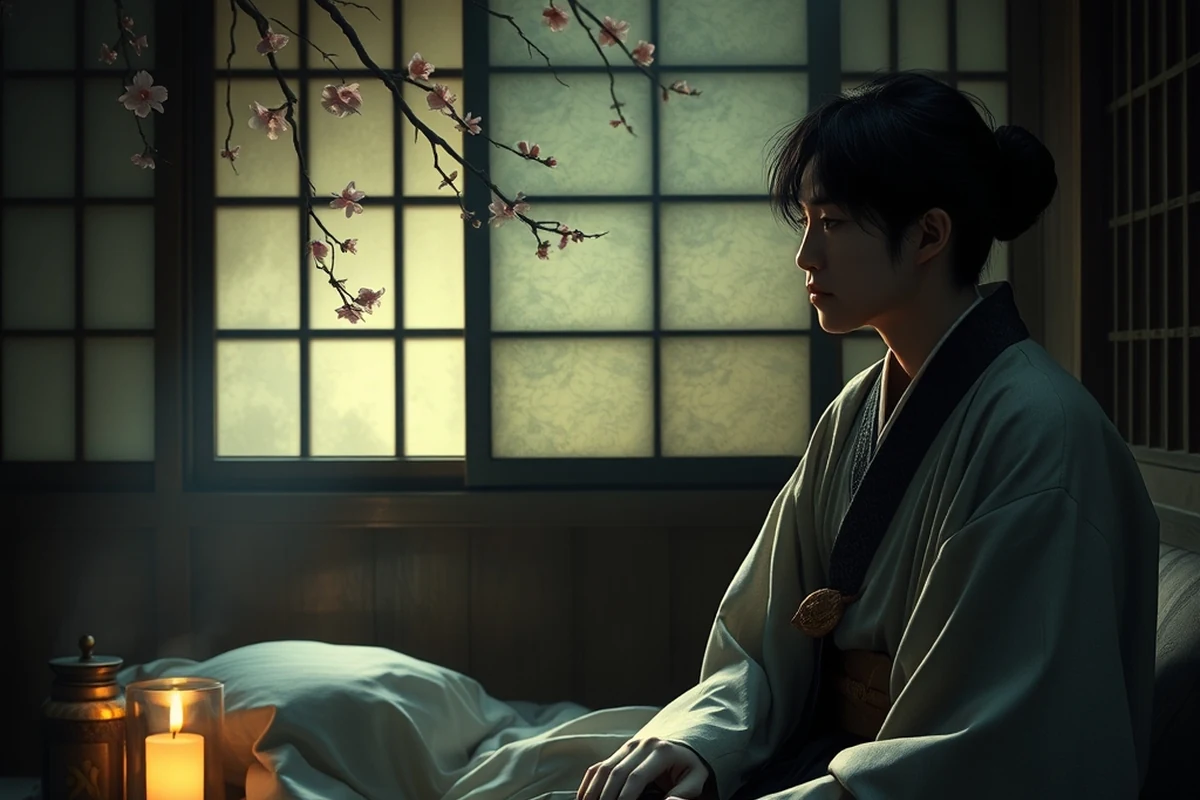
THE STORY OF O-TEI
A long time ago, in the town of Niigata, in the province of Echizen, there
lived a man called Nagao Chōsei.
Nagao was the son of a physician, and was educated for his father’s
profession. At an early age he had been betrothed to a girl called O-Tei, the
daughter of one of his father’s friends; and both families had agreed
that the wedding should take place as soon as Nagao had finished his studies.
But the health of O-Tei proved to be weak; and in her fifteenth year she was
attacked by a fatal consumption. When she became aware that she must die, she
sent for Nagao to bid him farewell.
As he knelt at her bedside, she said to him:—
“Nagao-Sama, (1) my betrothed, we were promised to each other from the
time of our childhood; and we were to have been married at the end of this
year. But now I am going to die;—the gods know what is best for us. If I
were able to live for some years longer, I could only continue to be a cause of
trouble and grief for others. With this frail body, I could not be a good wife;
and therefore even to wish to live, for your sake, would be a very selfish
wish. I am quite resigned to die; and I want you to promise that you will not
grieve… Besides, I want to tell you that I think we shall meet
again.”…
“Indeed we shall meet again,” Nagao answered earnestly. “And
in that Pure Land (2) there will be no pain of separation.”
“Nay, nay!” she responded softly, “I meant not the Pure Land.
I believe that we are destined to meet again in this world,—although I
shall be buried to-morrow.”
Nagao looked at her wonderingly, and saw her smile at his wonder. She
continued, in her gentle, dreamy voice,—
“Yes, I mean in this world,—in your own present life, Nagao-Sama…
Providing, indeed, that you wish it. Only, for this thing to happen, I must
again be born a girl, and grow up to womanhood. So you would have to wait.
Fifteen—sixteen years: that is a long time… But, my promised husband,
you are now only nineteen years old.”…
Eager to soothe her dying moments, he answered tenderly:—
“To wait for you, my betrothed, were no less a joy than a duty. We are
pledged to each other for the time of seven existences.”
“But you doubt?” she questioned, watching his face.
“My dear one,” he answered, “I doubt whether I should be able
to know you in another body, under another name,—unless you can tell me
of a sign or token.”
“That I cannot do,” she said. “Only the Gods and the Buddhas
know how and where we shall meet. But I am sure—very, very
sure—that, if you be not unwilling to receive me, I shall be able to come
back to you… Remember these words of mine.”…
She ceased to speak; and her eyes closed. She was dead.
Nagao had been sincerely attached to O-Tei; and his grief was deep. He had a
mortuary tablet made, inscribed with her zokumyō; [1] and he placed the tablet in his butsudan , [2] and every
day set offerings before it. He thought a great deal about the strange things
that O-Tei had said to him just before her death; and, in the hope of pleasing
her spirit, he wrote a solemn promise to wed her if she could ever return to
him in another body. This written promise he sealed with his seal, and placed
in the butsudan beside the mortuary tablet of O-Tei.
Nevertheless, as Nagao was an only son, it was necessary that he should marry.
He soon found himself obliged to yield to the wishes of his family, and to
accept a wife of his father’s choosing. After his marriage he continued
to set offerings before the tablet of O-Tei; and he never failed to remember
her with affection. But by degrees her image became dim in his
memory,—like a dream that is hard to recall. And the years went by.
During those years many misfortunes came upon him. He lost his parents by
death,—then his wife and his only child. So that he found himself alone
in the world. He abandoned his desolate home, and set out upon a long journey
in the hope of forgetting his sorrows.
One day, in the course of his travels, he arrived at Ikao,—a
mountain-village still famed for its thermal springs, and for the beautiful
scenery of its neighborhood. In the village-inn at which he stopped, a young
girl came to wait upon him; and, at the first sight of her face, he felt his
heart leap as it had never leaped before. So strangely did she resemble O-Tei
that he pinched himself to make sure that he was not dreaming. As she went and
came,—bringing fire and food, or arranging the chamber of the
guest,—her every attitude and motion revived in him some gracious memory
of the girl to whom he had been pledged in his youth. He spoke to her; and she
responded in a soft, clear voice of which the sweetness saddened him with a
sadness of other days.
Then, in great wonder, he questioned her, saying:—
“Elder Sister (3), so much do you look like a person whom I knew long
ago, that I was startled when you first entered this room. Pardon me,
therefore, for asking what is your native place, and what is your name?”
Immediately,—and in the unforgotten voice of the dead,—she thus
made answer:—
“My name is O-Tei; and you are Nagao Chōsei of Echigo, my promised
husband. Seventeen years ago, I died in Niigata: then you made in writing a
promise to marry me if ever I could come back to this world in the body of a
woman;—and you sealed that written promise with your seal, and put it in
the butsudan , beside the tablet inscribed with my name. And therefore I
came back.”…
As she uttered these last words, she fell unconscious.
Nagao married her; and the marriage was a happy one. But at no time afterwards
could she remember what she had told him in answer to his question at Ikao:
neither could she remember anything of her previous existence. The recollection
of the former birth,—mysteriously kindled in the moment of that
meeting,—had again become obscured, and so thereafter remained.


