
The Adventure Of The Golden Pince-Nez
Read The Adventure Of The Golden Pince-Nez, a Sherlock Holmes detective story by Arthur Conan Doyle, in the original English.
By Arthur Conan Doyle
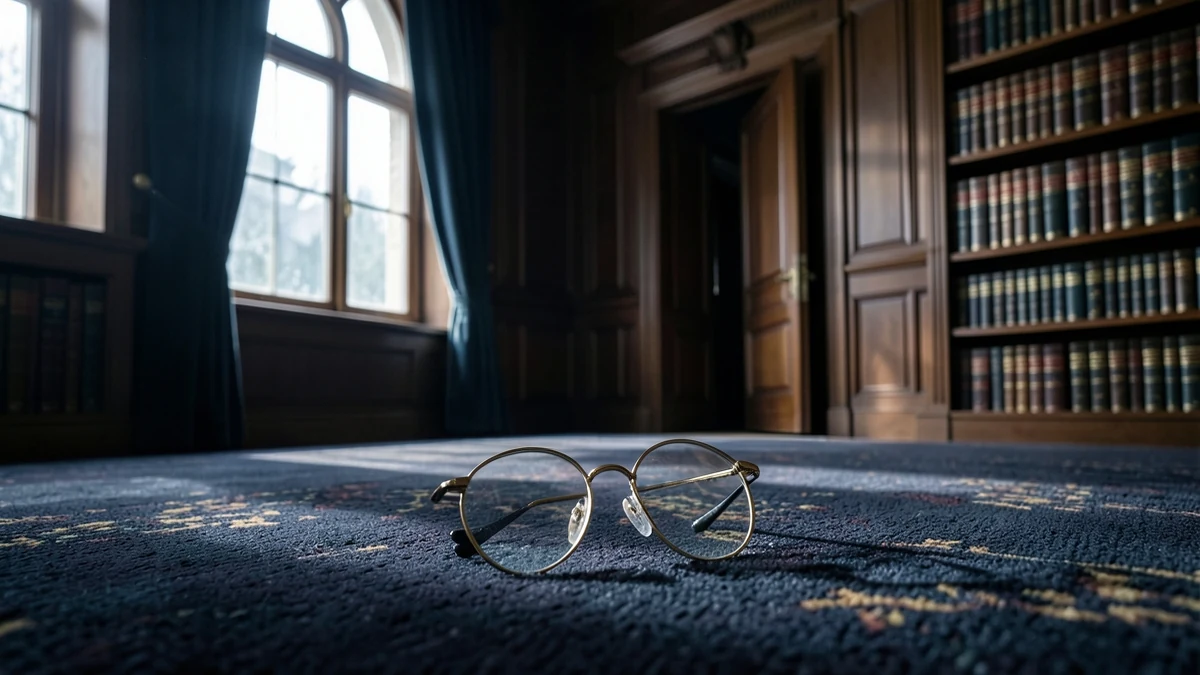
Edition and rights: Original English text from Project Gutenberg ebook #108, identified there as public domain in the USA. The literary text below is reproduced without AI rewriting.
Browse more detective stories.
THE ADVENTURE OF THE GOLDEN PINCE-NEZ
When I look at the three massive manuscript volumes which contain
our work for the year 1894, I confess that it is very difficult
for me, out of such a wealth of material, to select the cases
which are most interesting in themselves, and at the same time
most conducive to a display of those peculiar powers for which my
friend was famous. As I turn over the pages, I see my notes upon
the repulsive story of the red leech and the terrible death of
Crosby, the banker. Here also I find an account of the Addleton
tragedy, and the singular contents of the ancient British barrow.
The famous Smith-Mortimer succession case comes also within this
period, and so does the tracking and arrest of Huret, the
Boulevard assassin—an exploit which won for Holmes an autograph
letter of thanks from the French President and the Order of the
Legion of Honour. Each of these would furnish a narrative, but on
the whole I am of opinion that none of them unites so many
singular points of interest as the episode of Yoxley Old Place,
which includes not only the lamentable death of young Willoughby
Smith, but also those subsequent developments which threw so
curious a light upon the causes of the crime.
It was a wild, tempestuous night, towards the close of November.
Holmes and I sat together in silence all the evening, he engaged
with a powerful lens deciphering the remains of the original
inscription upon a palimpsest, I deep in a recent treatise upon
surgery. Outside the wind howled down Baker Street, while the
rain beat fiercely against the windows. It was strange there, in
the very depths of the town, with ten miles of man’s handiwork on
every side of us, to feel the iron grip of Nature, and to be
conscious that to the huge elemental forces all London was no
more than the molehills that dot the fields. I walked to the
window, and looked out on the deserted street. The occasional
lamps gleamed on the expanse of muddy road and shining pavement.
A single cab was splashing its way from the Oxford Street end.
“Well, Watson, it’s as well we have not to turn out to-night,”
said Holmes, laying aside his lens and rolling up the palimpsest.
“I’ve done enough for one sitting. It is trying work for the
eyes. So far as I can make out, it is nothing more exciting than
an Abbey’s accounts dating from the second half of the fifteenth
century. Halloa! halloa! halloa! What’s this?”
Amid the droning of the wind there had come the stamping of a
horse’s hoofs, and the long grind of a wheel as it rasped against
the curb. The cab which I had seen had pulled up at our door.
“What can he want?” I ejaculated, as a man stepped out of it.
“Want? He wants us. And we, my poor Watson, want overcoats and
cravats and goloshes, and every aid that man ever invented to
fight the weather. Wait a bit, though! There’s the cab off again!
There’s hope yet. He’d have kept it if he had wanted us to come.
Run down, my dear fellow, and open the door, for all virtuous
folk have been long in bed.”
When the light of the hall lamp fell upon our midnight visitor, I
had no difficulty in recognizing him. It was young Stanley
Hopkins, a promising detective, in whose career Holmes had
several times shown a very practical interest.
“Is he in?” he asked, eagerly.
“Come up, my dear sir,” said Holmes’s voice from above. “I hope
you have no designs upon us such a night as this.”
The detective mounted the stairs, and our lamp gleamed upon his
shining waterproof. I helped him out of it, while Holmes knocked
a blaze out of the logs in the grate.
“Now, my dear Hopkins, draw up and warm your toes,” said he.
“Here’s a cigar, and the doctor has a prescription containing hot
water and a lemon, which is good medicine on a night like this.
It must be something important which has brought you out in such
a gale.”
“It is indeed, Mr. Holmes. I’ve had a bustling afternoon, I
promise you. Did you see anything of the Yoxley case in the
latest editions?”
“I’ve seen nothing later than the fifteenth century to-day.”
“Well, it was only a paragraph, and all wrong at that, so you
have not missed anything. I haven’t let the grass grow under my
feet. It’s down in Kent, seven miles from Chatham and three from
the railway line. I was wired for at 3:15, reached Yoxley Old
Place at 5, conducted my investigation, was back at Charing Cross
by the last train, and straight to you by cab.”
“Which means, I suppose, that you are not quite clear about your
case?”
“It means that I can make neither head nor tail of it. So far as
I can see, it is just as tangled a business as ever I handled,
and yet at first it seemed so simple that one couldn’t go wrong.
There’s no motive, Mr. Holmes. That’s what bothers me—I can’t put
my hand on a motive. Here’s a man dead—there’s no denying
that—but, so far as I can see, no reason on earth why anyone
should wish him harm.”
Holmes lit his cigar and leaned back in his chair.
“Let us hear about it,” said he.
“I’ve got my facts pretty clear,” said Stanley Hopkins. “All I
want now is to know what they all mean. The story, so far as I
can make it out, is like this. Some years ago this country house,
Yoxley Old Place, was taken by an elderly man, who gave the name
of Professor Coram. He was an invalid, keeping his bed half the
time, and the other half hobbling round the house with a stick or
being pushed about the grounds by the gardener in a Bath chair.
He was well liked by the few neighbours who called upon him, and
he has the reputation down there of being a very learned man. His
household used to consist of an elderly housekeeper, Mrs. Marker,
and of a maid, Susan Tarlton. These have both been with him since
his arrival, and they seem to be women of excellent character.
The professor is writing a learned book, and he found it
necessary, about a year ago, to engage a secretary. The first two
that he tried were not successes, but the third, Mr. Willoughby
Smith, a very young man straight from the university, seems to
have been just what his employer wanted. His work consisted in
writing all the morning to the professor’s dictation, and he
usually spent the evening in hunting up references and passages
which bore upon the next day’s work. This Willoughby Smith has
nothing against him, either as a boy at Uppingham or as a young
man at Cambridge. I have seen his testimonials, and from the
first he was a decent, quiet, hard-working fellow, with no weak
spot in him at all. And yet this is the lad who has met his death
this morning in the professor’s study under circumstances which
can point only to murder.”
The wind howled and screamed at the windows. Holmes and I drew
closer to the fire, while the young inspector slowly and point by
point developed his singular narrative.
“If you were to search all England,” said he, “I don’t suppose
you could find a household more self-contained or freer from
outside influences. Whole weeks would pass, and not one of them
go past the garden gate. The professor was buried in his work and
existed for nothing else. Young Smith knew nobody in the
neighbourhood, and lived very much as his employer did. The two
women had nothing to take them from the house. Mortimer, the
gardener, who wheels the Bath chair, is an army pensioner—an old
Crimean man of excellent character. He does not live in the
house, but in a three-roomed cottage at the other end of the
garden. Those are the only people that you would find within the
grounds of Yoxley Old Place. At the same time, the gate of the
garden is a hundred yards from the main London to Chatham road.
It opens with a latch, and there is nothing to prevent anyone
from walking in.
“Now I will give you the evidence of Susan Tarlton, who is the
only person who can say anything positive about the matter. It
was in the forenoon, between eleven and twelve. She was engaged
at the moment in hanging some curtains in the upstairs front
bedroom. Professor Coram was still in bed, for when the weather
is bad he seldom rises before midday. The housekeeper was busied
with some work in the back of the house. Willoughby Smith had
been in his bedroom, which he uses as a sitting-room, but the
maid heard him at that moment pass along the passage and descend
to the study immediately below her. She did not see him, but she
says that she could not be mistaken in his quick, firm tread. She
did not hear the study door close, but a minute or so later there
was a dreadful cry in the room below. It was a wild, hoarse
scream, so strange and unnatural that it might have come either
from a man or a woman. At the same instant there was a heavy
thud, which shook the old house, and then all was silence. The
maid stood petrified for a moment, and then, recovering her
courage, she ran downstairs. The study door was shut and she
opened it. Inside, young Mr. Willoughby Smith was stretched upon
the floor. At first she could see no injury, but as she tried to
raise him she saw that blood was pouring from the underside of
his neck. It was pierced by a very small but very deep wound,
which had divided the carotid artery. The instrument with which
the injury had been inflicted lay upon the carpet beside him. It
was one of those small sealing-wax knives to be found on
old-fashioned writing-tables, with an ivory handle and a stiff
blade. It was part of the fittings of the professor’s own desk.
“At first the maid thought that young Smith was already dead, but
on pouring some water from the carafe over his forehead he opened
his eyes for an instant. ‘The professor,’ he murmured—‘it was
she.’ The maid is prepared to swear that those were the exact
words. He tried desperately to say something else, and he held
his right hand up in the air. Then he fell back dead.
“In the meantime the housekeeper had also arrived upon the scene,
but she was just too late to catch the young man’s dying words.
Leaving Susan with the body, she hurried to the professor’s room.
He was sitting up in bed, horribly agitated, for he had heard
enough to convince him that something terrible had occurred. Mrs.
Marker is prepared to swear that the professor was still in his
night-clothes, and indeed it was impossible for him to dress
without the help of Mortimer, whose orders were to come at twelve
o’clock. The professor declares that he heard the distant cry,
but that he knows nothing more. He can give no explanation of the
young man’s last words, ‘The professor—it was she,’ but imagines
that they were the outcome of delirium. He believes that
Willoughby Smith had not an enemy in the world, and can give no
reason for the crime. His first action was to send Mortimer, the
gardener, for the local police. A little later the chief
constable sent for me. Nothing was moved before I got there, and
strict orders were given that no one should walk upon the paths
leading to the house. It was a splendid chance of putting your
theories into practice, Mr. Sherlock Holmes. There was really
nothing wanting.”
“Except Mr. Sherlock Holmes,” said my companion, with a somewhat
bitter smile. “Well, let us hear about it. What sort of a job did
you make of it?”
“I must ask you first, Mr. Holmes, to glance at this rough plan,
which will give you a general idea of the position of the
professor’s study and the various points of the case. It will
help you in following my investigation.”
He unfolded the rough chart, which I here reproduce, and he laid
it across Holmes’s knee. I rose and, standing behind Holmes,
studied it over his shoulder.
Professor's-Study
“It is very rough, of course, and it only deals with the points
which seem to me to be essential. All the rest you will see later
for yourself. Now, first of all, presuming that the assassin
entered the house, how did he or she come in? Undoubtedly by the
garden path and the back door, from which there is direct access
to the study. Any other way would have been exceedingly
complicated. The escape must have also been made along that line,
for of the two other exits from the room one was blocked by Susan
as she ran downstairs and the other leads straight to the
professor’s bedroom. I therefore directed my attention at once to
the garden path, which was saturated with recent rain, and would
certainly show any footmarks.
“My examination showed me that I was dealing with a cautious and
expert criminal. No footmarks were to be found on the path. There
could be no question, however, that someone had passed along the
grass border which lines the path, and that he had done so in
order to avoid leaving a track. I could not find anything in the
nature of a distinct impression, but the grass was trodden down,
and someone had undoubtedly passed. It could only have been the
murderer, since neither the gardener nor anyone else had been
there that morning, and the rain had only begun during the
night.”
“One moment,” said Holmes. “Where does this path lead to?”
“To the road.”
“How long is it?”
“A hundred yards or so.”
“At the point where the path passes through the gate, you could
surely pick up the tracks?”
“Unfortunately, the path was tiled at that point.”
“Well, on the road itself?”
“No, it was all trodden into mire.”
“Tut-tut! Well, then, these tracks upon the grass, were they
coming or going?”
“It was impossible to say. There was never any outline.”
“A large foot or a small?”
“You could not distinguish.”
Holmes gave an ejaculation of impatience.
“It has been pouring rain and blowing a hurricane ever since,”
said he. “It will be harder to read now than that palimpsest.
Well, well, it can’t be helped. What did you do, Hopkins, after
you had made certain that you had made certain of nothing?”
“I think I made certain of a good deal, Mr. Holmes. I knew that
someone had entered the house cautiously from without. I next
examined the corridor. It is lined with cocoanut matting and had
taken no impression of any kind. This brought me into the study
itself. It is a scantily furnished room. The main article is a
large writing-table with a fixed bureau. This bureau consists of
a double column of drawers, with a central small cupboard between
them. The drawers were open, the cupboard locked. The drawers, it
seems, were always open, and nothing of value was kept in them.
There were some papers of importance in the cupboard, but there
were no signs that this had been tampered with, and the professor
assures me that nothing was missing. It is certain that no
robbery has been committed.
“I come now to the body of the young man. It was found near the
bureau, and just to the left of it, as marked upon that chart.
The stab was on the right side of the neck and from behind
forward, so that it is almost impossible that it could have been
self-inflicted.”
“Unless he fell upon the knife,” said Holmes.
“Exactly. The idea crossed my mind. But we found the knife some
feet away from the body, so that seems impossible. Then, of
course, there are the man’s own dying words. And, finally, there
was this very important piece of evidence which was found clasped
in the dead man’s right hand.”
From his pocket Stanley Hopkins drew a small paper packet. He
unfolded it and disclosed a golden pince-nez, with two broken
ends of black silk cord dangling from the end of it. “Willoughby
Smith had excellent sight,” he added. “There can be no question
that this was snatched from the face or the person of the
assassin.”
Sherlock Holmes took the glasses into his hand, and examined them
with the utmost attention and interest. He held them on his nose,
endeavoured to read through them, went to the window and stared
up the street with them, looked at them most minutely in the full
light of the lamp, and finally, with a chuckle, seated himself at
the table and wrote a few lines upon a sheet of paper, which he
tossed across to Stanley Hopkins.
“That’s the best I can do for you,” said he. “It may prove to be
of some use.”
The astonished detective read the note aloud. It ran as follows:
“Wanted, a woman of good address, attired like a lady. She has a
remarkably thick nose, with eyes which are set close upon either
side of it. She has a puckered forehead, a peering expression,
and probably rounded shoulders. There are indications that she
has had recourse to an optician at least twice during the last
few months. As her glasses are of remarkable strength, and as
opticians are not very numerous, there should be no difficulty in
tracing her.”
Holmes smiled at the astonishment of Hopkins, which must have
been reflected upon my features. “Surely my deductions are
simplicity itself,” said he. “It would be difficult to name any
articles which afford a finer field for inference than a pair of
glasses, especially so remarkable a pair as these. That they
belong to a woman I infer from their delicacy, and also, of
course, from the last words of the dying man. As to her being a
person of refinement and well dressed, they are, as you perceive,
handsomely mounted in solid gold, and it is inconceivable that
anyone who wore such glasses could be slatternly in other
respects. You will find that the clips are too wide for your
nose, showing that the lady’s nose was very broad at the base.
This sort of nose is usually a short and coarse one, but there is
a sufficient number of exceptions to prevent me from being
dogmatic or from insisting upon this point in my description. My
own face is a narrow one, and yet I find that I cannot get my
eyes into the centre, nor near the centre, of these glasses.
Therefore, the lady’s eyes are set very near to the sides of the
nose. You will perceive, Watson, that the glasses are concave and
of unusual strength. A lady whose vision has been so extremely
contracted all her life is sure to have the physical
characteristics of such vision, which are seen in the forehead,
the eyelids, and the shoulders.”
“Yes,” I said, “I can follow each of your arguments. I confess,
however, that I am unable to understand how you arrive at the
double visit to the optician.”
Holmes took the glasses in his hand.
“You will perceive,” he said, “that the clips are lined with tiny
bands of cork to soften the pressure upon the nose. One of these
is discoloured and worn to some slight extent, but the other is
new. Evidently one has fallen off and been replaced. I should
judge that the older of them has not been there more than a few
months. They exactly correspond, so I gather that the lady went
back to the same establishment for the second.”
“By George, it’s marvellous!” cried Hopkins, in an ecstasy of
admiration. “To think that I had all that evidence in my hand and
never knew it! I had intended, however, to go the round of the
London opticians.”
“Of course you would. Meanwhile, have you anything more to tell
us about the case?”
“Nothing, Mr. Holmes. I think that you know as much as I do
now—probably more. We have had inquiries made as to any stranger
seen on the country roads or at the railway station. We have
heard of none. What beats me is the utter want of all object in
the crime. Not a ghost of a motive can anyone suggest.”
“Ah! there I am not in a position to help you. But I suppose you
want us to come out to-morrow?”
“If it is not asking too much, Mr. Holmes. There’s a train from
Charing Cross to Chatham at six in the morning, and we should be
at Yoxley Old Place between eight and nine.”
“Then we shall take it. Your case has certainly some features of
great interest, and I shall be delighted to look into it. Well,
it’s nearly one, and we had best get a few hours’ sleep. I
daresay you can manage all right on the sofa in front of the
fire. I’ll light my spirit lamp, and give you a cup of coffee
before we start.”
The gale had blown itself out next day, but it was a bitter
morning when we started upon our journey. We saw the cold winter
sun rise over the dreary marshes of the Thames and the long,
sullen reaches of the river, which I shall ever associate with
our pursuit of the Andaman Islander in the earlier days of our
career. After a long and weary journey, we alighted at a small
station some miles from Chatham. While a horse was being put into
a trap at the local inn, we snatched a hurried breakfast, and so
we were all ready for business when we at last arrived at Yoxley
Old Place. A constable met us at the garden gate.
“Well, Wilson, any news?”
“No, sir—nothing.”
“No reports of any stranger seen?”
“No, sir. Down at the station they are certain that no stranger
either came or went yesterday.”
“Have you had inquiries made at inns and lodgings?”
“Yes, sir: there is no one that we cannot account for.”
“Well, it’s only a reasonable walk to Chatham. Anyone might stay
there or take a train without being observed. This is the garden
path of which I spoke, Mr. Holmes. I’ll pledge my word there was
no mark on it yesterday.”
“On which side were the marks on the grass?”
“This side, sir. This narrow margin of grass between the path and
the flower-bed. I can’t see the traces now, but they were clear
to me then.”
“Yes, yes: someone has passed along,” said Holmes, stooping over
the grass border. “Our lady must have picked her steps carefully,
must she not, since on the one side she would leave a track on
the path, and on the other an even clearer one on the soft bed?”
“Yes, sir, she must have been a cool hand.”
I saw an intent look pass over Holmes’s face.
“You say that she must have come back this way?”
“Yes, sir, there is no other.”
“On this strip of grass?”
“Certainly, Mr. Holmes.”
“Hum! It was a very remarkable performance—very remarkable. Well,
I think we have exhausted the path. Let us go farther. This
garden door is usually kept open, I suppose? Then this visitor
had nothing to do but to walk in. The idea of murder was not in
her mind, or she would have provided herself with some sort of
weapon, instead of having to pick this knife off the
writing-table. She advanced along this corridor, leaving no
traces upon the cocoanut matting. Then she found herself in this
study. How long was she there? We have no means of judging.”
“Not more than a few minutes, sir. I forgot to tell you that Mrs.
Marker, the housekeeper, had been in there tidying not very long
before—about a quarter of an hour, she says.”
“Well, that gives us a limit. Our lady enters this room, and what
does she do? She goes over to the writing-table. What for? Not
for anything in the drawers. If there had been anything worth her
taking, it would surely have been locked up. No, it was for
something in that wooden bureau. Halloa! what is that scratch
upon the face of it? Just hold a match, Watson. Why did you not
tell me of this, Hopkins?”
The mark which he was examining began upon the brass-work on the
right-hand side of the keyhole, and extended for about four
inches, where it had scratched the varnish from the surface.
“I noticed it, Mr. Holmes, but you’ll always find scratches round
a keyhole.”
“This is recent, quite recent. See how the brass shines where it
is cut. An old scratch would be the same colour as the surface.
Look at it through my lens. There’s the varnish, too, like earth
on each side of a furrow. Is Mrs. Marker there?”
A sad-faced, elderly woman came into the room.
“Did you dust this bureau yesterday morning?”
“Yes, sir.”
“Did you notice this scratch?”
“No, sir, I did not.”
“I am sure you did not, for a duster would have swept away these
shreds of varnish. Who has the key of this bureau?”
“The Professor keeps it on his watch-chain.”
“Is it a simple key?”
“No, sir, it is a Chubb’s key.”
“Very good. Mrs. Marker, you can go. Now we are making a little
progress. Our lady enters the room, advances to the bureau, and
either opens it or tries to do so. While she is thus engaged,
young Willoughby Smith enters the room. In her hurry to withdraw
the key, she makes this scratch upon the door. He seizes her, and
she, snatching up the nearest object, which happens to be this
knife, strikes at him in order to make him let go his hold. The
blow is a fatal one. He falls and she escapes, either with or
without the object for which she has come. Is Susan, the maid,
there? Could anyone have got away through that door after the
time that you heard the cry, Susan?”
“No, sir, it is impossible. Before I got down the stair, I’d have
seen anyone in the passage. Besides, the door never opened, or I
would have heard it.”
“That settles this exit. Then no doubt the lady went out the way
she came. I understand that this other passage leads only to the
professor’s room. There is no exit that way?”
“No, sir.”
“We shall go down it and make the acquaintance of the professor.
Halloa, Hopkins! this is very important, very important indeed.
The professor’s corridor is also lined with cocoanut matting.”
“Well, sir, what of that?”
“Don’t you see any bearing upon the case? Well, well. I don’t
insist upon it. No doubt I am wrong. And yet it seems to me to be
suggestive. Come with me and introduce me.”
We passed down the passage, which was of the same length as that
which led to the garden. At the end was a short flight of steps
ending in a door. Our guide knocked, and then ushered us into the
professor’s bedroom.
It was a very large chamber, lined with innumerable volumes,
which had overflowed from the shelves and lay in piles in the
corners, or were stacked all round at the base of the cases. The
bed was in the centre of the room, and in it, propped up with
pillows, was the owner of the house. I have seldom seen a more
remarkable-looking person. It was a gaunt, aquiline face which
was turned towards us, with piercing dark eyes, which lurked in
deep hollows under overhung and tufted brows. His hair and beard
were white, save that the latter was curiously stained with
yellow around his mouth. A cigarette glowed amid the tangle of
white hair, and the air of the room was fetid with stale tobacco
smoke. As he held out his hand to Holmes, I perceived that it was
also stained with yellow nicotine.
“A smoker, Mr. Holmes?” said he, speaking in well-chosen English,
with a curious little mincing accent. “Pray take a cigarette. And
you, sir? I can recommend them, for I have them especially
prepared by Ionides, of Alexandria. He sends me a thousand at a
time, and I grieve to say that I have to arrange for a fresh
supply every fortnight. Bad, sir, very bad, but an old man has
few pleasures. Tobacco and my work—that is all that is left to
me.”
Holmes had lit a cigarette and was shooting little darting
glances all over the room.
“Tobacco and my work, but now only tobacco,” the old man
exclaimed. “Alas! what a fatal interruption! Who could have
foreseen such a terrible catastrophe? So estimable a young man! I
assure you that, after a few months’ training, he was an
admirable assistant. What do you think of the matter, Mr.
Holmes?”
“I have not yet made up my mind.”
“I shall indeed be indebted to you if you can throw a light where
all is so dark to us. To a poor bookworm and invalid like myself
such a blow is paralysing. I seem to have lost the faculty of
thought. But you are a man of action—you are a man of affairs. It
is part of the everyday routine of your life. You can preserve
your balance in every emergency. We are fortunate, indeed, in
having you at our side.”
Holmes was pacing up and down one side of the room whilst the old
professor was talking. I observed that he was smoking with
extraordinary rapidity. It was evident that he shared our host’s
liking for the fresh Alexandrian cigarettes.
“Yes, sir, it is a crushing blow,” said the old man. “That is my
_magnum opus_—the pile of papers on the side table yonder. It is
my analysis of the documents found in the Coptic monasteries of
Syria and Egypt, a work which will cut deep at the very
foundation of revealed religion. With my enfeebled health I do
not know whether I shall ever be able to complete it, now that my
assistant has been taken from me. Dear me! Mr. Holmes, why, you
are even a quicker smoker than I am myself.”
Holmes smiled.
“I am a connoisseur,” said he, taking another cigarette from the
box—his fourth—and lighting it from the stub of that which he had
finished. “I will not trouble you with any lengthy
cross-examination, Professor Coram, since I gather that you were
in bed at the time of the crime, and could know nothing about it.
I would only ask this: What do you imagine that this poor fellow
meant by his last words: ‘The professor—it was she’?”
The professor shook his head.
“Susan is a country girl,” said he, “and you know the incredible
stupidity of that class. I fancy that the poor fellow murmured
some incoherent delirious words, and that she twisted them into
this meaningless message.”
“I see. You have no explanation yourself of the tragedy?”
“Possibly an accident, possibly—I only breathe it among
ourselves—a suicide. Young men have their hidden troubles—some
affair of the heart, perhaps, which we have never known. It is a
more probable supposition than murder.”
“But the eyeglasses?”
“Ah! I am only a student—a man of dreams. I cannot explain the
practical things of life. But still, we are aware, my friend,
that love-gages may take strange shapes. By all means take
another cigarette. It is a pleasure to see anyone appreciate them
so. A fan, a glove, glasses—who knows what article may be carried
as a token or treasured when a man puts an end to his life? This
gentleman speaks of footsteps in the grass, but, after all, it is
easy to be mistaken on such a point. As to the knife, it might
well be thrown far from the unfortunate man as he fell. It is
possible that I speak as a child, but to me it seems that
Willoughby Smith has met his fate by his own hand.”
Holmes seemed struck by the theory thus put forward, and he
continued to walk up and down for some time, lost in thought and
consuming cigarette after cigarette.
“Tell me, Professor Coram,” he said, at last, “what is in that
cupboard in the bureau?”
“Nothing that would help a thief. Family papers, letters from my
poor wife, diplomas of universities which have done me honour.
Here is the key. You can look for yourself.”
Holmes picked up the key, and looked at it for an instant, then
he handed it back.
“No, I hardly think that it would help me,” said he. “I should
prefer to go quietly down to your garden, and turn the whole
matter over in my head. There is something to be said for the
theory of suicide which you have put forward. We must apologize
for having intruded upon you, Professor Coram, and I promise that
we won’t disturb you until after lunch. At two o’clock we will
come again, and report to you anything which may have happened in
the interval.”
Holmes was curiously distrait, and we walked up and down the
garden path for some time in silence.
“Have you a clue?” I asked, at last.
“It depends upon those cigarettes that I smoked,” said he. “It is
possible that I am utterly mistaken. The cigarettes will show
me.”
“My dear Holmes,” I exclaimed, “how on earth——”
“Well, well, you may see for yourself. If not, there’s no harm
done. Of course, we always have the optician clue to fall back
upon, but I take a short cut when I can get it. Ah, here is the
good Mrs. Marker! Let us enjoy five minutes of instructive
conversation with her.”
I may have remarked before that Holmes had, when he liked, a
peculiarly ingratiating way with women, and that he very readily
established terms of confidence with them. In half the time which
he had named, he had captured the housekeeper’s goodwill and was
chatting with her as if he had known her for years.
“Yes, Mr. Holmes, it is as you say, sir. He does smoke something
terrible. All day and sometimes all night, sir. I’ve seen that
room of a morning—well, sir, you’d have thought it was a London
fog. Poor young Mr. Smith, he was a smoker also, but not as bad
as the professor. His health—well, I don’t know that it’s better
nor worse for the smoking.”
“Ah!” said Holmes, “but it kills the appetite.”
“Well, I don’t know about that, sir.”
“I suppose the professor eats hardly anything?”
“Well, he is variable. I’ll say that for him.”
“I’ll wager he took no breakfast this morning, and won’t face his
lunch after all the cigarettes I saw him consume.”
“Well, you’re out there, sir, as it happens, for he ate a
remarkable big breakfast this morning. I don’t know when I’ve
known him make a better one, and he’s ordered a good dish of
cutlets for his lunch. I’m surprised myself, for since I came
into that room yesterday and saw young Mr. Smith lying there on
the floor, I couldn’t bear to look at food. Well, it takes all
sorts to make a world, and the professor hasn’t let it take his
appetite away.”
We loitered the morning away in the garden. Stanley Hopkins had
gone down to the village to look into some rumours of a strange
woman who had been seen by some children on the Chatham Road the
previous morning. As to my friend, all his usual energy seemed to
have deserted him. I had never known him handle a case in such a
half-hearted fashion. Even the news brought back by Hopkins that
he had found the children, and that they had undoubtedly seen a
woman exactly corresponding with Holmes’s description, and
wearing either spectacles or eyeglasses, failed to rouse any sign
of keen interest. He was more attentive when Susan, who waited
upon us at lunch, volunteered the information that she believed
Mr. Smith had been out for a walk yesterday morning, and that he
had only returned half an hour before the tragedy occurred. I
could not myself see the bearing of this incident, but I clearly
perceived that Holmes was weaving it into the general scheme
which he had formed in his brain. Suddenly he sprang from his
chair and glanced at his watch. “Two o’clock, gentlemen,” said
he. “We must go up and have it out with our friend, the
professor.”
The old man had just finished his lunch, and certainly his empty
dish bore evidence to the good appetite with which his
housekeeper had credited him. He was, indeed, a weird figure as
he turned his white mane and his glowing eyes towards us. The
eternal cigarette smouldered in his mouth. He had been dressed
and was seated in an armchair by the fire.
“Well, Mr. Holmes, have you solved this mystery yet?” He shoved
the large tin of cigarettes which stood on a table beside him
towards my companion. Holmes stretched out his hand at the same
moment, and between them they tipped the box over the edge. For a
minute or two we were all on our knees retrieving stray
cigarettes from impossible places. When we rose again, I observed
Holmes’s eyes were shining and his cheeks tinged with colour.
Only at a crisis have I seen those battle-signals flying.
“Yes,” said he, “I have solved it.”
Stanley Hopkins and I stared in amazement. Something like a sneer
quivered over the gaunt features of the old professor.
“Indeed! In the garden?”
“No, here.”
“Here! When?”
“This instant.”
“You are surely joking, Mr. Sherlock Holmes. You compel me to
tell you that this is too serious a matter to be treated in such
a fashion.”
“I have forged and tested every link of my chain, Professor
Coram, and I am sure that it is sound. What your motives are, or
what exact part you play in this strange business, I am not yet
able to say. In a few minutes I shall probably hear it from your
own lips. Meanwhile I will reconstruct what is past for your
benefit, so that you may know the information which I still
require.
“A lady yesterday entered your study. She came with the intention
of possessing herself of certain documents which were in your
bureau. She had a key of her own. I have had an opportunity of
examining yours, and I do not find that slight discolouration
which the scratch made upon the varnish would have produced. You
were not an accessory, therefore, and she came, so far as I can
read the evidence, without your knowledge to rob you.”
The professor blew a cloud from his lips. “This is most
interesting and instructive,” said he. “Have you no more to add?
Surely, having traced this lady so far, you can also say what has
become of her.”
“I will endeavour to do so. In the first place she was seized by
your secretary, and stabbed him in order to escape. This
catastrophe I am inclined to regard as an unhappy accident, for I
am convinced that the lady had no intention of inflicting so
grievous an injury. An assassin does not come unarmed. Horrified
by what she had done, she rushed wildly away from the scene of
the tragedy. Unfortunately for her, she had lost her glasses in
the scuffle, and as she was extremely short-sighted she was
really helpless without them. She ran down a corridor, which she
imagined to be that by which she had come—both were lined with
cocoanut matting—and it was only when it was too late that she
understood that she had taken the wrong passage, and that her
retreat was cut off behind her. What was she to do? She could not
go back. She could not remain where she was. She must go on. She
went on. She mounted a stair, pushed open a door, and found
herself in your room.”
The old man sat with his mouth open, staring wildly at Holmes.
Amazement and fear were stamped upon his expressive features.
Now, with an effort, he shrugged his shoulders and burst into
insincere laughter.
“All very fine, Mr. Holmes,” said he. “But there is one little
flaw in your splendid theory. I was myself in my room, and I
never left it during the day.”
“I am aware of that, Professor Coram.”
“And you mean to say that I could lie upon that bed and not be
aware that a woman had entered my room?”
“I never said so. You _were_ aware of it. You spoke with her. You
recognized her. You aided her to escape.”
Again the professor burst into high-keyed laughter. He had risen
to his feet, and his eyes glowed like embers.
“You are mad!” he cried. “You are talking insanely. I helped her
to escape? Where is she now?”
“She is there,” said Holmes, and he pointed to a high bookcase in
the corner of the room.
I saw the old man throw up his arms, a terrible convulsion passed
over his grim face, and he fell back in his chair. At the same
instant the bookcase at which Holmes pointed swung round upon a
hinge, and a woman rushed out into the room. “You are right!” she
cried, in a strange foreign voice. “You are right! I am here.”
She was brown with the dust and draped with the cobwebs which had
come from the walls of her hiding-place. Her face, too, was
streaked with grime, and at the best she could never have been
handsome, for she had the exact physical characteristics which
Holmes had divined, with, in addition, a long and obstinate chin.
What with her natural blindness, and what with the change from
dark to light, she stood as one dazed, blinking about her to see
where and who we were. And yet, in spite of all these
disadvantages, there was a certain nobility in the woman’s
bearing—a gallantry in the defiant chin and in the upraised head,
which compelled something of respect and admiration.
Stanley Hopkins had laid his hand upon her arm and claimed her as
his prisoner, but she waved him aside gently, and yet with an
over-mastering dignity which compelled obedience. The old man lay
back in his chair with a twitching face, and stared at her with
brooding eyes.
“Yes, sir, I am your prisoner,” she said. “From where I stood I
could hear everything, and I know that you have learned the
truth. I confess it all. It was I who killed the young man. But
you are right—you who say it was an accident. I did not even know
that it was a knife which I held in my hand, for in my despair I
snatched anything from the table and struck at him to make him
let me go. It is the truth that I tell.”
“Madam,” said Holmes, “I am sure that it is the truth. I fear
that you are far from well.”
She had turned a dreadful colour, the more ghastly under the dark
dust-streaks upon her face. She seated herself on the side of the
bed; then she resumed.
“I have only a little time here,” she said, “but I would have you
to know the whole truth. I am this man’s wife. He is not an
Englishman. He is a Russian. His name I will not tell.”
For the first time the old man stirred. “God bless you, Anna!” he
cried. “God bless you!”
She cast a look of the deepest disdain in his direction. “Why
should you cling so hard to that wretched life of yours,
Sergius?” said she. “It has done harm to many and good to
none—not even to yourself. However, it is not for me to cause the
frail thread to be snapped before God’s time. I have enough
already upon my soul since I crossed the threshold of this cursed
house. But I must speak or I shall be too late.
“I have said, gentlemen, that I am this man’s wife. He was fifty
and I a foolish girl of twenty when we married. It was in a city
of Russia, a university—I will not name the place.”
“God bless you, Anna!” murmured the old man again.
“We were reformers—revolutionists—Nihilists, you understand. He
and I and many more. Then there came a time of trouble, a police
officer was killed, many were arrested, evidence was wanted, and
in order to save his own life and to earn a great reward, my
husband betrayed his own wife and his companions. Yes, we were
all arrested upon his confession. Some of us found our way to the
gallows, and some to Siberia. I was among these last, but my term
was not for life. My husband came to England with his ill-gotten
gains and has lived in quiet ever since, knowing well that if the
Brotherhood knew where he was not a week would pass before
justice would be done.”
The old man reached out a trembling hand and helped himself to a
cigarette. “I am in your hands, Anna,” said he. “You were always
good to me.”
“I have not yet told you the height of his villainy,” said she.
“Among our comrades of the Order, there was one who was the
friend of my heart. He was noble, unselfish, loving—all that my
husband was not. He hated violence. We were all guilty—if that is
guilt—but he was not. He wrote forever dissuading us from such a
course. These letters would have saved him. So would my diary, in
which, from day to day, I had entered both my feelings towards
him and the view which each of us had taken. My husband found and
kept both diary and letters. He hid them, and he tried hard to
swear away the young man’s life. In this he failed, but Alexis
was sent a convict to Siberia, where now, at this moment, he
works in a salt mine. Think of that, you villain, you
villain!—now, now, at this very moment, Alexis, a man whose name
you are not worthy to speak, works and lives like a slave, and
yet I have your life in my hands, and I let you go.”
“You were always a noble woman, Anna,” said the old man, puffing
at his cigarette.
She had risen, but she fell back again with a little cry of pain.
“I must finish,” she said. “When my term was over I set myself to
get the diary and letters which, if sent to the Russian
government, would procure my friend’s release. I knew that my
husband had come to England. After months of searching I
discovered where he was. I knew that he still had the diary, for
when I was in Siberia I had a letter from him once, reproaching
me and quoting some passages from its pages. Yet I was sure that,
with his revengeful nature, he would never give it to me of his
own free-will. I must get it for myself. With this object I
engaged an agent from a private detective firm, who entered my
husband’s house as a secretary—it was your second secretary,
Sergius, the one who left you so hurriedly. He found that papers
were kept in the cupboard, and he got an impression of the key.
He would not go farther. He furnished me with a plan of the
house, and he told me that in the forenoon the study was always
empty, as the secretary was employed up here. So at last I took
my courage in both hands, and I came down to get the papers for
myself. I succeeded; but at what a cost!
“I had just taken the paper; and was locking the cupboard, when
the young man seized me. I had seen him already that morning. He
had met me on the road, and I had asked him to tell me where
Professor Coram lived, not knowing that he was in his employ.”
“Exactly! Exactly!” said Holmes. “The secretary came back, and
told his employer of the woman he had met. Then, in his last
breath, he tried to send a message that it was she—the she whom
he had just discussed with him.”
“You must let me speak,” said the woman, in an imperative voice,
and her face contracted as if in pain. “When he had fallen I
rushed from the room, chose the wrong door, and found myself in
my husband’s room. He spoke of giving me up. I showed him that if
he did so, his life was in my hands. If he gave me to the law, I
could give him to the Brotherhood. It was not that I wished to
live for my own sake, but it was that I desired to accomplish my
purpose. He knew that I would do what I said—that his own fate
was involved in mine. For that reason, and for no other, he
shielded me. He thrust me into that dark hiding-place—a relic of
old days, known only to himself. He took his meals in his own
room, and so was able to give me part of his food. It was agreed
that when the police left the house I should slip away by night
and come back no more. But in some way you have read our plans.”
She tore from the bosom of her dress a small packet. “These are
my last words,” said she; “here is the packet which will save
Alexis. I confide it to your honour and to your love of justice.
Take it! You will deliver it at the Russian Embassy. Now, I have
done my duty, and——”
“Stop her!” cried Holmes. He had bounded across the room and had
wrenched a small phial from her hand.
“Too late!” she said, sinking back on the bed. “Too late! I took
the poison before I left my hiding-place. My head swims! I am
going! I charge you, sir, to remember the packet.”
“A simple case, and yet, in some ways, an instructive one,”
Holmes remarked, as we travelled back to town. “It hinged from
the outset upon the pince-nez. But for the fortunate chance of
the dying man having seized these, I am not sure that we could
ever have reached our solution. It was clear to me, from the
strength of the glasses, that the wearer must have been very
blind and helpless when deprived of them. When you asked me to
believe that she walked along a narrow strip of grass without
once making a false step, I remarked, as you may remember, that
it was a noteworthy performance. In my mind I set it down as an
impossible performance, save in the unlikely case that she had a
second pair of glasses. I was forced, therefore, to consider
seriously the hypothesis that she had remained within the house.
On perceiving the similarity of the two corridors, it became
clear that she might very easily have made such a mistake, and,
in that case, it was evident that she must have entered the
professor’s room. I was keenly on the alert, therefore, for
whatever would bear out this supposition, and I examined the room
narrowly for anything in the shape of a hiding-place. The carpet
seemed continuous and firmly nailed, so I dismissed the idea of a
trap-door. There might well be a recess behind the books. As you
are aware, such devices are common in old libraries. I observed
that books were piled on the floor at all other points, but that
one bookcase was left clear. This, then, might be the door. I
could see no marks to guide me, but the carpet was of a dun
colour, which lends itself very well to examination. I therefore
smoked a great number of those excellent cigarettes, and I
dropped the ash all over the space in front of the suspected
bookcase. It was a simple trick, but exceedingly effective. I
then went downstairs, and I ascertained, in your presence,
Watson, without your perceiving the drift of my remarks, that
Professor Coram’s consumption of food had increased—as one would
expect when he is supplying a second person. We then ascended to
the room again, when, by upsetting the cigarette-box, I obtained
a very excellent view of the floor, and was able to see quite
clearly, from the traces upon the cigarette ash, that the
prisoner had in our absence come out from her retreat. Well,
Hopkins, here we are at Charing Cross, and I congratulate you on
having brought your case to a successful conclusion. You are
going to headquarters, no doubt. I think, Watson, you and I will
drive together to the Russian Embassy.”
1 / 1


