
The Adventure Of The Priory School
Read The Adventure Of The Priory School, a Sherlock Holmes detective story by Arthur Conan Doyle, in the original English.
By Arthur Conan Doyle
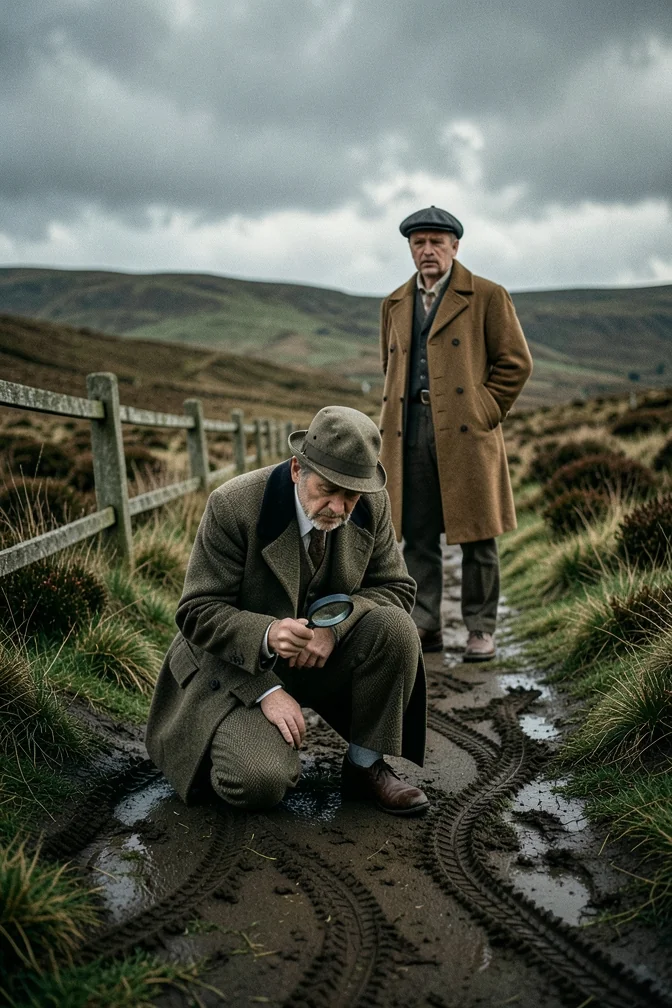
Edition and rights: Original English text from Project Gutenberg ebook #108, identified there as public domain in the USA. The literary text below is reproduced without AI rewriting.
Browse more detective stories.
THE ADVENTURE OF THE PRIORY SCHOOL
We have had some dramatic entrances and exits upon our small
stage at Baker Street, but I cannot recollect anything more
sudden and startling than the first appearance of Thorneycroft
Huxtable, M.A., Ph.D., etc. His card, which seemed too small to
carry the weight of his academic distinctions, preceded him by a
few seconds, and then he entered himself—so large, so pompous,
and so dignified that he was the very embodiment of
self-possession and solidity. And yet his first action, when the
door had closed behind him, was to stagger against the table,
whence he slipped down upon the floor, and there was that
majestic figure prostrate and insensible upon our bearskin
hearth-rug.
We had sprung to our feet, and for a few moments we stared in
silent amazement at this ponderous piece of wreckage, which told
of some sudden and fatal storm far out on the ocean of life. Then
Holmes hurried with a cushion for his head, and I with brandy for
his lips. The heavy, white face was seamed with lines of trouble,
the hanging pouches under the closed eyes were leaden in colour,
the loose mouth drooped dolorously at the corners, the rolling
chins were unshaven. Collar and shirt bore the grime of a long
journey, and the hair bristled unkempt from the well-shaped head.
It was a sorely stricken man who lay before us.
“What is it, Watson?” asked Holmes.
“Absolute exhaustion—possibly mere hunger and fatigue,” said I,
with my finger on the thready pulse, where the stream of life
trickled thin and small.
“Return ticket from Mackleton, in the north of England,” said
Holmes, drawing it from the watch-pocket. “It is not twelve
o’clock yet. He has certainly been an early starter.”
The puckered eyelids had begun to quiver, and now a pair of
vacant grey eyes looked up at us. An instant later the man had
scrambled on to his feet, his face crimson with shame.
“Forgive this weakness, Mr. Holmes, I have been a little
overwrought. Thank you, if I might have a glass of milk and a
biscuit, I have no doubt that I should be better. I came
personally, Mr. Holmes, in order to insure that you would return
with me. I feared that no telegram would convince you of the
absolute urgency of the case.”
“When you are quite restored——”
“I am quite well again. I cannot imagine how I came to be so
weak. I wish you, Mr. Holmes, to come to Mackleton with me by the
next train.”
My friend shook his head.
“My colleague, Dr. Watson, could tell you that we are very busy
at present. I am retained in this case of the Ferrers Documents,
and the Abergavenny murder is coming up for trial. Only a very
important issue could call me from London at present.”
“Important!” Our visitor threw up his hands. “Have you heard
nothing of the abduction of the only son of the Duke of
Holdernesse?”
“What! the late Cabinet Minister?”
“Exactly. We had tried to keep it out of the papers, but there
was some rumour in the _Globe_ last night. I thought it might
have reached your ears.”
Holmes shot out his long, thin arm and picked out Volume “H” in
his encyclopædia of reference.
“‘Holdernesse, 6th Duke, K.G., P.C.’—half the alphabet! ‘Baron
Beverley, Earl of Carston’—dear me, what a list! ‘Lord Lieutenant
of Hallamshire since 1900. Married Edith, daughter of Sir Charles
Appledore, 1888. Heir and only child, Lord Saltire. Owns about
two hundred and fifty thousand acres. Minerals in Lancashire and
Wales. Address: Carlton House Terrace; Holdernesse Hall,
Hallamshire; Carston Castle, Bangor, Wales. Lord of the
Admiralty, 1872; Chief Secretary of State for——’ Well, well, this
man is certainly one of the greatest subjects of the Crown!”
“The greatest and perhaps the wealthiest. I am aware, Mr. Holmes,
that you take a very high line in professional matters, and that
you are prepared to work for the work’s sake. I may tell you,
however, that his Grace has already intimated that a check for
five thousand pounds will be handed over to the person who can
tell him where his son is, and another thousand to him who can
name the man or men who have taken him.”
“It is a princely offer,” said Holmes. “Watson, I think that we
shall accompany Dr. Huxtable back to the north of England. And
now, Dr. Huxtable, when you have consumed that milk, you will
kindly tell me what has happened, when it happened, how it
happened, and, finally, what Dr. Thorneycroft Huxtable, of the
Priory School, near Mackleton, has to do with the matter, and why
he comes three days after an event—the state of your chin gives
the date—to ask for my humble services.”
Our visitor had consumed his milk and biscuits. The light had
come back to his eyes and the colour to his cheeks, as he set
himself with great vigour and lucidity to explain the situation.
“I must inform you, gentlemen, that the Priory is a preparatory
school, of which I am the founder and principal. _Huxtable’s
Sidelights on Horace_ may possibly recall my name to your
memories. The Priory is, without exception, the best and most
select preparatory school in England. Lord Leverstoke, the Earl
of Blackwater, Sir Cathcart Soames—they all have intrusted their
sons to me. But I felt that my school had reached its zenith
when, weeks ago, the Duke of Holdernesse sent Mr. James Wilder,
his secretary, with intimation that young Lord Saltire, ten years
old, his only son and heir, was about to be committed to my
charge. Little did I think that this would be the prelude to the
most crushing misfortune of my life.
“On May 1st the boy arrived, that being the beginning of the
summer term. He was a charming youth, and he soon fell into our
ways. I may tell you—I trust that I am not indiscreet, but
half-confidences are absurd in such a case—that he was not
entirely happy at home. It is an open secret that the Duke’s
married life had not been a peaceful one, and the matter had
ended in a separation by mutual consent, the Duchess taking up
her residence in the south of France. This had occurred very
shortly before, and the boy’s sympathies are known to have been
strongly with his mother. He moped after her departure from
Holdernesse Hall, and it was for this reason that the Duke
desired to send him to my establishment. In a fortnight the boy
was quite at home with us and was apparently absolutely happy.
“He was last seen on the night of May 13th—that is, the night of
last Monday. His room was on the second floor and was approached
through another larger room, in which two boys were sleeping.
These boys saw and heard nothing, so that it is certain that
young Saltire did not pass out that way. His window was open, and
there is a stout ivy plant leading to the ground. We could trace
no footmarks below, but it is sure that this is the only possible
exit.
“His absence was discovered at seven o’clock on Tuesday morning.
His bed had been slept in. He had dressed himself fully, before
going off, in his usual school suit of black Eton jacket and dark
grey trousers. There were no signs that anyone had entered the
room, and it is quite certain that anything in the nature of
cries or a struggle would have been heard, since Caunter, the
elder boy in the inner room, is a very light sleeper.
“When Lord Saltire’s disappearance was discovered, I at once
called a roll of the whole establishment—boys, masters, and
servants. It was then that we ascertained that Lord Saltire had
not been alone in his flight. Heidegger, the German master, was
missing. His room was on the second floor, at the farther end of
the building, facing the same way as Lord Saltire’s. His bed had
also been slept in, but he had apparently gone away partly
dressed, since his shirt and socks were lying on the floor. He
had undoubtedly let himself down by the ivy, for we could see the
marks of his feet where he had landed on the lawn. His bicycle
was kept in a small shed beside this lawn, and it also was gone.
“He had been with me for two years, and came with the best
references, but he was a silent, morose man, not very popular
either with masters or boys. No trace could be found of the
fugitives, and now, on Thursday morning, we are as ignorant as we
were on Tuesday. Inquiry was, of course, made at once at
Holdernesse Hall. It is only a few miles away, and we imagined
that, in some sudden attack of homesickness, he had gone back to
his father, but nothing had been heard of him. The Duke is
greatly agitated, and, as to me, you have seen yourselves the
state of nervous prostration to which the suspense and the
responsibility have reduced me. Mr. Holmes, if ever you put
forward your full powers, I implore you to do so now, for never
in your life could you have a case which is more worthy of them.”
Sherlock Holmes had listened with the utmost intentness to the
statement of the unhappy schoolmaster. His drawn brows and the
deep furrow between them showed that he needed no exhortation to
concentrate all his attention upon a problem which, apart from
the tremendous interests involved must appeal so directly to his
love of the complex and the unusual. He now drew out his notebook
and jotted down one or two memoranda.
“You have been very remiss in not coming to me sooner,” said he,
severely. “You start me on my investigation with a very serious
handicap. It is inconceivable, for example, that this ivy and
this lawn would have yielded nothing to an expert observer.”
“I am not to blame, Mr. Holmes. His Grace was extremely desirous
to avoid all public scandal. He was afraid of his family
unhappiness being dragged before the world. He has a deep horror
of anything of the kind.”
“But there has been some official investigation?”
“Yes, sir, and it has proved most disappointing. An apparent clue
was at once obtained, since a boy and a young man were reported
to have been seen leaving a neighbouring station by an early
train. Only last night we had news that the couple had been
hunted down in Liverpool, and they prove to have no connection
whatever with the matter in hand. Then it was that in my despair
and disappointment, after a sleepless night, I came straight to
you by the early train.”
“I suppose the local investigation was relaxed while this false
clue was being followed up?”
“It was entirely dropped.”
“So that three days have been wasted. The affair has been most
deplorably handled.”
“I feel it and admit it.”
“And yet the problem should be capable of ultimate solution. I
shall be very happy to look into it. Have you been able to trace
any connection between the missing boy and this German master?”
“None at all.”
“Was he in the master’s class?”
“No, he never exchanged a word with him, so far as I know.”
“That is certainly very singular. Had the boy a bicycle?”
“No.”
“Was any other bicycle missing?”
“No.”
“Is that certain?”
“Quite.”
“Well, now, you do not mean to seriously suggest that this German
rode off upon a bicycle in the dead of the night, bearing the boy
in his arms?”
“Certainly not.”
“Then what is the theory in your mind?”
“The bicycle may have been a blind. It may have been hidden
somewhere, and the pair gone off on foot.”
“Quite so, but it seems rather an absurd blind, does it not? Were
there other bicycles in this shed?”
“Several.”
“Would he not have hidden _a couple_, had he desired to give the
idea that they had gone off upon them?”
“I suppose he would.”
“Of course he would. The blind theory won’t do. But the incident
is an admirable starting-point for an investigation. After all, a
bicycle is not an easy thing to conceal or to destroy. One other
question. Did anyone call to see the boy on the day before he
disappeared?”
“No.”
“Did he get any letters?”
“Yes, one letter.”
“From whom?”
“From his father.”
“Do you open the boys’ letters?”
“No.”
“How do you know it was from the father?”
“The coat of arms was on the envelope, and it was addressed in
the Duke’s peculiar stiff hand. Besides, the Duke remembers
having written.”
“When had he a letter before that?”
“Not for several days.”
“Had he ever one from France?”
“No, never.”
“You see the point of my questions, of course. Either the boy was
carried off by force or he went of his own free will. In the
latter case, you would expect that some prompting from outside
would be needed to make so young a lad do such a thing. If he has
had no visitors, that prompting must have come in letters; hence
I try to find out who were his correspondents.”
“I fear I cannot help you much. His only correspondent, so far as
I know, was his own father.”
“Who wrote to him on the very day of his disappearance. Were the
relations between father and son very friendly?”
“His Grace is never very friendly with anyone. He is completely
immersed in large public questions, and is rather inaccessible to
all ordinary emotions. But he was always kind to the boy in his
own way.”
“But the sympathies of the latter were with the mother?”
“Yes.”
“Did he say so?”
“No.”
“The Duke, then?”
“Good Heavens, no!”
“Then how could you know?”
“I have had some confidential talks with Mr. James Wilder, his
Grace’s secretary. It was he who gave me the information about
Lord Saltire’s feelings.”
“I see. By the way, that last letter of the Duke’s—was it found
in the boy’s room after he was gone?”
“No, he had taken it with him. I think, Mr. Holmes, it is time
that we were leaving for Euston.”
“I will order a four-wheeler. In a quarter of an hour, we shall
be at your service. If you are telegraphing home, Mr. Huxtable,
it would be well to allow the people in your neighbourhood to
imagine that the inquiry is still going on in Liverpool, or
wherever else that red herring led your pack. In the meantime I
will do a little quiet work at your own doors, and perhaps the
scent is not so cold but that two old hounds like Watson and
myself may get a sniff of it.”
That evening found us in the cold, bracing atmosphere of the Peak
country, in which Dr. Huxtable’s famous school is situated. It
was already dark when we reached it. A card was lying on the hall
table, and the butler whispered something to his master, who
turned to us with agitation in every heavy feature.
“The Duke is here,” said he. “The Duke and Mr. Wilder are in the
study. Come, gentlemen, and I will introduce you.”
I was, of course, familiar with the pictures of the famous
statesman, but the man himself was very different from his
representation. He was a tall and stately person, scrupulously
dressed, with a drawn, thin face, and a nose which was
grotesquely curved and long. His complexion was of a dead pallor,
which was more startling by contrast with a long, dwindling beard
of vivid red, which flowed down over his white waistcoat with his
watch-chain gleaming through its fringe. Such was the stately
presence who looked stonily at us from the centre of Dr.
Huxtable’s hearthrug. Beside him stood a very young man, whom I
understood to be Wilder, the private secretary. He was small,
nervous, alert with intelligent light-blue eyes and mobile
features. It was he who at once, in an incisive and positive
tone, opened the conversation.
“I called this morning, Dr. Huxtable, too late to prevent you
from starting for London. I learned that your object was to
invite Mr. Sherlock Holmes to undertake the conduct of this case.
His Grace is surprised, Dr. Huxtable, that you should have taken
such a step without consulting him.”
“When I learned that the police had failed——”
“His Grace is by no means convinced that the police have failed.”
“But surely, Mr. Wilder——”
“You are well aware, Dr. Huxtable, that his Grace is particularly
anxious to avoid all public scandal. He prefers to take as few
people as possible into his confidence.”
“The matter can be easily remedied,” said the brow-beaten doctor;
“Mr. Sherlock Holmes can return to London by the morning train.”
“Hardly that, Doctor, hardly that,” said Holmes, in his blandest
voice. “This northern air is invigorating and pleasant, so I
propose to spend a few days upon your moors, and to occupy my
mind as best I may. Whether I have the shelter of your roof or of
the village inn is, of course, for you to decide.”
I could see that the unfortunate doctor was in the last stage of
indecision, from which he was rescued by the deep, sonorous voice
of the red-bearded Duke, which boomed out like a dinner-gong.
“I agree with Mr. Wilder, Dr. Huxtable, that you would have done
wisely to consult me. But since Mr. Holmes has already been taken
into your confidence, it would indeed be absurd that we should
not avail ourselves of his services. Far from going to the inn,
Mr. Holmes, I should be pleased if you would come and stay with
me at Holdernesse Hall.”
“I thank your Grace. For the purposes of my investigation, I
think that it would be wiser for me to remain at the scene of the
mystery.”
“Just as you like, Mr. Holmes. Any information which Mr. Wilder
or I can give you is, of course, at your disposal.”
“It will probably be necessary for me to see you at the Hall,”
said Holmes. “I would only ask you now, sir, whether you have
formed any explanation in your own mind as to the mysterious
disappearance of your son?”
“No, sir, I have not.”
“Excuse me if I allude to that which is painful to you, but I
have no alternative. Do you think that the Duchess had anything
to do with the matter?”
The great minister showed perceptible hesitation.
“I do not think so,” he said, at last.
“The other most obvious explanation is that the child has been
kidnapped for the purpose of levying ransom. You have not had any
demand of the sort?”
“No, sir.”
“One more question, your Grace. I understand that you wrote to
your son upon the day when this incident occurred.”
“No, I wrote upon the day before.”
“Exactly. But he received it on that day?”
“Yes.”
“Was there anything in your letter which might have unbalanced
him or induced him to take such a step?”
“No, sir, certainly not.”
“Did you post that letter yourself?”
The nobleman’s reply was interrupted by his secretary, who broke
in with some heat.
“His Grace is not in the habit of posting letters himself,” said
he. “This letter was laid with others upon the study table, and I
myself put them in the post-bag.”
“You are sure this one was among them?”
“Yes, I observed it.”
“How many letters did your Grace write that day?”
“Twenty or thirty. I have a large correspondence. But surely this
is somewhat irrelevant?”
“Not entirely,” said Holmes.
“For my own part,” the Duke continued, “I have advised the police
to turn their attention to the south of France. I have already
said that I do not believe that the Duchess would encourage so
monstrous an action, but the lad had the most wrong-headed
opinions, and it is possible that he may have fled to her, aided
and abetted by this German. I think, Dr. Huxtable, that we will
now return to the Hall.”
I could see that there were other questions which Holmes would
have wished to put, but the nobleman’s abrupt manner showed that
the interview was at an end. It was evident that to his intensely
aristocratic nature this discussion of his intimate family
affairs with a stranger was most abhorrent, and that he feared
lest every fresh question would throw a fiercer light into the
discreetly shadowed corners of his ducal history.
When the nobleman and his secretary had left, my friend flung
himself at once with characteristic eagerness into the
investigation.
The boy’s chamber was carefully examined, and yielded nothing
save the absolute conviction that it was only through the window
that he could have escaped. The German master’s room and effects
gave no further clue. In his case a trailer of ivy had given way
under his weight, and we saw by the light of a lantern the mark
on the lawn where his heels had come down. That one dint in the
short, green grass was the only material witness left of this
inexplicable nocturnal flight.
Sherlock Holmes left the house alone, and only returned after
eleven. He had obtained a large ordnance map of the
neighbourhood, and this he brought into my room, where he laid it
out on the bed, and, having balanced the lamp in the middle of
it, he began to smoke over it, and occasionally to point out
objects of interest with the reeking amber of his pipe.
“This case grows upon me, Watson,” said he. “There are decidedly
some points of interest in connection with it. In this early
stage, I want you to realize those geographical features which
may have a good deal to do with our investigation.
Holmes'-map
HOLMES’ MAP OF THE NEIGHBOURHOOD OF THE SCHOOL.
“Look at this map. This dark square is the Priory School. I’ll
put a pin in it. Now, this line is the main road. You see that it
runs east and west past the school, and you see also that there
is no side road for a mile either way. If these two folk passed
away by road, it was _this_ road.”
“Exactly.”
“By a singular and happy chance, we are able to some extent to
check what passed along this road during the night in question.
At this point, where my pipe is now resting, a county constable
was on duty from twelve to six. It is, as you perceive, the first
cross-road on the east side. This man declares that he was not
absent from his post for an instant, and he is positive that
neither boy nor man could have gone that way unseen. I have
spoken with this policeman to-night and he appears to me to be a
perfectly reliable person. That blocks this end. We have now to
deal with the other. There is an inn here, the Red Bull, the
landlady of which was ill. She had sent to Mackleton for a
doctor, but he did not arrive until morning, being absent at
another case. The people at the inn were alert all night,
awaiting his coming, and one or other of them seems to have
continually had an eye upon the road. They declare that no one
passed. If their evidence is good, then we are fortunate enough
to be able to block the west, and also to be able to say that the
fugitives did _not_ use the road at all.”
“But the bicycle?” I objected.
“Quite so. We will come to the bicycle presently. To continue our
reasoning: if these people did not go by the road, they must have
traversed the country to the north of the house or to the south
of the house. That is certain. Let us weigh the one against the
other. On the south of the house is, as you perceive, a large
district of arable land, cut up into small fields, with stone
walls between them. There, I admit that a bicycle is impossible.
We can dismiss the idea. We turn to the country on the north.
Here there lies a grove of trees, marked as the ‘Ragged Shaw,’
and on the farther side stretches a great rolling moor, Lower
Gill Moor, extending for ten miles and sloping gradually upward.
Here, at one side of this wilderness, is Holdernesse Hall, ten
miles by road, but only six across the moor. It is a peculiarly
desolate plain. A few moor farmers have small holdings, where
they rear sheep and cattle. Except these, the plover and the
curlew are the only inhabitants until you come to the
Chesterfield high road. There is a church there, you see, a few
cottages, and an inn. Beyond that the hills become precipitous.
Surely it is here to the north that our quest must lie.”
“But the bicycle?” I persisted.
“Well, well!” said Holmes, impatiently. “A good cyclist does not
need a high road. The moor is intersected with paths, and the
moon was at the full. Halloa! what is this?”
There was an agitated knock at the door, and an instant
afterwards Dr. Huxtable was in the room. In his hand he held a
blue cricket-cap with a white chevron on the peak.
“At last we have a clue!” he cried. “Thank heaven! at last we are
on the dear boy’s track! It is his cap.”
“Where was it found?”
“In the van of the gipsies who camped on the moor. They left on
Tuesday. To-day the police traced them down and examined their
caravan. This was found.”
“How do they account for it?”
“They shuffled and lied—said that they found it on the moor on
Tuesday morning. They know where he is, the rascals! Thank
goodness, they are all safe under lock and key. Either the fear
of the law or the Duke’s purse will certainly get out of them all
that they know.”
“So far, so good,” said Holmes, when the doctor had at last left
the room. “It at least bears out the theory that it is on the
side of the Lower Gill Moor that we must hope for results. The
police have really done nothing locally, save the arrest of these
gipsies. Look here, Watson! There is a watercourse across the
moor. You see it marked here in the map. In some parts it widens
into a morass. This is particularly so in the region between
Holdernesse Hall and the school. It is vain to look elsewhere for
tracks in this dry weather, but at _that_ point there is
certainly a chance of some record being left. I will call you
early to-morrow morning, and you and I will try if we can throw
some little light upon the mystery.”
The day was just breaking when I woke to find the long, thin form
of Holmes by my bedside. He was fully dressed, and had apparently
already been out.
“I have done the lawn and the bicycle shed,” said he. “I have
also had a rumble through the Ragged Shaw. Now, Watson, there is
cocoa ready in the next room. I must beg you to hurry, for we
have a great day before us.”
His eyes shone, and his cheek was flushed with the exhilaration
of the master workman who sees his work lie ready before him. A
very different Holmes, this active, alert man, from the
introspective and pallid dreamer of Baker Street. I felt, as I
looked upon that supple figure, alive with nervous energy, that
it was indeed a strenuous day that awaited us.
And yet it opened in the blackest disappointment. With high hopes
we struck across the peaty, russet moor, intersected with a
thousand sheep paths, until we came to the broad, light-green
belt which marked the morass between us and Holdernesse.
Certainly, if the lad had gone homeward, he must have passed
this, and he could not pass it without leaving his traces. But no
sign of him or the German could be seen. With a darkening face my
friend strode along the margin, eagerly observant of every muddy
stain upon the mossy surface. Sheep-marks there were in
profusion, and at one place, some miles down, cows had left their
tracks. Nothing more.
“Check number one,” said Holmes, looking gloomily over the
rolling expanse of the moor. “There is another morass down
yonder, and a narrow neck between. Halloa! halloa! halloa! what
have we here?”
We had come on a small black ribbon of pathway. In the middle of
it, clearly marked on the sodden soil, was the track of a
bicycle.
“Hurrah!” I cried. “We have it.”
But Holmes was shaking his head, and his face was puzzled and
expectant rather than joyous.
“A bicycle, certainly, but not _the_ bicycle,” said he. “I am
familiar with forty-two different impressions left by tires.
This, as you perceive, is a Dunlop, with a patch upon the outer
cover. Heidegger’s tires were Palmer’s, leaving longitudinal
stripes. Aveling, the mathematical master, was sure upon the
point. Therefore, it is not Heidegger’s track.”
“The boy’s, then?”
“Possibly, if we could prove a bicycle to have been in his
possession. But this we have utterly failed to do. This track, as
you perceive, was made by a rider who was going from the
direction of the school.”
“Or towards it?”
“No, no, my dear Watson. The more deeply sunk impression is, of
course, the hind wheel, upon which the weight rests. You perceive
several places where it has passed across and obliterated the
more shallow mark of the front one. It was undoubtedly heading
away from the school. It may or may not be connected with our
inquiry, but we will follow it backwards before we go any
farther.”
We did so, and at the end of a few hundred yards lost the tracks
as we emerged from the boggy portion of the moor. Following the
path backwards, we picked out another spot, where a spring
trickled across it. Here, once again, was the mark of the
bicycle, though nearly obliterated by the hoofs of cows. After
that there was no sign, but the path ran right on into Ragged
Shaw, the wood which backed on to the school. From this wood the
cycle must have emerged. Holmes sat down on a boulder and rested
his chin in his hands. I had smoked two cigarettes before he
moved.
“Well, well,” said he, at last. “It is, of course, possible that
a cunning man might change the tires of his bicycle in order to
leave unfamiliar tracks. A criminal who was capable of such a
thought is a man whom I should be proud to do business with. We
will leave this question undecided and hark back to our morass
again, for we have left a good deal unexplored.”
We continued our systematic survey of the edge of the sodden
portion of the moor, and soon our perseverance was gloriously
rewarded. Right across the lower part of the bog lay a miry path.
Holmes gave a cry of delight as he approached it. An impression
like a fine bundle of telegraph wires ran down the centre of it.
It was the Palmer tires.
“Here is Herr Heidegger, sure enough!” cried Holmes, exultantly.
“My reasoning seems to have been pretty sound, Watson.”
“I congratulate you.”
“But we have a long way still to go. Kindly walk clear of the
path. Now let us follow the trail. I fear that it will not lead
very far.”
We found, however, as we advanced that this portion of the moor
is intersected with soft patches, and, though we frequently lost
sight of the track, we always succeeded in picking it up once
more.
“Do you observe,” said Holmes, “that the rider is now undoubtedly
forcing the pace? There can be no doubt of it. Look at this
impression, where you get both tires clear. The one is as deep as
the other. That can only mean that the rider is throwing his
weight on to the handle-bar, as a man does when he is sprinting.
By Jove! he has had a fall.”
There was a broad, irregular smudge covering some yards of the
track. Then there were a few footmarks, and the tire reappeared
once more.
“A side-slip,” I suggested.
Holmes held up a crumpled branch of flowering gorse. To my horror
I perceived that the yellow blossoms were all dabbled with
crimson. On the path, too, and among the heather were dark stains
of clotted blood.
“Bad!” said Holmes. “Bad! Stand clear, Watson! Not an unnecessary
footstep! What do I read here? He fell wounded—he stood up—he
remounted—he proceeded. But there is no other track. Cattle on
this side path. He was surely not gored by a bull? Impossible!
But I see no traces of anyone else. We must push on, Watson.
Surely, with stains as well as the track to guide us, he cannot
escape us now.”
Our search was not a very long one. The tracks of the tire began
to curve fantastically upon the wet and shining path. Suddenly,
as I looked ahead, the gleam of metal caught my eye from amid the
thick gorse-bushes. Out of them we dragged a bicycle,
Palmer-tired, one pedal bent, and the whole front of it horribly
smeared and slobbered with blood. On the other side of the bushes
a shoe was projecting. We ran round, and there lay the
unfortunate rider. He was a tall man, full-bearded, with
spectacles, one glass of which had been knocked out. The cause of
his death was a frightful blow upon the head, which had crushed
in part of his skull. That he could have gone on after receiving
such an injury said much for the vitality and courage of the man.
He wore shoes, but no socks, and his open coat disclosed a
nightshirt beneath it. It was undoubtedly the German master.
Holmes turned the body over reverently, and examined it with
great attention. He then sat in deep thought for a time, and I
could see by his ruffled brow that this grim discovery had not,
in his opinion, advanced us much in our inquiry.
“It is a little difficult to know what to do, Watson,” said he,
at last. “My own inclinations are to push this inquiry on, for we
have already lost so much time that we cannot afford to waste
another hour. On the other hand, we are bound to inform the
police of the discovery, and to see that this poor fellow’s body
is looked after.”
“I could take a note back.”
“But I need your company and assistance. Wait a bit! There is a
fellow cutting peat up yonder. Bring him over here, and he will
guide the police.”
I brought the peasant across, and Holmes dispatched the
frightened man with a note to Dr. Huxtable.
“Now, Watson,” said he, “we have picked up two clues this
morning. One is the bicycle with the Palmer tire, and we see what
that has led to. The other is the bicycle with the patched
Dunlop. Before we start to investigate that, let us try to
realize what we _do_ know, so as to make the most of it, and to
separate the essential from the accidental.”
“First of all, I wish to impress upon you that the boy certainly
left of his own free-will. He got down from his window and he
went off, either alone or with someone. That is sure.”
I assented.
“Well, now, let us turn to this unfortunate German master. The
boy was fully dressed when he fled. Therefore, he foresaw what he
would do. But the German went without his socks. He certainly
acted on very short notice.”
“Undoubtedly.”
“Why did he go? Because, from his bedroom window, he saw the
flight of the boy, because he wished to overtake him and bring
him back. He seized his bicycle, pursued the lad, and in pursuing
him met his death.”
“So it would seem.”
“Now I come to the critical part of my argument. The natural
action of a man in pursuing a little boy would be to run after
him. He would know that he could overtake him. But the German
does not do so. He turns to his bicycle. I am told that he was an
excellent cyclist. He would not do this, if he did not see that
the boy had some swift means of escape.”
“The other bicycle.”
“Let us continue our reconstruction. He meets his death five
miles from the school—not by a bullet, mark you, which even a lad
might conceivably discharge, but by a savage blow dealt by a
vigorous arm. The lad, then, _had_ a companion in his flight. And
the flight was a swift one, since it took five miles before an
expert cyclist could overtake them. Yet we survey the ground
round the scene of the tragedy. What do we find? A few
cattle-tracks, nothing more. I took a wide sweep round, and there
is no path within fifty yards. Another cyclist could have had
nothing to do with the actual murder, nor were there any human
foot-marks.”
“Holmes,” I cried, “this is impossible.”
“Admirable!” he said. “A most illuminating remark. It _is_
impossible as I state it, and therefore I must in some respect
have stated it wrong. Yet you saw for yourself. Can you suggest
any fallacy?”
“He could not have fractured his skull in a fall?”
“In a morass, Watson?”
“I am at my wits’ end.”
“Tut, tut, we have solved some worse problems. At least we have
plenty of material, if we can only use it. Come, then, and,
having exhausted the Palmer, let us see what the Dunlop with the
patched cover has to offer us.”
We picked up the track and followed it onward for some distance,
but soon the moor rose into a long, heather-tufted curve, and we
left the watercourse behind us. No further help from tracks could
be hoped for. At the spot where we saw the last of the Dunlop
tire it might equally have led to Holdernesse Hall, the stately
towers of which rose some miles to our left, or to a low, grey
village which lay in front of us and marked the position of the
Chesterfield high road.
As we approached the forbidding and squalid inn, with the sign of
a game-cock above the door, Holmes gave a sudden groan, and
clutched me by the shoulder to save himself from falling. He had
had one of those violent strains of the ankle which leave a man
helpless. With difficulty he limped up to the door, where a
squat, dark, elderly man was smoking a black clay pipe.
“How are you, Mr. Reuben Hayes?” said Holmes.
“Who are you, and how do you get my name so pat?” the countryman
answered, with a suspicious flash of a pair of cunning eyes.
“Well, it’s printed on the board above your head. It’s easy to
see a man who is master of his own house. I suppose you haven’t
such a thing as a carriage in your stables?”
“No, I have not.”
“I can hardly put my foot to the ground.”
“Don’t put it to the ground.”
“But I can’t walk.”
“Well, then hop.”
Mr. Reuben Hayes’s manner was far from gracious, but Holmes took
it with admirable good-humour.
“Look here, my man,” said he. “This is really rather an awkward
fix for me. I don’t mind how I get on.”
“Neither do I,” said the morose landlord.
“The matter is very important. I would offer you a sovereign for
the use of a bicycle.”
The landlord pricked up his ears.
“Where do you want to go?”
“To Holdernesse Hall.”
“Pals of the Dook, I suppose?” said the landlord, surveying our
mud-stained garments with ironical eyes.
Holmes laughed good-naturedly.
“He’ll be glad to see us, anyhow.”
“Why?”
“Because we bring him news of his lost son.”
The landlord gave a very visible start.
“What, you’re on his track?”
“He has been heard of in Liverpool. They expect to get him every
hour.”
Again a swift change passed over the heavy, unshaven face. His
manner was suddenly genial.
“I’ve less reason to wish the Dook well than most men,” said he,
“for I was head coachman once, and cruel bad he treated me. It
was him that sacked me without a character on the word of a lying
corn-chandler. But I’m glad to hear that the young lord was heard
of in Liverpool, and I’ll help you to take the news to the Hall.”
“Thank you,” said Holmes. “We’ll have some food first. Then you
can bring round the bicycle.”
“I haven’t got a bicycle.”
Holmes held up a sovereign.
“I tell you, man, that I haven’t got one. I’ll let you have two
horses as far as the Hall.”
“Well, well,” said Holmes, “we’ll talk about it when we’ve had
something to eat.”
When we were left alone in the stone-flagged kitchen, it was
astonishing how rapidly that sprained ankle recovered. It was
nearly nightfall, and we had eaten nothing since early morning,
so that we spent some time over our meal. Holmes was lost in
thought, and once or twice he walked over to the window and
stared earnestly out. It opened on to a squalid courtyard. In the
far corner was a smithy, where a grimy lad was at work. On the
other side were the stables. Holmes had sat down again after one
of these excursions, when he suddenly sprang out of his chair
with a loud exclamation.
“By heaven, Watson, I believe that I’ve got it!” he cried. “Yes,
yes, it must be so. Watson, do you remember seeing any cow-tracks
to-day?”
“Yes, several.”
“Where?”
“Well, everywhere. They were at the morass, and again on the
path, and again near where poor Heidegger met his death.”
“Exactly. Well, now, Watson, how many cows did you see on the
moor?”
“I don’t remember seeing any.”
“Strange, Watson, that we should see tracks all along our line,
but never a cow on the whole moor. Very strange, Watson, eh?”
“Yes, it is strange.”
“Now, Watson, make an effort, throw your mind back. Can you see
those tracks upon the path?”
“Yes, I can.”
“Can you recall that the tracks were sometimes like that,
Watson,”—he arranged a number of breadcrumbs in this fashion—: :
: : :—“and sometimes like this”—: . : . : . : .—“and occasionally
like this”—.・.・.・. “Can you remember that?”
“No, I cannot.”
“But I can. I could swear to it. However, we will go back at our
leisure and verify it. What a blind beetle I have been, not to
draw my conclusion.”
“And what is your conclusion?”
“Only that it is a remarkable cow which walks, canters, and
gallops. By George! Watson, it was no brain of a country publican
that thought out such a blind as that. The coast seems to be
clear, save for that lad in the smithy. Let us slip out and see
what we can see.”
There were two rough-haired, unkempt horses in the tumble-down
stable. Holmes raised the hind leg of one of them and laughed
aloud.
“Old shoes, but newly shod—old shoes, but new nails. This case
deserves to be a classic. Let us go across to the smithy.”
The lad continued his work without regarding us. I saw Holmes’s
eye darting to right and left among the litter of iron and wood
which was scattered about the floor. Suddenly, however, we heard
a step behind us, and there was the landlord, his heavy eyebrows
drawn over his savage eyes, his swarthy features convulsed with
passion. He held a short, metal-headed stick in his hand, and he
advanced in so menacing a fashion that I was right glad to feel
the revolver in my pocket.
“You infernal spies!” the man cried. “What are you doing there?”
“Why, Mr. Reuben Hayes,” said Holmes, coolly, “one might think
that you were afraid of our finding something out.”
The man mastered himself with a violent effort, and his grim
mouth loosened into a false laugh, which was more menacing than
his frown.
“You’re welcome to all you can find out in my smithy,” said he.
“But look here, mister, I don’t care for folk poking about my
place without my leave, so the sooner you pay your score and get
out of this the better I shall be pleased.”
“All right, Mr. Hayes, no harm meant,” said Holmes. “We have been
having a look at your horses, but I think I’ll walk, after all.
It’s not far, I believe.”
“Not more than two miles to the Hall gates. That’s the road to
the left.” He watched us with sullen eyes until we had left his
premises.
We did not go very far along the road, for Holmes stopped the
instant that the curve hid us from the landlord’s view.
“We were warm, as the children say, at that inn,” said he. “I
seem to grow colder every step that I take away from it. No, no,
I can’t possibly leave it.”
“I am convinced,” said I, “that this Reuben Hayes knows all about
it. A more self-evident villain I never saw.”
“Oh! he impressed you in that way, did he? There are the horses,
there is the smithy. Yes, it is an interesting place, this
Fighting Cock. I think we shall have another look at it in an
unobtrusive way.”
A long, sloping hillside, dotted with grey limestone boulders,
stretched behind us. We had turned off the road, and were making
our way up the hill, when, looking in the direction of
Holdernesse Hall, I saw a cyclist coming swiftly along.
“Get down, Watson!” cried Holmes, with a heavy hand upon my
shoulder. We had hardly sunk from view when the man flew past us
on the road. Amid a rolling cloud of dust, I caught a glimpse of
a pale, agitated face—a face with horror in every lineament, the
mouth open, the eyes staring wildly in front. It was like some
strange caricature of the dapper James Wilder whom we had seen
the night before.
“The Duke’s secretary!” cried Holmes. “Come, Watson, let us see
what he does.”
We scrambled from rock to rock, until in a few moments we had
made our way to a point from which we could see the front door of
the inn. Wilder’s bicycle was leaning against the wall beside it.
No one was moving about the house, nor could we catch a glimpse
of any faces at the windows. Slowly the twilight crept down as
the sun sank behind the high towers of Holdernesse Hall. Then, in
the gloom, we saw the two side-lamps of a trap light up in the
stable-yard of the inn, and shortly afterwards heard the rattle
of hoofs, as it wheeled out into the road and tore off at a
furious pace in the direction of Chesterfield.
“What do you make of that, Watson?” Holmes whispered.
“It looks like a flight.”
“A single man in a dog-cart, so far as I could see. Well, it
certainly was not Mr. James Wilder, for there he is at the door.”
A red square of light had sprung out of the darkness. In the
middle of it was the black figure of the secretary, his head
advanced, peering out into the night. It was evident that he was
expecting someone. Then at last there were steps in the road, a
second figure was visible for an instant against the light, the
door shut, and all was black once more. Five minutes later a lamp
was lit in a room upon the first floor.
“It seems to be a curious class of custom that is done by the
Fighting Cock,” said Holmes.
“The bar is on the other side.”
“Quite so. These are what one may call the private guests. Now,
what in the world is Mr. James Wilder doing in that den at this
hour of night, and who is the companion who comes to meet him
there? Come, Watson, we must really take a risk and try to
investigate this a little more closely.”
Together we stole down to the road and crept across to the door
of the inn. The bicycle still leaned against the wall. Holmes
struck a match and held it to the back wheel, and I heard him
chuckle as the light fell upon a patched Dunlop tire. Up above us
was the lighted window.
“I must have a peep through that, Watson. If you bend your back
and support yourself upon the wall, I think that I can manage.”
An instant later, his feet were on my shoulders, but he was
hardly up before he was down again.
“Come, my friend,” said he, “our day’s work has been quite long
enough. I think that we have gathered all that we can. It’s a
long walk to the school, and the sooner we get started the
better.”
He hardly opened his lips during that weary trudge across the
moor, nor would he enter the school when he reached it, but went
on to Mackleton Station, whence he could send some telegrams.
Late at night I heard him consoling Dr. Huxtable, prostrated by
the tragedy of his master’s death, and later still he entered my
room as alert and vigorous as he had been when he started in the
morning. “All goes well, my friend,” said he. “I promise that
before to-morrow evening we shall have reached the solution of
the mystery.”
At eleven o’clock next morning my friend and I were walking up
the famous yew avenue of Holdernesse Hall. We were ushered
through the magnificent Elizabethan doorway and into his Grace’s
study. There we found Mr. James Wilder, demure and courtly, but
with some trace of that wild terror of the night before still
lurking in his furtive eyes and in his twitching features.
“You have come to see his Grace? I am sorry, but the fact is that
the Duke is far from well. He has been very much upset by the
tragic news. We received a telegram from Dr. Huxtable yesterday
afternoon, which told us of your discovery.”
“I must see the Duke, Mr. Wilder.”
“But he is in his room.”
“Then I must go to his room.”
“I believe he is in his bed.”
“I will see him there.”
Holmes’s cold and inexorable manner showed the secretary that it
was useless to argue with him.
“Very good, Mr. Holmes, I will tell him that you are here.”
After an hour’s delay, the great nobleman appeared. His face was
more cadaverous than ever, his shoulders had rounded, and he
seemed to me to be an altogether older man than he had been the
morning before. He greeted us with a stately courtesy and seated
himself at his desk, his red beard streaming down on the table.
“Well, Mr. Holmes?” said he.
But my friend’s eyes were fixed upon the secretary, who stood by
his master’s chair.
“I think, your Grace, that I could speak more freely in Mr.
Wilder’s absence.”
The man turned a shade paler and cast a malignant glance at
Holmes.
“If your Grace wishes——”
“Yes, yes, you had better go. Now, Mr. Holmes, what have you to
say?”
My friend waited until the door had closed behind the retreating
secretary.
“The fact is, your Grace,” said he, “that my colleague, Dr.
Watson, and myself had an assurance from Dr. Huxtable that a
reward had been offered in this case. I should like to have this
confirmed from your own lips.”
“Certainly, Mr. Holmes.”
“It amounted, if I am correctly informed, to five thousand pounds
to anyone who will tell you where your son is?”
“Exactly.”
“And another thousand to the man who will name the person or
persons who keep him in custody?”
“Exactly.”
“Under the latter heading is included, no doubt, not only those
who may have taken him away, but also those who conspire to keep
him in his present position?”
“Yes, yes,” cried the Duke, impatiently. “If you do your work
well, Mr. Sherlock Holmes, you will have no reason to complain of
niggardly treatment.”
My friend rubbed his thin hands together with an appearance of
avidity which was a surprise to me, who knew his frugal tastes.
“I fancy that I see your Grace’s check-book upon the table,” said
he. “I should be glad if you would make me out a check for six
thousand pounds. It would be as well, perhaps, for you to cross
it. The Capital and Counties Bank, Oxford Street branch are my
agents.”
His Grace sat very stern and upright in his chair and looked
stonily at my friend.
“Is this a joke, Mr. Holmes? It is hardly a subject for
pleasantry.”
“Not at all, your Grace. I was never more earnest in my life.”
“What do you mean, then?”
“I mean that I have earned the reward. I know where your son is,
and I know some, at least, of those who are holding him.”
The Duke’s beard had turned more aggressively red than ever
against his ghastly white face.
“Where is he?” he gasped.
“He is, or was last night, at the Fighting Cock Inn, about two
miles from your park gate.”
The Duke fell back in his chair.
“And whom do you accuse?”
Sherlock Holmes’s answer was an astounding one. He stepped
swiftly forward and touched the Duke upon the shoulder.
“I accuse _you_,” said he. “And now, your Grace, I’ll trouble you
for that check.”
Never shall I forget the Duke’s appearance as he sprang up and
clawed with his hands, like one who is sinking into an abyss.
Then, with an extraordinary effort of aristocratic self-command,
he sat down and sank his face in his hands. It was some minutes
before he spoke.
“How much do you know?” he asked at last, without raising his
head.
“I saw you together last night.”
“Does anyone else beside your friend know?”
“I have spoken to no one.”
The Duke took a pen in his quivering fingers and opened his
check-book.
“I shall be as good as my word, Mr. Holmes. I am about to write
your check, however unwelcome the information which you have
gained may be to me. When the offer was first made, I little
thought the turn which events might take. But you and your friend
are men of discretion, Mr. Holmes?”
“I hardly understand your Grace.”
“I must put it plainly, Mr. Holmes. If only you two know of this
incident, there is no reason why it should go any farther. I
think twelve thousand pounds is the sum that I owe you, is it
not?”
But Holmes smiled and shook his head.
“I fear, your Grace, that matters can hardly be arranged so
easily. There is the death of this schoolmaster to be accounted
for.”
“But James knew nothing of that. You cannot hold him responsible
for that. It was the work of this brutal ruffian whom he had the
misfortune to employ.”
“I must take the view, your Grace, that when a man embarks upon a
crime, he is morally guilty of any other crime which may spring
from it.”
“Morally, Mr. Holmes. No doubt you are right. But surely not in
the eyes of the law. A man cannot be condemned for a murder at
which he was not present, and which he loathes and abhors as much
as you do. The instant that he heard of it he made a complete
confession to me, so filled was he with horror and remorse. He
lost not an hour in breaking entirely with the murderer. Oh, Mr.
Holmes, you must save him—you must save him! I tell you that you
must save him!” The Duke had dropped the last attempt at
self-command, and was pacing the room with a convulsed face and
with his clenched hands raving in the air. At last he mastered
himself and sat down once more at his desk. “I appreciate your
conduct in coming here before you spoke to anyone else,” said he.
“At least, we may take counsel how far we can minimize this
hideous scandal.”
“Exactly,” said Holmes. “I think, your Grace, that this can only
be done by absolute frankness between us. I am disposed to help
your Grace to the best of my ability, but, in order to do so, I
must understand to the last detail how the matter stands. I
realize that your words applied to Mr. James Wilder, and that he
is not the murderer.”
“No, the murderer has escaped.”
Sherlock Holmes smiled demurely.
“Your Grace can hardly have heard of any small reputation which I
possess, or you would not imagine that it is so easy to escape
me. Mr. Reuben Hayes was arrested at Chesterfield, on my
information, at eleven o’clock last night. I had a telegram from
the head of the local police before I left the school this
morning.”
The Duke leaned back in his chair and stared with amazement at my
friend.
“You seem to have powers that are hardly human,” said he. “So
Reuben Hayes is taken? I am right glad to hear it, if it will not
react upon the fate of James.”
“Your secretary?”
“No, sir, my son.”
It was Holmes’s turn to look astonished.
“I confess that this is entirely new to me, your Grace. I must
beg you to be more explicit.”
“I will conceal nothing from you. I agree with you that complete
frankness, however painful it may be to me, is the best policy in
this desperate situation to which James’s folly and jealousy have
reduced us. When I was a very young man, Mr. Holmes, I loved with
such a love as comes only once in a lifetime. I offered the lady
marriage, but she refused it on the grounds that such a match
might mar my career. Had she lived, I would certainly never have
married anyone else. She died, and left this one child, whom for
her sake I have cherished and cared for. I could not acknowledge
the paternity to the world, but I gave him the best of
educations, and since he came to manhood I have kept him near my
person. He surmised my secret, and has presumed ever since upon
the claim which he has upon me, and upon his power of provoking a
scandal which would be abhorrent to me. His presence had
something to do with the unhappy issue of my marriage. Above all,
he hated my young legitimate heir from the first with a
persistent hatred. You may well ask me why, under these
circumstances, I still kept James under my roof. I answer that it
was because I could see his mother’s face in his, and that for
her dear sake there was no end to my long-suffering. All her
pretty ways too—there was not one of them which he could not
suggest and bring back to my memory. I _could_ not send him away.
But I feared so much lest he should do Arthur—that is, Lord
Saltire—a mischief, that I dispatched him for safety to Dr.
Huxtable’s school.
“James came into contact with this fellow Hayes, because the man
was a tenant of mine, and James acted as agent. The fellow was a
rascal from the beginning, but, in some extraordinary way, James
became intimate with him. He had always a taste for low company.
When James determined to kidnap Lord Saltire, it was of this
man’s service that he availed himself. You remember that I wrote
to Arthur upon that last day. Well, James opened the letter and
inserted a note asking Arthur to meet him in a little wood called
the Ragged Shaw, which is near to the school. He used the
Duchess’s name, and in that way got the boy to come. That evening
James bicycled over—I am telling you what he has himself
confessed to me—and he told Arthur, whom he met in the wood, that
his mother longed to see him, that she was awaiting him on the
moor, and that if he would come back into the wood at midnight he
would find a man with a horse, who would take him to her. Poor
Arthur fell into the trap. He came to the appointment, and found
this fellow Hayes with a led pony. Arthur mounted, and they set
off together. It appears—though this James only heard
yesterday—that they were pursued, that Hayes struck the pursuer
with his stick, and that the man died of his injuries. Hayes
brought Arthur to his public-house, the Fighting Cock, where he
was confined in an upper room, under the care of Mrs. Hayes, who
is a kindly woman, but entirely under the control of her brutal
husband.
“Well, Mr. Holmes, that was the state of affairs when I first saw
you two days ago. I had no more idea of the truth than you. You
will ask me what was James’s motive in doing such a deed. I
answer that there was a great deal which was unreasoning and
fanatical in the hatred which he bore my heir. In his view he
should himself have been heir of all my estates, and he deeply
resented those social laws which made it impossible. At the same
time, he had a definite motive also. He was eager that I should
break the entail, and he was of opinion that it lay in my power
to do so. He intended to make a bargain with me—to restore Arthur
if I would break the entail, and so make it possible for the
estate to be left to him by will. He knew well that I should
never willingly invoke the aid of the police against him. I say
that he would have proposed such a bargain to me, but he did not
actually do so, for events moved too quickly for him, and he had
not time to put his plans into practice.
“What brought all his wicked scheme to wreck was your discovery
of this man Heidegger’s dead body. James was seized with horror
at the news. It came to us yesterday, as we sat together in this
study. Dr. Huxtable had sent a telegram. James was so overwhelmed
with grief and agitation that my suspicions, which had never been
entirely absent, rose instantly to a certainty, and I taxed him
with the deed. He made a complete voluntary confession. Then he
implored me to keep his secret for three days longer, so as to
give his wretched accomplice a chance of saving his guilty life.
I yielded—as I have always yielded—to his prayers, and instantly
James hurried off to the Fighting Cock to warn Hayes and give him
the means of flight. I could not go there by daylight without
provoking comment, but as soon as night fell I hurried off to see
my dear Arthur. I found him safe and well, but horrified beyond
expression by the dreadful deed he had witnessed. In deference to
my promise, and much against my will, I consented to leave him
there for three days, under the charge of Mrs. Hayes, since it
was evident that it was impossible to inform the police where he
was without telling them also who was the murderer, and I could
not see how that murderer could be punished without ruin to my
unfortunate James. You asked for frankness, Mr. Holmes, and I
have taken you at your word, for I have now told you everything
without an attempt at circumlocution or concealment. Do you in
turn be as frank with me.”
“I will,” said Holmes. “In the first place, your Grace, I am
bound to tell you that you have placed yourself in a most serious
position in the eyes of the law. You have condoned a felony, and
you have aided the escape of a murderer, for I cannot doubt that
any money which was taken by James Wilder to aid his accomplice
in his flight came from your Grace’s purse.”
The Duke bowed his assent.
“This is, indeed, a most serious matter. Even more culpable in my
opinion, your Grace, is your attitude towards your younger son.
You leave him in this den for three days.”
“Under solemn promises——”
“What are promises to such people as these? You have no guarantee
that he will not be spirited away again. To humour your guilty
elder son, you have exposed your innocent younger son to imminent
and unnecessary danger. It was a most unjustifiable action.”
The proud lord of Holdernesse was not accustomed to be so rated
in his own ducal hall. The blood flushed into his high forehead,
but his conscience held him dumb.
“I will help you, but on one condition only. It is that you ring
for the footman and let me give such orders as I like.”
Without a word, the Duke pressed the electric bell. A servant
entered.
“You will be glad to hear,” said Holmes, “that your young master
is found. It is the Duke’s desire that the carriage shall go at
once to the Fighting Cock Inn to bring Lord Saltire home.
“Now,” said Holmes, when the rejoicing lackey had disappeared,
“having secured the future, we can afford to be more lenient with
the past. I am not in an official position, and there is no
reason, so long as the ends of justice are served, why I should
disclose all that I know. As to Hayes, I say nothing. The gallows
awaits him, and I would do nothing to save him from it. What he
will divulge I cannot tell, but I have no doubt that your Grace
could make him understand that it is to his interest to be
silent. From the police point of view he will have kidnapped the
boy for the purpose of ransom. If they do not themselves find it
out, I see no reason why I should prompt them to take a broader
point of view. I would warn your Grace, however, that the
continued presence of Mr. James Wilder in your household can only
lead to misfortune.”
“I understand that, Mr. Holmes, and it is already settled that he
shall leave me forever, and go to seek his fortune in Australia.”
“In that case, your Grace, since you have yourself stated that
any unhappiness in your married life was caused by his presence, I
would suggest that you make such amends as you can to the
Duchess, and that you try to resume those relations which have
been so unhappily interrupted.”
“That also I have arranged, Mr. Holmes. I wrote to the Duchess
this morning.”
“In that case,” said Holmes, rising, “I think that my friend and
I can congratulate ourselves upon several most happy results from
our little visit to the North. There is one other small point
upon which I desire some light. This fellow Hayes had shod his
horses with shoes which counterfeited the tracks of cows. Was it
from Mr. Wilder that he learned so extraordinary a device?”
The Duke stood in thought for a moment, with a look of intense
surprise on his face. Then he opened a door and showed us into a
large room furnished as a museum. He led the way to a glass case
in a corner, and pointed to the inscription.
“These shoes,” it ran, “were dug up in the moat of Holdernesse
Hall. They are for the use of horses, but they are shaped below
with a cloven foot of iron, so as to throw pursuers off the
track. They are supposed to have belonged to some of the
marauding Barons of Holdernesse in the Middle Ages.”
Holmes opened the case, and moistening his finger he passed it
along the shoe. A thin film of recent mud was left upon his skin.
“Thank you,” said he, as he replaced the glass. “It is the second
most interesting object that I have seen in the North.”
“And the first?”
Holmes folded up his check and placed it carefully in his
notebook. “I am a poor man,” said he, as he patted it
affectionately, and thrust it into the depths of his inner
pocket.
1 / 1


