
The Adventure of the Six Napoleons
Read The Adventure of the Six Napoleons by Arthur Conan Doyle, a Sherlock Holmes detective story from The Return of Sherlock Holmes.
By Arthur Conan Doyle
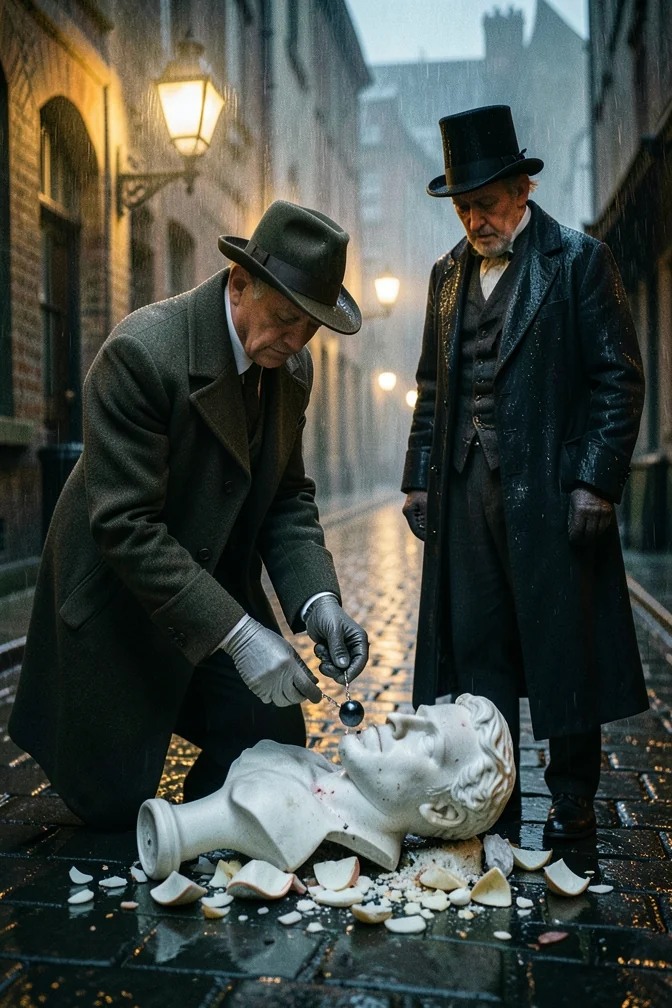
Edition and rights: Original English text from Project Gutenberg ebook #108, identified there as public domain in the USA. The literary text below is reproduced without AI rewriting.
Browse more detective stories.
THE ADVENTURE OF THE SIX NAPOLEONS


      It was no very unusual thing for Mr. Lestrade, of Scotland Yard,
      to look in upon us of an evening, and his visits were welcome to
      Sherlock Holmes, for they enabled him to keep in touch with all
      that was going on at the police headquarters. In return for the
      news which Lestrade would bring, Holmes was always ready to
      listen with attention to the details of any case upon which the
      detective was engaged, and was able occasionally, without any
      active interference, to give some hint or suggestion drawn from
      his own vast knowledge and experience.

      On this particular evening, Lestrade had spoken of the weather
      and the newspapers. Then he had fallen silent, puffing
      thoughtfully at his cigar. Holmes looked keenly at him.

      “Anything remarkable on hand?” he asked.

      “Oh, no, Mr. Holmes—nothing very particular.”

      “Then tell me about it.”

      Lestrade laughed.

      “Well, Mr. Holmes, there is no use denying that there _is_
      something on my mind. And yet it is such an absurd business, that
      I hesitated to bother you about it. On the other hand, although
      it is trivial, it is undoubtedly queer, and I know that you have
      a taste for all that is out of the common. But, in my opinion, it
      comes more in Dr. Watson’s line than ours.”

      “Disease?” said I.

      “Madness, anyhow. And a queer madness, too. You wouldn’t think
      there was anyone living at this time of day who had such a hatred
      of Napoleon the First that he would break any image of him that
      he could see.”

      Holmes sank back in his chair.

      “That’s no business of mine,” said he.

      “Exactly. That’s what I said. But then, when the man commits
      burglary in order to break images which are not his own, that
      brings it away from the doctor and on to the policeman.”

      Holmes sat up again.

      “Burglary! This is more interesting. Let me hear the details.”

      Lestrade took out his official notebook and refreshed his memory
      from its pages.

      “The first case reported was four days ago,” said he. “It was at
      the shop of Morse Hudson, who has a place for the sale of
      pictures and statues in the Kennington Road. The assistant had
      left the front shop for an instant, when he heard a crash, and
      hurrying in he found a plaster bust of Napoleon, which stood with
      several other works of art upon the counter, lying shivered into
      fragments. He rushed out into the road, but, although several
      passers-by declared that they had noticed a man run out of the
      shop, he could neither see anyone nor could he find any means of
      identifying the rascal. It seemed to be one of those senseless
      acts of hooliganism which occur from time to time, and it was
      reported to the constable on the beat as such. The plaster cast
      was not worth more than a few shillings, and the whole affair
      appeared to be too childish for any particular investigation.

      “The second case, however, was more serious, and also more
      singular. It occurred only last night.

      “In Kennington Road, and within a few hundred yards of Morse
      Hudson’s shop, there lives a well-known medical practitioner,
      named Dr. Barnicot, who has one of the largest practices upon the
      south side of the Thames. His residence and principal
      consulting-room is at Kennington Road, but he has a branch
      surgery and dispensary at Lower Brixton Road, two miles away.
      This Dr. Barnicot is an enthusiastic admirer of Napoleon, and his
      house is full of books, pictures, and relics of the French
      Emperor. Some little time ago he purchased from Morse Hudson two
      duplicate plaster casts of the famous head of Napoleon by the
      French sculptor, Devine. One of these he placed in his hall in
      the house at Kennington Road, and the other on the mantelpiece of
      the surgery at Lower Brixton. Well, when Dr. Barnicot came down
      this morning he was astonished to find that his house had been
      burgled during the night, but that nothing had been taken save
      the plaster head from the hall. It had been carried out and had
      been dashed savagely against the garden wall, under which its
      splintered fragments were discovered.”

      Holmes rubbed his hands.

      “This is certainly very novel,” said he.

      “I thought it would please you. But I have not got to the end
      yet. Dr. Barnicot was due at his surgery at twelve o’clock, and
      you can imagine his amazement when, on arriving there, he found
      that the window had been opened in the night and that the broken
      pieces of his second bust were strewn all over the room. It had
      been smashed to atoms where it stood. In neither case were there
      any signs which could give us a clue as to the criminal or
      lunatic who had done the mischief. Now, Mr. Holmes, you have got
      the facts.”

      “They are singular, not to say grotesque,” said Holmes. “May I
      ask whether the two busts smashed in Dr. Barnicot’s rooms were
      the exact duplicates of the one which was destroyed in Morse
      Hudson’s shop?”

      “They were taken from the same mould.”

      “Such a fact must tell against the theory that the man who breaks
      them is influenced by any general hatred of Napoleon. Considering
      how many hundreds of statues of the great Emperor must exist in
      London, it is too much to suppose such a coincidence as that a
      promiscuous iconoclast should chance to begin upon three
      specimens of the same bust.”

      “Well, I thought as you do,” said Lestrade. “On the other hand,
      this Morse Hudson is the purveyor of busts in that part of
      London, and these three were the only ones which had been in his
      shop for years. So, although, as you say, there are many hundreds
      of statues in London, it is very probable that these three were
      the only ones in that district. Therefore, a local fanatic would
      begin with them. What do you think, Dr. Watson?”

      “There are no limits to the possibilities of monomania,” I
      answered. “There is the condition which the modern French
      psychologists have called the _idée fixe_, which may be trifling
      in character, and accompanied by complete sanity in every other
      way. A man who had read deeply about Napoleon, or who had
      possibly received some hereditary family injury through the great
      war, might conceivably form such an _idée fixe_ and under its
      influence be capable of any fantastic outrage.”

      “That won’t do, my dear Watson,” said Holmes, shaking his head,
      “for no amount of _idée fixe_ would enable your interesting
      monomaniac to find out where these busts were situated.”

      “Well, how do _you_ explain it?”

      “I don’t attempt to do so. I would only observe that there is a
      certain method in the gentleman’s eccentric proceedings. For
      example, in Dr. Barnicot’s hall, where a sound might arouse the
      family, the bust was taken outside before being broken, whereas
      in the surgery, where there was less danger of an alarm, it was
      smashed where it stood. The affair seems absurdly trifling, and
      yet I dare call nothing trivial when I reflect that some of my
      most classic cases have had the least promising commencement. You
      will remember, Watson, how the dreadful business of the Abernetty
      family was first brought to my notice by the depth which the
      parsley had sunk into the butter upon a hot day. I can’t afford,
      therefore, to smile at your three broken busts, Lestrade, and I
      shall be very much obliged to you if you will let me hear of any
      fresh development of so singular a chain of events.”

      The development for which my friend had asked came in a quicker
      and an infinitely more tragic form than he could have imagined. I
      was still dressing in my bedroom next morning, when there was a
      tap at the door and Holmes entered, a telegram in his hand. He
      read it aloud:

      “Come instantly, 131, Pitt Street, Kensington.—LESTRADE.”

      “What is it, then?” I asked.

      “Don’t know—may be anything. But I suspect it is the sequel of
      the story of the statues. In that case our friend the
      image-breaker has begun operations in another quarter of London.
      There’s coffee on the table, Watson, and I have a cab at the
      door.”

      In half an hour we had reached Pitt Street, a quiet little
      backwater just beside one of the briskest currents of London
      life. No. 131 was one of a row, all flat-chested, respectable,
      and most unromantic dwellings. As we drove up, we found the
      railings in front of the house lined by a curious crowd. Holmes
      whistled.

      “By George! It’s attempted murder at the least. Nothing less will
      hold the London message-boy. There’s a deed of violence indicated
      in that fellow’s round shoulders and outstretched neck. What’s
      this, Watson? The top steps swilled down and the other ones dry.
      Footsteps enough, anyhow! Well, well, there’s Lestrade at the
      front window, and we shall soon know all about it.”

      The official received us with a very grave face and showed us
      into a sitting-room, where an exceedingly unkempt and agitated
      elderly man, clad in a flannel dressing-gown, was pacing up and
      down. He was introduced to us as the owner of the house—Mr.
      Horace Harker, of the Central Press Syndicate.

      “It’s the Napoleon bust business again,” said Lestrade. “You
      seemed interested last night, Mr. Holmes, so I thought perhaps
      you would be glad to be present now that the affair has taken a
      very much graver turn.”

      “What has it turned to, then?”

      “To murder. Mr. Harker, will you tell these gentlemen exactly
      what has occurred?”

      The man in the dressing-gown turned upon us with a most
      melancholy face.

      “It’s an extraordinary thing,” said he, “that all my life I have
      been collecting other people’s news, and now that a real piece of
      news has come my own way I am so confused and bothered that I
      can’t put two words together. If I had come in here as a
      journalist, I should have interviewed myself and had two columns
      in every evening paper. As it is, I am giving away valuable copy
      by telling my story over and over to a string of different
      people, and I can make no use of it myself. However, I’ve heard
      your name, Mr. Sherlock Holmes, and if you’ll only explain this
      queer business, I shall be paid for my trouble in telling you the
      story.”

      Holmes sat down and listened.

      “It all seems to centre round that bust of Napoleon which I
      bought for this very room about four months ago. I picked it up
      cheap from Harding Brothers, two doors from the High Street
      Station. A great deal of my journalistic work is done at night,
      and I often write until the early morning. So it was to-day. I
      was sitting in my den, which is at the back of the top of the
      house, about three o’clock, when I was convinced that I heard
      some sounds downstairs. I listened, but they were not repeated,
      and I concluded that they came from outside. Then suddenly, about
      five minutes later, there came a most horrible yell—the most
      dreadful sound, Mr. Holmes, that ever I heard. It will ring in my
      ears as long as I live. I sat frozen with horror for a minute or
      two. Then I seized the poker and went downstairs. When I entered
      this room I found the window wide open, and I at once observed
      that the bust was gone from the mantelpiece. Why any burglar
      should take such a thing passes my understanding, for it was only
      a plaster cast and of no real value whatever.

      “You can see for yourself that anyone going out through that open
      window could reach the front doorstep by taking a long stride.
      This was clearly what the burglar had done, so I went round and
      opened the door. Stepping out into the dark, I nearly fell over a
      dead man, who was lying there. I ran back for a light and there
      was the poor fellow, a great gash in his throat and the whole
      place swimming in blood. He lay on his back, his knees drawn up,
      and his mouth horribly open. I shall see him in my dreams. I had
      just time to blow on my police-whistle, and then I must have
      fainted, for I knew nothing more until I found the policeman
      standing over me in the hall.”

      “Well, who was the murdered man?” asked Holmes.

      “There’s nothing to show who he was,” said Lestrade. “You shall
      see the body at the mortuary, but we have made nothing of it up
      to now. He is a tall man, sunburned, very powerful, not more than
      thirty. He is poorly dressed, and yet does not appear to be a
      labourer. A horn-handled clasp knife was lying in a pool of blood
      beside him. Whether it was the weapon which did the deed, or
      whether it belonged to the dead man, I do not know. There was no
      name on his clothing, and nothing in his pockets save an apple,
      some string, a shilling map of London, and a photograph. Here it
      is.”

      It was evidently taken by a snapshot from a small camera. It
      represented an alert, sharp-featured simian man, with thick
      eyebrows and a very peculiar projection of the lower part of the
      face, like the muzzle of a baboon.

      “And what became of the bust?” asked Holmes, after a careful
      study of this picture.

      “We had news of it just before you came. It has been found in the
      front garden of an empty house in Campden House Road. It was
      broken into fragments. I am going round now to see it. Will you
      come?”

      “Certainly. I must just take one look round.” He examined the
      carpet and the window. “The fellow had either very long legs or
      was a most active man,” said he. “With an area beneath, it was no
      mean feat to reach that window ledge and open that window.
      Getting back was comparatively simple. Are you coming with us to
      see the remains of your bust, Mr. Harker?”

      The disconsolate journalist had seated himself at a
      writing-table.

      “I must try and make something of it,” said he, “though I have no
      doubt that the first editions of the evening papers are out
      already with full details. It’s like my luck! You remember when
      the stand fell at Doncaster? Well, I was the only journalist in
      the stand, and my journal the only one that had no account of it,
      for I was too shaken to write it. And now I’ll be too late with a
      murder done on my own doorstep.”

      As we left the room, we heard his pen travelling shrilly over the
      foolscap.

      The spot where the fragments of the bust had been found was only
      a few hundred yards away. For the first time our eyes rested upon
      this presentment of the great emperor, which seemed to raise such
      frantic and destructive hatred in the mind of the unknown. It lay
      scattered, in splintered shards, upon the grass. Holmes picked up
      several of them and examined them carefully. I was convinced,
      from his intent face and his purposeful manner, that at last he
      was upon a clue.

      “Well?” asked Lestrade.

      Holmes shrugged his shoulders.

      “We have a long way to go yet,” said he. “And yet—and yet—well,
      we have some suggestive facts to act upon. The possession of this
      trifling bust was worth more, in the eyes of this strange
      criminal, than a human life. That is one point. Then there is the
      singular fact that he did not break it in the house, or
      immediately outside the house, if to break it was his sole
      object.”

      “He was rattled and bustled by meeting this other fellow. He
      hardly knew what he was doing.”

      “Well, that’s likely enough. But I wish to call your attention
      very particularly to the position of this house, in the garden of
      which the bust was destroyed.”

      Lestrade looked about him.

      “It was an empty house, and so he knew that he would not be
      disturbed in the garden.”

      “Yes, but there is another empty house farther up the street
      which he must have passed before he came to this one. Why did he
      not break it there, since it is evident that every yard that he
      carried it increased the risk of someone meeting him?”

      “I give it up,” said Lestrade.

      Holmes pointed to the street lamp above our heads.

      “He could see what he was doing here, and he could not there.
      That was his reason.”

      “By Jove! that’s true,” said the detective. “Now that I come to
      think of it, Dr. Barnicot’s bust was broken not far from his red
      lamp. Well, Mr. Holmes, what are we to do with that fact?”

      “To remember it—to docket it. We may come on something later
      which will bear upon it. What steps do you propose to take now,
      Lestrade?”

      “The most practical way of getting at it, in my opinion, is to
      identify the dead man. There should be no difficulty about that.
      When we have found who he is and who his associates are, we
      should have a good start in learning what he was doing in Pitt
      Street last night, and who it was who met him and killed him on
      the doorstep of Mr. Horace Harker. Don’t you think so?”

      “No doubt; and yet it is not quite the way in which I should
      approach the case.”

      “What would you do then?”

      “Oh, you must not let me influence you in any way. I suggest that
      you go on your line and I on mine. We can compare notes
      afterwards, and each will supplement the other.”

      “Very good,” said Lestrade.

      “If you are going back to Pitt Street, you might see Mr. Horace
      Harker. Tell him for me that I have quite made up my mind, and
      that it is certain that a dangerous homicidal lunatic, with
      Napoleonic delusions, was in his house last night. It will be
      useful for his article.”

      Lestrade stared.

      “You don’t seriously believe that?”

      Holmes smiled.

      “Don’t I? Well, perhaps I don’t. But I am sure that it will
      interest Mr. Horace Harker and the subscribers of the Central
      Press Syndicate. Now, Watson, I think that we shall find that we
      have a long and rather complex day’s work before us. I should be
      glad, Lestrade, if you could make it convenient to meet us at
      Baker Street at six o’clock this evening. Until then I should
      like to keep this photograph, found in the dead man’s pocket. It
      is possible that I may have to ask your company and assistance
      upon a small expedition which will have to be undertaken to-night,
      if my chain of reasoning should prove to be correct. Until then
      good-bye and good luck!”

      Sherlock Holmes and I walked together to the High Street, where
      we stopped at the shop of Harding Brothers, whence the bust had
      been purchased. A young assistant informed us that Mr. Harding
      would be absent until afternoon, and that he was himself a
      newcomer, who could give us no information. Holmes’s face showed
      his disappointment and annoyance.

      “Well, well, we can’t expect to have it all our own way, Watson,”
      he said, at last. “We must come back in the afternoon, if Mr.
      Harding will not be here until then. I am, as you have no doubt
      surmised, endeavouring to trace these busts to their source, in
      order to find if there is not something peculiar which may
      account for their remarkable fate. Let us make for Mr. Morse
      Hudson, of the Kennington Road, and see if he can throw any light
      upon the problem.”

      A drive of an hour brought us to the picture-dealer’s
      establishment. He was a small, stout man with a red face and a
      peppery manner.

      “Yes, sir. On my very counter, sir,” said he. “What we pay rates
      and taxes for I don’t know, when any ruffian can come in and
      break one’s goods. Yes, sir, it was I who sold Dr. Barnicot his
      two statues. Disgraceful, sir! A Nihilist plot—that’s what I make
      it. No one but an anarchist would go about breaking statues. Red
      republicans—that’s what I call ’em. Who did I get the statues
      from? I don’t see what that has to do with it. Well, if you
      really want to know, I got them from Gelder & Co., in Church
      Street, Stepney. They are a well-known house in the trade, and
      have been this twenty years. How many had I? Three—two and one
      are three—two of Dr. Barnicot’s, and one smashed in broad
      daylight on my own counter. Do I know that photograph? No, I
      don’t. Yes, I do, though. Why, it’s Beppo. He was a kind of
      Italian piece-work man, who made himself useful in the shop. He
      could carve a bit, and gild and frame, and do odd jobs. The
      fellow left me last week, and I’ve heard nothing of him since.
      No, I don’t know where he came from nor where he went to. I had
      nothing against him while he was here. He was gone two days
      before the bust was smashed.”

      “Well, that’s all we could reasonably expect from Morse Hudson,”
      said Holmes, as we emerged from the shop. “We have this Beppo as
      a common factor, both in Kennington and in Kensington, so that is
      worth a ten-mile drive. Now, Watson, let us make for Gelder &
      Co., of Stepney, the source and origin of the busts. I shall be
      surprised if we don’t get some help down there.”

      In rapid succession we passed through the fringe of fashionable
      London, hotel London, theatrical London, literary London,
      commercial London, and, finally, maritime London, till we came to
      a riverside city of a hundred thousand souls, where the tenement
      houses swelter and reek with the outcasts of Europe. Here, in a
      broad thoroughfare, once the abode of wealthy City merchants, we
      found the sculpture works for which we searched. Outside was a
      considerable yard full of monumental masonry. Inside was a large
      room in which fifty workers were carving or moulding. The
      manager, a big blond German, received us civilly and gave a clear
      answer to all Holmes’s questions. A reference to his books showed
      that hundreds of casts had been taken from a marble copy of
      Devine’s head of Napoleon, but that the three which had been sent
      to Morse Hudson a year or so before had been half of a batch of
      six, the other three being sent to Harding Brothers, of
      Kensington. There was no reason why those six should be different
      from any of the other casts. He could suggest no possible cause
      why anyone should wish to destroy them—in fact, he laughed at the
      idea. Their wholesale price was six shillings, but the retailer
      would get twelve or more. The cast was taken in two moulds from
      each side of the face, and then these two profiles of plaster of
      Paris were joined together to make the complete bust. The work
      was usually done by Italians, in the room we were in. When
      finished, the busts were put on a table in the passage to dry,
      and afterwards stored. That was all he could tell us.

      But the production of the photograph had a remarkable effect upon
      the manager. His face flushed with anger, and his brows knotted
      over his blue Teutonic eyes.

      “Ah, the rascal!” he cried. “Yes, indeed, I know him very well.
      This has always been a respectable establishment, and the only
      time that we have ever had the police in it was over this very
      fellow. It was more than a year ago now. He knifed another
      Italian in the street, and then he came to the works with the
      police on his heels, and he was taken here. Beppo was his
      name—his second name I never knew. Serve me right for engaging a
      man with such a face. But he was a good workman—one of the best.”

      “What did he get?”

      “The man lived and he got off with a year. I have no doubt he is
      out now, but he has not dared to show his nose here. We have a
      cousin of his here, and I daresay he could tell you where he is.”

      “No, no,” cried Holmes, “not a word to the cousin—not a word, I
      beg of you. The matter is very important, and the farther I go
      with it, the more important it seems to grow. When you referred
      in your ledger to the sale of those casts I observed that the
      date was June 3rd of last year. Could you give me the date when
      Beppo was arrested?”

      “I could tell you roughly by the pay-list,” the manager answered.
      “Yes,” he continued, after some turning over of pages, “he was
      paid last on May 20th.”

      “Thank you,” said Holmes. “I don’t think that I need intrude upon
      your time and patience any more.” With a last word of caution
      that he should say nothing as to our researches, we turned our
      faces westward once more.

      The afternoon was far advanced before we were able to snatch a
      hasty luncheon at a restaurant. A news-bill at the entrance
      announced “Kensington Outrage. Murder by a Madman,” and the
      contents of the paper showed that Mr. Horace Harker had got his
      account into print after all. Two columns were occupied with a
      highly sensational and flowery rendering of the whole incident.
      Holmes propped it against the cruet-stand and read it while he
      ate. Once or twice he chuckled.

      “This is all right, Watson,” said he. “Listen to this:

      “It is satisfactory to know that there can be no difference of
      opinion upon this case, since Mr. Lestrade, one of the most
      experienced members of the official force, and Mr. Sherlock
      Holmes, the well-known consulting expert, have each come to the
      conclusion that the grotesque series of incidents, which have
      ended in so tragic a fashion, arise from lunacy rather than from
      deliberate crime. No explanation save mental aberration can cover
      the facts.

      “The Press, Watson, is a most valuable institution, if you only
      know how to use it. And now, if you have quite finished, we will
      hark back to Kensington and see what the manager of Harding
      Brothers has to say on the matter.”

      The founder of that great emporium proved to be a brisk, crisp
      little person, very dapper and quick, with a clear head and a
      ready tongue.

      “Yes, sir, I have already read the account in the evening papers.
      Mr. Horace Harker is a customer of ours. We supplied him with the
      bust some months ago. We ordered three busts of that sort from
      Gelder & Co., of Stepney. They are all sold now. To whom? Oh, I
      daresay by consulting our sales book we could very easily tell
      you. Yes, we have the entries here. One to Mr. Harker you see,
      and one to Mr. Josiah Brown, of Laburnum Lodge, Laburnum Vale,
      Chiswick, and one to Mr. Sandeford, of Lower Grove Road, Reading.
      No, I have never seen this face which you show me in the
      photograph. You would hardly forget it, would you, sir, for I’ve
      seldom seen an uglier. Have we any Italians on the staff? Yes,
      sir, we have several among our workpeople and cleaners. I daresay
      they might get a peep at that sales book if they wanted to. There
      is no particular reason for keeping a watch upon that book. Well,
      well, it’s a very strange business, and I hope that you will let
      me know if anything comes of your inquiries.”

      Holmes had taken several notes during Mr. Harding’s evidence, and
      I could see that he was thoroughly satisfied by the turn which
      affairs were taking. He made no remark, however, save that,
      unless we hurried, we should be late for our appointment with
      Lestrade. Sure enough, when we reached Baker Street the detective
      was already there, and we found him pacing up and down in a fever
      of impatience. His look of importance showed that his day’s work
      had not been in vain.

      “Well?” he asked. “What luck, Mr. Holmes?”

      “We have had a very busy day, and not entirely a wasted one,” my
      friend explained. “We have seen both the retailers and also the
      wholesale manufacturers. I can trace each of the busts now from
      the beginning.”

      “The busts,” cried Lestrade. “Well, well, you have your own
      methods, Mr. Sherlock Holmes, and it is not for me to say a word
      against them, but I think I have done a better day’s work than
      you. I have identified the dead man.”

      “You don’t say so?”

      “And found a cause for the crime.”

      “Splendid!”

      “We have an inspector who makes a specialty of Saffron Hill and
      the Italian Quarter. Well, this dead man had some Catholic emblem
      round his neck, and that, along with his colour, made me think he
      was from the South. Inspector Hill knew him the moment he caught
      sight of him. His name is Pietro Venucci, from Naples, and he is
      one of the greatest cut-throats in London. He is connected with
      the Mafia, which, as you know, is a secret political society,
      enforcing its decrees by murder. Now, you see how the affair
      begins to clear up. The other fellow is probably an Italian also,
      and a member of the Mafia. He has broken the rules in some
      fashion. Pietro is set upon his track. Probably the photograph we
      found in his pocket is the man himself, so that he may not knife
      the wrong person. He dogs the fellow, he sees him enter a house,
      he waits outside for him, and in the scuffle he receives his own
      death-wound. How is that, Mr. Sherlock Holmes?”

      Holmes clapped his hands approvingly.

      “Excellent, Lestrade, excellent!” he cried. “But I didn’t quite
      follow your explanation of the destruction of the busts.”

      “The busts! You never can get those busts out of your head. After
      all, that is nothing; petty larceny, six months at the most. It
      is the murder that we are really investigating, and I tell you
      that I am gathering all the threads into my hands.”

      “And the next stage?”

      “Is a very simple one. I shall go down with Hill to the Italian
      Quarter, find the man whose photograph we have got, and arrest
      him on the charge of murder. Will you come with us?”

      “I think not. I fancy we can attain our end in a simpler way. I
      can’t say for certain, because it all depends—well, it all
      depends upon a factor which is completely outside our control.
      But I have great hopes—in fact, the betting is exactly two to
      one—that if you will come with us to-night I shall be able to
      help you to lay him by the heels.”

      “In the Italian Quarter?”

      “No, I fancy Chiswick is an address which is more likely to find
      him. If you will come with me to Chiswick to-night, Lestrade,
      I’ll promise to go to the Italian Quarter with you to-morrow, and
      no harm will be done by the delay. And now I think that a few
      hours’ sleep would do us all good, for I do not propose to leave
      before eleven o’clock, and it is unlikely that we shall be back
      before morning. You’ll dine with us, Lestrade, and then you are
      welcome to the sofa until it is time for us to start. In the
      meantime, Watson, I should be glad if you would ring for an
      express messenger, for I have a letter to send and it is
      important that it should go at once.”

      Holmes spent the evening in rummaging among the files of the old
      daily papers with which one of our lumber-rooms was packed. When
      at last he descended, it was with triumph in his eyes, but he
      said nothing to either of us as to the result of his researches.
      For my own part, I had followed step by step the methods by which
      he had traced the various windings of this complex case, and,
      though I could not yet perceive the goal which we would reach, I
      understood clearly that Holmes expected this grotesque criminal
      to make an attempt upon the two remaining busts, one of which, I
      remembered, was at Chiswick. No doubt the object of our journey
      was to catch him in the very act, and I could not but admire the
      cunning with which my friend had inserted a wrong clue in the
      evening paper, so as to give the fellow the idea that he could
      continue his scheme with impunity. I was not surprised when
      Holmes suggested that I should take my revolver with me. He had
      himself picked up the loaded hunting-crop, which was his
      favourite weapon.

      A four-wheeler was at the door at eleven, and in it we drove to a
      spot at the other side of Hammersmith Bridge. Here the cabman was
      directed to wait. A short walk brought us to a secluded road
      fringed with pleasant houses, each standing in its own grounds.
      In the light of a street lamp we read “Laburnum Villa” upon the
      gate-post of one of them. The occupants had evidently retired to
      rest, for all was dark save for a fanlight over the hall door,
      which shed a single blurred circle on to the garden path. The
      wooden fence which separated the grounds from the road threw a
      dense black shadow upon the inner side, and here it was that we
      crouched.

      “I fear that you’ll have a long wait,” Holmes whispered. “We may
      thank our stars that it is not raining. I don’t think we can even
      venture to smoke to pass the time. However, it’s a two to one
      chance that we get something to pay us for our trouble.”

      It proved, however, that our vigil was not to be so long as
      Holmes had led us to fear, and it ended in a very sudden and
      singular fashion. In an instant, without the least sound to warn
      us of his coming, the garden gate swung open, and a lithe, dark
      figure, as swift and active as an ape, rushed up the garden path.
      We saw it whisk past the light thrown from over the door and
      disappear against the black shadow of the house. There was a long
      pause, during which we held our breath, and then a very gentle
      creaking sound came to our ears. The window was being opened. The
      noise ceased, and again there was a long silence. The fellow was
      making his way into the house. We saw the sudden flash of a dark
      lantern inside the room. What he sought was evidently not there,
      for again we saw the flash through another blind, and then
      through another.

      “Let us get to the open window. We will nab him as he climbs
      out,” Lestrade whispered.

      But before we could move, the man had emerged again. As he came
      out into the glimmering patch of light, we saw that he carried
      something white under his arm. He looked stealthily all round
      him. The silence of the deserted street reassured him. Turning
      his back upon us he laid down his burden, and the next instant
      there was the sound of a sharp tap, followed by a clatter and
      rattle. The man was so intent upon what he was doing that he
      never heard our steps as we stole across the grass plot. With the
      bound of a tiger Holmes was on his back, and an instant later
      Lestrade and I had him by either wrist, and the handcuffs had
      been fastened. As we turned him over I saw a hideous, sallow
      face, with writhing, furious features, glaring up at us, and I
      knew that it was indeed the man of the photograph whom we had
      secured.

      But it was not our prisoner to whom Holmes was giving his
      attention. Squatted on the doorstep, he was engaged in most
      carefully examining that which the man had brought from the
      house. It was a bust of Napoleon, like the one which we had seen
      that morning, and it had been broken into similar fragments.
      Carefully Holmes held each separate shard to the light, but in no
      way did it differ from any other shattered piece of plaster. He
      had just completed his examination when the hall lights flew up,
      the door opened, and the owner of the house, a jovial, rotund
      figure in shirt and trousers, presented himself.

      “Mr. Josiah Brown, I suppose?” said Holmes.

      “Yes, sir; and you, no doubt, are Mr. Sherlock Holmes? I had the
      note which you sent by the express messenger, and I did exactly
      what you told me. We locked every door on the inside and awaited
      developments. Well, I’m very glad to see that you have got the
      rascal. I hope, gentlemen, that you will come in and have some
      refreshment.”

      However, Lestrade was anxious to get his man into safe quarters,
      so within a few minutes our cab had been summoned and we were all
      four upon our way to London. Not a word would our captive say,
      but he glared at us from the shadow of his matted hair, and once,
      when my hand seemed within his reach, he snapped at it like a
      hungry wolf. We stayed long enough at the police-station to learn
      that a search of his clothing revealed nothing save a few
      shillings and a long sheath knife, the handle of which bore
      copious traces of recent blood.

      “That’s all right,” said Lestrade, as we parted. “Hill knows all
      these gentry, and he will give a name to him. You’ll find that my
      theory of the Mafia will work out all right. But I’m sure I am
      exceedingly obliged to you, Mr. Holmes, for the workmanlike way
      in which you laid hands upon him. I don’t quite understand it all
      yet.”

      “I fear it is rather too late an hour for explanations,” said
      Holmes. “Besides, there are one or two details which are not
      finished off, and it is one of those cases which are worth
      working out to the very end. If you will come round once more to
      my rooms at six o’clock to-morrow, I think I shall be able to
      show you that even now you have not grasped the entire meaning of
      this business, which presents some features which make it
      absolutely original in the history of crime. If ever I permit you
      to chronicle any more of my little problems, Watson, I foresee
      that you will enliven your pages by an account of the singular
      adventure of the Napoleonic busts.”

      When we met again next evening, Lestrade was furnished with much
      information concerning our prisoner. His name, it appeared, was
      Beppo, second name unknown. He was a well-known ne’er-do-well
      among the Italian colony. He had once been a skilful sculptor and
      had earned an honest living, but he had taken to evil courses and
      had twice already been in jail—once for a petty theft, and once,
      as we had already heard, for stabbing a fellow-countryman. He
      could talk English perfectly well. His reasons for destroying the
      busts were still unknown, and he refused to answer any questions
      upon the subject, but the police had discovered that these same
      busts might very well have been made by his own hands, since he
      was engaged in this class of work at the establishment of Gelder
      & Co. To all this information, much of which we already knew,
      Holmes listened with polite attention, but I, who knew him so
      well, could clearly see that his thoughts were elsewhere, and I
      detected a mixture of mingled uneasiness and expectation beneath
      that mask which he was wont to assume. At last he started in his
      chair, and his eyes brightened. There had been a ring at the
      bell. A minute later we heard steps upon the stairs, and an
      elderly red-faced man with grizzled side-whiskers was ushered in.
      In his right hand he carried an old-fashioned carpet-bag, which
      he placed upon the table.

      “Is Mr. Sherlock Holmes here?”

      My friend bowed and smiled. “Mr. Sandeford, of Reading, I
      suppose?” said he.

      “Yes, sir, I fear that I am a little late, but the trains were
      awkward. You wrote to me about a bust that is in my possession.”

      “Exactly.”

      “I have your letter here. You said, ‘I desire to possess a copy
      of Devine’s Napoleon, and am prepared to pay you ten pounds for
      the one which is in your possession.’ Is that right?”

      “Certainly.”

      “I was very much surprised at your letter, for I could not
      imagine how you knew that I owned such a thing.”

      “Of course you must have been surprised, but the explanation is
      very simple. Mr. Harding, of Harding Brothers, said that they had
      sold you their last copy, and he gave me your address.”

      “Oh, that was it, was it? Did he tell you what I paid for it?”

      “No, he did not.”

      “Well, I am an honest man, though not a very rich one. I only
      gave fifteen shillings for the bust, and I think you ought to
      know that before I take ten pounds from you.

      “I am sure the scruple does you honour, Mr. Sandeford. But I have
      named that price, so I intend to stick to it.”

      “Well, it is very handsome of you, Mr. Holmes. I brought the bust
      up with me, as you asked me to do. Here it is!” He opened his
      bag, and at last we saw placed upon our table a complete specimen
      of that bust which we had already seen more than once in
      fragments.

      Holmes took a paper from his pocket and laid a ten-pound note
      upon the table.

      “You will kindly sign that paper, Mr. Sandeford, in the presence
      of these witnesses. It is simply to say that you transfer every
      possible right that you ever had in the bust to me. I am a
      methodical man, you see, and you never know what turn events
      might take afterwards. Thank you, Mr. Sandeford; here is your
      money, and I wish you a very good evening.”

      When our visitor had disappeared, Sherlock Holmes’s movements
      were such as to rivet our attention. He began by taking a clean
      white cloth from a drawer and laying it over the table. Then he
      placed his newly acquired bust in the centre of the cloth.
      Finally, he picked up his hunting-crop and struck Napoleon a
      sharp blow on the top of the head. The figure broke into
      fragments, and Holmes bent eagerly over the shattered remains.
      Next instant, with a loud shout of triumph he held up one
      splinter, in which a round, dark object was fixed like a plum in
      a pudding.

      “Gentlemen,” he cried, “let me introduce you to the famous black
      pearl of the Borgias.”

      Lestrade and I sat silent for a moment, and then, with a
      spontaneous impulse, we both broke at clapping, as at the
      well-wrought crisis of a play. A flush of colour sprang to
      Holmes’s pale cheeks, and he bowed to us like the master
      dramatist who receives the homage of his audience. It was at such
      moments that for an instant he ceased to be a reasoning machine,
      and betrayed his human love for admiration and applause. The same
      singularly proud and reserved nature which turned away with
      disdain from popular notoriety was capable of being moved to its
      depths by spontaneous wonder and praise from a friend.

      “Yes, gentlemen,” said he, “it is the most famous pearl now
      existing in the world, and it has been my good fortune, by a
      connected chain of inductive reasoning, to trace it from the
      Prince of Colonna’s bedroom at the Dacre Hotel, where it was
      lost, to the interior of this, the last of the six busts of
      Napoleon which were manufactured by Gelder & Co., of Stepney. You
      will remember, Lestrade, the sensation caused by the
      disappearance of this valuable jewel and the vain efforts of the
      London police to recover it. I was myself consulted upon the
      case, but I was unable to throw any light upon it. Suspicion fell
      upon the maid of the Princess, who was an Italian, and it was
      proved that she had a brother in London, but we failed to trace
      any connection between them. The maid’s name was Lucretia
      Venucci, and there is no doubt in my mind that this Pietro who
      was murdered two nights ago was the brother. I have been looking
      up the dates in the old files of the paper, and I find that the
      disappearance of the pearl was exactly two days before the arrest
      of Beppo, for some crime of violence—an event which took place in
      the factory of Gelder & Co., at the very moment when these busts
      were being made. Now you clearly see the sequence of events,
      though you see them, of course, in the inverse order to the way
      in which they presented themselves to me. Beppo had the pearl in
      his possession. He may have stolen it from Pietro, he may have
      been Pietro’s confederate, he may have been the go-between of
      Pietro and his sister. It is of no consequence to us which is the
      correct solution.

      “The main fact is that he _had_ the pearl, and at that moment,
      when it was on his person, he was pursued by the police. He made
      for the factory in which he worked, and he knew that he had only
      a few minutes in which to conceal this enormously valuable prize,
      which would otherwise be found on him when he was searched. Six
      plaster casts of Napoleon were drying in the passage. One of them
      was still soft. In an instant Beppo, a skilful workman, made a
      small hole in the wet plaster, dropped in the pearl, and with a
      few touches covered over the aperture once more. It was an
      admirable hiding-place. No one could possibly find it. But Beppo
      was condemned to a year’s imprisonment, and in the meanwhile his
      six busts were scattered over London. He could not tell which
      contained his treasure. Only by breaking them could he see. Even
      shaking would tell him nothing, for as the plaster was wet it was
      probable that the pearl would adhere to it—as, in fact, it has
      done. Beppo did not despair, and he conducted his search with
      considerable ingenuity and perseverance. Through a cousin who
      works with Gelder, he found out the retail firms who had bought
      the busts. He managed to find employment with Morse Hudson, and
      in that way tracked down three of them. The pearl was not there.
      Then, with the help of some Italian employee, he succeeded in
      finding out where the other three busts had gone. The first was
      at Harker’s. There he was dogged by his confederate, who held
      Beppo responsible for the loss of the pearl, and he stabbed him
      in the scuffle which followed.”

      “If he was his confederate, why should he carry his photograph?”
      I asked.

      “As a means of tracing him, if he wished to inquire about him
      from any third person. That was the obvious reason. Well, after
      the murder I calculated that Beppo would probably hurry rather
      than delay his movements. He would fear that the police would
      read his secret, and so he hastened on before they should get
      ahead of him. Of course, I could not say that he had not found
      the pearl in Harker’s bust. I had not even concluded for certain
      that it was the pearl, but it was evident to me that he was
      looking for something, since he carried the bust past the other
      houses in order to break it in the garden which had a lamp
      overlooking it. Since Harker’s bust was one in three, the chances
      were exactly as I told you—two to one against the pearl being
      inside it. There remained two busts, and it was obvious that he
      would go for the London one first. I warned the inmates of the
      house, so as to avoid a second tragedy, and we went down, with
      the happiest results. By that time, of course, I knew for certain
      that it was the Borgia pearl that we were after. The name of the
      murdered man linked the one event with the other. There only
      remained a single bust—the Reading one—and the pearl must be
      there. I bought it in your presence from the owner—and there it
      lies.”

      We sat in silence for a moment.

      “Well,” said Lestrade, “I’ve seen you handle a good many cases,
      Mr. Holmes, but I don’t know that I ever knew a more workmanlike
      one than that. We’re not jealous of you at Scotland Yard. No,
      sir, we are very proud of you, and if you come down to-morrow,
      there’s not a man, from the oldest inspector to the youngest
      constable, who wouldn’t be glad to shake you by the hand.”

      “Thank you!” said Holmes. “Thank you!” and as he turned away, it
      seemed to me that he was more nearly moved by the softer human
      emotions than I had ever seen him. A moment later he was the cold
      and practical thinker once more. “Put the pearl in the safe,
      Watson,” said he, “and get out the papers of the Conk-Singleton
      forgery case. Good-bye, Lestrade. If any little problem comes
      your way, I shall be happy, if I can, to give you a hint or two
      as to its solution.”
1 / 1


