
The Speckled Band
Read The Speckled Band, a public-domain detective story in the original English.
By Arthur Conan Doyle
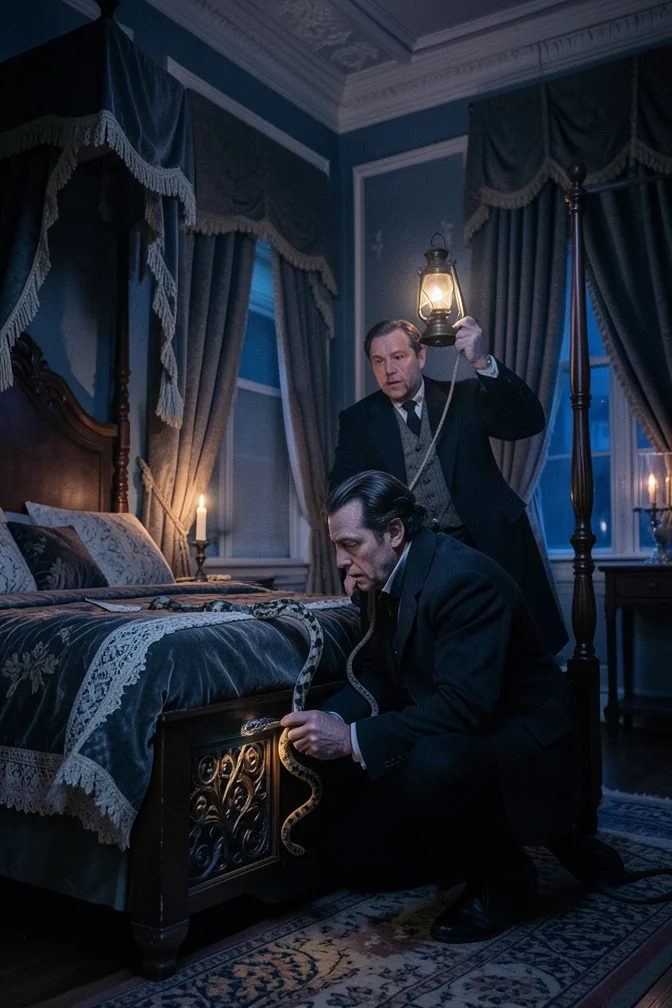
Edition and rights: Original English text from Project Gutenberg ebook #1661, marked public domain in the USA. The literary text below is reproduced without AI rewriting.
Browse more detective stories.
On glancing over my notes of the seventy odd cases in which I have

during the last eight years studied the methods of my friend Sherlock

Holmes, I find many tragic, some comic, a large number merely strange,

but none commonplace; for, working as he did rather for the love of his

art than for the acquirement of wealth, he refused to associate himself

with any investigation which did not tend towards the unusual, and even

the fantastic. Of all these varied cases, however, I cannot recall any

which presented more singular features than that which was associated

with the well-known Surrey family of the Roylotts of Stoke Moran. The

events in question occurred in the early days of my association with

Holmes, when we were sharing rooms as bachelors in Baker Street. It is

possible that I might have placed them upon record before, but a

promise of secrecy was made at the time, from which I have only been

freed during the last month by the untimely death of the lady to whom

the pledge was given. It is perhaps as well that the facts should now

come to light, for I have reasons to know that there are widespread

rumours as to the death of Dr. Grimesby Roylott which tend to make the

matter even more terrible than the truth.


It was early in April in the year ’83 that I woke one morning to find

Sherlock Holmes standing, fully dressed, by the side of my bed. He was

a late riser, as a rule, and as the clock on the mantelpiece showed me

that it was only a quarter-past seven, I blinked up at him in some

surprise, and perhaps just a little resentment, for I was myself

regular in my habits.


“Very sorry to knock you up, Watson,” said he, “but it’s the common lot

this morning. Mrs. Hudson has been knocked up, she retorted upon me,

and I on you.”


“What is it, then—a fire?”


“No; a client. It seems that a young lady has arrived in a considerable

state of excitement, who insists upon seeing me. She is waiting now in

the sitting-room. Now, when young ladies wander about the metropolis at

this hour of the morning, and knock sleepy people up out of their beds,

I presume that it is something very pressing which they have to

communicate. Should it prove to be an interesting case, you would, I am

sure, wish to follow it from the outset. I thought, at any rate, that I

should call you and give you the chance.”


“My dear fellow, I would not miss it for anything.”


I had no keener pleasure than in following Holmes in his professional

investigations, and in admiring the rapid deductions, as swift as

intuitions, and yet always founded on a logical basis with which he

unravelled the problems which were submitted to him. I rapidly threw on

my clothes and was ready in a few minutes to accompany my friend down

to the sitting-room. A lady dressed in black and heavily veiled, who

had been sitting in the window, rose as we entered.


“Good-morning, madam,” said Holmes cheerily. “My name is Sherlock

Holmes. This is my intimate friend and associate, Dr. Watson, before

whom you can speak as freely as before myself. Ha! I am glad to see

that Mrs. Hudson has had the good sense to light the fire. Pray draw up

to it, and I shall order you a cup of hot coffee, for I observe that

you are shivering.”


“It is not cold which makes me shiver,” said the woman in a low voice,

changing her seat as requested.


“What, then?”


“It is fear, Mr. Holmes. It is terror.” She raised her veil as she

spoke, and we could see that she was indeed in a pitiable state of

agitation, her face all drawn and grey, with restless frightened eyes,

like those of some hunted animal. Her features and figure were those of

a woman of thirty, but her hair was shot with premature grey, and her

expression was weary and haggard. Sherlock Holmes ran her over with one

of his quick, all-comprehensive glances.


“You must not fear,” said he soothingly, bending forward and patting

her forearm. “We shall soon set matters right, I have no doubt. You

have come in by train this morning, I see.”


“You know me, then?”


“No, but I observe the second half of a return ticket in the palm of

your left glove. You must have started early, and yet you had a good

drive in a dog-cart, along heavy roads, before you reached the

station.”


The lady gave a violent start and stared in bewilderment at my

companion.


“There is no mystery, my dear madam,” said he, smiling. “The left arm

of your jacket is spattered with mud in no less than seven places. The

marks are perfectly fresh. There is no vehicle save a dog-cart which

throws up mud in that way, and then only when you sit on the left-hand

side of the driver.”


“Whatever your reasons may be, you are perfectly correct,” said she. “I

started from home before six, reached Leatherhead at twenty past, and

came in by the first train to Waterloo. Sir, I can stand this strain no

longer; I shall go mad if it continues. I have no one to turn to—none,

save only one, who cares for me, and he, poor fellow, can be of little

aid. I have heard of you, Mr. Holmes; I have heard of you from Mrs.

Farintosh, whom you helped in the hour of her sore need. It was from

her that I had your address. Oh, sir, do you not think that you could

help me, too, and at least throw a little light through the dense

darkness which surrounds me? At present it is out of my power to reward

you for your services, but in a month or six weeks I shall be married,

with the control of my own income, and then at least you shall not find

me ungrateful.”


Holmes turned to his desk and, unlocking it, drew out a small

case-book, which he consulted.


“Farintosh,” said he. “Ah yes, I recall the case; it was concerned with

an opal tiara. I think it was before your time, Watson. I can only say,

madam, that I shall be happy to devote the same care to your case as I

did to that of your friend. As to reward, my profession is its own

reward; but you are at liberty to defray whatever expenses I may be put

to, at the time which suits you best. And now I beg that you will lay

before us everything that may help us in forming an opinion upon the

matter.”


“Alas!” replied our visitor, “the very horror of my situation lies in

the fact that my fears are so vague, and my suspicions depend so

entirely upon small points, which might seem trivial to another, that

even he to whom of all others I have a right to look for help and

advice looks upon all that I tell him about it as the fancies of a

nervous woman. He does not say so, but I can read it from his soothing

answers and averted eyes. But I have heard, Mr. Holmes, that you can

see deeply into the manifold wickedness of the human heart. You may

advise me how to walk amid the dangers which encompass me.”


“I am all attention, madam.”


“My name is Helen Stoner, and I am living with my stepfather, who is

the last survivor of one of the oldest Saxon families in England, the

Roylotts of Stoke Moran, on the western border of Surrey.”


Holmes nodded his head. “The name is familiar to me,” said he.


“The family was at one time among the richest in England, and the

estates extended over the borders into Berkshire in the north, and

Hampshire in the west. In the last century, however, four successive

heirs were of a dissolute and wasteful disposition, and the family ruin

was eventually completed by a gambler in the days of the Regency.

Nothing was left save a few acres of ground, and the

two-hundred-year-old house, which is itself crushed under a heavy

mortgage. The last squire dragged out his existence there, living the

horrible life of an aristocratic pauper; but his only son, my

stepfather, seeing that he must adapt himself to the new conditions,

obtained an advance from a relative, which enabled him to take a

medical degree and went out to Calcutta, where, by his professional

skill and his force of character, he established a large practice. In a

fit of anger, however, caused by some robberies which had been

perpetrated in the house, he beat his native butler to death and

narrowly escaped a capital sentence. As it was, he suffered a long term

of imprisonment and afterwards returned to England a morose and

disappointed man.


“When Dr. Roylott was in India he married my mother, Mrs. Stoner, the

young widow of Major-General Stoner, of the Bengal Artillery. My sister

Julia and I were twins, and we were only two years old at the time of

my mother’s re-marriage. She had a considerable sum of money—not less

than £ 1000 a year—and this she bequeathed to Dr. Roylott entirely

while we resided with him, with a provision that a certain annual sum

should be allowed to each of us in the event of our marriage. Shortly

after our return to England my mother died—she was killed eight years

ago in a railway accident near Crewe. Dr. Roylott then abandoned his

attempts to establish himself in practice in London and took us to live

with him in the old ancestral house at Stoke Moran. The money which my

mother had left was enough for all our wants, and there seemed to be no

obstacle to our happiness.


“But a terrible change came over our stepfather about this time.

Instead of making friends and exchanging visits with our neighbours,

who had at first been overjoyed to see a Roylott of Stoke Moran back in

the old family seat, he shut himself up in his house and seldom came

out save to indulge in ferocious quarrels with whoever might cross his

path. Violence of temper approaching to mania has been hereditary in

the men of the family, and in my stepfather’s case it had, I believe,

been intensified by his long residence in the tropics. A series of

disgraceful brawls took place, two of which ended in the police-court,

until at last he became the terror of the village, and the folks would

fly at his approach, for he is a man of immense strength, and

absolutely uncontrollable in his anger.


“Last week he hurled the local blacksmith over a parapet into a stream,

and it was only by paying over all the money which I could gather

together that I was able to avert another public exposure. He had no

friends at all save the wandering gipsies, and he would give these

vagabonds leave to encamp upon the few acres of bramble-covered land

which represent the family estate, and would accept in return the

hospitality of their tents, wandering away with them sometimes for

weeks on end. He has a passion also for Indian animals, which are sent

over to him by a correspondent, and he has at this moment a cheetah and

a baboon, which wander freely over his grounds and are feared by the

villagers almost as much as their master.


“You can imagine from what I say that my poor sister Julia and I had no

great pleasure in our lives. No servant would stay with us, and for a

long time we did all the work of the house. She was but thirty at the

time of her death, and yet her hair had already begun to whiten, even

as mine has.”


“Your sister is dead, then?”


“She died just two years ago, and it is of her death that I wish to

speak to you. You can understand that, living the life which I have

described, we were little likely to see anyone of our own age and

position. We had, however, an aunt, my mother’s maiden sister, Miss

Honoria Westphail, who lives near Harrow, and we were occasionally

allowed to pay short visits at this lady’s house. Julia went there at

Christmas two years ago, and met there a half-pay major of marines, to

whom she became engaged. My stepfather learned of the engagement when

my sister returned and offered no objection to the marriage; but within

a fortnight of the day which had been fixed for the wedding, the

terrible event occurred which has deprived me of my only companion.”


Sherlock Holmes had been leaning back in his chair with his eyes closed

and his head sunk in a cushion, but he half opened his lids now and

glanced across at his visitor.


“Pray be precise as to details,” said he.


“It is easy for me to be so, for every event of that dreadful time is

seared into my memory. The manor-house is, as I have already said, very

old, and only one wing is now inhabited. The bedrooms in this wing are

on the ground floor, the sitting-rooms being in the central block of

the buildings. Of these bedrooms the first is Dr. Roylott’s, the second

my sister’s, and the third my own. There is no communication between

them, but they all open out into the same corridor. Do I make myself

plain?”


“Perfectly so.”


“The windows of the three rooms open out upon the lawn. That fatal

night Dr. Roylott had gone to his room early, though we knew that he

had not retired to rest, for my sister was troubled by the smell of the

strong Indian cigars which it was his custom to smoke. She left her

room, therefore, and came into mine, where she sat for some time,

chatting about her approaching wedding. At eleven o’clock she rose to

leave me, but she paused at the door and looked back.


“‘Tell me, Helen,’ said she, ‘have you ever heard anyone whistle in the

dead of the night?’


“‘Never,’ said I.


“‘I suppose that you could not possibly whistle, yourself, in your

sleep?’


“‘Certainly not. But why?’


“‘Because during the last few nights I have always, about three in the

morning, heard a low, clear whistle. I am a light sleeper, and it has

awakened me. I cannot tell where it came from—perhaps from the next

room, perhaps from the lawn. I thought that I would just ask you

whether you had heard it.’


“‘No, I have not. It must be those wretched gipsies in the plantation.’


“‘Very likely. And yet if it were on the lawn, I wonder that you did

not hear it also.’


“‘Ah, but I sleep more heavily than you.’


“‘Well, it is of no great consequence, at any rate.’ She smiled back at

me, closed my door, and a few moments later I heard her key turn in the

lock.”


“Indeed,” said Holmes. “Was it your custom always to lock yourselves in

at night?”


“Always.”


“And why?”


“I think that I mentioned to you that the Doctor kept a cheetah and a

baboon. We had no feeling of security unless our doors were locked.”


“Quite so. Pray proceed with your statement.”


“I could not sleep that night. A vague feeling of impending misfortune

impressed me. My sister and I, you will recollect, were twins, and you

know how subtle are the links which bind two souls which are so closely

allied. It was a wild night. The wind was howling outside, and the rain

was beating and splashing against the windows. Suddenly, amid all the

hubbub of the gale, there burst forth the wild scream of a terrified

woman. I knew that it was my sister’s voice. I sprang from my bed,

wrapped a shawl round me, and rushed into the corridor. As I opened my

door I seemed to hear a low whistle, such as my sister described, and a

few moments later a clanging sound, as if a mass of metal had fallen.

As I ran down the passage, my sister’s door was unlocked, and revolved

slowly upon its hinges. I stared at it horror-stricken, not knowing

what was about to issue from it. By the light of the corridor-lamp I

saw my sister appear at the opening, her face blanched with terror, her

hands groping for help, her whole figure swaying to and fro like that

of a drunkard. I ran to her and threw my arms round her, but at that

moment her knees seemed to give way and she fell to the ground. She

writhed as one who is in terrible pain, and her limbs were dreadfully

convulsed. At first I thought that she had not recognised me, but as I

bent over her she suddenly shrieked out in a voice which I shall never

forget, ‘Oh, my God! Helen! It was the band! The speckled band!’ There

was something else which she would fain have said, and she stabbed with

her finger into the air in the direction of the Doctor’s room, but a

fresh convulsion seized her and choked her words. I rushed out, calling

loudly for my stepfather, and I met him hastening from his room in his

dressing-gown. When he reached my sister’s side she was unconscious,

and though he poured brandy down her throat and sent for medical aid

from the village, all efforts were in vain, for she slowly sank and

died without having recovered her consciousness. Such was the dreadful

end of my beloved sister.”


“One moment,” said Holmes, “are you sure about this whistle and

metallic sound? Could you swear to it?”


“That was what the county coroner asked me at the inquiry. It is my

strong impression that I heard it, and yet, among the crash of the gale

and the creaking of an old house, I may possibly have been deceived.”


“Was your sister dressed?”


“No, she was in her night-dress. In her right hand was found the

charred stump of a match, and in her left a match-box.”


“Showing that she had struck a light and looked about her when the

alarm took place. That is important. And what conclusions did the

coroner come to?”


“He investigated the case with great care, for Dr. Roylott’s conduct

had long been notorious in the county, but he was unable to find any

satisfactory cause of death. My evidence showed that the door had been

fastened upon the inner side, and the windows were blocked by

old-fashioned shutters with broad iron bars, which were secured every

night. The walls were carefully sounded, and were shown to be quite

solid all round, and the flooring was also thoroughly examined, with

the same result. The chimney is wide, but is barred up by four large

staples. It is certain, therefore, that my sister was quite alone when

she met her end. Besides, there were no marks of any violence upon

her.”


“How about poison?”


“The doctors examined her for it, but without success.”


“What do you think that this unfortunate lady died of, then?”


“It is my belief that she died of pure fear and nervous shock, though

what it was that frightened her I cannot imagine.”


“Were there gipsies in the plantation at the time?”


“Yes, there are nearly always some there.”


“Ah, and what did you gather from this allusion to a band—a speckled

band?”


“Sometimes I have thought that it was merely the wild talk of delirium,

sometimes that it may have referred to some band of people, perhaps to

these very gipsies in the plantation. I do not know whether the spotted

handkerchiefs which so many of them wear over their heads might have

suggested the strange adjective which she used.”


Holmes shook his head like a man who is far from being satisfied.


“These are very deep waters,” said he; “pray go on with your

narrative.”


“Two years have passed since then, and my life has been until lately

lonelier than ever. A month ago, however, a dear friend, whom I have

known for many years, has done me the honour to ask my hand in

marriage. His name is Armitage—Percy Armitage—the second son of Mr.

Armitage, of Crane Water, near Reading. My stepfather has offered no

opposition to the match, and we are to be married in the course of the

spring. Two days ago some repairs were started in the west wing of the

building, and my bedroom wall has been pierced, so that I have had to

move into the chamber in which my sister died, and to sleep in the very

bed in which she slept. Imagine, then, my thrill of terror when last

night, as I lay awake, thinking over her terrible fate, I suddenly

heard in the silence of the night the low whistle which had been the

herald of her own death. I sprang up and lit the lamp, but nothing was

to be seen in the room. I was too shaken to go to bed again, however,

so I dressed, and as soon as it was daylight I slipped down, got a

dog-cart at the Crown Inn, which is opposite, and drove to Leatherhead,

from whence I have come on this morning with the one object of seeing

you and asking your advice.”


“You have done wisely,” said my friend. “But have you told me all?”


“Yes, all.”


“Miss Roylott, you have not. You are screening your stepfather.”


“Why, what do you mean?”


For answer Holmes pushed back the frill of black lace which fringed the

hand that lay upon our visitor’s knee. Five little livid spots, the

marks of four fingers and a thumb, were printed upon the white wrist.


“You have been cruelly used,” said Holmes.


The lady coloured deeply and covered over her injured wrist. “He is a

hard man,” she said, “and perhaps he hardly knows his own strength.”


There was a long silence, during which Holmes leaned his chin upon his

hands and stared into the crackling fire.


“This is a very deep business,” he said at last. “There are a thousand

details which I should desire to know before I decide upon our course

of action. Yet we have not a moment to lose. If we were to come to

Stoke Moran to-day, would it be possible for us to see over these rooms

without the knowledge of your stepfather?”


“As it happens, he spoke of coming into town to-day upon some most

important business. It is probable that he will be away all day, and

that there would be nothing to disturb you. We have a housekeeper now,

but she is old and foolish, and I could easily get her out of the way.”


“Excellent. You are not averse to this trip, Watson?”


“By no means.”


“Then we shall both come. What are you going to do yourself?”


“I have one or two things which I would wish to do now that I am in

town. But I shall return by the twelve o’clock train, so as to be there

in time for your coming.”


“And you may expect us early in the afternoon. I have myself some small

business matters to attend to. Will you not wait and breakfast?”


“No, I must go. My heart is lightened already since I have confided my

trouble to you. I shall look forward to seeing you again this

afternoon.” She dropped her thick black veil over her face and glided

from the room.


“And what do you think of it all, Watson?” asked Sherlock Holmes,

leaning back in his chair.


“It seems to me to be a most dark and sinister business.”


“Dark enough and sinister enough.”


“Yet if the lady is correct in saying that the flooring and walls are

sound, and that the door, window, and chimney are impassable, then her

sister must have been undoubtedly alone when she met her mysterious

end.”


“What becomes, then, of these nocturnal whistles, and what of the very

peculiar words of the dying woman?”


“I cannot think.”


“When you combine the ideas of whistles at night, the presence of a

band of gipsies who are on intimate terms with this old doctor, the

fact that we have every reason to believe that the doctor has an

interest in preventing his stepdaughter’s marriage, the dying allusion

to a band, and, finally, the fact that Miss Helen Stoner heard a

metallic clang, which might have been caused by one of those metal bars

that secured the shutters falling back into its place, I think that

there is good ground to think that the mystery may be cleared along

those lines.”


“But what, then, did the gipsies do?”


“I cannot imagine.”


“I see many objections to any such theory.”


“And so do I. It is precisely for that reason that we are going to

Stoke Moran this day. I want to see whether the objections are fatal,

or if they may be explained away. But what in the name of the devil!”


The ejaculation had been drawn from my companion by the fact that our

door had been suddenly dashed open, and that a huge man had framed

himself in the aperture. His costume was a peculiar mixture of the

professional and of the agricultural, having a black top-hat, a long

frock-coat, and a pair of high gaiters, with a hunting-crop swinging in

his hand. So tall was he that his hat actually brushed the cross bar of

the doorway, and his breadth seemed to span it across from side to

side. A large face, seared with a thousand wrinkles, burned yellow with

the sun, and marked with every evil passion, was turned from one to the

other of us, while his deep-set, bile-shot eyes, and his high, thin,

fleshless nose, gave him somewhat the resemblance to a fierce old bird

of prey.


“Which of you is Holmes?” asked this apparition.


“My name, sir; but you have the advantage of me,” said my companion

quietly.


“I am Dr. Grimesby Roylott, of Stoke Moran.”


“Indeed, Doctor,” said Holmes blandly. “Pray take a seat.”


“I will do nothing of the kind. My stepdaughter has been here. I have

traced her. What has she been saying to you?”


“It is a little cold for the time of the year,” said Holmes.


“What has she been saying to you?” screamed the old man furiously.


“But I have heard that the crocuses promise well,” continued my

companion imperturbably.


“Ha! You put me off, do you?” said our new visitor, taking a step

forward and shaking his hunting-crop. “I know you, you scoundrel! I

have heard of you before. You are Holmes, the meddler.”


My friend smiled.


“Holmes, the busybody!”


His smile broadened.


“Holmes, the Scotland Yard Jack-in-office!”


Holmes chuckled heartily. “Your conversation is most entertaining,”

said he. “When you go out close the door, for there is a decided

draught.”


“I will go when I have had my say. Don’t you dare to meddle with my

affairs. I know that Miss Stoner has been here. I traced her! I am a

dangerous man to fall foul of! See here.” He stepped swiftly forward,

seized the poker, and bent it into a curve with his huge brown hands.


“See that you keep yourself out of my grip,” he snarled, and hurling

the twisted poker into the fireplace he strode out of the room.


“He seems a very amiable person,” said Holmes, laughing. “I am not

quite so bulky, but if he had remained I might have shown him that my

grip was not much more feeble than his own.” As he spoke he picked up

the steel poker and, with a sudden effort, straightened it out again.


“Fancy his having the insolence to confound me with the official

detective force! This incident gives zest to our investigation,

however, and I only trust that our little friend will not suffer from

her imprudence in allowing this brute to trace her. And now, Watson, we

shall order breakfast, and afterwards I shall walk down to Doctors’

Commons, where I hope to get some data which may help us in this

matter.”


It was nearly one o’clock when Sherlock Holmes returned from his

excursion. He held in his hand a sheet of blue paper, scrawled over

with notes and figures.


“I have seen the will of the deceased wife,” said he. “To determine its

exact meaning I have been obliged to work out the present prices of the

investments with which it is concerned. The total income, which at the

time of the wife’s death was little short of £ 1,100, is now, through

the fall in agricultural prices, not more than £ 750. Each daughter can

claim an income of £ 250, in case of marriage. It is evident,

therefore, that if both girls had married, this beauty would have had a

mere pittance, while even one of them would cripple him to a very

serious extent. My morning’s work has not been wasted, since it has

proved that he has the very strongest motives for standing in the way

of anything of the sort. And now, Watson, this is too serious for

dawdling, especially as the old man is aware that we are interesting

ourselves in his affairs; so if you are ready, we shall call a cab and

drive to Waterloo. I should be very much obliged if you would slip your

revolver into your pocket. An Eley’s No. 2 is an excellent argument

with gentlemen who can twist steel pokers into knots. That and a

tooth-brush are, I think, all that we need.”


At Waterloo we were fortunate in catching a train for Leatherhead,

where we hired a trap at the station inn and drove for four or five

miles through the lovely Surrey lanes. It was a perfect day, with a

bright sun and a few fleecy clouds in the heavens. The trees and

wayside hedges were just throwing out their first green shoots, and the

air was full of the pleasant smell of the moist earth. To me at least

there was a strange contrast between the sweet promise of the spring

and this sinister quest upon which we were engaged. My companion sat in

the front of the trap, his arms folded, his hat pulled down over his

eyes, and his chin sunk upon his breast, buried in the deepest thought.

Suddenly, however, he started, tapped me on the shoulder, and pointed

over the meadows.


“Look there!” said he.


A heavily timbered park stretched up in a gentle slope, thickening into

a grove at the highest point. From amid the branches there jutted out

the grey gables and high roof-tree of a very old mansion.


“Stoke Moran?” said he.


“Yes, sir, that be the house of Dr. Grimesby Roylott,” remarked the

driver.


“There is some building going on there,” said Holmes; “that is where we

are going.”


“There’s the village,” said the driver, pointing to a cluster of roofs

some distance to the left; “but if you want to get to the house, you’ll

find it shorter to get over this stile, and so by the footpath over the

fields. There it is, where the lady is walking.”


“And the lady, I fancy, is Miss Stoner,” observed Holmes, shading his

eyes. “Yes, I think we had better do as you suggest.”


We got off, paid our fare, and the trap rattled back on its way to

Leatherhead.


“I thought it as well,” said Holmes as we climbed the stile, “that this

fellow should think we had come here as architects, or on some definite

business. It may stop his gossip. Good-afternoon, Miss Stoner. You see

that we have been as good as our word.”


Our client of the morning had hurried forward to meet us with a face

which spoke her joy. “I have been waiting so eagerly for you,” she

cried, shaking hands with us warmly. “All has turned out splendidly.

Dr. Roylott has gone to town, and it is unlikely that he will be back

before evening.”


“We have had the pleasure of making the Doctor’s acquaintance,” said

Holmes, and in a few words he sketched out what had occurred. Miss

Stoner turned white to the lips as she listened.


“Good heavens!” she cried, “he has followed me, then.”


“So it appears.”


“He is so cunning that I never know when I am safe from him. What will

he say when he returns?”


“He must guard himself, for he may find that there is someone more

cunning than himself upon his track. You must lock yourself up from him

to-night. If he is violent, we shall take you away to your aunt’s at

Harrow. Now, we must make the best use of our time, so kindly take us

at once to the rooms which we are to examine.”


The building was of grey, lichen-blotched stone, with a high central

portion and two curving wings, like the claws of a crab, thrown out on

each side. In one of these wings the windows were broken and blocked

with wooden boards, while the roof was partly caved in, a picture of

ruin. The central portion was in little better repair, but the

right-hand block was comparatively modern, and the blinds in the

windows, with the blue smoke curling up from the chimneys, showed that

this was where the family resided. Some scaffolding had been erected

against the end wall, and the stone-work had been broken into, but

there were no signs of any workmen at the moment of our visit. Holmes

walked slowly up and down the ill-trimmed lawn and examined with deep

attention the outsides of the windows.


“This, I take it, belongs to the room in which you used to sleep, the

centre one to your sister’s, and the one next to the main building to

Dr. Roylott’s chamber?”


“Exactly so. But I am now sleeping in the middle one.”


“Pending the alterations, as I understand. By the way, there does not

seem to be any very pressing need for repairs at that end wall.”


“There were none. I believe that it was an excuse to move me from my

room.”


“Ah! that is suggestive. Now, on the other side of this narrow wing

runs the corridor from which these three rooms open. There are windows

in it, of course?”


“Yes, but very small ones. Too narrow for anyone to pass through.”


“As you both locked your doors at night, your rooms were unapproachable

from that side. Now, would you have the kindness to go into your room

and bar your shutters?”


Miss Stoner did so, and Holmes, after a careful examination through the

open window, endeavoured in every way to force the shutter open, but

without success. There was no slit through which a knife could be

passed to raise the bar. Then with his lens he tested the hinges, but

they were of solid iron, built firmly into the massive masonry. “Hum!”

said he, scratching his chin in some perplexity, “my theory certainly

presents some difficulties. No one could pass these shutters if they

were bolted. Well, we shall see if the inside throws any light upon the

matter.”


A small side door led into the whitewashed corridor from which the

three bedrooms opened. Holmes refused to examine the third chamber, so

we passed at once to the second, that in which Miss Stoner was now

sleeping, and in which her sister had met with her fate. It was a

homely little room, with a low ceiling and a gaping fireplace, after

the fashion of old country-houses. A brown chest of drawers stood in

one corner, a narrow white-counterpaned bed in another, and a

dressing-table on the left-hand side of the window. These articles,

with two small wicker-work chairs, made up all the furniture in the

room save for a square of Wilton carpet in the centre. The boards round

and the panelling of the walls were of brown, worm-eaten oak, so old

and discoloured that it may have dated from the original building of

the house. Holmes drew one of the chairs into a corner and sat silent,

while his eyes travelled round and round and up and down, taking in

every detail of the apartment.


“Where does that bell communicate with?” he asked at last pointing to a

thick bell-rope which hung down beside the bed, the tassel actually

lying upon the pillow.


“It goes to the housekeeper’s room.”


“It looks newer than the other things?”


“Yes, it was only put there a couple of years ago.”


“Your sister asked for it, I suppose?”


“No, I never heard of her using it. We used always to get what we

wanted for ourselves.”


“Indeed, it seemed unnecessary to put so nice a bell-pull there. You

will excuse me for a few minutes while I satisfy myself as to this

floor.” He threw himself down upon his face with his lens in his hand

and crawled swiftly backward and forward, examining minutely the cracks

between the boards. Then he did the same with the wood-work with which

the chamber was panelled. Finally he walked over to the bed and spent

some time in staring at it and in running his eye up and down the wall.

Finally he took the bell-rope in his hand and gave it a brisk tug.


“Why, it’s a dummy,” said he.


“Won’t it ring?”


“No, it is not even attached to a wire. This is very interesting. You

can see now that it is fastened to a hook just above where the little

opening for the ventilator is.”


“How very absurd! I never noticed that before.”


“Very strange!” muttered Holmes, pulling at the rope. “There are one or

two very singular points about this room. For example, what a fool a

builder must be to open a ventilator into another room, when, with the

same trouble, he might have communicated with the outside air!”


“That is also quite modern,” said the lady.


“Done about the same time as the bell-rope?” remarked Holmes.


“Yes, there were several little changes carried out about that time.”


“They seem to have been of a most interesting character—dummy

bell-ropes, and ventilators which do not ventilate. With your

permission, Miss Stoner, we shall now carry our researches into the

inner apartment.”


Dr. Grimesby Roylott’s chamber was larger than that of his

step-daughter, but was as plainly furnished. A camp-bed, a small wooden

shelf full of books, mostly of a technical character, an armchair

beside the bed, a plain wooden chair against the wall, a round table,

and a large iron safe were the principal things which met the eye.

Holmes walked slowly round and examined each and all of them with the

keenest interest.


“What’s in here?” he asked, tapping the safe.


“My stepfather’s business papers.”


“Oh! you have seen inside, then?”


“Only once, some years ago. I remember that it was full of papers.”


“There isn’t a cat in it, for example?”


“No. What a strange idea!”


“Well, look at this!” He took up a small saucer of milk which stood on

the top of it.


“No; we don’t keep a cat. But there is a cheetah and a baboon.”


“Ah, yes, of course! Well, a cheetah is just a big cat, and yet a

saucer of milk does not go very far in satisfying its wants, I daresay.

There is one point which I should wish to determine.” He squatted down

in front of the wooden chair and examined the seat of it with the

greatest attention.


“Thank you. That is quite settled,” said he, rising and putting his

lens in his pocket. “Hullo! Here is something interesting!”


The object which had caught his eye was a small dog lash hung on one

corner of the bed. The lash, however, was curled upon itself and tied

so as to make a loop of whipcord.


“What do you make of that, Watson?”


“It’s a common enough lash. But I don’t know why it should be tied.”


“That is not quite so common, is it? Ah, me! it’s a wicked world, and

when a clever man turns his brains to crime it is the worst of all. I

think that I have seen enough now, Miss Stoner, and with your

permission we shall walk out upon the lawn.”


I had never seen my friend’s face so grim or his brow so dark as it was

when we turned from the scene of this investigation. We had walked

several times up and down the lawn, neither Miss Stoner nor myself

liking to break in upon his thoughts before he roused himself from his

reverie.


“It is very essential, Miss Stoner,” said he, “that you should

absolutely follow my advice in every respect.”


“I shall most certainly do so.”


“The matter is too serious for any hesitation. Your life may depend

upon your compliance.”


“I assure you that I am in your hands.”


“In the first place, both my friend and I must spend the night in your

room.”


Both Miss Stoner and I gazed at him in astonishment.


“Yes, it must be so. Let me explain. I believe that that is the village

inn over there?”


“Yes, that is the Crown.”


“Very good. Your windows would be visible from there?”


“Certainly.”


“You must confine yourself to your room, on pretence of a headache,

when your stepfather comes back. Then when you hear him retire for the

night, you must open the shutters of your window, undo the hasp, put

your lamp there as a signal to us, and then withdraw quietly with

everything which you are likely to want into the room which you used to

occupy. I have no doubt that, in spite of the repairs, you could manage

there for one night.”


“Oh, yes, easily.”


“The rest you will leave in our hands.”


“But what will you do?”


“We shall spend the night in your room, and we shall investigate the

cause of this noise which has disturbed you.”


“I believe, Mr. Holmes, that you have already made up your mind,” said

Miss Stoner, laying her hand upon my companion’s sleeve.


“Perhaps I have.”


“Then, for pity’s sake, tell me what was the cause of my sister’s

death.”


“I should prefer to have clearer proofs before I speak.”


“You can at least tell me whether my own thought is correct, and if she

died from some sudden fright.”


“No, I do not think so. I think that there was probably some more

tangible cause. And now, Miss Stoner, we must leave you for if Dr.

Roylott returned and saw us our journey would be in vain. Good-bye, and

be brave, for if you will do what I have told you, you may rest assured

that we shall soon drive away the dangers that threaten you.”


Sherlock Holmes and I had no difficulty in engaging a bedroom and

sitting-room at the Crown Inn. They were on the upper floor, and from

our window we could command a view of the avenue gate, and of the

inhabited wing of Stoke Moran Manor House. At dusk we saw Dr. Grimesby

Roylott drive past, his huge form looming up beside the little figure

of the lad who drove him. The boy had some slight difficulty in undoing

the heavy iron gates, and we heard the hoarse roar of the Doctor’s

voice and saw the fury with which he shook his clinched fists at him.

The trap drove on, and a few minutes later we saw a sudden light spring

up among the trees as the lamp was lit in one of the sitting-rooms.


“Do you know, Watson,” said Holmes as we sat together in the gathering

darkness, “I have really some scruples as to taking you to-night. There

is a distinct element of danger.”


“Can I be of assistance?”


“Your presence might be invaluable.”


“Then I shall certainly come.”


“It is very kind of you.”


“You speak of danger. You have evidently seen more in these rooms than

was visible to me.”


“No, but I fancy that I may have deduced a little more. I imagine that

you saw all that I did.”


“I saw nothing remarkable save the bell-rope, and what purpose that

could answer I confess is more than I can imagine.”


“You saw the ventilator, too?”


“Yes, but I do not think that it is such a very unusual thing to have a

small opening between two rooms. It was so small that a rat could

hardly pass through.”


“I knew that we should find a ventilator before ever we came to Stoke

Moran.”


“My dear Holmes!”


“Oh, yes, I did. You remember in her statement she said that her sister

could smell Dr. Roylott’s cigar. Now, of course that suggested at once

that there must be a communication between the two rooms. It could only

be a small one, or it would have been remarked upon at the coroner’s

inquiry. I deduced a ventilator.”


“But what harm can there be in that?”


“Well, there is at least a curious coincidence of dates. A ventilator

is made, a cord is hung, and a lady who sleeps in the bed dies. Does

not that strike you?”


“I cannot as yet see any connection.”


“Did you observe anything very peculiar about that bed?”


“No.”


“It was clamped to the floor. Did you ever see a bed fastened like that

before?”


“I cannot say that I have.”


“The lady could not move her bed. It must always be in the same

relative position to the ventilator and to the rope—or so we may call

it, since it was clearly never meant for a bell-pull.”


“Holmes,” I cried, “I seem to see dimly what you are hinting at. We are

only just in time to prevent some subtle and horrible crime.”


“Subtle enough and horrible enough. When a doctor does go wrong he is

the first of criminals. He has nerve and he has knowledge. Palmer and

Pritchard were among the heads of their profession. This man strikes

even deeper, but I think, Watson, that we shall be able to strike

deeper still. But we shall have horrors enough before the night is

over; for goodness’ sake let us have a quiet pipe and turn our minds

for a few hours to something more cheerful.”


About nine o’clock the light among the trees was extinguished, and all

was dark in the direction of the Manor House. Two hours passed slowly

away, and then, suddenly, just at the stroke of eleven, a single bright

light shone out right in front of us.


“That is our signal,” said Holmes, springing to his feet; “it comes

from the middle window.”


As we passed out he exchanged a few words with the landlord, explaining

that we were going on a late visit to an acquaintance, and that it was

possible that we might spend the night there. A moment later we were

out on the dark road, a chill wind blowing in our faces, and one yellow

light twinkling in front of us through the gloom to guide us on our

sombre errand.


There was little difficulty in entering the grounds, for unrepaired

breaches gaped in the old park wall. Making our way among the trees, we

reached the lawn, crossed it, and were about to enter through the

window when out from a clump of laurel bushes there darted what seemed

to be a hideous and distorted child, who threw itself upon the grass

with writhing limbs and then ran swiftly across the lawn into the

darkness.


“My God!” I whispered; “did you see it?”


Holmes was for the moment as startled as I. His hand closed like a vice

upon my wrist in his agitation. Then he broke into a low laugh and put

his lips to my ear.


“It is a nice household,” he murmured. “That is the baboon.”


I had forgotten the strange pets which the Doctor affected. There was a

cheetah, too; perhaps we might find it upon our shoulders at any

moment. I confess that I felt easier in my mind when, after following

Holmes’ example and slipping off my shoes, I found myself inside the

bedroom. My companion noiselessly closed the shutters, moved the lamp

onto the table, and cast his eyes round the room. All was as we had

seen it in the daytime. Then creeping up to me and making a trumpet of

his hand, he whispered into my ear again so gently that it was all that

I could do to distinguish the words:


“The least sound would be fatal to our plans.”


I nodded to show that I had heard.


“We must sit without light. He would see it through the ventilator.”


I nodded again.


“Do not go asleep; your very life may depend upon it. Have your pistol

ready in case we should need it. I will sit on the side of the bed, and

you in that chair.”


I took out my revolver and laid it on the corner of the table.


Holmes had brought up a long thin cane, and this he placed upon the bed

beside him. By it he laid the box of matches and the stump of a candle.

Then he turned down the lamp, and we were left in darkness.


How shall I ever forget that dreadful vigil? I could not hear a sound,

not even the drawing of a breath, and yet I knew that my companion sat

open-eyed, within a few feet of me, in the same state of nervous

tension in which I was myself. The shutters cut off the least ray of

light, and we waited in absolute darkness.


From outside came the occasional cry of a night-bird, and once at our

very window a long drawn catlike whine, which told us that the cheetah

was indeed at liberty. Far away we could hear the deep tones of the

parish clock, which boomed out every quarter of an hour. How long they

seemed, those quarters! Twelve struck, and one and two and three, and

still we sat waiting silently for whatever might befall.


Suddenly there was the momentary gleam of a light up in the direction

of the ventilator, which vanished immediately, but was succeeded by a

strong smell of burning oil and heated metal. Someone in the next room

had lit a dark-lantern. I heard a gentle sound of movement, and then

all was silent once more, though the smell grew stronger. For half an

hour I sat with straining ears. Then suddenly another sound became

audible—a very gentle, soothing sound, like that of a small jet of

steam escaping continually from a kettle. The instant that we heard it,

Holmes sprang from the bed, struck a match, and lashed furiously with

his cane at the bell-pull.


“You see it, Watson?” he yelled. “You see it?”


But I saw nothing. At the moment when Holmes struck the light I heard a

low, clear whistle, but the sudden glare flashing into my weary eyes

made it impossible for me to tell what it was at which my friend lashed

so savagely. I could, however, see that his face was deadly pale and

filled with horror and loathing. He had ceased to strike and was gazing

up at the ventilator when suddenly there broke from the silence of the

night the most horrible cry to which I have ever listened. It swelled

up louder and louder, a hoarse yell of pain and fear and anger all

mingled in the one dreadful shriek. They say that away down in the

village, and even in the distant parsonage, that cry raised the

sleepers from their beds. It struck cold to our hearts, and I stood

gazing at Holmes, and he at me, until the last echoes of it had died

away into the silence from which it rose.


“What can it mean?” I gasped.


“It means that it is all over,” Holmes answered. “And perhaps, after

all, it is for the best. Take your pistol, and we will enter Dr.

Roylott’s room.”


With a grave face he lit the lamp and led the way down the corridor.

Twice he struck at the chamber door without any reply from within. Then

he turned the handle and entered, I at his heels, with the cocked

pistol in my hand.


It was a singular sight which met our eyes. On the table stood a

dark-lantern with the shutter half open, throwing a brilliant beam of

light upon the iron safe, the door of which was ajar. Beside this

table, on the wooden chair, sat Dr. Grimesby Roylott clad in a long

grey dressing-gown, his bare ankles protruding beneath, and his feet

thrust into red heelless Turkish slippers. Across his lap lay the short

stock with the long lash which we had noticed during the day. His chin

was cocked upward and his eyes were fixed in a dreadful, rigid stare at

the corner of the ceiling. Round his brow he had a peculiar yellow

band, with brownish speckles, which seemed to be bound tightly round

his head. As we entered he made neither sound nor motion.


“The band! the speckled band!” whispered Holmes.


I took a step forward. In an instant his strange headgear began to

move, and there reared itself from among his hair the squat

diamond-shaped head and puffed neck of a loathsome serpent.


“It is a swamp adder!” cried Holmes; “the deadliest snake in India. He

has died within ten seconds of being bitten. Violence does, in truth,

recoil upon the violent, and the schemer falls into the pit which he

digs for another. Let us thrust this creature back into its den, and we

can then remove Miss Stoner to some place of shelter and let the county

police know what has happened.”


As he spoke he drew the dog-whip swiftly from the dead man’s lap, and

throwing the noose round the reptile’s neck he drew it from its horrid

perch and, carrying it at arm’s length, threw it into the iron safe,

which he closed upon it.


Such are the true facts of the death of Dr. Grimesby Roylott, of Stoke

Moran. It is not necessary that I should prolong a narrative which has

already run to too great a length by telling how we broke the sad news

to the terrified girl, how we conveyed her by the morning train to the

care of her good aunt at Harrow, of how the slow process of official

inquiry came to the conclusion that the doctor met his fate while

indiscreetly playing with a dangerous pet. The little which I had yet

to learn of the case was told me by Sherlock Holmes as we travelled

back next day.


“I had,” said he, “come to an entirely erroneous conclusion which

shows, my dear Watson, how dangerous it always is to reason from

insufficient data. The presence of the gipsies, and the use of the word

‘band,’ which was used by the poor girl, no doubt, to explain the

appearance which she had caught a hurried glimpse of by the light of

her match, were sufficient to put me upon an entirely wrong scent. I

can only claim the merit that I instantly reconsidered my position

when, however, it became clear to me that whatever danger threatened an

occupant of the room could not come either from the window or the door.

My attention was speedily drawn, as I have already remarked to you, to

this ventilator, and to the bell-rope which hung down to the bed. The

discovery that this was a dummy, and that the bed was clamped to the

floor, instantly gave rise to the suspicion that the rope was there as

a bridge for something passing through the hole and coming to the bed.

The idea of a snake instantly occurred to me, and when I coupled it

with my knowledge that the doctor was furnished with a supply of

creatures from India, I felt that I was probably on the right track.

The idea of using a form of poison which could not possibly be

discovered by any chemical test was just such a one as would occur to a

clever and ruthless man who had had an Eastern training. The rapidity

with which such a poison would take effect would also, from his point

of view, be an advantage. It would be a sharp-eyed coroner, indeed, who

could distinguish the two little dark punctures which would show where

the poison fangs had done their work. Then I thought of the whistle. Of

course he must recall the snake before the morning light revealed it to

the victim. He had trained it, probably by the use of the milk which we

saw, to return to him when summoned. He would put it through this

ventilator at the hour that he thought best, with the certainty that it

would crawl down the rope and land on the bed. It might or might not

bite the occupant, perhaps she might escape every night for a week, but

sooner or later she must fall a victim.


“I had come to these conclusions before ever I had entered his room. An

inspection of his chair showed me that he had been in the habit of

standing on it, which of course would be necessary in order that he

should reach the ventilator. The sight of the safe, the saucer of milk,

and the loop of whipcord were enough to finally dispel any doubts which

may have remained. The metallic clang heard by Miss Stoner was

obviously caused by her stepfather hastily closing the door of his safe

upon its terrible occupant. Having once made up my mind, you know the

steps which I took in order to put the matter to the proof. I heard the

creature hiss as I have no doubt that you did also, and I instantly lit

the light and attacked it.”


“With the result of driving it through the ventilator.”


“And also with the result of causing it to turn upon its master at the

other side. Some of the blows of my cane came home and roused its

snakish temper, so that it flew upon the first person it saw. In this

way I am no doubt indirectly responsible for Dr. Grimesby Roylott’s

death, and I cannot say that it is likely to weigh very heavily upon my

conscience.”


IX. THE ADVENTURE OF THE ENGINEER’S THUMB


Of all the problems which have been submitted to my friend, Mr.

Sherlock Holmes, for solution during the years of our intimacy, there

were only two which I was the means of introducing to his notice—that

of Mr. Hatherley’s thumb, and that of Colonel Warburton’s madness. Of

these the latter may have afforded a finer field for an acute and

original observer, but the other was so strange in its inception and so

dramatic in its details that it may be the more worthy of being placed

upon record, even if it gave my friend fewer openings for those

deductive methods of reasoning by which he achieved such remarkable

results. The story has, I believe, been told more than once in the

newspapers, but, like all such narratives, its effect is much less

striking when set forth _en bloc_ in a single half-column of print than

when the facts slowly evolve before your own eyes, and the mystery

clears gradually away as each new discovery furnishes a step which

leads on to the complete truth. At the time the circumstances made a

deep impression upon me, and the lapse of two years has hardly served

to weaken the effect.


It was in the summer of ’89, not long after my marriage, that the

events occurred which I am now about to summarise. I had returned to

civil practice and had finally abandoned Holmes in his Baker Street

rooms, although I continually visited him and occasionally even

persuaded him to forgo his Bohemian habits so far as to come and visit

us. My practice had steadily increased, and as I happened to live at no

very great distance from Paddington Station, I got a few patients from

among the officials. One of these, whom I had cured of a painful and

lingering disease, was never weary of advertising my virtues and of

endeavouring to send me on every sufferer over whom he might have any

influence.


One morning, at a little before seven o’clock, I was awakened by the

maid tapping at the door to announce that two men had come from

Paddington and were waiting in the consulting-room. I dressed

hurriedly, for I knew by experience that railway cases were seldom

trivial, and hastened downstairs. As I descended, my old ally, the

guard, came out of the room and closed the door tightly behind him.


“I’ve got him here,” he whispered, jerking his thumb over his shoulder;

“he’s all right.”


“What is it, then?” I asked, for his manner suggested that it was some

strange creature which he had caged up in my room.


“It’s a new patient,” he whispered. “I thought I’d bring him round

myself; then he couldn’t slip away. There he is, all safe and sound. I

must go now, Doctor; I have my dooties, just the same as you.” And off

he went, this trusty tout, without even giving me time to thank him.


I entered my consulting-room and found a gentleman seated by the table.

He was quietly dressed in a suit of heather tweed with a soft cloth cap

which he had laid down upon my books. Round one of his hands he had a

handkerchief wrapped, which was mottled all over with bloodstains. He

was young, not more than five-and-twenty, I should say, with a strong,

masculine face; but he was exceedingly pale and gave me the impression

of a man who was suffering from some strong agitation, which it took

all his strength of mind to control.


“I am sorry to knock you up so early, Doctor,” said he, “but I have had

a very serious accident during the night. I came in by train this

morning, and on inquiring at Paddington as to where I might find a

doctor, a worthy fellow very kindly escorted me here. I gave the maid a

card, but I see that she has left it upon the side-table.”


I took it up and glanced at it. “Mr. Victor Hatherley, hydraulic

engineer, 16A, Victoria Street (3rd floor).” That was the name, style,

and abode of my morning visitor. “I regret that I have kept you

waiting,” said I, sitting down in my library-chair. “You are fresh from

a night journey, I understand, which is in itself a monotonous

occupation.”


“Oh, my night could not be called monotonous,” said he, and laughed. He

laughed very heartily, with a high, ringing note, leaning back in his

chair and shaking his sides. All my medical instincts rose up against

that laugh.


“Stop it!” I cried; “pull yourself together!” and I poured out some

water from a caraffe.


It was useless, however. He was off in one of those hysterical

outbursts which come upon a strong nature when some great crisis is

over and gone. Presently he came to himself once more, very weary and

pale-looking.


“I have been making a fool of myself,” he gasped.


“Not at all. Drink this.” I dashed some brandy into the water, and the

colour began to come back to his bloodless cheeks.


“That’s better!” said he. “And now, Doctor, perhaps you would kindly

attend to my thumb, or rather to the place where my thumb used to be.”


He unwound the handkerchief and held out his hand. It gave even my

hardened nerves a shudder to look at it. There were four protruding

fingers and a horrid red, spongy surface where the thumb should have

been. It had been hacked or torn right out from the roots.


“Good heavens!” I cried, “this is a terrible injury. It must have bled

considerably.”


“Yes, it did. I fainted when it was done, and I think that I must have

been senseless for a long time. When I came to I found that it was

still bleeding, so I tied one end of my handkerchief very tightly round

the wrist and braced it up with a twig.”


“Excellent! You should have been a surgeon.”


“It is a question of hydraulics, you see, and came within my own

province.”


“This has been done,” said I, examining the wound, “by a very heavy and

sharp instrument.”


“A thing like a cleaver,” said he.


“An accident, I presume?”


“By no means.”


“What! a murderous attack?”


“Very murderous indeed.”


“You horrify me.”


I sponged the wound, cleaned it, dressed it, and finally covered it

over with cotton wadding and carbolised bandages. He lay back without

wincing, though he bit his lip from time to time.


“How is that?” I asked when I had finished.


“Capital! Between your brandy and your bandage, I feel a new man. I was

very weak, but I have had a good deal to go through.”


“Perhaps you had better not speak of the matter. It is evidently trying

to your nerves.”


“Oh, no, not now. I shall have to tell my tale to the police; but,

between ourselves, if it were not for the convincing evidence of this

wound of mine, I should be surprised if they believed my statement, for

it is a very extraordinary one, and I have not much in the way of proof

with which to back it up; and, even if they believe me, the clues which

I can give them are so vague that it is a question whether justice will

be done.”


“Ha!” cried I, “if it is anything in the nature of a problem which you

desire to see solved, I should strongly recommend you to come to my

friend, Mr. Sherlock Holmes, before you go to the official police.”


“Oh, I have heard of that fellow,” answered my visitor, “and I should

be very glad if he would take the matter up, though of course I must

use the official police as well. Would you give me an introduction to

him?”


“I’ll do better. I’ll take you round to him myself.”


“I should be immensely obliged to you.”


“We’ll call a cab and go together. We shall just be in time to have a

little breakfast with him. Do you feel equal to it?”


“Yes; I shall not feel easy until I have told my story.”


“Then my servant will call a cab, and I shall be with you in an

instant.” I rushed upstairs, explained the matter shortly to my wife,

and in five minutes was inside a hansom, driving with my new

acquaintance to Baker Street.


Sherlock Holmes was, as I expected, lounging about his sitting-room in

his dressing-gown, reading the agony column of _The Times_ and smoking

his before-breakfast pipe, which was composed of all the plugs and

dottles left from his smokes of the day before, all carefully dried and

collected on the corner of the mantelpiece. He received us in his

quietly genial fashion, ordered fresh rashers and eggs, and joined us

in a hearty meal. When it was concluded he settled our new acquaintance

upon the sofa, placed a pillow beneath his head, and laid a glass of

brandy and water within his reach.


“It is easy to see that your experience has been no common one, Mr.

Hatherley,” said he. “Pray, lie down there and make yourself absolutely

at home. Tell us what you can, but stop when you are tired and keep up

your strength with a little stimulant.”


“Thank you,” said my patient, “but I have felt another man since the

doctor bandaged me, and I think that your breakfast has completed the

cure. I shall take up as little of your valuable time as possible, so I

shall start at once upon my peculiar experiences.”


Holmes sat in his big armchair with the weary, heavy-lidded expression

which veiled his keen and eager nature, while I sat opposite to him,

and we listened in silence to the strange story which our visitor

detailed to us.


“You must know,” said he, “that I am an orphan and a bachelor, residing

alone in lodgings in London. By profession I am a hydraulic engineer,

and I have had considerable experience of my work during the seven

years that I was apprenticed to Venner & Matheson, the well-known firm,

of Greenwich. Two years ago, having served my time, and having also

come into a fair sum of money through my poor father’s death, I

determined to start in business for myself and took professional

chambers in Victoria Street.


“I suppose that everyone finds his first independent start in business

a dreary experience. To me it has been exceptionally so. During two

years I have had three consultations and one small job, and that is

absolutely all that my profession has brought me. My gross takings

amount to £ 27 10_s_. Every day, from nine in the morning until four in

the afternoon, I waited in my little den, until at last my heart began

to sink, and I came to believe that I should never have any practice at

all.


“Yesterday, however, just as I was thinking of leaving the office, my

clerk entered to say there was a gentleman waiting who wished to see me

upon business. He brought up a card, too, with the name of ‘Colonel

Lysander Stark’ engraved upon it. Close at his heels came the colonel

himself, a man rather over the middle size, but of an exceeding

thinness. I do not think that I have ever seen so thin a man. His whole

face sharpened away into nose and chin, and the skin of his cheeks was

drawn quite tense over his outstanding bones. Yet this emaciation

seemed to be his natural habit, and due to no disease, for his eye was

bright, his step brisk, and his bearing assured. He was plainly but

neatly dressed, and his age, I should judge, would be nearer forty than

thirty.


“‘Mr. Hatherley?’ said he, with something of a German accent. ‘You have

been recommended to me, Mr. Hatherley, as being a man who is not only

proficient in his profession but is also discreet and capable of

preserving a secret.’


“I bowed, feeling as flattered as any young man would at such an

address. ‘May I ask who it was who gave me so good a character?’


“‘Well, perhaps it is better that I should not tell you that just at

this moment. I have it from the same source that you are both an orphan

and a bachelor and are residing alone in London.’


“‘That is quite correct,’ I answered; ‘but you will excuse me if I say

that I cannot see how all this bears upon my professional

qualifications. I understand that it was on a professional matter that

you wished to speak to me?’


“‘Undoubtedly so. But you will find that all I say is really to the

point. I have a professional commission for you, but absolute secrecy

is quite essential—absolute secrecy, you understand, and of course we

may expect that more from a man who is alone than from one who lives in

the bosom of his family.’


“‘If I promise to keep a secret,’ said I, ‘you may absolutely depend

upon my doing so.’


“He looked very hard at me as I spoke, and it seemed to me that I had

never seen so suspicious and questioning an eye.


“‘Do you promise, then?’ said he at last.


“‘Yes, I promise.’


“‘Absolute and complete silence before, during, and after? No reference

to the matter at all, either in word or writing?’


“‘I have already given you my word.’


“‘Very good.’ He suddenly sprang up, and darting like lightning across

the room he flung open the door. The passage outside was empty.


“‘That’s all right,’ said he, coming back. ‘I know that clerks are

sometimes curious as to their master’s affairs. Now we can talk in

safety.’ He drew up his chair very close to mine and began to stare at

me again with the same questioning and thoughtful look.


“A feeling of repulsion, and of something akin to fear had begun to

rise within me at the strange antics of this fleshless man. Even my

dread of losing a client could not restrain me from showing my

impatience.


“‘I beg that you will state your business, sir,’ said I; ‘my time is of

value.’ Heaven forgive me for that last sentence, but the words came to

my lips.


“‘How would fifty guineas for a night’s work suit you?’ he asked.


“‘Most admirably.’


“‘I say a night’s work, but an hour’s would be nearer the mark. I

simply want your opinion about a hydraulic stamping machine which has

got out of gear. If you show us what is wrong we shall soon set it

right ourselves. What do you think of such a commission as that?’


“‘The work appears to be light and the pay munificent.’


“‘Precisely so. We shall want you to come to-night by the last train.’


“‘Where to?’


“‘To Eyford, in Berkshire. It is a little place near the borders of

Oxfordshire, and within seven miles of Reading. There is a train from

Paddington which would bring you there at about 11:15.’


“‘Very good.’


“‘I shall come down in a carriage to meet you.’


“‘There is a drive, then?’


“‘Yes, our little place is quite out in the country. It is a good seven

miles from Eyford Station.’


“‘Then we can hardly get there before midnight. I suppose there would

be no chance of a train back. I should be compelled to stop the night.’


“‘Yes, we could easily give you a shake-down.’


“‘That is very awkward. Could I not come at some more convenient hour?’


“‘We have judged it best that you should come late. It is to recompense

you for any inconvenience that we are paying to you, a young and

unknown man, a fee which would buy an opinion from the very heads of

your profession. Still, of course, if you would like to draw out of the

business, there is plenty of time to do so.’


“I thought of the fifty guineas, and of how very useful they would be

to me. ‘Not at all,’ said I, ‘I shall be very happy to accommodate

myself to your wishes. I should like, however, to understand a little

more clearly what it is that you wish me to do.’


“‘Quite so. It is very natural that the pledge of secrecy which we have

exacted from you should have aroused your curiosity. I have no wish to

commit you to anything without your having it all laid before you. I

suppose that we are absolutely safe from eavesdroppers?’


“‘Entirely.’


“‘Then the matter stands thus. You are probably aware that

fuller’s-earth is a valuable product, and that it is only found in one

or two places in England?’


“‘I have heard so.’


“‘Some little time ago I bought a small place—a very small place—within

ten miles of Reading. I was fortunate enough to discover that there was

a deposit of fuller’s-earth in one of my fields. On examining it,

however, I found that this deposit was a comparatively small one, and

that it formed a link between two very much larger ones upon the right

and left—both of them, however, in the grounds of my neighbours. These

good people were absolutely ignorant that their land contained that

which was quite as valuable as a gold-mine. Naturally, it was to my

interest to buy their land before they discovered its true value, but

unfortunately I had no capital by which I could do this. I took a few

of my friends into the secret, however, and they suggested that we

should quietly and secretly work our own little deposit and that in

this way we should earn the money which would enable us to buy the

neighbouring fields. This we have now been doing for some time, and in

order to help us in our operations we erected a hydraulic press. This

press, as I have already explained, has got out of order, and we wish

your advice upon the subject. We guard our secret very jealously,

however, and if it once became known that we had hydraulic engineers

coming to our little house, it would soon rouse inquiry, and then, if

the facts came out, it would be good-bye to any chance of getting these

fields and carrying out our plans. That is why I have made you promise

me that you will not tell a human being that you are going to Eyford

to-night. I hope that I make it all plain?’


“‘I quite follow you,’ said I. ‘The only point which I could not quite

understand was what use you could make of a hydraulic press in

excavating fuller’s-earth, which, as I understand, is dug out like

gravel from a pit.’


“‘Ah!’ said he carelessly, ‘we have our own process. We compress the

earth into bricks, so as to remove them without revealing what they

are. But that is a mere detail. I have taken you fully into my

confidence now, Mr. Hatherley, and I have shown you how I trust you.’

He rose as he spoke. ‘I shall expect you, then, at Eyford at 11:15.’


“‘I shall certainly be there.’


“‘And not a word to a soul.’ He looked at me with a last long,

questioning gaze, and then, pressing my hand in a cold, dank grasp, he

hurried from the room.


“Well, when I came to think it all over in cool blood I was very much

astonished, as you may both think, at this sudden commission which had

been intrusted to me. On the one hand, of course, I was glad, for the

fee was at least tenfold what I should have asked had I set a price

upon my own services, and it was possible that this order might lead to

other ones. On the other hand, the face and manner of my patron had

made an unpleasant impression upon me, and I could not think that his

explanation of the fuller’s-earth was sufficient to explain the

necessity for my coming at midnight, and his extreme anxiety lest I

should tell anyone of my errand. However, I threw all fears to the

winds, ate a hearty supper, drove to Paddington, and started off,

having obeyed to the letter the injunction as to holding my tongue.


“At Reading I had to change not only my carriage but my station.

However, I was in time for the last train to Eyford, and I reached the

little dim-lit station after eleven o’clock. I was the only passenger

who got out there, and there was no one upon the platform save a single

sleepy porter with a lantern. As I passed out through the wicket gate,

however, I found my acquaintance of the morning waiting in the shadow

upon the other side. Without a word he grasped my arm and hurried me

into a carriage, the door of which was standing open. He drew up the

windows on either side, tapped on the wood-work, and away we went as

fast as the horse could go.”


“One horse?” interjected Holmes.


“Yes, only one.”


“Did you observe the colour?”


“Yes, I saw it by the side-lights when I was stepping into the

carriage. It was a chestnut.”


“Tired-looking or fresh?”


“Oh, fresh and glossy.”


“Thank you. I am sorry to have interrupted you. Pray continue your most

interesting statement.”


“Away we went then, and we drove for at least an hour. Colonel Lysander

Stark had said that it was only seven miles, but I should think, from

the rate that we seemed to go, and from the time that we took, that it

must have been nearer twelve. He sat at my side in silence all the

time, and I was aware, more than once when I glanced in his direction,

that he was looking at me with great intensity. The country roads seem

to be not very good in that part of the world, for we lurched and

jolted terribly. I tried to look out of the windows to see something of

where we were, but they were made of frosted glass, and I could make

out nothing save the occasional bright blur of a passing light. Now and

then I hazarded some remark to break the monotony of the journey, but

the colonel answered only in monosyllables, and the conversation soon

flagged. At last, however, the bumping of the road was exchanged for

the crisp smoothness of a gravel-drive, and the carriage came to a

stand. Colonel Lysander Stark sprang out, and, as I followed after him,

pulled me swiftly into a porch which gaped in front of us. We stepped,

as it were, right out of the carriage and into the hall, so that I

failed to catch the most fleeting glance of the front of the house. The

instant that I had crossed the threshold the door slammed heavily

behind us, and I heard faintly the rattle of the wheels as the carriage

drove away.


“It was pitch dark inside the house, and the colonel fumbled about

looking for matches and muttering under his breath. Suddenly a door

opened at the other end of the passage, and a long, golden bar of light

shot out in our direction. It grew broader, and a woman appeared with a

lamp in her hand, which she held above her head, pushing her face

forward and peering at us. I could see that she was pretty, and from

the gloss with which the light shone upon her dark dress I knew that it

was a rich material. She spoke a few words in a foreign tongue in a

tone as though asking a question, and when my companion answered in a

gruff monosyllable she gave such a start that the lamp nearly fell from

her hand. Colonel Stark went up to her, whispered something in her ear,

and then, pushing her back into the room from whence she had come, he

walked towards me again with the lamp in his hand.


“‘Perhaps you will have the kindness to wait in this room for a few

minutes,’ said he, throwing open another door. It was a quiet, little,

plainly furnished room, with a round table in the centre, on which

several German books were scattered. Colonel Stark laid down the lamp

on the top of a harmonium beside the door. ‘I shall not keep you

waiting an instant,’ said he, and vanished into the darkness.


“I glanced at the books upon the table, and in spite of my ignorance of

German I could see that two of them were treatises on science, the

others being volumes of poetry. Then I walked across to the window,

hoping that I might catch some glimpse of the country-side, but an oak

shutter, heavily barred, was folded across it. It was a wonderfully

silent house. There was an old clock ticking loudly somewhere in the

passage, but otherwise everything was deadly still. A vague feeling of

uneasiness began to steal over me. Who were these German people, and

what were they doing living in this strange, out-of-the-way place? And

where was the place? I was ten miles or so from Eyford, that was all I

knew, but whether north, south, east, or west I had no idea. For that

matter, Reading, and possibly other large towns, were within that

radius, so the place might not be so secluded, after all. Yet it was

quite certain, from the absolute stillness, that we were in the

country. I paced up and down the room, humming a tune under my breath

to keep up my spirits and feeling that I was thoroughly earning my

fifty-guinea fee.


“Suddenly, without any preliminary sound in the midst of the utter

stillness, the door of my room swung slowly open. The woman was

standing in the aperture, the darkness of the hall behind her, the

yellow light from my lamp beating upon her eager and beautiful face. I

could see at a glance that she was sick with fear, and the sight sent a

chill to my own heart. She held up one shaking finger to warn me to be

silent, and she shot a few whispered words of broken English at me, her

eyes glancing back, like those of a frightened horse, into the gloom

behind her.


“‘I would go,’ said she, trying hard, as it seemed to me, to speak

calmly; ‘I would go. I should not stay here. There is no good for you

to do.’


“‘But, madam,’ said I, ‘I have not yet done what I came for. I cannot

possibly leave until I have seen the machine.’


“‘It is not worth your while to wait,’ she went on. ‘You can pass

through the door; no one hinders.’ And then, seeing that I smiled and

shook my head, she suddenly threw aside her constraint and made a step

forward, with her hands wrung together. ‘For the love of Heaven!’ she

whispered, ‘get away from here before it is too late!’


“But I am somewhat headstrong by nature, and the more ready to engage

in an affair when there is some obstacle in the way. I thought of my

fifty-guinea fee, of my wearisome journey, and of the unpleasant night

which seemed to be before me. Was it all to go for nothing? Why should

I slink away without having carried out my commission, and without the

payment which was my due? This woman might, for all I knew, be a

monomaniac. With a stout bearing, therefore, though her manner had

shaken me more than I cared to confess, I still shook my head and

declared my intention of remaining where I was. She was about to renew

her entreaties when a door slammed overhead, and the sound of several

footsteps was heard upon the stairs. She listened for an instant, threw

up her hands with a despairing gesture, and vanished as suddenly and as

noiselessly as she had come.


“The newcomers were Colonel Lysander Stark and a short thick man with a

chinchilla beard growing out of the creases of his double chin, who was

introduced to me as Mr. Ferguson.


“‘This is my secretary and manager,’ said the colonel. ‘By the way, I

was under the impression that I left this door shut just now. I fear

that you have felt the draught.’


“‘On the contrary,’ said I, ‘I opened the door myself because I felt

the room to be a little close.’


“He shot one of his suspicious looks at me. ‘Perhaps we had better

proceed to business, then,’ said he. ‘Mr. Ferguson and I will take you

up to see the machine.’


“‘I had better put my hat on, I suppose.’


“‘Oh, no, it is in the house.’


“‘What, you dig fuller’s-earth in the house?’


“‘No, no. This is only where we compress it. But never mind that. All

we wish you to do is to examine the machine and to let us know what is

wrong with it.’


“We went upstairs together, the colonel first with the lamp, the fat

manager and I behind him. It was a labyrinth of an old house, with

corridors, passages, narrow winding staircases, and little low doors,

the thresholds of which were hollowed out by the generations who had

crossed them. There were no carpets and no signs of any furniture above

the ground floor, while the plaster was peeling off the walls, and the

damp was breaking through in green, unhealthy blotches. I tried to put

on as unconcerned an air as possible, but I had not forgotten the

warnings of the lady, even though I disregarded them, and I kept a keen

eye upon my two companions. Ferguson appeared to be a morose and silent

man, but I could see from the little that he said that he was at least

a fellow-countryman.


“Colonel Lysander Stark stopped at last before a low door, which he

unlocked. Within was a small, square room, in which the three of us

could hardly get at one time. Ferguson remained outside, and the

colonel ushered me in.


“‘We are now,’ said he, ‘actually within the hydraulic press, and it

would be a particularly unpleasant thing for us if anyone were to turn

it on. The ceiling of this small chamber is really the end of the

descending piston, and it comes down with the force of many tons upon

this metal floor. There are small lateral columns of water outside

which receive the force, and which transmit and multiply it in the

manner which is familiar to you. The machine goes readily enough, but

there is some stiffness in the working of it, and it has lost a little

of its force. Perhaps you will have the goodness to look it over and to

show us how we can set it right.’


“I took the lamp from him, and I examined the machine very thoroughly.

It was indeed a gigantic one, and capable of exercising enormous

pressure. When I passed outside, however, and pressed down the levers

which controlled it, I knew at once by the whishing sound that there

was a slight leakage, which allowed a regurgitation of water through

one of the side cylinders. An examination showed that one of the

india-rubber bands which was round the head of a driving-rod had shrunk

so as not quite to fill the socket along which it worked. This was

clearly the cause of the loss of power, and I pointed it out to my

companions, who followed my remarks very carefully and asked several

practical questions as to how they should proceed to set it right. When

I had made it clear to them, I returned to the main chamber of the

machine and took a good look at it to satisfy my own curiosity. It was

obvious at a glance that the story of the fuller’s-earth was the merest

fabrication, for it would be absurd to suppose that so powerful an

engine could be designed for so inadequate a purpose. The walls were of

wood, but the floor consisted of a large iron trough, and when I came

to examine it I could see a crust of metallic deposit all over it. I

had stooped and was scraping at this to see exactly what it was when I

heard a muttered exclamation in German and saw the cadaverous face of

the colonel looking down at me.


“‘What are you doing there?’ he asked.


“I felt angry at having been tricked by so elaborate a story as that

which he had told me. ‘I was admiring your fuller’s-earth,’ said I; ‘I

think that I should be better able to advise you as to your machine if

I knew what the exact purpose was for which it was used.’


“The instant that I uttered the words I regretted the rashness of my

speech. His face set hard, and a baleful light sprang up in his grey

eyes.


“‘Very well,’ said he, ‘you shall know all about the machine.’ He took

a step backward, slammed the little door, and turned the key in the

lock. I rushed towards it and pulled at the handle, but it was quite

secure, and did not give in the least to my kicks and shoves. ‘Hullo!’

I yelled. ‘Hullo! Colonel! Let me out!’


“And then suddenly in the silence I heard a sound which sent my heart

into my mouth. It was the clank of the levers and the swish of the

leaking cylinder. He had set the engine at work. The lamp still stood

upon the floor where I had placed it when examining the trough. By its

light I saw that the black ceiling was coming down upon me, slowly,

jerkily, but, as none knew better than myself, with a force which must

within a minute grind me to a shapeless pulp. I threw myself,

screaming, against the door, and dragged with my nails at the lock. I

implored the colonel to let me out, but the remorseless clanking of the

levers drowned my cries. The ceiling was only a foot or two above my

head, and with my hand upraised I could feel its hard, rough surface.

Then it flashed through my mind that the pain of my death would depend

very much upon the position in which I met it. If I lay on my face the

weight would come upon my spine, and I shuddered to think of that

dreadful snap. Easier the other way, perhaps; and yet, had I the nerve

to lie and look up at that deadly black shadow wavering down upon me?

Already I was unable to stand erect, when my eye caught something which

brought a gush of hope back to my heart.


“I have said that though the floor and ceiling were of iron, the walls

were of wood. As I gave a last hurried glance around, I saw a thin line

of yellow light between two of the boards, which broadened and

broadened as a small panel was pushed backward. For an instant I could

hardly believe that here was indeed a door which led away from death.

The next instant I threw myself through, and lay half-fainting upon the

other side. The panel had closed again behind me, but the crash of the

lamp, and a few moments afterwards the clang of the two slabs of metal,

told me how narrow had been my escape.


“I was recalled to myself by a frantic plucking at my wrist, and I

found myself lying upon the stone floor of a narrow corridor, while a

woman bent over me and tugged at me with her left hand, while she held

a candle in her right. It was the same good friend whose warning I had

so foolishly rejected.


“‘Come! come!’ she cried breathlessly. ‘They will be here in a moment.

They will see that you are not there. Oh, do not waste the so-precious

time, but come!’


“This time, at least, I did not scorn her advice. I staggered to my

feet and ran with her along the corridor and down a winding stair. The

latter led to another broad passage, and just as we reached it we heard

the sound of running feet and the shouting of two voices, one answering

the other from the floor on which  we were and from the one beneath. My

guide stopped and looked about her like one  who is at her wit’s end.

Then she threw open a door which led into a bedroom, through the window

of which the moon was shining brightly.


“‘It is your only chance,’ said she. ‘It is high, but it may be that

you can jump it.’


“As she spoke a light sprang into view at the further end of the

passage, and I saw the lean figure of Colonel Lysander Stark rushing

forward with a lantern in one hand and a weapon like a butcher’s

cleaver in the other. I rushed across the bedroom, flung open the

window, and looked out. How quiet and sweet and wholesome the garden

looked in the moonlight, and it could not be more than thirty feet

down. I clambered out upon the sill, but I hesitated to jump until I

should have heard what passed between my saviour and the ruffian who

pursued me. If she were ill-used, then at any risks I was determined to

go back to her assistance. The thought had hardly flashed through my

mind before he was at the door, pushing his way past her; but she threw

her arms round him and tried to hold him back.


“‘Fritz! Fritz!’ she cried in English, ‘remember your promise after the

last time. You said it should not be again. He will be silent! Oh, he

will be silent!’


“‘You are mad, Elise!’ he shouted, struggling to break away from her.

‘You will be the ruin of us. He has seen too much. Let me pass, I say!’

He dashed her to one side, and, rushing to the window, cut at me with

his heavy weapon. I had let myself go, and was hanging by the hands to

the sill, when his blow fell. I was conscious of a dull pain, my grip

loosened, and I fell into the garden below.


“I was shaken but not hurt by the fall; so I picked myself up and

rushed off among the bushes as hard as I could run, for I understood

that I was far from being out of danger yet. Suddenly, however, as I

ran, a deadly dizziness and sickness came over me. I glanced down at my

hand, which was throbbing painfully, and then, for the first time, saw

that my thumb had been cut off and that the blood was pouring from my

wound. I endeavoured to tie my handkerchief round it, but there came a

sudden buzzing in my ears, and next moment I fell in a dead faint among

the rose-bushes.


“How long I remained unconscious I cannot tell. It must have been a

very long time, for the moon had sunk, and a bright morning was

breaking when I came to myself. My clothes were all sodden with dew,

and my coat-sleeve was drenched with blood from my wounded thumb. The

smarting of it recalled in an instant all the particulars of my night’s

adventure, and I sprang to my feet with the feeling that I might hardly

yet be safe from my pursuers. But to my astonishment, when I came to

look round me, neither house nor garden were to be seen. I had been

lying in an angle of the hedge close by the high road, and just a little

lower down was a long building, which proved, upon my approaching it,

to be the very station at which I had arrived upon the previous night.

Were it not for the ugly wound upon my hand, all that had passed during

those dreadful hours might have been an evil dream.


“Half dazed, I went into the station and asked about the morning train.

There would be one to Reading in less than an hour. The same porter was

on duty, I found, as had been there when I arrived. I inquired of him

whether he had ever heard of Colonel Lysander Stark. The name was

strange to him. Had he observed a carriage the night before waiting for

me? No, he had not. Was there a police-station anywhere near? There was

one about three miles off.


“It was too far for me to go, weak and ill as I was. I determined to

wait until I got back to town before telling my story to the police. It

was a little past six when I arrived, so I went first to have my wound

dressed, and then the doctor was kind enough to bring me along here. I

put the case into your hands and shall do exactly what you advise.”


We both sat in silence for some little time after listening to this

extraordinary narrative. Then Sherlock Holmes pulled down from the

shelf one of the ponderous commonplace books in which he placed his

cuttings.


“Here is an advertisement which will interest you,” said he. “It

appeared in all the papers about a year ago. Listen to this: ‘Lost, on

the 9th inst., Mr. Jeremiah Hayling, aged twenty-six, a hydraulic

engineer. Left his lodgings at ten o’clock at night, and has not been

heard of since. Was dressed in,’ etc., etc. Ha! That represents the

last time that the colonel needed to have his machine overhauled, I

fancy.”


“Good heavens!” cried my patient. “Then that explains what the girl

said.”


“Undoubtedly. It is quite clear that the colonel was a cool and

desperate man, who was absolutely determined that nothing should stand

in the way of his little game, like those out-and-out pirates who will

leave no survivor from a captured ship. Well, every moment now is

precious, so if you feel equal to it we shall go down to Scotland Yard

at once as a preliminary to starting for Eyford.”


Some three hours or so afterwards we were all in the train together,

bound from Reading to the little Berkshire village. There were Sherlock

Holmes, the hydraulic engineer, Inspector Bradstreet, of Scotland Yard,

a plain-clothes man, and myself. Bradstreet had spread an ordnance map

of the county out upon the seat and was busy with his compasses drawing

a circle with Eyford for its centre.


“There you are,” said he. “That circle is drawn at a radius of ten

miles from the village. The place we want must be somewhere near that

line. You said ten miles, I think, sir.”


“It was an hour’s good drive.”


“And you think that they brought you back all that way when you were

unconscious?”


“They must have done so. I have a confused memory, too, of having been

lifted and conveyed somewhere.”


“What I cannot understand,” said I, “is why they should have spared you

when they found you lying fainting in the garden. Perhaps the villain

was softened by the woman’s entreaties.”


“I hardly think that likely. I never saw a more inexorable face in my

life.”


“Oh, we shall soon clear up all that,” said Bradstreet. “Well, I have

drawn my circle, and I only wish I knew at what point upon it the folk

that we are in search of are to be found.”


“I think I could lay my finger on it,” said Holmes quietly.


“Really, now!” cried the inspector, “you have formed your opinion!

Come, now, we shall see who agrees with you. I say it is south, for the

country is more deserted there.”


“And I say east,” said my patient.


“I am for west,” remarked the plain-clothes man. “There are several

quiet little villages up there.”


“And I am for north,” said I, “because there are no hills there, and

our friend says that he did not notice the carriage go up any.”


“Come,” cried the inspector, laughing; “it’s a very pretty diversity of

opinion. We have boxed the compass among us. Who do you give your

casting vote to?”


“You are all wrong.”


“But we can’t all be.”


“Oh, yes, you can. This is my point.” He placed his finger in the

centre of the circle. “This is where we shall find them.”


“But the twelve-mile drive?” gasped Hatherley.


“Six out and six back. Nothing simpler. You say yourself that the horse

was fresh and glossy when you got in. How could it be that if it had

gone twelve miles over heavy roads?”


“Indeed, it is a likely ruse enough,” observed Bradstreet thoughtfully.

“Of course there can be no doubt as to the nature of this gang.”


“None at all,” said Holmes. “They are coiners on a large scale, and

have used the machine to form the amalgam which has taken the place of

silver.”


“We have known for some time that a clever gang was at work,” said the

inspector. “They have been turning out half-crowns by the thousand. We

even traced them as far as Reading, but could get no farther, for they

had covered their traces in a way that showed that they were very old

hands. But now, thanks to this lucky chance, I think that we have got

them right enough.”


But the inspector was mistaken, for those criminals were not destined

to fall into the hands of justice. As we rolled into Eyford Station we

saw a gigantic column of smoke which streamed up from behind a small

clump of trees in the neighbourhood and hung like an immense ostrich

feather over the landscape.


“A house on fire?” asked Bradstreet as the train steamed off again on

its way.


“Yes, sir!” said the station-master.


“When did it break out?”


“I hear that it was during the night, sir, but it has got worse, and

the whole place is in a blaze.”


“Whose house is it?”


“Dr. Becher’s.”


“Tell me,” broke in the engineer, “is Dr. Becher a German, very thin,

with a long, sharp nose?”


The station-master laughed heartily. “No, sir, Dr. Becher is an

Englishman, and there isn’t a man in the parish who has a better-lined

waistcoat. But he has a gentleman staying with him, a patient, as I

understand, who is a foreigner, and he looks as if a little good

Berkshire beef would do him no harm.”


The station-master had not finished his speech before we were all

hastening in the direction of the fire. The road topped a low hill, and

there was a great widespread whitewashed building in front of us,

spouting fire at every chink and window, while in the garden in front

three fire-engines were vainly striving to keep the flames under.


“That’s it!” cried Hatherley, in intense excitement. “There is the

gravel-drive, and there are the rose-bushes where I lay. That second

window is the one that I jumped from.”


“Well, at least,” said Holmes, “you have had your revenge upon them.

There can be no question that it was your oil-lamp which, when it was

crushed in the press, set fire to the wooden walls, though no doubt

they were too excited in the chase after you to observe it at the time.

Now keep your eyes open in this crowd for your friends of last night,

though I very much fear that they are a good hundred miles off by now.”


And Holmes’ fears came to be realised, for from that day to this no

word has ever been heard either of the beautiful woman, the sinister

German, or the morose Englishman. Early that morning a peasant had met

a cart containing several people and some very bulky boxes driving

rapidly in the direction of Reading, but there all traces of the

fugitives disappeared, and even Holmes’ ingenuity failed ever to

discover the least clue as to their whereabouts.


The firemen had been much perturbed at the strange arrangements which

they had found within, and still more so by discovering a newly severed

human thumb upon a window-sill of the second floor. About sunset,

however, their efforts were at last successful, and they subdued the

flames, but not before the roof had fallen in, and the whole place been

reduced to such absolute ruin that, save some twisted cylinders and

iron piping, not a trace remained of the machinery which had cost our

unfortunate acquaintance so dearly. Large masses of nickel and of tin

were discovered stored in an out-house, but no coins were to be found,

which may have explained the presence of those bulky boxes which have

been already referred to.


How our hydraulic engineer had been conveyed from the garden to the

spot where he recovered his senses might have remained forever a

mystery were it not for the soft mould, which told us a very plain

tale. He had evidently been carried down by two persons, one of whom

had remarkably small feet and the other unusually large ones. On the

whole, it was most probable that the silent Englishman, being less bold

or less murderous than his companion, had assisted the woman to bear

the unconscious man out of the way of danger.


“Well,” said our engineer ruefully as we took our seats to return once

more to London, “it has been a pretty business for me! I have lost my

thumb and I have lost a fifty-guinea fee, and what have I gained?”


“Experience,” said Holmes, laughing. “Indirectly it may be of value,

you know; you have only to put it into words to gain the reputation of

being excellent company for the remainder of your existence.”


X. THE ADVENTURE OF
1 / 1


