
The Adventure Of The Three Students
Read The Adventure Of The Three Students, a Sherlock Holmes detective story by Arthur Conan Doyle, in the original English.
By Arthur Conan Doyle
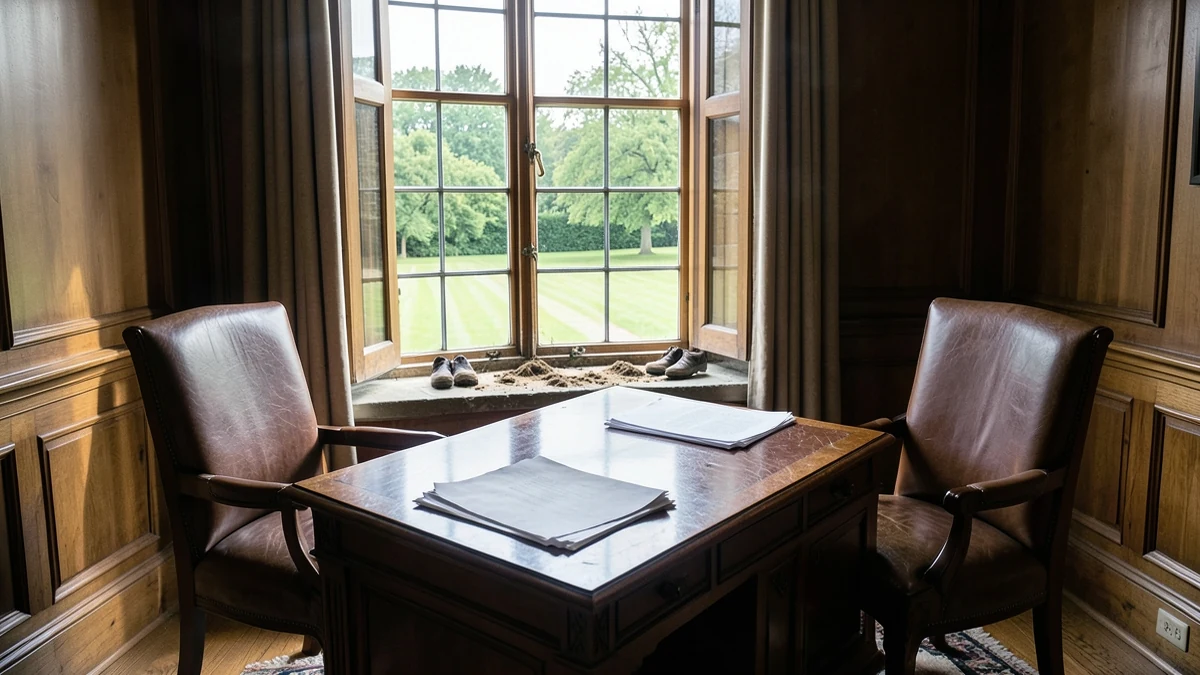
Edition and rights: Original English text from Project Gutenberg ebook #108, identified there as public domain in the USA. The literary text below is reproduced without AI rewriting.
Browse more detective stories.
THE ADVENTURE OF THE THREE STUDENTS


      It was in the year ’95 that a combination of events, into which I
      need not enter, caused Mr. Sherlock Holmes and myself to spend
      some weeks in one of our great university towns, and it was
      during this time that the small but instructive adventure which I
      am about to relate befell us. It will be obvious that any details
      which would help the reader exactly to identify the college or
      the criminal would be injudicious and offensive. So painful a
      scandal may well be allowed to die out. With due discretion the
      incident itself may, however, be described, since it serves to
      illustrate some of those qualities for which my friend was
      remarkable. I will endeavour, in my statement, to avoid such
      terms as would serve to limit the events to any particular place,
      or give a clue as to the people concerned.

      We were residing at the time in furnished lodgings close to a
      library where Sherlock Holmes was pursuing some laborious
      researches in early English charters—researches which led to
      results so striking that they may be the subject of one of my
      future narratives. Here it was that one evening we received a
      visit from an acquaintance, Mr. Hilton Soames, tutor and lecturer
      at the College of St. Luke’s. Mr. Soames was a tall, spare man,
      of a nervous and excitable temperament. I had always known him to
      be restless in his manner, but on this particular occasion he was
      in such a state of uncontrollable agitation that it was clear
      something very unusual had occurred.

      “I trust, Mr. Holmes, that you can spare me a few hours of your
      valuable time. We have had a very painful incident at St. Luke’s,
      and really, but for the happy chance of your being in town, I
      should have been at a loss what to do.”

      “I am very busy just now, and I desire no distractions,” my
      friend answered. “I should much prefer that you called in the aid
      of the police.”

      “No, no, my dear sir; such a course is utterly impossible. When
      once the law is evoked it cannot be stayed again, and this is
      just one of those cases where, for the credit of the college, it
      is most essential to avoid scandal. Your discretion is as
      well-known as your powers, and you are the one man in the world
      who can help me. I beg you, Mr. Holmes, to do what you can.”

      My friend’s temper had not improved since he had been deprived of
      the congenial surroundings of Baker Street. Without his
      scrapbooks, his chemicals, and his homely untidiness, he was an
      uncomfortable man. He shrugged his shoulders in ungracious
      acquiescence, while our visitor in hurried words and with much
      excitable gesticulation poured forth his story.

      “I must explain to you, Mr. Holmes, that to-morrow is the first
      day of the examination for the Fortescue Scholarship. I am one of
      the examiners. My subject is Greek, and the first of the papers
      consists of a large passage of Greek translation which the
      candidate has not seen. This passage is printed on the
      examination paper, and it would naturally be an immense advantage
      if the candidate could prepare it in advance. For this reason,
      great care is taken to keep the paper secret.

      “To-day, about three o’clock, the proofs of this paper arrived
      from the printers. The exercise consists of half a chapter of
      Thucydides. I had to read it over carefully, as the text must be
      absolutely correct. At four-thirty my task was not yet completed.
      I had, however, promised to take tea in a friend’s rooms, so I
      left the proof upon my desk. I was absent rather more than an
      hour.

      “You are aware, Mr. Holmes, that our college doors are double—a
      green baize one within and a heavy oak one without. As I
      approached my outer door, I was amazed to see a key in it. For an
      instant I imagined that I had left my own there, but on feeling
      in my pocket I found that it was all right. The only duplicate
      which existed, so far as I knew, was that which belonged to my
      servant, Bannister—a man who has looked after my room for ten
      years, and whose honesty is absolutely above suspicion. I found
      that the key was indeed his, that he had entered my room to know
      if I wanted tea, and that he had very carelessly left the key in
      the door when he came out. His visit to my room must have been
      within a very few minutes of my leaving it. His forgetfulness
      about the key would have mattered little upon any other occasion,
      but on this one day it has produced the most deplorable
      consequences.

      “The moment I looked at my table, I was aware that someone had
      rummaged among my papers. The proof was in three long slips. I
      had left them all together. Now, I found that one of them was
      lying on the floor, one was on the side table near the window,
      and the third was where I had left it.”

      Holmes stirred for the first time.

      “The first page on the floor, the second in the window, the third
      where you left it,” said he.

      “Exactly, Mr. Holmes. You amaze me. How could you possibly know
      that?”

      “Pray continue your very interesting statement.”

      “For an instant I imagined that Bannister had taken the
      unpardonable liberty of examining my papers. He denied it,
      however, with the utmost earnestness, and I am convinced that he
      was speaking the truth. The alternative was that someone passing
      had observed the key in the door, had known that I was out, and
      had entered to look at the papers. A large sum of money is at
      stake, for the scholarship is a very valuable one, and an
      unscrupulous man might very well run a risk in order to gain an
      advantage over his fellows.

      “Bannister was very much upset by the incident. He had nearly
      fainted when we found that the papers had undoubtedly been
      tampered with. I gave him a little brandy and left him collapsed
      in a chair, while I made a most careful examination of the room.
      I soon saw that the intruder had left other traces of his
      presence besides the rumpled papers. On the table in the window
      were several shreds from a pencil which had been sharpened. A
      broken tip of lead was lying there also. Evidently the rascal had
      copied the paper in a great hurry, had broken his pencil, and had
      been compelled to put a fresh point to it.”

      “Excellent!” said Holmes, who was recovering his good-humour as
      his attention became more engrossed by the case. “Fortune has
      been your friend.”

      “This was not all. I have a new writing-table with a fine surface
      of red leather. I am prepared to swear, and so is Bannister, that
      it was smooth and unstained. Now I found a clean cut in it about
      three inches long—not a mere scratch, but a positive cut. Not
      only this, but on the table I found a small ball of black dough
      or clay, with specks of something which looks like sawdust in it.
      I am convinced that these marks were left by the man who rifled
      the papers. There were no footmarks and no other evidence as to
      his identity. I was at my wits’ end, when suddenly the happy
      thought occurred to me that you were in the town, and I came
      straight round to put the matter into your hands. Do help me, Mr.
      Holmes. You see my dilemma. Either I must find the man or else
      the examination must be postponed until fresh papers are
      prepared, and since this cannot be done without explanation,
      there will ensue a hideous scandal, which will throw a cloud not
      only on the college, but on the university. Above all things, I
      desire to settle the matter quietly and discreetly.”

      “I shall be happy to look into it and to give you such advice as
      I can,” said Holmes, rising and putting on his overcoat. “The
      case is not entirely devoid of interest. Had anyone visited you
      in your room after the papers came to you?”

      “Yes, young Daulat Ras, an Indian student, who lives on the same
      stair, came in to ask me some particulars about the examination.”

      “For which he was entered?”

      “Yes.”

      “And the papers were on your table?”

      “To the best of my belief, they were rolled up.”

      “But might be recognized as proofs?”

      “Possibly.”

      “No one else in your room?”

      “No.”

      “Did anyone know that these proofs would be there?”

      “No one save the printer.”

      “Did this man Bannister know?”

      “No, certainly not. No one knew.”

      “Where is Bannister now?”

      “He was very ill, poor fellow. I left him collapsed in the chair.
      I was in such a hurry to come to you.”

      “You left your door open?”

      “I locked up the papers first.”

      “Then it amounts to this, Mr. Soames: that, unless the Indian
      student recognized the roll as being proofs, the man who tampered
      with them came upon them accidentally without knowing that they
      were there.”

      “So it seems to me.”

      Holmes gave an enigmatic smile.

      “Well,” said he, “let us go round. Not one of your cases,
      Watson—mental, not physical. All right; come if you want to. Now,
      Mr. Soames—at your disposal!”

      The sitting-room of our client opened by a long, low, latticed
      window on to the ancient lichen-tinted court of the old college.
      A Gothic arched door led to a worn stone staircase. On the ground
      floor was the tutor’s room. Above were three students, one on
      each story. It was already twilight when we reached the scene of
      our problem. Holmes halted and looked earnestly at the window.
      Then he approached it, and, standing on tiptoe with his neck
      craned, he looked into the room.

      “He must have entered through the door. There is no opening
      except the one pane,” said our learned guide.

      “Dear me!” said Holmes, and he smiled in a singular way as he
      glanced at our companion. “Well, if there is nothing to be
      learned here, we had best go inside.”

      The lecturer unlocked the outer door and ushered us into his
      room. We stood at the entrance while Holmes made an examination
      of the carpet.

      “I am afraid there are no signs here,” said he. “One could hardly
      hope for any upon so dry a day. Your servant seems to have quite
      recovered. You left him in a chair, you say. Which chair?”

      “By the window there.”

      “I see. Near this little table. You can come in now. I have
      finished with the carpet. Let us take the little table first. Of
      course, what has happened is very clear. The man entered and took
      the papers, sheet by sheet, from the central table. He carried
      them over to the window table, because from there he could see if
      you came across the courtyard, and so could effect an escape.”

      “As a matter of fact, he could not,” said Soames, “for I entered
      by the side door.”

      “Ah, that’s good! Well, anyhow, that was in his mind. Let me see
      the three strips. No finger impressions—no! Well, he carried over
      this one first, and he copied it. How long would it take him to
      do that, using every possible contraction? A quarter of an hour,
      not less. Then he tossed it down and seized the next. He was in
      the midst of that when your return caused him to make a very
      hurried retreat—_very_ hurried, since he had not time to replace
      the papers which would tell you that he had been there. You were
      not aware of any hurrying feet on the stair as you entered the
      outer door?”

      “No, I can’t say I was.”

      “Well, he wrote so furiously that he broke his pencil, and had,
      as you observe, to sharpen it again. This is of interest, Watson.
      The pencil was not an ordinary one. It was above the usual size,
      with a soft lead, the outer colour was dark blue, the maker’s
      name was printed in silver lettering, and the piece remaining is
      only about an inch and a half long. Look for such a pencil, Mr.
      Soames, and you have got your man. When I add that he possesses a
      large and very blunt knife, you have an additional aid.”

      Mr. Soames was somewhat overwhelmed by this flood of information.
      “I can follow the other points,” said he, “but really, in this
      matter of the length——”

      Holmes held out a small chip with the letters NN and a space of
      clear wood after them.

      “You see?”

      “No, I fear that even now——”

      “Watson, I have always done you an injustice. There are others.
      What could this NN be? It is at the end of a word. You are aware
      that Johann Faber is the most common maker’s name. Is it not
      clear that there is just as much of the pencil left as usually
      follows the Johann?” He held the small table sideways to the
      electric light. “I was hoping that if the paper on which he wrote
      was thin, some trace of it might come through upon this polished
      surface. No, I see nothing. I don’t think there is anything more
      to be learned here. Now for the central table. This small pellet
      is, I presume, the black, doughy mass you spoke of. Roughly
      pyramidal in shape and hollowed out, I perceive. As you say,
      there appear to be grains of sawdust in it. Dear me, this is very
      interesting. And the cut—a positive tear, I see. It began with a
      thin scratch and ended in a jagged hole. I am much indebted to
      you for directing my attention to this case, Mr. Soames. Where
      does that door lead to?”

      “To my bedroom.”

      “Have you been in it since your adventure?”

      “No, I came straight away for you.”

      “I should like to have a glance round. What a charming,
      old-fashioned room! Perhaps you will kindly wait a minute, until
      I have examined the floor. No, I see nothing. What about this
      curtain? You hang your clothes behind it. If anyone were forced
      to conceal himself in this room he must do it there, since the
      bed is too low and the wardrobe too shallow. No one there, I
      suppose?”

      As Holmes drew the curtain I was aware, from some little rigidity
      and alertness of his attitude, that he was prepared for an
      emergency. As a matter of fact, the drawn curtain disclosed
      nothing but three or four suits of clothes hanging from a line of
      pegs. Holmes turned away, and stooped suddenly to the floor.

      “Halloa! What’s this?” said he.

      It was a small pyramid of black, putty-like stuff, exactly like
      the one upon the table of the study. Holmes held it out on his
      open palm in the glare of the electric light.

      “Your visitor seems to have left traces in your bedroom as well
      as in your sitting-room, Mr. Soames.”

      “What could he have wanted there?”

      “I think it is clear enough. You came back by an unexpected way,
      and so he had no warning until you were at the very door. What
      could he do? He caught up everything which would betray him, and
      he rushed into your bedroom to conceal himself.”

      “Good gracious, Mr. Holmes, do you mean to tell me that, all the
      time I was talking to Bannister in this room, we had the man
      prisoner if we had only known it?”

      “So I read it.”

      “Surely there is another alternative, Mr. Holmes. I don’t know
      whether you observed my bedroom window?”

      “Lattice-paned, lead framework, three separate windows, one
      swinging on hinge, and large enough to admit a man.”

      “Exactly. And it looks out on an angle of the courtyard so as to
      be partly invisible. The man might have effected his entrance
      there, left traces as he passed through the bedroom, and finally,
      finding the door open, have escaped that way.”

      Holmes shook his head impatiently.

      “Let us be practical,” said he. “I understand you to say that
      there are three students who use this stair, and are in the habit
      of passing your door?”

      “Yes, there are.”

      “And they are all in for this examination?”

      “Yes.”

      “Have you any reason to suspect any one of them more than the
      others?”

      Soames hesitated.

      “It is a very delicate question,” said he. “One hardly likes to
      throw suspicion where there are no proofs.”

      “Let us hear the suspicions. I will look after the proofs.”

      “I will tell you, then, in a few words the character of the three
      men who inhabit these rooms. The lower of the three is Gilchrist,
      a fine scholar and athlete, plays in the Rugby team and the
      cricket team for the college, and got his Blue for the hurdles
      and the long jump. He is a fine, manly fellow. His father was the
      notorious Sir Jabez Gilchrist, who ruined himself on the turf. My
      scholar has been left very poor, but he is hard-working and
      industrious. He will do well.

      “The second floor is inhabited by Daulat Ras, the Indian. He is a
      quiet, inscrutable fellow; as most of those Indians are. He is
      well up in his work, though his Greek is his weak subject. He is
      steady and methodical.

      “The top floor belongs to Miles McLaren. He is a brilliant fellow
      when he chooses to work—one of the brightest intellects of the
      university; but he is wayward, dissipated, and unprincipled. He
      was nearly expelled over a card scandal in his first year. He has
      been idling all this term, and he must look forward with dread to
      the examination.”

      “Then it is he whom you suspect?”

      “I dare not go so far as that. But, of the three, he is perhaps
      the least unlikely.”

      “Exactly. Now, Mr. Soames, let us have a look at your servant,
      Bannister.”

      He was a little, white-faced, clean-shaven, grizzly-haired fellow
      of fifty. He was still suffering from this sudden disturbance of
      the quiet routine of his life. His plump face was twitching with
      his nervousness, and his fingers could not keep still.

      “We are investigating this unhappy business, Bannister,” said his
      master.

      “Yes, sir.”

      “I understand,” said Holmes, “that you left your key in the
      door?”

      “Yes, sir.”

      “Was it not very extraordinary that you should do this on the
      very day when there were these papers inside?”

      “It was most unfortunate, sir. But I have occasionally done the
      same thing at other times.”

      “When did you enter the room?”

      “It was about half-past four. That is Mr. Soames’ tea time.”

      “How long did you stay?”

      “When I saw that he was absent, I withdrew at once.”

      “Did you look at these papers on the table?”

      “No, sir—certainly not.”

      “How came you to leave the key in the door?”

      “I had the tea-tray in my hand. I thought I would come back for
      the key. Then I forgot.”

      “Has the outer door a spring lock?”

      “No, sir.”

      “Then it was open all the time?”

      “Yes, sir.”

      “Anyone in the room could get out?”

      “Yes, sir.”

      “When Mr. Soames returned and called for you, you were very much
      disturbed?”

      “Yes, sir. Such a thing has never happened during the many years
      that I have been here. I nearly fainted, sir.”

      “So I understand. Where were you when you began to feel bad?”

      “Where was I, sir? Why, here, near the door.”

      “That is singular, because you sat down in that chair over yonder
      near the corner. Why did you pass these other chairs?”

      “I don’t know, sir, it didn’t matter to me where I sat.”

      “I really don’t think he knew much about it, Mr. Holmes. He was
      looking very bad—quite ghastly.”

      “You stayed here when your master left?”

      “Only for a minute or so. Then I locked the door and went to my
      room.”

      “Whom do you suspect?”

      “Oh, I would not venture to say, sir. I don’t believe there is
      any gentleman in this university who is capable of profiting by
      such an action. No, sir, I’ll not believe it.”

      “Thank you, that will do,” said Holmes. “Oh, one more word. You
      have not mentioned to any of the three gentlemen whom you attend
      that anything is amiss?”

      “No, sir—not a word.”

      “You haven’t seen any of them?”

      “No, sir.”

      “Very good. Now, Mr. Soames, we will take a walk in the
      quadrangle, if you please.”

      Three yellow squares of light shone above us in the gathering
      gloom.

      “Your three birds are all in their nests,” said Holmes, looking
      up. “Halloa! What’s that? One of them seems restless enough.”

      It was the Indian, whose dark silhouette appeared suddenly upon
      his blind. He was pacing swiftly up and down his room.

      “I should like to have a peep at each of them,” said Holmes. “Is
      it possible?”

      “No difficulty in the world,” Soames answered. “This set of rooms
      is quite the oldest in the college, and it is not unusual for
      visitors to go over them. Come along, and I will personally
      conduct you.”

      “No names, please!” said Holmes, as we knocked at Gilchrist’s
      door. A tall, flaxen-haired, slim young fellow opened it, and
      made us welcome when he understood our errand. There were some
      really curious pieces of mediæval domestic architecture within.
      Holmes was so charmed with one of them that he insisted on
      drawing it in his notebook, broke his pencil, had to borrow one
      from our host and finally borrowed a knife to sharpen his own.
      The same curious accident happened to him in the rooms of the
      Indian—a silent, little, hook-nosed fellow, who eyed us askance,
      and was obviously glad when Holmes’s architectural studies had
      come to an end. I could not see that in either case Holmes had
      come upon the clue for which he was searching. Only at the third
      did our visit prove abortive. The outer door would not open to
      our knock, and nothing more substantial than a torrent of bad
      language came from behind it. “I don’t care who you are. You can
      go to blazes!” roared the angry voice. “Tomorrow’s the exam, and
      I won’t be drawn by anyone.”

      “A rude fellow,” said our guide, flushing with anger as we
      withdrew down the stair. “Of course, he did not realize that it
      was I who was knocking, but none the less his conduct was very
      uncourteous, and, indeed, under the circumstances rather
      suspicious.”

      Holmes’s response was a curious one.

      “Can you tell me his exact height?” he asked.

      “Really, Mr. Holmes, I cannot undertake to say. He is taller than
      the Indian, not so tall as Gilchrist. I suppose five foot six
      would be about it.”

      “That is very important,” said Holmes. “And now, Mr. Soames, I
      wish you good-night.”

      Our guide cried aloud in his astonishment and dismay. “Good
      gracious, Mr. Holmes, you are surely not going to leave me in
      this abrupt fashion! You don’t seem to realize the position.
      To-morrow is the examination. I must take some definite action
      to-night. I cannot allow the examination to be held if one of the
      papers has been tampered with. The situation must be faced.”

      “You must leave it as it is. I shall drop round early to-morrow
      morning and chat the matter over. It is possible that I may be in
      a position then to indicate some course of action. Meanwhile, you
      change nothing—nothing at all.”

      “Very good, Mr. Holmes.”

      “You can be perfectly easy in your mind. We shall certainly find
      some way out of your difficulties. I will take the black clay
      with me, also the pencil cuttings. Good-bye.”

      When we were out in the darkness of the quadrangle, we again
      looked up at the windows. The Indian still paced his room. The
      others were invisible.

      “Well, Watson, what do you think of it?” Holmes asked, as we came
      out into the main street. “Quite a little parlour game—sort of
      three-card trick, is it not? There are your three men. It must be
      one of them. You take your choice. Which is yours?”

      “The foul-mouthed fellow at the top. He is the one with the worst
      record. And yet that Indian was a sly fellow also. Why should he
      be pacing his room all the time?”

      “There is nothing in that. Many men do it when they are trying to
      learn anything by heart.”

      “He looked at us in a queer way.”

      “So would you, if a flock of strangers came in on you when you
      were preparing for an examination next day, and every moment was
      of value. No, I see nothing in that. Pencils, too, and knives—all
      was satisfactory. But that fellow _does_ puzzle me.”

      “Who?”

      “Why, Bannister, the servant. What’s his game in the matter?”

      “He impressed me as being a perfectly honest man.”

      “So he did me. That’s the puzzling part. Why should a perfectly
      honest man—well, well, here’s a large stationer’s. We shall begin
      our researches here.”

      There were only four stationers of any consequences in the town,
      and at each Holmes produced his pencil chips, and bid high for a
      duplicate. All were agreed that one could be ordered, but that it
      was not a usual size of pencil and that it was seldom kept in
      stock. My friend did not appear to be depressed by his failure,
      but shrugged his shoulders in half-humorous resignation.

      “No good, my dear Watson. This, the best and only final clue, has
      run to nothing. But, indeed, I have little doubt that we can
      build up a sufficient case without it. By Jove! my dear fellow,
      it is nearly nine, and the landlady babbled of green peas at
      seven-thirty. What with your eternal tobacco, Watson, and your
      irregularity at meals, I expect that you will get notice to quit,
      and that I shall share your downfall—not, however, before we have
      solved the problem of the nervous tutor, the careless servant,
      and the three enterprising students.”

      Holmes made no further allusion to the matter that day, though he
      sat lost in thought for a long time after our belated dinner. At
      eight in the morning, he came into my room just as I finished my
      toilet.

      “Well, Watson,” said he, “it is time we went down to St. Luke’s.
      Can you do without breakfast?”

      “Certainly.”

      “Soames will be in a dreadful fidget until we are able to tell
      him something positive.”

      “Have you anything positive to tell him?”

      “I think so.”

      “You have formed a conclusion?”

      “Yes, my dear Watson, I have solved the mystery.”

      “But what fresh evidence could you have got?”

      “Aha! It is not for nothing that I have turned myself out of bed
      at the untimely hour of six. I have put in two hours’ hard work
      and covered at least five miles, with something to show for it.
      Look at that!”

      He held out his hand. On the palm were three little pyramids of
      black, doughy clay.

      “Why, Holmes, you had only two yesterday.”

      “And one more this morning. It is a fair argument that wherever
      No. 3 came from is also the source of Nos. 1 and 2. Eh, Watson?
      Well, come along and put friend Soames out of his pain.”

      The unfortunate tutor was certainly in a state of pitiable
      agitation when we found him in his chambers. In a few hours the
      examination would commence, and he was still in the dilemma
      between making the facts public and allowing the culprit to
      compete for the valuable scholarship. He could hardly stand still
      so great was his mental agitation, and he ran towards Holmes with
      two eager hands outstretched.

      “Thank heaven that you have come! I feared that you had given it
      up in despair. What am I to do? Shall the examination proceed?”

      “Yes, let it proceed, by all means.”

      “But this rascal--?”

      “He shall not compete.”

      “You know him?”

      “I think so. If this matter is not to become public, we must give
      ourselves certain powers and resolve ourselves into a small
      private court-martial. You there, if you please, Soames! Watson,
      you here! I’ll take the armchair in the middle. I think that we
      are now sufficiently imposing to strike terror into a guilty
      breast. Kindly ring the bell!”

      Bannister entered, and shrank back in evident surprise and fear
      at our judicial appearance.

      “You will kindly close the door,” said Holmes. “Now, Bannister,
      will you please tell us the truth about yesterday’s incident?”

      The man turned white to the roots of his hair.

      “I have told you everything, sir.”

      “Nothing to add?”

      “Nothing at all, sir.”

      “Well, then, I must make some suggestions to you. When you sat
      down on that chair yesterday, did you do so in order to conceal
      some object which would have shown who had been in the room?”

      Bannister’s face was ghastly.

      “No, sir, certainly not.”

      “It is only a suggestion,” said Holmes, suavely. “I frankly admit
      that I am unable to prove it. But it seems probable enough, since
      the moment that Mr. Soames’s back was turned, you released the
      man who was hiding in that bedroom.”

      Bannister licked his dry lips.

      “There was no man, sir.”

      “Ah, that’s a pity, Bannister. Up to now you may have spoken the
      truth, but now I know that you have lied.”

      The man’s face set in sullen defiance.

      “There was no man, sir.”

      “Come, come, Bannister!”

      “No, sir, there was no one.”

      “In that case, you can give us no further information. Would you
      please remain in the room? Stand over there near the bedroom
      door. Now, Soames, I am going to ask you to have the great
      kindness to go up to the room of young Gilchrist, and to ask him
      to step down into yours.”

      An instant later the tutor returned, bringing with him the
      student. He was a fine figure of a man, tall, lithe, and agile,
      with a springy step and a pleasant, open face. His troubled blue
      eyes glanced at each of us, and finally rested with an expression
      of blank dismay upon Bannister in the farther corner.

      “Just close the door,” said Holmes. “Now, Mr. Gilchrist, we are
      all quite alone here, and no one need ever know one word of what
      passes between us. We can be perfectly frank with each other. We
      want to know, Mr. Gilchrist, how you, an honourable man, ever
      came to commit such an action as that of yesterday?”

      The unfortunate young man staggered back, and cast a look full of
      horror and reproach at Bannister.

      “No, no, Mr. Gilchrist, sir, I never said a word—never one word!”
      cried the servant.

      “No, but you have now,” said Holmes. “Now, sir, you must see that
      after Bannister’s words your position is hopeless, and that your
      only chance lies in a frank confession.”

      For a moment Gilchrist, with upraised hand, tried to control his
      writhing features. The next he had thrown himself on his knees
      beside the table, and burying his face in his hands, he had burst
      into a storm of passionate sobbing.

      “Come, come,” said Holmes, kindly, “it is human to err, and at
      least no one can accuse you of being a callous criminal. Perhaps
      it would be easier for you if I were to tell Mr. Soames what
      occurred, and you can check me where I am wrong. Shall I do so?
      Well, well, don’t trouble to answer. Listen, and see that I do
      you no injustice.

      “From the moment, Mr. Soames, that you said to me that no one,
      not even Bannister, could have told that the papers were in your
      room, the case began to take a definite shape in my mind. The
      printer one could, of course, dismiss. He could examine the
      papers in his own office. The Indian I also thought nothing of.
      If the proofs were in a roll, he could not possibly know what
      they were. On the other hand, it seemed an unthinkable
      coincidence that a man should dare to enter the room, and that by
      chance on that very day the papers were on the table. I dismissed
      that. The man who entered knew that the papers were there. How
      did he know?

      “When I approached your room, I examined the window. You amused
      me by supposing that I was contemplating the possibility of
      someone having in broad daylight, under the eyes of all these
      opposite rooms, forced himself through it. Such an idea was
      absurd. I was measuring how tall a man would need to be in order
      to see, as he passed, what papers were on the central table. I am
      six feet high, and I could do it with an effort. No one less than
      that would have a chance. Already you see I had reason to think
      that, if one of your three students was a man of unusual height,
      he was the most worth watching of the three.

      “I entered, and I took you into my confidence as to the
      suggestions of the side table. Of the centre table I could make
      nothing, until in your description of Gilchrist you mentioned
      that he was a long-distance jumper. Then the whole thing came to
      me in an instant, and I only needed certain corroborative proofs,
      which I speedily obtained.

      “What happened was this. This young fellow had employed his
      afternoon at the athletic grounds, where he had been practising
      the jump. He returned carrying his jumping-shoes, which are
      provided, as you are aware, with several sharp spikes. As he
      passed your window he saw, by means of his great height, these
      proofs upon your table, and conjectured what they were. No harm
      would have been done had it not been that, as he passed your
      door, he perceived the key which had been left by the
      carelessness of your servant. A sudden impulse came over him to
      enter, and see if they were indeed the proofs. It was not a
      dangerous exploit for he could always pretend that he had simply
      looked in to ask a question.

      “Well, when he saw that they were indeed the proofs, it was then
      that he yielded to temptation. He put his shoes on the table.
      What was it you put on that chair near the window?”

      “Gloves,” said the young man.

      Holmes looked triumphantly at Bannister. “He put his gloves on
      the chair, and he took the proofs, sheet by sheet, to copy them.
      He thought the tutor must return by the main gate and that he
      would see him. As we know, he came back by the side gate.
      Suddenly he heard him at the very door. There was no possible
      escape. He forgot his gloves but he caught up his shoes and
      darted into the bedroom. You observe that the scratch on that
      table is slight at one side, but deepens in the direction of the
      bedroom door. That in itself is enough to show us that the shoe
      had been drawn in that direction, and that the culprit had taken
      refuge there. The earth round the spike had been left on the
      table, and a second sample was loosened and fell in the bedroom.
      I may add that I walked out to the athletic grounds this morning,
      saw that tenacious black clay is used in the jumping-pit and
      carried away a specimen of it, together with some of the fine tan
      or sawdust which is strewn over it to prevent the athlete from
      slipping. Have I told the truth, Mr. Gilchrist?”

      The student had drawn himself erect.

      “Yes, sir, it is true,” said he.

      “Good heavens! have you nothing to add?” cried Soames.

      “Yes, sir, I have, but the shock of this disgraceful exposure has
      bewildered me. I have a letter here, Mr. Soames, which I wrote to
      you early this morning in the middle of a restless night. It was
      before I knew that my sin had found me out. Here it is, sir. You
      will see that I have said, ‘I have determined not to go in for
      the examination. I have been offered a commission in the
      Rhodesian Police, and I am going out to South Africa at once.’”

      “I am indeed pleased to hear that you did not intend to profit by
      your unfair advantage,” said Soames. “But why did you change your
      purpose?”

      Gilchrist pointed to Bannister.

      “There is the man who set me in the right path,” said he.

      “Come now, Bannister,” said Holmes. “It will be clear to you,
      from what I have said, that only you could have let this young
      man out, since you were left in the room, and must have locked
      the door when you went out. As to his escaping by that window, it
      was incredible. Can you not clear up the last point in this
      mystery, and tell us the reasons for your action?”

      “It was simple enough, sir, if you only had known, but, with all
      your cleverness, it was impossible that you could know. Time was,
      sir, when I was butler to old Sir Jabez Gilchrist, this young
      gentleman’s father. When he was ruined I came to the college as
      servant, but I never forgot my old employer because he was down
      in the world. I watched his son all I could for the sake of the
      old days. Well, sir, when I came into this room yesterday, when
      the alarm was given, the very first thing I saw was Mr.
      Gilchrist’s tan gloves a-lying in that chair. I knew those gloves
      well, and I understood their message. If Mr. Soames saw them, the
      game was up. I flopped down into that chair, and nothing would
      budge me until Mr. Soames went for you. Then out came my poor
      young master, whom I had dandled on my knee, and confessed it all
      to me. Wasn’t it natural, sir, that I should save him, and wasn’t
      it natural also that I should try to speak to him as his dead
      father would have done, and make him understand that he could not
      profit by such a deed? Could you blame me, sir?”

      “No, indeed,” said Holmes, heartily, springing to his feet.
      “Well, Soames, I think we have cleared your little problem up,
      and our breakfast awaits us at home. Come, Watson! As to you,
      sir, I trust that a bright future awaits you in Rhodesia. For
      once you have fallen low. Let us see, in the future, how high you
      can rise.”
1 / 1


