
How Nuth Would Have Practised His Art Upon the Gnoles
Read How Nuth Would Have Practised His Art Upon the Gnoles by Lord Dunsany in the original English.
By Lord Dunsany
Edition: Complete story in the original English, from Project Gutenberg #7477. No translation or AI rewriting of the literary text. Original spelling retained.
This eBook is for the use of anyone anywhere in the United States and most other parts of the world at no cost and with almost no restrictions whatsoever. You may copy it, give it away or re-use it under the terms of the Project Gutenberg License included with this eBook or online at www.gutenberg.org. If you are not located in the United States, you will have to check the laws of the country where you are located before using this eBook.
Despite the advertisements of rival firms, it is probable that every tradesman knows that nobody in business at the present time has a position equal to that of Mr. Nuth. To those outside the magic circle of business, his name is scarcely known; he does not need to advertise, he is consummate. He is superior even to modern competition, and, whatever claims they boast, his rivals know it. His terms are moderate, so much cash down when the goods are delivered, so much in blackmail afterwards. He consults your convenience. His skill may be counted upon; I have seen a shadow on a windy night move more noisily than Nuth, for Nuth is a burglar by trade. Men have been known to stay in country houses and to send a dealer afterwards to bargain for a piece of tapestry that they saw there–some article of furniture, some picture. This is bad taste: but those whose culture is more elegant invariably send Nuth a night or two after their visit. He has a way with tapestry; you would scarcely notice that the edges had been cut. And often when I see some huge, new house full of old furniture and portraits from other ages, I say to myself, “These mouldering chairs, these full-length ancestors and carved mahogany are the produce of the incomparable Nuth.”
It may be urged against my use of the word incomparable that in the burglary business the name of Slith stands paramount and alone; and of this I am not ignorant; but Slith is a classic, and lived long ago, and knew nothing at all of modern competition; besides which the surprising nature of his doom has possibly cast a glamour upon Slith that exaggerates in our eyes his undoubted merits.
It must not be thought that I am a friend of Nuth’s; on the contrary such politics as I have are on the side of Property; and he needs no words from me, for his position is almost unique in trade, being among the very few that do not need to advertise.
At the time that my story begins Nuth lived in a roomy house in Belgrave Square: in his inimitable way he had made friends with the caretaker. The place suited Nuth, and, whenever anyone came to inspect it before purchase, the caretaker used to praise the house in the words that Nuth had suggested. “If it wasn’t for the drains,” she would say, “it’s the finest house in London,” and when they pounced on this remark and asked questions about the drains, she would answer them that the drains also were good, but not so good as the house. They did not see Nuth when they went over the rooms, but Nuth was there.
Here in a neat black dress on one spring morning came an old woman whose bonnet was lined with red, asking for Mr. Nuth; and with her came her large and awkward son. Mrs. Eggins, the caretaker, glanced up the street, and then she let them in, and left them to wait in the drawing-room amongst furniture all mysterious with sheets. For a long while they waited, and then there was a smell of pipe-tobacco, and there was Nuth standing quite close to them.
“Lord,” said the old woman whose bonnet was lined with red, “you did make me start.” And then she saw by his eyes that that was not the way to speak to Mr. Nuth.
And at last Nuth spoke, and very nervously the old woman explained that her son was a likely lad, and had been in business already but wanted to better himself, and she wanted Mr. Nuth to teach him a livelihood.
First of all Nuth wanted to see a business reference, and when he was shown one from a jeweller with whom he happened to be hand-in-glove the upshot of it was that he agreed to take young Tonker (for this was the surname of the likely lad) and to make him his apprentice. And the old woman whose bonnet was lined with red went back to her little cottage in the country, and every evening said to her old man, “Tonker, we must fasten the shutters of a night-time, for Tommy’s a burglar now.”
The details of the likely lad’s apprenticeship I do not propose to give; for those that are in the business know those details already, and those that are in other businesses care only for their own, while men of leisure who have no trade at all would fail to appreciate the gradual degrees by which Tommy Tonker came first to cross bare boards, covered with little obstacles in the dark, without making any sound, and then to go silently up creaky stairs, and then to open doors, and lastly to climb.
Let it suffice that the business prospered greatly, while glowing reports of Tommy Tonker’s progress were sent from time to time to the old woman whose bonnet was lined with red in the labourious handwriting of Nuth. Nuth had given up lessons in writing very early, for he seemed to have some prejudice against forgery, and therefore considered writing a waste of time. And then there came the transaction with Lord Castlenorman at his Surrey residence. Nuth selected a Saturday night, for it chanced that Saturday was observed as Sabbath in the family of Lord Castlenorman, and by eleven o’clock the whole house was quiet. Five minutes before midnight Tommy Tonker, instructed by Mr. Nuth, who waited outside, came away with one pocketful of rings and shirt-studs. It was quite a light pocketful, but the jewellers in Paris could not match it without sending specially to Africa, so that Lord Castlenorman had to borrow bone shirt-studs.
Not even rumour whispered the name of Nuth. Were I to say that this turned his head, there are those to whom the assertion would give pain, for his associates hold that his astute judgment was unaffected by circumstance. I will say, therefore, that it spurred his genius to plan what no burglar had ever planned before. It was nothing less than to burgle the house of the gnoles. And this that abstemious man unfolded to Tonker over a cup of tea. Had Tonker not been nearly insane with pride over their recent transaction, and had he not been blinded by a veneration for Nuth, he would have–but I cry over spilt milk. He expostulated respectfully; he said he would rather not go; he said it was not fair; he allowed himself to argue; and in the end, one windy October morning with a menace in the air found him and Nuth drawing near to the dreadful wood.
Nuth, by weighing little emeralds against pieces of common rock, had ascertained the probable weight of those house-ornaments that the gnoles are believed to possess in the narrow, lofty house wherein they have dwelt from of old. They decided to steal two emeralds and to carry them between them on a cloak; but if they should be too heavy one must be dropped at once. Nuth warned young Tonker against greed, and explained that the emeralds were worth less than cheese until they were safe away from the dreadful wood.
Everything had been planned, and they walked now in silence.
No track led up to the sinister gloom of the trees, either of men or cattle; not even a poacher had been there snaring elves for over a hundred years. You did not trespass twice in the dells of the gnoles. And, apart from the things that were done there, the trees themselves were a warning, and did not wear the wholesome look of those that we plant ourselves.
The nearest village was some miles away with the backs of all its houses turned to the wood, and without one window at all facing in that direction. They did not speak of it there, and elsewhere it is unheard of.
Into this wood stepped Nuth and Tommy Tonker. They had no firearms. Tonker had asked for a pistol, but Nuth replied that the sound of a shot “would bring everything down on us,” and no more was said about it.
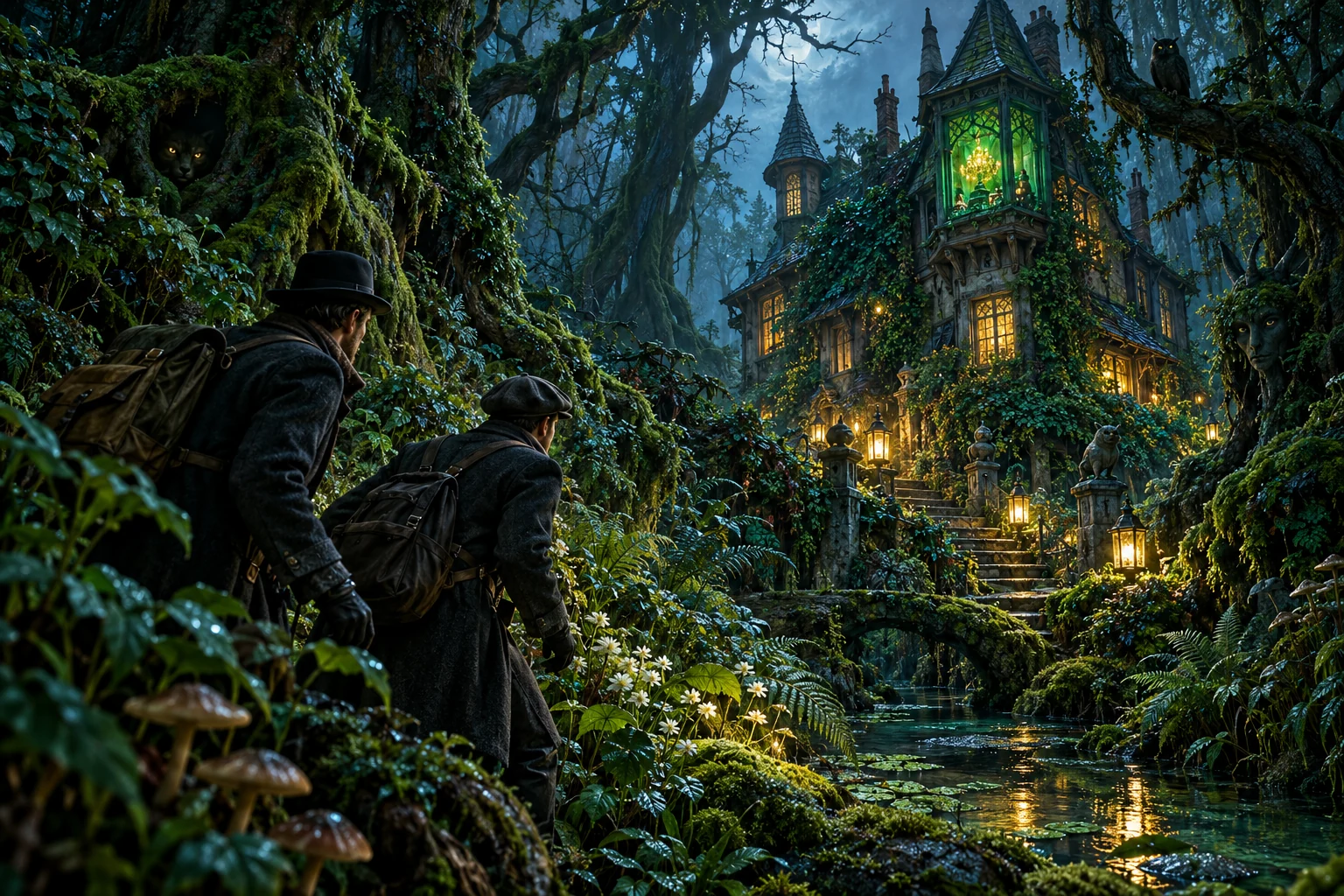
Into the wood they went all day, deeper and deeper. They saw the skeleton of some early Georgian poacher nailed to a door in an oak tree; sometimes they saw a fairy scuttle away from them; once Tonker stepped heavily on a hard, dry stick, after which they both lay still for twenty minutes. And the sunset flared full of omens through the tree trunks, and night fell, and they came by fitful starlight, as Nuth had foreseen, to that lean, high house where the gnoles so secretly dwelt.
All was so silent by that unvalued house that the faded courage of Tonker flickered up, but to Nuth’s experienced sense it seemed too silent; and all the while there was that look in the sky that was worse than a spoken doom, so that Nuth, as is often the case when men are in doubt, had leisure to fear the worst. Nevertheless he did not abandon the business, but sent the likely lad with the instruments of his trade by means of the ladder to the old green casement. And the moment that Tonker touched the withered boards, the silence that, though ominous, was earthly, became unearthly like the touch of a ghoul. And Tonker heard his breath offending against that silence, and his heart was like mad drums in a night attack, and a string of one of his sandals went tap on a rung of a ladder, and the leaves of the forest were mute, and the breeze of the night was still; and Tonker prayed that a mouse or a mole might make any noise at all, but not a creature stirred, even Nuth was still. And then and there, while yet he was undiscovered, the likely lad made up his mind, as he should have done long before, to leave those colossal emeralds where they were and have nothing further to do with the lean, high house of the gnoles, but to quit this sinister wood in the nick of time and retire from business at once and buy a place in the country. Then he descended softly and beckoned to Nuth. But the gnoles had watched him through knavish holes that they bore in trunks of the trees, and the unearthly silence gave way, as it were with a grace, to the rapid screams of Tonker as they picked him up from behind–screams that came faster and faster until they were incoherent. And where they took him it is not good to ask, and what they did with him I shall not say.
Nuth looked on for a while from the corner of the house with a mild surprise on his face as he rubbed his chin, for the trick of the holes in the trees was new to him; then he stole nimbly away through the dreadful wood.
“And did they catch Nuth?” you ask me, gentle reader.
“Oh, no, my child” (for such a question is childish). “Nobody ever catches Nuth.”
Source and edition terms: https://www.gutenberg.org/ebooks/7477 · Project Gutenberg License. Original-language text; original publisher illustrations are not reproduced.
Source acknowledgements and license
START: FULL LICENSE
THE FULL PROJECT GUTENBERG™ LICENSE
PLEASE READ THIS BEFORE YOU DISTRIBUTE OR USE THIS WORK
To protect the Project Gutenberg™ mission of promoting the free distribution of electronic works, by using or distributing this work (or any other work associated in any way with the phrase “Project Gutenberg”), you agree to comply with all the terms of the Full Project Gutenberg License available with this file or online at www.gutenberg.org/license.
Section 1. General Terms of Use and Redistributing Project Gutenberg electronic works
1.A. By reading or using any part of this Project Gutenberg electronic work, you indicate that you have read, understand, agree to and accept all the terms of this license and intellectual property (trademark/copyright) agreement. If you do not agree to abide by all the terms of this agreement, you must cease using and return or destroy all copies of Project Gutenberg electronic works in your possession. If you paid a fee for obtaining a copy of or access to a Project Gutenberg electronic work and you do not agree to be bound by the terms of this agreement, you may obtain a refund from the person or entity to whom you paid the fee as set forth in paragraph 1.E.8.
1.B. “Project Gutenberg” is a registered trademark. It may only be used on or associated in any way with an electronic work by people who agree to be bound by the terms of this agreement. There are a few things that you can do with most Project Gutenberg electronic works even without complying with the full terms of this agreement. See paragraph 1.C below. There are a lot of things you can do with Project Gutenberg electronic works if you follow the terms of this agreement and help preserve free future access to Project Gutenberg electronic works. See paragraph 1.E below.
1.C. The Project Gutenberg Literary Archive Foundation (“the Foundation” or PGLAF), owns a compilation copyright in the collection of Project Gutenberg electronic works. Nearly all the individual works in the collection are in the public domain in the United States. If an individual work is unprotected by copyright law in the United States and you are located in the United States, we do not claim a right to prevent you from copying, distributing, performing, displaying or creating derivative works based on the work as long as all references to Project Gutenberg are removed. Of course, we hope that you will support the Project Gutenberg mission of promoting free access to electronic works by freely sharing Project Gutenberg works in compliance with the terms of this agreement for keeping the Project Gutenberg name associated with the work. You can easily comply with the terms of this agreement by keeping this work in the same format with its attached full Project Gutenberg License when you share it without charge with others.
1.D. The copyright laws of the place where you are located also govern what you can do with this work. Copyright laws in most countries are in a constant state of change. If you are outside the United States, check the laws of your country in addition to the terms of this agreement before downloading, copying, displaying, performing, distributing or creating derivative works based on this work or any other Project Gutenberg work. The Foundation makes no representations concerning the copyright status of any work in any country other than the United States.
1.E. Unless you have removed all references to Project Gutenberg:
1.E.1. The following sentence, with active links to, or other immediate access to, the full Project Gutenberg License must appear prominently whenever any copy of a Project Gutenberg work (any work on which the phrase “Project Gutenberg” appears, or with which the phrase “Project Gutenberg” is associated) is accessed, displayed, performed, viewed, copied or distributed:
This eBook is for the use of anyone anywhere in the United States and most
other parts of the world at no cost and with almost no restrictions
whatsoever. You may copy it, give it away or re-use it under the terms
of the Project Gutenberg™ License included with this eBook or online
at www.gutenberg.org. If you
are not located in the United States, you will have to check the laws
of the country where you are located before using this eBook.
1.E.2. If an individual Project Gutenberg electronic work is derived from texts not protected by U.S. copyright law (does not contain a notice indicating that it is posted with permission of the copyright holder), the work can be copied and distributed to anyone in the United States without paying any fees or charges. If you are redistributing or providing access to a work with the phrase “Project Gutenberg” associated with or appearing on the work, you must comply either with the requirements of paragraphs 1.E.1 through 1.E.7 or obtain permission for the use of the work and the Project Gutenberg trademark as set forth in paragraphs 1.E.8 or 1.E.9.
1.E.3. If an individual Project Gutenberg electronic work is posted with the permission of the copyright holder, your use and distribution must comply with both paragraphs 1.E.1 through 1.E.7 and any additional terms imposed by the copyright holder. Additional terms will be linked to the Project Gutenberg License for all works posted with the permission of the copyright holder found at the beginning of this work.
1.E.4. Do not unlink or detach or remove the full Project Gutenberg License terms from this work, or any files containing a part of this work or any other work associated with Project Gutenberg.
1.E.5. Do not copy, display, perform, distribute or redistribute this electronic work, or any part of this electronic work, without prominently displaying the sentence set forth in paragraph 1.E.1 with active links or immediate access to the full terms of the Project Gutenberg License.
1.E.6. You may convert to and distribute this work in any binary, compressed, marked up, nonproprietary or proprietary form, including any word processing or hypertext form. However, if you provide access to or distribute copies of a Project Gutenberg work in a format other than “Plain Vanilla ASCII” or other format used in the official version posted on the official Project Gutenberg website (www.gutenberg.org), you must, at no additional cost, fee or expense to the user, provide a copy, a means of exporting a copy, or a means of obtaining a copy upon request, of the work in its original “Plain Vanilla ASCII” or other form. Any alternate format must include the full Project Gutenberg License as specified in paragraph 1.E.1.
1.E.7. Do not charge a fee for access to, viewing, displaying, performing, copying or distributing any Project Gutenberg works unless you comply with paragraph 1.E.8 or 1.E.9.
1.E.8. You may charge a reasonable fee for copies of or providing access to or distributing Project Gutenberg electronic works provided that:
• You pay a royalty fee of 20% of the gross profits you derive from
    the use of Project Gutenberg works calculated using the method
    you already use to calculate your applicable taxes. The fee is owed
    to the owner of the Project Gutenberg trademark, but he has
    agreed to donate royalties under this paragraph to the Project
    Gutenberg Literary Archive Foundation. Royalty payments must be paid
    within 60 days following each date on which you prepare (or are
    legally required to prepare) your periodic tax returns. Royalty
    payments should be clearly marked as such and sent to the Project
    Gutenberg Literary Archive Foundation at the address specified in
    Section 4, “Information about donations to the Project Gutenberg
    Literary Archive Foundation.”

• You provide a full refund of any money paid by a user who notifies
    you in writing (or by e-mail) within 30 days of receipt that s/he
    does not agree to the terms of the full Project Gutenberg™
    License. You must require such a user to return or destroy all
    copies of the works possessed in a physical medium and discontinue
    all use of and all access to other copies of Project Gutenberg™
    works.

• You provide, in accordance with paragraph 1.F.3, a full refund of
    any money paid for a work or a replacement copy, if a defect in the
    electronic work is discovered and reported to you within 90 days of
    receipt of the work.

• You comply with all other terms of this agreement for free
    distribution of Project Gutenberg™ works.
1.E.9. If you wish to charge a fee or distribute a Project Gutenberg™ electronic work or group of works on different terms than are set forth in this agreement, you must obtain permission in writing from the Project Gutenberg Literary Archive Foundation, the manager of the Project Gutenberg™ trademark. Contact the Foundation as set forth in Section 3 below.
1.F.
1.F.1. Project Gutenberg volunteers and employees expend considerable effort to identify, do copyright research on, transcribe and proofread works not protected by U.S. copyright law in creating the Project Gutenberg™ collection. Despite these efforts, Project Gutenberg™ electronic works, and the medium on which they may be stored, may contain “Defects,” such as, but not limited to, incomplete, inaccurate or corrupt data, transcription errors, a copyright or other intellectual property infringement, a defective or damaged disk or other medium, a computer virus, or computer codes that damage or cannot be read by your equipment.
1.F.2. LIMITED WARRANTY, DISCLAIMER OF DAMAGES - Except for the “Right of Replacement or Refund” described in paragraph 1.F.3, the Project Gutenberg Literary Archive Foundation, the owner of the Project Gutenberg™ trademark, and any other party distributing a Project Gutenberg™ electronic work under this agreement, disclaim all liability to you for damages, costs and expenses, including legal fees. YOU AGREE THAT YOU HAVE NO REMEDIES FOR NEGLIGENCE, STRICT LIABILITY, BREACH OF WARRANTY OR BREACH OF CONTRACT EXCEPT THOSE PROVIDED IN PARAGRAPH 1.F.3. YOU AGREE THAT THE FOUNDATION, THE TRADEMARK OWNER, AND ANY DISTRIBUTOR UNDER THIS AGREEMENT WILL NOT BE LIABLE TO YOU FOR ACTUAL, DIRECT, INDIRECT, CONSEQUENTIAL, PUNITIVE OR INCIDENTAL DAMAGES EVEN IF YOU GIVE NOTICE OF THE POSSIBILITY OF SUCH DAMAGE.
1.F.3. LIMITED RIGHT OF REPLACEMENT OR REFUND - If you discover a defect in this electronic work within 90 days of receiving it, you can receive a refund of the money (if any) you paid for it by sending a written explanation to the person you received the work from. If you received the work on a physical medium, you must return the medium with your written explanation. The person or entity that provided you with the defective work may elect to provide a replacement copy in lieu of a refund. If you received the work electronically, the person or entity providing it to you may choose to give you a second opportunity to receive the work electronically in lieu of a refund. If the second copy is also defective, you may demand a refund in writing without further opportunities to fix the problem.
1.F.4. Except for the limited right of replacement or refund set forth in paragraph 1.F.3, this work is provided to you ‘AS-IS’, WITH NO OTHER WARRANTIES OF ANY KIND, EXPRESS OR IMPLIED, INCLUDING BUT NOT LIMITED TO WARRANTIES OF MERCHANTABILITY OR FITNESS FOR ANY PURPOSE.
1.F.5. Some states do not allow disclaimers of certain implied warranties or the exclusion or limitation of certain types of damages. If any disclaimer or limitation set forth in this agreement violates the law of the state applicable to this agreement, the agreement shall be interpreted to make the maximum disclaimer or limitation permitted by the applicable state law. The invalidity or unenforceability of any provision of this agreement shall not void the remaining provisions.
1.F.6. INDEMNITY - You agree to indemnify and hold the Foundation, the trademark owner, any agent or employee of the Foundation, anyone providing copies of Project Gutenberg™ electronic works in accordance with this agreement, and any volunteers associated with the production, promotion and distribution of Project Gutenberg™ electronic works, harmless from all liability, costs and expenses, including legal fees, that arise directly or indirectly from any of the following which you do or cause to occur: (a) distribution of this or any Project Gutenberg work, (b) alteration, modification, or additions or deletions to any Project Gutenberg work, and (c) any Defect you cause.
Section 2. Information about the Mission of Project Gutenberg
Project Gutenberg is synonymous with the free distribution of electronic works in formats readable by the widest variety of computers including obsolete, old, middle-aged and new computers. It exists because of the efforts of hundreds of volunteers and donations from people in all walks of life.
Volunteers and financial support to provide volunteers with the assistance they need are critical to reaching Project Gutenberg’s goals and ensuring that the Project Gutenberg collection will remain freely available for generations to come. In 2001, the Project Gutenberg Literary Archive Foundation was created to provide a secure and permanent future for Project Gutenberg and future generations. To learn more about the Project Gutenberg Literary Archive Foundation and how your efforts and donations can help, see Sections 3 and 4 and the Foundation information page at www.gutenberg.org.
Section 3. Information about the Project Gutenberg Literary Archive Foundation
The Project Gutenberg Literary Archive Foundation is a non-profit 501(c)(3) educational corporation organized under the laws of the state of Mississippi and granted tax exempt status by the Internal Revenue Service. The Foundation’s EIN or federal tax identification number is 64-6221541. Contributions to the Project Gutenberg Literary Archive Foundation are tax deductible to the full extent permitted by U.S. federal laws and your state’s laws.
The Foundation’s business office is located at 41 Watchung Plaza #516, Montclair NJ 07042, USA, +1 (862) 621-9288. Email contact links and up to date contact information can be found at the Foundation’s website and official page at www.gutenberg.org/contact
Section 4. Information about Donations to the Project Gutenberg Literary Archive Foundation
Project Gutenberg™ depends upon and cannot survive without widespread public support and donations to carry out its mission of increasing the number of public domain and licensed works that can be freely distributed in machine-readable form accessible by the widest array of equipment including outdated equipment. Many small donations ($1 to $5,000) are particularly important to maintaining tax exempt status with the IRS.
The Foundation is committed to complying with the laws regulating charities and charitable donations in all 50 states of the United States. Compliance requirements are not uniform and it takes a considerable effort, much paperwork and many fees to meet and keep up with these requirements. We do not solicit donations in locations where we have not received written confirmation of compliance. To SEND DONATIONS or determine the status of compliance for any particular state visit www.gutenberg.org/donate.
While we cannot and do not solicit contributions from states where we have not met the solicitation requirements, we know of no prohibition against accepting unsolicited donations from donors in such states who approach us with offers to donate.
International donations are gratefully accepted, but we cannot make any statements concerning tax treatment of donations received from outside the United States. U.S. laws alone swamp our small staff.
Please check the Project Gutenberg web pages for current donation methods and addresses. Donations are accepted in a number of other ways including checks, online payments and credit card donations. To donate, please visit: www.gutenberg.org/donate.
Section 5. General Information About Project Gutenberg electronic works
Professor Michael S. Hart was the originator of the Project Gutenberg concept of a library of electronic works that could be freely shared with anyone. For forty years, he produced and distributed Project Gutenberg eBooks with only a loose network of volunteer support.
Project Gutenberg eBooks are often created from several printed editions, all of which are confirmed as not protected by copyright in the U.S. unless a copyright notice is included. Thus, we do not necessarily keep eBooks in compliance with any particular paper edition.
Most people start at our website which has the main PG search facility: www.gutenberg.org.
This website includes information about Project Gutenberg, including how to make donations to the Project Gutenberg Literary Archive Foundation, how to help produce our new eBooks, and how to subscribe to our email newsletter to hear about new eBooks.


