
SPINDLE, SHUTTLE, AND NEEDLE
Read SPINDLE, SHUTTLE, AND NEEDLE, a public-domain fantasy story in the original English.
By Various; edited by Andrew Lang
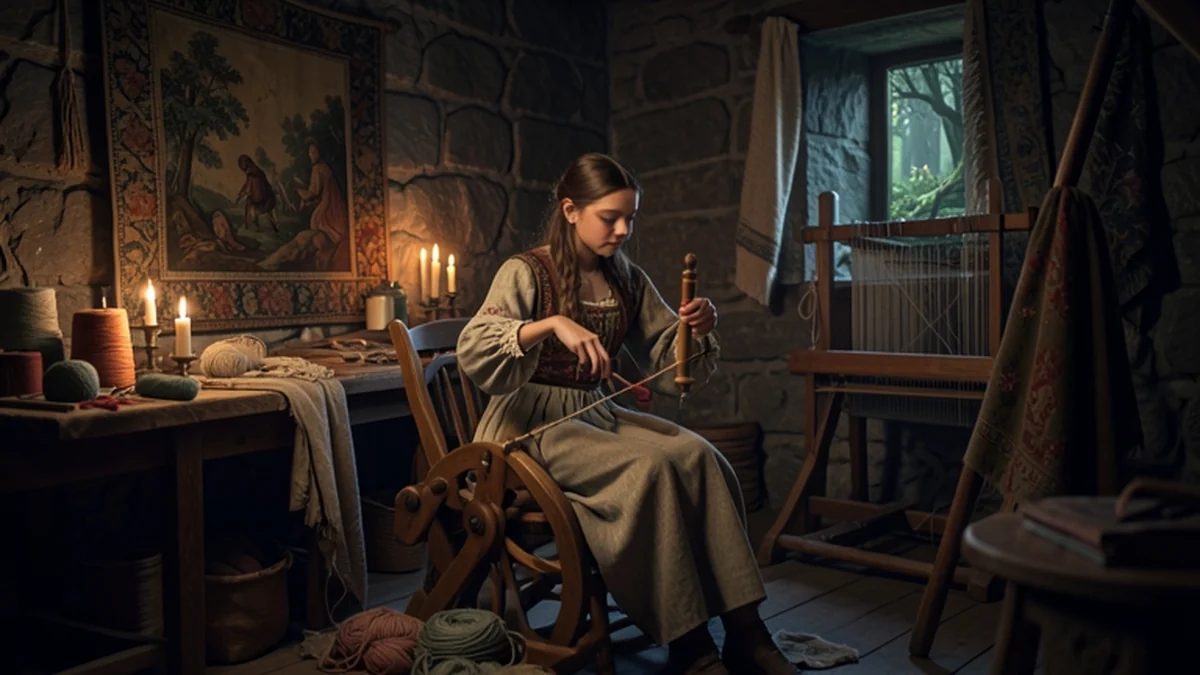
Edition and rights: Original English text from Project Gutenberg ebook #7277, marked public domain in the USA. The literary text below is reproduced without AI rewriting.
Once upon a time there lived a girl who lost her father and mother when
she was quite a tiny child. Her godmother lived all alone in a little
cottage at the far end of the village, and there she earned her living by
spinning, weaving, and sewing. The old woman took the little orphan home
with her and brought her up in good, pious, industrious habits.

When the girl was fifteen years old, her godmother fell ill, and, calling
the child to her bedside, she said: ‘My dear daughter, I feel that my end
is near. I leave you my cottage, which will, at least, shelter you, and
also my spindle, my weaver’s shuttle, and my needle, with which to earn
your bread.’

Then she laid her hands on the girl’s head, blessed her, and added: ‘Mind
and be good, and then all will go well with you.’ With that she closed her
eyes for the last time, and when she was carried to her grave the girl
walked behind her coffin weeping bitterly, and paid her all the last
honours.

After this the girl lived all alone in the little cottage. She worked
hard, spinning, weaving, and sewing, and her old godmother’s blessing
seemed to prosper all she did. The flax seemed to spread and increase; and
when she wove a carpet or a piece of linen, or made a shirt, she was sure
to find a customer who paid her well, so that not only did she feel no
want herself, but she was able to help those who did.

Now, it happened that about this time the King’s son was making a tour
through the entire country to look out for a bride. He could not marry a
poor woman, and he did not wish for a rich one.

‘She shall be my wife,’ said he, ‘who is at once the poorest and the
richest.’

When he reached the village where the girl lived, he inquired who was the
richest and who the poorest woman in it. The richest was named first; the
poorest, he was told, was a young girl who lived alone in a little cottage
at the far end of the village.

The rich girl sat at her door dressed out in all her best clothes, and
when the King’s son came near she got up, went to meet him, and made him a
low curtsey. He looked well at her, said nothing, but rode on further.

When he reached the poor girl’s house he did not find her at her door, for
she was at work in her room. The Prince reined in his horse, looked in at
the window through which the sun was shining brightly, and saw the girl
sitting at her wheel busily spinning away.

She looked up, and when she saw the King’s son gazing in at her, she
blushed red all over, cast down her eyes and span on. Whether the thread
was quite as even as usual I really cannot say, but she went on spinning
till the King’s son had ridden off. Then she stepped to the window and
opened the lattice, saying, ‘The room is so hot,’ but she looked after him
as long as she could see the white plumes in his hat.

Then she sat down to her work once more and span on, and as she did so an
old saying which, she had often heard her godmother repeat whilst at work,
came into her head, and she began to sing:

‘Spindle, spindle, go and see, If my love will come to me.’

Lo, and behold! the spindle leapt from her hand and rushed out of the
room, and when she had sufficiently recovered from her surprise to look
after it she saw it dancing merrily through the fields, dragging a long
golden thread after it, and soon it was lost to sight.

The girl, having lost her spindle, took up the shuttle and, seating
herself at her loom, began to weave. Meantime the spindle danced on and
on, and just as it had come to the end of the golden thread, it reached
the King’s son.

‘What do I see?’ he cried; ‘this spindle seems to wish to point out the
way to me.’ So he turned his horses head and rode back beside the golden
thread.

Meantime the girl sat weaving, and sang:

‘Shuttle, weave both web and woof, Bring my love beneath my roof.’

The shuttle instantly escaped from her hand, and with one bound was out at
the door. On the threshold it began weaving the loveliest carpet that was
ever seen. Roses and lilies bloomed on both sides, and in the centre a
thicket seemed to grow with rabbits and hares running through it, stags
and fawns peeping through the branches, whilst on the topmost boughs sat
birds of brilliant plumage and so life-like one almost expected to hear
them sing. The shuttle flew from side to side and the carpet seemed almost
to grow of itself.

As the shuttle had run away the girl sat down to sew. She took her needle
and sang:

‘Needle, needle, stitch away, Make my chamber bright and gay,’

and the needle promptly slipped from her fingers and flew about the room
like lightning. You would have thought invisible spirits were at work, for
in next to no time the table and benches were covered with green cloth,
the chairs with velvet, and elegant silk curtains hung before the windows.
The needle had barely put in its last stitch when the girl, glancing at
the window, spied the white plumed hat of the King’s son who was being led
back by the spindle with the golden thread.

He dismounted and walked over the carpet into the house, and when he
entered the room there stood the girl blushing like any rose. ‘You are the
poorest and yet the richest,’ said he: ‘come with me, you shall be my
bride.’

She said nothing, but she held out her hand. Then he kissed her, and led
her out, lifted her on his horse and took her to his royal palace, where
the wedding was celebrated with great rejoicings.

The spindle, the shuttle, and the needle were carefully placed in the
treasury, and were always held in the very highest honour.

Grimm.
1 / 1


