
TALE OF A TORTOISE AND OF A MISCHIEVOUS MONKEY
Read TALE OF A TORTOISE AND OF A MISCHIEVOUS MONKEY, a public-domain fantasy story in the original English.
By Various; edited by Andrew Lang
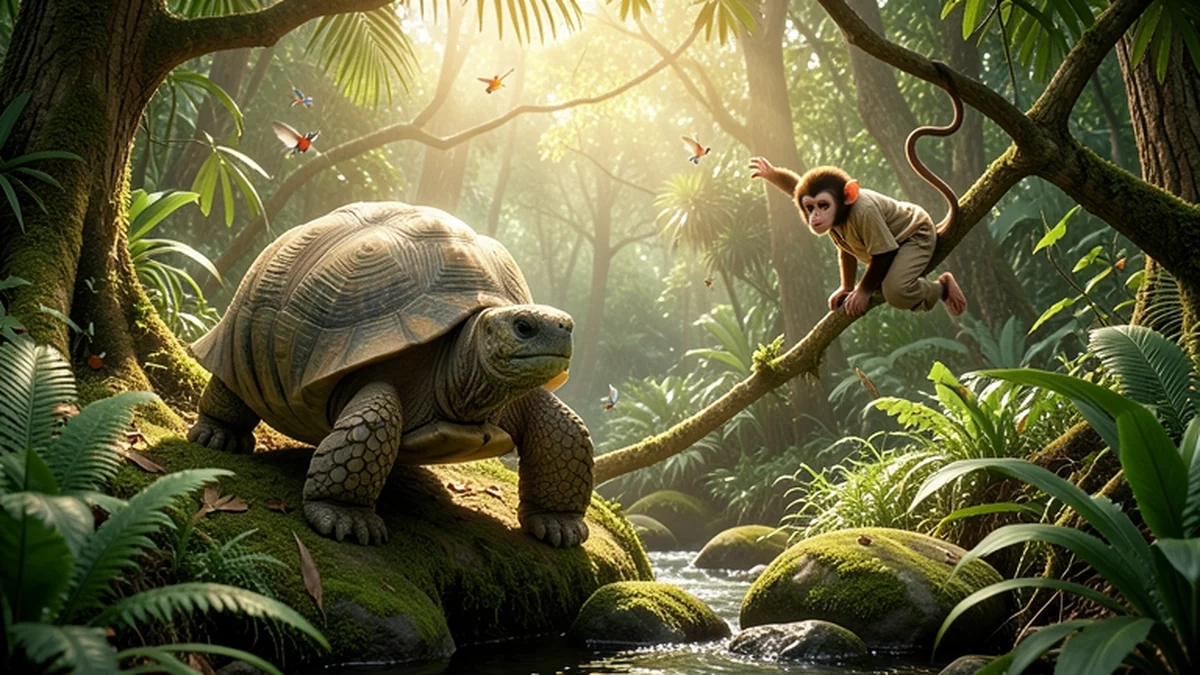
Edition and rights: Original English text from Project Gutenberg ebook #31201, marked public domain in the USA. The literary text below is reproduced without AI rewriting.
Once upon a time there was a country where the rivers
were larger, and the forests deeper, than anywhere else.
Hardly any men came there, and the wild creatures had
it all to themselves, and used to play all sorts of strange
games with each other. The great trees, chained one to
the other by thick flowering plants with bright scarlet or
yellow blossoms, were famous hiding-places for the monkeys,
who could wait unseen, till a puma or an elephant
passed by, and then jump on their backs and go for a
ride, swinging themselves up by the creepers when they
had had enough. Near the rivers huge tortoises were
to be found, and though to our eyes a tortoise seems a
dull, slow thing, it is wonderful to think how clever they
were, and how often they outwitted many of their livelier
friends.

There was one tortoise in particular that always managed
to get the better of everybody, and many were the
tales told in the forest of his great deeds. They began
when he was quite young, and tired of staying at home
with his father and mother. He left them one day, and
walked off in search of adventures. In a wide open
space surrounded by trees he met with an elephant, who
was having his supper before taking his evening bath in
the river which ran close by. ‘Let us see which of us
two is strongest,’ said the young tortoise, marching up to
the elephant. ‘Very well,’ replied the elephant, much
[Pg 328]
amused at the impertinence of the little creature; ‘when
would you like the trial to be?’

‘In an hour’s time; I have some business to do first,’
answered the tortoise. And he hastened away as fast as
his short legs would carry him.

In a pool of the river a whale was resting, blowing
water into the air and making a lovely fountain. The
tortoise, however, was too young and too busy to admire
such things, and he called to the whale to stop, as he wanted
to speak to him. ‘Would you like to try which of us is
the stronger?’ said he. The whale looked at him, sent
up another fountain, and answered: ‘Oh, yes; certainly.
When do you wish to begin? I am quite ready.’

‘Then give me one of your longest bones, and I will
fasten it to my leg. When I give the signal, you must
pull, and we will see which can pull the hardest.’

‘Very good,’ replied the whale; and he took out one of
his bones and passed it to the tortoise.

The tortoise picked up the end of the bone in his
mouth and went back to the elephant. ‘I will fasten this
to your leg,’ said he, ‘in the same way as it is fastened to
mine, and we must both pull as hard as we can. We
shall soon see which is the stronger.’ So he wound it
carefully round the elephant’s leg, and tied it in a firm
knot. ‘Now!’ cried he, plunging into a thick bush
behind him.

The whale tugged at one end, and the elephant tugged
at the other, and neither had any idea that he had not
the tortoise for his foe. When the whale pulled hardest
the elephant was dragged into the water; and when the
elephant pulled the hardest the whale was hauled on to
the land. They were very evenly matched, and the battle
was a hard one.

At last they were quite tired, and the tortoise, who was
watching, saw that they could play no more. So he
crept from his hiding-place, and dipping himself in the
river, he went to the elephant and said: ‘I see that you
[Pg 329]
really are stronger than I thought. Suppose we give it
up for to-day?’ Then he dried himself on some moss and
went to the whale and said: ‘I see that you really are
stronger than I thought. Suppose we give it up for to-day?’

The two adversaries were only too glad to be allowed
to rest, and believed to the end of their days that, after all,
the tortoise was stronger than either of them.

A day or two later the young tortoise was taking a
stroll, when he met a fox, and stopped to speak to him.
‘Let us try,’ said he in a careless manner, ‘which of us
can lie buried in the ground during seven years.’

‘I shall be delighted,’ answered the fox, ‘only I would
rather that you began.’

‘It is all the same to me,’ replied the tortoise; ‘if you
come round this way to-morrow you will see that I have
fulfilled my part of the bargain.’

So he looked about for a suitable place, and found a
convenient hole at the foot of an orange tree. He crept
into it, and the next morning the fox heaped up the earth
round him, and promised to feed him every day with fresh
fruit. The fox so far kept his word that each morning
when the sun rose he appeared to ask how the tortoise
was getting on. ‘Oh, very well; but I wish you would
give me some fruit,’ replied he.

‘Alas! the fruit is not ripe enough yet for you to eat,’
answered the fox, who hoped that the tortoise would die
of hunger long before the seven years were over.

‘Oh dear, oh dear! I am so hungry!’ cried the tortoise.

‘I am sure you must be; but it will be all right to-morrow,’
said the fox, trotting off, not knowing that the
oranges dropped down the hollow trunk, straight into
the tortoise’s hole, and that he had as many as he could
possibly eat.

So the seven years went by; and when the tortoise
came out of his hole he was as fat as ever.

Now it was the fox’s turn, and he chose his hole, and
[Pg 330]
the tortoise heaped the earth round, promising to return
every day or two with a nice young bird for his dinner.
‘Well, how are you getting on?’ he would ask cheerfully
when he paid his visits.

‘Oh, all right; only I wish you had brought a bird with
you,’ answered the fox.

‘I have been so unlucky, I have never been able to
catch one,’ replied the tortoise. ‘However, I shall be
more fortunate to-morrow, I am sure.’

But not many to-morrows after, when the tortoise
arrived with his usual question: ‘Well, how are you
getting on?’ he received no answer, for the fox was lying
in his hole quite still, dead of hunger.

By this time the tortoise was grown up, and was
looked up to throughout the forest as a person to be
feared for his strength and wisdom. But he was not
considered a very swift runner, until an adventure with a
deer added to his fame.

One day, when he was basking in the sun, a stag
passed by, and stopped for a little conversation. ‘Would
you care to see which of us can run fastest?’ asked
the tortoise, after some talk. The stag thought the question
so silly that he only shrugged his shoulders. ‘Of
course, the victor would have the right to kill the other,’
went on the tortoise. ‘Oh, on that condition I agree,’
answered the deer; ‘but I am afraid you are a dead man.’

‘It is no use trying to frighten me,’ replied the tortoise.
‘But I should like three days for training; then I
shall be ready to start when the sun strikes on the big
tree at the edge of the great clearing.’

The first thing the tortoise did was to call his brothers
and his cousins together, and he posted them carefully
under ferns all along the line of the great clearing, making
a sort of ladder which stretched for many miles.
This done to his satisfaction, he went back to the starting
place.

The stag was quite punctual, and as soon as the sun’s
[Pg 331]
rays struck the trunk of the tree the stag started off, and
was soon far out of the sight of the tortoise. Every now
and then he would turn his head as he ran, and call out:
‘How are you getting on?’ and the tortoise who happened
to be nearest at that moment would answer:
‘All right, I am close up to you.’

Full of astonishment, the stag would redouble his
efforts, but it was no use. Each time he asked: ‘Are you
there?’ the answer would come: ‘Yes, of course, where
else should I be?’ And the stag ran, and ran, and ran,
till he could run no more, and dropped down dead on the
grass.

And the tortoise, when he thinks about it, laughs still.

But the tortoise was not the only creature of whose
tricks stories were told in the forest. There was a famous
monkey who was just as clever and more mischievous,
because he was so much quicker on his feet and with his
hands. It was quite impossible to catch him and give
him the thrashing he so often deserved, for he just swung
himself up into a tree and laughed at the angry victim
who was sitting below. Sometimes, however, the inhabitants
of the forest were so foolish as to provoke him, and
then they got the worst of it. This was what happened
to the barber, whom the monkey visited one morning,
saying that he wished to be shaved. The barber bowed
politely to his customer, and begging him to be seated, tied
a large cloth round his neck, and rubbed his chin with soap;
but instead of cutting off his beard, the barber made a
snip at the end of his tail. It was only a very little bit,
and the monkey started up more in rage than in pain.
‘Give me back the end of my tail,’ he roared, ‘or I will
take one of your razors.’ The barber refused to give back
the missing piece, so the monkey caught up a razor from
the table and ran away with it, and no one in the forest
could be shaved for days, as there was not another to be
got for miles and miles.

[Pg 332]
As he was making his way to his own particular
palm-tree, where the cocoa-nuts grew, which were so
useful for pelting passers-by, he met a woman who was
scaling a fish with a bit of wood, for in this side of the
forest a few people lived in huts near the river.

‘That must be hard work,’ said the monkey, stopping
to look; ‘try my knife—you will get on quicker.’ And he
handed her the razor as he spoke. A few days later he
came back and rapped at the door of the hut. ‘I have
called for my razor,’ he said, when the woman appeared.

‘I have lost it,’ answered she.

‘If you don’t give it to me at once I will take your
sardine,’ replied the monkey, who did not believe her.
The woman protested she had not got the knife, so he
took the sardine and ran off.

A little further along he saw a baker who was standing
at the door, eating one of his loaves. ‘That must be
rather dry,’ said the monkey, ‘try my fish’; and the man
did not need twice telling. A few days later the monkey
stopped again at the baker’s hut. ‘I’ve called for that
fish,’ he said.

‘That fish? But I have eaten it!’ exclaimed the
baker in dismay.

‘If you have eaten it I shall take this barrel of meal in
exchange,’ replied the monkey; and he walked off with
the barrel under his arm.

As he went he saw a woman with a group of little
girls round her, teaching them how to dress hair. ‘Here
is something to make cakes for the children,’ he said,
putting down his barrel, which by this time he found
rather heavy. The children were delighted, and ran
directly to find some flat stones to bake their cakes on,
and when they had made and eaten them, they thought
they had never tasted anything so nice. Indeed, when
they saw the monkey approaching not long after, they
rushed to meet him, hoping that he was bringing them
some more presents. But he took no notice of their
[Pg 333]
questions, he only said to their mother: ‘I’ve called for
my barrel of meal.’

‘Why, you gave it to me to make cakes of!’ cried the
mother.

‘If I can’t get my barrel of meal, I shall take one of
your children,’ answered the monkey. ‘I am in want of
somebody who can bake me bread when I am tired of
fruit, and who knows how to make cocoa-nut cakes.’

‘Oh, leave me my child, and I will find you another
barrel of meal,’ wept the mother.

‘I don’t want another barrel, I want that one,’
answered the monkey sternly. And as the woman stood
wringing her hands, he caught up the little girl that he
thought the prettiest and took her to his home in the
palm tree.

She never went back to the hut, but on the whole she
was not much to be pitied, for monkeys are nearly as
good as children to play with, and they taught her how
to swing, and to climb, and to fly from tree to tree, and
everything else they knew, which was a great deal.

Now the monkey’s tiresome tricks had made him
many enemies in the forest, but no one hated him so
much as the puma. The cause of their quarrel was known
only to themselves, but everybody was aware of the fact,
and took care to be out of the way when there was any
chance of these two meeting. Often and often the puma
had laid traps for the monkey, which he felt sure his foe
could not escape; and the monkey would pretend that he
saw nothing, and rejoice the hidden puma’s heart by
seeming to walk straight into the snare, when, lo! a loud
laugh would be heard, and the monkey’s grinning face
would peer out of a mass of creepers and disappear before
his foe could reach him.

This state of things had gone on for quite a long
while, when at last there came a season such as the
oldest parrot in the forest could never remember. Instead
of two or three hundred inches of rain falling, which they
[Pg 334]
were all accustomed to, month after month passed without
a cloud, and the rivers and springs dried up, till
there was only one small pool left for everyone to drink
from. There was not an animal for miles round that did
not grieve over this shocking condition of affairs, not one
at least except the puma. His only thought for years
had been how to get the monkey into his power, and
this time he imagined his chance had really arrived. He
would hide himself in a thicket, and when the monkey
came down to drink—and come he must—the puma
would spring out and seize him. Yes, on this occasion
there could be no escape!

And no more there would have been if the puma had
had greater patience; but in his excitement he moved
a little too soon. The monkey, who was stooping to
drink, heard a rustling, and turning caught the gleam of
two yellow, murderous eyes. With a mighty spring he
grasped a creeper which was hanging above him, and
landed himself on the branch of a tree; feeling the breath
of the puma on his feet as the animal bounded from his
cover. Never had the monkey been so near death, and it
was some time before he recovered enough courage to
venture on the ground again.

Up there in the shelter of the trees, he began to turn
over in his head plans for escaping the snares of the
puma. And at length chance helped him. Peeping
down to the earth, he saw a man coming along the path
carrying on his head a large gourd filled with honey.

He waited till the man was just underneath the tree,
then he hung from a bough, and caught the gourd
while the man looked up wondering, for he was no tree-climber.
Then the monkey rubbed the honey all over him,
and a quantity of leaves from a creeper that was hanging
close by; he stuck them all close together into the honey,
so that he looked like a walking bush. This finished, he
ran to the pool to see the result, and, quite pleased with
himself, set out in search of adventures.

[Pg 335]
Soon the report went through the forest that a new
animal had appeared from no one knew where, and that
when somebody had asked his name, the strange creature
had answered that it was Jack-in-the-Green. Thanks to
this, the monkey was allowed to drink at the pool as often
as he liked, for neither beast nor bird had the faintest
notion who he was. And if they made any inquiries the
only answer they got was that the water of which he had
drunk deeply had turned his hair into leaves, so that
they all knew what would happen in case they became
too greedy.

By-and-by the great rains began again. The rivers
and streams filled up, and there was no need for him to
go back to the pool, near the home of his enemy, the
puma, as there was a large number of places for him to
choose from. So one night, when everything was still and
silent, and even the chattering parrots were asleep on one
leg, the monkey stole down softly from his perch, and
washed off the honey and the leaves, and came out from
his bath in his own proper skin. On his way to breakfast
he met a rabbit, and stopped for a little talk.

‘I am feeling rather dull,’ he remarked; ‘I think it
would do me good to hunt a while. What do you say?’

‘Oh, I am quite willing,’ answered the rabbit, proud
of being spoken to by such a large creature. ‘But the
question is, what shall we hunt?’

‘There is no credit in going after an elephant or a
tiger,’ replied the monkey stroking his chin, ‘they are so
big they could not possibly get out of your way. It
shows much more skill to be able to catch a small thing
that can hide itself in a moment behind a leaf. I’ll tell
you what! Suppose I hunt butterflies, and you, serpents.’

The rabbit, who was young and without experience,
was delighted with this idea, and they both set out on
their various ways.

The monkey quietly climbed up the nearest tree, and
ate fruit most of the day, but the rabbit tired himself to
[Pg 336]
death poking his nose into every heap of dried leaves he
saw, hoping to find a serpent among them. Luckily for
himself the serpents were all away for the afternoon, at
a meeting of their own, for there is nothing a serpent likes
so well for dinner as a nice plump rabbit. But, as it was,
the dried leaves were all empty, and the rabbit at last fell
asleep where he was. Then the monkey, who had been
watching him, fell down and pulled his ears, to the rage
of the rabbit, who vowed vengeance.

It was not easy to catch the monkey off his guard,
and the rabbit waited long before an opportunity arrived.
But one day Jack-in-the-Green was sitting on a stone,
wondering what he should do next, when the rabbit
crept softly behind him, and gave his tail a sharp pull.
The monkey gave a shriek of pain, and darted up into a
tree, but when he saw that it was only the rabbit who had
dared to insult him so, he chattered so fast in his anger,
and looked so fierce, that the rabbit fled into the nearest
hole, and stayed there for several days, trembling with
fright.

Soon after this adventure the monkey went away into
another part of the country, right on the outskirts of the
forest, where there was a beautiful garden full of oranges
hanging ripe from the trees. This garden was a favourite
place for birds of all kinds, each hoping to secure an
orange for dinner, and in order to frighten the birds
away and keep a little fruit for himself, the master had
fastened a waxen figure on one of the boughs.

Now the monkey was as fond of oranges as any of the
birds, and when he saw a man standing in the tree where
the largest and sweetest oranges grew, he spoke to him at
once. ‘You man,’ he said rudely, ‘throw me down that
big orange up there, or I will throw a stone at you.’ The
wax figure took no notice of this request, so the monkey,
who was easily made angry, picked up a stone, and flung
it with all his force. But instead of falling to the ground
again, the stone stuck to the soft wax.

[Pg 337]
At this moment a breeze shook the tree, and the
orange on which the monkey had set his heart dropped
from the bough. He picked it up and ate it every bit,
including the rind, and it was so good he thought he
should like another. So he called again to the wax
figure to throw him an orange, and as the figure did not
move, he hurled another stone, which stuck to the wax as
the first had done. Seeing that the man was quite
indifferent to stones, the monkey grew more angry still,
and climbing the tree hastily, gave the figure a violent
kick. But like the two stones his leg remained stuck to
the wax, and he was held fast. ‘Let me go at once, or I
will give you another kick,’ he cried, suiting the action to
the word, and this time also his foot remained in the
grasp of the man. Not knowing what he did, the monkey
hit out, first with one hand and then with the other, and
when he found that he was literally bound hand and foot,
he became so mad with anger and terror that in his
struggles he fell to the ground, dragging the figure after
him. This freed his hands and feet, but besides the shock
of the fall, they had tumbled into a bed of thorns, and he
limped away broken and bruised, and groaning loudly;
for when monkeys are hurt, they take pains that everybody
shall know it.

It was a long time before Jack was well enough to go
about again; but when he did, he had an encounter with
his old enemy the puma. And this was how it came
about.

One day the puma invited his friend the stag to go
with him and see a comrade, who was famous for the
good milk he got from his cows. The stag loved milk,
and gladly accepted the invitation, and when the sun
began to get a little low the two started on their walk.
On the way they arrived on the banks of a river, and as
there were no bridges in those days it was necessary to
swim across it. The stag was not fond of swimming, and
began to say that he was tired, and thought that after all
[Pg 338]
it was not worth going so far to get milk, and that he
would return home. But the puma easily saw through
these excuses, and laughed at him.

‘The river is not deep at all,’ he said; ‘why, you will
never be off your feet. Come, pluck up your courage and
follow me.’

The stag was afraid of the river; still, he was much
more afraid of being laughed at, and he plunged in after
the puma; but in an instant the current had swept him
away, and if it had not borne him by accident to a shallow
place on the opposite side, where he managed to scramble
up the bank, he would certainly have been drowned. As
it was, he scrambled out, shaking with terror, and found
the puma waiting for him. ‘You had a narrow escape
that time,’ said the puma.

After resting for a few minutes, to let the stag recover
from his fright, they went on their way till they came to
a grove of bananas.

‘They look very good,’ observed the puma with a
longing glance, ‘and I am sure you must be hungry,
friend stag? Suppose you were to climb the tree and get
some. You shall eat the green ones, they are the best
and sweetest; and you can throw the yellow ones down
to me. I dare say they will do quite well!’ The stag
did as he was bid, though, not being used to climbing, it
gave him a deal of trouble and sore knees, and, besides,
his horns were continually getting entangled in the
creepers. What was worse, when once he had tasted the
bananas, he found them not at all to his liking, so he threw
them all down, green and yellow alike, and let the puma
take his choice. And what a dinner he made! When
he had quite done, they set forth once more.

The path lay through a field of maize, where several
men were working. As they came up to them, the puma
whispered: ‘Go on in front, friend stag, and just say
“Bad luck to all workers!”’ The stag obeyed, but the
men were hot and tired, and did not think this a good
[Pg 339]
joke. So they set their dogs at him, and he was obliged
to run away as fast as he could.

‘I hope your industry will be rewarded as it deserves,’
said the puma as he passed along; and the men were
pleased, and offered him some of their maize to eat.

By-and-by the puma saw a small snake with a
beautiful shining skin, lying coiled up at the foot of a
tree. ‘What a lovely bracelet that would make for your
daughter, friend stag!’ said he. The stag stooped and
picked up the snake, which bit him, and he turned angrily
to the puma. ‘Why did you not tell me it would bite?’
he asked.

‘Is it my fault if you are an idiot?’ replied the puma.

At last they reached their journey’s end, but by this
time it was late, and the puma’s comrade was ready for
bed, so they slung their hammocks in convenient places,
and went to sleep. But in the middle of the night the
puma rose softly and stole out of the door to the sheep-fold,
where he killed and ate the fattest sheep he could
find, and taking a bowl full of its blood, he sprinkled the
sleeping stag with it. This done, he returned to bed.

In the morning the shepherd went as usual to let the
sheep out of the fold, and found one of them missing. He
thought directly of the puma, and ran to accuse him of
having eaten the sheep. ‘I, my good man? What has
put it into your head to think of such a thing? Have I
got any blood about me? If anyone has eaten a sheep it
must be my friend the stag.’ Then the shepherd went to
examine the sleeping stag, and of course he saw the blood.
‘Ah! I will teach you how to steal!’ cried he, and he
hit the stag such a blow on his skull that he died in a
moment. The noise awakened the comrade above, and he
came downstairs. The puma greeted him with joy, and
begged he might have some of the famous milk as soon as
possible, for he was very thirsty. A large bucket was set
before the puma directly. He drank it to the last drop,
and then took leave.

[Pg 340]
On his way home he met the monkey. ‘Are you
fond of milk?’ asked he. ‘I know a place where you get
it very nice. I will show you it if you like.’ The monkey
knew that the puma was not so good-natured for nothing,
but he felt quite able to take care of himself, so he
said he should have much pleasure in accompanying his
friend.

They soon reached the same river, and, as before, the
puma remarked: ‘Friend monkey, you will find it very
shallow; there is no cause for fear. Jump in, and I will
follow.’

‘Do you think you have the stag to deal with?’ asked
the monkey, laughing. ‘I should prefer to follow; if
not I shall go no further.’ The puma understood
that it was useless trying to make the monkey do as he
wished, so he chose a shallow place and began to swim
across. The monkey waited till the puma had got to the
middle, then he gave a great spring and jumped on
his back, knowing quite well that the puma would be
afraid to shake him off, lest he should be swept away
into deep water. So in this manner they reached the
bank.

The banana grove was not far distant, and here the
puma thought he would pay the monkey out for forcing
him to carry him over the river. ‘Friend monkey, look
what fine bananas,’ cried he. ‘You are fond of climbing;
suppose you run up and throw me down a few. You can
eat the green ones, which are the nicest, and I will be
content with the yellow.’

‘Very well,’ answered the monkey, swinging himself
up; but he ate all the yellow ones himself, and only
threw down the green ones that were left. The puma was
furious and cried out: ‘I will punch your head for that.’
But the monkey only answered: ‘If you are going to
talk such nonsense I won’t walk with you.’ And the
puma was silent.

In a few minutes more they arrived at the field where
[Pg 341]
the men were reaping the maize, and the puma remarked
as he had done before: ‘Friend monkey, if you wish to
please these men, just say as you go by: “Bad luck to all
workers.”’

‘Very well,’ replied the monkey; but, instead, he
nodded and smiled, and said: ‘I hope your industry may
be rewarded as it deserves.’ The men thanked him
heartily, let him pass on, and the puma followed behind
him.

Further along the path they saw the shining snake
lying on the moss. ‘What a lovely necklace for your
daughter,’ exclaimed the puma. ‘Pick it up and take it
with you.’

‘You are very kind, but I will leave it for you,’
answered the monkey, and nothing more was said about
the snake.

Not long after this they reached the comrade’s house,
and found him just ready to go to bed. So, without stopping
to talk, the guests slung their hammocks, the monkey
taking care to place his so high that no one could get
at him. Besides, he thought it would be more prudent
not to fall asleep, so he only lay still and snored loudly.
When it was quite dark and no sound was to be heard,
the puma crept out to the sheep-fold, killed the sheep,
and carried back a bowl full of its blood with which to
sprinkle the monkey. But the monkey, who had been
watching him out of the corner of his eye, waited until
the puma drew near, and with a violent kick upset the
bowl all over the puma himself.

When the puma saw what had happened, he turned
in a great hurry to leave the house, but before he could do
so, he saw the shepherd coming, and hastily lay down
again.

‘This is the second time I have lost a sheep,’ the man
said to the monkey; ‘it will be the worse for the thief
when I catch him, I can tell you.’ The monkey did not
answer, but silently pointed to the puma who was
[Pg 342]
pretending to be asleep. The shepherd stooped and saw
the blood, and cried out: ‘Ah! so it is you, is it? then
take that!’ and with his stick he gave the puma such a
blow on the head that he died then and there.

Then the monkey got up and went to the dairy, and
drank all the milk he could find. Afterwards he returned
home and married, and that is the last we heard of him.

[Adapted from Folklore Brésilien.]

[Pg 343]
1 / 1


