
THE DIRTY SHEPHERDESS
Read THE DIRTY SHEPHERDESS, a public-domain fantasy story in the original English.
By Various; edited by Andrew Lang
Edition and rights: Original English text from Project Gutenberg ebook #7277, marked public domain in the USA. The literary text below is reproduced without AI rewriting.
Once upon a time there lived a King who had two daughters, and he loved
them with all his heart. When they grew up, he was suddenly seized with a
wish to know if they, on their part, truly loved him, and he made up his
mind that he would give his kingdom to whichever best proved her devotion.

So he called the elder Princess and said to her, ‘How much do you love
me?’

‘As the apple of my eye!’ answered she.

‘Ah!’ exclaimed the King, kissing her tenderly as he spoke, ‘you are
indeed a good daughter.’

Then he sent for the younger, and asked her how much she loved him.

‘I look upon you, my father,’ she answered, ‘as I look upon salt in my
food.’

But the King did not like her words, and ordered her to quit the court,
and never again to appear before him. The poor Princess went sadly up to
her room and began to cry, but when she was reminded of her father’s
commands, she dried her eyes, and made a bundle of her jewels and her best
dresses and hurriedly left the castle where she was born.

She walked straight along the road in front of her, without knowing very
well where she was going or what was to become of her, for she had never
been shown how to work, and all she had learnt consisted of a few
household rules, and receipts of dishes which her mother had taught her
long ago. And as she was afraid that no housewife would want to engage a
girl with such a pretty face, she determined to make herself as ugly as
she could.

She therefore took off the dress that she was wearing and put on some
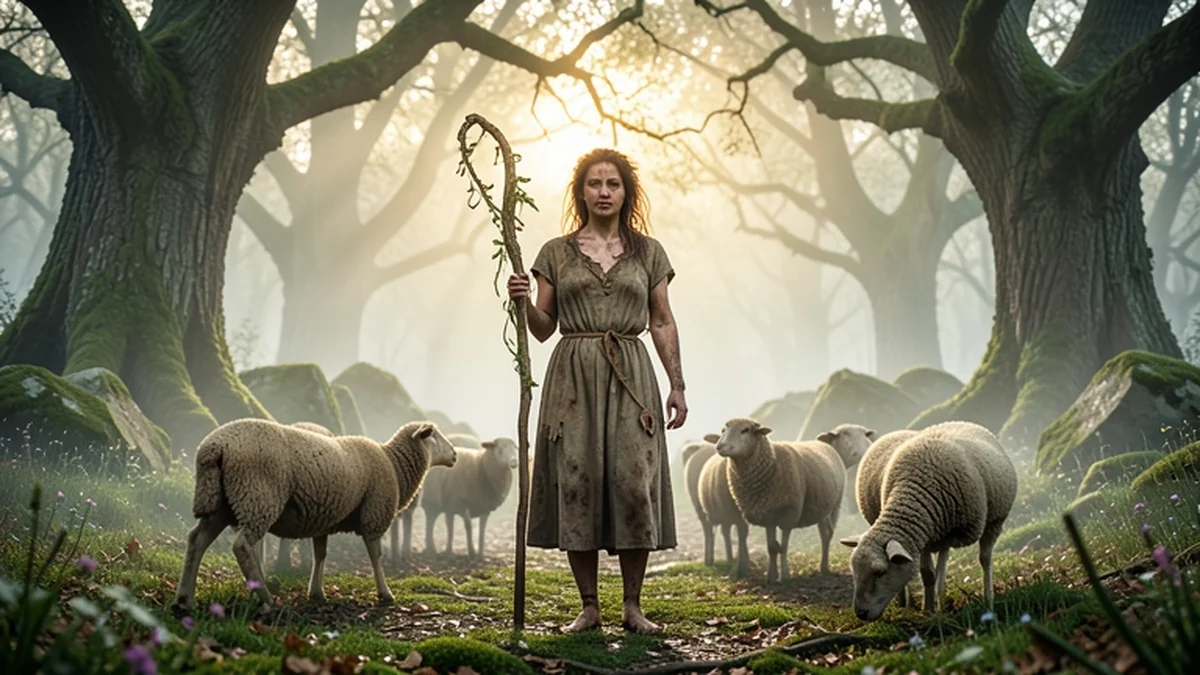
horrible old rags belonging to a beggar, all torn and covered with mud.
After that she smeared mud all over her hands and face, and shook her hair
into a great tangle. Having thus changed her appearance, she went about
offering herself as a goose-girl or shepherdess. But the farmers’ wives
would have nothing to say to such a dirty maiden, and sent her away with a
morsel of bread for charity’s sake.

After walking for a great many days without being able to find any work,
she came to a large farm where they were in want of a shepherdess, and
engaged her gladly.

One day when she was keeping her sheep in a lonely tract of land, she
suddenly felt a wish to dress herself in her robes of splendour. She
washed herself carefully in the stream, and as she always carried her
bundle with her, it was easy to shake off her rags, and transform herself
in a few moments into a great lady.

The King’s son, who had lost his way out hunting, perceived this lovely
damsel a long way off, and wished to look at her closer. But as soon as
the girl saw what he was at, she fled into the wood as swiftly as a bird.
The Prince ran after her, but as he was running he caught his foot in the
root of a tree and fell, and when he got up again, she was nowhere to be
seen.

When she was quite safe, she put on her rags again, and smeared over her
face and hands. However the young Prince, who was both hot and thirsty,
found his way to the farm, to ask for a drink of cider, and he inquired
the name of the beautiful lady that kept the sheep. At this everyone began
to laugh, for they said that the shepherdess was one of the ugliest and
dirtiest creatures under the sun.

The Prince thought some witchcraft must be at work, and he hastened away
before the return of the shepherdess, who became that evening the butt of
everybody’s jests.

But the King’s son thought often of the lovely maiden whom he had only
seen for a moment, though she seemed to him much more fascinating than any
lady of the Court. At last he dreamed of nothing else, and grew thinner
day by day till his parents inquired what was the matter, promising to do
all they could to make him as happy as he once was. He dared not tell them
the truth, lest they should laugh at him, so he only said that he should
like some bread baked by the kitchen girl in the distant farm.

Although the wish appeared rather odd, they hastened to fulfil it, and the
farmer was told the request of the King’s son. The maiden showed no
surprise at receiving such an order, but merely asked for some flour,
salt, and water, and also that she might be left alone in a little room
adjoining the oven, where the kneading-trough stood. Before beginning her
work she washed herself carefully, and even put on her rings; but, while
she was baking, one of her rings slid into the dough. When she had
finished she dirtied herself again, and let the lumps of the dough stick
to her fingers, so that she became as ugly as before.

The loaf, which was a very little one, was brought to the King’s son, who
ate it with pleasure. But in cutting it he found the ring of the Princess,
and declared to his parents that he would marry the girl whom that ring
fitted.

So the King made a proclamation through his whole kingdom and ladies came
from afar to lay claim to the honour. But the ring was so tiny that even
those who had the smallest hands could only get it on their little
fingers. In a short time all the maidens of the kingdom, including the
peasant girls, had tried on the ring, and the King was just about to
announce that their efforts had been in vain, when the Prince observed
that he had not yet seen the shepherdess.

They sent to fetch her, and she arrived covered with rags, but with her
hands cleaner than usual, so that she could easily slip on the ring. The
King’s son declared that he would fulfil his promise, and when his parents
mildly remarked that the girl was only a keeper of sheep, and a very ugly
one too, the maiden boldly said that she was born a princess, and that, if
they would only give her some water and leave her alone in a room for a
few minutes, she would show that she could look as well as anyone in fine
clothes.

They did what she asked, and when she entered in a magnificent dress, she
looked so beautiful that all saw she must be a princess in disguise. The
King’s son recognized the charming damsel of whom he had once caught a
glimpse, and, flinging himself at her feet, asked if she would marry him.
The Princess then told her story, and said that it would be necessary to
send an ambassador to her father to ask his consent and to invite him to
the wedding.

The Princess’s father, who had never ceased to repent his harshness
towards his daughter, had sought her through the land, but as no one could
tell him anything of her, he supposed her dead. Therefore it was with
great joy he heard that she was living and that a king’s son asked her in
marriage, and he quitted his kingdom with his elder daughter so as to be
present at the ceremony.

By the orders of the bride, they only served her father at the wedding
breakfast bread without salt, and meat without seasoning. Seeing him make
faces, and eat very little, his daughter, who sat beside him, inquired if
his dinner was not to his taste.

‘No,’ he replied, ‘the dishes are carefully cooked and sent up, but they
are all so dreadfully tasteless.’

‘Did not I tell you, my father, that salt was the best thing in life? And
yet, when I compared you to salt, to show how much I loved you, you
thought slightingly of me and you chased me from your presence.’

The King embraced his daughter, and allowed that he had been wrong to
misinterpret her words. Then, for the rest of the wedding feast they gave
him bread made with salt, and dishes with seasoning, and he said they were
the very best he had ever eaten.

Sebillot.
1 / 1


