
THE DRAGON AND HIS GRANDMOTHER
Read THE DRAGON AND HIS GRANDMOTHER, a public-domain fantasy story in the original English.
By Various; edited by Andrew Lang
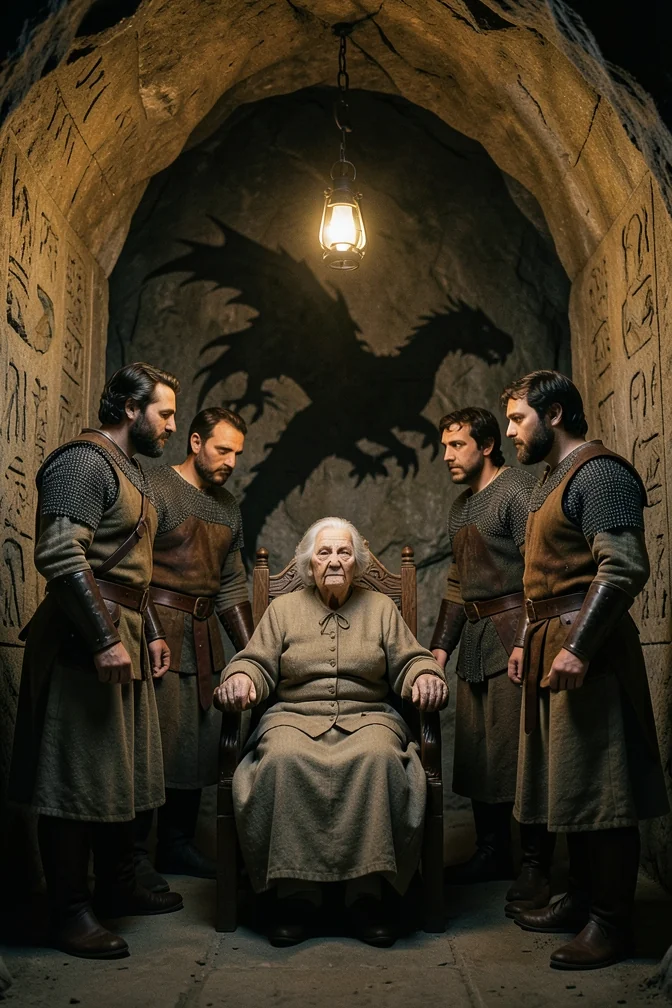
Edition and rights: Original English text from Project Gutenberg ebook #640, marked public domain in the USA. The literary text below is reproduced without AI rewriting.
There was once a great war, and the King had a great many soldiers, but he
gave them so little pay that they could not live upon it. Then three of
them took counsel together and determined to desert.

One of them said to the others, ‘If we are caught, we shall be hanged on
the gallows; how shall we set about it?’ The other said, ‘Do you see that
large cornfield there? If we were to hide ourselves in that, no one could
find us. The army cannot come into it, and to-morrow it is to march on.’

They crept into the corn, but the army did not march on, but remained
encamped close around them. They sat for two days and two nights in the
corn, and grew so hungry that they nearly died; but if they were to
venture out, it was certain death.

They said at last, ‘What use was it our deserting? We must perish here
miserably.’

Whilst they were speaking a fiery dragon came flying through the air. It
hovered near them, and asked why they were hidden there.

They answered, ‘We are three soldiers, and have deserted because our pay
was so small. Now if we remain here we shall die of hunger, and if we move
out we shall be strung up on the gallows.’

‘If you will serve me for seven years,’ said the dragon, I will lead you
through the midst of the army so that no one shall catch you.’ ‘We have no
choice, and must take your offer,’ said they. Then the dragon seized them
in his claws, took them through the air over the army, and set them down
on the earth a long way from it.

He gave them a little whip, saying, ‘Whip and slash with this, and as much
money as you want will jump up before you. You can then live as great
lords, keep horses, and drive about in carriages. But after seven years
you are mine.’ Then he put a book before them, which he made all three of
them sign. ‘I will then give you a riddle,’ he said; ‘if you guess it, you
shall be free and out of my power.’ The dragon then flew away, and they
journeyed on with their little whip. They had as much money as they
wanted, wore grand clothes, and made their way into the world. Wherever
they went they lived in merrymaking and splendour, drove about with horses
and carriages, ate and drank, but did nothing wrong.

The time passed quickly away, and when the seven years were nearly ended
two of them grew terribly anxious and frightened, but the third made light
of it, saying, ‘Don’t be afraid, brothers, I wasn’t born yesterday; I will
guess the riddle.’

They went into a field, sat down, and the two pulled long faces. An old
woman passed by, and asked them why they were so sad. ‘Alas! what have you
to do with it? You cannot help us.’ ‘Who knows?’ she answered. ‘Only
confide your trouble in me.’

Then they told her that they had become the servants of the Dragon for
seven long years, and how he had given them money as plentifully as
blackberries; but as they had signed their names they were his, unless
when the seven years had passed they could guess a riddle. The old woman
said, ‘If you would help yourselves, one of you must go into the wood, and
there he will come upon a tumble-down building of rocks which looks like a
little house. He must go in, and there he will find help.’

The two melancholy ones thought, ‘That won’t save us!’ and they remained
where they were. But the third and merry one jumped up and went into the
wood till he found the rock hut. In the hut sat a very old woman, who was
the Dragon’s grandmother. She asked him how he came, and what was his
business there. He told her all that happened, and because she was pleased
with him she took compassion on him, and said she would help him.

She lifted up a large stone which lay over the cellar, saying, ‘Hide
yourself there; you can hear all that is spoken in this room. Only sit
still and don’t stir. When the Dragon comes, I will ask him what the
riddle is, for he tells me everything; then listen carefully what he
answers.’

At midnight the Dragon flew in, and asked for his supper. His grandmother
laid the table, and brought out food and drink till he was satisfied, and
they ate and drank together. Then in the course of the conversation she
asked him what he had done in the day, and how many souls he had
conquered.

‘I haven’t had much luck to-day,’ he said, ‘but I have a tight hold on
three soldiers.’

‘Indeed! three soldiers!’ said she. ‘Who cannot escape you?’

‘They are mine,’ answered the Dragon scornfully, ‘for I shall only give
them one riddle which they will never be able to guess.’

‘What sort of a riddle is it?’ she asked.

‘I will tell you this. In the North Sea lies a dead sea-cat—that
shall be their roast meat; and the rib of a whale—that shall be
their silver spoon; and the hollow foot of a dead horse—that shall
be their wineglass.’

When the Dragon had gone to bed, his old grandmother pulled up the stone
and let out the soldier.

‘Did you pay attention to everything?’

‘Yes,’ he replied, ‘I know enough, and can help myself splendidly.’

Then he went by another way through the window secretly, and in all haste
back to his comrades. He told them how the Dragon had been outwitted by
his grandmother, and how he had heard from his own lips the answer to the
riddle.

Then they were all delighted and in high spirits, took out their whip, and
cracked so much money that it came jumping up from the ground. When the
seven years had quite gone, the Fiend came with his book, and, pointing at
the signatures, said, ‘I will take you underground with me; you shall have
a meal there. If you can tell me what you will get for your roast meat,
you shall be free, and shall also keep the whip.’

Then said the first soldier, ‘In the North Sea lies a dead sea-cat; that
shall be the roast meat.’

The Dragon was much annoyed, and hummed and hawed a good deal, and asked
the second, ‘But what shall be your spoon?’

‘The rib of a whale shall be our silver spoon.’

The Dragon-made a face, and growled again three times, ‘Hum, hum, hum,’
and said to the third, ‘Do you know what your wineglass shall be?’

‘An old horse’s hoof shall be our wineglass.’

Then the Dragon flew away with a loud shriek, and had no more power over
them. But the three soldiers took the little whip, whipped as much money
as they wanted, and lived happily to their lives end.

THE DONKEY CABBAGE

There was once a young Hunter who went boldly into the forest. He had a
merry and light heart, and as he went whistling along there came an ugly
old woman, who said to him, ‘Good-day, dear hunter! You are very merry and
contented, but I suffer hunger and thirst, so give me a trifle.’ The
Hunter was sorry for the poor old woman, and he felt in his pocket and
gave her all he could spare. He was going on then, but the old woman
stopped him and said, ‘Listen, dear hunter, to what I say. Because of your
kind heart I will make you a present. Go on your way, and in a short time
you will come to a tree on which sit nine birds who have a cloak in their
claws and are quarrelling over it. Then take aim with your gun and shoot
in the middle of them; they will let the cloak fall, but one of the birds
will be hit and will drop down dead. Take the cloak with you; it is a
wishing-cloak, and when you throw it on your shoulders you have only to
wish yourself at a certain place, and in the twinkling of an eye you are
there. Take the heart out of the dead bird and swallow it whole, and early
every morning when you get up you will find a gold piece under your
pillow.’

The Hunter thanked the wise woman, and thought to himself ‘These are
splendid things she has promised me, if only they come to pass!’ So he
walked on about a hundred yards, and then he heard above him in the
branches such a screaming and chirping that he looked up, and there he saw
a heap of birds tearing a cloth with their beaks and feet, shrieking,
tugging, and fighting, as if each wanted it for himself. ‘Well,’ said the
Hunter, ‘this is wonderful! It is just as the old woman said’; and he took
his gun on his shoulder, pulled the trigger, and shot into the midst of
them, so that their feathers flew about. Then the flock took flight with
much screaming, but one fell dead, and the cloak fluttered down. Then the
Hunter did as the old woman had told him: he cut open the bird, found its
heart, swallowed it, and took the cloak home with him. The next morning
when he awoke he remembered the promise, and wanted to see if it had come
true. But when he lifted up his pillow, there sparkled the gold piece, and
the next morning he found another, and so on every time he got up. He
collected a heap of gold, but at last he thought to himself, ‘What good is
all my gold to me if I stay at home? I will travel and look a bit about me
in the world.’ So he took leave of his parents, slung his hunting knapsack
and his gun round him, and journeyed into the world.

It happened that one day he went through a thick wood, and when he came to
the end of it there lay in the plain before him a large castle. At one of
the windows in it stood an old woman with a most beautiful maiden by her
side, looking out. But the old woman was a witch, and she said to the
girl, ‘There comes one out of the wood who has a wonderful treasure in his
body which we must manage to possess ourselves of, darling daughter; we
have more right to it than he. He has a bird’s heart in him, and so every
morning there lies a gold piece under his pillow.’

She told her how they could get hold of it, and how she was to coax it
from him, and at last threatened her angrily, saying, ‘And if you do not
obey me, you shall repent it!’

When the Hunter came nearer he saw the maiden, and said to himself, ‘I
have travelled so far now that I will rest, and turn into this beautiful
castle; money I have in plenty.’ But the real reason was that he had
caught sight of the lovely face.

He went into the house, and was kindly received and hospitably
entertained. It was not long before he was so much in love with the
witch-maiden that he thought of nothing else, and only looked in her eyes,
and whatever she wanted, that he gladly did. Then the old witch said, ‘Now
we must have the bird-heart; he will not feel when it is gone.’ She
prepared a drink, and when it was ready she poured it in a goblet and gave
it to the maiden, who had to hand it to the hunter.

‘Drink to me now, my dearest,’ she said. Then he took the goblet, and when
he had swallowed the drink the bird-heart came out of his mouth. The
maiden had to get hold of it secretly and then swallow it herself, for the
old witch wanted to have it. Thenceforward he found no more gold under his
pillow, and it lay under the maiden’s; but he was so much in love and so
much bewitched that he thought of nothing except spending all his time
with the maiden.

Then the old witch said, ‘We have the bird-heart, but we must also get the
wishing-cloak from him.’

The maiden answered, ‘We will leave him that; he has already lost his
wealth!’

The old witch grew angry, and said, ‘Such a cloak is a wonderful thing, it
is seldom to be had in the world, and have it I must and will.’ She beat
the maiden, and said that if she did not obey it would go ill with her.

So she did her mother’s bidding, and, standing one day by the window, she
looked away into the far distance as if she were very sad.

‘Why are you standing there looking so sad?’ asked the Hunter.

‘Alas, my love,’ she replied, ‘over there lies the granite mountain where
the costly precious stones grow. I have a great longing to go there, so
that when I think of it I am very sad. For who can fetch them? Only the
birds who fly; a man, never.’

‘If you have no other trouble,’ said the Hunter, ‘that one I can easily
remove from your heart.’

So he wrapped her round in his cloak and wished themselves to the granite
mountain, and in an instant there they were, sitting on it! The precious
stones sparkled so brightly on all sides that it was a pleasure to see
them, and they collected the most beautiful and costly together. But now
the old witch had through her caused the Hunter’s eyes to become heavy.

He said to the maiden, ‘We will sit down for a little while and rest; I am
so tired that I can hardly stand on my feet.’

So they sat down, and he laid his head on her lap and fell asleep. As soon
as he was sound asleep she unfastened the cloak from his shoulders, threw
it on her own, left the granite and stones, and wished herself home again.

But when the Hunter had finished his sleep and awoke, he found that his
love had betrayed him and left him alone on the wild mountain. ‘Oh,’ said
he, ‘why is faithlessness so great in the world?’ and he sat down in
sorrow and trouble, not knowing what to do.

But the mountain belonged to fierce and huge giants, who lived on it and
traded there, and he had not sat long before he saw three of them striding
towards him. So he lay down as if he had fallen into a deep sleep.

The giants came up, and the first pushed him with his foot, and said,
‘What sort of an earthworm is that?’

The second said, ‘Crush him dead.’

But the third said contemptuously, ‘It is not worth the trouble! Let him
live; he cannot remain here, and if he goes higher up the mountain the
clouds will take him and carry him off.’

Talking thus they went away. But the Hunter had listened to their talk,
and as soon as they had gone he rose and climbed to the summit. When he
had sat there a little while a cloud swept by, and, seizing him, carried
him away. It travelled for a time in the sky, and then it sank down and
hovered over a large vegetable garden surrounded by walls, so that he came
safely to the ground amidst cabbages and vegetables. The Hunter then
looked about him, saying, ‘If only I had something to eat! I am so hungry,
and it will go badly with me in the future, for I see here not an apple or
pear or fruit of any kind—nothing but vegetables everywhere.’ At
last he thought, ‘At a pinch I can eat a salad; it does not taste
particularly nice, but it will refresh me.’ So he looked about for a good
head and ate it, but no sooner had he swallowed a couple of mouthfuls than
he felt very strange, and found himself wonderfully changed. Four legs
began to grow on him, a thick head, and two long ears, and he saw with
horror that he had changed into a donkey. But as he was still very hungry
and this juicy salad tasted very good to his present nature, he went on
eating with a still greater appetite. At last he got hold of another kind
of cabbage, but scarcely had swallowed it when he felt another change, and
he once more regained his human form.

The Hunter now lay down and slept off his weariness. When he awoke the
next morning he broke off a head of the bad and a head of the good
cabbage, thinking, ‘This will help me to regain my own, and to punish
faithlessness.’ Then he put the heads in his pockets, climbed the wall,
and started off to seek the castle of his love. When he had wandered about
for a couple of days he found it quite easily. He then browned his face
quickly, so that his own mother would not have known him, and went into
the castle, where he begged for a lodging.

‘I am so tired,’ he said, ‘I can go no farther.’

The witch asked, ‘Countryman, who are you, and what is your business?’

He answered, ‘I am a messenger of the King, and have been sent to seek the
finest salad that grows under the sun. I have been so lucky as to find it,
and am bringing it with me; but the heat of the sun is so great that the
tender cabbage threatens to grow soft, and I do not know if I shall be
able to bring it any farther.’

When the old witch heard of the fine salad she wanted to eat it, and said,
‘Dear countryman, just let me taste the wonderful salad.’

‘Why not?’ he answered; ‘I have brought two heads with me, and will give
you one.’

So saying, he opened his sack and gave her the bad one. The witch
suspected no evil, and her mouth watered to taste the new dish, so that
she went into the kitchen to prepare it herself. When it was ready she
could not wait till it was served at the table, but she immediately took a
couple of leaves and put them in her mouth. No sooner, however, had she
swallowed them than she lost human form, and ran into the courtyard in the
shape of a donkey.

Now the servant came into the kitchen, and when she saw the salad standing
there ready cooked she was about to carry it up, but on the way, according
to her old habit, she tasted it and ate a couple of leaves. Immediately
the charm worked, and she became a donkey, and ran out to join the old
witch, and the dish with the salad in it fell to the ground. In the
meantime, the messenger was sitting with the lovely maiden, and as no one
came with the salad, and she wanted very much to taste it, she said, ‘I
don’t know where the salad is.’

Then thought the Hunter, ‘The cabbage must have already begun to work.’
And he said, ‘I will go to the kitchen and fetch it myself.’

When he came there he saw the two donkeys running about in the courtyard,
but the salad was lying on the ground.

‘That’s all right,’ said he; ‘two have had their share!’ And lifting the
remaining leaves up, he laid them on the dish and brought them to the
maiden.

‘I am bringing you the delicious food my own self,’ he said, ‘so that you
need not wait any longer.’

Then she ate, and, as the others had done, she at once lost her human
form, and ran as a donkey into the yard.

When the Hunter had washed his face, so that the changed ones might know
him, he went into the yard, saying, ‘Now you shall receive a reward for
your faithlessness.’

He tied them all three with a rope, and drove them away till he came to a
mill. He knocked at the window, and the miller put his head out and asked
what he wanted.

‘I have three tiresome animals,’ he answered, ‘which I don’t want to keep
any longer. If you will take them, give them food and stabling, and do as
I tell you with them, I will pay you as much as you want.’

The miller replied, ‘Why not? What shall I do with them?’

Then the Hunter said that to the old donkey, which was the witch, three
beatings and one meal; to the younger one, which was the servant, one
beating and three meals; and to the youngest one, which was the maiden, no
beating and three meals; for he could not find it in his heart to let the
maiden be beaten.

Then he went back into the castle, and he found there all that he wanted.
After a couple of days the miller came and said that he must tell him that
the old donkey which was to have three beatings and only one meal had
died. ‘The two others,’ he added, ‘are certainly not dead, and get their
three meals every day, but they are so sad that they cannot last much
longer.’

Then the Hunter took pity on them, laid aside his anger, and told the
miller to drive them back again. And when they came he gave them some of
the good cabbage to eat, so that they became human again. Then the
beautiful maiden fell on her knees before him, saying, ‘Oh, my dearest,
forgive me the ill I have done you! My mother compelled me to do it; it
was against my will, for I love you dearly. Your wishing-cloak is hanging
in a cupboard, and as for the bird-heart I will make a drink and give it
back to you.’

But he changed his mind, and said, ‘Keep it; it makes no difference, for I
will take you to be my own dear true wife.’

And the wedding was celebrated, and they lived happy together till death.

THE LITTLE GREEN FROG(8)

(8) Cabinet des Fees.

In a part of the world whose name I forget lived once upon a time two
kings, called Peridor and Diamantino. They were cousins as well as
neighbours, and both were under the protection of the fairies; though it
is only fair to say that the fairies did not love them half so well as
their wives did.

Now it often happens that as princes can generally manage to get their own
way it is harder for them to be good than it is for common people. So it
was with Peridor and Diamantino; but of the two, the fairies declared that
Diamantino was much the worst; indeed, he behaved so badly to his wife
Aglantino, that the fairies would not allow him to live any longer; and he
died, leaving behind him a little daughter. As she was an only child, of
course this little girl was the heiress of the kingdom, but, being still
only a baby, her mother, the widow of Diamantino, was proclaimed regent.
The Queen-dowager was wise and good, and tried her best to make her people
happy. The only thing she had to vex her was the absence of her daughter;
for the fairies, for reasons of their own, determined to bring up the
little Princess Serpentine among themselves.

As to the other King, he was really fond of his wife, Queen Constance, but
he often grieved her by his thoughtless ways, and in order to punish him
for his carelessness, the fairies caused her to die quite suddenly. When
she was gone the King felt how much he had loved her, and his grief was so
great (though he never neglected his duties) that his subjects called him
Peridor the Sorrowful. It seems hardly possible that any man should live
like Peridor for fifteen years plunged in such depth of grief, and most
likely he would have died too if it had not been for the fairies.

The one comfort the poor King had was his son, Prince Saphir, who was only
three years old at the time of his mother’s death, and great care was
given to his education. By the time he was fifteen Saphir had learnt
everything that a prince should know, and he was, besides, charming and
agreeable.

It was about this time that the fairies suddenly took fright lest his love
for his father should interfere with the plans they had made for the young
prince. So, to prevent this, they placed in a pretty little room of which
Saphir was very fond a little mirror in a black frame, such as were often
brought from Venice. The Prince did not notice for some days that there
was anything new in the room, but at last he perceived it, and went up to
look at it more closely. What was his surprise to see reflected in the
mirror, not his own face, but that of a young girl as lovely as the
morning! And, better still, every movement of the girl, just growing out
of childhood, was also reflected in the wonderful glass.

As might have been expected, the young Prince lost his heart completely to
the beautiful image, and it was impossible to get him out of the room, so
busy was he in watching the lovely unknown. Certainly it was very
delightful to be able to see her whom he loved at any moment he chose, but
his spirits sometimes sank when he wondered what was to be the end of this
adventure.

The magic mirror had been for about a year in the Prince’s possession,
when one day a new subject of disquiet seized upon him. As usual, he was
engaged in looking at the girl, when suddenly he thought he saw a second
mirror reflected in the first, exactly like his own, and with the same
power. And in this he was perfectly right. The young girl had only
possessed it for a short time, and neglected all her duties for the sake
of the mirror. Now it was not difficult for Saphir to guess the reason of
the change in her, nor why the new mirror was consulted so often; but try
as he would he could never see the face of the person who was reflected in
it, for the young girl’s figure always came between. All he knew was that
the face was that of a man, and this was quite enough to make him madly
jealous. This was the doing of the fairies, and we must suppose that they
had their reasons for acting as they did.

When these things happened Saphir was about eighteen years old, and
fifteen years had passed away since the death of his mother. King Peridor
had grown more and more unhappy as time went on, and at last he fell so
ill that it seemed as if his days were numbered. He was so much beloved by
his subjects that this sad news was heard with despair by the nation, and
more than all by the Prince.

During his whole illness the King never spoke of anything but the Queen,
his sorrow at having grieved her, and his hope of one day seeing her
again. All the doctors and all the water-cures in the kingdom had been
tried, and nothing would do him any good. At last he persuaded them to let
him lie quietly in his room, where no one came to trouble him.

Perhaps the worst pain he had to bear was a sort of weight on his chest,
which made it very hard for him to breathe. So he commanded his servants
to leave the windows open in order that he might get more air. One day,
when he had been left alone for a few minutes, a bird with brilliant
plumage came and fluttered round the window, and finally rested on the
sill. His feathers were sky-blue and gold, his feet and his beak of such
glittering rubies that no one could bear to look at them, his eyes made
the brightest diamonds look dull, and on his head he wore a crown. I
cannot tell you what the crown was made of, but I am quite certain that it
was still more splendid than all the rest. As to his voice I can say
nothing about that, for the bird never sang at all. In fact, he did
nothing but gaze steadily at the King, and as he gazed, the King felt his
strength come back to him. In a little while the bird flew into the room,
still with his eyes fixed on the King, and at every glance the strength of
the sick man became greater, till he was once more as well as he used to
be before the Queen died. Filled with joy at his cure, he tried to seize
the bird to whom he owed it all, but, swifter than a swallow, it managed
to avoid him. In vain he described the bird to his attendants, who rushed
at his first call; in vain they sought the wonderful creature both on
horse and foot, and summoned the fowlers to their aid: the bird could
nowhere be found. The love the people bore King Peridor was so strong, and
the reward he promised was so large, that in the twinkling of an eye every
man, woman, and child had fled into the fields, and the towns were quite
empty.

All this bustle, however, ended in nothing but confusion, and, what was
worse, the King soon fell back into the same condition as he was in
before. Prince Saphir, who loved his father very dearly, was so unhappy at
this that he persuaded himself that he might succeed where the others had
failed, and at once prepared himself for a more distant search. In spite
of the opposition he met with, he rode away, followed by his household,
trusting to chance to help him. He had formed no plan, and there was no
reason that he should choose one path more than another. His only idea was
to make straight for those spots which were the favourite haunts of birds.
But in vain he examined all the hedges and all the thickets; in vain he
questioned everyone he met along the road. The more he sought the less he
found.

At last he came to one of the largest forests in all the world, composed
entirely of cedars. But in spite of the deep shadows cast by the
wide-spreading branches of the trees, the grass underneath was soft and
green, and covered with the rarest flowers. It seemed to Saphir that this
was exactly the place where the birds would choose to live, and he
determined not to quit the wood until he had examined it from end to end.
And he did more. He ordered some nets to be prepared and painted of the
same colours as the bird’s plumage, thinking that we are all easily caught
by what is like ourselves. In this he had to help him not only the fowlers
by profession, but also his attendants, who excelled in this art. For a
man is not a courtier unless he can do everything.

After searching as usual for nearly a whole day Prince Saphir began to
feel overcome with thirst. He was too tired to go any farther, when
happily he discovered a little way off a bubbling fountain of the clearest
water. Being an experienced traveller, he drew from his pocket a little
cup (without which no one should ever take a journey), and was just about
to dip it in the water, when a lovely little green frog, much prettier
than frogs generally are, jumped into the cup. Far from admiring its
beauty, Saphir shook it impatiently off; but it was no good, for quick as
lightning the frog jumped back again. Saphir, who was raging with thirst,
was just about to shake it off anew, when the little creature fixed upon
him the most beautiful eyes in the world, and said, ‘I am a friend of the
bird you are seeking, and when you have quenched your thirst listen to
me.’

So the Prince drank his fill, and then, by the command of the Little Green
Frog, he lay down on the grass to rest himself.

‘Now,’ she began, ‘be sure you do exactly in every respect what I tell
you. First you must call together your attendants, and order them to
remain in a little hamlet close by until you want them. Then go, quite
alone, down a road that you will find on your right hand, looking
southwards. This road is planted all the way with cedars of Lebanon; and
after going down it a long way you will come at last to a magnificent
castle. And now,’ she went on, ‘attend carefully to what I am going to
say. Take this tiny grain of sand, and put it into the ground as close as
you can to the gate of the castle. It has the virtue both of opening the
gate and also of sending to sleep all the inhabitants. Then go at once to
the stable, and pay no heed to anything except what I tell you. Choose the
handsomest of all the horses, leap quickly on its back, and come to me as
fast as you can. Farewell, Prince; I wish you good luck,’ and with these
words the Little Frog plunged into the water and disappeared.

The Prince, who felt more hopeful than he had done since he left home, did
precisely as he had been ordered. He left his attendants in the hamlet,
found the road the frog had described to him, and followed it all alone,
and at last he arrived at the gate of the castle, which was even more
splendid than he had expected, for it was built of crystal, and all its
ornaments were of massive gold. However, he had no thoughts to spare for
its beauty, and quickly buried his grain of sand in the earth. In one
instant the gates flew open, and all the dwellers inside fell sound
asleep. Saphir flew straight to the stable, and already had his hand on
the finest horse it contained, when his eye was caught by a suit of
magnificent harness hanging up close by. It occurred to him directly that
the harness belonged to the horse, and without ever thinking of harm (for
indeed he who steals a horse can hardly be blamed for taking his saddle),
he hastily placed it on the animal’s back. Suddenly the people in the
castle became broad awake, and rushed to the stable. They flung themselves
on the Prince, seized him, and dragged him before their lord; but, luckily
for the Prince, who could only find very lame excuses for his conduct, the
lord of the castle took a fancy to his face, and let him depart without
further questions.

Very sad, and very much ashamed of himself poor Saphir crept back to the
fountain, where the Frog was awaiting him with a good scolding.

‘Whom do you take me for?’ she exclaimed angrily. ‘Do you really believe
that it was just for the pleasure of talking that I gave you the advice
you have neglected so abominably?’

But the Prince was so deeply grieved, and apologised so very humbly, that
after some time the heart of the good little Frog was softened, and she
gave him another tiny little grain, but instead of being sand it was now a
grain of gold. She directed him to do just as he had done before, with
only this difference, that instead of going to the stable which had been
the ruin of his hopes, he was to enter right into the castle itself, and
to glide as fast as he could down the passages till he came to a room
filled with perfume, where he would find a beautiful maiden asleep on a
bed. He was to wake the maiden instantly and carry her off, and to be sure
not to pay any heed to whatever resistance she might make.

The Prince obeyed the Frog’s orders one by one, and all went well for this
second time also. The gate opened, the inhabitants fell sound asleep, and
he walked down the passage till he found the girl on her bed, exactly as
he had been told he would. He woke her, and begged her firmly, but
politely, to follow him quickly. After a little persuasion the maiden
consented, but only on condition that she was allowed first to put on her
dress. This sounded so reasonable and natural that it did not enter the
Prince’s head to refuse her request.

But the maiden’s hand had hardly touched the dress when the palace
suddenly awoke from its sleep, and the Prince was seized and bound. He was
so vexed with his own folly, and so taken aback at the disaster, that he
did not attempt to explain his conduct, and things would have gone badly
with him if his friends the fairies had not softened the hearts of his
captors, so that they once more allowed him to leave quietly. However,
what troubled him most was the idea of having to meet the Frog who had
been his benefactress. How was he ever to appear before her with this
tale? Still, after a long struggle with himself, he made up his mind that
there was nothing else to be done, and that he deserved whatever she might
say to him. And she said a great deal, for she had worked herself into a
terrible passion; but the Prince humbly implored her pardon, and ventured
to point out that it would have been very hard to refuse the young lady’s
reasonable request. ‘You must learn to do as you are told,’ was all the
Frog would reply.

But poor Saphir was so unhappy, and begged so hard for forgiveness, that
at last the Frog’s anger gave way, and she held up to him a tiny diamond
stone. ‘Go back,’ she said, ‘to the castle, and bury this little diamond
close to the door. But be careful not to return to the stable or to the
bedroom; they have proved too fatal to you. Walk straight to the garden
and enter through a portico, into a small green wood, in the midst of
which is a tree with a trunk of gold and leaves of emeralds. Perched on
this tree you will see the beautiful bird you have been seeking so long.
You must cut the branch on which it is sitting, and bring it back to me
without delay. But I warn you solemnly that if you disobey my directions,
as you have done twice before, you have nothing more to expect either of
me or anyone else.’

With these words she jumped into the water, and the Prince, who had taken
her threats much to heart, took his departure, firmly resolved not to
deserve them. He found it all just as he had been told: the portico, the
wood, the magnificent tree, and the beautiful bird, which was sleeping
soundly on one of the branches. He speedily lopped off the branch, and
though he noticed a splendid golden cage hanging close by, which would
have been very useful for the bird to travel in, he left it alone, and
came back to the fountain, holding his breath and walking on tip-toe all
the way, for fear lest he should awake his prize. But what was his
surprise, when instead of finding the fountain in the spot where he had
left it, he saw in its place a little rustic palace built in the best
taste, and standing in the doorway a charming maiden, at whose sight his
mind seemed to give way.

‘What! Madam!’ he cried, hardly knowing what he said. ‘What! Is it you?’

The maiden blushed and answered: ‘Ah, my lord, it is long since I first
beheld your face, but I did not think you had ever seen mine.’

‘Oh, madam,’ replied he, ‘you can never guess the days and the hours I
have passed lost in admiration of you.’ And after these words they each
related all the strange things that had happened, and the more they talked
the more they felt convinced of the truth of the images they had seen in
their mirrors. After some time spent in the most tender conversation, the
Prince could not restrain himself from asking the lovely unknown by what
lucky chance she was wandering in the forest; where the fountain had gone;
and if she knew anything of the Frog to whom he owed all his happiness,
and to whom he must give up the bird, which, somehow or other, was still
sound asleep.

‘Ah, my lord,’ she replied, with rather an awkward air, ‘as to the Frog,
she stands before you. Let me tell you my story; it is not a long one. I
know neither my country nor my parents, and the only thing I can say for
certain is that I am called Serpentine. The fairies, who have taken care
of me ever since I was born, wished me to be in ignorance as to my family,
but they have looked after my education, and have bestowed on me endless
kindness. I have always lived in seclusion, and for the last two years I
have wished for nothing better. I had a mirror’—here shyness and
embarrassment choked her words—but regaining her self-control, she
added, ‘You know that fairies insist on being obeyed without questioning.
It was they who changed the little house you saw before you into the
fountain for which you are now asking, and, having turned me into a frog,
they ordered me to say to the first person who came to the fountain
exactly what I repeated to you. But, my lord, when you stood before me, it
was agony to my heart, filled as it was with thoughts of you, to appear to
your eyes under so monstrous a form. However, there was no help for it,
and, painful as it was, I had to submit. I desired your success with all
my soul, not only for your own sake, but also for my own, because I could
not get back my proper shape till you had become master of the beautiful
bird, though I am quite ignorant as to your reason for seeking it.’

On this Saphir explained about the state of his father’s health, and all
that has been told before.

On hearing this story Serpentine grew very sad, and her lovely eyes filled
with tears.

‘Ah, my lord,’ she said, ‘you know nothing of me but what you have seen in
the mirror; and I, who cannot even name my parents, learn that you are a
king’s son.’

In vain Saphir declared that love made them equal; Serpentine would only
reply: ‘I love you too much to allow you to marry beneath your rank. I
shall be very unhappy, of course, but I shall never alter my mind. If I do
not find from the fairies that my birth is worthy of you, then, whatever
be my feelings, I will never accept your hand.’

The conversation was at this point, and bid fair to last some time longer,
when one of the fairies appeared in her ivory car, accompanied by a
beautiful woman past her early youth. At this moment the bird suddenly
awakened, and, flying on to Saphir’s shoulder (which it never afterwards
left), began fondling him as well as a bird can do. The fairy told
Serpentine that she was quite satisfied with her conduct, and made herself
very agreeable to Saphir, whom she presented to the lady she had brought
with her, explaining that the lady was no other than his Aunt Aglantine,
widow of Diamantino.

Then they all fell into each other’s arms, till the fairy mounted her
chariot, placed Aglantine by her side, and Saphir and Serpentine on the
front seat. She also sent a message to the Prince’s attendants that they
might travel slowly back to the Court of King Peridor, and that the
beautiful bird had really been found. This matter being comfortably
arranged, she started off her chariot. But in spite of the swiftness with
which they flew through the air, the time passed even quicker for Saphir
and Serpentine, who had so much to think about.

They were still quite confused with the pleasure of seeing each other,
when the chariot arrived at King Peridor’s palace. He had had himself
carried to a room on the roof, where his nurses thought that he would die
at any moment. Directly the chariot drew within sight of the castle the
beautiful bird took flight, and, making straight for the dying King, at
once cured him of his sickness. Then she resumed her natural shape, and he
found that the bird was no other than the Queen Constance, whom he had
long believed to be dead. Peridor was rejoiced to embrace his wife and his
son once more, and with the help of the fairies began to make preparations
for the marriage of Saphir and Serpentine, who turned out to be the
daughter of Aglantine and Diamantino, and as much a princess as he was a
prince. The people of the kingdom were delighted, and everybody lived
happy and contented to the end of their lives.

THE SEVEN-HEADED SERPENT(9)

(9) ‘Die Siebenkopfige Schlange,’ from Schmidt’s Griechische Mahrchen.

Once upon a time there was a king who determined to take a long voyage. He
assembled his fleet and all the seamen, and set out. They went straight on
night and day, until they came to an island which was covered with large
trees, and under every tree lay a lion. As soon as the King had landed his
men, the lions all rose up together and tried to devour them. After a long
battle they managed to overcome the wild beasts, but the greater number of
the men were killed. Those who remained alive now went on through the
forest and found on the other side of it a beautiful garden, in which all
the plants of the world flourished together.

There were also in the garden three springs: the first flowed with silver,
the second with gold, and the third with pearls. The men unbuckled their
knapsacks and filled them with those precious things. In the middle of the
garden they found a large lake, and when they reached the edge of it the
Lake began to speak, and said to them, ‘What men are you, and what brings
you here? Are you come to visit our king?’ But they were too much
frightened to answer.

Then the Lake said, ‘You do well to be afraid, for it is at your peril
that you are come hither. Our king, who has seven heads, is now asleep,
but in a few minutes he will wake up and come to me to take his bath! Woe
to anyone who meets him in the garden, for it is impossible to escape from
him. This is what you must do if you wish to save your lives. Take off
your clothes and spread them on the path which leads from here to the
castle. The King will then glide over something soft, which he likes very
much, and he will be so pleased with that that he will not devour you. He
will give you some punishment, but then he will let you go.’

The men did as the Lake advised them, and waited for a time. At noon the
earth began to quake, and opened in many places, and out of the openings
appeared lions, tigers, and other wild beasts, which surrounded the
castle, and thousands and thousands of beasts came out of the castle
following their king, the Seven-headed Serpent. The Serpent glided over
the clothes which were spread for him, came to the Lake, and asked it who
had strewed those soft things on the path? The Lake answered that it had
been done by people who had come to do him homage. The King commanded that
the men should be brought before him. They came humbly on their knees, and
in a few words told him their story. Then he spoke to them with a mighty
and terrible voice, and said, ‘Because you have dared to come here, I lay
upon you the punishment. Every year you must bring me from among your
people twelve youths and twelve maidens, that I may devour them. If you do
not do this, I will destroy your whole nation.’

Then he desired one of his beasts to show the men the way out of the
garden, and dismissed them. They then left the island and went back to
their own country, where they related what had happened to them. Soon the
time came round when the king of the beasts would expect the youths and
maidens to be brought to him. The King therefore issued a proclamation
inviting twelve youths and twelve maidens to offer themselves up to save
their country; and immediately many young people, far more than enough,
hastened to do so. A new ship was built, and set with black sails, and in
it the youths and maidens who were appointed for the king of the beasts
embarked and set out for his country. When they arrived there they went at
once to the Lake, and this time the lions did not stir, nor did the
springs flow, and neither did the Lake speak. So they waited then, and it
was not long before the earth quaked even more terribly than the first
time. The Seven-headed Serpent came without his train of beasts, saw his
prey waiting for him, and devoured it at one mouthful. Then the ship’s
crew returned home, and the same thing happened yearly until many years
had passed.

Now the King of this unhappy country was growing old, and so was the
Queen, and they had no children. One day the Queen was sitting at the
window weeping bitterly because she was childless, and knew that the crown
would therefore pass to strangers after the King’s death. Suddenly a
little old woman appeared before her, holding an apple in her hand, and
said, ‘Why do you weep, my Queen, and what makes you so unhappy?’

‘Alas, good mother,’ answered the Queen, ‘I am unhappy because I have no
children.’

‘Is that what vexes you?’ said the old woman. ‘Listen to me. I am a nun
from the Spinning Convent,(10) and my mother when she died left me this
apple. Whoever eats this apple shall have a child.’

(10) Convent Gnothi.

The Queen gave money to the old woman, and bought the apple from her. Then
she peeled it, ate it, and threw the rind out of the window, and it so
happened that a mare that was running loose in the court below ate up the
rind. After a time the Queen had a little boy, and the mare also had a
male foal. The boy and the foal grew up together and loved each other like
brothers. In course of time the King died, and so did the Queen, and their
son, who was now nineteen years old, was left alone. One day, when he and
his horse were talking together, the Horse said to him, ‘Listen to me, for
I love you and wish for your good and that of the country. If you go on
every year sending twelve youths and twelve maidens to the King of the
Beasts, your country will very soon be ruined. Mount upon my back: I will
take you to a woman who can direct you how to kill the Seven-headed
Serpent.’

Then the youth mounted his horse, who carried him far away to a mountain
which was hollow, for in its side was a great underground cavern. In the
cavern sat an old woman spinning. This was the cloister of the nuns, and
the old woman was the Abbess. They all spent their time in spinning, and
that is why the convent has this name. All round the walls of the cavern
there were beds cut out of the solid rock, upon which the nuns slept, and
in the middle a light was burning. It was the duty of the nuns to watch
the light in turns, that it might never go out, and if anyone of them let
it go out the others put her to death.

As soon as the King’s son saw the old Abbess spinning he threw himself at
her feet and entreated her to tell him how he could kill the Seven-headed
Serpent.

She made the youth rise, embraced him, and said, ‘Know, my son, that it is
I who sent the nun to your mother and caused you to be born, and with you
the horse, with whose help you will be able to free the world from the
monster. I will tell you what you have to do. Load your horse with cotton,
and go by a secret passage which I will show you, which is hidden from the
wild beasts, to the Serpent’s palace. You will find the King asleep upon
his bed, which is all hung round with bells, and over his bed you will see
a sword hanging. With this sword only it is possible to kill the Serpent,
because even if its blade breaks a new one will grow again for every head
the monster has. Thus you will be able to cut off all his seven heads. And
this you must also do in order to deceive the King: you must slip into his
bed-chamber very softly, and stop up all the bells which are round his bed
with cotton. Then take down the sword gently, and quickly give the monster
a blow on his tail with it. This will make him waken up, and if he catches
sight of you he will seize you. But you must quickly cut off his first
head, and then wait till the next one comes up. Then strike it off also,
and so go on till you have cut off all his seven heads.’

The old Abbess then gave the Prince her blessing, and he set out upon his
enterprise, arrived at the Serpent’s castle by following the secret
passage which she had shown him, and by carefully attending to all her
directions he happily succeeded in killing the monster. As soon as the
wild beasts heard of their king’s death, they all hastened to the castle,
but the youth had long since mounted his horse and was already far out of
their reach. They pursued him as fast as they could, but they found it
impossible to overtake him, and he reached home in safety. Thus he freed
his country from this terrible oppression.

THE GRATEFUL BEASTS(11)

(11) From the Hungarian. Kletke.

There was once upon a time a man and woman who had three fine-looking
sons, but they were so poor that they had hardly enough food for
themselves, let alone their children. So the sons determined to set out
into the world and to try their luck. Before starting their mother gave
them each a loaf of bread and her blessing, and having taken a tender
farewell of her and their father the three set forth on their travels.

The youngest of the three brothers, whose name was Ferko, was a beautiful
youth, with a splendid figure, blue eyes, fair hair, and a complexion like
milk and roses. His two brothers were as jealous of him as they could be,
for they thought that with his good looks he would be sure to be more
fortunate than they would ever be.

One day all the three were sitting resting under a tree, for the sun was
hot and they were tired of walking. Ferko fell fast asleep, but the other
two remained awake, and the eldest said to the second brother, ‘What do
you say to doing our brother Ferko some harm? He is so beautiful that
everyone takes a fancy to him, which is more than they do to us. If we
could only get him out of the way we might succeed better.’

‘I quite agree with you,’ answered the second brother, ‘and my advice is
to eat up his loaf of bread, and then to refuse to give him a bit of ours
until he has promised to let us put out his eyes or break his legs.’

His eldest brother was delighted with this proposal, and the two wicked
wretches seized Ferko’s loaf and ate it all up, while the poor boy was
still asleep.

When he did awake he felt very hungry and turned to eat his bread, but his
brothers cried out, ‘You ate your loaf in your sleep, you glutton, and you
may starve as long as you like, but you won’t get a scrap of ours.’

Ferko was at a loss to understand how he could have eaten in his sleep,
but he said nothing, and fasted all that day and the next night. But on
the following morning he was so hungry that he burst into tears, and
implored his brothers to give him a little bit of their bread. Then the
cruel creatures laughed, and repeated what they had said the day before;
but when Ferko continued to beg and beseech them, the eldest said at last,
‘If you will let us put out one of your eyes and break one of your legs,
then we will give you a bit of our bread.’

At these words poor Ferko wept more bitterly than before, and bore the
torments of hunger till the sun was high in the heavens; then he could
stand it no longer, and he consented to allow his left eye to be put out
and his left leg to be broken. When this was done he stretched out his
hand eagerly for the piece of bread, but his brothers gave him such a tiny
scrap that the starving youth finished it in a moment and besought them
for a second bit.

But the more Ferko wept and told his brothers that he was dying of hunger,
the more they laughed and scolded him for his greed. So he endured the
pangs of starvation all that day, but when night came his endurance gave
way, and he let his right eye be put out and his right leg broken for a
second piece of bread.

After his brothers had thus successfully maimed and disfigured him for
life, they left him groaning on the ground and continued their journey
without him.

Poor Ferko ate up the scrap of bread they had left him and wept bitterly,
but no one heard him or came to his help. Night came on, and the poor
blind youth had no eyes to close, and could only crawl along the ground,
not knowing in the least where he was going. But when the sun was once
more high in the heavens, Ferko felt the blazing heat scorch him, and
sought for some cool shady place to rest his aching limbs. He climbed to
the top of a hill and lay down in the grass, and as he thought under the
shadow of a big tree. But it was no tree he leant against, but a gallows
on which two ravens were seated. The one was saying to the other as the
weary youth lay down, ‘Is there anything the least wonderful or remarkable
about this neighbourhood?’

‘I should just think there was,’ replied the other; ‘many things that
don’t exist anywhere else in the world. There is a lake down there below
us, and anyone who bathes in it, though he were at death’s door, becomes
sound and well on the spot, and those who wash their eyes with the dew on
this hill become as sharp-sighted as the eagle, even if they have been
blind from their youth.’

‘Well,’ answered the first raven, ‘my eyes are in no want of this healing
bath, for, Heaven be praised, they are as good as ever they were; but my
wing has been very feeble and weak ever since it was shot by an arrow many
years ago, so let us fly at once to the lake that I may be restored to
health and strength again.’ And so they flew away.

Their words rejoiced Ferko’s heart, and he waited impatiently till evening
should come and he could rub the precious dew on his sightless eyes.

At last it began to grow dusk, and the sun sank behind the mountains;
gradually it became cooler on the hill, and the grass grew wet with dew.
Then Ferko buried his face in the ground till his eyes were damp with
dewdrops, and in a moment he saw clearer than he had ever done in his life
before. The moon was shining brightly, and lighted him to the lake where
he could bathe his poor broken legs.

Then Ferko crawled to the edge of the lake and dipped his limbs in the
water. No sooner had he done so than his legs felt as sound and strong as
they had been before, and Ferko thanked the kind fate that had led him to
the hill where he had overheard the ravens’ conversation. He filled a
bottle with the healing water, and then continued his journey in the best
of spirits.

He had not gone far before he met a wolf, who was limping disconsolately
along on three legs, and who on perceiving Ferko began to howl dismally.

‘My good friend,’ said the youth, ‘be of good cheer, for I can soon heal
your leg,’ and with these words he poured some of the precious water over
the wolf’s paw, and in a minute the animal was springing about sound and
well on all fours. The grateful creature thanked his benefactor warmly,
and promised Ferko to do him a good turn if he should ever need it.

Ferko continued his way till he came to a ploughed field. Here he noticed
a little mouse creeping wearily along on its hind paws, for its front paws
had both been broken in a trap.

Ferko felt so sorry for the little beast that he spoke to it in the most
friendly manner, and washed its small paws with the healing water. In a
moment the mouse was sound and whole, and after thanking the kind
physician it scampered away over the ploughed furrows.

Ferko again proceeded on his journey, but he hadn’t gone far before a
queen bee flew against him, trailing one wing behind her, which had been
cruelly torn in two by a big bird. Ferko was no less willing to help her
than he had been to help the wolf and the mouse, so he poured some healing
drops over the wounded wing. On the spot the queen bee was cured, and
turning to Ferko she said, ‘I am most grateful for your kindness, and
shall reward you some day.’ And with these words she flew away humming,
gaily.

Then Ferko wandered on for many a long day, and at length reached a
strange kingdom. Here, he thought to himself, he might as well go straight
to the palace and offer his services to the King of the country, for he
had heard that the King’s daughter was as beautiful as the day.

So he went to the royal palace, and as he entered the door the first
people he saw were his two brothers who had so shamefully ill-treated him.
They had managed to obtain places in the King’s service, and when they
recognised Ferko with his eyes and legs sound and well they were
frightened to death, for they feared he would tell the King of their
conduct, and that they would be hung.

No sooner had Ferko entered the palace than all eyes were turned on the
handsome youth, and the King’s daughter herself was lost in admiration,
for she had never seen anyone so handsome in her life before. His brothers
noticed this, and envy and jealousy were added to their fear, so much so
that they determined once more to destroy him. They went to the King and
told him that Ferko was a wicked magician, who had come to the palace with
the intention of carrying off the Princess.

Then the King had Ferko brought before him, and said, ‘You are accused of
being a magician who wishes to rob me of my daughter, and I condemn you to
death; but if you can fulfil three tasks which I shall set you to do your
life shall be spared, on condition you leave the country; but if you
cannot perform what I demand you shall be hung on the nearest tree.’

And turning to the two wicked brothers he said, ‘Suggest something for him
to do; no matter how difficult, he must succeed in it or die.’

They did not think long, but replied, ‘Let him build your Majesty in one
day a more beautiful palace than this, and if he fails in the attempt let
him be hung.’

The King was pleased with this proposal, and commanded Ferko to set to
work on the following day. The two brothers were delighted, for they
thought they had now got rid of Ferko for ever. The poor youth himself was
heart-broken, and cursed the hour he had crossed the boundary of the
King’s domain. As he was wandering disconsolately about the meadows round
the palace, wondering how he could escape being put to death, a little bee
flew past, and settling on his shoulder whispered in his ear, ‘What is
troubling you, my kind benefactor? Can I be of any help to you? I am the
bee whose wing you healed, and would like to show my gratitude in some
way.’

Ferko recognised the queen bee, and said, ‘Alas! how could you help me?
for I have been set to do a task which no one in the whole world could do,
let him be ever such a genius! To-morrow I must build a palace more
beautiful than the King’s, and it must be finished before evening.’

‘Is that all?’ answered the bee, ‘then you may comfort yourself; for
before the sun goes down to-morrow night a palace shall be built unlike
any that King has dwelt in before. Just stay here till I come again and
tell you that it is finished.’ Having said this she flew merrily away, and
Ferko, reassured by her words, lay down on the grass and slept peacefully
till the next morning.

Early on the following day the whole town was on its feet, and everyone
wondered how and where the stranger would build the wonderful palace. The
Princess alone was silent and sorrowful, and had cried all night till her
pillow was wet, so much did she take the fate of the beautiful youth to
heart.

Ferko spent the whole day in the meadows waiting the return of the bee.
And when evening was come the queen bee flew by, and perching on his
shoulder she said, ‘The wonderful palace is ready. Be of good cheer, and
lead the King to the hill just outside the city walls.’ And humming gaily
she flew away again.

Ferko went at once to the King and told him the palace was finished. The
whole court went out to see the wonder, and their astonishment was great
at the sight which met their eyes. A splendid palace reared itself on the
hill just outside the walls of the city, made of the most exquisite
flowers that ever grew in mortal garden. The roof was all of crimson
roses, the windows of lilies, the walls of white carnations, the floors of
glowing auriculas and violets, the doors of gorgeous tulips and narcissi
with sunflowers for knockers, and all round hyacinths and other
sweet-smelling flowers bloomed in masses, so that the air was perfumed far
and near and enchanted all who were present.

This splendid palace had been built by the grateful queen bee, who had
summoned all the other bees in the kingdom to help her.

The King’s amazement knew no bounds, and the Princess’s eyes beamed with
delight as she turned them from the wonderful building on the delighted
Ferko. But the two brothers had grown quite green with envy, and only
declared the more that Ferko was nothing but a wicked magician.

The King, although he had been surprised and astonished at the way his
commands had been carried out, was very vexed that the stranger should
escape with his life, and turning to the two brothers he said, ‘He has
certainly accomplished the first task, with the aid no doubt of his
diabolical magic; but what shall we give him to do now? Let us make it as
difficult as possible, and if he fails he shall die.’

Then the eldest brother replied, ‘The corn has all been cut, but it has
not yet been put into barns; let the knave collect all the grain in the
kingdom into one big heap before to-morrow night, and if as much as a
stalk of corn is left let him be put to death.

The Princess grew white with terror when she heard these words; but Ferko
felt much more cheerful than he had done the first time, and wandered out
into the meadows again, wondering how he was to get out of the difficulty.
But he could think of no way of escape. The sun sank to rest and night
came on, when a little mouse started out of the grass at Ferko’s feet, and
said to him, ‘I’m delighted to see you, my kind benefactor; but why are
you looking so sad? Can I be of any help to you, and thus repay your great
kindness to me?’

Then Ferko recognised the mouse whose front paws he had healed, and
replied, ‘Alas I how can you help me in a matter that is beyond any human
power! Before to-morrow night all the grain in the kingdom has to be
gathered into one big heap, and if as much as a stalk of corn is wanting I
must pay for it with my life.’

‘Is that all?’ answered the mouse; ‘that needn’t distress you much. Just
trust in me, and before the sun sets again you shall hear that your task
is done.’ And with these words the little creature scampered away into the
fields.

Ferko, who never doubted that the mouse would be as good as its word, lay
down comforted on the soft grass and slept soundly till next morning. The
day passed slowly, and with the evening came the little mouse and said,
‘Now there is not a single stalk of corn left in any field; they are all
collected in one big heap on the hill out there.’

Then Ferko went joyfully to the King and told him that all he demanded had
been done. And the whole Court went out to see the wonder, and were no
less astonished than they had been the first time. For in a heap higher
than the King’s palace lay all the grain of the country, and not a single
stalk of corn had been left behind in any of the fields. And how had all
this been done? The little mouse had summoned every other mouse in the
land to its help, and together they had collected all the grain in the
kingdom.

The King could not hide his amazement, but at the same time his wrath
increased, and he was more ready than ever to believe the two brothers,
who kept on repeating that Ferko was nothing more nor less than a wicked
magician. Only the beautiful Princess rejoiced over Ferko’s success, and
looked on him with friendly glances, which the youth returned.

The more the cruel King gazed on the wonder before him, the more angry he
became, for he could not, in the face of his promise, put the stranger to
death. He turned once more to the two brothers and said, ‘His diabolical
magic has helped him again, but now what third task shall we set him to
do? No matter how impossible it is, he must do it or die.’

The eldest answered quickly, ‘Let him drive all the wolves of the kingdom
on to this hill before to-morrow night. If he does this he may go free; if
not he shall be hung as you have said.’

At these words the Princess burst into tears, and when the King saw this
he ordered her to be shut up in a high tower and carefully guarded till
the dangerous magician should either have left the kingdom or been hung on
the nearest tree.

Ferko wandered out into the fields again, and sat down on the stump of a
tree wondering what he should do next. Suddenly a big wolf ran up to him,
and standing still said, ‘I’m very glad to see you again, my kind
benefactor. What are you thinking about all alone by yourself? If I can
help you in any way only say the word, for I would like to give you a
proof of my gratitude.’

Ferko at once recognised the wolf whose broken leg he had healed, and told
him what he had to do the following day if he wished to escape with his
life. ‘But how in the world,’ he added, ‘am I to collect all the wolves of
the kingdom on to that hill over there?’

‘If that’s all you want done,’ answered the wolf, ‘you needn’t worry
yourself. I’ll undertake the task, and you’ll hear from me again before
sunset to-morrow. Keep your spirits up.’ And with these words he trotted
quickly away.

Then the youth rejoiced greatly, for now he felt that his life was safe;
but he grew very sad when he thought of the beautiful Princess, and that
he would never see her again if he left the country. He lay down once more
on the grass and soon fell fast asleep.

All the next day he spent wandering about the fields, and toward evening
the wolf came running to him in a great hurry and said, ‘I have collected
together all the wolves in the kingdom, and they are waiting for you in
the wood. Go quickly to the King, and tell him to go to the hill that he
may see the wonder you have done with his own eyes. Then return at once to
me and get on my back, and I will help you to drive all the wolves
together.’

Then Ferko went straight to the palace and told the King that he was ready
to perform the third task if he would come to the hill and see it done.
Ferko himself returned to the fields, and mounting on the wolf’s back he
rode to the wood close by.

Quick as lightning the wolf flew round the wood, and in a minute many
hundred wolves rose up before him, increasing in number every moment, till
they could be counted by thousands. He drove them all before him on to the
hill, where the King and his whole Court and Ferko’s two brothers were
standing. Only the lovely Princess was not present, for she was shut up in
her tower weeping bitterly.

The wicked brothers stamped and foamed with rage when they saw the failure
of their wicked designs. But the King was overcome by a sudden terror when
he saw the enormous pack of wolves approaching nearer and nearer, and
calling out to Ferko he said, ‘Enough, enough, we don’t want any more.’

But the wolf on whose back Ferko sat, said to its rider, ‘Go on! go on!’
and at the same moment many more wolves ran up the hill, howling horribly
and showing their white teeth.

The King in his terror called out, ‘Stop a moment; I will give you half my
kingdom if you will drive all the wolves away.’ But Ferko pretended not to
hear, and drove some more thousands before him, so that everyone quaked
with horror and fear.

Then the King raised his voice again and called out, ‘Stop! you shall have
my whole kingdom, if you will only drive these wolves back to the places
they came from.’

But the wolf kept on encouraging Ferko, and said, ‘Go on! go on!’ So he
led the wolves on, till at last they fell on the King and on the wicked
brothers, and ate them and the whole Court up in a moment.

Then Ferko went straight to the palace and set the Princess free, and on
the same day he married her and was crowned King of the country. And the
wolves all went peacefully back to their own homes, and Ferko and his
bride lived for many years in peace and happiness together, and were much
beloved by great and small in the land.

THE GIANTS AND THE HERD-BOY(12)

(12) From the Bukowniaer. Von Wliolocki.

There was once upon a time a poor boy who had neither father nor mother.
In order to gain a living he looked after the sheep of a great Lord. Day
and night he spent out in the open fields, and only when it was very wet
and stormy did he take refuge in a little hut on the edge of a big forest.
Now one night, when he was sitting on the grass beside his flocks, he
heard not very far from him the sound as of some one crying. He rose up
and followed the direction of the noise. To his dismay and astonishment he
found a Giant lying at the entrance of the wood; he was about to run off
as fast as his legs could carry him, when the Giant called out: ‘Don’t be
afraid, I won’t harm you. On the contrary, I will reward you handsomely if
you will bind up my foot. I hurt it when I was trying to root up an
oak-tree.’ The Herd-boy took off his shirt, and bound up the Giant’s
wounded foot with it. Then the Giant rose up and said, ‘Now come and I
will reward you. We are going to celebrate a marriage to-day, and I
promise you we shall have plenty of fun. Come and enjoy yourself, but in
order that my brothers mayn’t see you, put this band round your waist and
then you’ll be invisible.’ With these words he handed the Herd-boy a belt,
and walking on in front he led him to a fountain where hundreds of Giants
and Giantesses were assembled preparing to hold a wedding. They danced and
played different games till midnight; then one of the Giants tore up a
plant by its roots, and all the Giants and Giantesses made themselves so
thin that they disappeared into the earth through the hole made by the
uprooting of the plant. The wounded Giant remained behind to the last and
called out, ‘Herd-boy, where are you?’ ‘Here I am, close to you,’ was the
reply. ‘Touch me,’ said the Giant, ‘so that you too may come with us under
ground.’ The Herd-boy did as he was told, and before he could have
believed it possible he found himself in a big hall, where even the walls
were made of pure gold. Then to his astonishment he saw that the hall was
furnished with the tables and chairs that belonged to his master. In a few
minutes the company began to eat and drink.

The banquet was a very gorgeous one, and the poor youth fell to and ate
and drank lustily. When he had eaten and drunk as much as he could he
thought to himself, ‘Why shouldn’t I put a loaf of bread in my pocket? I
shall be glad of it to-morrow.’ So he seized a loaf when no one was
looking and stowed it away under his tunic. No sooner had he done so than
the wounded Giant limped up to him and whispered softly, ‘Herd-boy, where
are you?’ ‘Here I am,’ replied the youth. ‘Then hold on to me,’ said the
Giant, ‘so that I may lead you up above again.’ So the Herd-boy held on to
the Giant, and in a few moments he found himself on the earth once more,
but the Giant had vanished. The Herd-boy returned to his sheep, and took
off the invisible belt which he hid carefully in his bag.

The next morning the lad felt hungry, and thought he would cut off a piece
of the loaf he had carried away from the Giants’ wedding feast, and eat
it. But although he tried with all his might, he couldn’t cut off the
smallest piece. Then in despair he bit the loaf, and what was his
astonishment when a piece of gold fell out of his mouth and rolled at his
feet. He bit the bread a second and third time, and each time a piece of
gold fell out of his mouth; but the bread remained untouched. The Herd-boy
was very much delighted over his stroke of good fortune, and, hiding the
magic loaf in his bag, he hurried off to the nearest village to buy
himself something to eat, and then returned to his sheep.

Now the Lord whose sheep the Herd-boy looked after had a very lovely
daughter, who always smiled and nodded to the youth when she walked with
her father in his fields. For a long time the Herd-boy had made up his
mind to prepare a surprise for this beautiful creature on her birthday. So
when the day approached he put on his invisible belt, took a sack of gold
pieces with him, and slipping into her room in the middle of the night, he
placed the bag of gold beside her bed and returned to his sheep. The
girl’s joy was great, and so was her parents’ next day when they found the
sack full of gold pieces. The Herd-boy was so pleased to think what
pleasure he had given that the next night he placed another bag of gold
beside the girl’s bed. And this he continued to do for seven nights, and
the girl and her parents made up their minds that it must be a good Fairy
who brought the gold every night. But one night they determined to watch,
and see from their hiding place who the bringer of the sack of gold really
was.

On the eighth night a fearful storm of wind and rain came on while the
Herd-boy was on his way to bring the beautiful girl another bag of gold.
Then for the first time he noticed, just as he reached his master’s house,
that he had forgotten the belt which made him invisible. He didn’t like
the idea of going back to his hut in the wind and wet, so he just stepped
as he was into the girl’s room, laid the sack of gold beside her, and was
turning to leave the room, when his master confronted him and said, ‘You
young rogue, so you were going to steal the gold that a good Fairy brings
every night, were you?’ The Herd-boy was so taken aback by his words, that
he stood trembling before him, and did not dare to explain his presence.
Then his master spoke. ‘As you have hitherto always behaved well in my
service I will not send you to prison; but leave your place instantly and
never let me see your face again.’ So the Herd-boy went back to his hut,
and taking his loaf and belt with him, he went to the nearest town. There
he bought himself some fine clothes, and a beautiful coach with four
horses, hired two servants, and drove back to his master. You may imagine
how astonished he was to see his Herd-boy returning to him in this manner!
Then the youth told him of the piece of good luck that had befallen him,
and asked him for the hand of his beautiful daughter. This was readily
granted, and the two lived in peace and happiness to the end of their
lives.

THE INVISIBLE PRINCE

Once upon a time there lived a Fairy who had power over the earth, the
sea, fire, and the air; and this Fairy had four sons. The eldest, who was
quick and lively, with a vivid imagination, she made Lord of Fire, which
was in her opinion the noblest of all the elements. To the second son,
whose wisdom and prudence made amends for his being rather dull, she gave
the government of the earth. The third was wild and savage, and of
monstrous stature; and the Fairy, his mother, who was ashamed of his
defects, hoped to hide them by creating him King of the Seas. The
youngest, who was the slave of his passions and of a very uncertain
temper, became Prince of the Air.

Being the youngest, he was naturally his mother’s favourite; but this did
not blind her to his weaknesses, and she foresaw that some day he would
suffer much pain through falling in love. So she thought the best thing
she could do was to bring him up with a horror of women; and, to her great
delight, she saw this dislike only increased as he grew older. From his
earliest childhood he heard nothing but stories of princes who had fallen
into all sorts of troubles through love; and she drew such terrible
pictures of poor little Cupid that the young man had no difficulty in
believing that he was the root of all evil.

All the time that this wise mother could spare from filling her son with
hatred for all womenkind she passed in giving him a love of the pleasures
of the chase, which henceforth became his chief joy. For his amusement she
had made a new forest, planted with the most splendid trees, and turned
loose in it every animal that could be found in any of the four quarters
of the globe. In the midst of this forest she built a palace which had not
its equal for beauty in the whole world, and then she considered that she
had done enough to make any prince happy.

Now it is all very well to abuse the God of Love, but a man cannot
struggle against his fate. In his secret heart the Prince got tired of his
mother’s constant talk on this subject; and when one day she quitted the
palace to attend to some business, begging him never to go beyond the
grounds, he at once jumped at the chance of disobeying her.

Left to himself the Prince soon forgot the wise counsels of his mother,
and feeling very much bored with his own company, he ordered some of the
spirits of the air to carry him to the court of a neighbouring sovereign.
This kingdom was situated in the Island of Roses, where the climate is so
delicious that the grass is always green and the flowers always sweet. The
waves, instead of beating on the rocks, seemed to die gently on the shore;
clusters of golden bushes covered the land, and the vines were bent low
with grapes.

The King of this island had a daughter named Rosalie, who was more lovely
than any girl in the whole world. No sooner had the eyes of the Prince of
the Air rested on her than he forgot all the terrible woes which had been
prophesied to him ever since he was born, for in one single moment the
plans of years are often upset. He instantly began to think how best to
make himself happy, and the shortest way that occurred to him was to have
Rosalie carried off by his attendant spirits.

It is easy to imagine the feelings of the King when he found that his
daughter had vanished. He wept her loss night and day, and his only
comfort was to talk over it with a young and unknown prince, who had just
arrived at the Court. Alas! he did not know what a deep interest the
stranger had in Rosalie, for he too had seen her, and had fallen a victim
to her charms.

One day the King, more sorrowful than usual, was walking sadly along the
sea-shore, when after a long silence the unknown Prince, who was his only
companion, suddenly spoke. ‘There is no evil without a remedy,’ he said to
the unhappy father; ‘and if you will promise me your daughter in marriage,
I will undertake to bring her back to you.’

‘You are trying to soothe me by vain promises,’ answered the King. ‘Did I
not see her caught up into the air, in spite of cries which would have
softened the heart of any one but the barbarian who has robbed me of her?
The unfortunate girl is pining away in some unknown land, where perhaps no
foot of man has ever trod, and I shall see her no more. But go, generous
stranger; bring back Rosalie if you can, and live happy with her ever
after in this country, of which I now declare you heir.’

Although the stranger’s name and rank were unknown to Rosalie’s father, he
was really the son of the King of the Golden Isle, which had for capital a
city that extended from one sea to another. The walls, washed by the quiet
waters, were covered with gold, which made one think of the yellow sands.
Above them was a rampart of orange and lemon trees, and all the streets
were paved with gold.

The King of this beautiful island had one son, for whom a life of
adventure had been foretold at his birth. This so frightened his father
and mother that in order to comfort them a Fairy, who happened to be
present at the time, produced a little pebble which she told them to keep
for the Prince till he grew up, as by putting it in his mouth he would
become invisible, as long as he did not try to speak, for if he did the
stone would lose all its virtue. In this way the good fairy hoped that the
Prince would be protected against all dangers.

No sooner did the Prince begin to grow out of boyhood than he longed to
see if the other countries of the world were as splendid as the one in
which he lived. So, under pretence of visiting some small islands that
belonged to his father, he set out. But a frightful storm drove his ship
on to unknown shores, where most of his followers were put to death by the
savages, and the Prince himself only managed to escape by making use of
his magic pebble. By this means he passed through the midst of them
unseen, and wandered on till he reached the coast, where he re-embarked on
board his ship.

The first land he sighted was the Island of Roses, and he went at once to
the court of the King, Rosalie’s father. The moment his eyes beheld the
Princess, he fell in love with her like everyone else.

He had already spent several months in this condition when the Prince of
the Air whirled her away, to the grief and despair of every man on the
island. But sad though everybody was, the Prince of the Golden Isle was
perfectly inconsolable, and he passed both days and nights in bemoaning
his loss.

‘Alas!’ he cried; ‘shall I never see my lovely Princess again?’ Who knows
where she may be, and what fairy may have her in his keeping? I am only a
man, but I am strong in my love, and I will seek the whole world through
till I find her.’

So saying, he left the court, and made ready for his journey.

He travelled many weary days without hearing a single word of the lost
Princess, till one morning, as he was walking through a thick forest, he
suddenly perceived a magnificent palace standing at the end of a pine
avenue, and his heart bounded to think that he might be gazing on
Rosalie’s prison. He hastened his steps, and quickly arrived at the gate
of the palace, which was formed of a single agate. The gate swung open to
let him through, and he next passed successively three courts, surrounded
by deep ditches filled with running water, with birds of brilliant plumage
flying about the banks. Everything around was rare and beautiful, but the
Prince scarcely raised his eyes to all these wonders. He thought only of
the Princess and where he should find her, but in vain he opened every
door and searched in every corner; he neither saw Rosalie nor anyone else.
At last there was no place left for him to search but a little wood, which
contained in the centre a sort of hall built entirely of orange-trees,
with four small rooms opening out of the corners. Three of these were
empty except for statues and wonderful things, but in the fourth the
Invisible Prince caught sight of Rosalie. His joy at beholding her again
was, however, somewhat lessened by seeing that the Prince of the Air was
kneeling at her feet, and pleading his own cause. But it was in vain that
he implored her to listen; she only shook her head. ‘No,’ was all she
would say; ‘you snatched me from my father whom I loved, and all the
splendour in the world can never console me. Go! I can never feel anything
towards you but hate and contempt.’ With these words she turned away and
entered her own apartments.

Unknown to herself the Invisible Prince had followed her, but fearing to
be discovered by the Princess in the presence of others, he made up his
mind to wait quietly till dark; and employed the long hours in writing a
poem to the Princess, which he laid on the bed beside her. This done, he
thought of nothing but how best to deliver Rosalie, and he resolved to
take advantage of a visit which the Prince of the Air paid every year to
his mother and brothers in order to strike the blow.

One day Rosalie was sitting alone in her room thinking of her troubles
when she suddenly saw a pen get up from off the desk and begin to write
all by itself on a sheet of white paper. As she did not know that it was
guided by an invisible hand she was very much astonished, and the moment
that the pen had ceased to move she instantly went over to the table,
where she found some lovely verses, telling her that another shared her
distresses, whatever they might be, and loved her with all his heart; and
that he would never rest until he had delivered her from the hands of the
man she hated. Thus encouraged, she told him all her story, and of the
arrival of a young stranger in her father’s palace, whose looks had so
charmed her that since that day she had thought of no one else. At these
words the Prince could contain himself no longer. He took the pebble from
his mouth, and flung himself at Rosalie’s feet.

When they had got over the first rapture of meeting they began to make
plans to escape from the power of the Prince of the Air. But this did not
prove easy, for the magic stone would only serve for one person at a time,
and in order to save Rosalie the Prince of the Golden Isle would have to
expose himself to the fury of his enemy. But Rosalie would not hear of
this.

‘No, Prince,’ she said; ‘since you are here this island no longer feels a
prison. Besides, you are under the protection of a Fairy, who always
visits your father’s court at this season. Go instantly and seek her, and
when she is found implore the gift of another stone with similar powers.
Once you have that, there will be no further difficulty in the way of
escape.’

The Prince of the Air returned a few days later from his mother’s palace,
but the Invisible Prince had already set out. He had, however, entirely
forgotten the road by which he had come, and lost himself for so long in
the forest, that when at last he reached home the Fairy had already left,
and, in spite of all his grief, there was nothing for it but to wait till
the Fairy’s next visit, and allow Rosalie to suffer three months longer.
This thought drove him to despair, and he had almost made up his mind to
return to the place of her captivity, when one day, as he was strolling
along an alley in the woods, he saw a huge oak open its trunk, and out of
it step two Princes in earnest conversation. As our hero had the magic
stone in his mouth they imagined themselves alone, and did not lower their
voices.

‘What!’ said one, ‘are you always going to allow yourself to be tormented
by a passion which can never end happily, and in your whole kingdom can
you find nothing else to satisfy you?’

‘What is the use,’ replied the other, ‘of being Prince of the Gnomes, and
having a mother who is queen over all the four elements, if I cannot win
the love of the Princess Argentine? From the moment that I first saw her,
sitting in the forest surrounded by flowers, I have never ceased to think
of her night and day, and, although I love her, I am quite convinced that
she will never care for me. You know that I have in my palace the cabinets
of the years. In the first, great mirrors reflect the past; in the second,
we contemplate the present; in the third, the future can be read. It was
here that I fled after I had gazed on the Princess Argentine, but instead
of love I only saw scorn and contempt. Think how great must be my
devotion, when, in spite of my fate, I still love on!’

Now the Prince of the Golden Isle was enchanted with this conversation,
for the Princess Argentine was his sister, and he hoped, by means of her
influence over the Prince of the Gnomes, to obtain from his brother the
release of Rosalie. So he joyfully returned to his father’s palace, where
he found his friend the Fairy, who at once presented him with a magic
pebble like his own. As may be imagined, he lost no time in setting out to
deliver Rosalie, and travelled so fast that he soon arrived at the forest,
in the midst of which she lay a captive. But though he found the palace he
did not find Rosalie. He hunted high and low, but there was no sign of
her, and his despair was so great that he was ready, a thousand times
over, to take his own life. At last he remembered the conversation of the
two Princes about the cabinets of the years, and that if he could manage
to reach the oak tree, he would be certain to discover what had become of
Rosalie. Happily, he soon found out the secret of the passage and entered
the cabinet of the present, where he saw reflected in the mirrors the
unfortunate Rosalie sitting on the floor weeping bitterly, and surrounded
with genii, who never left her night or day.

This sight only increased the misery of the Prince, for he did not know
where the castle was, nor how to set about finding it. However, he
resolved to seek the whole world through till he came to the right place.
He began by setting sail in a favourable wind, but his bad luck followed
him even on the sea. He had scarcely lost sight of the land when a violent
storm arose, and after several hours of beating about, the vessel was
driven on to some rocks, on which it dashed itself to bits. The Prince was
fortunate enough to be able to lay hold of a floating spar, and contrived
to keep himself afloat; and, after a long struggle with the winds and
waves, he was cast upon a strange island. But what was his surprise, on
reaching the shore, to hear sounds of the most heartrending distress,
mingled with the sweetest songs which had ever charmed him! His curiosity
was instantly roused, and he advanced cautiously till he saw two huge
dragons guarding the gate of a wood. They were terrible indeed to look
upon. Their bodies were covered with glittering scales; their curly tails
extended far over the land; flames darted from their mouths and noses, and
their eyes would have made the bravest shudder; but as the Prince was
invisible and they did not see him, he slipped past them into the wood. He
found himself at once in a labyrinth, and wandered about for a long time
without meeting anyone; in fact, the only sight he saw was a circle of
human hands, sticking out of the ground above the wrist, each with a
bracelet of gold, on which a name was written. The farther he advanced in
the labyrinth the more curious he became, till he was stopped by two
corpses lying in the midst of a cypress alley, each with a scarlet cord
round his neck and a bracelet on his arm on which were engraved their own
names, and those of two Princesses.

The invisible Prince recognised these dead men as Kings of two large
islands near his own home, but the names of the Princesses were unknown to
him. He grieved for their unhappy fate, and at once proceeded to bury
them; but no sooner had he laid them in their graves, than their hands
started up through the earth and remained sticking up like those of their
fellows.

The Prince went on his way, thinking about this strange adventure, when
suddenly at the turn of the walk he perceived a tall man whose face was
the picture of misery, holding in his hands a silken cord of the exact
colour of those round the necks of the dead men. A few steps further this
man came up with another as miserable to the full as he himself; they
silently embraced, and then without a word passed the cords round their
throats, and fell dead side by side. In vain the Prince rushed to their
assistance and strove to undo the cord. He could not loosen it; so he
buried them like the others and continued his path.

He felt, however, that great prudence was necessary, or he himself might
become the victim of some enchantment; and he was thankful to slip past
the dragons, and enter a beautiful park, with clear streams and sweet
flowers, and a crowd of men and maidens. But he could not forget the
terrible things he had seen, and hoped eagerly for a clue to the mystery.
Noticing two young people talking together, he drew near thinking that he
might get some explanation of what puzzled him. And so he did.

‘You swear,’ said the Prince, ‘that you will love me till you die, but I
fear your faithless heart, and I feel that I shall soon have to seek the
Fairy Despair, ruler of half this island. She carries off the lovers who
have been cast away by their mistresses, and wish to have done with life.
She places them in a labyrinth where they are condemned to walk for ever,
with a bracelet on their arms and a cord round their necks, unless they
meet another as miserable as themselves. Then the cord is pulled and they
lie where they fall, till they are buried by the first passer by. Terrible
as this death would be,’ added the Prince, ‘it would be sweeter than life
if I had lost your love.’

The sight of all these happy lovers only made the Prince grieve the more,
and he wandered along the seashore spending his days; but one day he was
sitting on a rock bewailing his fate, and the impossibility of leaving the
island, when all in a moment the sea appeared to raise itself nearly to
the skies, and the caves echoed with hideous screams. As he looked a woman
rose from the depths of the sea, flying madly before a furious giant. The
cries she uttered softened the heart of the Prince; he took the stone from
his mouth, and drawing his sword he rushed after the giant, so as to give
the lady time to escape. But hardly had he come within reach of the enemy,
than the giant touched him with a ring that he held in his hand, and the
Prince remained immovable where he stood. The giant then hastily rejoined
his prey, and, seizing her in his arms, he plunged her into the sea. Then
he sent some tritons to bind chains about the Prince of the Golden Isle,
and he too felt himself borne to the depths of the ocean, and without the
hope of ever again seeing the Princess.

Now the giant whom the invisible had so rashly attacked was the Lord of
the Sea, and the third son of the Queen of the Elements, and he had
touched the youth with a magic ring which enabled a mortal to live under
water. So the Prince of the Golden Isle found, when bound in chains by the
tritons, he was carried through the homes of strange monsters and past
immense seaweed forests, till he reached a vast sandy space, surrounded by
huge rocks. On the tallest of the rocks sat the giant as on a throne.

‘Rash mortal,’ said he, when the Prince was dragged before him, ‘you have
deserved death, but you shall live only to suffer more cruelly. Go, and
add to the number of those whom it is my pleasure to torture.’

At these words the unhappy Prince found himself tied to a rock; but he was
not alone in his misfortunes, for all round him were chained Princes and
Princesses, whom the giant had led captive. Indeed, it was his chief
delight to create a storm, in order to add to the list of his prisoners.

As his hands were fastened, it was impossible for the Prince of the Golden
Isle to make use of his magic stone, and he passed his nights and days
dreaming of Rosalie. But at last the time came when the giant took it into
his head to amuse himself by arranging fights between some of his
captives. Lots were drawn, and one fell upon our Prince, whose chains were
immediately loosened. The moment he was set free, he snatched up his
stone, and became invisible.

The astonishment of the giant at the sudden disappearance of the Prince
may well be imagined. He ordered all the passages to be watched, but it
was too late, for the Prince had already glided between two rocks. He
wandered for a long while through the forests, where he met nothing but
fearful monsters; he climbed rock after rock, steered his way from tree to
tree, till at length he arrived at the edge of the sea, at the foot of a
mountain that he remembered to have seen in the cabinet of the present,
where Rosalie was held captive.

Filled with joy, he made his way to the top of the mountain which pierced
the clouds, and there he found a palace. He entered, and in the middle of
a long gallery he discovered a crystal room, in the midst of which sat
Rosalie, guarded night and day by genii. There was no door anywhere, nor
any window. At this sight the Prince became more puzzled than ever, for he
did not know how he was to warn Rosalie of his return. Yet it broke his
heart to see her weeping from dawn till dark.

One day, as Rosalie was walking up and down her room, she was surprised to
see that the crystal which served for a wall had grown cloudy, as if some
one had breathed on it, and, what was more, wherever she moved the
brightness of the crystal always became clouded. This was enough to cause
the Princess to suspect that her lover had returned. In order to set the
Prince of the Air’s mind at rest she began by being very gracious to him,
so that when she begged that her captivity might be a little lightened she
should not be refused. At first the only favour she asked was to be
allowed to walk for one hour every day up and down the long gallery. This
was granted, and the Invisible Prince speedily took the opportunity of
handing her the stone, which she at once slipped into her mouth. No words
can paint the fury of her captor at her disappearance. He ordered the
spirits of the air to fly through all space, and to bring back Rosalie
wherever she might be. They instantly flew off to obey his commands, and
spread themselves over the whole earth.

Meantime Rosalie and the Invisible Prince had reached, hand in hand, a
door of the gallery which led through a terrace into the gardens. In
silence they glided along, and thought themselves already safe, when a
furious monster dashed itself by accident against Rosalie and the
Invisible Prince, and in her fright she let go his hand. No one can speak
as long as he is invisible, and besides, they knew that the spirits were
all around them, and at the slightest sound they would be recognised; so
all they could do was to feel about in the hope that their hands might
once more meet.

But, alas! the joy of liberty lasted but a short time. The Princess,
having wandered in vain up and down the forest, stopped at last on the
edge of a fountain. As she walked she wrote on the trees: ‘If ever the
Prince, my lover, comes this way, let him know that it is here I dwell,
and that I sit daily on the edge of this fountain, mingling my tears with
its waters.’

These words were read by one of the genii, who repeated them to his
master. The Prince of the Air, in his turn making himself invisible, was
led to the fountain, and waited for Rosalie. When she drew near he held
out his hand, which she grasped eagerly, taking it for that of her lover;
and, seizing his opportunity, the Prince passed a cord round her arms, and
throwing off his invisibility cried to his spirits to drag her into the
lowest pit.

It was at this moment that the Invisible Prince appeared, and at the sight
of the Prince of the Genii mounting into the air, holding a silken cord,
he guessed instantly that he was carrying off Rosalie.

He felt so overwhelmed by despair that he thought for an instant of
putting an end to his life. ‘Can I survive my misfortunes?’ he cried. ‘I
fancied I had come to an end of my troubles, and now they are worse than
ever. What will become of me? Never can I discover the place where this
monster will hide Rosalie.’

The unhappy youth had determined to let himself die, and indeed his sorrow
alone was enough to kill him, when the thought that by means of the
cabinets of the years he might find out where the Princess was imprisoned,
gave him a little ray of comfort. So he continued to walk on through the
forest, and after some hours he arrived at the gate of a temple, guarded
by two huge lions. Being invisible, he was able to enter unharmed. In the
middle of the temple was an altar, on which lay a book, and behind the
altar hung a great curtain. The Prince approached the altar and opened the
book, which contained the names of all the lovers in the world: and in it
he read that Rosalie had been carried off by the Prince of the Air to an
abyss which had no entrance except the one that lay by way of the Fountain
of Gold.

Now, as the Prince had not the smallest idea where this fountain was to be
found, it might be thought that he was not much nearer Rosalie than
before. This was not, however, the view taken by the Prince.

‘Though every step that I take may perhaps lead me further from her,’ he
said to himself, ‘I am still thankful to know that she is alive
somewhere.’

On leaving the temple the Invisible Prince saw six paths lying before him,
each of which led through the wood. He was hesitating which to choose,
when he suddenly beheld two people coming towards him, down the track
which lay most to his right. They turned out to be the Prince Gnome and
his friend, and the sudden desire to get some news of his sister, Princess
Argentine, caused the Invisible Prince to follow them and to listen to
their conversation.

‘Do you think,’ the Prince Gnome was saying, ‘do you think that I would
not break my chains if I could? I know that the Princess Argentine will
never love me, yet each day I feel her dearer still. And as if this were
not enough, I have the horror of feeling that she probably loves another.
So I have resolved to put myself out of my pain by means of the Golden
Fountain. A single drop of its water falling on the sand around will trace
the name of my rival in her heart. I dread the test, and yet this very
dread convinces me of my misfortune.’

It may be imagined that after listening to these words the Invisible
Prince followed Prince Gnome like his shadow, and after walking some time
they arrived at the Golden Fountain. The unhappy lover stooped down with a
sigh, and dipping his finger in the water let fall a drop on the sand. It
instantly wrote the name of Prince Flame, his brother. The shock of this
discovery was so real, that Prince Gnome sank fainting into the arms of
his friend.

Meanwhile the Invisible Prince was turning over in his mind how he could
best deliver Rosalie. As, since he had been touched by the Giant’s ring,
he had the power to live in the water as well as on land, he at once dived
into the fountain. He perceived in one corner a door leading into the
mountain, and at the foot of the mountain was a high rock on which was
fixed an iron ring with a cord attached. The Prince promptly guessed that
the cord was used to chain the Princess, and drew his sword and cut it. In
a moment he felt the Princess’s hand in his, for she had always kept her
magic pebble in her mouth, in spite of the prayers and entreaties of the
Prince of the Air to make herself visible.

So hand in hand the invisible Prince and Rosalie crossed the mountain; but
as the Princess had no power of living under water, she could not pass the
Golden Fountain. Speechless and invisible they clung together on the
brink, trembling at the frightful tempest the Prince of the Air had raised
in his fury. The storm had already lasted many days when tremendous heat
began to make itself felt. The lightning flashed, the thunder rattled,
fire bolts fell from heaven, burning up the forests and even the fields of
corn. In one instant the very streams were dried up, and the Prince,
seizing his opportunity, carried the Princess over the Golden Fountain.

It took them a long time still to reach the Golden Isle, but at last they
got there, and we may be quite sure they never wanted to leave it any
more.

THE CROW(13)

(13) From the Polish. Kletke.

Once upon a time there were three Princesses who were all three young and
beautiful; but the youngest, although she was not fairer than the other
two, was the most loveable of them all.

About half a mile from the palace in which they lived there stood a
castle, which was uninhabited and almost a ruin, but the garden which
surrounded it was a mass of blooming flowers, and in this garden the
youngest Princess used often to walk.

One day when she was pacing to and fro under the lime trees, a black crow
hopped out of a rose-bush in front of her. The poor beast was all torn and
bleeding, and the kind little Princess was quite unhappy about it. When
the crow saw this it turned to her and said:

‘I am not really a black crow, but an enchanted Prince, who has been
doomed to spend his youth in misery. If you only liked, Princess, you
could save me. But you would have to say good-bye to all your own people
and come and be my constant companion in this ruined castle. There is one
habitable room in it, in which there is a golden bed; there you will have
to live all by yourself, and don’t forget that whatever you may see or
hear in the night you must not scream out, for if you give as much as a
single cry my sufferings will be doubled.’

The good-natured Princess at once left her home and her family and hurried
to the ruined castle, and took possession of the room with the golden bed.

When night approached she lay down, but though she shut her eyes tight
sleep would not come. At midnight she heard to her great horror some one
coming along the passage, and in a minute her door was flung wide open and
a troop of strange beings entered the room. They at once proceeded to
light a fire in the huge fireplace; then they placed a great cauldron of
boiling water on it. When they had done this, they approached the bed on
which the trembling girl lay, and, screaming and yelling all the time,
they dragged her towards the cauldron. She nearly died with fright, but
she never uttered a sound. Then of a sudden the cock crew, and all the
evil spirits vanished.

At the same moment the crow appeared and hopped all round the room with
joy. It thanked the Princess most heartily for her goodness, and said that
its sufferings had already been greatly lessened.

Now one of the Princess’s elder sisters, who was very inquisitive, had
found out about everything, and went to pay her youngest sister a visit in
the ruined castle. She implored her so urgently to let her spend the night
with her in the golden bed, that at last the good-natured little Princess
consented. But at midnight, when the odd folk appeared, the elder sister
screamed with terror, and from this time on the youngest Princess insisted
always on keeping watch alone.

So she lived in solitude all the daytime, and at night she would have been
frightened, had she not been so brave; but every day the crow came and
thanked her for her endurance, and assured her that his sufferings were
far less than they had been.

And so two years passed away, when one day the crow came to the Princess
and said: ‘In another year I shall be freed from the spell I am under at
present, because then the seven years will be over. But before I can
resume my natural form, and take possession of the belongings of my
forefathers, you must go out into the world and take service as a
maidservant.’

The young Princess consented at once, and for a whole year she served as a
maid; but in spite of her youth and beauty she was very badly treated, and
suffered many things. One evening, when she was spinning flax, and had
worked her little white hands weary, she heard a rustling beside her and a
cry of joy. Then she saw a handsome youth standing beside her; who knelt
down at her feet and kissed the little weary white hands.

‘I am the Prince,’ he said, ‘who you in your goodness, when I was
wandering about in the shape of a black crow, freed from the most awful
torments. Come now to my castle with me, and let us live there happily
together.’

So they went to the castle where they had both endured so much. But when
they reached it, it was difficult to believe that it was the same, for it
had all been rebuilt and done up again. And there they lived for a hundred
years, a hundred years of joy and happiness.
1 / 1


