
THE ENCHANTED SNAKE
Read THE ENCHANTED SNAKE, a public-domain fantasy story in the original English.
By Various; edited by Andrew Lang
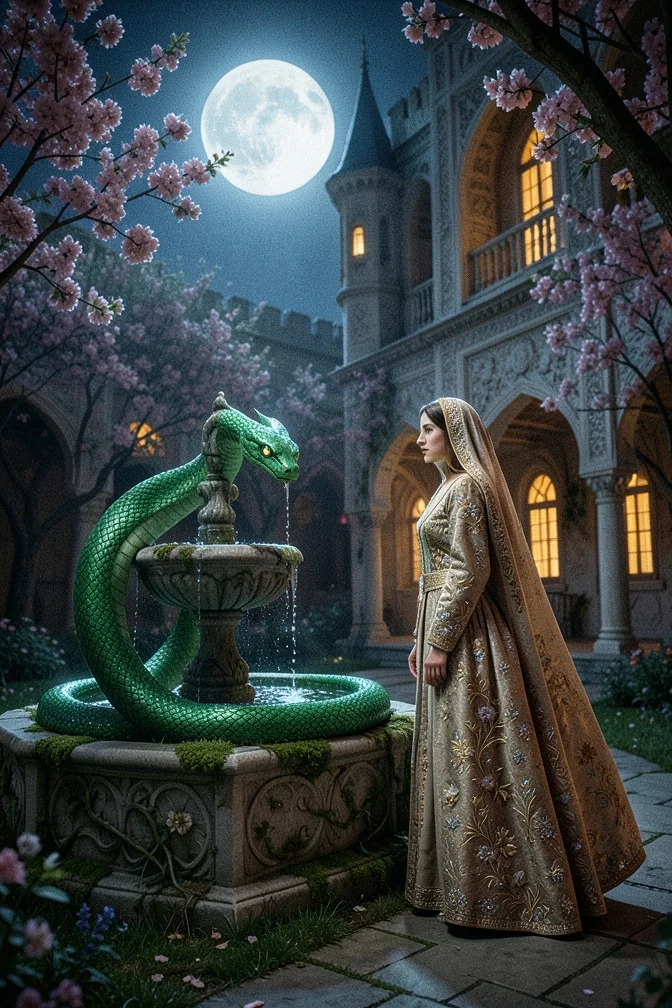
Edition and rights: Original English text from Project Gutenberg ebook #7277, marked public domain in the USA. The literary text below is reproduced without AI rewriting.
There was once upon a time a poor woman who would have given all she
possessed for a child, but she hadn’t one.

Now it happened one day that her husband went to the wood to collect
brushwood, and when he had brought it home, he discovered a pretty little
snake among the twigs.

When Sabatella, for that was the name of the peasant’s wife, saw the
little beast, she sighed deeply and said, ‘Even the snakes have their
brood; I alone am unfortunate and have no children.’ No sooner had she
said these words than, to her intense surprise, the little snake looked up
into her face and spoke: ‘Since you have no children, be a mother to me
instead, and I promise you will never repent it, for I will love you as if
I were your own son.’

At first Sabatella was frightened to death at hearing a snake speak, but
plucking up her courage, she replied, ‘If it weren’t for any other reason
than your kindly thought, I would agree to what you say, and I will love
you and look after you like a mother.’

So she gave the snake a little hole in the house for its bed, fed it with
all the nicest food she could think of, and seemed as if she never could
show it enough kindness. Day by day it grew bigger and fatter, and at last
one morning it said to Cola-Mattheo, the peasant, whom it always regarded
as its father, ‘Dear papa, I am now of a suitable age and wish to marry.’

‘I’m quite agreeable,’ answered Mattheo, ‘and I’ll do my best to find
another snake like yourself and arrange a match between you.’

‘Why, if you do that,’ replied the snake, ‘we shall be no better than the
vipers and reptiles, and that’s not what I want at all. No; I’d much
prefer to marry the King’s daughter; therefore I pray you go without
further delay, and demand an audience of the King, and tell him a snake
wishes to marry his daughter.’

Cola-Mattheo, who was rather a simpleton, went as he was desired to the
King, and having obtained an audience, he said, ‘Your Majesty, I have
often heard that people lose nothing by asking, so I have come to inform
you that a snake wants to marry your daughter, and I’d be glad to know if
you are willing to mate a dove with a serpent?’

The King, who saw at once that the man was a fool, said, in order to get
quit of him, ‘Go home and tell your friend the snake that if he can turn
this palace into ivory, inlaid with gold and silver, before to-morrow at
noon, I will let him marry my daughter.’ And with a hearty laugh he
dismissed the peasant.

When Cola-Mattheo brought this answer back to the snake, the little
creature didn’t seem the least put out, but said, ‘To-morrow morning,
before sunrise, you must go to the wood and gather a bunch of green herbs,
and then rub the threshold of the palace with them, and you’ll see what
will happen.’

Cola-Mattheo, who was, as I have said before, a great simpleton, made no
reply; but before sunrise next morning he went to the wood and gathered a
bunch of St. John’s Wort, and rosemary, and suchlike herbs, and rubbed
them, as he had been told, on the floor of the palace. Hardly had he done
so than the walls immediately turned into ivory, so richly inlaid with
gold and silver that they dazzled the eyes of all beholders. The King,
when he rose and saw the miracle that had been performed, was beside
himself with amazement, and didn’t know what in the world he was to do.

But when Cola-Mattheo came next day, and, in the name of the snake,
demanded the hand of the Princess, the King replied, ‘Don’t be in such a
hurry; if the snake really wants to marry my daughter, he must do some
more things first, and one of these is to turn all the paths and walls of
my garden into pure gold before noon to-morrow.’

When the snake was told of this new condition, he replied, ‘To-morrow
morning, early, you must go and collect all the odds and ends of rubbish
you can find in the streets, and then take them and throw them on the
paths and walls of the garden, and you’ll see then if we won’t be more
than a match for the old King.’

So Cola-Mattheo rose at cock-crow, took a large basket under his arm, and
carefully collected all the broken fragments of pots and pans, and jugs
and lamps, and other trash of that sort. No sooner had he scattered them
over the paths and walls of the King’s garden than they became one blaze
of glittering gold, so that everyone’s eyes were dazzled with the
brilliancy, and everyone’s soul was filled with wonder. The King, too, was
amazed at the sight, but still he couldn’t make up his mind to part with
his daughter, so when Cola-Mattheo came to remind him of his promise he
replied, ‘I have still a third demand to make. If the snake can turn all
the trees and fruit of my garden into precious stones, then I promise him
my daughter in marriage.’

When the peasant informed the snake what the King had said, he replied,
‘To-morrow morning, early, you must go to the market and buy all the fruit
you see there, and then sow all the stones and seeds in the palace garden,
and, if I’m not mistaken, the King will be satisfied with the result.’

Cola-Mattheo rose at dawn, and taking a basket on his arm, he went to the
market, and bought all the pomegranates, apricots, cherries, and other
fruit he could find there, and sowed the seeds and stones in the palace
garden. In one moment, the trees were all ablaze with rubies, emeralds,
diamonds, and every other precious stone you can think of.

This time the King felt obliged to keep his promise, and calling his
daughter to him, he said, ‘My dear Grannonia,’ for that was the Princess’s
name, ‘more as a joke than anything else, I demanded what seemed to me
impossibilities from your bridegroom, but now that he has done all I
required, I am bound to stick to my part of the bargain. Be a good child,
and as you love me, do not force me to break my word, but give yourself up
with as good grace as you can to a most unhappy fate.’

‘Do with me what you like, my lord and father, for your will is my law,’
answered Grannonia.

When the King heard this, he told Cola-Mattheo to bring the snake to the
palace, and said that he was prepared to receive the creature as his
son-in-law.

The snake arrived at court in a carriage made of gold and drawn by six
white elephants; but wherever it appeared on the way, the people fled in
terror at the sight of the fearful reptile.

When the snake reached the palace, all the courtiers shook and trembled
with fear down to the very scullion, and the King and Queen were in such a
state of nervous collapse that they hid themselves in a far-away turret.
Grannonia alone kept her presence of mind, and although both her father
and mother implored her to fly for her life, she wouldn’t move a step,
saying, ‘I’m certainly not going to fly from the man you have chosen for
my husband.’

As soon as the snake saw Grannonia, it wound its tail round her and kissed
her. Then, leading her into a room, it shut the door, and throwing off its
skin, it changed into a beautiful young man with golden locks, and
flashing eyes, who embraced Grannonia tenderly, and said all sorts of
pretty things to her.

When the King saw the snake shut itself into a room with his daughter, he
said to his wife, ‘Heaven be merciful to our child, for I fear it is all
over with her now. This cursed snake has most likely swallowed her up.’
Then they put their eyes to the keyhole to see what had happened.

Their amazement knew no bounds when they saw a beautiful youth standing
before their daughter with the snake’s skin lying on the floor beside him.
In their excitement they burst open the door, and seizing the skin they
threw it into the fire. But no sooner had they done this than the young
man called out, ‘Oh, wretched people! what have you done?’ and before they
had time to look round he had changed himself into a dove, and dashing
against the window he broke a pane of glass, and flew away from their
sight.

But Grannonia, who in one and the same moment saw herself merry and sad,
cheerful and despairing, rich and beggared, complained bitterly over this
robbery of her happiness, this poisoning of her cup of joy, this unlucky
stroke of fortune, and laid all the blame on her parents, though they
assured her that they had meant no harm. But the Princess refused to be
comforted, and at night, when all the inhabitants of the palace were
asleep, she stole out by a back door, disguised as a peasant woman,
determined to seek for her lost happiness till she found it. When she got
to the outskirts of the town, led by the light of the moon, she met a fox,
who offered to accompany her, an offer which Grannonia gladly accepted,
saying ‘You are most heartily welcome, for I don’t know my way at all
about the neighbourhood.’

So they went on their way together, and came at last to a wood, where,
being tired with walking, they paused to rest under the shade of a tree,
where a spring of water sported with the tender grass, refreshing it with
its crystal spray.

They laid themselves down on the green carpet and soon fell fast asleep,
and did not waken again till the sun was high in the heavens. They rose up
and stood for some time listening to the birds singing, because Grannonia
delighted in their songs.

When the fox perceived this, he said: ‘If you only understood, as I do,
what these little birds are saying, your pleasure would be even greater.’

Provoked by his words—for we all know that curiosity is as deeply
inborn in every woman as even the love of talking—Grannonia implored
the fox to tell her what the birds had said.

At first the wily fox refused to tell her what he had gathered from the
conversation of the birds, but at last he gave way to her entreaties, and
told her that they had spoken of the misfortunes of a beautiful young
Prince, whom a wicked enchantress had turned into a snake for the period
of seven years. At the end of this time he had fallen in love with a
charming Princess, but that when he had shut himself up into a room with
her, and had thrown off his snake’s skin, her parents had forced their way
into the room and had burnt the skin, whereupon the Prince, changed into
the likeness of a dove, had broken a pane of glass in trying to fly out of
the window, and had wounded himself so badly that the doctors despaired of
his life.

Grannonia, when she learnt that they were talking of her lover, asked at
once whose son he was, and if there was any hope of his recovery; to which
the fox made answer that the birds had said he was the son of the King of
Vallone Grosso, and that the only thing that could cure him was to rub the
wounds on his head with the blood of the very birds who had told the tale.

Then Grannonia knelt down before the fox, and begged him in her sweetest
way to catch the birds for her and procure their blood, promising at the
same time to reward him richly.

‘All right,’ said the fox, ‘only don’t be in such a hurry; let’s wait till
night, when the little birds have gone to roost, then I’ll climb up and
catch them all for you.’

So they passed the day, talking now of the beauty of the Prince, now of
the father of the Princess, and then of the misfortune that had happened.
At last the night arrived, and all the little birds were asleep high up on
the branches of a big tree. The fox climbed up stealthily and caught the
little creatures with his paws one after the other; and when he had killed
them all he put their blood into a little bottle which he wore at his side
and returned with it to Grannonia, who was beside herself with joy at the
result of the fox’s raid. But the fox said, ‘My dear daughter, your joy is
in vain, because, let me tell you, this blood is of no earthly use to you
unless you add some of mine to it,’ and with these words he took to his
heels.

Grannonia, who saw her hopes dashed to the ground in this cruel way, had
recourse to flattery and cunning, weapons which have often stood the sex
in good stead, and called out after the fox, ‘Father Fox, you would be
quite right to save your skin, if, in the first place, I didn’t feel I
owed so much to you, and if, in the second, there weren’t other foxes in
the world; but as you know how grateful I feel to you, and as there are
heaps of other foxes about, you can trust yourself to me. Don’t behave
like the cow that kicks the pail over after it has filled it with milk,
but continue your journey with me, and when we get to the capital you can
sell me to the King as a servant girl.’

It never entered the fox’s head that even foxes can be outwitted, so after
a bit he consented to go with her; but he hadn’t gone far before the
cunning girl seized a stick, and gave him such a blow with it on the head,
that he dropped down dead on the spot. Then Grannonia took some of his
blood and poured it into her little bottle; and went on her way as fast as
she could to Vallone Grosso.

When she arrived there she went straight to the Royal palace, and let the
King be told she had come to cure the young Prince.

The King commanded her to be brought before him at once, and was much
astonished when he saw that it was a girl who undertook to do what all the
cleverest doctors of his kingdom had failed in. As an attempt hurts no
one, he willingly consented that she should do what she could.

‘All I ask,’ said Grannonia, ‘is that, should I succeed in what you
desire, you will give me your son in marriage.’

The King, who had given up all hopes of his son’s recovery, replied: ‘Only
restore him to life and health and he shall be yours. It is only fair to
give her a husband who gives me a son.’

And so they went into the Prince’s room. The moment Grannonia had rubbed
the blood on his wounds the illness left him, and he was as sound and well
as ever. When the King saw his son thus marvellously restored to life and
health, he turned to him and said: ‘My dear son, I thought of you as dead,
and now, to my great joy and amazement, you are alive again. I promised
this young woman that if she should cure you, to bestow your hand and
heart on her, and seeing that Heaven has been gracious, you must fulfil
the promise I made her; for gratitude alone forces me to pay this debt.’

But the Prince answered: ‘My lord and father, I would that my will were as
free as my love for you is great. But as I have plighted my word to
another maiden, you will see yourself, and so will this young woman, that
I cannot go back from my word, and be faithless to her whom I love.’

When Grannonia heard these words, and saw how deeply rooted the Prince’s
love for her was, she felt very happy, and blushing rosy red, she said:
‘But should I get the other lady to give up her rights, would you then
consent to marry me?’

‘Far be it from me,’ replied the Prince, ‘to banish the beautiful picture
of my love from my heart. Whatever she may say, my heart and desire will
remain the same, and though I were to lose my life for it, I couldn’t
consent to this exchange.’

Grannonia could keep silence no longer, and throwing off her peasant’s
disguise, she discovered herself to the Prince, who was nearly beside
himself with joy when he recognised his fair lady-love. He then told his
father at once who she was, and what she had done and suffered for his
sake.

Then they invited the King and Queen of Starza-Longa to their Court, and
had a great wedding feast, and proved once more that there is no better
seasoning for the joys of true love than a few pangs of grief.
1 / 1


