
THE ENCHANTED WATCH
Read THE ENCHANTED WATCH, a public-domain fantasy story in the original English.
By Various; edited by Andrew Lang
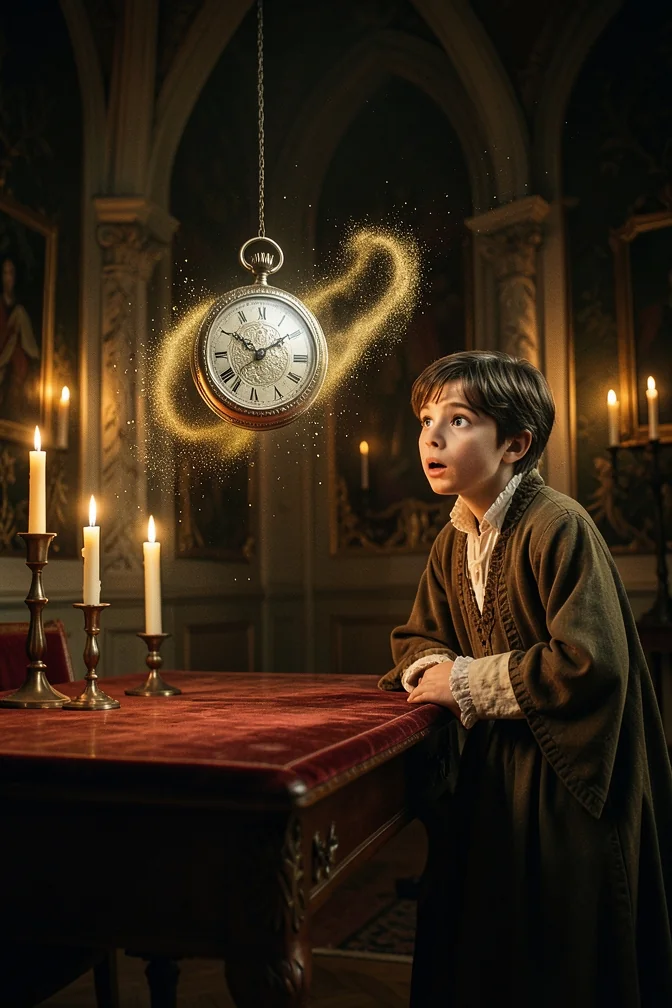
Edition and rights: Original English text from Project Gutenberg ebook #7277, marked public domain in the USA. The literary text below is reproduced without AI rewriting.
Once upon a time there lived a rich man who had three sons. When they grew
up, he sent the eldest to travel and see the world, and three years passed
before his family saw him again. Then he returned, magnificently dressed,
and his father was so delighted with his behaviour, that he gave a great
feast in his honour, to which all the relations and friends were invited.

When the rejoicings were ended, the second son begged leave of his father
to go in his turn to travel and mix with the world. The father was
enchanted at the request, and gave him plenty of money for his expenses,
saying, ‘If you behave as well as your brother, I will do honour to you as
I did to him.’ The young man promised to do his best, and his conduct
during three years was all that it should be. Then he went home, and his
father was so pleased with him that his feast of welcome was even more
splendid than the one before.

The third brother, whose name was Jenik, or Johnnie, was considered the
most foolish of the three. He never did anything at home except sit over
the stove and dirty himself with the ashes; but he also begged his
father’s leave to travel for three years. ‘Go if you like, you idiot; but
what good will it do you?’

The youth paid no heed to his father’s observations as long as he obtained
permission to go. The father saw him depart with joy, glad to get rid of
him, and gave him a handsome sum of money for his needs.

Once, as he was making one of his journeys, Jenik chanced to cross a
meadow where some shepherds were just about to kill a dog. He entreated
them to spare it, and to give it to him instead which they willingly did,
and he went on his way, followed by the dog. A little further on he came
upon a cat, which someone was going to put to death. He implored its life,
and the cat followed him. Finally, in another place, he saved a serpent,
which was also handed over to him and now they made a party of four—the
dog behind Jenik, the cat behind the dog, and the serpent behind the cat.

Then the serpent said to Jenik, ‘Go wherever you see me go,’ for in the
autumn, when all the serpents hide themselves in their holes, this serpent
was going in search of his king, who was king of all the snakes.

Then he added: ‘My king will scold me for my long absence, everyone else
is housed for the winter, and I am very late. I shall have to tell him
what danger I have been in, and how, without your help, I should certainly
have lost my life. The king will ask what you would like in return, and be
sure you beg for the watch which hangs on the wall. It has all sorts of
wonderful properties, you only need to rub it to get whatever you like.’

No sooner said than done. Jenik became the master of the watch, and the
moment he got out he wished to put its virtues to the proof. He was
hungry, and thought it would be delightful to eat in the meadow a loaf of
new bread and a steak of good beef washed down by a flask of wine, so he
scratched the watch, and in an instant it was all before him. Imagine his
joy!

Evening soon came, and Jenik rubbed his watch, and thought it would be
very pleasant to have a room with a comfortable bed and a good supper. In
an instant they were all before him. After supper he went to bed and slept
till morning, as every honest man ought to do. Then he set forth for his
father’s house, his mind dwelling on the feast that would be awaiting him.
But as he returned in the same old clothes in which he went away, his
father flew into a great rage, and refused to do anything for him. Jenik
went to his old place near the stove, and dirtied himself in the ashes
without anybody minding.

The third day, feeling rather dull, he thought it would be nice to see a
three-story house filled with beautiful furniture, and with vessels of
silver and gold. So he rubbed the watch, and there it all was. Jenik went
to look for his father, and said to him: ‘You offered me no feast of
welcome, but permit me to give one to you, and come and let me show you my
plate.’

The father was much astonished, and longed to know where his son had got
all this wealth. Jenik did not reply, but begged him to invite all their
relations and friends to a grand banquet.

So the father invited all the world, and everyone was amazed to see such
splendid things, so much plate, and so many fine dishes on the table.
After the first course Jenik prayed his father to invite the King, and his
daughter the Princess. He rubbed his watch and wished for a carriage
ornamented with gold and silver, and drawn by six horses, with harness
glittering with precious stones. The father did not dare to sit in this
gorgeous coach, but went to the palace on foot. The King and his daughter
were immensely surprised with the beauty of the carriage, and mounted the
steps at once to go to Jenik’s banquet. Then Jenik rubbed his watch
afresh, and wished that for six miles the way to the house should be paved
with marble. Who ever felt so astonished as the King? Never had he
travelled over such a gorgeous road.

When Jenik heard the wheels of the carriage, he rubbed his watch and
wished for a still more beautiful house, four stories high, and hung with
gold, silver, and damask; filled with wonderful tables, covered with
dishes such as no king had ever eaten before. The King, the Queen, and the
Princess were speechless with surprise. Never had they seen such a
splendid palace, nor such a high feast! At dessert the King asked Jenik’s
father to give him the young man for a son-in-law. No sooner said than
done! The marriage took place at once, and the King returned to his own
palace, and left Jenik with his wife in the enchanted house.

Now Jenik was not a very clever man, and at the end of a very short time
he began to bore his wife. She inquired how he managed to build palaces
and to get so many precious things. He told her all about the watch, and
she never rested till she had stolen the precious talisman. One night she
took the watch, rubbed it, and wished for a carriage drawn by four horses;
and in this carriage she at once set out for her father’s palace. There
she called to her own attendants, bade them follow her into the carriage,
and drove straight to the sea-side. Then she rubbed her watch, and wished
that the sea might be crossed by a bridge, and that a magnificent palace
might arise in the middle of the sea. No sooner said than done. The
Princess entered the house, rubbed her watch, and in an instant the bridge
was gone.

Left alone, Jenik felt very miserable. His father, mother, and brothers,
and, indeed, everybody else, all laughed at him. Nothing remained to him
but the cat and dog whose lives he had once saved. He took them with him
and went far away, for he could no longer live with his family. He reached
at last a great desert, and saw some crows flying towards a mountain. One
of them was a long way behind, and when he arrived his brothers inquired
what had made him so late. ‘Winter is here,’ they said, ‘and it is time to
fly to other countries.’ He told them that he had seen in the middle of
the sea the most wonderful house that ever was built.

On hearing this, Jenik at once concluded that this must be the
hiding-place of his wife. So he proceeded directly to the shore with his
dog and his cat. When he arrived on the beach, he said to the dog: ‘You
are an excellent swimmer, and you, little one, are very light; jump on the
dog’s back and he will take you to the palace. Once there, he will hide
himself near the door, and you must steal secretly in and try to get hold
of my watch.’

No sooner said than done. The two animals crossed the sea; the dog hid
near the house, and the cat stole into the chamber. The Princess
recognised him, and guessed why he had come; and she took the watch down
to the cellar and locked it in a box. But the cat wriggled its way into
the cellar, and the moment the Princess turned her back, he scratched and
scratched till he had made a hole in the box. Then he took the watch
between his teeth, and waited quietly till the Princess came back.
Scarcely had she opened the door when the cat was outside, and the watch
into the bargain.

The cat was no sooner beyond the gates than she said to the dog:

‘We are going to cross the sea; be very careful not to speak to me.’

The dog laid this to heart and said nothing; but when they approached the
shore he could not help asking, ‘Have you got the watch?’

The cat did not answer—he was afraid that he might let the talisman
fall. When they touched the shore the dog repeated his question.

‘Yes,’ said the cat.

And the watch fell into the sea. Then our two friends began each to accuse
the other, and both looked sorrowfully at the place where their treasure
had fallen in. Suddenly a fish appeared near the edge of the sea. The cat
seized it, and thought it would make them a good supper.

‘I have nine little children,’ cried the fish. ‘Spare the father of a
family!’

‘Granted,’ replied the cat; ‘but on condition that you find our watch.’

The fish executed his commission, and they brought the treasure back to
their master. Jenik rubbed the watch and wished that the palace, with the
Princess and all its inhabitants, should be swallowed up in the sea. No
sooner said than done. Jenik returned to his parents, and he and his
watch, his cat and his dog, lived together happily to the end of their
days.

Deulin.
1 / 1


