
The Quest of the Queen's Tears
Read The Quest of the Queen's Tears by Lord Dunsany in the original English.
By Lord Dunsany
Edition: Complete story in the original English, from Project Gutenberg #7477. No translation or AI rewriting of the literary text. Original spelling retained.
This eBook is for the use of anyone anywhere in the United States and most other parts of the world at no cost and with almost no restrictions whatsoever. You may copy it, give it away or re-use it under the terms of the Project Gutenberg License included with this eBook or online at www.gutenberg.org. If you are not located in the United States, you will have to check the laws of the country where you are located before using this eBook.
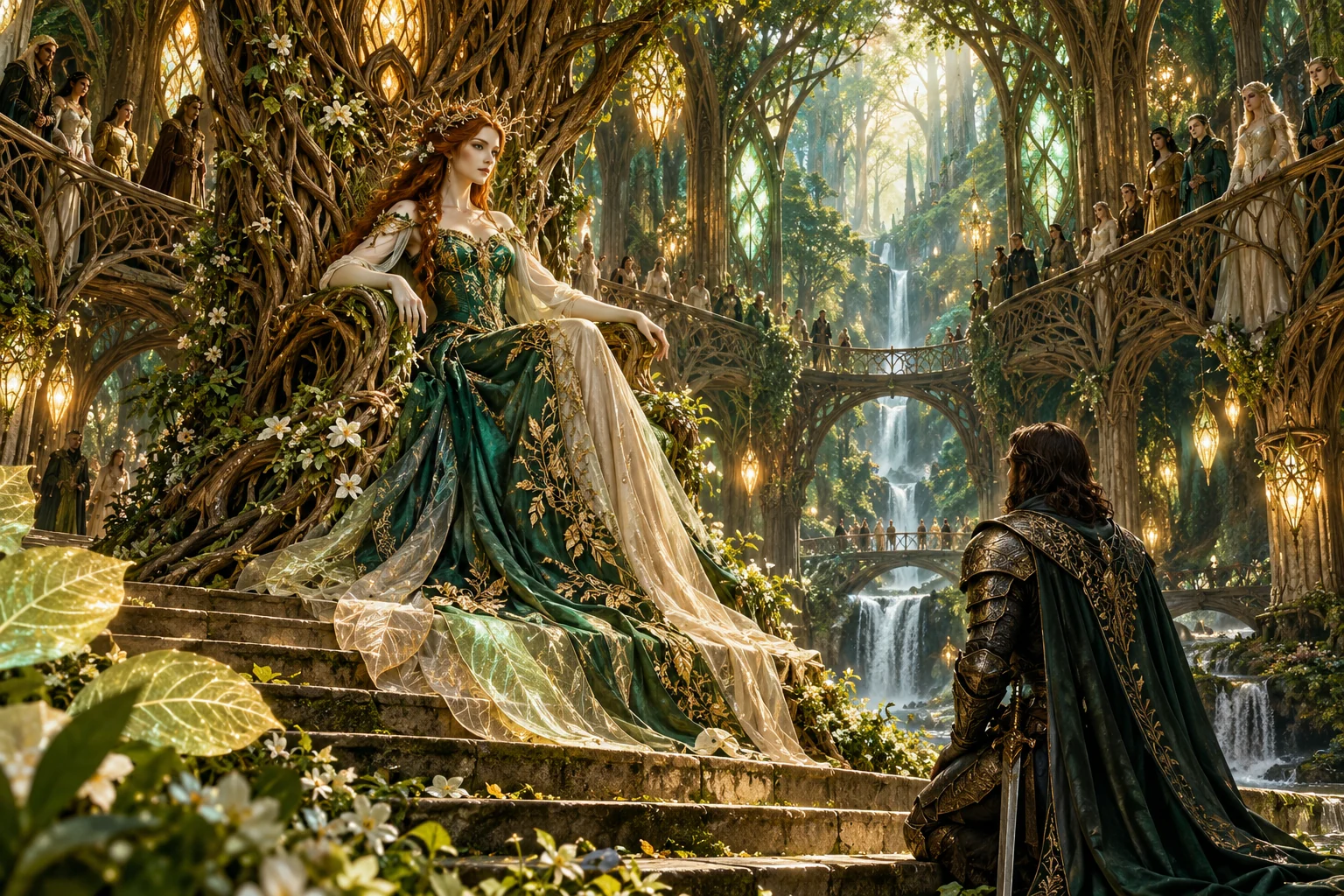
Sylvia, Queen of the Woods, in her woodland palace, held court, and made a mockery of her suitors. She would sing to them, she said, she would give them banquets, she would tell them tales of legendary days, her jugglers should caper before them, her armies salute them, her fools crack jests with them and make whimsical quips, only she could not love them.
This was not the way, they said, to treat princes in their splendour and mysterious troubadours concealing kingly names; it was not in accordance with fable; myth had no precedent for it. She should have thrown her glove, they said, into some lion’s den, she should have asked for a score of venomous heads of the serpents of Licantara, or demanded the death of any notable dragon, or sent them all upon some deadly quest, but that she could not love them–! It was unheard of–it had no parallel in the annals of romance.
And then she said that if they must needs have a quest she would offer her hand to him who first should move her to tears: and the quest should be called, for reference in histories or song, the Quest of the Queen’s Tears, and he that achieved them she would wed, be he only a petty duke of lands unknown to romance.
And many were moved to anger, for they hoped for some bloody quest; but the old lords chamberlain said, as they muttered among themselves in a far, dark end of the chamber, that the quest was hard and wise, for that if she could ever weep she might also love. They had known her all her childhood; she had never sighed. Many men had she seen, suitors and courtiers, and had never turned her head after one went by. Her beauty was as still sunsets of bitter evenings when all the world is frore, a wonder and a chill. She was as a sun-stricken mountain uplifted alone, all beautiful with ice, a desolate and lonely radiance late at evening far up beyond the comfortable world, not quite to be companioned by the stars, the doom of the mountaineer.
If she could weep, they said, she could love, they said.
And she smiled pleasantly on those ardent princes, and troubadours concealing kingly names.
Then one by one they told, each suitor prince the story of his love, with outstretched hands and kneeling on the knee; and very sorry and pitiful were the tales, so that often up in the galleries some maid of the palace wept. And very graciously she nodded her head like a listless magnolia in the deeps of the night moving idly to all the breezes its glorious bloom.
And when the princes had told their desperate loves and had departed away with no other spoil than of their own tears only, even then there came the unknown troubadours and told their tales in song, concealing their gracious names.
And there was one, Ackronnion, clothed with rags, on which was the dust of roads, and underneath the rags was war-scarred armour whereon were the dints of blows; and when he stroked his harp and sang his song, in the gallery above maidens wept, and even old lords chamberlain whimpered among themselves and thereafter laughed through their tears and said: “It is easy to make old people weep and to bring idle tears from lazy girls; but he will not set a-weeping the Queen of the Woods.”
And graciously she nodded, and he was the last. And disconsolate went away those dukes and princes, and troubadours in disguise. Yet Ackronnion pondered as he went away.
King he was of Afarmah, Lool and Haf, over-lord of Zeroora and hilly Chang, and duke of the dukedoms of Molong and Mlash, none of them unfamiliar with romance or unknown or overlooked in the making of myth. He pondered as he went in his thin disguise.
Now by those that do not remember their childhood, having other things to do, be it understood that underneath fairyland, which is, as all men know, at the edge of the world, there dwelleth the Gladsome Beast. A synonym he for joy.
It is known how the lark in its zenith, children at play out-of-doors, good witches and jolly old parents have all been compared–how aptly!–with this very same Gladsome Beast. Only one “crab” he has (if I may use slang for a moment to make myself perfectly clear), only one drawback, and that is that in the gladness of his heart he spoils the cabbages of the Old Man Who Looks After Fairyland,–and of course he eats men.
It must further be understood that whoever may obtain the tears of the Gladsome Beast in a bowl, and become drunken upon them, may move all persons to shed tears of joy so long as he remains inspired by the potion to sing or to make music.
Now Ackronnion pondered in this wise: that if he could obtain the tears of the Gladsome Beast by means of his art, withholding him from violence by the spell of music, and if a friend should slay the Gladsome Beast before his weeping ceased–for an end must come to weeping even with men–that so he might get safe away with the tears, and drink them before the Queen of the Woods and move her to tears of joy. He sought out therefore a humble knightly man who cared not for the beauty of Sylvia, Queen of the Woods, but had found a woodland maiden of his own once long ago in summer. And the man’s name was Arrath, a subject of Ackronnion, a knight-at-arms of the spear-guard: and together they set out through the fields of fable until they came to Fairyland, a kingdom sunning itself (as all men know) for leagues along the edges of the world. And by a strange old pathway they came to the land they sought, through a wind blowing up the pathway sheer from space with a kind of metallic taste from the roving stars. Even so they came to the windy house of thatch where dwells the Old Man Who Looks After Fairyland sitting by parlour windows that look away from the world. He made them welcome in his star-ward parlour, telling them tales of Space, and when they named to him their perilous quest he said it would be a charity to kill the Gladsome Beast; for he was clearly one of those that liked not its happy ways. And then he took them out through his back door, for the front door had no pathway nor even a step–from it the old man used to empty his slops sheer on to the Southern Cross–and so they came to the garden wherein his cabbages were, and those flowers that only blow in Fairyland, turning their faces always towards the comet, and he pointed them out the way to the place he called Underneath, where the Gladsome Beast had his lair. Then they manoeuvred. Ackronnion was to go by the way of the steps with his harp and an agate bowl, while Arrath went round by a crag on the other side. Then the Old Man Who Looks After Fairyland went back to his windy house, muttering angrily as he passed his cabbages, for he did not love the ways of the Gladsome Beast; and the two friends parted on their separate ways.
Nothing perceived them but that ominous crow glutted overlong already upon the flesh of man.
The wind blew bleak from the stars.
At first there was dangerous climbing, and then Ackronnion gained the smooth, broad steps that led from the edge to the lair, and at that moment heard at the top of the steps the continuous chuckles of the Gladsome Beast.
He feared then that its mirth might be insuperable, not to be saddened by the most grievous song; nevertheless he did not turn back then, but softly climbed the stairs and, placing the agate bowl upon a step, struck up the chaunt called Dolorous. It told of desolate, regretted things befallen happy cities long since in the prime of the world. It told of how the gods and beasts and men had long ago loved beautiful companions, and long ago in vain. It told of the golden host of happy hopes, but not of their achieving. It told how Love scorned Death, but told of Death’s laughter. The contented chuckles of the Gladsome Beast suddenly ceased in his lair. He rose and shook himself. He was still unhappy. Ackronnion still sang on the chaunt called Dolorous. The Gladsome Beast came mournfully up to him. Ackronnion ceased not for the sake of his panic, but still sang on. He sang of the malignity of time. Two tears welled large in the eyes of the Gladsome Beast. Ackronnion moved the agate bowl to a suitable spot with his foot. He sang of autumn and of passing away. Then the beast wept as the frore hills weep in the thaw, and the tears splashed big into the agate bowl. Ackronnion desperately chaunted on; he told of the glad unnoticed things men see and do not see again, of sunlight beheld unheeded on faces now withered away. The bowl was full. Ackronnion was desperate: the Beast was so close. Once he thought that its mouth was watering!–but it was only the tears that had run on the lips of the Beast. He felt as a morsel! The Beast was ceasing to weep! He sang of worlds that had disappointed the gods. And all of a sudden, crash! and the staunch spear of Arrath went home behind the shoulder, and the tears and the joyful ways of the Gladsome Beast were ended and over for ever.
And carefully they carried the bowl of tears away, leaving the body of the Gladsome Beast as a change of diet for the ominous crow; and going by the windy house of thatch they said farewell to the Old Man Who Looks After Fairyland, who when he heard of the deed rubbed his hands together and mumbled again and again, “And a very good thing, too. My cabbages! My cabbages!”
And not long after Ackronnion sang again in the sylvan palace of the Queen of the Woods, having first drunk all the tears in his agate bowl. And it was a gala night, and all the court were there and ambassadors from the lands of legend and myth, and even some from Terra Cognita.
And Ackronnion sang as he never sang before, and will not sing again. O, but dolorous, dolorous, are all the ways of man, few and fierce are his days, and the end trouble, and vain, vain his endeavour: and woman–who shall tell of it?–her doom is written with man’s by listless, careless gods with their faces to other spheres.
Somewhat thus he began, and then inspiration seized him, and all the trouble in the beauty of his song may not be set down by me: there was much of gladness in it, and all mingled with grief: it was like the way of man: it was like our destiny.
Sobs arose at his song, sighs came back along echoes: seneschals, soldiers, sobbed, and a clear cry made the maidens; like rain the tears came down from gallery to gallery.
All round the Queen of the Woods was a storm of sobbing and sorrow.
But no, she would not weep.
Source and edition terms: https://www.gutenberg.org/ebooks/7477 · Project Gutenberg License. Original-language text; original publisher illustrations are not reproduced.
Source acknowledgements and license
START: FULL LICENSE
THE FULL PROJECT GUTENBERG™ LICENSE
PLEASE READ THIS BEFORE YOU DISTRIBUTE OR USE THIS WORK
To protect the Project Gutenberg™ mission of promoting the free distribution of electronic works, by using or distributing this work (or any other work associated in any way with the phrase “Project Gutenberg”), you agree to comply with all the terms of the Full Project Gutenberg License available with this file or online at www.gutenberg.org/license.
Section 1. General Terms of Use and Redistributing Project Gutenberg electronic works
1.A. By reading or using any part of this Project Gutenberg electronic work, you indicate that you have read, understand, agree to and accept all the terms of this license and intellectual property (trademark/copyright) agreement. If you do not agree to abide by all the terms of this agreement, you must cease using and return or destroy all copies of Project Gutenberg electronic works in your possession. If you paid a fee for obtaining a copy of or access to a Project Gutenberg electronic work and you do not agree to be bound by the terms of this agreement, you may obtain a refund from the person or entity to whom you paid the fee as set forth in paragraph 1.E.8.
1.B. “Project Gutenberg” is a registered trademark. It may only be used on or associated in any way with an electronic work by people who agree to be bound by the terms of this agreement. There are a few things that you can do with most Project Gutenberg electronic works even without complying with the full terms of this agreement. See paragraph 1.C below. There are a lot of things you can do with Project Gutenberg electronic works if you follow the terms of this agreement and help preserve free future access to Project Gutenberg electronic works. See paragraph 1.E below.
1.C. The Project Gutenberg Literary Archive Foundation (“the Foundation” or PGLAF), owns a compilation copyright in the collection of Project Gutenberg electronic works. Nearly all the individual works in the collection are in the public domain in the United States. If an individual work is unprotected by copyright law in the United States and you are located in the United States, we do not claim a right to prevent you from copying, distributing, performing, displaying or creating derivative works based on the work as long as all references to Project Gutenberg are removed. Of course, we hope that you will support the Project Gutenberg mission of promoting free access to electronic works by freely sharing Project Gutenberg works in compliance with the terms of this agreement for keeping the Project Gutenberg name associated with the work. You can easily comply with the terms of this agreement by keeping this work in the same format with its attached full Project Gutenberg License when you share it without charge with others.
1.D. The copyright laws of the place where you are located also govern what you can do with this work. Copyright laws in most countries are in a constant state of change. If you are outside the United States, check the laws of your country in addition to the terms of this agreement before downloading, copying, displaying, performing, distributing or creating derivative works based on this work or any other Project Gutenberg work. The Foundation makes no representations concerning the copyright status of any work in any country other than the United States.
1.E. Unless you have removed all references to Project Gutenberg:
1.E.1. The following sentence, with active links to, or other immediate access to, the full Project Gutenberg License must appear prominently whenever any copy of a Project Gutenberg work (any work on which the phrase “Project Gutenberg” appears, or with which the phrase “Project Gutenberg” is associated) is accessed, displayed, performed, viewed, copied or distributed:
This eBook is for the use of anyone anywhere in the United States and most
other parts of the world at no cost and with almost no restrictions
whatsoever. You may copy it, give it away or re-use it under the terms
of the Project Gutenberg™ License included with this eBook or online
at www.gutenberg.org. If you
are not located in the United States, you will have to check the laws
of the country where you are located before using this eBook.
1.E.2. If an individual Project Gutenberg electronic work is derived from texts not protected by U.S. copyright law (does not contain a notice indicating that it is posted with permission of the copyright holder), the work can be copied and distributed to anyone in the United States without paying any fees or charges. If you are redistributing or providing access to a work with the phrase “Project Gutenberg” associated with or appearing on the work, you must comply either with the requirements of paragraphs 1.E.1 through 1.E.7 or obtain permission for the use of the work and the Project Gutenberg trademark as set forth in paragraphs 1.E.8 or 1.E.9.
1.E.3. If an individual Project Gutenberg electronic work is posted with the permission of the copyright holder, your use and distribution must comply with both paragraphs 1.E.1 through 1.E.7 and any additional terms imposed by the copyright holder. Additional terms will be linked to the Project Gutenberg License for all works posted with the permission of the copyright holder found at the beginning of this work.
1.E.4. Do not unlink or detach or remove the full Project Gutenberg License terms from this work, or any files containing a part of this work or any other work associated with Project Gutenberg.
1.E.5. Do not copy, display, perform, distribute or redistribute this electronic work, or any part of this electronic work, without prominently displaying the sentence set forth in paragraph 1.E.1 with active links or immediate access to the full terms of the Project Gutenberg License.
1.E.6. You may convert to and distribute this work in any binary, compressed, marked up, nonproprietary or proprietary form, including any word processing or hypertext form. However, if you provide access to or distribute copies of a Project Gutenberg work in a format other than “Plain Vanilla ASCII” or other format used in the official version posted on the official Project Gutenberg website (www.gutenberg.org), you must, at no additional cost, fee or expense to the user, provide a copy, a means of exporting a copy, or a means of obtaining a copy upon request, of the work in its original “Plain Vanilla ASCII” or other form. Any alternate format must include the full Project Gutenberg License as specified in paragraph 1.E.1.
1.E.7. Do not charge a fee for access to, viewing, displaying, performing, copying or distributing any Project Gutenberg works unless you comply with paragraph 1.E.8 or 1.E.9.
1.E.8. You may charge a reasonable fee for copies of or providing access to or distributing Project Gutenberg electronic works provided that:
• You pay a royalty fee of 20% of the gross profits you derive from
    the use of Project Gutenberg works calculated using the method
    you already use to calculate your applicable taxes. The fee is owed
    to the owner of the Project Gutenberg trademark, but he has
    agreed to donate royalties under this paragraph to the Project
    Gutenberg Literary Archive Foundation. Royalty payments must be paid
    within 60 days following each date on which you prepare (or are
    legally required to prepare) your periodic tax returns. Royalty
    payments should be clearly marked as such and sent to the Project
    Gutenberg Literary Archive Foundation at the address specified in
    Section 4, “Information about donations to the Project Gutenberg
    Literary Archive Foundation.”

• You provide a full refund of any money paid by a user who notifies
    you in writing (or by e-mail) within 30 days of receipt that s/he
    does not agree to the terms of the full Project Gutenberg™
    License. You must require such a user to return or destroy all
    copies of the works possessed in a physical medium and discontinue
    all use of and all access to other copies of Project Gutenberg™
    works.

• You provide, in accordance with paragraph 1.F.3, a full refund of
    any money paid for a work or a replacement copy, if a defect in the
    electronic work is discovered and reported to you within 90 days of
    receipt of the work.

• You comply with all other terms of this agreement for free
    distribution of Project Gutenberg™ works.
1.E.9. If you wish to charge a fee or distribute a Project Gutenberg™ electronic work or group of works on different terms than are set forth in this agreement, you must obtain permission in writing from the Project Gutenberg Literary Archive Foundation, the manager of the Project Gutenberg™ trademark. Contact the Foundation as set forth in Section 3 below.
1.F.
1.F.1. Project Gutenberg volunteers and employees expend considerable effort to identify, do copyright research on, transcribe and proofread works not protected by U.S. copyright law in creating the Project Gutenberg™ collection. Despite these efforts, Project Gutenberg™ electronic works, and the medium on which they may be stored, may contain “Defects,” such as, but not limited to, incomplete, inaccurate or corrupt data, transcription errors, a copyright or other intellectual property infringement, a defective or damaged disk or other medium, a computer virus, or computer codes that damage or cannot be read by your equipment.
1.F.2. LIMITED WARRANTY, DISCLAIMER OF DAMAGES - Except for the “Right of Replacement or Refund” described in paragraph 1.F.3, the Project Gutenberg Literary Archive Foundation, the owner of the Project Gutenberg™ trademark, and any other party distributing a Project Gutenberg™ electronic work under this agreement, disclaim all liability to you for damages, costs and expenses, including legal fees. YOU AGREE THAT YOU HAVE NO REMEDIES FOR NEGLIGENCE, STRICT LIABILITY, BREACH OF WARRANTY OR BREACH OF CONTRACT EXCEPT THOSE PROVIDED IN PARAGRAPH 1.F.3. YOU AGREE THAT THE FOUNDATION, THE TRADEMARK OWNER, AND ANY DISTRIBUTOR UNDER THIS AGREEMENT WILL NOT BE LIABLE TO YOU FOR ACTUAL, DIRECT, INDIRECT, CONSEQUENTIAL, PUNITIVE OR INCIDENTAL DAMAGES EVEN IF YOU GIVE NOTICE OF THE POSSIBILITY OF SUCH DAMAGE.
1.F.3. LIMITED RIGHT OF REPLACEMENT OR REFUND - If you discover a defect in this electronic work within 90 days of receiving it, you can receive a refund of the money (if any) you paid for it by sending a written explanation to the person you received the work from. If you received the work on a physical medium, you must return the medium with your written explanation. The person or entity that provided you with the defective work may elect to provide a replacement copy in lieu of a refund. If you received the work electronically, the person or entity providing it to you may choose to give you a second opportunity to receive the work electronically in lieu of a refund. If the second copy is also defective, you may demand a refund in writing without further opportunities to fix the problem.
1.F.4. Except for the limited right of replacement or refund set forth in paragraph 1.F.3, this work is provided to you ‘AS-IS’, WITH NO OTHER WARRANTIES OF ANY KIND, EXPRESS OR IMPLIED, INCLUDING BUT NOT LIMITED TO WARRANTIES OF MERCHANTABILITY OR FITNESS FOR ANY PURPOSE.
1.F.5. Some states do not allow disclaimers of certain implied warranties or the exclusion or limitation of certain types of damages. If any disclaimer or limitation set forth in this agreement violates the law of the state applicable to this agreement, the agreement shall be interpreted to make the maximum disclaimer or limitation permitted by the applicable state law. The invalidity or unenforceability of any provision of this agreement shall not void the remaining provisions.
1.F.6. INDEMNITY - You agree to indemnify and hold the Foundation, the trademark owner, any agent or employee of the Foundation, anyone providing copies of Project Gutenberg™ electronic works in accordance with this agreement, and any volunteers associated with the production, promotion and distribution of Project Gutenberg™ electronic works, harmless from all liability, costs and expenses, including legal fees, that arise directly or indirectly from any of the following which you do or cause to occur: (a) distribution of this or any Project Gutenberg work, (b) alteration, modification, or additions or deletions to any Project Gutenberg work, and (c) any Defect you cause.
Section 2. Information about the Mission of Project Gutenberg
Project Gutenberg is synonymous with the free distribution of electronic works in formats readable by the widest variety of computers including obsolete, old, middle-aged and new computers. It exists because of the efforts of hundreds of volunteers and donations from people in all walks of life.
Volunteers and financial support to provide volunteers with the assistance they need are critical to reaching Project Gutenberg’s goals and ensuring that the Project Gutenberg collection will remain freely available for generations to come. In 2001, the Project Gutenberg Literary Archive Foundation was created to provide a secure and permanent future for Project Gutenberg and future generations. To learn more about the Project Gutenberg Literary Archive Foundation and how your efforts and donations can help, see Sections 3 and 4 and the Foundation information page at www.gutenberg.org.
Section 3. Information about the Project Gutenberg Literary Archive Foundation
The Project Gutenberg Literary Archive Foundation is a non-profit 501(c)(3) educational corporation organized under the laws of the state of Mississippi and granted tax exempt status by the Internal Revenue Service. The Foundation’s EIN or federal tax identification number is 64-6221541. Contributions to the Project Gutenberg Literary Archive Foundation are tax deductible to the full extent permitted by U.S. federal laws and your state’s laws.
The Foundation’s business office is located at 41 Watchung Plaza #516, Montclair NJ 07042, USA, +1 (862) 621-9288. Email contact links and up to date contact information can be found at the Foundation’s website and official page at www.gutenberg.org/contact
Section 4. Information about Donations to the Project Gutenberg Literary Archive Foundation
Project Gutenberg™ depends upon and cannot survive without widespread public support and donations to carry out its mission of increasing the number of public domain and licensed works that can be freely distributed in machine-readable form accessible by the widest array of equipment including outdated equipment. Many small donations ($1 to $5,000) are particularly important to maintaining tax exempt status with the IRS.
The Foundation is committed to complying with the laws regulating charities and charitable donations in all 50 states of the United States. Compliance requirements are not uniform and it takes a considerable effort, much paperwork and many fees to meet and keep up with these requirements. We do not solicit donations in locations where we have not received written confirmation of compliance. To SEND DONATIONS or determine the status of compliance for any particular state visit www.gutenberg.org/donate.
While we cannot and do not solicit contributions from states where we have not met the solicitation requirements, we know of no prohibition against accepting unsolicited donations from donors in such states who approach us with offers to donate.
International donations are gratefully accepted, but we cannot make any statements concerning tax treatment of donations received from outside the United States. U.S. laws alone swamp our small staff.
Please check the Project Gutenberg web pages for current donation methods and addresses. Donations are accepted in a number of other ways including checks, online payments and credit card donations. To donate, please visit: www.gutenberg.org/donate.
Section 5. General Information About Project Gutenberg electronic works
Professor Michael S. Hart was the originator of the Project Gutenberg concept of a library of electronic works that could be freely shared with anyone. For forty years, he produced and distributed Project Gutenberg eBooks with only a loose network of volunteer support.
Project Gutenberg eBooks are often created from several printed editions, all of which are confirmed as not protected by copyright in the U.S. unless a copyright notice is included. Thus, we do not necessarily keep eBooks in compliance with any particular paper edition.
Most people start at our website which has the main PG search facility: www.gutenberg.org.
This website includes information about Project Gutenberg, including how to make donations to the Project Gutenberg Literary Archive Foundation, how to help produce our new eBooks, and how to subscribe to our email newsletter to hear about new eBooks.


