
THE STEADFAST TIN-SOLDIER
Read THE STEADFAST TIN-SOLDIER, a public-domain fantasy story in the original English.
By Various; edited by Andrew Lang
Edition and rights: Original English text from Project Gutenberg ebook #640, marked public domain in the USA. The literary text below is reproduced without AI rewriting.
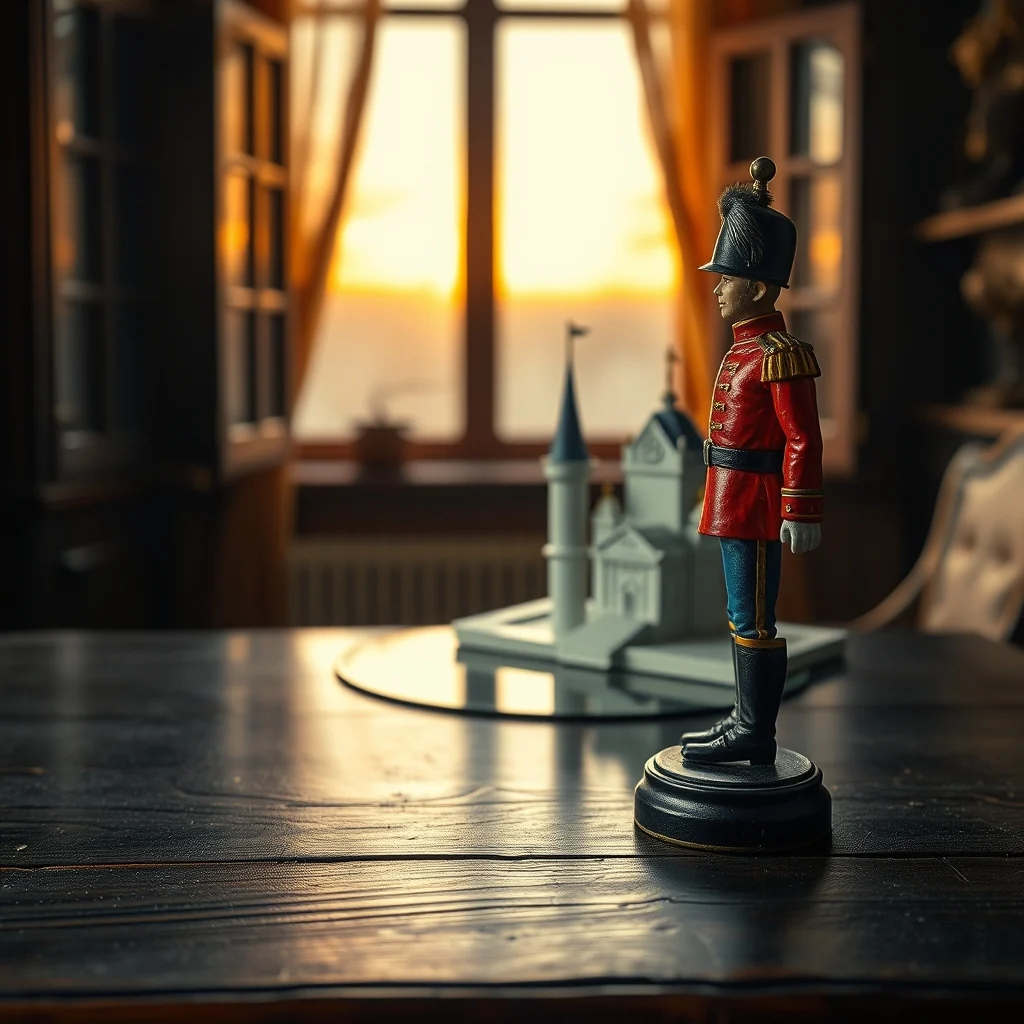
There were once upon a time five-and twenty tin-soldiers—all
brothers, as they were made out of the same old tin spoon. Their uniform
was red and blue, and they shouldered their guns and looked straight in
front of them. The first words that they heard in this world, when the lid
of the box in which they lay was taken off, were: ‘Hurrah, tin-soldiers!’
This was exclaimed by a little boy, clapping his hands; they had been
given to him because it was his birthday, and now he began setting them
out on the table. Each soldier was exactly like the other in shape, except
just one, who had been made last when the tin had run short; but there he
stood as firmly on his one leg as the others did on two, and he is the one
that became famous.

There were many other playthings on the table on which they were being set
out, but the nicest of all was a pretty little castle made of cardboard,
with windows through which you could see into the rooms. In front of the
castle stood some little trees surrounding a tiny mirror which looked like
a lake. Wax swans were floating about and reflecting themselves in it.
That was all very pretty; but the most beautiful thing was a little lady,
who stood in the open doorway. She was cut out of paper, but she had on a
dress of the finest muslin, with a scarf of narrow blue ribbon round her
shoulders, fastened in the middle with a glittering rose made of gold
paper, which was as large as her head. The little lady was stretching out
both her arms, for she was a Dancer, and was lifting up one leg so high in
the air that the Tin-soldier couldn’t find it anywhere, and thought that
she, too, had only one leg.

‘That’s the wife for me!’ he thought; ‘but she is so grand, and lives in a
castle, whilst I have only a box with four-and-twenty others. This is no
place for her! But I must make her acquaintance.’ Then he stretched
himself out behind a snuff-box that lay on the table; from thence he could
watch the dainty little lady, who continued to stand on one leg without
losing her balance.

When the night came all the other tin-soldiers went into their box, and
the people of the house went to bed. Then the toys began to play at
visiting, dancing, and fighting. The tin-soldiers rattled in their box,
for they wanted to be out too, but they could not raise the lid. The
nut-crackers played at leap-frog, and the slate-pencil ran about the
slate; there was such a noise that the canary woke up and began to talk to
them, in poetry too! The only two who did not stir from their places were
the Tin-soldier and the little Dancer. She remained on tip-toe, with both
arms outstretched; he stood steadfastly on his one leg, never moving his
eyes from her face.

The clock struck twelve, and crack! off flew the lid of the snuff-box; but
there was no snuff inside, only a little black imp—that was the
beauty of it.

‘Hullo, Tin-soldier!’ said the imp. ‘Don’t look at things that aren’t
intended for the likes of you!’

But the Tin-soldier took no notice, and seemed not to hear.

‘Very well, wait till to-morrow!’ said the imp.

When it was morning, and the children had got up, the Tin-soldier was put
in the window; and whether it was the wind or the little black imp, I
don’t know, but all at once the window flew open and out fell the little
Tin-soldier, head over heels, from the third-storey window! That was a
terrible fall, I can tell you! He landed on his head with his leg in the
air, his gun being wedged between two paving-stones.

The nursery-maid and the little boy came down at once to look for him,
but, though they were so near him that they almost trod on him, they did
not notice him. If the Tin-soldier had only called out ‘Here I am!’ they
must have found him; but he did not think it fitting for him to cry out,
because he had on his uniform.

Soon it began to drizzle; then the drops came faster, and there was a
regular down-pour. When it was over, two little street boys came along.

‘Just look!’ cried one. ‘Here is a Tin-soldier! He shall sail up and down
in a boat!’

So they made a little boat out of newspaper, put the Tin-soldier in it,
and made him sail up and down the gutter; both the boys ran along beside
him, clapping their hands. What great waves there were in the gutter, and
what a swift current! The paper-boat tossed up and down, and in the middle
of the stream it went so quick that the Tin-soldier trembled; but he
remained steadfast, showed no emotion, looked straight in front of him,
shouldering his gun. All at once the boat passed under a long tunnel that
was as dark as his box had been.

‘Where can I be coming now?’ he wondered. ‘Oh, dear! This is the black
imp’s fault! Ah, if only the little lady were sitting beside me in the
boat, it might be twice as dark for all I should care!’

Suddenly there came along a great water-rat that lived in the tunnel.

‘Have you a passport?’ asked the rat. ‘Out with your passport!’

But the Tin-soldier was silent, and grasped his gun more firmly.

The boat sped on, and the rat behind it. Ugh! how he showed his teeth, as
he cried to the chips of wood and straw: ‘Hold him, hold him! he has not
paid the toll! He has not shown his passport!’

But the current became swifter and stronger. The Tin-soldier could already
see daylight where the tunnel ended; but in his ears there sounded a
roaring enough to frighten any brave man. Only think! at the end of the
tunnel the gutter discharged itself into a great canal; that would be just
as dangerous for him as it would be for us to go down a waterfall.

Now he was so near to it that he could not hold on any longer. On went the
boat, the poor Tin-soldier keeping himself as stiff as he could: no one
should say of him afterwards that he had flinched. The boat whirled three,
four times round, and became filled to the brim with water: it began to
sink! The Tin-soldier was standing up to his neck in water, and deeper and
deeper sank the boat, and softer and softer grew the paper; now the water
was over his head. He was thinking of the pretty little Dancer, whose face
he should never see again, and there sounded in his ears, over and over
again:

‘Forward, forward, soldier bold!
Death’s before thee, grim and cold!’

The paper came in two, and the soldier fell—but at that moment he
was swallowed by a great fish.

Oh! how dark it was inside, even darker than in the tunnel, and it was
really very close quarters! But there the steadfast little Tin-soldier lay
full length, shouldering his gun.

Up and down swam the fish, then he made the most dreadful contortions, and
became suddenly quite still. Then it was as if a flash of lightning had
passed through him; the daylight streamed in, and a voice exclaimed, ‘Why,
here is the little Tin-soldier!’ The fish had been caught, taken to
market, sold, and brought into the kitchen, where the cook had cut it open
with a great knife. She took up the soldier between her finger and thumb,
and carried him into the room, where everyone wanted to see the hero who
had been found inside a fish; but the Tin-soldier was not at all proud.
They put him on the table, and—no, but what strange things do happen
in this world!—the Tin-soldier was in the same room in which he had
been before! He saw the same children, and the same toys on the table; and
there was the same grand castle with the pretty little Dancer. She was
still standing on one leg with the other high in the air; she too was
steadfast. That touched the Tin-soldier, he was nearly going to shed
tin-tears; but that would not have been fitting for a soldier. He looked
at her, but she said nothing.

All at once one of the little boys took up the Tin-soldier, and threw him
into the stove, giving no reasons; but doubtless the little black imp in
the snuff-box was at the bottom of this too.

There the Tin-soldier lay, and felt a heat that was truly terrible; but
whether he was suffering from actual fire, or from the ardour of his
passion, he did not know. All his colour had disappeared; whether this had
happened on his travels or whether it was the result of trouble, who can
say? He looked at the little lady, she looked at him, and he felt that he
was melting; but he remained steadfast, with his gun at his shoulder.
Suddenly a door opened, the draught caught up the little Dancer, and off
she flew like a sylph to the Tin-soldier in the stove, burst into flames—and
that was the end of her! Then the Tin-soldier melted down into a little
lump, and when next morning the maid was taking out the ashes, she found
him in the shape of a heart. There was nothing left of the little Dancer
but her gilt rose, burnt as black as a cinder.
1 / 1


