
THE THREE LITTLE PIGS
Read THE THREE LITTLE PIGS, a public-domain fantasy story in the original English.
By Various; edited by Andrew Lang
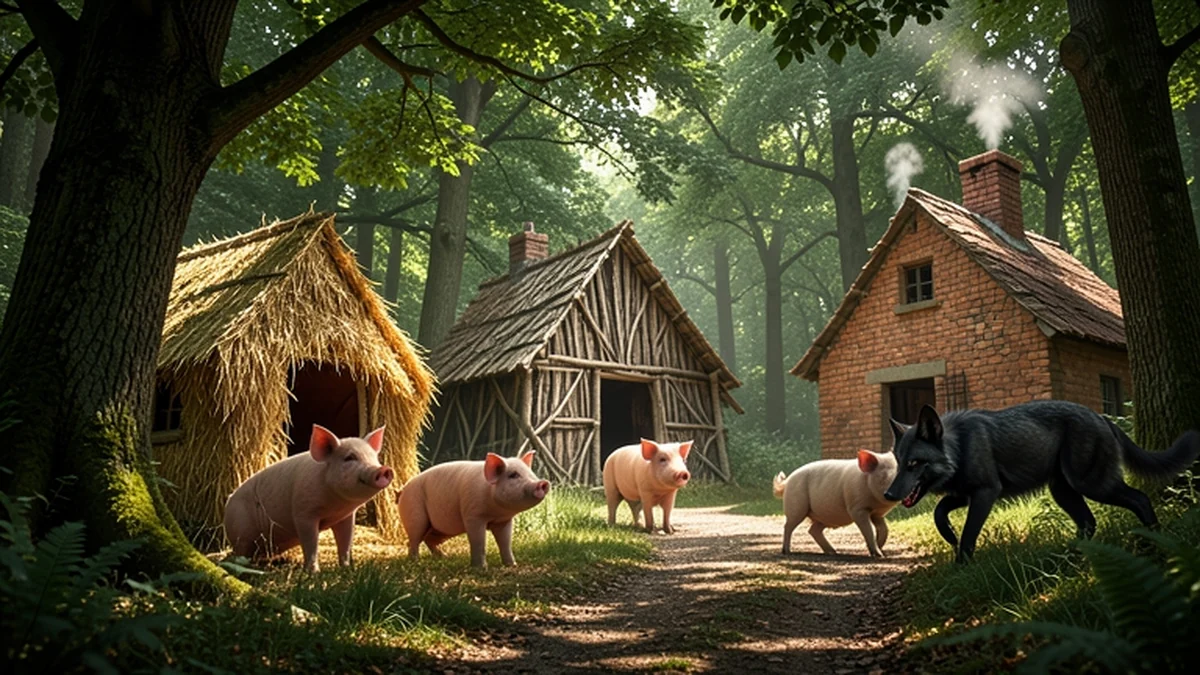
Edition and rights: Original English text from Project Gutenberg ebook #7277, marked public domain in the USA. The literary text below is reproduced without AI rewriting.
There was once upon a time a pig who lived with her three children on a
large, comfortable, old-fashioned farmyard. The eldest of the little pigs
was called Browny, the second Whitey, and the youngest and best looking
Blacky. Now Browny was a very dirty little pig, and I am sorry to say
spent most of his time rolling and wallowing about in the mud. He was
never so happy as on a wet day, when the mud in the farmyard got soft, and
thick, and slab. Then he would steal away from his mother’s side, and
finding the muddiest place in the yard, would roll about in it and
thoroughly enjoy himself. His mother often found fault with him for this,
and would shake her head sadly and say: ‘Ah, Browny! some day you will be
sorry that you did not obey your old mother.’ But no words of advice or
warning could cure Browny of his bad habits.

Whitey was quite a clever little pig, but she was greedy. She was always
thinking of her food, and looking forward to her dinner; and when the farm
girl was seen carrying the pails across the yard, she would rise up on her
hind legs and dance and caper with excitement. As soon as the food was
poured into the trough she jostled Blacky and Browny out of the way in her
eagerness to get the best and biggest bits for herself. Her mother often
scolded her for her selfishness, and told her that some day she would
suffer for being so greedy and grabbing.

Blacky was a good, nice little pig, neither dirty nor greedy. He had nice
dainty ways (for a pig), and his skin was always as smooth and shining as
black satin. He was much cleverer than Browny and Whitey, and his mother’s
heart used to swell with pride when she heard the farmer’s friends say to
each other that some day the little black fellow would be a prize pig.

Now the time came when the mother pig felt old and feeble and near her
end. One day she called the three little pigs round her and said:

‘My children, I feel that I am growing odd and weak, and that I shall not
live long. Before I die I should like to build a house for each of you, as
this dear old sty in which we have lived so happily will be given to a new
family of pigs, and you will have to turn out. Now, Browny, what sort of a
house would you like to have?’

‘A house of mud,’ replied Browny, looking longingly at a wet puddle in the
corner of the yard.

‘And you, Whitey?’ said the mother pig in rather a sad voice, for she was
disappointed that Browny had made so foolish a choice.

‘A house of cabbage,’ answered Whitey, with a mouth full, and scarcely
raising her snout out of the trough in which she was grubbing for some
potato-parings.

‘Foolish, foolish child!’ said the mother pig, looking quite distressed.
‘And you, Blacky?’ turning to her youngest son, ‘what sort of a house
shall I order for you?’

‘A house of brick, please mother, as it will be warm in winter, and cool
in summer, and safe all the year round.’

‘That is a sensible little pig,’ replied his mother, looking fondly at
him. ‘I will see that the three houses are got ready at once. And now one
last piece of advice. You have heard me talk of our old enemy the fox.
When he hears that I am dead, he is sure to try and get hold of you, to
carry you off to his den. He is very sly and will no doubt disguise
himself, and pretend to be a friend, but you must promise me not to let
him enter your houses on any pretext whatever.’

And the little pigs readily promised, for they had always had a great fear
of the fox, of whom they had heard many terrible tales. A short time
afterwards the old pig died, and the little pigs went to live in their own
houses.

Browny was quite delighted with his soft mud walls and with the clay
floor, which soon looked like nothing but a big mud pie. But that was what
Browny enjoyed, and he was as happy as possible, rolling about all day and
making himself in such a mess. One day, as he was lying half asleep in the
mud, he heard a soft knock at his door, and a gentle voice said:

‘May I come in, Master Browny? I want to see your beautiful new house.’

‘Who are you?’ said Browny, starting up in great fright, for though the
voice sounded gentle, he felt sure it was a feigned voice, and he feared
it was the fox.

‘I am a friend come to call on you,’ answered the voice.

‘No, no,’ replied Browny, ‘I don’t believe you are a friend. You are the
wicked fox, against whom our mother warned us. I won’t let you in.’

‘Oho! is that the way you answer me?’ said the fox, speaking very roughly
in his natural voice. ‘We shall soon see who is master here,’ and with his
paws he set to work and scraped a large hole in the soft mud walls. A
moment later he had jumped through it, and catching Browny by the neck,
flung him on his shoulders and trotted off with him to his den.

The next day, as Whitey was munching a few leaves of cabbage out of the
corner of her house, the fox stole up to her door, determined to carry her
off to join her brother in his den. He began speaking to her in the same
feigned gentle voice in which he had spoken to Browny; but it frightened
her very much when he said:

‘I am a friend come to visit you, and to have some of your good cabbage
for my dinner.’

‘Please don’t touch it,’ cried Whitey in great distress. ‘The cabbages are
the walls of my house, and if you eat them you will make a hole, and the
wind and rain will come in and give me a cold. Do go away; I am sure you
are not a friend, but our wicked enemy the fox.’ And poor Whitey began to
whine and to whimper, and to wish that she had not been such a greedy
little pig, and had chosen a more solid material than cabbages for her
house. But it was too late now, and in another minute the fox had eaten
his way through the cabbage walls, and had caught the trembling, shivering
Whitey, and carried her off to his den.

The next day the fox started off for Blacky’s house, because he had made
up his mind that he would get the three little pigs together in his den,
and then kill them, and invite all his friends to a feast. But when he
reached the brick house, he found that the door was bolted and barred, so
in his sly manner he began, ‘Do let me in, dear Blacky. I have brought you
a present of some eggs that I picked up in a farmyard on my way here.’

‘No, no, Mister Fox,’ replied Blacky, ‘I am not going to open my door to
you. I know your cunning ways. You have carried off poor Browny and
Whitey, but you are not going to get me.’

At this the fox was so angry that he dashed with all his force against the
wall, and tried to knock it down. But it was too strong and well-built;
and though the fox scraped and tore at the bricks with his paws he only
hurt himself, and at last he had to give it up, and limp away with his
fore-paws all bleeding and sore.

‘Never mind!’ he cried angrily as he went off, ‘I’ll catch you another
day, see if I don’t, and won’t I grind your bones to powder when I have
got you in my den!’ and he snarled fiercely and showed his teeth.

Next day Blacky had to go into the neighbouring town to do some marketing
and to buy a big kettle. As he was walking home with it slung over his
shoulder, he heard a sound of steps stealthily creeping after him. For a
moment his heart stood still with fear, and then a happy thought came to
him. He had just reached the top of a hill, and could see his own little
house nestling at the foot of it among the trees. In a moment he had
snatched the lid off the kettle and had jumped in himself. Coiling himself
round he lay quite snug in the bottom of the kettle, while with his
fore-leg he managed to put the lid on, so that he was entirely hidden.
With a little kick from the inside he started the kettle off, and down the
hill it rolled full tilt; and when the fox came up, all that he saw was a
large black kettle spinning over the ground at a great pace. Very much
disappointed, he was just going to turn away, when he saw the kettle stop
close to the little brick house, and in a moment later Blacky jumped out
of it and escaped with the kettle into the house, when he barred and
bolted the door, and put the shutter up over the window.

‘Oho!’ exclaimed the fox to himself, ‘you think you will escape me that
way, do you? We shall soon see about that, my friend,’ and very quietly
and stealthily he prowled round the house looking for some way to climb on
to the roof.

In the meantime Blacky had filled the kettle with water, and having put it
on the fire, sat down quietly waiting for it to boil. Just as the kettle
was beginning to sing, and steam to come out of the spout, he heard a
sound like a soft, muffled step, patter, patter, patter overhead, and the
next moment the fox’s head and fore-paws were seen coming down the
chimney. But Blacky very wisely had not put the lid on the kettle, and,
with a yelp of pain, the fox fell into the boiling water, and before he
could escape, Blacky had popped the lid on, and the fox was scalded to
death.

As soon as he was sure that their wicked enemy was really dead, and could
do them no further harm, Blacky started off to rescue Browny and Whitey.
As he approached the den he heard piteous grunts and squeals from his poor
little brother and sister who lived in constant terror of the fox killing
and eating them. But when they saw Blacky appear at the entrance to the
den their joy knew no bounds. He quickly found a sharp stone and cut the
cords by which they were tied to a stake in the ground, and then all three
started off together for Blacky’s house, where they lived happily ever
after; and Browny quite gave up rolling in the mud, and Whitey ceased to
be greedy, for they never forgot how nearly these faults had brought them
to an untimely end.
1 / 1


