
The Woman Who Made Her Husband Sift Dust
Read The Woman Who Made Her Husband Sift Dust, a public-domain fantasy tale from Arabian or Persian storytelling tradition.
By Traditional / Anonymous
Source and rights: Public-domain text from Project Gutenberg. The story text is preserved from the source edition with layout whitespace normalized for web reading.
.[FN#175]
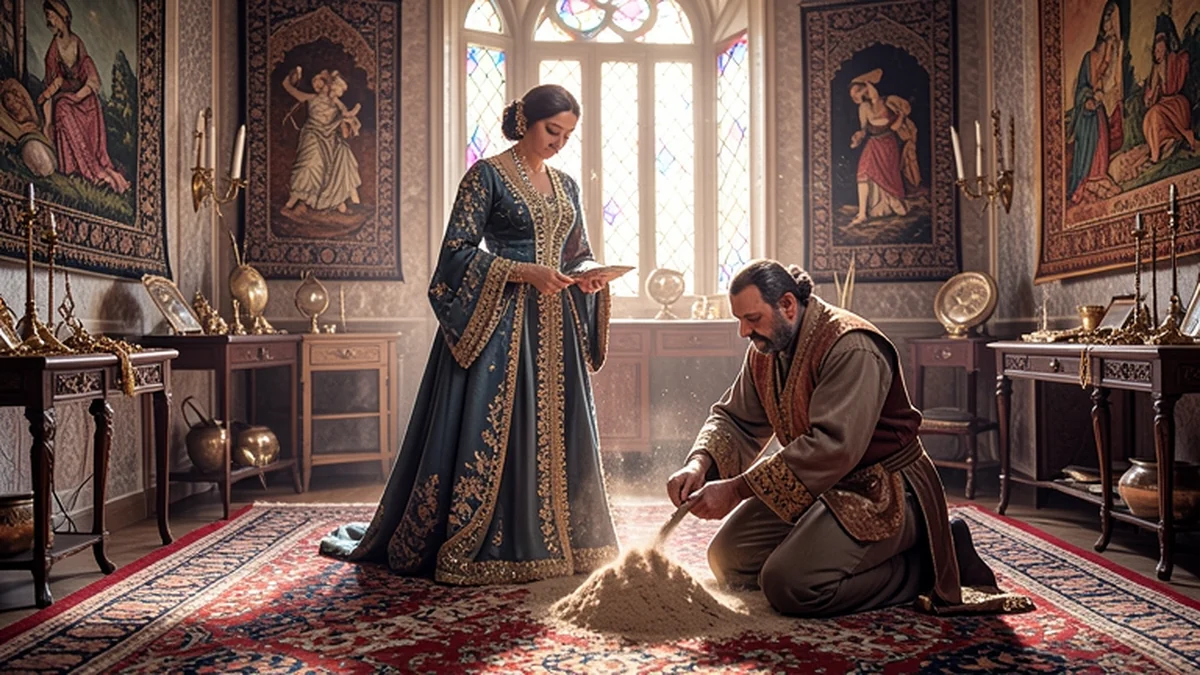
A man once gave his wife a dirham to buy rice; so she took it and went to the rice-seller, who gave her the rice and began to jest with her and ogle her, for she was dowered with beauty and loveliness, saying, “Rice is not good but with sugar which if thou wilt have, come in with me for an hour.” So, saying, “Give me sugar,” she went in with him into his shop and he won his will of her and said to his slave, “Weigh her out a dirham’s worth of sugar.” But he made the slave a privy sign, and the boy, taking the napkin, in which was the rice, emptied it out and put in earth and dust in its stead, and for the sugar set stones, after which he again knotted up the napkin and left it by her. His object, in doing this, was that she should come to him a second time; so, when she went forth of the shop, he gave her the napkin and she took it, thinking to have in it rice and sugar, and ganged her gait; but when she returned home and, setting it before her husband, went for a cooking-pot, he found in it earth and stones. So, as soon as she came back bringing the pot, he said to her, “Did I tell thee I had aught to build, that thou bringest me earth and stones?” When she saw this; she knew that the rice-seller’s slave had tricked her; so she said to her husband, “O man, in my trouble of mind for what hath befallen me, I went to fetch the sieve and brought the cooking-pot.” “What hath troubled thee?” asked he; and she answered, “O husband, I dropped the dirham thou gavest me in the market-street and was ashamed to search for it before the folk; yet I grudged to lose the silver, so I gathered up the earth from the place where it fell and brought it away, thinking to sift it at home. Wherefore I went to fetch the sieve, but brought the cooking-pot instead.” Then she fetched the sieve and gave it to her husband, saying, “Do thou sift it; for thine eyes are sharper than mine.” Accordingly he sat, sifting the clay, till his face and beard were covered with dust; and he discovered not her trick, neither knew what had befallen her. “This then, O King,” said the Wazir, “is an instance of the malice of women, and consider the saying of Allah Almighty,—Surely the cunning of you (women) is great![FN#176] And again, ‘Indeed, the malice of Satan is weak in comparison with the malice of women.’”[FN#177] The King gave ear to his Wazir’s speech and was persuaded thereby and was satisfied by what he cited to him of the signs of Allah[FN#178]; and the lights of good counsel arose and shone in the firmament of his understanding and he turned from his purpose of slaying his son. But on the fourth day, the favourite came in to him weeping and wailing and, kissing the ground before him, said, “O auspicious King, and lord of good rede, I have made plainly manifest to thee my grievance and thou hast dealt unjustly by me and hast forborne to avenge me on him who hath wronged me, because he is thy son and the darling of thy heart; but Allah (extolled and exalted be He!) will presently succour me against him, even as He succoured the King’s son against his father’s Wazir.” “And how was that?” asked the King; and she answered, “I have heard tell, O King, a tale of
The Enchanted String.[FN#179]
There was once in times gone by a King who had one son and none other; and, when the Prince grew up to man’s estate, he contracted him in marriage to another King’s daughter. Now the damsel was a model of beauty and grace and her uncle’s son had sought her in wedlock of her sire, but she would none of him. So, when he knew that she was to be married to another, envy and jealousy gat hold of him and he bethought himself and sent a noble present to the Wazir of the bridegroom’s father and much treasure, desiring him to use craft for slaying the Prince or contrive to make him leave his intent of espousing the girl and adding, “O Wazir, indeed jealousy moveth me to this for she is my cousin.”[FN#180] The Wazir accepted the present and sent an answer, saying, “Be of good cheer and of eyes cool and clear, for I will do all that thou wishest.” Presently, the bride’s father wrote to the Prince, bidding him to his capital, that he might go in to his daughter; whereupon the King his father gave him leave to wend his way thither, sending with him the bribed Wazir and a thousand horse, besides presents and litters, tents and pavilions. The Minister set out with the Prince, plotting the while in his heart to do him a mischief; and when they came into the desert, he called to mind a certain spring of running water in the mountains there, called Al-Zahra,[FN#181] whereof whosoever drank from a man became a woman. So he called a halt of the troops near the fountain and presently mounting steed again, said to the Prince, “Hast thou a mind to go with me and look upon a spring of water near hand?” The Prince mounted, knowing not what should befal him in the future,[FN#182] and they rode on, unattended by any, and without stopping till they came to the spring. The Prince being thirsty said to the Wazir, “O Minister, I am suffering from drouth,” and the other answered, “Get thee down and drink of this spring!” So he alighted and washed his hands and drank, when behold, he straightway became a woman. As soon as he knew what had befallen him, he cried out and wept till he fainted away, and the Wazir came up to him as if to learn what had befallen him and cried, “What aileth thee?” So he told him what had happened, and the Minister feigned to condole with him and weep for his affliction, saying, “Allah Almighty be thy refuge in thine affliction! How came this calamity upon thee and this great misfortune to betide thee, and we carrying thee with joy and gladness, that thou mightest go in to the King’s daughter? Verily, now I know not whether we shall go to her or not; but the rede[FN#183] is thine. What dost thou command me to do?” Quoth the Prince, “Go back to my sire and tell him what hath betided me, for I will not stir hence till this matter be removed from me or I die in my regret.” So he wrote a letter to his father, telling him what had happened, and the Wazir took it and set out on his return to the city, leaving what troops he had with the Prince and inwardly exulting for the success of his plot. As soon as he reached the King’s capital, he went in to him and, telling him what had passed, delivered the letter. The King mourned for his son with sore mourning and sent for the wise men and masters of esoteric science, that they might discover and explain to him this thing which had befallen his son, but none could give him an answer. Then the Wazir wrote to the lady’s cousin, conveying to him the glad news of the Prince’s misfortune, and he when he read the letter rejoiced with great joy and thought to marry the Princess and answered the Minister sending him rich presents and great store of treasure and thanking him exceedingly. Meanwhile, the Prince abode by the stream three days and three nights, eating not nor drinking and committing himself, in his strait, unto Allah (extolled and exalted be He!) who disappointeth not whoso relieth on him. On the fourth night, lo! there came to him a cavalier on a bright-bay steed[FN#184] with a crown on his head, as he were of the sons of the Kings, and said to him, “Who brought thee hither, O youth?” The Prince told him his mishap, how he was wending to his wedding, and how the Wazir had led him to a spring whereof he drank and incurred what had occurred; and as he spoke his speech was broken by tears. Having heard him the horseman pitied his case and said, “It was thy father’s Wazir who cast thee into this strait, for no man alive save he knoweth of this spring;” presently adding, “Mount thee behind me and come with me to my dwelling, for thou art my guest this night.” “Acquaint me who thou art ere I fare with thee,” quoth the Prince; and quoth the other, “I am a King’s son of the Jánn, as thou a King’s son of mankind; so be of good cheer and keep thine eyes clear of tear, for I will surely do away thy cark and care; and this is a slight thing unto me.” So the Prince mounted him behind the stranger, and they rode on, leaving the troops, from the first of the day till midnight, when the King’s son of the Jinn asked the Prince, “Knowest thou how many days’ march we have covered in this time?” “Not I.” “We have come a full year’s journey for a diligent horseman.” The Prince marvelled at this and said, “How shall I do to return to my people?” “That is not thine affair, but my business. As soon as thou art quit of thy complaint, thou shalt return to thy people in less than the twinkling of an eye; for that is an easy matter to me.” When the Prince heard these words he was ready to fly for excess of joy; it seemed to him as he were in the imbroglio of a dream and he exclaimed, “Glory be to Him who can restore the unhappy to happiness!”—And Shahrazad perceived the dawn of day and ceased saying her permitted say.
When it was the Five Hundred and Eighty-third Night,
She said, It hath reached me, O auspicious King, that the Prince of the Jinn said to the Prince of mankind, “When thou art quit of thy complaint, thou shalt return to thy folk in less than the twinkling of an eye;” and the King’s son rejoiced. They fared on all that night till the morning morrowed when lo! they found themselves in a green and smiling country, full of trees spireing and birds quiring and garths fruit-growing and palaces highshowing and waters a-flowing and odoriferous flowers a-blowing. Here the King’s son of the Jinn alighted from his steed and, bidding the Prince do the like, took him by the hand and carried him into one of the palaces, where he found a great King and puissant Sultan; and abode with him all that day eating and drinking, till nightfall. Then the King’s son of the Jinn mounted his courser and taking the Prince up behind him, fared on swiftly through the murks and glooms until morning, when lo, they found themselves in a dark land and a desert, full of black rocks and stones, as it were a piece of Hell; and the Prince asked the Jinni, “What is the name of this land?” Answered the other, “It is called the Black Country, and belongs to one of the Kings of the Jinn, by name Zu’l Janahayn, against whom none of the other Kings may prevail, neither may any enter his dominions save by his permit; so tarry thou here, whilst I go ask leave.” So saying, he went away and, returning after awhile, they fared on again, till they landed at a spring of water welling forth of a black rock, and the King’s son of the Jinn said to the King’s son of men, “Alight!” He dismounted and the other cried, “Drink of this water!” So he drank of the spring without stay or delay; and, no sooner had he done so than, by grace of Allah, he became a man as before. At this he joyed with exceeding joy and asked the Jinni, “O my brother, how is this spring called?” Answered the other, “It is called the Women’s Spring, for that no woman drinketh thereof but she becometh a man: wherefore do thou praise Allah the Most High and thank Him for thy restoration and mount.” So the Prince prostrated himself in gratitude to the Almighty, after which he mounted again and they fared on diligently all that day, till they returned to the Jinni’s home, where the Prince passed the night in all solace of life. They spent the next day in eating and drinking till nightfall, when the King’s son of the Jinn asked the Prince, “Hast thou a mind to return to thy people this very night?” “Yes,” he answered; “for indeed I long for them.” Then the Jinni called one of his father’s slaves, Rajiz[FN#185] hight, and said to him, “Take this young man mounted on thy shoulders, and let not the day dawn ere he be with his father-in-law and his wife.” Replied the slave, “Hearkening and obedience, and with love and gladness, and upon my head and eyes!” then, withdrawing awhile, re-appeared in the form of an Ifrit. When the Prince saw this, he lost his senses for affright, but the Jinni said to him, “Fear not; no harm shall befal thee. Mount thy horse and leap him on to the Ifrit’s shoulders.” “Nay,” answered he, “I will leave my horse with thee and bestride his shoulders myself.” So he bestrode the Ifrit’s shoulders and, when the Jinni cried, “Close thine eyes, O my lord, and be not a craven!” he strengthened his heart and shut his eyes. Thereupon the Ifrit rose with him into the air and ceased not to fly between sky and earth, whilst the Prince was unconscious, nor was the last third of the night come before he alighted down with him on the terrace-roof of his father-in-law’s palace. Then said the Ifrit, “Dismount and open thine eyes; for this is the palace of thy father-in-law and his daughter.” So he came down and the Ifrit flew away and left him on the roof of the palace. When the day broke and the Prince recovered from his troubles, he descended into the palace and as his father-in-law caught sight of him, he came to meet him and marvelled to see him descend from the roof of the palace, saying, “We see folk enter by the doors; but thou comest from the skies.” Quoth the Prince, “Whatso Allah (may He be extolled and exalted!) willeth that cometh to pass.” And he told him all that had befallen him, from first to last, whereat the King marvelled and rejoiced in his safety; and, as soon as the sun rose, bade his Wazir make ready splendid bride-feasts. So did he and they held the marriage festival: after which the Prince went in unto his bride and abode with her two months, then departed with her for his father’s capital. As for the damsel’s cousin, he died forthright of envy and jealousy. When the Prince and his bride drew near his father’s city, the King came out to meet them with his troops and Wazirs, and so Allah (blessed and exalted be He!) enabled the Prince to prevail against his bride’s cousin and his father’s Minister. “And I pray the Almighty” (added the damsel) “to aid thee against thy Wazirs, O King, and I beseech thee to do me justice on thy son!” When the King heard this, he bade put his son to death;—And Shahrazad perceived the dawn of day and ceased to say her permitted say.
When is was the Five Hundred and Eighty-forth Night,
She said, It hath reached me, O auspicious King, that when the favourite had told her tale to the King she said, “I beseech thee to do me justice by putting thy son to death.” Now this was the fourth day, so the fourth Wazir entered and, kissing the ground before him, said, “Allah stablish and protect the King! O King, be deliberate in doing this thou art resolved upon, for the wise man doth naught till he hath considered the issue thereof, and the proverb saith, ‘Whoso looketh not to his actions’ end, hath not the world to friend; and whoso acteth without consideration, there befalleth him what befel the Hammam-keeper with his wife.’” “And what betided him?” asked the King. And the Wazir answered, “I have heard tell, O King, a tale of the
Wazir’s Son and the Hammam-Keepeer’s Wife.”[FN#186]
There was once a bath-keeper, to whom resorted the notables of the folk and head men, and one day there came in to him a handsome youth of the sons of Wazirs who was fat and bulky of body. So he stood to serve him and when the young man put off his clothes[FN#187] he saw not his yard, for that it was hidden between his thighs, by reason of the excess of his fat, and there appeared thereof but what was like unto a filbert.[FN#188] At this the bath-keeper fell a-lamenting and smiting hand upon hand, which when the youth saw, he said to him, “What ails thee, O bath-keeper, to lament thus?” And he answered, saying, “O my lord, my lamentation is for thee, because thou art in sore straits, for all thy fair fortune and goodliness and exceeding comeliness, seeing thou hast naught wherewithal to do and receive delight, like unto other men.” Quoth the youth, “Thou sayst sooth, but thou mindest me of somewhat I had forgotten.” “What is that?” asked the bathkeeper, and the youth answered, “Take this gold piece and fetch me a pretty woman, that I may prove my nature on her.” So he took the money and betaking himself to his wife, said to her, “O woman, there is come to me in the bath a young man of the sons of the Wazirs, as he were the moon on the fullest night; but he hath no prickle like other men, for that which he hath is but some small matter like unto a filbert. I lamented over his youth and he gave me this dinar and asked me to fetch him a woman on whom he might approve himself. Now thou art worthier of the money than another, and from this no harm shall betide us, for I will protect thee. So do thou sit with him awhile and laugh at him and take this dinar from him.” So the good wife took the dinar and rising, adorned herself and donned the richest of her raiment. Now she was the fairest woman of her time. Then she went out with her husband and he carried her in to the Wazir’s son in a privy place. When she came in to him, she looked at him and finding him a handsome youth, fair of favour as he were the moon at full, was confounded at his beauty and loveliness; and on like wise his heart and wit were amazed at the first sight of her and the sweetness of her smile. So he rose forthright and locking the door, took the damsel in his arms and pressed her to his bosom and they embraced, whereupon the young man’s yard swelled and rose on end, as it were that of a jackass, and he rode upon her breast and futtered her, whilst she sobbed and sighed and writhed and wriggled under him. Now the bathkeeper was standing behind the door, awaiting what should betide between them, and he began to call her saying, “O Umm Abdillah, enough! Come out, for the day is long upon thy sucking child.” Quoth the youth, “Go forth to thy boy and come back;” but quoth she, “If I go forth from thee, my soul will depart my body; as regards the child, so I must either leave him to die of weeping or let him be reared an orphan, without a mother.” So she ceased not to abide with him till he had done his desire of her ten times running, while her husband stood at the door, calling her and crying out and weeping and imploring succour. But none came to aid him and he ceased not to do thus, saying, “I will slay myself!”; till at last, finding no way of access to his wife, and being distraught with rage and jealousy, to hear her sighing and murmuring and breathing hard under the young man, he went up to the top of the bath and, casting himself down therefrom, died. “Moreover, O King” (continued the Wazir), “there hath reached me another story of the malice of women.” “What is that?” asked the King, and the Wazir said, “Know, O King, that it is anent


