
The Wonderful Window
Read The Wonderful Window by Lord Dunsany in the original English.
By Lord Dunsany
Edition: Complete story in the original English, from Project Gutenberg #7477. No translation or AI rewriting of the literary text. Original spelling retained.
This eBook is for the use of anyone anywhere in the United States and most other parts of the world at no cost and with almost no restrictions whatsoever. You may copy it, give it away or re-use it under the terms of the Project Gutenberg License included with this eBook or online at www.gutenberg.org. If you are not located in the United States, you will have to check the laws of the country where you are located before using this eBook.
The old man in the Oriental-looking robe was being moved on by the police, and it was this that attracted to him and the parcel under his arm the attention of Mr. Sladden, whose livelihood was earned in the emporium of Messrs. Mergin and Chater, that is to say in their establishment.
Mr. Sladden had the reputation of being the silliest young man in Business; a touch of romance–a mere suggestion of it–would send his eyes gazing away as though the walls of the emporium were of gossamer and London itself a myth, instead of attending to customers.
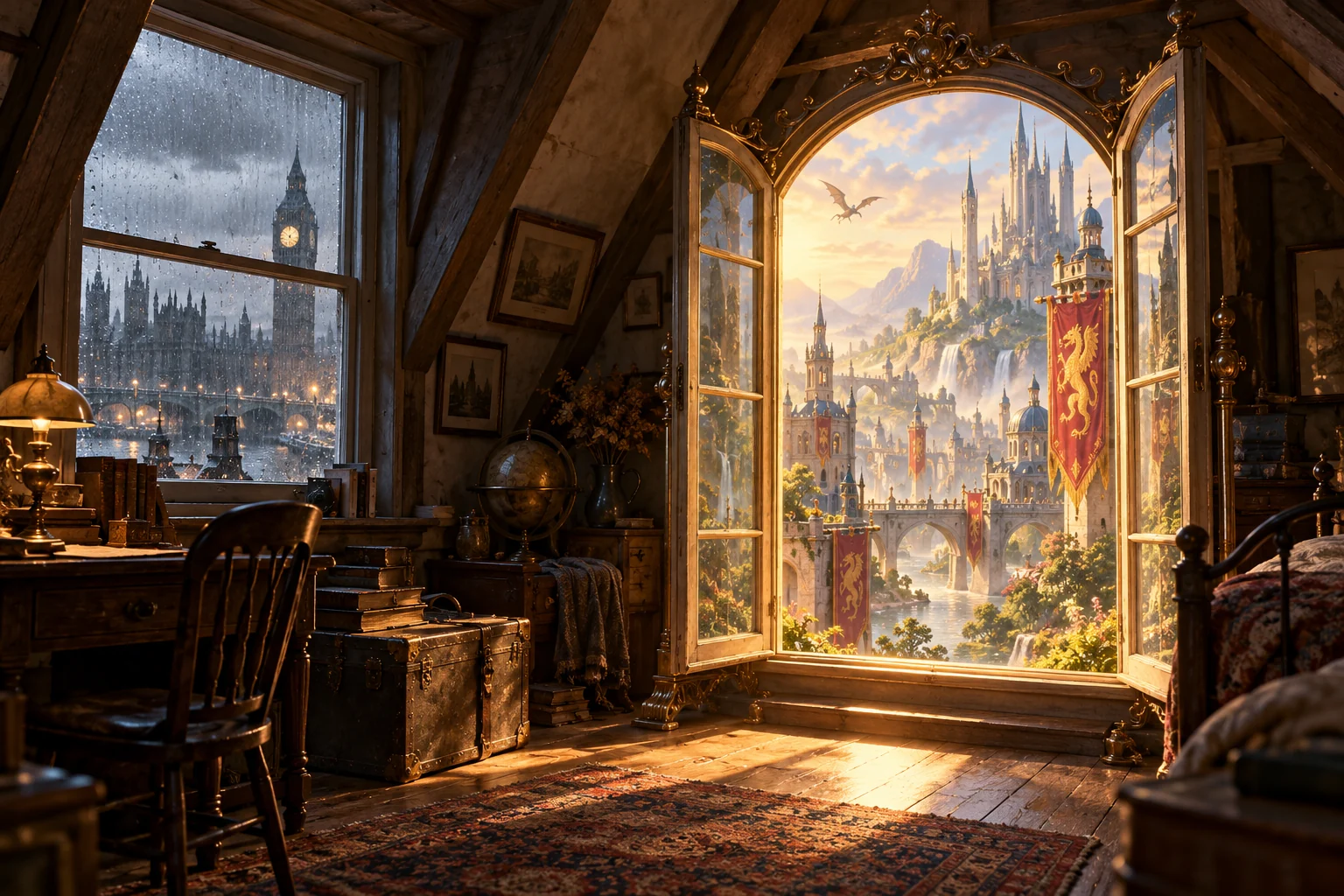
Merely the fact that the dirty piece of paper that wrapped the old man’s parcel was covered with Arabic writing was enough to give Mr. Sladden the idea of romance, and he followed until the little crowd fell off and the stranger stopped by the kerb and unwrapped his parcel and prepared to sell the thing that was inside it. It was a little window in old wood with small panes set in lead; it was not much more than a foot in breadth and was under two feet long. Mr. Sladden had never before seen a window sold in the street, so he asked the price of it.
“Its price is all you possess,” said the old man.
“Where did you get it?” said Mr. Sladden, for it was a strange window.
“I gave all that I possessed for it in the streets of Baghdad.”
“Did you possess much?” said Mr. Sladden.
“I had all that I wanted,” he said, “except this window.”
“It must be a good window,” said the young man.
“It is a magical window,” said the old one.
“I have only ten shillings on me, but I have fifteen-and-six at home.”
The old man thought for a while.
“Then twenty-five-and-sixpence is the price of the window,” he said.
It was only when the bargain was completed and the ten shillings paid and the strange old man was coming for his fifteen-and-six and to fit the magical window into his only room that it occurred to Mr. Sladden’s mind that he did not want a window. And then they were at the door of the house in which he rented a room, and it seemed too late to explain.
The stranger demanded privacy when he fitted up the window, so Mr. Sladden remained outside the door at the top of a little flight of creaky stairs. He heard no sound of hammering.
And presently the strange old man came out with his faded yellow robe and his great beard, and his eyes on far-off places. “It is finished,” he said, and he and the young man parted. And whether he remained a spot of colour and an anachronism in London, or whether he ever came again to Baghdad, and what dark hands kept on the circulation of his twenty-five-and-six, Mr. Sladden never knew.
Mr. Sladden entered the bare-boarded room in which he slept and spent all his indoor hours between closing-time and the hour at which Messrs. Mergin and Chater commenced. To the Penates of so dingy a room his neat frock-coat must have been a continual wonder. Mr. Sladden took it off and folded it carefully; and there was the old man’s window rather high up in the wall. There had been no window in that wall hitherto, nor any ornament at all but a small cupboard, so when Mr. Sladden had put his frock-coat safely away he glanced through his new window. It was where his cupboard had been in which he kept his tea-things: they were all standing on the table now. When Mr. Sladden glanced through his new window it was late in a summer’s evening; the butterflies some while ago would have closed their wings, though the bat would scarcely yet be drifting abroad–but this was in London: the shops were shut and street-lamps not yet lighted.
Mr. Sladden rubbed his eyes, then rubbed the window, and still he saw a sky of blazing blue, and far, far down beneath him, so that no sound came up from it or smoke of chimneys, a mediaeval city set with towers; brown roofs and cobbled streets, and then white walls and buttresses, and beyond them bright green fields and tiny streams. On the towers archers lolled, and along the walls were pikemen, and now and then a wagon went down some old-world street and lumbered through the gateway and out to the country, and now and then a wagon drew up to the city from the mist that was rolling with evening over the fields. Sometimes folks put their heads out of lattice windows, sometimes some idle troubadour seemed to sing, and nobody hurried or troubled about anything. Airy and dizzy though the distance was, for Mr. Sladden seemed higher above the city than any cathedral gargoyle, yet one clear detail he obtained as a clue: the banners floating from every tower over the idle archers had little golden dragons all over a pure white field.
He heard motor-buses roar by his other window, he heard the newsboys howling.
Mr. Sladden grew dreamier than ever after that on the premises, in the establishment of Messrs. Mergin and Chater. But in one matter he was wise and wakeful: he made continuous and careful inquiries about the golden dragons on a white flag, and talked to no one of his wonderful window. He came to know the flags of every king in Europe, he even dabbled in history, he made inquiries at shops that understood heraldry, but nowhere could he learn any trace of little dragons or on a field argent. And when it seemed that for him alone those golden dragons had fluttered he came to love them as an exile in some desert might love the lilies of his home or as a sick man might love swallows when he cannot easily live to another spring.
As soon as Messrs. Mergin and Chater closed, Mr. Sladden used to go back to his dingy room and gaze though the wonderful window until it grew dark in the city and the guard would go with a lantern round the ramparts and the night came up like velvet, full of strange stars. Another clue he tried to obtain one night by jotting down the shapes of the constellations, but this led him no further, for they were unlike any that shone upon either hemisphere.
Each day as soon as he woke he went first to the wonderful window, and there was the city, diminutive in the distance, all shining in the morning, and the golden dragons dancing in the sun, and the archers stretching themselves or swinging their arms on the tops of the windy towers. The window would not open, so that he never heard the songs that the troubadours sang down there beneath the gilded balconies; he did not even hear the belfries’ chimes, though he saw the jack-daws routed every hour from their homes. And the first thing that he always did was to cast his eye round all the little towers that rose up from the ramparts to see that the little golden dragons were flying there on their flags. And when he saw them flaunting themselves on white folds from every tower against the marvelous deep blue of the sky he dressed contentedly, and, taking one last look, went off to his work with a glory in his mind. It would have been difficult for the customers of Messrs. Mergin and Chater to guess the precise ambition of Mr. Sladden as he walked before them in his neat frock-coat: it was that he might be a man-at-arms or an archer in order to fight for the little golden dragons that flew on a white flag for an unknown king in an inaccessible city. At first Mr. Sladden used to walk round and round the mean street that he lived in, but he gained no clue from that; and soon he noticed that quite different winds blew below his wonderful window from those that blew on the other side of the house.
In August the evenings began to grow shorter: this was the very remark that the other employees made to him at the emporium, so that he almost feared that they suspected his secret, and he had much less time for the wonderful window, for lights were few down there and they blinked out early.
One morning late in August, just before he went to Business, Mr. Sladden saw a company of pikemen running down the cobbled road towards the gateway of the mediaeval city–Golden Dragon City he used to call it alone in his own mind, but he never spoke of it to anyone. The next thing that he noticed was that the archers were handling round bundles of arrows in addition to the quivers which they wore. Heads were thrust out of windows more than usual, a woman ran out and called some children indoors, a knight rode down the street, and then more pikemen appeared along the walls, and all the jack-daws were in the air. In the street no troubadour sang. Mr. Sladden took one look along the towers to see that the flags were flying, and all the golden dragons were streaming in the wind. Then he had to go to Business. He took a bus back that evening and ran upstairs. Nothing seemed to be happening in Golden Dragon City except a crowd in the cobbled street that led down to the gateway; the archers seemed to be reclining as usual lazily in their towers, and then a white flag went down with all its golden dragons; he did not see at first that all the archers were dead. The crowd was pouring towards him, towards the precipitous wall from which he looked; men with a white flag covered with golden dragons were moving backwards slowly, men with another flag were pressing them, a flag on which there was one huge red bear. Another banner went down upon a tower. Then he saw it all: the golden dragons were being beaten–his little golden dragons. The men of the bear were coming under the window; what ever he threw from that height would fall with terrific force: fire-irons, coal, his clock, whatever he had–he would fight for his little golden dragons yet. A flame broke out from one of the towers and licked the feet of a reclining archer; he did not stir. And now the alien standard was out of sight directly underneath. Mr. Sladden broke the panes of the wonderful window and wrenched away with a poker the lead that held them. Just as the glass broke he saw a banner covered with golden dragons fluttering still, and then as he drew back to hurl the poker there came to him the scent of mysterious spices, and there was nothing there, not even the daylight, for behind the fragments of the wonderful window was nothing but that small cupboard in which he kept his tea-things.
And though Mr. Sladden is older now and knows more of the world, and even has a Business of his own, he has never been able to buy such another window, and has not ever since, either from books or men, heard any rumour at all of Golden Dragon City.
Source and edition terms: https://www.gutenberg.org/ebooks/7477 · Project Gutenberg License. Original-language text; original publisher illustrations are not reproduced.
Source acknowledgements and license
START: FULL LICENSE
THE FULL PROJECT GUTENBERG™ LICENSE
PLEASE READ THIS BEFORE YOU DISTRIBUTE OR USE THIS WORK
To protect the Project Gutenberg™ mission of promoting the free distribution of electronic works, by using or distributing this work (or any other work associated in any way with the phrase “Project Gutenberg”), you agree to comply with all the terms of the Full Project Gutenberg License available with this file or online at www.gutenberg.org/license.
Section 1. General Terms of Use and Redistributing Project Gutenberg electronic works
1.A. By reading or using any part of this Project Gutenberg electronic work, you indicate that you have read, understand, agree to and accept all the terms of this license and intellectual property (trademark/copyright) agreement. If you do not agree to abide by all the terms of this agreement, you must cease using and return or destroy all copies of Project Gutenberg electronic works in your possession. If you paid a fee for obtaining a copy of or access to a Project Gutenberg electronic work and you do not agree to be bound by the terms of this agreement, you may obtain a refund from the person or entity to whom you paid the fee as set forth in paragraph 1.E.8.
1.B. “Project Gutenberg” is a registered trademark. It may only be used on or associated in any way with an electronic work by people who agree to be bound by the terms of this agreement. There are a few things that you can do with most Project Gutenberg electronic works even without complying with the full terms of this agreement. See paragraph 1.C below. There are a lot of things you can do with Project Gutenberg electronic works if you follow the terms of this agreement and help preserve free future access to Project Gutenberg electronic works. See paragraph 1.E below.
1.C. The Project Gutenberg Literary Archive Foundation (“the Foundation” or PGLAF), owns a compilation copyright in the collection of Project Gutenberg electronic works. Nearly all the individual works in the collection are in the public domain in the United States. If an individual work is unprotected by copyright law in the United States and you are located in the United States, we do not claim a right to prevent you from copying, distributing, performing, displaying or creating derivative works based on the work as long as all references to Project Gutenberg are removed. Of course, we hope that you will support the Project Gutenberg mission of promoting free access to electronic works by freely sharing Project Gutenberg works in compliance with the terms of this agreement for keeping the Project Gutenberg name associated with the work. You can easily comply with the terms of this agreement by keeping this work in the same format with its attached full Project Gutenberg License when you share it without charge with others.
1.D. The copyright laws of the place where you are located also govern what you can do with this work. Copyright laws in most countries are in a constant state of change. If you are outside the United States, check the laws of your country in addition to the terms of this agreement before downloading, copying, displaying, performing, distributing or creating derivative works based on this work or any other Project Gutenberg work. The Foundation makes no representations concerning the copyright status of any work in any country other than the United States.
1.E. Unless you have removed all references to Project Gutenberg:
1.E.1. The following sentence, with active links to, or other immediate access to, the full Project Gutenberg License must appear prominently whenever any copy of a Project Gutenberg work (any work on which the phrase “Project Gutenberg” appears, or with which the phrase “Project Gutenberg” is associated) is accessed, displayed, performed, viewed, copied or distributed:
This eBook is for the use of anyone anywhere in the United States and most
other parts of the world at no cost and with almost no restrictions
whatsoever. You may copy it, give it away or re-use it under the terms
of the Project Gutenberg™ License included with this eBook or online
at www.gutenberg.org. If you
are not located in the United States, you will have to check the laws
of the country where you are located before using this eBook.
1.E.2. If an individual Project Gutenberg electronic work is derived from texts not protected by U.S. copyright law (does not contain a notice indicating that it is posted with permission of the copyright holder), the work can be copied and distributed to anyone in the United States without paying any fees or charges. If you are redistributing or providing access to a work with the phrase “Project Gutenberg” associated with or appearing on the work, you must comply either with the requirements of paragraphs 1.E.1 through 1.E.7 or obtain permission for the use of the work and the Project Gutenberg trademark as set forth in paragraphs 1.E.8 or 1.E.9.
1.E.3. If an individual Project Gutenberg electronic work is posted with the permission of the copyright holder, your use and distribution must comply with both paragraphs 1.E.1 through 1.E.7 and any additional terms imposed by the copyright holder. Additional terms will be linked to the Project Gutenberg License for all works posted with the permission of the copyright holder found at the beginning of this work.
1.E.4. Do not unlink or detach or remove the full Project Gutenberg License terms from this work, or any files containing a part of this work or any other work associated with Project Gutenberg.
1.E.5. Do not copy, display, perform, distribute or redistribute this electronic work, or any part of this electronic work, without prominently displaying the sentence set forth in paragraph 1.E.1 with active links or immediate access to the full terms of the Project Gutenberg License.
1.E.6. You may convert to and distribute this work in any binary, compressed, marked up, nonproprietary or proprietary form, including any word processing or hypertext form. However, if you provide access to or distribute copies of a Project Gutenberg work in a format other than “Plain Vanilla ASCII” or other format used in the official version posted on the official Project Gutenberg website (www.gutenberg.org), you must, at no additional cost, fee or expense to the user, provide a copy, a means of exporting a copy, or a means of obtaining a copy upon request, of the work in its original “Plain Vanilla ASCII” or other form. Any alternate format must include the full Project Gutenberg License as specified in paragraph 1.E.1.
1.E.7. Do not charge a fee for access to, viewing, displaying, performing, copying or distributing any Project Gutenberg works unless you comply with paragraph 1.E.8 or 1.E.9.
1.E.8. You may charge a reasonable fee for copies of or providing access to or distributing Project Gutenberg electronic works provided that:
• You pay a royalty fee of 20% of the gross profits you derive from
    the use of Project Gutenberg works calculated using the method
    you already use to calculate your applicable taxes. The fee is owed
    to the owner of the Project Gutenberg trademark, but he has
    agreed to donate royalties under this paragraph to the Project
    Gutenberg Literary Archive Foundation. Royalty payments must be paid
    within 60 days following each date on which you prepare (or are
    legally required to prepare) your periodic tax returns. Royalty
    payments should be clearly marked as such and sent to the Project
    Gutenberg Literary Archive Foundation at the address specified in
    Section 4, “Information about donations to the Project Gutenberg
    Literary Archive Foundation.”

• You provide a full refund of any money paid by a user who notifies
    you in writing (or by e-mail) within 30 days of receipt that s/he
    does not agree to the terms of the full Project Gutenberg™
    License. You must require such a user to return or destroy all
    copies of the works possessed in a physical medium and discontinue
    all use of and all access to other copies of Project Gutenberg™
    works.

• You provide, in accordance with paragraph 1.F.3, a full refund of
    any money paid for a work or a replacement copy, if a defect in the
    electronic work is discovered and reported to you within 90 days of
    receipt of the work.

• You comply with all other terms of this agreement for free
    distribution of Project Gutenberg™ works.
1.E.9. If you wish to charge a fee or distribute a Project Gutenberg™ electronic work or group of works on different terms than are set forth in this agreement, you must obtain permission in writing from the Project Gutenberg Literary Archive Foundation, the manager of the Project Gutenberg™ trademark. Contact the Foundation as set forth in Section 3 below.
1.F.
1.F.1. Project Gutenberg volunteers and employees expend considerable effort to identify, do copyright research on, transcribe and proofread works not protected by U.S. copyright law in creating the Project Gutenberg™ collection. Despite these efforts, Project Gutenberg™ electronic works, and the medium on which they may be stored, may contain “Defects,” such as, but not limited to, incomplete, inaccurate or corrupt data, transcription errors, a copyright or other intellectual property infringement, a defective or damaged disk or other medium, a computer virus, or computer codes that damage or cannot be read by your equipment.
1.F.2. LIMITED WARRANTY, DISCLAIMER OF DAMAGES - Except for the “Right of Replacement or Refund” described in paragraph 1.F.3, the Project Gutenberg Literary Archive Foundation, the owner of the Project Gutenberg™ trademark, and any other party distributing a Project Gutenberg™ electronic work under this agreement, disclaim all liability to you for damages, costs and expenses, including legal fees. YOU AGREE THAT YOU HAVE NO REMEDIES FOR NEGLIGENCE, STRICT LIABILITY, BREACH OF WARRANTY OR BREACH OF CONTRACT EXCEPT THOSE PROVIDED IN PARAGRAPH 1.F.3. YOU AGREE THAT THE FOUNDATION, THE TRADEMARK OWNER, AND ANY DISTRIBUTOR UNDER THIS AGREEMENT WILL NOT BE LIABLE TO YOU FOR ACTUAL, DIRECT, INDIRECT, CONSEQUENTIAL, PUNITIVE OR INCIDENTAL DAMAGES EVEN IF YOU GIVE NOTICE OF THE POSSIBILITY OF SUCH DAMAGE.
1.F.3. LIMITED RIGHT OF REPLACEMENT OR REFUND - If you discover a defect in this electronic work within 90 days of receiving it, you can receive a refund of the money (if any) you paid for it by sending a written explanation to the person you received the work from. If you received the work on a physical medium, you must return the medium with your written explanation. The person or entity that provided you with the defective work may elect to provide a replacement copy in lieu of a refund. If you received the work electronically, the person or entity providing it to you may choose to give you a second opportunity to receive the work electronically in lieu of a refund. If the second copy is also defective, you may demand a refund in writing without further opportunities to fix the problem.
1.F.4. Except for the limited right of replacement or refund set forth in paragraph 1.F.3, this work is provided to you ‘AS-IS’, WITH NO OTHER WARRANTIES OF ANY KIND, EXPRESS OR IMPLIED, INCLUDING BUT NOT LIMITED TO WARRANTIES OF MERCHANTABILITY OR FITNESS FOR ANY PURPOSE.
1.F.5. Some states do not allow disclaimers of certain implied warranties or the exclusion or limitation of certain types of damages. If any disclaimer or limitation set forth in this agreement violates the law of the state applicable to this agreement, the agreement shall be interpreted to make the maximum disclaimer or limitation permitted by the applicable state law. The invalidity or unenforceability of any provision of this agreement shall not void the remaining provisions.
1.F.6. INDEMNITY - You agree to indemnify and hold the Foundation, the trademark owner, any agent or employee of the Foundation, anyone providing copies of Project Gutenberg™ electronic works in accordance with this agreement, and any volunteers associated with the production, promotion and distribution of Project Gutenberg™ electronic works, harmless from all liability, costs and expenses, including legal fees, that arise directly or indirectly from any of the following which you do or cause to occur: (a) distribution of this or any Project Gutenberg work, (b) alteration, modification, or additions or deletions to any Project Gutenberg work, and (c) any Defect you cause.
Section 2. Information about the Mission of Project Gutenberg
Project Gutenberg is synonymous with the free distribution of electronic works in formats readable by the widest variety of computers including obsolete, old, middle-aged and new computers. It exists because of the efforts of hundreds of volunteers and donations from people in all walks of life.
Volunteers and financial support to provide volunteers with the assistance they need are critical to reaching Project Gutenberg’s goals and ensuring that the Project Gutenberg collection will remain freely available for generations to come. In 2001, the Project Gutenberg Literary Archive Foundation was created to provide a secure and permanent future for Project Gutenberg and future generations. To learn more about the Project Gutenberg Literary Archive Foundation and how your efforts and donations can help, see Sections 3 and 4 and the Foundation information page at www.gutenberg.org.
Section 3. Information about the Project Gutenberg Literary Archive Foundation
The Project Gutenberg Literary Archive Foundation is a non-profit 501(c)(3) educational corporation organized under the laws of the state of Mississippi and granted tax exempt status by the Internal Revenue Service. The Foundation’s EIN or federal tax identification number is 64-6221541. Contributions to the Project Gutenberg Literary Archive Foundation are tax deductible to the full extent permitted by U.S. federal laws and your state’s laws.
The Foundation’s business office is located at 41 Watchung Plaza #516, Montclair NJ 07042, USA, +1 (862) 621-9288. Email contact links and up to date contact information can be found at the Foundation’s website and official page at www.gutenberg.org/contact
Section 4. Information about Donations to the Project Gutenberg Literary Archive Foundation
Project Gutenberg™ depends upon and cannot survive without widespread public support and donations to carry out its mission of increasing the number of public domain and licensed works that can be freely distributed in machine-readable form accessible by the widest array of equipment including outdated equipment. Many small donations ($1 to $5,000) are particularly important to maintaining tax exempt status with the IRS.
The Foundation is committed to complying with the laws regulating charities and charitable donations in all 50 states of the United States. Compliance requirements are not uniform and it takes a considerable effort, much paperwork and many fees to meet and keep up with these requirements. We do not solicit donations in locations where we have not received written confirmation of compliance. To SEND DONATIONS or determine the status of compliance for any particular state visit www.gutenberg.org/donate.
While we cannot and do not solicit contributions from states where we have not met the solicitation requirements, we know of no prohibition against accepting unsolicited donations from donors in such states who approach us with offers to donate.
International donations are gratefully accepted, but we cannot make any statements concerning tax treatment of donations received from outside the United States. U.S. laws alone swamp our small staff.
Please check the Project Gutenberg web pages for current donation methods and addresses. Donations are accepted in a number of other ways including checks, online payments and credit card donations. To donate, please visit: www.gutenberg.org/donate.
Section 5. General Information About Project Gutenberg electronic works
Professor Michael S. Hart was the originator of the Project Gutenberg concept of a library of electronic works that could be freely shared with anyone. For forty years, he produced and distributed Project Gutenberg eBooks with only a loose network of volunteer support.
Project Gutenberg eBooks are often created from several printed editions, all of which are confirmed as not protected by copyright in the U.S. unless a copyright notice is included. Thus, we do not necessarily keep eBooks in compliance with any particular paper edition.
Most people start at our website which has the main PG search facility: www.gutenberg.org.
This website includes information about Project Gutenberg, including how to make donations to the Project Gutenberg Literary Archive Foundation, how to help produce our new eBooks, and how to subscribe to our email newsletter to hear about new eBooks.


