
A Matter of Mean Elevation
Read A Matter of Mean Elevation, the complete 1910 story by O. Henry. Complete original English short story from Whirligigs (1910).
By O. Henry
Edition and rights: Complete original English text from Project Gutenberg ebook #1595. This edition is identified as public domain in the USA; the original author died in 1910, satisfying the ordinary Pakistan copyright term. This is the original work, not an AI retelling.
A MATTER OF MEAN ELEVATION


One winter the Alcazar Opera Company of New Orleans made a speculative
trip along the Mexican, Central American and South American coasts. The
venture proved a most successful one. The music-loving, impressionable
Spanish-Americans deluged the company with dollars and “vivas.” The
manager waxed plump and amiable. But for the prohibitive climate he
would have put forth the distinctive flower of his prosperity—the
overcoat of fur, braided, frogged and opulent. Almost was he persuaded
to raise the salaries of his company. But with a mighty effort he
conquered the impulse toward such an unprofitable effervescence of joy.

At Macuto, on the coast of Venezuela, the company scored its greatest
success. Imagine Coney Island translated into Spanish and you will
comprehend Macuto. The fashionable season is from November to March.
Down from La Guayra and Caracas and Valencia and other interior towns
flock the people for their holiday season. There are bathing and
fiestas and bull fights and scandal. And then the people have a passion
for music that the bands in the plaza and on the sea beach stir but do
not satisfy. The coming of the Alcazar Opera Company aroused the utmost
ardour and zeal among the pleasure seekers.

The illustrious Guzman Blanco, President and Dictator of Venezuela,
sojourned in Macuto with his court for the season. That potent
ruler—who himself paid a subsidy of 40,000 pesos each year to grand
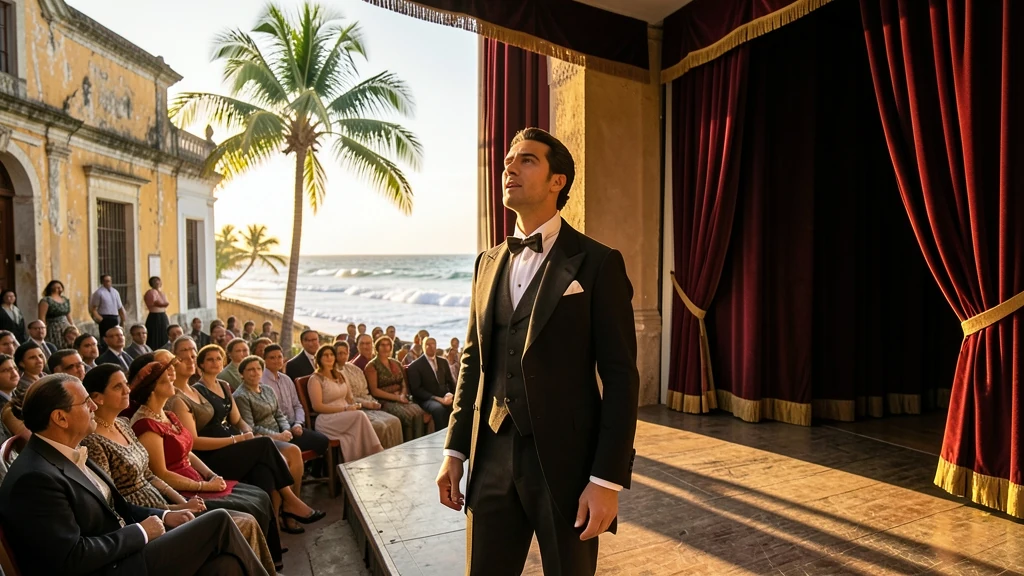
opera in Caracas—ordered one of the Government warehouses to be cleared
for a temporary theatre. A stage was quickly constructed and rough
wooden benches made for the audience. Private boxes were added for the
use of the President and the notables of the army and Government.

The company remained in Macuto for two weeks. Each performance filled
the house as closely as it could be packed. Then the music-mad people
fought for room in the open doors and windows, and crowded about,
hundreds deep, on the outside. Those audiences formed a brilliantly
diversified patch of colour. The hue of their faces ranged from the
clear olive of the pure-blood Spaniards down through the yellow and
brown shades of the Mestizos to the coal-black Carib and the Jamaica
Negro. Scattered among them were little groups of Indians with faces
like stone idols, wrapped in gaudy fibre-woven blankets—Indians down
from the mountain states of Zamora and Los Andes and Miranda to trade
their gold dust in the coast towns.

The spell cast upon these denizens of the interior fastnesses was
remarkable. They sat in petrified ecstasy, conspicuous among the
excitable Macutians, who wildly strove with tongue and hand to give
evidence of their delight. Only once did the sombre rapture of these
aboriginals find expression. During the rendition of “Faust,” Guzman
Blanco, extravagantly pleased by the “Jewel Song,” cast upon the stage
a purse of gold pieces. Other distinguished citizens followed his lead
to the extent of whatever loose coin they had convenient, while some of
the fair and fashionable señoras were moved, in imitation, to fling a
jewel or a ring or two at the feet of the Marguerite—who was, according
to the bills, Mlle. Nina Giraud. Then, from different parts of the
house rose sundry of the stolid hillmen and cast upon the stage little
brown and dun bags that fell with soft “thumps” and did not rebound. It
was, no doubt, pleasure at the tribute to her art that caused Mlle.
Giraud’s eyes to shine so brightly when she opened these little
deerskin bags in her dressing room and found them to contain pure gold
dust. If so, the pleasure was rightly hers, for her voice in song,
pure, strong and thrilling with the feeling of the emotional artist,
deserved the tribute that it earned.

But the triumph of the Alcazar Opera Company is not the theme—it but
leans upon and colours it. There happened in Macuto a tragic thing, an
unsolvable mystery, that sobered for a time the gaiety of the happy
season.

One evening between the short twilight and the time when she should
have whirled upon the stage in the red and black of the ardent Carmen,
Mlle. Nina Giraud disappeared from the sight and ken of 6,000 pairs of
eyes and as many minds in Macuto. There was the usual turmoil and
hurrying to seek her. Messengers flew to the little French-kept hotel
where she stayed; others of the company hastened here or there where
she might be lingering in some tienda or unduly prolonging her bath
upon the beach. All search was fruitless. Mademoiselle had vanished.

Half an hour passed and she did not appear. The dictator, unused to the
caprices of prime donne, became impatient. He sent an aide from his box
to say to the manager that if the curtain did not at once rise he would
immediately hale the entire company to the calabosa, though it would
desolate his heart, indeed, to be compelled to such an act. Birds in
Macuto could be made to sing.

The manager abandoned hope for the time of Mlle. Giraud. A member of
the chorus, who had dreamed hopelessly for years of the blessed
opportunity, quickly Carmenized herself and the opera went on.

Afterward, when the lost cantatrice appeared not, the aid of the
authorities was invoked. The President at once set the army, the police
and all citizens to the search. Not one clue to Mlle. Giraud’s
disappearance was found. The Alcazar left to fill engagements farther
down the coast.

On the way back the steamer stopped at Macuto and the manager made
anxious inquiry. Not a trace of the lady had been discovered. The
Alcazar could do no more. The personal belongings of the missing lady
were stored in the hotel against her possible later reappearance and
the opera company continued upon its homeward voyage to New Orleans.


On the _camino real_ along the beach the two saddle mules and the four
pack mules of Don Señor Johnny Armstrong stood, patiently awaiting the
crack of the whip of the _arriero_, Luis. That would be the signal for
the start on another long journey into the mountains. The pack mules
were loaded with a varied assortment of hardware and cutlery. These
articles Don Johnny traded to the interior Indians for the gold dust
that they washed from the Andean streams and stored in quills and bags
against his coming. It was a profitable business, and Señor Armstrong
expected soon to be able to purchase the coffee plantation that he
coveted.

Armstrong stood on the narrow sidewalk, exchanging garbled Spanish with
old Peralto, the rich native merchant who had just charged him four
prices for half a gross of pot-metal hatchets, and abridged English
with Rucker, the little German who was Consul for the United States.

“Take with you, señor,” said Peralto, “the blessings of the saints upon
your journey.”

“Better try quinine,” growled Rucker through his pipe. “Take two grains
every night. And don’t make your trip too long, Johnny, because we haf
needs of you. It is ein villainous game dot Melville play of whist, and
dere is no oder substitute. _Auf wiedersehen_, und keep your eyes dot
mule’s ears between when you on der edge of der brecipices ride.”

The bells of Luis’s mule jingled and the pack train filed after the
warning note. Armstrong, waved a good-bye and took his place at the
tail of the procession. Up the narrow street they turned, and passed
the two-story wooden Hotel Ingles, where Ives and Dawson and Richards
and the rest of the chaps were dawdling on the broad piazza, reading
week-old newspapers. They crowded to the railing and shouted many
friendly and wise and foolish farewells after him. Across the plaza
they trotted slowly past the bronze statue of Guzman Blanco, within its
fence of bayoneted rifles captured from revolutionists, and out of the
town between the rows of thatched huts swarming with the unclothed
youth of Macuto. They plunged into the damp coolness of banana groves
at length to emerge upon a bright stream, where brown women in scant
raiment laundered clothes destructively upon the rocks. Then the pack
train, fording the stream, attacked the sudden ascent, and bade adieu
to such civilization as the coast afforded.

For weeks Armstrong, guided by Luis, followed his regular route among
the mountains. After he had collected an arroba of the precious metal,
winning a profit of nearly $5,000, the heads of the lightened mules
were turned down-trail again. Where the head of the Guarico River
springs from a great gash in the mountain-side, Luis halted the train.

“Half a day’s journey from here, Señor,” said he, “is the village of
Tacuzama, which we have never visited. I think many ounces of gold may
be procured there. It is worth the trial.”

Armstrong concurred, and they turned again upward toward Tacuzama. The
trail was abrupt and precipitous, mounting through a dense forest. As
night fell, dark and gloomy, Luis once more halted. Before them was a
black chasm, bisecting the path as far as they could see.

Luis dismounted. “There should be a bridge,” he called, and ran along
the cleft a distance. “It is here,” he cried, and remounting, led the
way. In a few moments Armstrong, heard a sound as though a thunderous
drum were beating somewhere in the dark. It was the falling of the
mules’ hoofs upon the bridge made of strong hides lashed to poles and
stretched across the chasm. Half a mile further was Tacuzama. The
village was a congregation of rock and mud huts set in the profundity
of an obscure wood. As they rode in a sound inconsistent with that
brooding solitude met their ears. From a long, low mud hut that they
were nearing rose the glorious voice of a woman in song. The words were
English, the air familiar to Armstrong’s memory, but not to his musical
knowledge.

He slipped from his mule and stole to a narrow window in one end of the
house. Peering cautiously inside, he saw, within three feet of him, a
woman of marvellous, imposing beauty, clothed in a splendid loose robe
of leopard skins. The hut was packed close to the small space in which
she stood with the squatting figures of Indians.

The woman finished her song and seated herself close to the little
window, as if grateful for the unpolluted air that entered it. When she
had ceased several of the audience rose and cast little softly-falling
bags at her feet. A harsh murmur—no doubt a barbarous kind of applause
and comment—went through the grim assembly.

Armstrong, was used to seizing opportunities promptly. Taking advantage
of the noise he called to the woman in a low but distinct voice: “Do
not turn your head this way, but listen. I am an American. If you need
assistance tell me how I can render it. Answer as briefly as you can.”

The woman was worthy of his boldness. Only by a sudden flush of her
pale cheek did she acknowledge understanding of his words. Then she
spoke, scarcely moving her lips.

“I am held a prisoner by these Indians. God knows I need help. In two
hours come to the little hut twenty yards toward the Mountainside.
There will be a light and a red curtain in the window. There is always
a guard at the door, whom you will have to overcome. For the love of
heaven, do not fail to come.”

The story seems to shrink from adventure and rescue and mystery. The
theme is one too gentle for those brave and quickening tones. And yet
it reaches as far back as time itself. It has been named “environment,”
which is as weak a word as any to express the unnameable kinship of man
to nature, that queer fraternity that causes stones and trees and salt
water and clouds to play upon our emotions. Why are we made serious and
solemn and sublime by mountain heights, grave and contemplative by an
abundance of overhanging trees, reduced to inconstancy and monkey
capers by the ripples on a sandy beach? Did the protoplasm—but enough.
The chemists are looking into the matter, and before long they will
have all life in the table of the symbols.

Briefly, then, in order to confine the story within scientific bounds,
John Armstrong, went to the hut, choked the Indian guard and carried
away Mlle. Giraud. With her was also conveyed a number of pounds of
gold dust she had collected during her six months’ forced engagement in
Tacuzama. The Carabobo Indians are easily the most enthusiastic lovers
of music between the equator and the French Opera House in New Orleans.
They are also strong believers that the advice of Emerson was good when
he said: “The thing thou wantest, O discontented man —take it, and pay
the price.” A number of them had attended the performance of the
Alcazar Opera Company in Macuto, and found Mlle. Giraud’s style and
technique satisfactory. They wanted her, so they took her one evening
suddenly and without any fuss. They treated her with much
consideration, exacting only one song recital each day. She was quite
pleased at being rescued by Mr. Armstrong. So much for mystery and
adventure. Now to resume the theory of the protoplasm.

John Armstrong and Mlle. Giraud rode among the Andean peaks, enveloped
in their greatness and sublimity. The mightiest cousins, furthest
removed, in nature’s great family become conscious of the tie. Among
those huge piles of primordial upheaval, amid those gigantic silences
and elongated fields of distance the littlenesses of men are
precipitated as one chemical throws down a sediment from another. They
moved reverently, as in a temple. Their souls were uplifted in unison
with the stately heights. They travelled in a zone of majesty and
peace.

To Armstrong the woman seemed almost a holy thing. Yet bathed in the
white, still dignity of her martyrdom that purified her earthly beauty
and gave out, it seemed, an aura of transcendent loveliness, in those
first hours of companionship she drew from him an adoration that was
half human love, half the worship of a descended goddess.

Never yet since her rescue had she smiled. Over her dress she still
wore the robe of leopard skins, for the mountain air was cold. She
looked to be some splendid princess belonging to those wild and awesome
altitudes. The spirit of the region chimed with hers. Her eyes were
always turned upon the sombre cliffs, the blue gorges and the snow-clad
turrets, looking a sublime melancholy equal to their own. At times on
the journey she sang thrilling te deums and misereres that struck the
true note of the hills, and made their route seem like a solemn march
down a cathedral aisle. The rescued one spoke but seldom, her mood
partaking of the hush of nature that surrounded them. Armstrong looked
upon her as an angel. He could not bring himself to the sacrilege of
attempting to woo her as other women may be wooed.

On the third day they had descended as far as the _tierra templada_,
the zona of the table lands and foot hills. The mountains were receding
in their rear, but still towered, exhibiting yet impressively their
formidable heads. Here they met signs of man. They saw the white houses
of coffee plantations gleam across the clearings. They struck into a
road where they met travellers and pack-mules. Cattle were grazing on
the slopes. They passed a little village where the round-eyed _niños_
shrieked and called at sight of them.

Mlle. Giraud laid aside her leopard-skin robe. It seemed to be a trifle
incongruous now. In the mountains it had appeared fitting and natural.
And if Armstrong was not mistaken she laid aside with it something of
the high dignity of her demeanour. As the country became more populous
and significant of comfortable life he saw, with a feeling of joy, that
the exalted princess and priestess of the Andean peaks was changing to
a woman—an earth woman, but no less enticing. A little colour crept to
the surface of her marble cheek. She arranged the conventional dress
that the removal of the robe now disclosed with the solicitous touch of
one who is conscious of the eyes of others. She smoothed the careless
sweep of her hair. A mundane interest, long latent in the chilling
atmosphere of the ascetic peaks, showed in her eyes.

This thaw in his divinity sent Armstrong’s heart going faster. So might
an Arctic explorer thrill at his first ken of green fields and
liquescent waters. They were on a lower plane of earth and life and
were succumbing to its peculiar, subtle influence. The austerity of the
hills no longer thinned the air they breathed. About them was the
breath of fruit and corn and builded homes, the comfortable smell of
smoke and warm earth and the consolations man has placed between
himself and the dust of his brother earth from which he sprung. While
traversing those awful mountains, Mlle. Giraud had seemed to be wrapped
in their spirit of reverent reserve. Was this that same woman—now
palpitating, warm, eager, throbbing with conscious life and charm,
feminine to her finger-tips? Pondering over this, Armstrong felt
certain misgivings intrude upon his thoughts. He wished he could stop
there with this changing creature, descending no farther. Here was the
elevation and environment to which her nature seemed to respond with
its best. He feared to go down upon the man-dominated levels. Would her
spirit not yield still further in that artificial zone to which they
were descending?

Now from a little plateau they saw the sea flash at the edge of the
green lowlands. Mlle. Giraud gave a little, catching sigh.

“Oh! look, Mr. Armstrong, there is the sea! Isn’t it lovely? I’m so
tired of mountains.” She heaved a pretty shoulder in a gesture of
repugnance. “Those horrid Indians! Just think of what I suffered!
Although I suppose I attained my ambition of becoming a stellar
attraction, I wouldn’t care to repeat the engagement. It was very nice
of you to bring me away. Tell me, Mr. Armstrong—honestly, now —do I
look such an awful, awful fright? I haven’t looked into a mirror, you
know, for months.”

Armstrong made answer according to his changed moods. Also he laid his
hand upon hers as it rested upon the horn of her saddle. Luis was at
the head of the pack train and could not see. She allowed it to remain
there, and her eyes smiled frankly into his.

Then at sundown they dropped upon the coast level under the palms and
lemons among the vivid greens and scarlets and ochres of the _tierra
caliente_. They rode into Macuto, and saw the line of volatile bathers
frolicking in the surf. The mountains were very far away.

Mlle. Giraud’s eyes were shining with a joy that could not have existed
under the chaperonage of the mountain-tops. There were other spirits
calling to her—nymphs of the orange groves, pixies from the chattering
surf, imps, born of the music, the perfumes, colours and the
insinuating presence of humanity. She laughed aloud, musically, at a
sudden thought.

“Won’t there be a sensation?” she called to Armstrong. “Don’t I wish I
had an engagement just now, though! What a picnic the press agent would
have! ‘Held a prisoner by a band of savage Indians subdued by the spell
of her wonderful voice’—wouldn’t that make great stuff? But I guess I
quit the game winner, anyhow—there ought to be a couple of thousand
dollars in that sack of gold dust I collected as encores, don’t you
think?”

He left her at the door of the little Hotel de Buen Descansar, where
she had stopped before. Two hours later he returned to the hotel. He
glanced in at the open door of the little combined reception room and
café.

Half a dozen of Macuto’s representative social and official
_caballeros_ were distributed about the room. Señor Villablanca, the
wealthy rubber concessionist, reposed his fat figure on two chairs,
with an emollient smile beaming upon his chocolate-coloured face.
Guilbert, the French mining engineer, leered through his polished
nose-glasses. Colonel Mendez, of the regular army, in gold-laced
uniform and fatuous grin, was busily extracting corks from champagne
bottles. Other patterns of Macutian gallantry and fashion pranced and
posed. The air was hazy with cigarette smoke. Wine dripped upon the
floor.

Perched upon a table in the centre of the room in an attitude of easy
preëminence was Mlle. Giraud. A chic costume of white lawn and cherry
ribbons supplanted her travelling garb. There was a suggestion of lace,
and a frill or two, with a discreet, small implication of
hand-embroidered pink hosiery. Upon her lap rested a guitar. In her
face was the light of resurrection, the peace of elysium attained
through fire and suffering. She was singing to a lively accompaniment a
little song:

“When you see de big round moon
Comin’ up like a balloon,
Dis nigger skips fur to kiss de lips
Ob his stylish, black-faced coon.”


The singer caught sight of Armstrong.

“Hi! there, Johnny,” she called; “I’ve been expecting you for an hour.
What kept you? Gee! but these smoked guys are the slowest you ever saw.
They ain’t on, at all. Come along in, and I’ll make this
coffee-coloured old sport with the gold epaulettes open one for you
right off the ice.”

“Thank you,” said Armstrong; “not just now, I believe. I’ve several
things to attend to.”

He walked out and down the street, and met Rucker coming up from the
Consulate.

“Play you a game of billiards,” said Armstrong. “I want something to
take the taste of the sea level out of my mouth.”


VI
1 / 1


