
At Abdul Ali's Grave
Read At Abdul Ali's Grave, the complete 1912 story by E. F. Benson. A complete original English tale of the uncanny from a 1912 collection of Edwardian supernatural stories.
By E. F. Benson
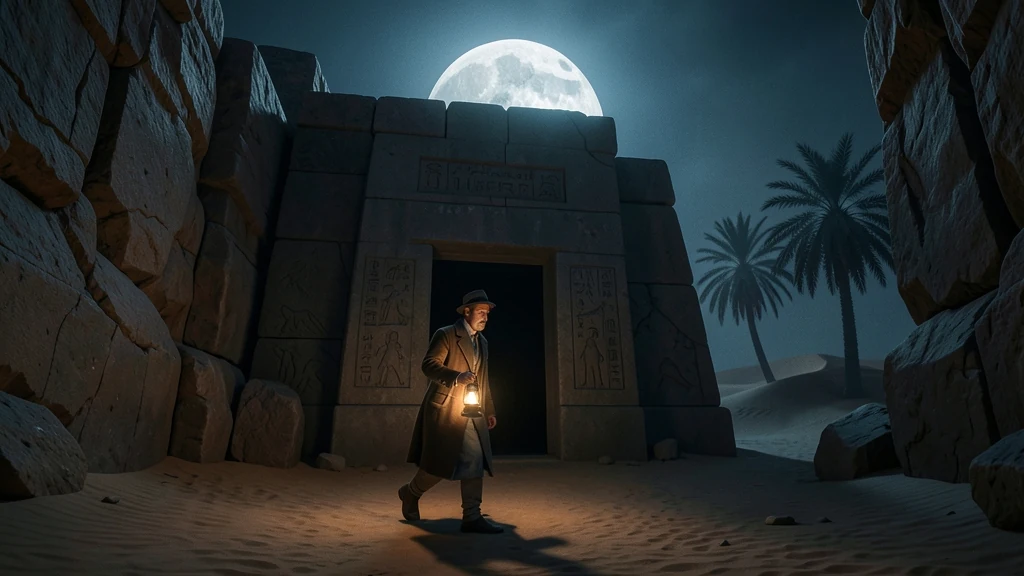
Edition and rights: Complete original English text from Project Gutenberg ebook #72421. This edition is identified as public domain in the USA; the original author died in 1940, satisfying the ordinary Pakistan copyright term. This is the original work, not an AI retelling.
AT ABDUL ALI’S GRAVE


Luxor, as most of those who have been there will allow, is a place of
notable charm, and boasts many attractions for the traveller, chief
among which he will reckon an excellent hotel containing a
billiard-room, a garden fit for the gods to sit in, any quantity of
visitors, at least a weekly dance on board a tourist steamer, quail
shooting, a climate as of Avilion, and a number of stupendously ancient
monuments for those archæologically inclined. But to certain others, few
indeed in number, but almost fanatically convinced of their own
orthodoxy, the charm of Luxor, like some sleeping beauty, only wakes
when these things cease, when the hotel has grown empty and the
billiard-marker “has gone for a long rest” to Cairo, when the decimated
quail and the decimating tourist have fled northwards, and the Theban
plain, Danæ to a tropical sun, is a gridiron across which no man would
willingly make a journey by day, not even if Queen Hatasoo herself
should signify that she would give him audience on the terraces of
Deir-el-Bahari. A suspicion however that the fanatic few were right, for
in other respects they were men of estimable opinions, induced me to
examine their convictions for myself, and thus it came about that two
years ago, certain days toward the beginning of June saw me still there,
a confirmed convert.

Much tobacco and the length of summer days had assisted us to the
analysis of the charm of which summer in the south is possessed, and
Weston--one of the earliest of the elect--and myself had discussed it at
some length, and though we reserved as the principal ingredient a
nameless something which baffled the chemist, and must be felt to be
understood, we were easily able to detect certain other drugs of sight
and sound, which we were agreed, contributed to the whole. A few of them
are here subjoined.

The waking in the warm darkness just before dawn to find that the desire
for stopping in bed fails with the awakening.

The silent start across the Nile in the still air with our horses, who,
like us, stand and sniff at the incredible sweetness of the coming
morning without apparently finding it less wonderful in repetition.

The moment infinitesimal in duration but infinite in sensation, just
before the sun rises, when the grey shrouded river is struck suddenly
out of darkness, and becomes a sheet of green bronze.

The rose flush, rapid as a change of colour in some chemical
combination, which shoots across the sky from east to west, followed
immediately by the sunlight which catches the peaks of the western
hills, and flows down like some luminous liquid.

The stir and whisper which goes through the world: a breeze springs up;
a lark soars and sings; the boatman shouts “Yallah. Yallah”; the horses
toss their heads.

The subsequent ride.

The subsequent breakfast on our return.

The subsequent absence of anything to do.

At sunset the ride into the desert thick with the scent of warm barren
sand, which smells like nothing else in the world, for it smells of
nothing at all.

The blaze of the tropical night.

Camel’s milk.

Converse with the fellahin, who are the most charming and least
accountable people on the face of the earth except when tourists are
about, and when in consequence there is no thought but backsheesh.

Lastly, and with this we are concerned, the possibility of odd
experiences.

       *       *       *       *       *

The beginning of the things which make this tale occurred four days ago,
when Abdul Ali, the oldest man in the village, died suddenly, full of
days and riches. Both, some thought, had probably been somewhat
exaggerated, but his relations affirmed without variation that he had as
many years as he had English pounds, and that each was a hundred. The
apt roundness of these numbers was incontestable, the thing was too
neat not to be true, and before he had been dead for twenty-four hours,
it was a matter of orthodoxy. But with regard to his relations, that
which turned their bereavement, which must soon have occurred, into a
source of blank dismay instead of pious resignation, was that not one of
these English pounds, not even their less satisfactory equivalent in
notes, which, out of the tourist season, are looked upon at Luxor as a
not very dependable variety of Philosopher’s stone, though certainly
capable of producing gold under favourable circumstances, could be
found. Abdul Ali with his hundred years was dead, his century of
sovereigns--they might as well have been an annuity--were dead with him,
and his son Mohamed, who had previously enjoyed a sort of brevet rank in
anticipation of the event, was considered to be throwing far more dust
in the air than the genuine affection even of a chief mourner wholly
justified.

Abdul, it is to be feared, was not a man of stereotyped respectability;
though full of years and riches, he enjoyed no great reputation for
honour. He drank wine whenever he could get it, he ate food during the
days of Ramadan, scornful of the fact, when his appetite desired it, he
was supposed to have the evil eye, and in his last moments he was
attended by the notorious Achmet, who is well known here to be practised
in Black Magic, and has been suspected of the much meaner crime of
robbing the bodies of those lately dead. For in Egypt, while to despoil
the bodies of ancient kings and priests is a privilege for which
advanced and learned societies vie with each other, to rob the corpses
of your contemporaries, is considered the deed of a dog. Mohamed who
soon exchanged the throwing of dust in the air for the more natural mode
of expressing chagrin, which is to gnaw the nails, told us in confidence
that he suspected Achmet of having ascertained the secret of where his
father’s money was, but it appeared that Achmet had as blank a face as
anybody when his patient, who was striving to make some communication to
him, went out into the great silence, and the suspicion that he knew
where the money was, gave way, in the minds of those who were competent
to form an estimate of his character, to a but dubious regret that he
had just failed to learn that very important fact.

So Abdul died and was buried, and we all went to the funeral feast at
which we ate more roast meat than one naturally cares about at five in
the afternoon on a June day, in consequence of which Weston and I, not
requiring dinner, stopped at home after our return from the ride into
the desert, and talked to Mohamed, Abdul’s son, and Hussein, Abdul’s
youngest grandson, a boy of about twenty, who is also our valet, cook
and housemaid, and they together woefully narrated of the money that had
been and was not, and told us scandalous tales about Achmet concerning
his weakness for cemeteries. They drank coffee and smoked, for though
Hussein was our servant, we had been that day the guests of his father,
and shortly after they had gone, up came Machmout.

Machmout, who says he thinks he is twelve, but does not know for
certain, is kitchen-maid, groom and gardener, and has to an
extraordinary degree some occult power resembling clairvoyance. Weston,
who is a member of the Society for Psychical Research, and the tragedy
of whose life has been the detection of the fraudulent medium Mrs Blunt,
says that it is all thought-reading, and has made notes of many of
Machmout’s performances, which may subsequently turn out to be of
interest. Thought-reading, however, does not seem to me to fully explain
the experience which followed Abdul’s funeral, and with Machmout I have
to put it down to White Magic, which should be a very inclusive term, or
to Pure Coincidence, which is even more inclusive, and will cover all
the inexplicable phenomena of the world, taken singly. Machmout’s method
of unloosing the forces of White Magic is simple, being the ink-mirror
known by name to many, and it is as follows.

A little black ink is poured into the palm of Machmout’s hand, or, as
ink has been at a premium lately owing to the last post-boat from Cairo
which contained stationery for us, having stuck on a sand-bank, a small
piece of black American cloth about an inch in diameter, is found to be
a perfect substitute. Upon this he gazes. After five or ten minutes his
shrewd monkey-like expression is struck from his face, his eyes, wide
open, remain fixed on the cloth, a complete rigidity sets in over his
muscles, and he tells us of the curious things he sees. In whatever
position he is, in that position he remains without the deflection of a
hair’s breadth until the ink is washed off or the cloth removed. Then he
looks up and says, “Khalás,” which means, “It is finished.”

We only engaged Machmout’s services as second general domestic a
fortnight ago, but the first evening he was with us he came upstairs
when he had finished his work, and said, “I will show you White Magic;
give me ink,” and proceeded to describe the front hall of our house in
London, saying that there were two horses at the door, and that a man
and woman soon came out, gave the horses each a piece of bread and
mounted. The thing was so probable that by the next mail I wrote asking
my mother to write down exactly what she was doing and where at half
past five (English time) on the evening of June 12. At the corresponding
time in Egypt Machmout was describing speaking to us of a “sitt” (lady)
having tea in a room which he described with some minuteness, and I am
waiting anxiously for her letter. The explanation which Weston gives us
of all these phenomena, is that a certain picture of people I know is
present in my mind, though I may not be aware of it,--present to my
subliminal self, I think, he says,--and that I give an unspoken
suggestion to the hypnotised Machmout. My explanation is that there
isn’t any explanation, for no suggestion on my part would make my
brother go out and ride at the moment when Machmout says he is so doing
(if indeed we find that Machmout’s visions are chronologically correct).
Consequently I prefer the open mind and am prepared to believe anything.
Weston, however, does not speak quite so calmly or scientifically about
Machmout’s last performance, and since it took place, he has almost
entirely ceased to urge me to become a member of the Society for
Psychical Research, in order that I may no longer be hidebound by vain
superstitions.

Machmout will not exercise these powers if his own folk are present, for
he says that when he is in this state, if a man who knew Black Magic was
in the room, or knew that he was practising White Magic, he could get
the spirit who presides over the Black Magic to kill the spirit of White
Magic, for the Black Magic is the more potent, and the two are foes. And
as the spirit of White Magic is on occasions a powerful friend--he had
before now befriended Machmout in a manner which I consider
incredible--Machmout is very desirous that he should abide long with
him. But Englishmen it appears do not know the Black Magic, so with us
he is safe. The spirit of Black Magic, to speak to whom it is death,
Machmout saw once “between heaven and earth, and night and day,” so he
phrases it, on the Karnak road. He may be known, he told us, by the fact
that he is of paler skin than his people, that he has two long teeth,
one in each corner of his mouth, and that his eyes, which are white all
over, are as big as the eyes of a horse.

Machmout squatted himself comfortably in the corner, and I gave him the
piece of black American cloth. As some minutes must elapse before he
gets into the hypnotic state in which the visions begin, I strolled out
on to the balcony for coolness. It was the hottest night we had yet had,
and though the sun had set three hours, the thermometer still registered
close on 100°. Above, the sky seemed veiled with grey, where it should
have been dark velvety blue, and a fitful puffing wind from the south
threatened three days of the sandy intolerable khamseen. A little way up
the street to the left was a small café in front of which were glowing
and waning little glowworm specks of light from the water pipes of Arabs
sitting out there in the dark. From inside came the click of brass
castanets in the hands of some dancing-girl, sounding sharp and precise
against the wailing bagpipe music of the strings and pipes which
accompany these movements which Arabs love and Europeans think so
unpleasing. Eastwards the sky was paler and luminous, for the moon was
imminently rising, and even as I looked the red rim of the enormous disc
cut the line of the desert, and on the instant with a curious aptness,
one of the Arabs outside the café broke out into that wonderful chant--

    “I cannot sleep for longing for thee, O full moon
     Far is thy throne over Mecca, slip down, O beloved, to me.”

Immediately afterwards I heard the piping monotone of Machmout’s voice
begin, and in a moment or two I went inside.

We have found that the experiments gave the quickest result by contact,
a fact which confirmed Weston in his explanation of them by thought
transference of some elaborate kind, which I confess I cannot
understand. He was writing at a table in the window when I came in, but
looked up.

“Take his hand,” he said, “at present he is quite incoherent.”

“Do you explain that?” I asked.

“It is closely analogous, so Myers thinks, to talking in sleep. He has
been saying something about a tomb. Do make a suggestion, and see if he
gives it right. He is remarkably sensitive and he responds quicker to
you than to me. Probably Abdul’s funeral suggested the tomb!”

A sudden thought struck me.

“Hush!” I said, “I want to listen.”

Machmout’s head was thrown a little back, and he held the hand in which
was the piece of cloth rather above his face. As usual he was talking
very slowly, and in a high staccato voice, absolutely unlike his usual
tones.

“On one side of the grave,” he piped, “is a tamarisk tree, and the green
beetles make _fantasia_ about it. On the other side is a mud wall. There
are many other graves about, but they are all asleep. This is _the_
grave, because it is awake, and is moist and not sandy.”

“I thought so,” said Weston, “It is Abdul’s grave he is talking about.”

“There is a red moon sitting on the desert,” continued Machmout, “and it
is now. There is the puffing of khamseen, and much dust coming. The moon
is red with dust, and because it is low.”

“Still sensitive to external conditions,” said Weston. “That is rather
curious. Pinch him, will you?”

I pinched Machmout; he did not pay the slightest attention.

“In the last house of the street, and in the doorway stands a man. Ah!
ah!” cried the boy suddenly, “it is the Black Magic he knows. Don’t let
him come. He is going out of the house,” he shrieked, “he is coming--no,
he is going the other way, towards the moon and the grave. He has the
Black Magic with him, which can raise the dead, and he has a murdering
knife, and a spade. I cannot see his face for the Black Magic is between
it and my eyes.”

Weston had got up, and, like me, was hanging on Machmout’s words.

“We will go there,” he said. “Here is an opportunity of testing it.
Listen a moment.”

“He is walking, walking, walking,” piped Machmout, “still walking to the
moon and the grave. The moon sits no longer on the desert, but has
sprung up a little way.”

I pointed out of the window.

“That at any rate is true,” I said.

Weston took the cloth out of Machmout’s hand, and the piping ceased. In
a moment he stretched himself, and rubbed his eyes.

“Khalás,” he said.

“Yes, it is Khalás.”

“Did I tell you of the sitt in England?” he asked.

“Yes, oh, yes,” I answered; “thank you, little Machmout. The White Magic
was very good to-night. Get you to bed.”

Machmout trotted obediently out of the room, and Weston closed the door
after him.

“We must be quick,” he said. “It is worth while going and giving the
thing a chance, though I wish he had seen something less gruesome. The
odd thing is that he was not at the funeral, and yet he describes the
grave accurately. What do you make of it?”

“I make that the White Magic has shown Machmout that somebody with
black magic is going to Abdul’s grave, perhaps to rob it,” I answered
resolutely.

“What are we to do when we get there?” asked Weston.

“See the Black Magic at work. Personally I am in a blue funk. So are
you.”

“There is no such thing as Black Magic,” said Weston. “Ah, I have it.
Give me that orange.”

Weston rapidly skinned it, and cut from the rind two circles as big as a
five shilling piece, and two long, white fangs of skin. The first he
fixed in his eye, the two latter in the corners of his mouth.

“The spirit of Black Magic?” I asked.

“The same.”

He took up a long black burnous and wrapped it round him. Even in the
bright lamp light, the spirit of black magic was a sufficiently terrific
personage.

“I don’t believe in black magic,” he said, “but others do. If it is
necessary to put a stop to--to anything that is going on, we will hoist
the man on his own petard. Come along. Whom do you suspect it is--I
mean, of course, who was the person you were thinking of when your
thoughts were transferred to Machmout.”

“What Machmout said,” I answered, “suggested Achmet to me.”

Weston indulged in a laugh of scientific incredulity, and we set off.

The moon, as the boy had told us, was just clear of the horizon, and as
it rose higher, its colour at first red and sombre, like the blaze of
some distant conflagration, paled to a tawny yellow. The hot wind from
the south, blowing no longer fitfully but with a steadily increasing
violence was thick with sand, and of an incredibly scorching heat, and
the tops of the palm trees in the garden of the deserted hotel on the
right were lashing themselves to and fro with a harsh rattle of dry
leaves. The cemetery lay on the outskirts of the village, and, as long
as our way lay between the mud walls of the huddling street, the wind
came to us only as the heat from behind closed furnace doors. Every now
and then with a whisper and whistle rising into a great buffeting flap,
a sudden whirlwind of dust would scour some twenty yards along the road,
and then break like a shore-quenched wave against one or other of the
mud walls or throw itself heavily against a house and fall in a shower
of sand. But once free of obstructions we were opposed to the full heat
and blast of the wind which blew full in our teeth. It was the first
summer khamseen of the year, and for the moment I wished I had gone
north with the tourist and the quail and the billiard marker, for
khamseen fetches the marrow out of the bones, and turns the body to
blotting paper. We passed no one in the street, and the only sound we
heard, except the wind, was the howling of moonstruck dogs.

The cemetery is surrounded by a tall mud-built wall, and sheltering for
a few moments under this we discussed our movements. The row of
tamarisks close to which the tomb lay went down the centre of the
graveyard, and by skirting the wall outside and climbing softly over
where they approached it, the fury of the wind might help us to get near
the grave without being seen, if anyone happened to be there. We had
just decided on this, and were moving on to put the scheme into
execution, when the wind dropped for a moment, and in the silence we
could hear the chump of the spade being driven into the earth, and what
gave me a sudden thrill of intimate horror, the cry of the
carrion-feeding hawk from the dusty sky just overhead.

Two minutes later we were creeping up in the shade of the tamarisks, to
where Abdul had been buried. The great green beetles which live on the
trees were flying about blindly, and once or twice one dashed into my
face with a whirr of mail-clad wings. When we were within some twenty
yards of the grave we stopped for a moment, and, looking cautiously out
from our shelter of tamarisks, saw the figure of a man already waist
deep in the earth, digging out the newly turned grave. Weston, who was
standing behind me had adjusted the characteristics of the spirit of
Black Magic so as to be ready for emergencies, and turning round
suddenly, and finding myself unawares face to face with that realistic
impersonation, though my nerves are not precariously strong, I could
have found it within me to shriek aloud. But that unsympathetic man of
iron only shook with suppressed laughter, and, holding the eyes in his
hand, motioned me forward again without speaking to where the trees grew
thicker. There we stood not a dozen yards away from the grave.

We waited, I suppose, for some ten minutes, while the man, whom we saw
to be Achmet, toiled on at his impious task. He was entirely naked, and
his brown skin glistened with the dews of exertion in the moonlight. At
times he chattered in a cold uncanny manner to himself, and once or
twice he stopped for breath. Then he began scraping the earth away with
his hands, and soon afterwards searched in his clothes which were lying
near for a piece of rope, with which he stepped into the grave, and in a
moment reappeared again with both ends in his hands. Then, standing
astride the grave, he pulled strongly, and one end of the coffin
appeared above the ground. He chipped a piece of the lid away to make
sure that he had the right end, and then, setting it upright, wrenched
off the top with his knife and there faced us leaning against the coffin
lid, the small shrivelled figure of the dead Abdul, swathed like a baby
in white.

I was just about to motion the spirit of Black Magic to make his
appearance, when Machmout’s words came into my head: “He has with him
the Black Magic which can raise the dead,” and sudden overwhelming
curiosity, which froze disgust and horror into chill unfeeling things,
came over me.

“Wait,” I whispered to Weston, “he will use the Black Magic.”

Again the wind dropped for a moment, and again, in the silence that came
with it, I heard the chiding of the hawk overhead, this time nearer, and
thought I heard more birds than one.

Achmet meantime had taken the covering from off the face, and had undone
the swathing band, which at the moment after death is bound round the
chin to close the jaw, and in Arab burial is always left there, and from
where we stood I could see that the jaw dropped when the bandage was
untied, as if, though the wind blew towards us with a ghastly scent of
mortality on it, the muscles were not even now set, though the man had
been dead sixty hours. But still a rank and burning curiosity to see
what this unclean ghoul would do next stifled all other feelings in my
mind. He seemed not to notice, or, at any rate, to disregard that mouth
gaping awry, and moved about nimbly in the moonlight.

He took from a pocket of his clothes, which were lying near, two small
black objects, which now are safely embedded in the mud at the bottom of
the Nile, and rubbed them briskly together. By degrees they grew
luminous with a sickly yellow pallor of light, and from his hands went
up a wavy, phosphorescent flame. One of these cubes he placed in the
open mouth of the corpse, the other in his own, and, taking the dead man
closely in his arms as though he would indeed dance with death, he
breathed long breaths from his mouth into that dead cavern which was
pressed to his. Suddenly he started back with a quick-drawn breath of
wonder and perhaps of horror, and stood for a space as if irresolute,
for the cube which the dead man held instead of lying loosely in the
jaw, was pressed tight between clenched teeth. After a moment of
irresolution he stepped back quickly to his clothes again, and took up
from near them the knife with which he had stripped off the coffin lid,
and holding this in one hand behind his back, with the other he took out
the cube from the dead man’s mouth, though with a visible exhibition of
force, and spoke.

“Abdul,” he said, “I am your friend, and I swear I will give your money
to Mohamed, if you will tell me where it is.”

Certain I am that the lips of the dead moved, and the eyelids fluttered
for a moment like the wings of a wounded bird, but at that sight, the
horror so grew on me that I was physically incapable of stifling the cry
that rose to my lips, and Achmet turned round. Next moment the complete
Spirit of Black Magic glided out of the shade of the trees, and stood
before him. The wretched man stood for a moment without stirring, then,
turning with shaking knees to flee, he stepped back and fell into the
grave he had just opened.

Weston turned on me angrily, dropping the eyes and the teeth of the
Afrit.

“You spoiled it all,” he cried. “It would perhaps have been the most
interesting ...” and his eye lighted on the dead Abdul, who peered
open-eyed from the coffin, then swayed, tottered, and fell forward, face
downwards on the ground close to him. For one moment he lay there, and
then the body rolled slowly on to its back without visible cause of
movement, and lay staring into the sky. The face was covered with dust,
but with the dust was mingled fresh blood. A nail had caught the cloth
that wound him, underneath which as usual were the clothes in which he
had died, for the Arabs do not wash their dead, and it had torn a great
rent through them all, leaving the right shoulder bare.

Weston strove to speak once, but failed. Then:

“I will go and inform the police,” he said, “if you will stop here, and
see that Achmet does not get out.”

But this I altogether refused to do, and, after covering the body with
the coffin to protect it from the hawks, we secured Achmet’s arms with
the rope he had already used that night, and took him off to Luxor.

Next morning Mohamed came to see us.

“I thought Achmet knew where the money was,” he said exultantly.

“Where was it?”

“In a little purse tied round the shoulder. The dog had already begun
stripping it. See”--and he brought it out of his pocket--“it is all
there in those English notes, five pounds each, and there are twenty of
them.”

Our conclusion was slightly different, for even Weston will allow that
Achmet _hoped_ to learn from dead lips the secret of the treasure, and
then to kill the man anew and bury him. But that is pure conjecture.

The only other point of interest lies in the two black cubes which we
picked up, and found to be graven with curious characters. These I put
one evening into Machmout’s hand, when he was exhibiting to us his
curious powers of “thought transference.” The effect was that he
screamed aloud, crying out that the Black Magic had come, and though I
did not feel certain about that, I thought they would be safer in
mid-Nile. Weston grumbled a little, and said that he had wanted to take
them to the British Museum, but that I feel sure was an afterthought.
1 / 1


