
Canon Alberic’s Scrap-book
Read Canon Alberic’s Scrap-book by M. R. James in the original English.
By M. R. James
Edition: Complete story in the original English, from Project Gutenberg #8486. No translation or AI rewriting of the literary text. Original spelling retained.
This eBook is for the use of anyone anywhere in the United States and most other parts of the world at no cost and with almost no restrictions whatsoever. You may copy it, give it away or re-use it under the terms of the Project Gutenberg License included with this eBook or online at www.gutenberg.org. If you are not located in the United States, you will have to check the laws of the country where you are located before using this eBook.
St Bertrand de Comminges is a decayed town on the spurs of the Pyrenees, not very far from Toulouse, and still nearer to Bagnères-de-Luchon. It was the site of a bishopric until the Revolution, and has a cathedral which is visited by a certain number of tourists. In the spring of 1883 an Englishman arrived at this old-world place—I can hardly dignify it with the name of city, for there are not a thousand inhabitants. He was a Cambridge man, who had come specially from Toulouse to see St Bertrand’s Church, and had left two friends, who were less keen archaeologists than himself, in their hotel at Toulouse, under promise to join him on the following morning. Half an hour at the church would satisfy them, and all three could then pursue their journey in the direction of Auch. But our Englishman had come early on the day in question, and proposed to himself to fill a note-book and to use several dozens of plates in the process of describing and photographing every corner of the wonderful church that dominates the little hill of Comminges. In order to carry out this design satisfactorily, it was necessary to monopolize the verger of the church for the day. The verger or sacristan (I prefer the latter appellation, inaccurate as it may be) was accordingly sent for by the somewhat brusque lady who keeps the inn of the Chapeau Rouge; and when he came, the Englishman found him an unexpectedly interesting object of study. It was not in the personal appearance of the little, dry, wizened old man that the interest lay, for he was precisely like dozens of other church-guardians in France, but in a curious furtive, or rather hunted and oppressed, air which he had. He was perpetually half glancing behind him; the muscles of his back and shoulders seemed to be hunched in a continual nervous contraction, as if he were expecting every moment to find himself in the clutch of an enemy. The Englishman hardly knew whether to put him down as a man haunted by a fixed delusion, or as one oppressed by a guilty conscience, or as an unbearably henpecked husband. The probabilities, when reckoned up, certainly pointed to the last idea; but, still, the impression conveyed was that of a more formidable persecutor even than a termagant wife.
However, the Englishman (let us call him Dennistoun) was soon too deep in his note-book and too busy with his camera to give more than an occasional glance to the sacristan. Whenever he did look at him, he found him at no great distance, either huddling himself back against the wall or crouching in one of the gorgeous stalls. Dennistoun became rather fidgety after a time. Mingled suspicions that he was keeping the old man from his déjeuner, that he was regarded as likely to make away with St Bertrand’s ivory crozier, or with the dusty stuffed crocodile that hangs over the font, began to torment him.
“Won’t you go home?” he said at last; “I’m quite well able to finish my notes alone; you can lock me in if you like. I shall want at least two hours more here, and it must be cold for you, isn’t it?”
“Good heavens!” said the little man, whom the suggestion seemed to throw into a state of unaccountable terror, “such a thing cannot be thought of for a moment. Leave monsieur alone in the church? No, no; two hours, three hours, all will be the same to me. I have breakfasted, I am not at all cold, with many thanks to monsieur.”
“Very well, my little man,” quoth Dennistoun to himself: “you have been warned, and you must take the consequences.”
Before the expiration of the two hours, the stalls, the enormous dilapidated organ, the choir-screen of Bishop John de Mauléon, the remnants of glass and tapestry, and the objects in the treasure-chamber, had been well and truly examined; the sacristan still keeping at Dennistoun’s heels, and every now and then whipping round as if he had been stung, when one or other of the strange noises that trouble a large empty building fell on his ear. Curious noises they were sometimes.
“Once,” Dennistoun said to me, “I could have sworn I heard a thin metallic voice laughing high up in the tower. I darted an inquiring glance at my sacristan. He was white to the lips. ‘It is he—that is—it is no one; the door is locked,’ was all he said, and we looked at each other for a full minute.”
Another little incident puzzled Dennistoun a good deal. He was examining a large dark picture that hangs behind the altar, one of a series illustrating the miracles of St Bertrand. The composition of the picture is well-nigh indecipherable, but there is a Latin legend below, which runs thus:
Qualiter S. Bertrandus liberavit hominem quem diabolus diu volebat strangulare. (How St Bertrand delivered a man whom the Devil long sought to strangle.)
Dennistoun was turning to the sacristan with a smile and a jocular remark of some sort on his lips, but he was confounded to see the old man on his knees, gazing at the picture with the eye of a suppliant in agony, his hands tightly clasped, and a rain of tears on his cheeks. Dennistoun naturally pretended to have noticed nothing, but the question would not go away from him, “Why should a daub of this kind affect anyone so strongly?” He seemed to himself to be getting some sort of clue to the reason of the strange look that had been puzzling him all the day: the man must be a monomaniac; but what was his monomania?
It was nearly five o’clock; the short day was drawing in, and the church began to fill with shadows, while the curious noises—the muffled footfalls and distant talking voices that had been perceptible all day—seemed, no doubt because of the fading light and the consequently quickened sense of hearing, to become more frequent and insistent.
The sacristan began for the first time to show signs of hurry and impatience. He heaved a sigh of relief when camera and note-book were finally packed up and stowed away, and hurriedly beckoned Dennistoun to the western door of the church, under the tower. It was time to ring the Angelus. A few pulls at the reluctant rope, and the great bell Bertrande, high in the tower, began to speak, and swung her voice up among the pines and down to the valleys, loud with mountain-streams, calling the dwellers on those lonely hills to remember and repeat the salutation of the angel to her whom he called Blessed among women. With that a profound quiet seemed to fall for the first time that day upon the little town, and Dennistoun and the sacristan went out of the church.
On the doorstep they fell into conversation.
“Monsieur seemed to interest himself in the old choir-books in the sacristy.”
“Undoubtedly. I was going to ask you if there were a library in the town.”
“No, monsieur; perhaps there used to be one belonging to the Chapter, but it is now such a small place—” Here came a strange pause of irresolution, as it seemed; then, with a sort of plunge, he went on: “But if monsieur is amateur des vieux livres, I have at home something that might interest him. It is not a hundred yards.”
At once all Dennistoun’s cherished dreams of finding priceless manuscripts in untrodden corners of France flashed up, to die down again the next moment. It was probably a stupid missal of Plantin’s printing, about 1580. Where was the likelihood that a place so near Toulouse would not have been ransacked long ago by collectors? However, it would be foolish not to go; he would reproach himself for ever after if he refused. So they set off. On the way the curious irresolution and sudden determination of the sacristan recurred to Dennistoun, and he wondered in a shamefaced way whether he was being decoyed into some purlieu to be made away with as a supposed rich Englishman. He contrived, therefore, to begin talking with his guide, and to drag in, in a rather clumsy fashion, the fact that he expected two friends to join him early the next morning. To his surprise, the announcement seemed to relieve the sacristan at once of some of the anxiety that oppressed him.
“That is well,” he said quite brightly—“that is very well. Monsieur will travel in company with his friends; they will be always near him. It is a good thing to travel thus in company—sometimes.”
The last word appeared to be added as an afterthought and to bring with it a relapse into gloom for the poor little man.
They were soon at the house, which was one rather larger than its neighbours, stone-built, with a shield carved over the door, the shield of Alberic de Mauléon, a collateral descendant, Dennistoun tells me, of Bishop John de Mauléon. This Alberic was a Canon of Comminges from 1680 to 1701. The upper windows of the mansion were boarded up, and the whole place bore, as does the rest of Comminges, the aspect of decaying age.
Arrived on his doorstep, the sacristan paused a moment.
“Perhaps,” he said, “perhaps, after all, monsieur has not the time?”
“Not at all—lots of time—nothing to do till tomorrow. Let us see what it is you have got.”
The door was opened at this point, and a face looked out, a face far younger than the sacristan’s, but bearing something of the same distressing look: only here it seemed to be the mark, not so much of fear for personal safety as of acute anxiety on behalf of another. Plainly, the owner of the face was the sacristan’s daughter; and, but for the expression I have described, she was a handsome girl enough. She brightened up considerably on seeing her father accompanied by an able-bodied stranger. A few remarks passed between father and daughter, of which Dennistoun only caught these words, said by the sacristan, “He was laughing in the church,” words which were answered only by a look of terror from the girl.
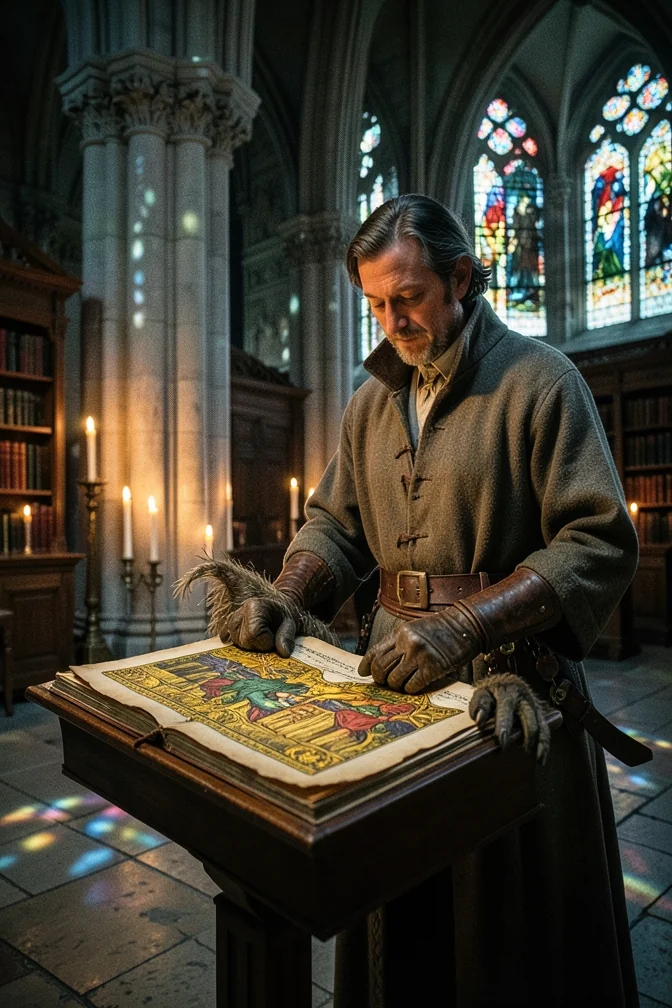
But in another minute they were in the sitting-room of the house, a small, high chamber with a stone floor, full of moving shadows cast by a wood-fire that flickered on a great hearth. Something of the character of an oratory was imparted to it by a tall crucifix, which reached almost to the ceiling on one side; the figure was painted of the natural colours, the cross was black. Under this stood a chest of some age and solidity, and when a lamp had been brought, and chairs set, the sacristan went to this chest, and produced therefrom, with growing excitement and nervousness, as Dennistoun thought, a large book, wrapped in a white cloth, on which cloth a cross was rudely embroidered in red thread. Even before the wrapping had been removed, Dennistoun began to be interested by the size and shape of the volume. “Too large for a missal,” he thought, “and not the shape of an antiphoner; perhaps it may be something good, after all.” The next moment the book was open, and Dennistoun felt that he had at last lit upon something better than good. Before him lay a large folio, bound, perhaps, late in the seventeenth century, with the arms of Canon Alberic de Mauléon stamped in gold on the sides. There may have been a hundred and fifty leaves of paper in the book, and on almost every one of them was fastened a leaf from an illuminated manuscript. Such a collection Dennistoun had hardly dreamed of in his wildest moments. Here were ten leaves from a copy of Genesis, illustrated with pictures, which could not be later than A.D. 700. Further on was a complete set of pictures from a Psalter, of English execution, of the very finest kind that the thirteenth century could produce; and, perhaps best of all, there were twenty leaves of uncial writing in Latin, which, as a few words seen here and there told him at once, must belong to some very early unknown patristic treatise. Could it possibly be a fragment of the copy of Papias “On the Words of Our Lord”, which was known to have existed as late as the twelfth century at Nîmes?[1] In any case, his mind was made up; that book must return to Cambridge with him, even if he had to draw the whole of his balance from the bank and stay at St. Bertrand till the money came. He glanced up at the sacristan to see if his face yielded any hint that the book was for sale. The sacristan was pale, and his lips were working.
[1] We now know that these leaves did contain a considerable fragment of that work, if not of that actual copy of it.
“If monsieur will turn on to the end,” he said.
So monsieur turned on, meeting new treasures at every rise of a leaf; and at the end of the book he came upon two sheets of paper, of much more recent date than anything he had yet seen, which puzzled him considerably. They must be contemporary, he decided, with the unprincipled Canon Alberic, who had doubtless plundered the Chapter library of St Bertrand to form this priceless scrap-book. On the first of the paper sheets was a plan, carefully drawn and instantly recognizable by a person who knew the ground, of the south aisle and cloisters of St Bertrand’s. There were curious signs looking like planetary symbols, and a few Hebrew words in the corners; and in the north-west angle of the cloister was a cross drawn in gold paint. Below the plan were some lines of writing in Latin, which ran thus:
Responsa 12mi Dec. 1694. Interrogatum est: Inveniamne? Responsum est: Invenies. Fiamne dives? Fies. Vivamne invidendus? Vives. Moriarne in lecto meo? Ita. (Answers of the 12th of December, 1694. It was asked: Shall I find it? Answer: Thou shalt. Shall I become rich? Thou wilt. Shall I live an object of envy? Thou wilt. Shall I die in my bed? Thou wilt.)
“A good specimen of the treasure-hunter’s record—quite reminds one of Mr Minor-Canon Quatremain in Old St Paul’s,” was Dennistoun’s comment, and he turned the leaf.
What he then saw impressed him, as he has often told me, more than he could have conceived any drawing or picture capable of impressing him. And, though the drawing he saw is no longer in existence, there is a photograph of it (which I possess) which fully bears out that statement. The picture in question was a sepia drawing at the end of the seventeenth century, representing, one would say at first sight, a Biblical scene; for the architecture (the picture represented an interior) and the figures had that semi-classical flavour about them which the artists of two hundred years ago thought appropriate to illustrations of the Bible. On the right was a King on his throne, the throne elevated on twelve steps, a canopy overhead, soldiers on either side—evidently King Solomon. He was bending forward with outstretched sceptre, in attitude of command; his face expressed horror and disgust, yet there was in it also the mark of imperious command and confident power. The left half of the picture was the strangest, however. The interest plainly centred there. On the pavement before the throne were grouped four soldiers, surrounding a crouching figure which must be described in a moment. A fifth soldier lay dead on the pavement, his neck distorted, and his eye-balls starting from his head. The four surrounding guards were looking at the King. In their faces, the sentiment of horror was intensified; they seemed, in fact, only restrained from flight by their implicit trust in their master. All this terror was plainly excited by the being that crouched in their midst. I entirely despair of conveying by any words the impression which this figure makes upon anyone who looks at it. I recollect once showing the photograph of the drawing to a lecturer on morphology—a person of, I was going to say, abnormally sane and unimaginative habits of mind. He absolutely refused to be alone for the rest of that evening, and he told me afterwards that for many nights he had not dared to put out his light before going to sleep. However, the main traits of the figure I can at least indicate. At first you saw only a mass of coarse, matted black hair; presently it was seen that this covered a body of fearful thinness, almost a skeleton, but with the muscles standing out like wires. The hands were of a dusky pallor, covered, like the body, with long, coarse hairs, and hideously taloned. The eyes, touched in with a burning yellow, had intensely black pupils, and were fixed upon the throned King with a look of beast-like hate. Imagine one of the awful bird-catching spiders of South America translated into human form, and endowed with intelligence just less than human, and you will have some faint conception of the terror inspired by the appalling effigy. One remark is universally made by those to whom I have shown the picture: “It was drawn from the life.”
As soon as the first shock of his irresistible fright had subsided, Dennistoun stole a look at his hosts. The sacristan’s hands were pressed upon his eyes; his daughter, looking up at the cross on the wall, was telling her beads feverishly.
At last the question was asked, “Is this book for sale?”
There was the same hesitation, the same plunge of determination that he had noticed before, and then came the welcome answer, “If monsieur pleases.”
“How much do you ask for it?”
“I will take two hundred and fifty francs.”
This was confounding. Even a collector’s conscience is sometimes stirred, and Dennistoun’s conscience was tenderer than a collector’s.
“My good man!” he said again and again, “your book is worth far more than two hundred and fifty francs, I assure you—far more.”
But the answer did not vary: “I will take two hundred and fifty francs, not more.”
There was really no possibility of refusing such a chance. The money was paid, the receipt signed, a glass of wine drunk over the transaction, and then the sacristan seemed to become a new man. He stood upright, he ceased to throw those suspicious glances behind him, he actually laughed or tried to laugh. Dennistoun rose to go.
“I shall have the honour of accompanying monsieur to his hotel?” said the sacristan.
“Oh no, thanks! it isn’t a hundred yards. I know the way perfectly, and there is a moon.”
The offer was pressed three or four times, and refused as often.
“Then, monsieur will summon me if—if he finds occasion; he will keep the middle of the road, the sides are so rough.”
“Certainly, certainly,” said Dennistoun, who was impatient to examine his prize by himself; and he stepped out into the passage with his book under his arm.
Here he was met by the daughter; she, it appeared, was anxious to do a little business on her own account; perhaps, like Gehazi, to “take somewhat” from the foreigner whom her father had spared.
“A silver crucifix and chain for the neck; monsieur would perhaps be good enough to accept it?”
Well, really, Dennistoun hadn’t much use for these things. What did mademoiselle want for it?
“Nothing—nothing in the world. Monsieur is more than welcome to it.”
The tone in which this and much more was said was unmistakably genuine, so that Dennistoun was reduced to profuse thanks, and submitted to have the chain put round his neck. It really seemed as if he had rendered the father and daughter some service which they hardly knew how to repay. As he set off with his book they stood at the door looking after him, and they were still looking when he waved them a last good night from the steps of the Chapeau Rouge.
Dinner was over, and Dennistoun was in his bedroom, shut up alone with his acquisition. The landlady had manifested a particular interest in him since he had told her that he had paid a visit to the sacristan and bought an old book from him. He thought, too, that he had heard a hurried dialogue between her and the said sacristan in the passage outside the salle à manger; some words to the effect that “Pierre and Bertrand would be sleeping in the house” had closed the conversation.
All this time a growing feeling of discomfort had been creeping over him—nervous reaction, perhaps, after the delight of his discovery. Whatever it was, it resulted in a conviction that there was someone behind him, and that he was far more comfortable with his back to the wall. All this, of course, weighed light in the balance as against the obvious value of the collection he had acquired. And now, as I said, he was alone in his bedroom, taking stock of Canon Alberic’s treasures, in which every moment revealed something more charming.
“Bless Canon Alberic!” said Dennistoun, who had an inveterate habit of talking to himself. “I wonder where he is now? Dear me! I wish that landlady would learn to laugh in a more cheering manner; it makes one feel as if there was someone dead in the house. Half a pipe more, did you say? I think perhaps you are right. I wonder what that crucifix is that the young woman insisted on giving me? Last century, I suppose. Yes, probably. It is rather a nuisance of a thing to have round one’s neck—just too heavy. Most likely her father has been wearing it for years. I think I might give it a clean up before I put it away.”
He had taken the crucifix off, and laid it on the table, when his attention was caught by an object lying on the red cloth just by his left elbow. Two or three ideas of what it might be flitted through his brain with their own incalculable quickness.
“A penwiper? No, no such thing in the house. A rat? No, too black. A large spider? I trust to goodness not—no. Good God! a hand like the hand in that picture!”
In another infinitesimal flash he had taken it in. Pale, dusky skin, covering nothing but bones and tendons of appalling strength; coarse black hairs, longer than ever grew on a human hand; nails rising from the ends of the fingers and curving sharply down and forward, grey, horny and wrinkled.
He flew out of his chair with deadly, inconceivable terror clutching at his heart. The shape, whose left hand rested on the table, was rising to a standing posture behind his seat, its right hand crooked above his scalp. There was black and tattered drapery about it; the coarse hair covered it as in the drawing. The lower jaw was thin—what can I call it?—shallow, like a beast’s; teeth showed behind the black lips; there was no nose; the eyes, of a fiery yellow, against which the pupils showed black and intense, and the exulting hate and thirst to destroy life which shone there, were the most horrifying features in the whole vision. There was intelligence of a kind in them—intelligence beyond that of a beast, below that of a man.
The feelings which this horror stirred in Dennistoun were the intensest physical fear and the most profound mental loathing. What did he do? What could he do? He has never been quite certain what words he said, but he knows that he spoke, that he grasped blindly at the silver crucifix, that he was conscious of a movement towards him on the part of the demon, and that he screamed with the voice of an animal in hideous pain.
Pierre and Bertrand, the two sturdy little serving-men, who rushed in, saw nothing, but felt themselves thrust aside by something that passed out between them, and found Dennistoun in a swoon. They sat up with him that night, and his two friends were at St Bertrand by nine o’clock next morning. He himself, though still shaken and nervous, was almost himself by that time, and his story found credence with them, though not until they had seen the drawing and talked with the sacristan.
Almost at dawn the little man had come to the inn on some pretence, and had listened with the deepest interest to the story retailed by the landlady. He showed no surprise.
“It is he—it is he! I have seen him myself,” was his only comment; and to all questionings but one reply was vouchsafed: “Deux fois je l’ai vu; mille fois je l’ai senti.” He would tell them nothing of the provenance of the book, nor any details of his experiences. “I shall soon sleep, and my rest will be sweet. Why should you trouble me?” he said.[2]
[2] He died that summer; his daughter married, and settled at St Papoul. She never understood the circumstances of her father’s “obsession”.
We shall never know what he or Canon Alberic de Mauléon suffered. At the back of that fateful drawing were some lines of writing which may be supposed to throw light on the situation:
Contradictio Salomonis cum demonio nocturno. Albericus de Mauléone delineavit. V. Deus in adiutorium. Ps. Qui habitat. Sancte Bertrande, demoniorum effugator, intercede pro me miserrimo. Primum uidi nocte 12(mi) Dec. 1694: uidebo mox ultimum. Peccaui et passus sum, plura adhuc passurus. Dec. 29, 1701.[3]
[3] i.e., The Dispute of Solomon with a demon of the night. Drawn by Alberic de Mauléon. Versicle. O Lord, make haste to help me. Psalm. Whoso dwelleth xci. Saint Bertrand, who puttest devils to flight, pray for me most unhappy. I saw it first on the night of Dec. 12, 1694: soon I shall see it for the last time. I have sinned and suffered, and have more to suffer yet. Dec. 29, 1701. The “Gallia Christiana” gives the date of the Canon’s death as December 31, 1701, “in bed, of a sudden seizure”. Details of this kind are not common in the great work of the Sammarthani.
I have never quite understood what was Dennistoun’s view of the events I have narrated. He quoted to me once a text from Ecclesiasticus: “Some spirits there be that are created for vengeance, and in their fury lay on sore strokes.” On another occasion he said: “Isaiah was a very sensible man; doesn’t he say something about night monsters living in the ruins of Babylon? These things are rather beyond us at present.”
Another confidence of his impressed me rather, and I sympathized with it. We had been, last year, to Comminges, to see Canon Alberic’s tomb. It is a great marble erection with an effigy of the Canon in a large wig and soutane, and an elaborate eulogy of his learning below. I saw Dennistoun talking for some time with the Vicar of St Bertrand’s, and as we drove away he said to me: “I hope it isn’t wrong: you know I am a Presbyterian—but I—I believe there will be ‘saying of Mass and singing of dirges’ for Alberic de Mauléon’s rest.” Then he added, with a touch of the Northern British in his tone, “I had no notion they came so dear.”
The book is in the Wentworth Collection at Cambridge. The drawing was photographed and then burnt by Dennistoun on the day when he left Comminges on the occasion of his first visit.
Source and edition terms: https://www.gutenberg.org/ebooks/8486 · Project Gutenberg License. Original-language text; original publisher illustrations are not reproduced.
Source acknowledgements and license
START: FULL LICENSE
THE FULL PROJECT GUTENBERG™ LICENSE
PLEASE READ THIS BEFORE YOU DISTRIBUTE OR USE THIS WORK
To protect the Project Gutenberg™ mission of promoting the free distribution of electronic works, by using or distributing this work (or any other work associated in any way with the phrase “Project Gutenberg”), you agree to comply with all the terms of the Full Project Gutenberg License available with this file or online at www.gutenberg.org/license.
Section 1. General Terms of Use and Redistributing Project Gutenberg electronic works
1.A. By reading or using any part of this Project Gutenberg electronic work, you indicate that you have read, understand, agree to and accept all the terms of this license and intellectual property (trademark/copyright) agreement. If you do not agree to abide by all the terms of this agreement, you must cease using and return or destroy all copies of Project Gutenberg electronic works in your possession. If you paid a fee for obtaining a copy of or access to a Project Gutenberg electronic work and you do not agree to be bound by the terms of this agreement, you may obtain a refund from the person or entity to whom you paid the fee as set forth in paragraph 1.E.8.
1.B. “Project Gutenberg” is a registered trademark. It may only be used on or associated in any way with an electronic work by people who agree to be bound by the terms of this agreement. There are a few things that you can do with most Project Gutenberg electronic works even without complying with the full terms of this agreement. See paragraph 1.C below. There are a lot of things you can do with Project Gutenberg electronic works if you follow the terms of this agreement and help preserve free future access to Project Gutenberg electronic works. See paragraph 1.E below.
1.C. The Project Gutenberg Literary Archive Foundation (“the Foundation” or PGLAF), owns a compilation copyright in the collection of Project Gutenberg electronic works. Nearly all the individual works in the collection are in the public domain in the United States. If an individual work is unprotected by copyright law in the United States and you are located in the United States, we do not claim a right to prevent you from copying, distributing, performing, displaying or creating derivative works based on the work as long as all references to Project Gutenberg are removed. Of course, we hope that you will support the Project Gutenberg mission of promoting free access to electronic works by freely sharing Project Gutenberg works in compliance with the terms of this agreement for keeping the Project Gutenberg name associated with the work. You can easily comply with the terms of this agreement by keeping this work in the same format with its attached full Project Gutenberg License when you share it without charge with others.
1.D. The copyright laws of the place where you are located also govern what you can do with this work. Copyright laws in most countries are in a constant state of change. If you are outside the United States, check the laws of your country in addition to the terms of this agreement before downloading, copying, displaying, performing, distributing or creating derivative works based on this work or any other Project Gutenberg work. The Foundation makes no representations concerning the copyright status of any work in any country other than the United States.
1.E. Unless you have removed all references to Project Gutenberg:
1.E.1. The following sentence, with active links to, or other immediate access to, the full Project Gutenberg License must appear prominently whenever any copy of a Project Gutenberg work (any work on which the phrase “Project Gutenberg” appears, or with which the phrase “Project Gutenberg” is associated) is accessed, displayed, performed, viewed, copied or distributed:
This eBook is for the use of anyone anywhere in the United States and most
other parts of the world at no cost and with almost no restrictions
whatsoever. You may copy it, give it away or re-use it under the terms
of the Project Gutenberg™ License included with this eBook or online
at www.gutenberg.org. If you
are not located in the United States, you will have to check the laws
of the country where you are located before using this eBook.
1.E.2. If an individual Project Gutenberg electronic work is derived from texts not protected by U.S. copyright law (does not contain a notice indicating that it is posted with permission of the copyright holder), the work can be copied and distributed to anyone in the United States without paying any fees or charges. If you are redistributing or providing access to a work with the phrase “Project Gutenberg” associated with or appearing on the work, you must comply either with the requirements of paragraphs 1.E.1 through 1.E.7 or obtain permission for the use of the work and the Project Gutenberg trademark as set forth in paragraphs 1.E.8 or 1.E.9.
1.E.3. If an individual Project Gutenberg electronic work is posted with the permission of the copyright holder, your use and distribution must comply with both paragraphs 1.E.1 through 1.E.7 and any additional terms imposed by the copyright holder. Additional terms will be linked to the Project Gutenberg License for all works posted with the permission of the copyright holder found at the beginning of this work.
1.E.4. Do not unlink or detach or remove the full Project Gutenberg License terms from this work, or any files containing a part of this work or any other work associated with Project Gutenberg.
1.E.5. Do not copy, display, perform, distribute or redistribute this electronic work, or any part of this electronic work, without prominently displaying the sentence set forth in paragraph 1.E.1 with active links or immediate access to the full terms of the Project Gutenberg License.
1.E.6. You may convert to and distribute this work in any binary, compressed, marked up, nonproprietary or proprietary form, including any word processing or hypertext form. However, if you provide access to or distribute copies of a Project Gutenberg work in a format other than “Plain Vanilla ASCII” or other format used in the official version posted on the official Project Gutenberg website (www.gutenberg.org), you must, at no additional cost, fee or expense to the user, provide a copy, a means of exporting a copy, or a means of obtaining a copy upon request, of the work in its original “Plain Vanilla ASCII” or other form. Any alternate format must include the full Project Gutenberg License as specified in paragraph 1.E.1.
1.E.7. Do not charge a fee for access to, viewing, displaying, performing, copying or distributing any Project Gutenberg works unless you comply with paragraph 1.E.8 or 1.E.9.
1.E.8. You may charge a reasonable fee for copies of or providing access to or distributing Project Gutenberg electronic works provided that:
• You pay a royalty fee of 20% of the gross profits you derive from
    the use of Project Gutenberg works calculated using the method
    you already use to calculate your applicable taxes. The fee is owed
    to the owner of the Project Gutenberg trademark, but he has
    agreed to donate royalties under this paragraph to the Project
    Gutenberg Literary Archive Foundation. Royalty payments must be paid
    within 60 days following each date on which you prepare (or are
    legally required to prepare) your periodic tax returns. Royalty
    payments should be clearly marked as such and sent to the Project
    Gutenberg Literary Archive Foundation at the address specified in
    Section 4, “Information about donations to the Project Gutenberg
    Literary Archive Foundation.”

• You provide a full refund of any money paid by a user who notifies
    you in writing (or by e-mail) within 30 days of receipt that s/he
    does not agree to the terms of the full Project Gutenberg™
    License. You must require such a user to return or destroy all
    copies of the works possessed in a physical medium and discontinue
    all use of and all access to other copies of Project Gutenberg™
    works.

• You provide, in accordance with paragraph 1.F.3, a full refund of
    any money paid for a work or a replacement copy, if a defect in the
    electronic work is discovered and reported to you within 90 days of
    receipt of the work.

• You comply with all other terms of this agreement for free
    distribution of Project Gutenberg™ works.
1.E.9. If you wish to charge a fee or distribute a Project Gutenberg™ electronic work or group of works on different terms than are set forth in this agreement, you must obtain permission in writing from the Project Gutenberg Literary Archive Foundation, the manager of the Project Gutenberg™ trademark. Contact the Foundation as set forth in Section 3 below.
1.F.
1.F.1. Project Gutenberg volunteers and employees expend considerable effort to identify, do copyright research on, transcribe and proofread works not protected by U.S. copyright law in creating the Project Gutenberg™ collection. Despite these efforts, Project Gutenberg™ electronic works, and the medium on which they may be stored, may contain “Defects,” such as, but not limited to, incomplete, inaccurate or corrupt data, transcription errors, a copyright or other intellectual property infringement, a defective or damaged disk or other medium, a computer virus, or computer codes that damage or cannot be read by your equipment.
1.F.2. LIMITED WARRANTY, DISCLAIMER OF DAMAGES - Except for the “Right of Replacement or Refund” described in paragraph 1.F.3, the Project Gutenberg Literary Archive Foundation, the owner of the Project Gutenberg™ trademark, and any other party distributing a Project Gutenberg™ electronic work under this agreement, disclaim all liability to you for damages, costs and expenses, including legal fees. YOU AGREE THAT YOU HAVE NO REMEDIES FOR NEGLIGENCE, STRICT LIABILITY, BREACH OF WARRANTY OR BREACH OF CONTRACT EXCEPT THOSE PROVIDED IN PARAGRAPH 1.F.3. YOU AGREE THAT THE FOUNDATION, THE TRADEMARK OWNER, AND ANY DISTRIBUTOR UNDER THIS AGREEMENT WILL NOT BE LIABLE TO YOU FOR ACTUAL, DIRECT, INDIRECT, CONSEQUENTIAL, PUNITIVE OR INCIDENTAL DAMAGES EVEN IF YOU GIVE NOTICE OF THE POSSIBILITY OF SUCH DAMAGE.
1.F.3. LIMITED RIGHT OF REPLACEMENT OR REFUND - If you discover a defect in this electronic work within 90 days of receiving it, you can receive a refund of the money (if any) you paid for it by sending a written explanation to the person you received the work from. If you received the work on a physical medium, you must return the medium with your written explanation. The person or entity that provided you with the defective work may elect to provide a replacement copy in lieu of a refund. If you received the work electronically, the person or entity providing it to you may choose to give you a second opportunity to receive the work electronically in lieu of a refund. If the second copy is also defective, you may demand a refund in writing without further opportunities to fix the problem.
1.F.4. Except for the limited right of replacement or refund set forth in paragraph 1.F.3, this work is provided to you ‘AS-IS’, WITH NO OTHER WARRANTIES OF ANY KIND, EXPRESS OR IMPLIED, INCLUDING BUT NOT LIMITED TO WARRANTIES OF MERCHANTABILITY OR FITNESS FOR ANY PURPOSE.
1.F.5. Some states do not allow disclaimers of certain implied warranties or the exclusion or limitation of certain types of damages. If any disclaimer or limitation set forth in this agreement violates the law of the state applicable to this agreement, the agreement shall be interpreted to make the maximum disclaimer or limitation permitted by the applicable state law. The invalidity or unenforceability of any provision of this agreement shall not void the remaining provisions.
1.F.6. INDEMNITY - You agree to indemnify and hold the Foundation, the trademark owner, any agent or employee of the Foundation, anyone providing copies of Project Gutenberg™ electronic works in accordance with this agreement, and any volunteers associated with the production, promotion and distribution of Project Gutenberg™ electronic works, harmless from all liability, costs and expenses, including legal fees, that arise directly or indirectly from any of the following which you do or cause to occur: (a) distribution of this or any Project Gutenberg work, (b) alteration, modification, or additions or deletions to any Project Gutenberg work, and (c) any Defect you cause.
Section 2. Information about the Mission of Project Gutenberg
Project Gutenberg is synonymous with the free distribution of electronic works in formats readable by the widest variety of computers including obsolete, old, middle-aged and new computers. It exists because of the efforts of hundreds of volunteers and donations from people in all walks of life.
Volunteers and financial support to provide volunteers with the assistance they need are critical to reaching Project Gutenberg’s goals and ensuring that the Project Gutenberg collection will remain freely available for generations to come. In 2001, the Project Gutenberg Literary Archive Foundation was created to provide a secure and permanent future for Project Gutenberg and future generations. To learn more about the Project Gutenberg Literary Archive Foundation and how your efforts and donations can help, see Sections 3 and 4 and the Foundation information page at www.gutenberg.org.
Section 3. Information about the Project Gutenberg Literary Archive Foundation
The Project Gutenberg Literary Archive Foundation is a non-profit 501(c)(3) educational corporation organized under the laws of the state of Mississippi and granted tax exempt status by the Internal Revenue Service. The Foundation’s EIN or federal tax identification number is 64-6221541. Contributions to the Project Gutenberg Literary Archive Foundation are tax deductible to the full extent permitted by U.S. federal laws and your state’s laws.
The Foundation’s business office is located at 41 Watchung Plaza #516, Montclair NJ 07042, USA, +1 (862) 621-9288. Email contact links and up to date contact information can be found at the Foundation’s website and official page at www.gutenberg.org/contact
Section 4. Information about Donations to the Project Gutenberg Literary Archive Foundation
Project Gutenberg™ depends upon and cannot survive without widespread public support and donations to carry out its mission of increasing the number of public domain and licensed works that can be freely distributed in machine-readable form accessible by the widest array of equipment including outdated equipment. Many small donations ($1 to $5,000) are particularly important to maintaining tax exempt status with the IRS.
The Foundation is committed to complying with the laws regulating charities and charitable donations in all 50 states of the United States. Compliance requirements are not uniform and it takes a considerable effort, much paperwork and many fees to meet and keep up with these requirements. We do not solicit donations in locations where we have not received written confirmation of compliance. To SEND DONATIONS or determine the status of compliance for any particular state visit www.gutenberg.org/donate.
While we cannot and do not solicit contributions from states where we have not met the solicitation requirements, we know of no prohibition against accepting unsolicited donations from donors in such states who approach us with offers to donate.
International donations are gratefully accepted, but we cannot make any statements concerning tax treatment of donations received from outside the United States. U.S. laws alone swamp our small staff.
Please check the Project Gutenberg web pages for current donation methods and addresses. Donations are accepted in a number of other ways including checks, online payments and credit card donations. To donate, please visit: www.gutenberg.org/donate.
Section 5. General Information About Project Gutenberg electronic works
Professor Michael S. Hart was the originator of the Project Gutenberg concept of a library of electronic works that could be freely shared with anyone. For forty years, he produced and distributed Project Gutenberg eBooks with only a loose network of volunteer support.
Project Gutenberg eBooks are often created from several printed editions, all of which are confirmed as not protected by copyright in the U.S. unless a copyright notice is included. Thus, we do not necessarily keep eBooks in compliance with any particular paper edition.
Most people start at our website which has the main PG search facility: www.gutenberg.org.
This website includes information about Project Gutenberg, including how to make donations to the Project Gutenberg Literary Archive Foundation, how to help produce our new eBooks, and how to subscribe to our email newsletter to hear about new eBooks.


