
Casting the Runes
Read Casting the Runes by M. R. James in the original English.
By M. R. James
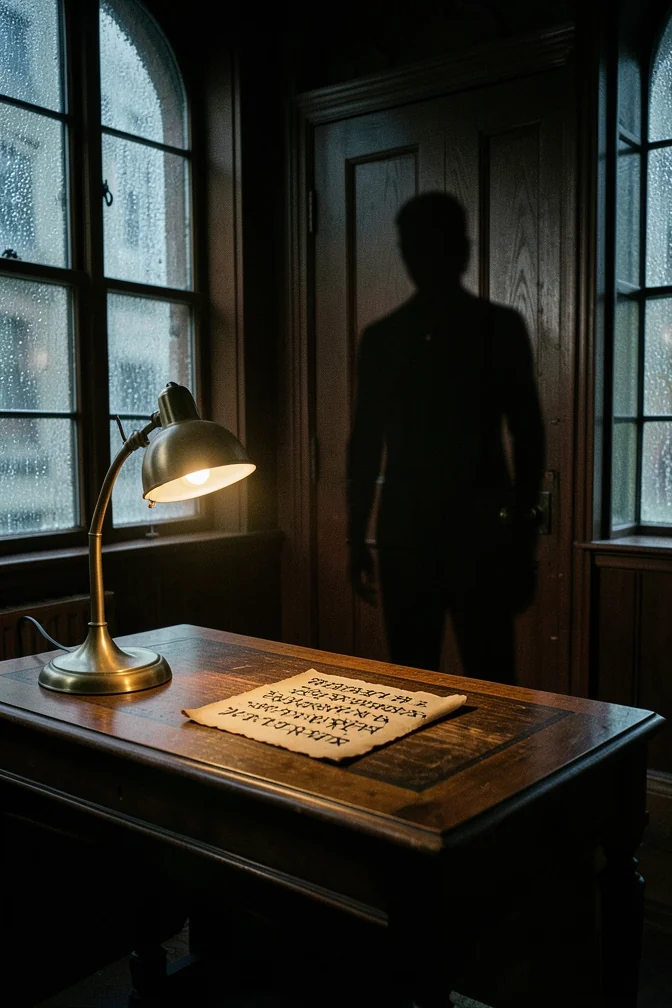
Edition: Complete story in the original English, from Project Gutenberg #9629. No translation or AI rewriting of the literary text. Original spelling retained.
This eBook is for the use of anyone anywhere in the United States and most other parts of the world at no cost and with almost no restrictions whatsoever. You may copy it, give it away or re-use it under the terms of the Project Gutenberg License included with this eBook or online at www.gutenberg.org. If you are not located in the United States, you will have to check the laws of the country where you are located before using this eBook.
April 15th, 190-
Dear Sir,
I am requested by the Council of the —- Association to return to you the draft of a paper on The Truth of Alchemy, which you have been good enough to offer to read at our forthcoming meeting, and to inform you that the Council do not see their way to including it in the programme.
I am,
Yours faithfully,
— Secretary.
* * * * *
April 18th
Dear Sir,
I am sorry to say that my engagements do not permit of my affording you an interview on the subject of your proposed paper. Nor do our laws allow of your discussing the matter with a Committee of our Council, as you suggest. Please allow me to assure you that the fullest consideration was given to the draft which you submitted, and that it was not declined without having been referred to the judgement of a most competent authority. No personal question (it can hardly be necessary for me to add) can have had the slightest influence on the decision of the Council.
Believe me (ut supra).
* * * * *
April 20th
The Secretary of the —- Association begs respectfully to inform Mr Karswell that it is impossible for him to communicate the name of any person or persons to whom the draft of Mr Karswell’s paper may have been submitted; and further desires to intimate that he cannot undertake to reply to any further letters on this subject.
* * * * *
‘And who is Mr Karswell?’ inquired the Secretary’s wife. She had called at his office, and (perhaps unwarrantably) had picked up the last of these three letters, which the typist had just brought in.
‘Why, my dear, just at present Mr Karswell is a very angry man. But I don’t know much about him otherwise, except that he is a person of wealth, his address is Lufford Abbey, Warwickshire, and he’s an alchemist, apparently, and wants to tell us all about it; and that’s about all–except that I don’t want to meet him for the next week or two. Now, if you’re ready to leave this place, I am.’
‘What have you been doing to make him angry?’ asked Mrs Secretary.
‘The usual thing, my dear, the usual thing: he sent in a draft of a paper he wanted to read at the next meeting, and we referred it to Edward Dunning–almost the only man in England who knows about these things–and he said it was perfectly hopeless, so we declined it. So Karswell has been pelting me with letters ever since. The last thing he wanted was the name of the man we referred his nonsense to; you saw my answer to that. But don’t you say anything about it, for goodness’ sake.’
‘I should think not, indeed. Did I ever do such a thing? I do hope, though, he won’t get to know that it was poor Mr Dunning.’
‘Poor Mr Dunning? I don’t know why you call him that; he’s a very happy man, is Dunning. Lots of hobbies and a comfortable home, and all his time to himself.’
‘I only meant I should be sorry for him if this man got hold of his name, and came and bothered him.’
‘Oh, ah! yes. I dare say he would be poor Mr Dunning then.’
The Secretary and his wife were lunching out, and the friends to whose house they were bound were Warwickshire people. So Mrs Secretary had already settled it in her own mind that she would question them judiciously about Mr Karswell. But she was saved the trouble of leading up to the subject, for the hostess said to the host, before many minutes had passed, ‘I saw the Abbot of Lufford this morning.’ The host whistled. ‘Did you? What in the world brings him up to town?’ ‘Goodness knows; he was coming out of the British Museum gate as I drove past.’ It was not unnatural that Mrs Secretary should inquire whether this was a real Abbot who was being spoken of. ‘Oh no, my dear: only a neighbour of ours in the country who bought Lufford Abbey a few years ago. His real name is Karswell.’ ‘Is he a friend of yours?’ asked Mr Secretary, with a private wink to his wife. The question let loose a torrent of declamation. There was really nothing to be said for Mr Karswell. Nobody knew what he did with himself: his servants were a horrible set of people; he had invented a new religion for himself, and practised no one could tell what appalling rites; he was very easily offended, and never forgave anybody; he had a dreadful face (so the lady insisted, her husband somewhat demurring); he never did a kind action, and whatever influence he did exert was mischievous. ‘Do the poor man justice, dear,’ the husband interrupted. ‘You forget the treat he gave the school children.’ ‘Forget it, indeed! But I’m glad you mentioned it, because it gives an idea of the man. Now, Florence, listen to this. The first winter he was at Lufford this delightful neighbour of ours wrote to the clergyman of his parish (he’s not ours, but we know him very well) and offered to show the school children some magic-lantern slides. He said he had some new kinds, which he thought would interest them. Well, the clergyman was rather surprised, because Mr Karswell had shown himself inclined to be unpleasant to the children–complaining of their trespassing, or something of the sort; but of course he accepted, and the evening was fixed, and our friend went himself to see that everything went right. He said he never had been so thankful for anything as that his own children were all prevented from being there: they were at a children’s party at our house, as a matter of fact. Because this Mr Karswell had evidently set out with the intention of frightening these poor village children out of their wits, and I do believe, if he had been allowed to go on, he would actually have done so. He began with some comparatively mild things. Red Riding Hood was one, and even then, Mr Farrer said, the wolf was so dreadful that several of the smaller children had to be taken out: and he said Mr Karswell began the story by producing a noise like a wolf howling in the distance, which was the most gruesome thing he had ever heard. All the slides he showed, Mr Farrer said, were most clever; they were absolutely realistic, and where he had got them or how he worked them he could not imagine. Well, the show went on, and the stories kept on becoming a little more terrifying each time, and the children were mesmerized into complete silence. At last he produced a series which represented a little boy passing through his own park–Lufford, I mean–in the evening. Every child in the room could recognize the place from the pictures. And this poor boy was followed, and at last pursued and overtaken, and either torn in pieces or somehow made away with, by a horrible hopping creature in white, which you saw first dodging about among the trees, and gradually it appeared more and more plainly. Mr Farrer said it gave him one of the worst nightmares he ever remembered, and what it must have meant to the children doesn’t bear thinking of. Of course this was too much, and he spoke very sharply indeed to Mr Karswell, and said it couldn’t go on. All he said was: “Oh, you think it’s time to bring our little show to an end and send them home to their beds? Very well!” And then, if you please, he switched on another slide, which showed a great mass of snakes, centipedes, and disgusting creatures with wings, and somehow or other he made it seem as if they were climbing out of the picture and getting in amongst the audience; and this was accompanied by a sort of dry rustling noise which sent the children nearly mad, and of course they stampeded. A good many of them were rather hurt in getting out of the room, and I don’t suppose one of them closed an eye that night. There was the most dreadful trouble in the village afterwards. Of course the mothers threw a good part of the blame on poor Mr Farrer, and, if they could have got past the gates, I believe the fathers would have broken every window in the Abbey. Well, now, that’s Mr Karswell: that’s the Abbot of Lufford, my dear, and you can imagine how we covet his society.’
‘Yes, I think he has all the possibilities of a distinguished criminal, has Karswell,’ said the host. ‘I should be sorry for anyone who got into his bad books.’
‘Is he the man, or am I mixing him up with someone else?’ asked the Secretary (who for some minutes had been wearing the frown of the man who is trying to recollect something). ‘Is he the man who brought out a History of Witchcraft some time back–ten years or more?’
‘That’s the man; do you remember the reviews of it?’
‘Certainly I do; and what’s equally to the point, I knew the author of the most incisive of the lot. So did you: you must remember John Harrington; he was at John’s in our time.’
‘Oh, very well indeed, though I don’t think I saw or heard anything of him between the time I went down and the day I read the account of the inquest on him.’
‘Inquest?’ said one of the ladies. ‘What has happened to him?’
‘Why, what happened was that he fell out of a tree and broke his neck. But the puzzle was, what could have induced him to get up there. It was a mysterious business, I must say. Here was this man–not an athletic fellow, was he? and with no eccentric twist about him that was ever noticed–walking home along a country road late in the evening–no tramps about–well known and liked in the place–and he suddenly begins to run like mad, loses his hat and stick, and finally shins up a tree–quite a difficult tree–growing in the hedgerow: a dead branch gives way, and he comes down with it and breaks his neck, and there he’s found next morning with the most dreadful face of fear on him that could be imagined. It was pretty evident, of course, that he had been chased by something, and people talked of savage dogs, and beasts escaped out of menageries; but there was nothing to be made of that. That was in ‘89, and I believe his brother Henry (whom I remember as well at Cambridge, but you probably don’t) has been trying to get on the track of an explanation ever since. He, of course, insists there was malice in it, but I don’t know. It’s difficult to see how it could have come in.’
After a time the talk reverted to the History of Witchcraft. ‘Did you ever look into it?’ asked the host.
‘Yes, I did,’ said the Secretary. ‘I went so far as to read it.’
‘Was it as bad as it was made out to be?’
‘Oh, in point of style and form, quite hopeless. It deserved all the pulverizing it got. But, besides that, it was an evil book. The man believed every word of what he was saying, and I’m very much mistaken if he hadn’t tried the greater part of his receipts.’
‘Well, I only remember Harrington’s review of it, and I must say if I’d been the author it would have quenched my literary ambition for good. I should never have held up my head again.’
‘It hasn’t had that effect in the present case. But come, it’s half-past three; I must be off.’
On the way home the Secretary’s wife said, ‘I do hope that horrible man won’t find out that Mr Dunning had anything to do with the rejection of his paper.’ ‘I don’t think there’s much chance of that,’ said the Secretary. ‘Dunning won’t mention it himself, for these matters are confidential, and none of us will for the same reason. Karswell won’t know his name, for Dunning hasn’t published anything on the same subject yet. The only danger is that Karswell might find out, if he was to ask the British Museum people who was in the habit of consulting alchemical manuscripts: I can’t very well tell them not to mention Dunning, can I? It would set them talking at once. Let’s hope it won’t occur to him.’
However, Mr Karswell was an astute man.
* * * * *
This much is in the way of prologue. On an evening rather later in the same week, Mr Edward Dunning was returning from the British Museum, where he had been engaged in Research, to the comfortable house in a suburb where he lived alone, tended by two excellent women who had been long with him. There is nothing to be added by way of description of him to what we have heard already. Let us follow him as he takes his sober course homewards.
* * * * *
A train took him to within a mile or two of his house, and an electric tram a stage farther. The line ended at a point some three hundred yards from his front door. He had had enough of reading when he got into the car, and indeed the light was not such as to allow him to do more than study the advertisements on the panes of glass that faced him as he sat. As was not unnatural, the advertisements in this particular line of cars were objects of his frequent contemplation, and, with the possible exception of the brilliant and convincing dialogue between Mr Lamplough and an eminent K.C. on the subject of Pyretic Saline, none of them afforded much scope to his imagination. I am wrong: there was one at the corner of the car farthest from him which did not seem familiar. It was in blue letters on a yellow ground, and all that he could read of it was a name–John Harrington–and something like a date. It could be of no interest to him to know more; but for all that, as the car emptied, he was just curious enough to move along the seat until he could read it well. He felt to a slight extent repaid for his trouble; the advertisement was not of the usual type. It ran thus: ‘In memory of John Harrington, F.S.A., of The Laurels, Ashbrooke. Died Sept. 18th, 1889. Three months were allowed.’
The car stopped. Mr Dunning, still contemplating the blue letters on the yellow ground, had to be stimulated to rise by a word from the conductor. ‘I beg your pardon,’ he said, ‘I was looking at that advertisement; it’s a very odd one, isn’t it?’ The conductor read it slowly. ‘Well, my word,’ he said, ‘I never see that one before. Well, that is a cure, ain’t it? Someone bin up to their jokes ’ere, I should think.’ He got out a duster and applied it, not without saliva, to the pane and then to the outside. ‘No,’ he said, returning, ’that ain’t no transfer; seems to me as if it was reg’lar in the glass, what I mean in the substance, as you may say. Don’t you think so, sir?’ Mr Dunning examined it and rubbed it with his glove, and agreed. ‘Who looks after these advertisements, and gives leave for them to be put up? I wish you would inquire. I will just take a note of the words.’ At this moment there came a call from the driver: ‘Look alive, George, time’s up.’ ‘All right, all right; there’s somethink else what’s up at this end. You come and look at this ’ere glass.’ ‘What’s gorn with the glass?’ said the driver, approaching. ‘Well, and oo’s ‘Arrington? What’s it all about?’ ‘I was just asking who was responsible for putting the advertisements up in your cars, and saying it would be as well to make some inquiry about this one.’ ‘Well, sir, that’s all done at the Company’s orfice, that work is: it’s our Mr Timms, I believe, looks into that. When we put up tonight I’ll leave word, and per’aps I’ll be able to tell you tomorrer if you ‘appen to be coming this way.’
This was all that passed that evening. Mr Dunning did just go to the trouble of looking up Ashbrooke, and found that it was in Warwickshire.
Next day he went to town again. The car (it was the same car) was too full in the morning to allow of his getting a word with the conductor: he could only be sure that the curious advertisement had been made away with. The close of the day brought a further element of mystery into the transaction. He had missed the tram, or else preferred walking home, but at a rather late hour, while he was at work in his study, one of the maids came to say that two men from the tramways was very anxious to speak to him. This was a reminder of the advertisement, which he had, he says, nearly forgotten. He had the men in–they were the conductor and driver of the car–and when the matter of refreshment had been attended to, asked what Mr Timms had had to say about the advertisement. ‘Well, sir, that’s what we took the liberty to step round about,’ said the conductor. ‘Mr Timms ’e give William ’ere the rough side of his tongue about that: ‘cordin’ to ‘im there warn’t no advertisement of that description sent in, nor ordered, nor paid for, nor put up, nor nothink, let alone not bein’ there, and we was playing the fool takin’ up his time. “Well,” I says, “if that’s the case, all I ask of you, Mr Timms,” I says, “is to take and look at it for yourself,” I says. “Of course if it ain’t there,” I says, “you may take and call me what you like.” “Right,” he says, “I will”: and we went straight off. Now, I leave it to you, sir, if that ad., as we term ’em, with ‘Arrington on it warn’t as plain as ever you see anythink–blue letters on yeller glass, and as I says at the time, and you borne me out, reg’lar in the glass, because, if you remember, you recollect of me swabbing it with my duster.’ ‘To be sure I do, quite clearly–well?’ ‘You may say well, I don’t think. Mr Timms he gets in that car with a light–no, he telled William to ‘old the light outside. “Now,” he says, “where’s your precious ad. what we’ve ’eard so much about?” “‘Ere it is,” I says, “Mr Timms,” and I laid my ‘and on it.’ The conductor paused.
‘Well,’ said Mr Dunning, ‘it was gone, I suppose. Broken?’
‘Broke!–not it. There warn’t, if you’ll believe me, no more trace of them letters–blue letters they was–on that piece o’ glass, than–well, it’s no good me talkin’. I never see such a thing. I leave it to William here if–but there, as I says, where’s the benefit in me going on about it?’
‘And what did Mr Timms say?’
‘Why ’e did what I give ‘im leave to–called us pretty much anythink he liked, and I don’t know as I blame him so much neither. But what we thought, William and me did, was as we seen you take down a bit of a note about that–well, that letterin’–’
‘I certainly did that, and I have it now. Did you wish me to speak to Mr Timms myself, and show it to him? Was that what you came in about?’
‘There, didn’t I say as much?’ said William. ‘Deal with a gent if you can get on the track of one, that’s my word. Now perhaps, George, you’ll allow as I ain’t took you very far wrong tonight.’
‘Very well, William, very well; no need for you to go on as if you’d ‘ad to frog’s-march me ’ere. I come quiet, didn’t I? All the same for that, we ‘adn’t ought to take up your time this way, sir; but if it so ‘appened you could find time to step round to the Company’s orfice in the morning and tell Mr Timms what you seen for yourself, we should lay under a very ‘igh obligation to you for the trouble. You see it ain’t bein’ called–well, one thing and another, as we mind, but if they got it into their ’ead at the orfice as we seen things as warn’t there, why, one thing leads to another, and where we should be a twelvemunce ’ence–well, you can understand what I mean.’
Amid further elucidations of the proposition, George, conducted by William, left the room.
The incredulity of Mr Timms (who had a nodding acquaintance with Mr Dunning) was greatly modified on the following day by what the latter could tell and show him; and any bad mark that might have been attached to the names of William and George was not suffered to remain on the Company’s books; but explanation there was none.
Mr Dunning’s interest in the matter was kept alive by an incident of the following afternoon. He was walking from his club to the train, and he noticed some way ahead a man with a handful of leaflets such as are distributed to passers-by by agents of enterprising firms. This agent had not chosen a very crowded street for his operations: in fact, Mr Dunning did not see him get rid of a single leaflet before he himself reached the spot. One was thrust into his hand as he passed: the hand that gave it touched his, and he experienced a sort of little shock as it did so. It seemed unnaturally rough and hot. He looked in passing at the giver, but the impression he got was so unclear that, however much he tried to reckon it up subsequently, nothing would come. He was walking quickly, and as he went on glanced at the paper. It was a blue one. The name of Harrington in large capitals caught his eye. He stopped, startled, and felt for his glasses. The next instant the leaflet was twitched out of his hand by a man who hurried past, and was irrecoverably gone. He ran back a few paces, but where was the passer-by? and where the distributor?
It was in a somewhat pensive frame of mind that Mr Dunning passed on the following day into the Select Manuscript Room of the British Museum, and filled up tickets for Harley 3586, and some other volumes. After a few minutes they were brought to him, and he was settling the one he wanted first upon the desk, when he thought he heard his own name whispered behind him. He turned round hastily, and in doing so, brushed his little portfolio of loose papers on to the floor. He saw no one he recognized except one of the staff in charge of the room, who nodded to him, and he proceeded to pick up his papers. He thought he had them all, and was turning to begin work, when a stout gentleman at the table behind him, who was just rising to leave, and had collected his own belongings, touched him on the shoulder, saying, ‘May I give you this? I think it should be yours,’ and handed him a missing quire. ‘It is mine, thank you,’ said Mr Dunning. In another moment the man had left the room. Upon finishing his work for the afternoon, Mr Dunning had some conversation with the assistant in charge, and took occasion to ask who the stout gentleman was. ‘Oh, he’s a man named Karswell,’ said the assistant; ‘he was asking me a week ago who were the great authorities on alchemy, and of course I told him you were the only one in the country. I’ll see if I can’t catch him: he’d like to meet you, I’m sure.’
‘For heaven’s sake don’t dream of it!’ said Mr Dunning, ‘I’m particularly anxious to avoid him.’
‘Oh! very well,’ said the assistant, ‘he doesn’t come here often: I dare say you won’t meet him.’
More than once on the way home that day Mr Dunning confessed to himself that he did not look forward with his usual cheerfulness to a solitary evening. It seemed to him that something ill-defined and impalpable had stepped in between him and his fellow-men–had taken him in charge, as it were. He wanted to sit close up to his neighbours in the train and in the tram, but as luck would have it both train and car were markedly empty. The conductor George was thoughtful, and appeared to be absorbed in calculations as to the number of passengers. On arriving at his house he found Dr Watson, his medical man, on his doorstep. ‘I’ve had to upset your household arrangements, I’m sorry to say, Dunning. Both your servants hors de combat. In fact, I’ve had to send them to the Nursing Home.’
‘Good heavens! what’s the matter?’
‘It’s something like ptomaine poisoning, I should think: you’ve not suffered yourself, I can see, or you wouldn’t be walking about. I think they’ll pull through all right.’
‘Dear, dear! Have you any idea what brought it on?’
‘Well, they tell me they bought some shell-fish from a hawker at their dinner-time. It’s odd. I’ve made inquiries, but I can’t find that any hawker has been to other houses in the street. I couldn’t send word to you; they won’t be back for a bit yet. You come and dine with me tonight, anyhow, and we can make arrangements for going on. Eight o’clock. Don’t be too anxious.’
The solitary evening was thus obviated; at the expense of some distress and inconvenience, it is true. Mr Dunning spent the time pleasantly enough with the doctor (a rather recent settler), and returned to his lonely home at about 11.30. The night he passed is not one on which he looks back with any satisfaction. He was in bed and the light was out. He was wondering if the charwoman would come early enough to get him hot water next morning, when he heard the unmistakable sound of his study door opening. No step followed it on the passage floor, but the sound must mean mischief, for he knew that he had shut the door that evening after putting his papers away in his desk. It was rather shame than courage that induced him to slip out into the passage and lean over the banister in his nightgown, listening. No light was visible; no further sound came: only a gust of warm, or even hot air played for an instant round his shins. He went back and decided to lock himself into his room. There was more unpleasantness, however. Either an economical suburban company had decided that their light would not be required in the small hours, and had stopped working, or else something was wrong with the meter; the effect was in any case that the electric light was off. The obvious course was to find a match, and also to consult his watch: he might as well know how many hours of discomfort awaited him. So he put his hand into the well-known nook under the pillow: only, it did not get so far. What he touched was, according to his account, a mouth, with teeth, and with hair about it, and, he declares, not the mouth of a human being. I do not think it is any use to guess what he said or did; but he was in a spare room with the door locked and his ear to it before he was clearly conscious again. And there he spent the rest of a most miserable night, looking every moment for some fumbling at the door: but nothing came.
The venturing back to his own room in the morning was attended with many listenings and quiverings. The door stood open, fortunately, and the blinds were up (the servants had been out of the house before the hour of drawing them down); there was, to be short, no trace of an inhabitant. The watch, too, was in its usual place; nothing was disturbed, only the wardrobe door had swung open, in accordance with its confirmed habit. A ring at the back door now announced the charwoman, who had been ordered the night before, and nerved Mr Dunning, after letting her in, to continue his search in other parts of the house. It was equally fruitless.
The day thus begun went on dismally enough. He dared not go to the Museum: in spite of what the assistant had said, Karswell might turn up there, and Dunning felt he could not cope with a probably hostile stranger. His own house was odious; he hated sponging on the doctor. He spent some little time in a call at the Nursing Home, where he was slightly cheered by a good report of his housekeeper and maid. Towards lunch-time he betook himself to his club, again experiencing a gleam of satisfaction at seeing the Secretary of the Association. At luncheon Dunning told his friend the more material of his woes, but could not bring himself to speak of those that weighed most heavily on his spirits. ‘My poor dear man,’ said the Secretary, ‘what an upset! Look here: we’re alone at home, absolutely. You must put up with us. Yes! no excuse: send your things in this afternoon.’ Dunning was unable to stand out: he was, in truth, becoming acutely anxious, as the hours went on, as to what that night might have waiting for him. He was almost happy as he hurried home to pack up.
His friends, when they had time to take stock of him, were rather shocked at his lorn appearance, and did their best to keep him up to the mark. Not altogether without success: but, when the two men were smoking alone later, Dunning became dull again. Suddenly he said, ‘Gayton, I believe that alchemist man knows it was I who got his paper rejected.’ Gayton whistled. ‘What makes you think that?’ he said. Dunning told of his conversation with the Museum assistant, and Gayton could only agree that the guess seemed likely to be correct. ‘Not that I care much,’ Dunning went on, ‘only it might be a nuisance if we were to meet. He’s a bad-tempered party, I imagine.’ Conversation dropped again; Gayton became more and more strongly impressed with the desolateness that came over Dunning’s face and bearing, and finally–though with a considerable effort–he asked him point-blank whether something serious was not bothering him. Dunning gave an exclamation of relief. ‘I was perishing to get it off my mind,’ he said. ‘Do you know anything about a man named John Harrington?’ Gayton was thoroughly startled, and at the moment could only ask why. Then the complete story of Dunning’s experiences came out–what had happened in the tramcar, in his own house, and in the street, the troubling of spirit that had crept over him, and still held him; and he ended with the question he had begun with. Gayton was at a loss how to answer him. To tell the story of Harrington’s end would perhaps be right; only, Dunning was in a nervous state, the story was a grim one, and he could not help asking himself whether there were not a connecting link between these two cases, in the person of Karswell. It was a difficult concession for a scientific man, but it could be eased by the phrase ‘hypnotic suggestion’. In the end he decided that his answer tonight should be guarded; he would talk the situation over with his wife. So he said that he had known Harrington at Cambridge, and believed he had died suddenly in 1889, adding a few details about the man and his published work. He did talk over the matter with Mrs Gayton, and, as he had anticipated, she leapt at once to the conclusion which had been hovering before him. It was she who reminded him of the surviving brother, Henry Harrington, and she also who suggested that he might be got hold of by means of their hosts of the day before. ‘He might be a hopeless crank,’ objected Gayton. ‘That could be ascertained from the Bennetts, who knew him,’ Mrs Gayton retorted; and she undertook to see the Bennetts the very next day.
* * * * *
It is not necessary to tell in further detail the steps by which Henry Harrington and Dunning were brought together.
* * * * *
The next scene that does require to be narrated is a conversation that took place between the two. Dunning had told Harrington of the strange ways in which the dead man’s name had been brought before him, and had said something, besides, of his own subsequent experiences. Then he had asked if Harrington was disposed, in return, to recall any of the circumstances connected with his brother’s death. Harrington’s surprise at what he heard can be imagined: but his reply was readily given.
‘John,’ he said, ‘was in a very odd state, undeniably, from time to time, during some weeks before, though not immediately before, the catastrophe. There were several things; the principal notion he had was that he thought he was being followed. No doubt he was an impressionable man, but he never had had such fancies as this before. I cannot get it out of my mind that there was ill-will at work, and what you tell me about yourself reminds me very much of my brother. Can you think of any possible connecting link?’
‘There is just one that has been taking shape vaguely in my mind. I’ve been told that your brother reviewed a book very severely not long before he died, and just lately I have happened to cross the path of the man who wrote that book in a way he would resent.’
‘Don’t tell me the man was called Karswell.’
‘Why not? that is exactly his name.’
Henry Harrington leant back. ‘That is final to my mind. Now I must explain further. From something he said, I feel sure that my brother John was beginning to believe–very much against his will–that Karswell was at the bottom of his trouble. I want to tell you what seems to me to have a bearing on the situation. My brother was a great musician, and used to run up to concerts in town. He came back, three months before he died, from one of these, and gave me his programme to look at–an analytical programme: he always kept them. “I nearly missed this one,” he said. “I suppose I must have dropped it: anyhow, I was looking for it under my seat and in my pockets and so on, and my neighbour offered me his; said ‘might he give it me, he had no further use for it,’ and he went away just afterwards. I don’t know who he was–a stout, clean-shaven man. I should have been sorry to miss it; of course I could have bought another, but this cost me nothing.” At another time he told me that he had been very uncomfortable both on the way to his hotel and during the night. I piece things together now in thinking it over. Then, not very long after, he was going over these programmes, putting them in order to have them bound up, and in this particular one (which by the way I had hardly glanced at), he found quite near the beginning a strip of paper with some very odd writing on it in red and black–most carefully done–it looked to me more like Runic letters than anything else. “Why,” he said, “this must belong to my fat neighbour. It looks as if it might be worth returning to him; it may be a copy of something; evidently someone has taken trouble over it. How can I find his address?” We talked it over for a little and agreed that it wasn’t worth advertising about, and that my brother had better look out for the man at the next concert, to which he was going very soon. The paper was lying on the book and we were both by the fire; it was a cold, windy summer evening. I suppose the door blew open, though I didn’t notice it: at any rate a gust–a warm gust it was–came quite suddenly between us, took the paper and blew it straight into the fire: it was light, thin paper, and flared and went up the chimney in a single ash. “Well,” I said, “you can’t give it back now.” He said nothing for a minute: then rather crossly, “No, I can’t; but why you should keep on saying so I don’t know.” I remarked that I didn’t say it more than once. “Not more than four times, you mean,” was all he said. I remember all that very clearly, without any good reason; and now to come to the point. I don’t know if you looked at that book of Karswell’s which my unfortunate brother reviewed. It’s not likely that you should: but I did, both before his death and after it. The first time we made game of it together. It was written in no style at all–split infinitives, and every sort of thing that makes an Oxford gorge rise. Then there was nothing that the man didn’t swallow: mixing up classical myths, and stories out of the Golden Legend with reports of savage customs of today–all very proper, no doubt, if you know how to use them, but he didn’t: he seemed to put the Golden Legend and the Golden Bough exactly on a par, and to believe both: a pitiable exhibition, in short. Well, after the misfortune, I looked over the book again. It was no better than before, but the impression which it left this time on my mind was different. I suspected–as I told you–that Karswell had borne ill-will to my brother, even that he was in some way responsible for what had happened; and now his book seemed to me to be a very sinister performance indeed. One chapter in particular struck me, in which he spoke of “casting the Runes” on people, either for the purpose of gaining their affection or of getting them out of the way–perhaps more especially the latter: he spoke of all this in a way that really seemed to me to imply actual knowledge. I’ve not time to go into details, but the upshot is that I am pretty sure from information received that the civil man at the concert was Karswell: I suspect–I more than suspect–that the paper was of importance: and I do believe that if my brother had been able to give it back, he might have been alive now. Therefore, it occurs to me to ask you whether you have anything to put beside what I have told you.’
By way of answer, Dunning had the episode in the Manuscript Room at the British Museum to relate. ‘Then he did actually hand you some papers; have you examined them? No? because we must, if you’ll allow it, look at them at once, and very carefully.’
They went to the still empty house–empty, for the two servants were not yet able to return to work. Dunning’s portfolio of papers was gathering dust on the writing-table. In it were the quires of small-sized scribbling paper which he used for his transcripts: and from one of these, as he took it up, there slipped and fluttered out into the room with uncanny quickness, a strip of thin light paper. The window was open, but Harrington slammed it to, just in time to intercept the paper, which he caught. ‘I thought so,’ he said; ‘it might be the identical thing that was given to my brother. You’ll have to look out, Dunning; this may mean something quite serious for you.’
A long consultation took place. The paper was narrowly examined. As Harrington had said, the characters on it were more like Runes than anything else, but not decipherable by either man, and both hesitated to copy them, for fear, as they confessed, of perpetuating whatever evil purpose they might conceal. So it has remained impossible (if I may anticipate a little) to ascertain what was conveyed in this curious message or commission. Both Dunning and Harrington are firmly convinced that it had the effect of bringing its possessors into very undesirable company. That it must be returned to the source whence it came they were agreed, and further, that the only safe and certain way was that of personal service; and here contrivance would be necessary, for Dunning was known by sight to Karswell. He must, for one thing, alter his appearance by shaving his beard. But then might not the blow fall first? Harrington thought they could time it. He knew the date of the concert at which the ‘black spot’ had been put on his brother: it was June 18th. The death had followed on Sept. 18th. Dunning reminded him that three months had been mentioned on the inscription on the car-window. ‘Perhaps,’ he added, with a cheerless laugh, ‘mine may be a bill at three months too. I believe I can fix it by my diary. Yes, April 23rd was the day at the Museum; that brings us to July 23rd. Now, you know, it becomes extremely important to me to know anything you will tell me about the progress of your brother’s trouble, if it is possible for you to speak of it.’ ‘Of course. Well, the sense of being watched whenever he was alone was the most distressing thing to him. After a time I took to sleeping in his room, and he was the better for that: still, he talked a great deal in his sleep. What about? Is it wise to dwell on that, at least before things are straightened out? I think not, but I can tell you this: two things came for him by post during those weeks, both with a London postmark, and addressed in a commercial hand. One was a woodcut of Bewick’s, roughly torn out of the page: one which shows a moonlit road and a man walking along it, followed by an awful demon creature. Under it were written the lines out of the “Ancient Mariner” (which I suppose the cut illustrates) about one who, having once looked round–
walks on,
And turns no more his head, Because he knows a frightful fiend Doth close behind him tread.
The other was a calendar, such as tradesmen often send. My brother paid no attention to this, but I looked at it after his death, and found that everything after Sept. 18 had been torn out. You may be surprised at his having gone out alone the evening he was killed, but the fact is that during the last ten days or so of his life he had been quite free from the sense of being followed or watched.’
The end of the consultation was this. Harrington, who knew a neighbour of Karswell’s, thought he saw a way of keeping a watch on his movements. It would be Dunning’s part to be in readiness to try to cross Karswell’s path at any moment, to keep the paper safe and in a place of ready access.
They parted. The next weeks were no doubt a severe strain upon Dunning’s nerves: the intangible barrier which had seemed to rise about him on the day when he received the paper, gradually developed into a brooding blackness that cut him off from the means of escape to which one might have thought he might resort. No one was at hand who was likely to suggest them to him, and he seemed robbed of all initiative. He waited with inexpressible anxiety as May, June, and early July passed on, for a mandate from Harrington. But all this time Karswell remained immovable at Lufford.
At last, in less than a week before the date he had come to look upon as the end of his earthly activities, came a telegram: ‘Leaves Victoria by boat train Thursday night. Do not miss. I come to you to-night. Harrington.’
He arrived accordingly, and they concocted plans. The train left Victoria at nine and its last stop before Dover was Croydon West. Harrington would mark down Karswell at Victoria, and look out for Dunning at Croydon, calling to him if need were by a name agreed upon. Dunning, disguised as far as might be, was to have no label or initials on any hand luggage, and must at all costs have the paper with him.
Dunning’s suspense as he waited on the Croydon platform I need not attempt to describe. His sense of danger during the last days had only been sharpened by the fact that the cloud about him had perceptibly been lighter; but relief was an ominous symptom, and, if Karswell eluded him now, hope was gone: and there were so many chances of that. The rumour of the journey might be itself a device. The twenty minutes in which he paced the platform and persecuted every porter with inquiries as to the boat train were as bitter as any he had spent. Still, the train came, and Harrington was at the window. It was important, of course, that there should be no recognition: so Dunning got in at the farther end of the corridor carriage, and only gradually made his way to the compartment where Harrington and Karswell were. He was pleased, on the whole, to see that the train was far from full.
Karswell was on the alert, but gave no sign of recognition. Dunning took the seat not immediately facing him, and attempted, vainly at first, then with increasing command of his faculties, to reckon the possibilities of making the desired transfer. Opposite to Karswell, and next to Dunning, was a heap of Karswell’s coats on the seat. It would be of no use to slip the paper into these–he would not be safe, or would not feel so, unless in some way it could be proffered by him and accepted by the other. There was a handbag, open, and with papers in it. Could he manage to conceal this (so that perhaps Karswell might leave the carriage without it), and then find and give it to him? This was the plan that suggested itself. If he could only have counselled with Harrington! but that could not be. The minutes went on. More than once Karswell rose and went out into the corridor. The second time Dunning was on the point of attempting to make the bag fall off the seat, but he caught Harrington’s eye, and read in it a warning. Karswell, from the corridor, was watching: probably to see if the two men recognized each other. He returned, but was evidently restless: and, when he rose the third time, hope dawned, for something did slip off his seat and fall with hardly a sound to the floor. Karswell went out once more, and passed out of range of the corridor window. Dunning picked up what had fallen, and saw that the key was in his hands in the form of one of Cook’s ticket-cases, with tickets in it. These cases have a pocket in the cover, and within very few seconds the paper of which we have heard was in the pocket of this one. To make the operation more secure, Harrington stood in the doorway of the compartment and fiddled with the blind. It was done, and done at the right time, for the train was now slowing down towards Dover.
In a moment more Karswell re-entered the compartment. As he did so, Dunning, managing, he knew not how, to suppress the tremble in his voice, handed him the ticket-case, saying, ‘May I give you this, sir? I believe it is yours.’ After a brief glance at the ticket inside, Karswell uttered the hoped-for response, ‘Yes, it is; much obliged to you, sir,’ and he placed it in his breast pocket.
Even in the few moments that remained–moments of tense anxiety, for they knew not to what a premature finding of the paper might lead–both men noticed that the carriage seemed to darken about them and to grow warmer; that Karswell was fidgety and oppressed; that he drew the heap of loose coats near to him and cast it back as if it repelled him; and that he then sat upright and glanced anxiously at both. They, with sickening anxiety, busied themselves in collecting their belongings; but they both thought that Karswell was on the point of speaking when the train stopped at Dover Town. It was natural that in the short space between town and pier they should both go into the corridor.
At the pier they got out, but so empty was the train that they were forced to linger on the platform until Karswell should have passed ahead of them with his porter on the way to the boat, and only then was it safe for them to exchange a pressure of the hand and a word of concentrated congratulation. The effect upon Dunning was to make him almost faint. Harrington made him lean up against the wall, while he himself went forward a few yards within sight of the gangway to the boat, at which Karswell had now arrived. The man at the head of it examined his ticket, and, laden with coats, he passed down into the boat. Suddenly the official called after him, ‘You, sir, beg pardon, did the other gentleman show his ticket?’ ‘What the devil do you mean by the other gentleman?’ Karswell’s snarling voice called back from the deck. The man bent over and looked at him. ‘The devil? Well, I don’t know, I’m sure,’ Harrington heard him say to himself, and then aloud, ‘My mistake, sir; must have been your rugs! ask your pardon.’ And then, to a subordinate near him, ‘‘Ad he got a dog with him, or what? Funny thing: I could ‘a’ swore ’e wasn’t alone. Well, whatever it was, they’ll ‘ave to see to it aboard. She’s off now. Another week and we shall be gettin’ the ‘oliday customers.’ In five minutes more there was nothing but the lessening lights of the boat, the long line of the Dover lamps, the night breeze, and the moon.
Long and long the two sat in their room at the ‘Lord Warden’. In spite of the removal of their greatest anxiety, they were oppressed with a doubt, not of the lightest. Had they been justified in sending a man to his death, as they believed they had? Ought they not to warn him, at least? ‘No,’ said Harrington; ‘if he is the murderer I think him, we have done no more than is just. Still, if you think it better–but how and where can you warn him?’ ‘He was booked to Abbeville only,’ said Dunning. ‘I saw that. If I wired to the hotels there in Joanne’s Guide, “Examine your ticket-case, Dunning,” I should feel happier. This is the 21st: he will have a day. But I am afraid he has gone into the dark.’ So telegrams were left at the hotel office.
It is not clear whether these reached their destination, or whether, if they did, they were understood. All that is known is that, on the afternoon of the 23rd, an English traveller, examining the front of St Wulfram’s Church at Abbeville, then under extensive repair, was struck on the head and instantly killed by a stone falling from the scaffold erected round the north-western tower, there being, as was clearly proved, no workman on the scaffold at that moment: and the traveller’s papers identified him as Mr Karswell.
Only one detail shall be added. At Karswell’s sale a set of Bewick, sold with all faults, was acquired by Harrington. The page with the woodcut of the traveller and the demon was, as he had expected, mutilated. Also, after a judicious interval, Harrington repeated to Dunning something of what he had heard his brother say in his sleep: but it was not long before Dunning stopped him.
Source and edition terms: https://www.gutenberg.org/ebooks/9629 · Project Gutenberg License. Original-language text; original publisher illustrations are not reproduced.
Source acknowledgements and license
START: FULL LICENSE
THE FULL PROJECT GUTENBERG™ LICENSE
PLEASE READ THIS BEFORE YOU DISTRIBUTE OR USE THIS WORK
To protect the Project Gutenberg™ mission of promoting the free distribution of electronic works, by using or distributing this work (or any other work associated in any way with the phrase “Project Gutenberg”), you agree to comply with all the terms of the Full Project Gutenberg License available with this file or online at www.gutenberg.org/license.
Section 1. General Terms of Use and Redistributing Project Gutenberg electronic works
1.A. By reading or using any part of this Project Gutenberg electronic work, you indicate that you have read, understand, agree to and accept all the terms of this license and intellectual property (trademark/copyright) agreement. If you do not agree to abide by all the terms of this agreement, you must cease using and return or destroy all copies of Project Gutenberg electronic works in your possession. If you paid a fee for obtaining a copy of or access to a Project Gutenberg electronic work and you do not agree to be bound by the terms of this agreement, you may obtain a refund from the person or entity to whom you paid the fee as set forth in paragraph 1.E.8.
1.B. “Project Gutenberg” is a registered trademark. It may only be used on or associated in any way with an electronic work by people who agree to be bound by the terms of this agreement. There are a few things that you can do with most Project Gutenberg electronic works even without complying with the full terms of this agreement. See paragraph 1.C below. There are a lot of things you can do with Project Gutenberg electronic works if you follow the terms of this agreement and help preserve free future access to Project Gutenberg electronic works. See paragraph 1.E below.
1.C. The Project Gutenberg Literary Archive Foundation (“the Foundation” or PGLAF), owns a compilation copyright in the collection of Project Gutenberg electronic works. Nearly all the individual works in the collection are in the public domain in the United States. If an individual work is unprotected by copyright law in the United States and you are located in the United States, we do not claim a right to prevent you from copying, distributing, performing, displaying or creating derivative works based on the work as long as all references to Project Gutenberg are removed. Of course, we hope that you will support the Project Gutenberg mission of promoting free access to electronic works by freely sharing Project Gutenberg works in compliance with the terms of this agreement for keeping the Project Gutenberg name associated with the work. You can easily comply with the terms of this agreement by keeping this work in the same format with its attached full Project Gutenberg License when you share it without charge with others.
1.D. The copyright laws of the place where you are located also govern what you can do with this work. Copyright laws in most countries are in a constant state of change. If you are outside the United States, check the laws of your country in addition to the terms of this agreement before downloading, copying, displaying, performing, distributing or creating derivative works based on this work or any other Project Gutenberg work. The Foundation makes no representations concerning the copyright status of any work in any country other than the United States.
1.E. Unless you have removed all references to Project Gutenberg:
1.E.1. The following sentence, with active links to, or other immediate access to, the full Project Gutenberg License must appear prominently whenever any copy of a Project Gutenberg work (any work on which the phrase “Project Gutenberg” appears, or with which the phrase “Project Gutenberg” is associated) is accessed, displayed, performed, viewed, copied or distributed:
This eBook is for the use of anyone anywhere in the United States and most
other parts of the world at no cost and with almost no restrictions
whatsoever. You may copy it, give it away or re-use it under the terms
of the Project Gutenberg™ License included with this eBook or online
at www.gutenberg.org. If you
are not located in the United States, you will have to check the laws
of the country where you are located before using this eBook.
1.E.2. If an individual Project Gutenberg electronic work is derived from texts not protected by U.S. copyright law (does not contain a notice indicating that it is posted with permission of the copyright holder), the work can be copied and distributed to anyone in the United States without paying any fees or charges. If you are redistributing or providing access to a work with the phrase “Project Gutenberg” associated with or appearing on the work, you must comply either with the requirements of paragraphs 1.E.1 through 1.E.7 or obtain permission for the use of the work and the Project Gutenberg trademark as set forth in paragraphs 1.E.8 or 1.E.9.
1.E.3. If an individual Project Gutenberg electronic work is posted with the permission of the copyright holder, your use and distribution must comply with both paragraphs 1.E.1 through 1.E.7 and any additional terms imposed by the copyright holder. Additional terms will be linked to the Project Gutenberg License for all works posted with the permission of the copyright holder found at the beginning of this work.
1.E.4. Do not unlink or detach or remove the full Project Gutenberg License terms from this work, or any files containing a part of this work or any other work associated with Project Gutenberg.
1.E.5. Do not copy, display, perform, distribute or redistribute this electronic work, or any part of this electronic work, without prominently displaying the sentence set forth in paragraph 1.E.1 with active links or immediate access to the full terms of the Project Gutenberg License.
1.E.6. You may convert to and distribute this work in any binary, compressed, marked up, nonproprietary or proprietary form, including any word processing or hypertext form. However, if you provide access to or distribute copies of a Project Gutenberg work in a format other than “Plain Vanilla ASCII” or other format used in the official version posted on the official Project Gutenberg website (www.gutenberg.org), you must, at no additional cost, fee or expense to the user, provide a copy, a means of exporting a copy, or a means of obtaining a copy upon request, of the work in its original “Plain Vanilla ASCII” or other form. Any alternate format must include the full Project Gutenberg License as specified in paragraph 1.E.1.
1.E.7. Do not charge a fee for access to, viewing, displaying, performing, copying or distributing any Project Gutenberg works unless you comply with paragraph 1.E.8 or 1.E.9.
1.E.8. You may charge a reasonable fee for copies of or providing access to or distributing Project Gutenberg electronic works provided that:
• You pay a royalty fee of 20% of the gross profits you derive from
    the use of Project Gutenberg works calculated using the method
    you already use to calculate your applicable taxes. The fee is owed
    to the owner of the Project Gutenberg trademark, but he has
    agreed to donate royalties under this paragraph to the Project
    Gutenberg Literary Archive Foundation. Royalty payments must be paid
    within 60 days following each date on which you prepare (or are
    legally required to prepare) your periodic tax returns. Royalty
    payments should be clearly marked as such and sent to the Project
    Gutenberg Literary Archive Foundation at the address specified in
    Section 4, “Information about donations to the Project Gutenberg
    Literary Archive Foundation.”

• You provide a full refund of any money paid by a user who notifies
    you in writing (or by e-mail) within 30 days of receipt that s/he
    does not agree to the terms of the full Project Gutenberg™
    License. You must require such a user to return or destroy all
    copies of the works possessed in a physical medium and discontinue
    all use of and all access to other copies of Project Gutenberg™
    works.

• You provide, in accordance with paragraph 1.F.3, a full refund of
    any money paid for a work or a replacement copy, if a defect in the
    electronic work is discovered and reported to you within 90 days of
    receipt of the work.

• You comply with all other terms of this agreement for free
    distribution of Project Gutenberg™ works.
1.E.9. If you wish to charge a fee or distribute a Project Gutenberg™ electronic work or group of works on different terms than are set forth in this agreement, you must obtain permission in writing from the Project Gutenberg Literary Archive Foundation, the manager of the Project Gutenberg™ trademark. Contact the Foundation as set forth in Section 3 below.
1.F.
1.F.1. Project Gutenberg volunteers and employees expend considerable effort to identify, do copyright research on, transcribe and proofread works not protected by U.S. copyright law in creating the Project Gutenberg™ collection. Despite these efforts, Project Gutenberg™ electronic works, and the medium on which they may be stored, may contain “Defects,” such as, but not limited to, incomplete, inaccurate or corrupt data, transcription errors, a copyright or other intellectual property infringement, a defective or damaged disk or other medium, a computer virus, or computer codes that damage or cannot be read by your equipment.
1.F.2. LIMITED WARRANTY, DISCLAIMER OF DAMAGES - Except for the “Right of Replacement or Refund” described in paragraph 1.F.3, the Project Gutenberg Literary Archive Foundation, the owner of the Project Gutenberg™ trademark, and any other party distributing a Project Gutenberg™ electronic work under this agreement, disclaim all liability to you for damages, costs and expenses, including legal fees. YOU AGREE THAT YOU HAVE NO REMEDIES FOR NEGLIGENCE, STRICT LIABILITY, BREACH OF WARRANTY OR BREACH OF CONTRACT EXCEPT THOSE PROVIDED IN PARAGRAPH 1.F.3. YOU AGREE THAT THE FOUNDATION, THE TRADEMARK OWNER, AND ANY DISTRIBUTOR UNDER THIS AGREEMENT WILL NOT BE LIABLE TO YOU FOR ACTUAL, DIRECT, INDIRECT, CONSEQUENTIAL, PUNITIVE OR INCIDENTAL DAMAGES EVEN IF YOU GIVE NOTICE OF THE POSSIBILITY OF SUCH DAMAGE.
1.F.3. LIMITED RIGHT OF REPLACEMENT OR REFUND - If you discover a defect in this electronic work within 90 days of receiving it, you can receive a refund of the money (if any) you paid for it by sending a written explanation to the person you received the work from. If you received the work on a physical medium, you must return the medium with your written explanation. The person or entity that provided you with the defective work may elect to provide a replacement copy in lieu of a refund. If you received the work electronically, the person or entity providing it to you may choose to give you a second opportunity to receive the work electronically in lieu of a refund. If the second copy is also defective, you may demand a refund in writing without further opportunities to fix the problem.
1.F.4. Except for the limited right of replacement or refund set forth in paragraph 1.F.3, this work is provided to you ‘AS-IS’, WITH NO OTHER WARRANTIES OF ANY KIND, EXPRESS OR IMPLIED, INCLUDING BUT NOT LIMITED TO WARRANTIES OF MERCHANTABILITY OR FITNESS FOR ANY PURPOSE.
1.F.5. Some states do not allow disclaimers of certain implied warranties or the exclusion or limitation of certain types of damages. If any disclaimer or limitation set forth in this agreement violates the law of the state applicable to this agreement, the agreement shall be interpreted to make the maximum disclaimer or limitation permitted by the applicable state law. The invalidity or unenforceability of any provision of this agreement shall not void the remaining provisions.
1.F.6. INDEMNITY - You agree to indemnify and hold the Foundation, the trademark owner, any agent or employee of the Foundation, anyone providing copies of Project Gutenberg™ electronic works in accordance with this agreement, and any volunteers associated with the production, promotion and distribution of Project Gutenberg™ electronic works, harmless from all liability, costs and expenses, including legal fees, that arise directly or indirectly from any of the following which you do or cause to occur: (a) distribution of this or any Project Gutenberg work, (b) alteration, modification, or additions or deletions to any Project Gutenberg work, and (c) any Defect you cause.
Section 2. Information about the Mission of Project Gutenberg
Project Gutenberg is synonymous with the free distribution of electronic works in formats readable by the widest variety of computers including obsolete, old, middle-aged and new computers. It exists because of the efforts of hundreds of volunteers and donations from people in all walks of life.
Volunteers and financial support to provide volunteers with the assistance they need are critical to reaching Project Gutenberg’s goals and ensuring that the Project Gutenberg collection will remain freely available for generations to come. In 2001, the Project Gutenberg Literary Archive Foundation was created to provide a secure and permanent future for Project Gutenberg and future generations. To learn more about the Project Gutenberg Literary Archive Foundation and how your efforts and donations can help, see Sections 3 and 4 and the Foundation information page at www.gutenberg.org.
Section 3. Information about the Project Gutenberg Literary Archive Foundation
The Project Gutenberg Literary Archive Foundation is a non-profit 501(c)(3) educational corporation organized under the laws of the state of Mississippi and granted tax exempt status by the Internal Revenue Service. The Foundation’s EIN or federal tax identification number is 64-6221541. Contributions to the Project Gutenberg Literary Archive Foundation are tax deductible to the full extent permitted by U.S. federal laws and your state’s laws.
The Foundation’s business office is located at 41 Watchung Plaza #516, Montclair NJ 07042, USA, +1 (862) 621-9288. Email contact links and up to date contact information can be found at the Foundation’s website and official page at www.gutenberg.org/contact
Section 4. Information about Donations to the Project Gutenberg Literary Archive Foundation
Project Gutenberg™ depends upon and cannot survive without widespread public support and donations to carry out its mission of increasing the number of public domain and licensed works that can be freely distributed in machine-readable form accessible by the widest array of equipment including outdated equipment. Many small donations ($1 to $5,000) are particularly important to maintaining tax exempt status with the IRS.
The Foundation is committed to complying with the laws regulating charities and charitable donations in all 50 states of the United States. Compliance requirements are not uniform and it takes a considerable effort, much paperwork and many fees to meet and keep up with these requirements. We do not solicit donations in locations where we have not received written confirmation of compliance. To SEND DONATIONS or determine the status of compliance for any particular state visit www.gutenberg.org/donate.
While we cannot and do not solicit contributions from states where we have not met the solicitation requirements, we know of no prohibition against accepting unsolicited donations from donors in such states who approach us with offers to donate.
International donations are gratefully accepted, but we cannot make any statements concerning tax treatment of donations received from outside the United States. U.S. laws alone swamp our small staff.
Please check the Project Gutenberg web pages for current donation methods and addresses. Donations are accepted in a number of other ways including checks, online payments and credit card donations. To donate, please visit: www.gutenberg.org/donate.
Section 5. General Information About Project Gutenberg electronic works
Professor Michael S. Hart was the originator of the Project Gutenberg concept of a library of electronic works that could be freely shared with anyone. For forty years, he produced and distributed Project Gutenberg eBooks with only a loose network of volunteer support.
Project Gutenberg eBooks are often created from several printed editions, all of which are confirmed as not protected by copyright in the U.S. unless a copyright notice is included. Thus, we do not necessarily keep eBooks in compliance with any particular paper edition.
Most people start at our website which has the main PG search facility: www.gutenberg.org.
This website includes information about Project Gutenberg, including how to make donations to the Project Gutenberg Literary Archive Foundation, how to help produce our new eBooks, and how to subscribe to our email newsletter to hear about new eBooks.


