
Caterpillars
Read Caterpillars, the complete 1912 story by E. F. Benson. A complete original English tale of the uncanny from a 1912 collection of Edwardian supernatural stories.
By E. F. Benson
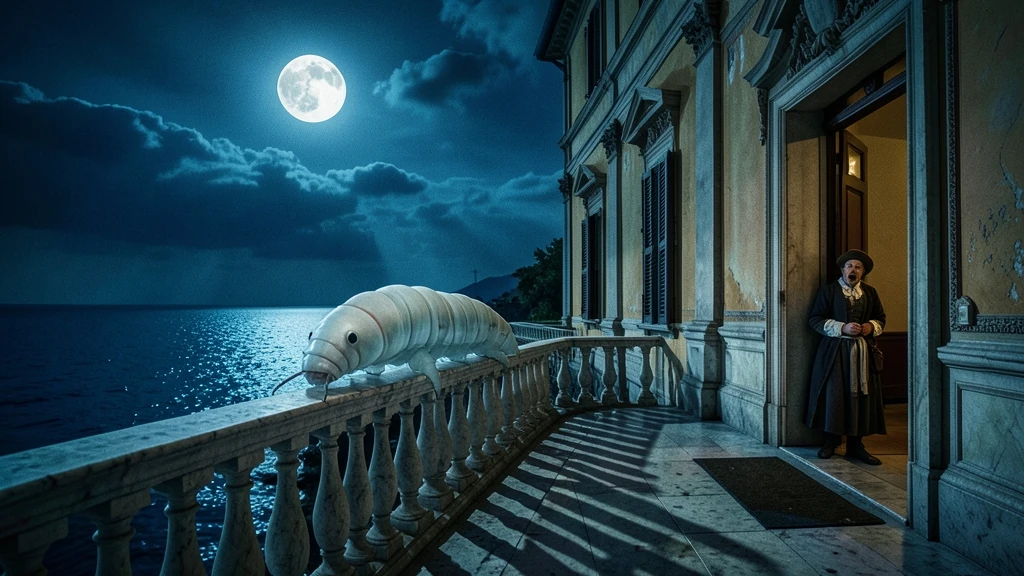
Edition and rights: Complete original English text from Project Gutenberg ebook #72421. This edition is identified as public domain in the USA; the original author died in 1940, satisfying the ordinary Pakistan copyright term. This is the original work, not an AI retelling.
CATERPILLARS


I saw a month or two ago in an Italian paper that the Villa Cascana, in
which I once stayed, had been pulled down, and that a manufactory of
some sort was in process of erection on its site. There is therefore no
longer any reason for refraining from writing of those things which I
myself saw (or imagined I saw) in a certain room and on a certain
landing of the villa in question, nor from mentioning the circumstances
which followed, which may or may not (according to the opinion of the
reader) throw some light on or be somehow connected with this
experience.

The Villa Cascana was in all ways but one a perfectly delightful house,
yet, if it were standing now, nothing in the world--I use the phrase in
its literal sense--would induce me to set foot in it again, for I
believe it to have been haunted in a very terrible and practical manner.
Most ghosts, when all is said and done, do not do much harm; they may
perhaps terrify, but the person whom they visit usually gets over their
visitation. They may on the other hand be entirely friendly and
beneficent. But the appearances in the Villa Cascana were not
beneficent, and had they made their “visit” in a very slightly
different manner, I do not suppose I should have got over it any more
than Arthur Inglis did.

       *       *       *       *       *

The house stood on an ilex-clad hill not far from Sestri di Levante on
the Italian Riviera, looking out over the iridescent blues of that
enchanted sea, while behind it rose the pale green chestnut woods that
climb up the hillsides till they give place to the pines that, black in
contrast with them, crown the slopes. All round it the garden in the
luxuriance of mid-spring bloomed and was fragrant, and the scent of
magnolia and rose, borne on the salt freshness of the winds from the
sea, flowed like a stream through the cool vaulted rooms.

On the ground floor a broad pillared _loggia_ ran round three sides of
the house, the top of which formed a balcony for certain rooms of the
first floor. The main staircase, broad and of grey marble steps, led up
from the hall to the landing outside these rooms, which were three in
number, namely two big sitting-rooms and a bedroom arranged _en suite_.
The latter was unoccupied, the sitting-rooms were in use. From these the
main staircase was continued to the second floor, where were situated
certain bedrooms, one of which I occupied, while from the other side of
the first-floor landing some half-dozen steps led to another suite of
rooms, where, at the time I am speaking of, Arthur Inglis, the artist,
had his bedroom and studio. Thus the landing outside my bedroom at the
top of the house, commanded both the landing of the first floor, and
also the steps that led to Inglis’ rooms. Jim Stanley and his wife,
finally (whose guest I was), occupied rooms in another wing of the
house, where also were the servants’ quarters.

I arrived just in time for lunch on a brilliant noon of mid-May. The
garden was shouting with colour and fragrance, and not less delightful
after my broiling walk up from the _marina_, should have been the coming
from the reverberating heat and blaze of the day into the marble
coolness of the villa. Only (the reader has my bare word for this, and
nothing more), the moment I set foot in the house I felt that something
was wrong. This feeling, I may say, was quite vague, though very strong,
and I remember that when I saw letters waiting for me on the table in
the hall I felt certain that the explanation was here: I was convinced
that there was bad news of some sort for me. Yet when I opened them I
found no such explanation of my premonition: my correspondents all
reeked of prosperity. Yet this clear miscarriage of a presentiment did
not dissipate my uneasiness. In that cool fragrant house there was
something wrong.

I am at pains to mention this because to the general view it may explain
that though I am as a rule so excellent a sleeper that the extinction of
my light on getting into bed is apparently contemporaneous with being
called on the following morning, I slept very badly on my first night
in the Villa Cascana. It may also explain the fact that when I did sleep
(if it was indeed in sleep that I saw what I thought I saw) I dreamed in
a very vivid and original manner, original, that is to say, in the sense
that something that, as far as I knew, had never previously entered into
my consciousness, usurped it then. But since, in addition to this evil
premonition, certain words and events occurring during the rest of the
day, might have suggested something of what I thought happened that
night, it will be well to relate them.

After lunch, then, I went round the house with Mrs Stanley, and during
our tour she referred, it is true, to the unoccupied bedroom on the
first floor, which opened out of the room where we had lunched.

“We left that unoccupied,” she said, “because Jim and I have a charming
bedroom and dressing-room, as you saw, in the wing, and if we used it
ourselves we should have to turn the dining-room into a dressing-room
and have our meals downstairs. As it is, however, we have our little
flat there, Arthur Inglis has his little flat in the other passage; and
I remembered (aren’t I extraordinary?) that you once said that the
higher up you were in a house the better you were pleased. So I put you
at the top of the house, instead of giving you that room.”

It is true, that a doubt, vague as my uneasy premonition, crossed my
mind at this. I did not see why Mrs Stanley should have explained all
this, if there had not been more to explain. I allow, therefore, that
the thought that there was something to explain about the unoccupied
bedroom was momentarily present to my mind.

The second thing that may have borne on my dream was this.

At dinner the conversation turned for a moment on ghosts. Inglis, with
the certainty of conviction, expressed his belief that anybody who could
possibly believe in the existence of supernatural phenomena was unworthy
of the name of an ass. The subject instantly dropped. As far as I can
recollect, nothing else occurred or was said that could bear on what
follows.

We all went to bed rather early, and personally I yawned my way
upstairs, feeling hideously sleepy. My room was rather hot, and I threw
all the windows wide, and from without poured in the white light of the
moon, and the love-song of many nightingales. I undressed quickly, and
got into bed, but though I had felt so sleepy before, I now felt
extremely wide-awake. But I was quite content to be awake: I did not
toss or turn, I felt perfectly happy listening to the song and seeing
the light. Then, it is possible, I may have gone to sleep, and what
follows may have been a dream. I thought anyhow that after a time the
nightingales ceased singing and the moon sank. I thought also that if,
for some unexplained reason, I was going to lie awake all night, I might
as well read, and I remembered that I had left a book in which I was
interested in the dining-room on the first floor. So I got out of bed,
lit a candle, and went downstairs. I went into the room, saw on a
side-table the book I had come to look for, and then, simultaneously,
saw that the door into the unoccupied bedroom was open. A curious grey
light, not of dawn nor of moonshine, came out of it, and I looked in.
The bed stood just opposite the door, a big four-poster, hung with
tapestry at the head. Then I saw that the greyish light of the bedroom
came from the bed, or rather from what was on the bed. For it was
covered with great caterpillars, a foot or more in length, which crawled
over it. They were faintly luminous, and it was the light from them that
showed me the room. Instead of the sucker-feet of ordinary caterpillars
they had rows of pincers like crabs, and they moved by grasping what
they lay on with their pincers, and then sliding their bodies forward.
In colour these dreadful insects were yellowish-grey, and they were
covered with irregular lumps and swellings. There must have been
hundreds of them, for they formed a sort of writhing, crawling pyramid
on the bed. Occasionally one fell off on to the floor, with a soft
fleshy thud, and though the floor was of hard concrete, it yielded to
the pincer-feet as if it had been putty, and, crawling back, the
caterpillar would mount on to the bed again, to rejoin its fearful
companions. They appeared to have no faces, so to speak, but at one end
of them there was a mouth that opened sideways in respiration.

Then, as I looked, it seemed to me as if they all suddenly became
conscious of my presence. All the mouths at any rate were turned in my
direction, and next moment they began dropping off the bed with those
soft fleshy thuds on to the floor, and wriggling towards me. For one
second a paralysis as of a dream was on me, but the next I was running
upstairs again to my room, and I remember feeling the cold of the marble
steps on my bare feet. I rushed into my bedroom, and slammed the door
behind me, and then--I was certainly wide awake now--I found myself
standing by my bed with the sweat of terror pouring from me. The noise
of the banged door still rang in my ears. But, as would have been more
usual, if this had been mere nightmare, the terror that had been mine
when I saw those foul beasts crawling about the bed or dropping softly
on to the floor did not cease then. Awake now, if dreaming before, I did
not at all recover from the horror of dream: it did not seem to me that
I had dreamed. And until dawn, I sat or stood, not daring to lie down,
thinking that every rustle or movement that I heard was the approach of
the caterpillars. To them and the claws that bit into the cement the
wood of the door was child’s play: steel would not keep them out.

But with the sweet and noble return of day the horror vanished: the
whisper of wind became benignant again: the nameless fear, whatever it
was, was smoothed out and terrified me no longer. Dawn broke, hueless at
first; then it grew dove-coloured, then the flaming pageant of light
spread over the sky.

       *       *       *       *       *

The admirable rule of the house was that everybody had breakfast where
and when he pleased, and in consequence it was not till lunch-time that
I met any of the other members of our party, since I had breakfast on my
balcony, and wrote letters and other things till lunch. In fact, I got
down to that meal rather late, after the other three had begun. Between
my knife and fork there was a small pill-box of cardboard, and as I sat
down Inglis spoke.

“Do look at that,” he said, “since you are interested in natural
history. I found it crawling on my counterpane last night, and I don’t
know what it is.”

I think that before I opened the pill-box I expected something of the
sort which I found in it. Inside it, anyhow, was a small caterpillar,
greyish-yellow in colour, with curious bumps and excrescences on its
rings. It was extremely active, and hurried round the box, this way and
that. Its feet were unlike the feet of any caterpillar I ever saw: they
were like the pincers of a crab. I looked, and shut the lid down again.

“No, I don’t know it,” I said, “but it looks rather unwholesome. What
are you going to do with it?”

“Oh, I shall keep it,” said Inglis. “It has begun to spin: I want to see
what sort of a moth it turns into.”

I opened the box again, and saw that these hurrying movements were
indeed the beginning of the spinning of the web of its cocoon. Then
Inglis spoke again.

“It has got funny feet, too,” he said. “They are like crabs’ pincers.
What’s the Latin for crab? Oh, yes, Cancer. So in case it is unique,
let’s christen it: ‘Cancer Inglisensis.’”

Then something happened in my brain, some momentary piecing together of
all that I had seen or dreamed. Something in his words seemed to me to
throw light on it all, and my own intense horror at the experience of
the night before linked itself on to what he had just said. In effect, I
took the box and threw it, caterpillar and all, out of the window. There
was a gravel path just outside, and beyond it, a fountain playing into a
basin. The box fell on to the middle of this.

Inglis laughed.

“So the students of the occult don’t like solid facts,” he said. “My
poor caterpillar!”

The talk went off again at once on to other subjects, and I have only
given in detail, as they happened, these trivialities in order to be
sure myself that I have recorded everything that could have borne on
occult subjects or on the subject of caterpillars. But at the moment
when I threw the pill-box into the fountain, I lost my head: my only
excuse is that, as is probably plain, the tenant of it was, in
miniature, exactly what I had seen crowded on to the bed in the
unoccupied room. And though this translation of those phantoms into
flesh and blood--or whatever it is that caterpillars are made of--ought
perhaps to have relieved the horror of the night, as a matter of fact it
did nothing of the kind. It only made the crawling pyramid that covered
the bed in the unoccupied room more hideously real.

       *       *       *       *       *

After lunch we spent a lazy hour or two strolling about the garden or
sitting in the loggia, and it must have been about four o’clock when
Stanley and I started off to bathe, down the path that led by the
fountain into which I had thrown the pill-box. The water was shallow and
clear, and at the bottom of it I saw its white remains. The water had
disintegrated the cardboard, and it had become no more than a few strips
and shreds of sodden paper. The centre of the fountain was a marble
Italian Cupid which squirted the water out of a wine-skin held under its
arm. And crawling up its leg was the caterpillar. Strange and scarcely
credible as it seemed, it must have survived the falling-to-bits of its
prison, and made its way to shore, and there it was, out of arm’s reach,
weaving and waving this way and that as it evolved its cocoon.

Then, as I looked at it, it seemed to me again that, like the
caterpillar I had seen last night, it saw me, and breaking out of the
threads that surrounded it, it crawled down the marble leg of the Cupid
and began swimming like a snake across the water of the fountain towards
me. It came with extraordinary speed (the fact of a caterpillar being
able to swim was new to me), and in another moment was crawling up the
marble lip of the basin. Just then Inglis joined us.

“Why, if it isn’t old ‘Cancer Inglisensis’ again,” he said, catching
sight of the beast. “What a tearing hurry it is in.”

We were standing side by side on the path, and when the caterpillar had
advanced to within about a yard of us, it stopped, and began waving
again, as if in doubt as to the direction in which it should go. Then it
appeared to make up its mind, and crawled on to Inglis’ shoe.

“It likes me best,” he said, “but I don’t really know that I like it.
And as it won’t drown I think perhaps----”

He shook it off his shoe on to the gravel path and trod on it.

       *       *       *       *       *

All afternoon the air got heavier and heavier with the Sirocco that was
without doubt coming up from the south, and that night again I went up
to bed feeling very sleepy; but below my drowsiness, so to speak, there
was the consciousness, stronger than before, that there was something
wrong in the house, that something dangerous was close at hand. But I
fell asleep at once, and--how long after I do not know--either woke or
dreamed I awoke, feeling that I must get up at once, _or I should be too
late_. Then (dreaming or awake) I lay and fought this fear, telling
myself that I was but the prey of my own nerves disordered by Sirocco or
what not, and at the same time quite clearly knowing in another part of
my mind, so to speak, that every moment’s delay added to the danger. At
last this second feeling became irresistible, and I put on coat and
trousers and went out of my room on to the landing. And then I saw that
I had already delayed too long, and that I was now too late.

The whole of the landing of the first floor below was invisible under
the swarm of caterpillars that crawled there. The folding doors into the
sitting-room from which opened the bedroom where I had seen them last
night, were shut, but they were squeezing through the cracks of it, and
dropping one by one through the keyhole, elongating themselves into mere
string as they passed, and growing fat and lumpy again on emerging.
Some, as if exploring, were nosing about the steps into the passage at
the end of which were Inglis’ rooms, others were crawling on the lowest
steps of the staircase that led up to where I stood. The landing,
however, was completely covered with them: I was cut off. And of the
frozen horror that seized me when I saw that, I can give no idea in
words.

       *       *       *       *       *

Then at last a general movement began to take place, and they grew
thicker on the steps that led to Inglis’ room. Gradually, like some
hideous tide of flesh, they advanced along the passage, and I saw the
foremost, visible by the pale grey luminousness that came from them,
reach his door. Again and again I tried to shout and warn him, in terror
all the time that they would turn at the sound of my voice and mount my
stair instead, but for all my efforts I felt that no sound came from my
throat. They crawled along the hinge-crack of his door, passing through
as they had done before, and still I stood there making impotent efforts
to shout to him, to bid him escape while there was time.

       *       *       *       *       *

At last the passage was completely empty: they had all gone, and at that
moment I was conscious for the first time of the cold of the marble
landing on which I stood barefooted. The dawn was just beginning to
break in the Eastern sky.

       *       *       *       *       *

Six months later I met Mrs Stanley in a country house in England. We
talked on many subjects and at last she said:

“I don’t think I have seen you since I got that dreadful news about
Arthur Inglis a month ago.”

“I haven’t heard,” said I.

“No? He has got cancer. They don’t even advise an operation, for there
is no hope of a cure: he is riddled with it, the doctors say.”

Now during all these six months I do not think a day had passed on which
I had not had in my mind the dreams (or whatever you like to call them)
which I had seen in the Villa Cascana.

“It is awful, is it not?” she continued, “and I feel, I can’t help
feeling, that he may have----”

“Caught it at the villa?” I asked.

She looked at me in blank surprise.

“Why did you say that?” she asked. “How did you know?”

Then she told me. In the unoccupied bedroom a year before there had been
a fatal case of cancer. She had, of course, taken the best advice and
had been told that the utmost dictates of prudence would be obeyed so
long as she did not put anybody to sleep in the room, which had also
been thoroughly disinfected and newly white-washed and painted. But----
1 / 1


