
How Fear Departed from the Long Gallery
Read How Fear Departed from the Long Gallery, the complete 1912 story by E. F. Benson. A complete original English tale of the uncanny from a 1912 collection of Edwardian supernatural stories.
By E. F. Benson
Edition and rights: Complete original English text from Project Gutenberg ebook #72421. This edition is identified as public domain in the USA; the original author died in 1940, satisfying the ordinary Pakistan copyright term. This is the original work, not an AI retelling.
HOW FEAR DEPARTED FROM THE LONG GALLERY


CHURCH-PEVERIL is a house so beset and frequented by spectres, both
visible and audible, that none of the family which it shelters under its
acre and a half of green copper roofs takes psychical phenomena with any
seriousness. For to the Peverils the appearance of a ghost is a matter
of hardly greater significance than is the appearance of the post to
those who live in more ordinary houses. It arrives, that is to say,
practically every day, it knocks (or makes other noises), it is observed
coming up the drive (or in other places). I myself, when staying there
have seen the present Mrs Peveril, who is rather short-sighted, peer
into the dusk, while we were taking our coffee on the terrace after
dinner, and say to her daughter:

“My dear, was not that the Blue Lady who has just gone into the
shrubbery. I hope she won’t frighten Flo. Whistle for Flo, dear.”

(Flo, it may be remarked, is the youngest and most precious of many
dachshunds).

Blanche Peveril gave a cursory whistle, and crunched the sugar left
unmelted at the bottom of her coffee-cup between her very white teeth.

“Oh, darling, Flo isn’t so silly as to mind,” she said. “Poor blue Aunt
Barbara is such a bore! Whenever I meet her she always looks as if she
wanted to speak to me, but when I say, ‘What is it, Aunt Barbara?’ she
never utters, but only points somewhere towards the house, which is so
vague. I believe there was something she wanted to confess about two
hundred years ago, but she has forgotten what it is.”

Here Flo gave two or three short pleased barks, and came out of the
shrubbery wagging her tail, and capering round what appeared to me to be
a perfectly empty space on the lawn.

“There! Flo has made friends with her,” said Mrs Peveril. “I wonder why
she dresses in that very stupid shade of blue.”

       *       *       *       *       *

From this it may be gathered that even with regard to psychical
phenomena there is some truth in the proverb that speaks of familiarity.
But the Peverils do not exactly treat their ghosts with contempt, since
most of that delightful family never despised anybody except such people
as avowedly did not care for hunting or shooting, or golf or skating.
And as all of their ghosts are of their family, it seems reasonable to
suppose that they all, even the poor Blue Lady, excelled at one time in
field-sports. So far then they harbour no such unkindness or contempt,
but only pity. Of one Peveril, indeed, who broke his neck in vainly
attempting to ride up the main staircase on a thoroughbred mare after
some monstrous and violent deed in the back-garden, they are very fond,
and Blanche comes downstairs in the morning with an eye unusually bright
when she can announce that Master Anthony was “very loud” last night. He
(apart from the fact of his having been so foul a ruffian) was a
tremendous fellow across country, and they like these indications of the
continuance of his superb vitality. In fact, it is supposed to be a
compliment, when you go to stay at Church-Peveril, to be assigned a
bedroom which is frequented by defunct members of the family. It means
that you are worthy to look on the august and villainous dead,
and you will find yourself shown into some vaulted or tapestried
chamber, without benefit of electric light, and are told that
great-great-grandmamma Bridget occasionally has vague business by the
fireplace, but it is better not to talk to her, and that you will hear
Master Anthony “awfully well” if he attempts the front staircase any
time before morning. There you are left for your night’s repose, and,
having quakingly undressed, begin reluctantly to put out your candles.
It is draughty in these great chambers, and the solemn tapestry swings
and bellows and subsides, and the firelight dances on the forms of
huntsmen and warriors and stern pursuits. Then you climb into your bed,
a bed so huge that you feel as if the desert of Sahara was spread for
you, and pray, like the mariners who sailed with St Paul, for day. And,
all the time, you are aware that Freddy and Harry and Blanche and
possibly even Mrs Peveril are quite capable of dressing up and making
disquieting tappings outside your door, so that when you open it some
inconjecturable horror fronts you. For myself, I stick steadily to the
assertion that I have an obscure valvular disease of the heart, and so
sleep undisturbed in the new wing of the house where Aunt Barbara, and
great-great-grandmamma Bridget and Master Anthony never penetrate. I
forget the details of great-great-grandmamma Bridget, but she certainly
cut the throat of some distant relation before she disembowelled herself
with the axe that had been used at Agincourt. Before that she had led a
very sultry life, crammed with amazing incident.

       *       *       *       *       *

But there is one ghost at Church-Peveril at which the family never
laugh, in which they feel no friendly and amused interest, and of which
they only speak just as much as is necessary for the safety of their
guests. More properly it should be described as two ghosts, for the
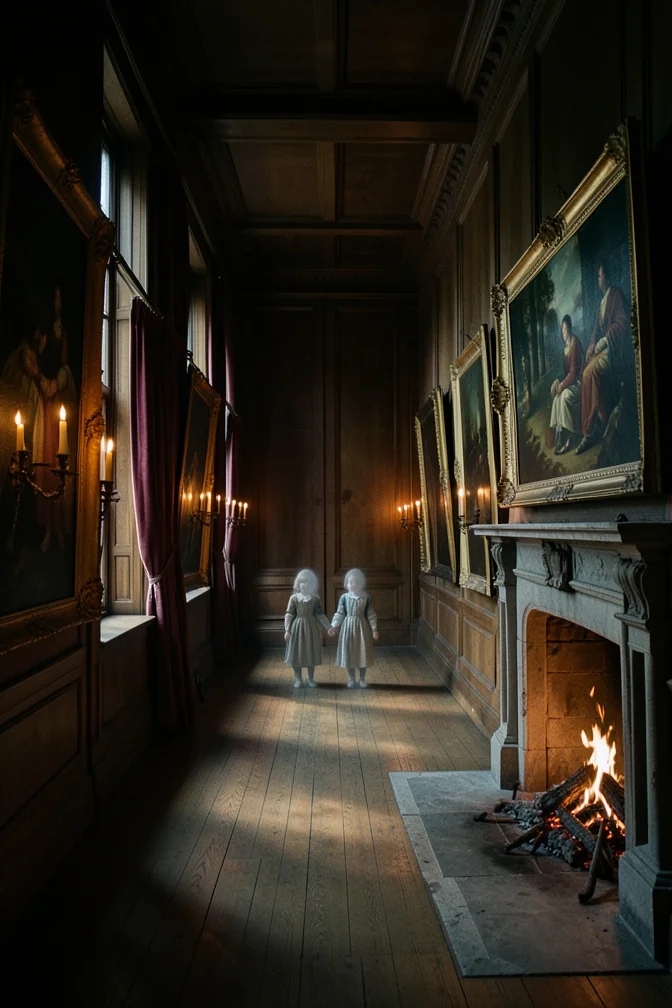
“haunt” in question is that of two very young children, who were twins.
These, not without reason, the family take very seriously indeed. The
story of them, as told me by Mrs Peveril, is as follows:

In the year 1602, the same being the last of Queen Elizabeth’s reign, a
certain Dick Peveril was greatly in favour at Court. He was brother to
Master Joseph Peveril, then owner of the family house and lands, who two
years previously, at the respectable age of seventy-four, became father
of twin boys, first-born of his progeny. It is known that the royal and
ancient virgin had said to handsome Dick, who was nearly forty years his
brother’s junior, “’Tis pity that you are not master of Church Peveril,”
and these words probably suggested to him a sinister design. Be that as
it may, handsome Dick, who very adequately sustained the family
reputation for wickedness, set off to ride down to Yorkshire, and found
that, very conveniently, his brother Joseph had just been seized with an
apoplexy, which appeared to be the result of a continued spell of hot
weather combined with the necessity of quenching his thirst with an
augmented amount of sack, and had actually died while handsome Dick,
with God knows what thoughts in his mind, was journeying northwards.
Thus it came about that he arrived at Church-Peveril just in time for
his brother’s funeral. It was with great propriety that he attended the
obsequies, and returned to spend a sympathetic day or two of mourning
with his widowed sister-in-law, who was but a faint-hearted dame,
little fit to be mated with such hawks as these. On the second night of
his stay, he did that which the Peverils regret to this day. He entered
the room where the twins slept with their nurse, and quietly strangled
the latter as she slept. Then he took the twins and put them into the
fire which warms the long gallery. The weather, which up to the day of
Joseph’s death had been so hot, had changed suddenly to bitter cold, and
the fire was heaped high with burning logs and was exultant with flame.
In the core of this conflagration he struck out a cremation-chamber, and
into that he threw the two children, stamping them down with his
riding-boots. They could just walk, but they could not walk out of that
ardent place. It is said that he laughed as he added more logs. Thus he
became master of Church Peveril.

The crime was never brought home to him, but he lived no longer than a
year in the enjoyment of his blood-stained inheritance. When he lay
a-dying he made his confession to the priest who attended him, but his
spirit struggled forth from its fleshly coil before Absolution could be
given him. On that very night there began in Church-Peveril the haunting
which to this day is but seldom spoken of by the family, and then only
in low tones and with serious mien. For, only an hour or two after
handsome Dick’s death, one of the servants passing the door of the long
gallery heard from within peals of the loud laughter so jovial and yet
so sinister, which he had thought would never be heard in the house
again. In a moment of that cold courage, which is so nearly akin to
mortal terror, he opened the door and entered, expecting to see he knew
not what manifestation of him who lay dead in the room below. Instead he
saw two little white-robed figures toddling towards him hand in hand
across the moon-lit floor.

The watchers in the room below ran upstairs startled by the crash of his
fallen body, and found him lying in the grip of some dread convulsion.
Just before morning he regained consciousness and told his tale. Then
pointing with trembling and ash-grey finger towards the door, he
screamed aloud, and so fell back dead.

       *       *       *       *       *

During the next fifty years this strange and terrible legend of the
twin-babies became fixed and consolidated. Their appearance, luckily for
those who inhabit the house, was exceedingly rare, and during these
years they seem to have been seen four or five times only. On each
occasion they appeared at night, between sunset and sunrise, always in
the same long gallery, and always as two toddling children scarcely able
to walk. And on each occasion the luckless individual who saw them died
either speedily or terribly, or with both speed and terror, after the
accursed vision had appeared to him. Sometimes he might live for a few
months: he was lucky if he died, as did the servant who first saw them,
in a few hours. Vastly more awful was the fate of a certain Mrs Canning,
who had the ill-luck to see them in the middle of the next century, or
to be quite accurate, in the year 1760. By this time the hours and the
place of their appearance were well-known, and, as up till a year ago,
visitors were warned not to go between sunset and sunrise into the long
gallery.

But Mrs Canning, a brilliantly clever and beautiful woman, admirer also
and friend of the notorious sceptic M. Voltaire, wilfully went and sat
night after night, in spite of all protestations, in the haunted place.
For four evenings she saw nothing, but on the fifth she had her will,
for the door in the middle of the gallery opened, and there came
toddling towards her the ill-omened innocent little pair. It seemed that
even then she was not frightened, but she thought good, poor wretch, to
mock at them, telling them it was time for them to get back into the
fire. They gave no word in answer, but turned away from her crying and
sobbing. Immediately after they disappeared from her vision and she
rustled downstairs to where the family and guests in the house were
waiting for her, with the triumphant announcement that she had seen them
both, and must needs write to M. Voltaire, saying that she had spoken to
spirits made manifest. It would make him laugh. But when some months
later the whole news reached him he did not laugh at all.

Mrs Canning was one of the great beauties of her day, and in the year
1760 she was at the height and zenith of her blossoming. The chief
beauty, if it is possible to single out one point where all was so
exquisite, lay in the dazzling colour and incomparable brilliance of her
complexion. She was now just thirty years of age, but, in spite of the
excesses of her life, retained the snow and roses of girlhood, and she
courted the bright light of day which other women shunned, for it but
showed to greater advantage the splendour of her skin. In consequence
she was very considerably dismayed one morning, about a fortnight after
her strange experience in the long gallery, to observe on her left cheek
an inch or two below her turquoise-coloured eyes, a little greyish patch
of skin, about as big as a threepenny piece. It was in vain that she
applied her accustomed washes and ungents: vain, too, were the arts of
her _fardeuse_ and of her medical adviser. For a week she kept herself
secluded, martyring herself with solitude and unaccustomed physics, and
for result at the end of the week she had no amelioration to comfort
herself with: instead this woeful grey patch had doubled itself in size.
Thereafter the nameless disease, whatever it was, developed in new and
terrible ways. From the centre of the discoloured place there sprouted
forth little lichen-like tendrils of greenish-grey, and another patch
appeared on her lower lip. This, too, soon vegetated, and one morning
on opening her eyes to the horror of a new day, she found that her
vision was strangely blurred. She sprang to her looking-glass, and what
she saw caused her to shriek aloud with horror. From under her upper
eye-lid a fresh growth had sprung up, mushroom-like, in the night, and
its filaments extended downwards, screening the pupil of her eye. Soon
after her tongue and throat were attacked: the air passages became
obstructed, and death by suffocation was merciful after such suffering.

More terrible yet was the case of a certain Colonel Blantyre who fired
at the children with his revolver. What he went through is not to be
recorded here.

       *       *       *       *       *

It is this haunting, then, that the Peverils take quite seriously, and
every guest on his arrival in the house is told that the long gallery
must not be entered after nightfall on any pretext whatever. By day,
however, it is a delightful room and intrinsically merits description,
apart from the fact that the due understanding of its geography is
necessary for the account that here follows. It is full eighty feet in
length, and is lit by a row of six tall windows looking over the gardens
at the back of the house. A door communicates with the landing at the
top of the main staircase, and about half-way down the gallery in the
wall facing the windows is another door communicating with the back
staircase and servants’ quarters, and thus the gallery forms a constant
place of passage for them in going to the rooms on the first landing. It
was through this door that the baby-figures came when they appeared to
Mrs Canning, and on several other occasions they have been known to make
their entry here, for the room out of which handsome Dick took them lies
just beyond at the top of the back stairs. Further on again in the
gallery is the fireplace into which he thrust them, and at the far end a
large bow-window looks straight down the avenue. Above this fireplace
there hangs with grim significance a portrait of handsome Dick, in the
insolent beauty of early manhood, attributed to Holbein, and a dozen
other portraits of great merit face the windows. During the day this is
the most frequented sitting-room in the house, for its other visitors
never appear there then, nor does it then ever resound with the harsh
jovial laugh of handsome Dick, which sometimes, after dark has fallen,
is heard by passers-by on the landing outside. But Blanche does not grow
bright-eyed when she hears it: she shuts her ears and hastens to put a
greater distance between her and the sound of that atrocious mirth.

But during the day the long gallery is frequented by many occupants, and
much laughter in no wise sinister or saturnine resounds there. When
summer lies hot over the land, those occupants lounge in the deep window
seats, and when winter spreads his icy fingers and blows shrilly between
his frozen palms, congregate round the fireplace at the far end, and
perch, in companies of cheerful chatterers, upon sofa and chair, and
chair-back and floor. Often have I sat there on long August evenings up
till dressing-time, but never have I been there when anyone has seemed
disposed to linger over-late without hearing the warning: “It is close
on sunset: shall we go?” Later on in the shorter autumn days they often
have tea laid there, and sometimes it has happened that, even while
merriment was most uproarious, Mrs Peveril has suddenly looked out of
the window and said, “My dears, it is getting so late: let us finish our
nonsense downstairs in the hall.” And then for a moment a curious hush
always falls on loquacious family and guests alike, and as if some bad
news had just been known, we all make our silent way out of the place.
But the spirits of the Peverils (of the living ones, that is to say) are
the most mercurial imaginable, and the blight which the thought of
handsome Dick and his doings casts over them passes away again with
amazing rapidity.

       *       *       *       *       *

A typical party, large, young, and peculiarly cheerful, was staying at
Church-Peveril shortly after Christmas last year, and as usual on
December 31, Mrs Peveril was giving her annual New Year’s Eve ball. The
house was quite full, and she had commandeered as well the greater part
of the Peveril Arms to provide sleeping-quarters for the overflow from
the house. For some days past a black and windless frost had stopped all
hunting, but it is an ill windlessness that blows no good (if so mixed a
metaphor may be forgiven), and the lake below the house had for the last
day or two been covered with an adequate and admirable sheet of ice.
Everyone in the house had been occupied all the morning of that day in
performing swift and violent manœuvres on the elusive surface, and as
soon as lunch was over we all, with one exception, hurried out again.
This one exception was Madge Dalrymple who had had the misfortune to
fall rather badly earlier in the day, but hoped, by resting her injured
knee, instead of joining the skaters again, to be able to dance that
evening. The hope, it is true, was of the most sanguine sort, for she
could but hobble ignobly back to the house, but with the breezy optimism
which characterises the Peverils (she is Blanche’s first cousin), she
remarked that it would be but tepid enjoyment that she could, in her
present state, derive from further skating, and thus she sacrificed
little, but might gain much.

Accordingly after a rapid cup of coffee which was served in the long
gallery, we left Madge comfortably reclined on the big sofa at
right-angles to the fireplace, with an attractive book to beguile the
tedium till tea. Being of the family, she knew all about handsome Dick
and the babies, and the fate of Mrs Canning and Colonel Blantyre, but as
we went out I heard Blanche say to her, “Don’t run it too fine, dear,”
and Madge had replied, “No; I’ll go away well before sunset.” And so we
left her alone in the long gallery.

       *       *       *       *       *

Madge read her attractive book for some minutes, but failing to get
absorbed in it, put it down and limped across to the window. Though it
was still but little after two, it was but a dim and uncertain light
that entered, for the crystalline brightness of the morning had given
place to a veiled obscurity produced by flocks of thick clouds which
were coming sluggishly up from the north-east. Already the whole sky was
overcast with them, and occasionally a few snowflakes fluttered
waveringly down past the long windows. From the darkness and bitter cold
of the afternoon, it seemed to her that there was like to be a heavy
snowfall before long, and these outward signs were echoed inwardly in
her by that muffled drowsiness of the brain, which to those who are
sensitive to the pressures and lightnesses of weather portends storm.
Madge was peculiarly the prey of such external influences: to her a
brisk morning gave an ineffable brightness and briskness of spirit, and
correspondingly the approach of heavy weather produced a somnolence in
sensation that both drowsed and depressed her.

It was in such mood as this that she limped back again to the sofa
beside the log-fire. The whole house was comfortably heated by
water-pipes, and though the fire of logs and peat, an adorable mixture,
had been allowed to burn low, the room was very warm. Idly she watched
the dwindling flames, not opening her book again, but lying on the sofa
with face towards the fireplace, intending drowsily and not immediately
to go to her own room and spend the hours, until the return of the
skaters made gaiety in the house again, in writing one or two neglected
letters. Still drowsily she began thinking over what she had to
communicate: one letter several days overdue should go to her mother,
who was immensely interested in the psychical affairs of the family. She
would tell her how Master Anthony had been prodigiously active on the
staircase a night or two ago, and how the Blue Lady, regardless of the
severity of the weather, had been seen by Mrs Peveril that morning,
strolling about. It was rather interesting: the Blue Lady had gone down
the laurel walk and had been seen by her to enter the stables, where, at
the moment, Freddy Peveril was inspecting the frost-bound hunters.
Identically then, a sudden panic had spread through the stables, and the
horses had whinnied and kicked, and shied, and sweated. Of the fatal
twins nothing had been seen for many years past, but, as her mother
knew, the Peverils never used the long gallery after dark.

Then for a moment she sat up, remembering that she was in the long
gallery now. But it was still but a little after half-past two, and if
she went to her room in half an hour, she would have ample time to
write this and another letter before tea. Till then she would read her
book. But she found she had left it on the window-sill, and it seemed
scarcely worth while to get it. She felt exceedingly drowsy.

The sofa where she lay had been lately re-covered, in a greyish green
shade of velvet, somewhat the colour of lichen. It was of very thick
soft texture, and she luxuriously stretched her arms out, one on each
side of her body, and pressed her fingers into the nap. How horrible
that story of Mrs Canning was: the growth on her face was of the colour
of lichen. And then without further transition or blurring of thought
Madge fell asleep.

She dreamed. She dreamed that she awoke and found herself exactly where
she had gone to sleep, and in exactly the same attitude. The flames from
the logs had burned up again, and leaped on the walls, fitfully
illuminating the picture of handsome Dick above the fire-place. In her
dream she knew exactly what she had done to-day, and for what reason she
was lying here now instead of being out with the rest of the skaters.
She remembered also (still dreaming), that she was going to write a
letter or two before tea, and prepared to get up in order to go to her
room. As she half-rose she caught sight of her own arms lying out on
each side of her on the grey velvet sofa. But she could not see where
her hands ended, and where the grey velvet began: her fingers seemed to
have melted into the stuff. She could see her wrists quite clearly, and
a blue vein on the backs of her hands, and here and there a knuckle.
Then, in her dream she remembered, the last thought which had been in
her mind before she fell asleep, namely the growth of the
lichen-coloured vegetation on the face and the eyes and the throat of
Mrs Canning. At that thought the strangling terror of real nightmare
began: she knew that she was being transformed into this grey stuff, and
she was absolutely unable to move. Soon the grey would spread up her
arms, and over her feet; when they came in from skating they would find
here nothing but a huge misshapen cushion of lichen-coloured velvet, and
that would be she. The horror grew more acute, and then by a violent
effort she shook herself free of the clutches of this very evil dream,
and she awoke.

For a minute or two she lay there, conscious only of the tremendous
relief at finding herself awake. She felt again with her fingers the
pleasant touch of the velvet, and drew them backwards and forwards,
assuring herself that she was not, as her dream had suggested, melting
into greyness and softness. But she was still, in spite of the violence
of her awakening, very sleepy, and lay there till, looking down, she was
aware that she could not see her hands at all. It was very nearly dark.

At that moment a sudden flicker of flame came from the dying fire, and a
flare of burning gas from the peat flooded the room. The portrait of
handsome Dick looked evilly down on her, and her hands were visible
again. And then a panic worse than the panic of her dreams seized her.
Daylight had altogether faded, and she knew that she was alone in the
dark in the terrible gallery. This panic was of the nature of nightmare,
for she felt unable to move for terror. But it was worse than nightmare
because she knew she was awake. And then the full cause of this frozen
fear dawned on her; she knew with the certainty of absolute conviction
that she was about to see the twin-babies.

She felt a sudden moisture break out on her face, and within her mouth
her tongue and throat went suddenly dry, and she felt her tongue grate
along the inner surface of her teeth. All power of movement had slipped
from her limbs, leaving them dead and inert, and she stared with wide
eyes into the blackness. The spurt of flame from the peat had burned
itself out again, and darkness encompassed her.

Then on the wall opposite her, facing the windows, there grew a faint
light of dusky crimson. For a moment she thought it but heralded the
approach of the awful vision, then hope revived in her heart, and she
remembered that thick clouds had overcast the sky before she went to
sleep, and guessed that this light came from the sun not yet quite sunk
and set. This sudden revival of hope gave her the necessary stimulus,
and she sprang off the sofa where she lay. She looked out of the window
and saw the dull glow on the horizon. But before she could take a step
forward it was obscured again. A tiny sparkle of light came from the
hearth which did no more than illuminate the tiles of the fireplace, and
snow falling heavily tapped at the window panes. There was neither light
nor sound except these.

But the courage that had come to her, giving her the power of movement,
had not quite deserted her, and she began feeling her way down the
gallery. And then she found that she was lost. She stumbled against a
chair, and, recovering herself, stumbled against another. Then a table
barred her way, and, turning swiftly aside, she found herself up against
the back of a sofa. Once more she turned and saw the dim gleam of the
firelight on the side opposite to that on which she expected it. In her
blind gropings she must have reversed her direction. But which way was
she to go now? She seemed blocked in by furniture. And all the time
insistent and imminent was the fact that the two innocent terrible
ghosts were about to appear to her.

Then she began to pray, “Lighten our darkness, O Lord,” she said to
herself. But she could not remember how the prayer continued, and she
had sore need of it. There was something about the perils of the night.
All this time she felt about her with groping, fluttering hands. The
fire-glimmer which should have been on her left was on her right again;
therefore she must turn herself round again. “Lighten our darkness,” she
whispered, and then aloud she repeated, “Lighten our darkness.”

She stumbled up against a screen, and could not remember the existence
of any such screen. Hastily she felt beside it with blind hands, and
touched something soft and velvety. Was it the sofa on which she had
lain? If so, where was the head of it. It had a head and a back and
feet--it was like a person, all covered with grey lichen. Then she lost
her head completely. All that remained to her was to pray; she was lost,
lost in this awful place, where no one came in the dark except the
babies that cried. And she heard her voice rising from whisper to
speech, and speech to scream. She shrieked out the holy words, she
yelled them as if blaspheming as she groped among tables and chairs and
the pleasant things of ordinary life which had become so terrible.

       *       *       *       *       *

Then came a sudden and an awful answer to her screamed prayer. Once more
a pocket of inflammable gas in the peat on the hearth was reached by the
smouldering embers, and the room started into light. She saw the evil
eyes of handsome Dick, she saw the little ghostly snow-flakes falling
thickly outside. And she saw where she was, just opposite the door
through which the terrible twins made their entrance. Then the flame
went out again, and left her in blackness once more. But she had gained
something, for she had her geography now. The centre of the room was
bare of furniture, and one swift dart would take her to the door of the
landing above the main staircase and into safety. In that gleam she had
been able to see the handle of the door, bright-brassed, luminous like a
star. She would go straight for it; it was but a matter of a few seconds
now.

She took a long breath, partly of relief, partly to satisfy the demands
of her galloping heart. But the breath was only half-taken when she was
stricken once more into the immobility of nightmare.

There came a little whisper, it was no more than that, from the door
opposite which she stood, and through which the twin-babies entered. It
was not quite dark outside it, for she could see that the door was
opening. And there stood in the opening two little white figures, side
by side. They came towards her slowly, shufflingly. She could not see
face or form at all distinctly, but the two little white figures were
advancing. She knew them to be the ghosts of terror, innocent of the
awful doom they were bound to bring, even as she was innocent. With the
inconceivable rapidity of thought, she made up her mind what to do. She
had not hurt them or laughed at them, and they, they were but babies
when the wicked and bloody deed had sent them to their burning death.
Surely the spirits of these children would not be inaccessible to the
cry of one who was of the same blood as they, who had committed no fault
that merited the doom they brought. If she entreated them they might
have mercy, they might forebear to bring the curse on her, they might
allow her to pass out of the place without blight, without the sentence
of death, or the shadow of things worse than death upon her.

It was but for the space of a moment that she hesitated, then she sank
down on to her knees, and stretched out her hands towards them.

“Oh, my dears,” she said, “I only fell asleep. I have done no more wrong
than that----”

She paused a moment, and her tender girl’s heart thought no more of
herself, but only of them, those little innocent spirits on whom so
awful a doom was laid, that they should bring death where other children
bring laughter, and doom for delight. But all those who had seen them
before had dreaded and feared them, or had mocked at them.

Then, as the enlightenment of pity dawned on her, her fear fell from her
like the wrinkled sheath that holds the sweet folded buds of Spring.

“Dears, I am so sorry for you,” she said. “It is not your fault that you
must bring me what you must bring, but I am not afraid any longer. I am
only sorry for you. God bless you, you poor darlings.”

She raised her head and looked at them. Though it was so dark, she could
now see their faces, though all was dim and wavering, like the light of
pale flames shaken by a draught. But the faces were not miserable or
fierce--they smiled at her with shy little baby smiles. And as she
looked they grew faint, fading slowly away like wreaths of vapour in
frosty air.

       *       *       *       *       *

Madge did not at once move when they had vanished, for instead of fear
there was wrapped round her a wonderful sense of peace, so happy and
serene that she would not willingly stir, and so perhaps disturb it. But
before long she got up, and feeling her way, but without any sense of
nightmare pressing her on, or frenzy of fear to spur her, she went out
of the long gallery, to find Blanche just coming upstairs whistling and
swinging her skates.

“How’s the leg, dear,” she asked, “You’re not limping any more.”

Till that moment Madge had not thought of it.

“I think it must be all right,” she said, “I had forgotten it anyhow.
Blanche, dear, you won’t be frightened for me, will you, but--but I have
seen the twins.”

For a moment Blanche’s face whitened with terror.

“What?” she said in a whisper.

“Yes, I saw them just now. But they were kind, they smiled at me, and I
was so sorry for them. And somehow I am sure I have nothing to fear.”

       *       *       *       *       *

It seems that Madge was right, for nothing untoward has come to her.
Something, her attitude to them, we must suppose, her pity, her
sympathy, touched and dissolved and annihilated the curse. Indeed, I was
at Church Peveril only last week, arriving there after dark. Just as I
passed the gallery door, Blanche came out.

“Ah, there you are,” she said, “I’ve just been seeing the twins. They
looked too sweet and stopped nearly ten minutes. Let us have tea at
once.”
1 / 1


