
Lost Hearts
Read Lost Hearts by M. R. James in the original English.
By M. R. James
Edition: Complete story in the original English, from Project Gutenberg #8486. No translation or AI rewriting of the literary text. Original spelling retained.
This eBook is for the use of anyone anywhere in the United States and most other parts of the world at no cost and with almost no restrictions whatsoever. You may copy it, give it away or re-use it under the terms of the Project Gutenberg License included with this eBook or online at www.gutenberg.org. If you are not located in the United States, you will have to check the laws of the country where you are located before using this eBook.
It was, as far as I can ascertain, in September of the year 1811 that a post-chaise drew up before the door of Aswarby Hall, in the heart of Lincolnshire. The little boy who was the only passenger in the chaise, and who jumped out as soon as it had stopped, looked about him with the keenest curiosity during the short interval that elapsed between the ringing of the bell and the opening of the hall door. He saw a tall, square, red-brick house, built in the reign of Anne; a stone-pillared porch had been added in the purer classical style of 1790; the windows of the house were many, tall and narrow, with small panes and thick white woodwork. A pediment, pierced with a round window, crowned the front. There were wings to right and left, connected by curious glazed galleries, supported by colonnades, with the central block. These wings plainly contained the stables and offices of the house. Each was surmounted by an ornamental cupola with a gilded vane.
An evening light shone on the building, making the window-panes glow like so many fires. Away from the Hall in front stretched a flat park studded with oaks and fringed with firs, which stood out against the sky. The clock in the church-tower, buried in trees on the edge of the park, only its golden weather-cock catching the light, was striking six, and the sound came gently beating down the wind. It was altogether a pleasant impression, though tinged with the sort of melancholy appropriate to an evening in early autumn, that was conveyed to the mind of the boy who was standing in the porch waiting for the door to open to him.
The post-chaise had brought him from Warwickshire, where, some six months before, he had been left an orphan. Now, owing to the generous offer of his elderly cousin, Mr Abney, he had come to live at Aswarby. The offer was unexpected, because all who knew anything of Mr Abney looked upon him as a somewhat austere recluse, into whose steady-going household the advent of a small boy would import a new and, it seemed, incongruous element. The truth is that very little was known of Mr Abney’s pursuits or temper. The Professor of Greek at Cambridge had been heard to say that no one knew more of the religious beliefs of the later pagans than did the owner of Aswarby. Certainly his library contained all the then available books bearing on the Mysteries, the Orphic poems, the worship of Mithras, and the Neo-Platonists. In the marble-paved hall stood a fine group of Mithras slaying a bull, which had been imported from the Levant at great expense by the owner. He had contributed a description of it to the Gentleman’s Magazine, and he had written a remarkable series of articles in the Critical Museum on the superstitions of the Romans of the Lower Empire. He was looked upon, in fine, as a man wrapped up in his books, and it was a matter of great surprise among his neighbours that he should ever have heard of his orphan cousin, Stephen Elliott, much more that he should have volunteered to make him an inmate of Aswarby Hall.
Whatever may have been expected by his neighbours, it is certain that Mr Abney—the tall, the thin, the austere—seemed inclined to give his young cousin a kindly reception. The moment the front-door was opened he darted out of his study, rubbing his hands with delight.
“How are you, my boy?—how are you? How old are you?” said he—“that is, you are not too much tired, I hope, by your journey to eat your supper?”
“No, thank you, sir,” said Master Elliott; “I am pretty well.”
“That’s a good lad,” said Mr Abney. “And how old are you, my boy?”
It seemed a little odd that he should have asked the question twice in the first two minutes of their acquaintance.
“I’m twelve years old next birthday, sir,” said Stephen.
“And when is your birthday, my dear boy? Eleventh of September, eh? That’s well—that’s very well. Nearly a year hence, isn’t it? I like—ha, ha!—I like to get these things down in my book. Sure it’s twelve? Certain?”
“Yes, quite sure, sir.”
“Well, well! Take him to Mrs Bunch’s room, Parkes, and let him have his tea—supper—whatever it is.”
“Yes, sir,” answered the staid Mr Parkes; and conducted Stephen to the lower regions.
Mrs Bunch was the most comfortable and human person whom Stephen had as yet met in Aswarby. She made him completely at home; they were great friends in a quarter of an hour: and great friends they remained. Mrs Bunch had been born in the neighbourhood some fifty-five years before the date of Stephen’s arrival, and her residence at the Hall was of twenty years’ standing. Consequently, if anyone knew the ins and outs of the house and the district, Mrs Bunch knew them; and she was by no means disinclined to communicate her information.
Certainly there were plenty of things about the Hall and the Hall gardens which Stephen, who was of an adventurous and inquiring turn, was anxious to have explained to him. “Who built the temple at the end of the laurel walk? Who was the old man whose picture hung on the staircase, sitting at a table, with a skull under his hand?” These and many similar points were cleared up by the resources of Mrs Bunch’s powerful intellect. There were others, however, of which the explanations furnished were less satisfactory.
One November evening Stephen was sitting by the fire in the housekeeper’s room reflecting on his surroundings.
“Is Mr Abney a good man, and will he go to heaven?” he suddenly asked, with the peculiar confidence which children possess in the ability of their elders to settle these questions, the decision of which is believed to be reserved for other tribunals.
“Good?—bless the child!” said Mrs Bunch. “Master’s as kind a soul as ever I see! Didn’t I never tell you of the little boy as he took in out of the street, as you may say, this seven years back? and the little girl, two years after I first come here?”
“No. Do tell me all about them, Mrs Bunch—now, this minute!”
“Well,” said Mrs Bunch, “the little girl I don’t seem to recollect so much about. I know master brought her back with him from his walk one day, and give orders to Mrs Ellis, as was housekeeper then, as she should be took every care with. And the pore child hadn’t no one belonging to her—she telled me so her own self—and here she lived with us a matter of three weeks it might be; and then, whether she were somethink of a gipsy in her blood or what not, but one morning she out of her bed afore any of us had opened a eye, and neither track nor yet trace of her have I set eyes on since. Master was wonderful put about, and had all the ponds dragged; but it’s my belief she was had away by them gipsies, for there was singing round the house for as much as an hour the night she went, and Parkes, he declare as he heard them a-calling in the woods all that afternoon. Dear, dear! a hodd child she was, so silent in her ways and all, but I was wonderful taken up with her, so domesticated she was—surprising.”
“And what about the little boy?” said Stephen.
“Ah, that pore boy!” sighed Mrs Bunch. “He were a foreigner—Jevanny he called hisself—and he come a-tweaking his ’urdy-gurdy round and about the drive one winter day, and master ’ad him in that minute, and ast all about where he came from, and how old he was, and how he made his way, and where was his relatives, and all as kind as heart could wish. But it went the same way with him. They’re a hunruly lot, them foreign nations, I do suppose, and he was off one fine morning just the same as the girl. Why he went and what he done was our question for as much as a year after; for he never took his ’urdy-gurdy, and there it lays on the shelf.”
The remainder of the evening was spent by Stephen in miscellaneous cross-examination of Mrs Bunch and in efforts to extract a tune from the hurdy-gurdy.
That night he had a curious dream. At the end of the passage at the top of the house, in which his bedroom was situated, there was an old disused bathroom. It was kept locked, but the upper half of the door was glazed, and, since the muslin curtains which used to hang there had long been gone, you could look in and see the lead-lined bath affixed to the wall on the right hand, with its head towards the window.
On the night of which I am speaking, Stephen Elliott found himself, as he thought, looking through the glazed door. The moon was shining through the window, and he was gazing at a figure which lay in the bath.
His description of what he saw reminds me of what I once beheld myself in the famous vaults of St Michan’s Church in Dublin, which possess the horrid property of preserving corpses from decay for centuries. A figure inexpressibly thin and pathetic, of a dusty leaden colour, enveloped in a shroud-like garment, the thin lips crooked into a faint and dreadful smile, the hands pressed tightly over the region of the heart.
As he looked upon it, a distant, almost inaudible moan seemed to issue from its lips, and the arms began to stir. The terror of the sight forced Stephen backwards, and he awoke to the fact that he was indeed standing on the cold boarded floor of the passage in the full light of the moon. With a courage which I do not think can be common among boys of his age, he went to the door of the bathroom to ascertain if the figure of his dream were really there. It was not, and he went back to bed.
Mrs Bunch was much impressed next morning by his story, and went so far as to replace the muslin curtain over the glazed door of the bathroom. Mr Abney, moreover, to whom he confided his experiences at breakfast, was greatly interested, and made notes of the matter in what he called “his book”.
The spring equinox was approaching, as Mr Abney frequently reminded his cousin, adding that this had been always considered by the ancients to be a critical time for the young: that Stephen would do well to take care of himself, and to shut his bedroom window at night; and that Censorinus had some valuable remarks on the subject. Two incidents that occurred about this time made an impression upon Stephen’s mind.
The first was after an unusually uneasy and oppressed night that he had passed—though he could not recall any particular dream that he had had.
The following evening Mrs Bunch was occupying herself in mending his nightgown.
“Gracious me, Master Stephen!” she broke forth rather irritably, “how do you manage to tear your nightdress all to flinders this way? Look here, sir, what trouble you do give to poor servants that have to darn and mend after you!”
There was indeed a most destructive and apparently wanton series of slits or scorings in the garment, which would undoubtedly require a skilful needle to make good. They were confined to the left side of the chest—long, parallel slits, about six inches in length, some of them not quite piercing the texture of the linen. Stephen could only express his entire ignorance of their origin: he was sure they were not there the night before.
“But,” he said, “Mrs Bunch, they are just the same as the scratches on the outside of my bedroom door; and I’m sure I never had anything to do with making them.”
Mrs Bunch gazed at him open-mouthed, then snatched up a candle, departed hastily from the room, and was heard making her way upstairs. In a few minutes she came down.
“Well,” she said, “Master Stephen, it’s a funny thing to me how them marks and scratches can ’a’ come there—too high up for any cat or dog to ’ave made ’em, much less a rat: for all the world like a Chinaman’s finger-nails, as my uncle in the tea-trade used to tell us of when we was girls together. I wouldn’t say nothing to master, not if I was you, Master Stephen, my dear; and just turn the key of the door when you go to your bed.”
“I always do, Mrs Bunch, as soon as I’ve said my prayers.”
“Ah, that’s a good child: always say your prayers, and then no one can’t hurt you.”
Herewith Mrs Bunch addressed herself to mending the injured nightgown, with intervals of meditation, until bed-time. This was on a Friday night in March, 1812.
On the following evening the usual duet of Stephen and Mrs Bunch was augmented by the sudden arrival of Mr Parkes, the butler, who as a rule kept himself rather to himself in his own pantry. He did not see that Stephen was there: he was, moreover, flustered and less slow of speech than was his wont.
“Master may get up his own wine, if he likes, of an evening,” was his first remark. “Either I do it in the daytime or not at all, Mrs Bunch. I don’t know what it may be: very like it’s the rats, or the wind got into the cellars; but I’m not so young as I was, and I can’t go through with it as I have done.”
“Well, Mr Parkes, you know it is a surprising place for the rats, is the Hall.”
“I’m not denying that, Mrs Bunch; and, to be sure, many a time I’ve heard the tale from the men in the shipyards about the rat that could speak. I never laid no confidence in that before; but tonight, if I’d demeaned myself to lay my ear to the door of the further bin, I could pretty much have heard what they was saying.”
“Oh, there, Mr Parkes, I’ve no patience with your fancies! Rats talking in the wine-cellar indeed!”
“Well, Mrs Bunch, I’ve no wish to argue with you: all I say is, if you choose to go to the far bin, and lay your ear to the door, you may prove my words this minute.”
“What nonsense you do talk, Mr Parkes—not fit for children to listen to! Why, you’ll be frightening Master Stephen there out of his wits.”
“What! Master Stephen?” said Parkes, awaking to the consciousness of the boy’s presence. “Master Stephen knows well enough when I’m a-playing a joke with you, Mrs Bunch.”
In fact, Master Stephen knew much too well to suppose that Mr Parkes had in the first instance intended a joke. He was interested, not altogether pleasantly, in the situation; but all his questions were unsuccessful in inducing the butler to give any more detailed account of his experiences in the wine-cellar.
We have now arrived at March 24, 1812. It was a day of curious experiences for Stephen: a windy, noisy day, which filled the house and the gardens with a restless impression. As Stephen stood by the fence of the grounds, and looked out into the park, he felt as if an endless procession of unseen people were sweeping past him on the wind, borne on resistlessly and aimlessly, vainly striving to stop themselves, to catch at something that might arrest their flight and bring them once again into contact with the living world of which they had formed a part. After luncheon that day Mr Abney said:
“Stephen, my boy, do you think you could manage to come to me tonight as late as eleven o’clock in my study? I shall be busy until that time, and I wish to show you something connected with your future life which it is most important that you should know. You are not to mention this matter to Mrs Bunch nor to anyone else in the house; and you had better go to your room at the usual time.”
Here was a new excitement added to life: Stephen eagerly grasped at the opportunity of sitting up till eleven o’clock. He looked in at the library door on his way upstairs that evening, and saw a brazier, which he had often noticed in the corner of the room, moved out before the fire; an old silver-gilt cup stood on the table, filled with red wine, and some written sheets of paper lay near it. Mr Abney was sprinkling some incense on the brazier from a round silver box as Stephen passed, but did not seem to notice his step.
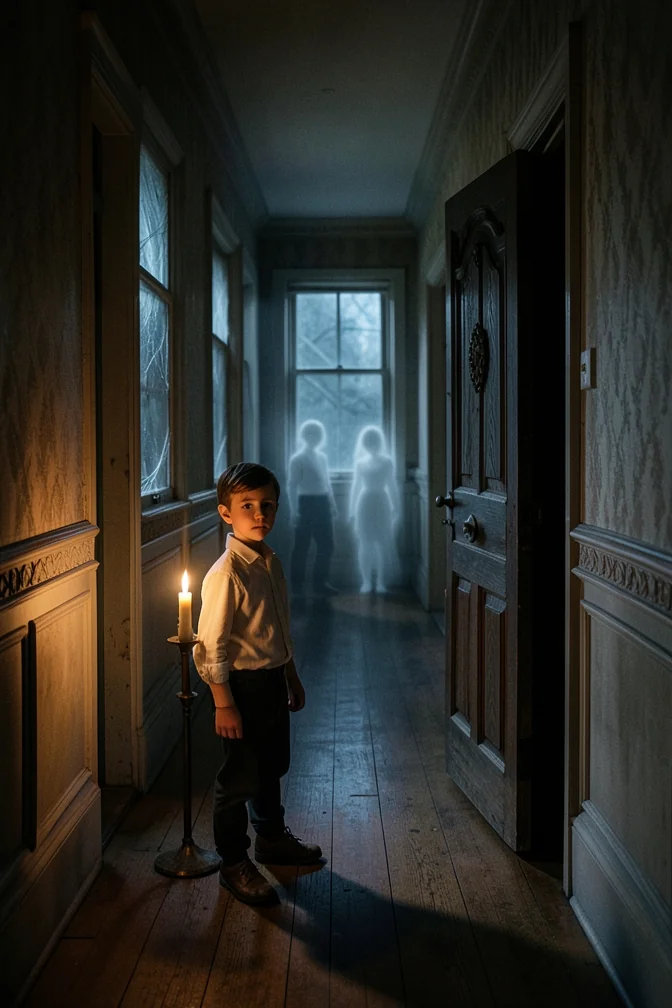
The wind had fallen, and there was a still night and a full moon. At about ten o’clock Stephen was standing at the open window of his bedroom, looking out over the country. Still as the night was, the mysterious population of the distant moon-lit woods was not yet lulled to rest. From time to time strange cries as of lost and despairing wanderers sounded from across the mere. They might be the notes of owls or water-birds, yet they did not quite resemble either sound. Were not they coming nearer? Now they sounded from the nearer side of the water, and in a few moments they seemed to be floating about among the shrubberies. Then they ceased; but just as Stephen was thinking of shutting the window and resuming his reading of Robinson Crusoe, he caught sight of two figures standing on the gravelled terrace that ran along the garden side of the Hall—the figures of a boy and girl, as it seemed; they stood side by side, looking up at the windows. Something in the form of the girl recalled irresistibly his dream of the figure in the bath. The boy inspired him with more acute fear.
Whilst the girl stood still, half smiling, with her hands clasped over her heart, the boy, a thin shape, with black hair and ragged clothing, raised his arms in the air with an appearance of menace and of unappeasable hunger and longing. The moon shone upon his almost transparent hands, and Stephen saw that the nails were fearfully long and that the light shone through them. As he stood with his arms thus raised, he disclosed a terrifying spectacle. On the left side of his chest there opened a black and gaping rent; and there fell upon Stephen’s brain, rather than upon his ear, the impression of one of those hungry and desolate cries that he had heard resounding over the woods of Aswarby all that evening. In another moment this dreadful pair had moved swiftly and noiselessly over the dry gravel, and he saw them no more.
Inexpressibly frightened as he was, he determined to take his candle and go down to Mr Abney’s study, for the hour appointed for their meeting was near at hand. The study or library opened out of the front-hall on one side, and Stephen, urged on by his terrors, did not take long in getting there. To effect an entrance was not so easy. It was not locked, he felt sure, for the key was on the outside of the door as usual. His repeated knocks produced no answer. Mr Abney was engaged: he was speaking. What! why did he try to cry out? and why was the cry choked in his throat? Had he, too, seen the mysterious children? But now everything was quiet, and the door yielded to Stephen’s terrified and frantic pushing.
On the table in Mr Abney’s study certain papers were found which explained the situation to Stephen Elliott when he was of an age to understand them. The most important sentences were as follows:
“It was a belief very strongly and generally held by the ancients—of whose wisdom in these matters I have had such experience as induces me to place confidence in their assertions—that by enacting certain processes, which to us moderns have something of a barbaric complexion, a very remarkable enlightenment of the spiritual faculties in man may be attained: that, for example, by absorbing the personalities of a certain number of his fellow-creatures, an individual may gain a complete ascendancy over those orders of spiritual beings which control the elemental forces of our universe.
“It is recorded of Simon Magus that he was able to fly in the air, to become invisible, or to assume any form he pleased, by the agency of the soul of a boy whom, to use the libellous phrase employed by the author of the Clementine Recognitions, he had ‘murdered’. I find it set down, moreover, with considerable detail in the writings of Hermes Trismegistus, that similar happy results may be produced by the absorption of the hearts of not less than three human beings below the age of twenty-one years. To the testing of the truth of this receipt I have devoted the greater part of the last twenty years, selecting as the corpora vilia of my experiment such persons as could conveniently be removed without occasioning a sensible gap in society. The first step I effected by the removal of one Phoebe Stanley, a girl of gipsy extraction, on March 24, 1792. The second, by the removal of a wandering Italian lad, named Giovanni Paoli, on the night of March 23, 1805. The final ‘victim’—to employ a word repugnant in the highest degree to my feelings—must be my cousin, Stephen Elliott. His day must be this March 24, 1812.
“The best means of effecting the required absorption is to remove the heart from the living subject, to reduce it to ashes, and to mingle them with about a pint of some red wine, preferably port. The remains of the first two subjects, at least, it will be well to conceal: a disused bathroom or wine-cellar will be found convenient for such a purpose. Some annoyance may be experienced from the psychic portion of the subjects, which popular language dignifies with the name of ghosts. But the man of philosophic temperament—to whom alone the experiment is appropriate—will be little prone to attach importance to the feeble efforts of these beings to wreak their vengeance on him. I contemplate with the liveliest satisfaction the enlarged and emancipated existence which the experiment, if successful, will confer on me; not only placing me beyond the reach of human justice (so-called), but eliminating to a great extent the prospect of death itself.”
Mr Abney was found in his chair, his head thrown back, his face stamped with an expression of rage, fright, and mortal pain. In his left side was a terrible lacerated wound, exposing the heart. There was no blood on his hands, and a long knife that lay on the table was perfectly clean. A savage wild-cat might have inflicted the injuries. The window of the study was open, and it was the opinion of the coroner that Mr Abney had met his death by the agency of some wild creature. But Stephen Elliott’s study of the papers I have quoted led him to a very different conclusion.
Source and edition terms: https://www.gutenberg.org/ebooks/8486 · Project Gutenberg License. Original-language text; original publisher illustrations are not reproduced.
Source acknowledgements and license
START: FULL LICENSE
THE FULL PROJECT GUTENBERG™ LICENSE
PLEASE READ THIS BEFORE YOU DISTRIBUTE OR USE THIS WORK
To protect the Project Gutenberg™ mission of promoting the free distribution of electronic works, by using or distributing this work (or any other work associated in any way with the phrase “Project Gutenberg”), you agree to comply with all the terms of the Full Project Gutenberg License available with this file or online at www.gutenberg.org/license.
Section 1. General Terms of Use and Redistributing Project Gutenberg electronic works
1.A. By reading or using any part of this Project Gutenberg electronic work, you indicate that you have read, understand, agree to and accept all the terms of this license and intellectual property (trademark/copyright) agreement. If you do not agree to abide by all the terms of this agreement, you must cease using and return or destroy all copies of Project Gutenberg electronic works in your possession. If you paid a fee for obtaining a copy of or access to a Project Gutenberg electronic work and you do not agree to be bound by the terms of this agreement, you may obtain a refund from the person or entity to whom you paid the fee as set forth in paragraph 1.E.8.
1.B. “Project Gutenberg” is a registered trademark. It may only be used on or associated in any way with an electronic work by people who agree to be bound by the terms of this agreement. There are a few things that you can do with most Project Gutenberg electronic works even without complying with the full terms of this agreement. See paragraph 1.C below. There are a lot of things you can do with Project Gutenberg electronic works if you follow the terms of this agreement and help preserve free future access to Project Gutenberg electronic works. See paragraph 1.E below.
1.C. The Project Gutenberg Literary Archive Foundation (“the Foundation” or PGLAF), owns a compilation copyright in the collection of Project Gutenberg electronic works. Nearly all the individual works in the collection are in the public domain in the United States. If an individual work is unprotected by copyright law in the United States and you are located in the United States, we do not claim a right to prevent you from copying, distributing, performing, displaying or creating derivative works based on the work as long as all references to Project Gutenberg are removed. Of course, we hope that you will support the Project Gutenberg mission of promoting free access to electronic works by freely sharing Project Gutenberg works in compliance with the terms of this agreement for keeping the Project Gutenberg name associated with the work. You can easily comply with the terms of this agreement by keeping this work in the same format with its attached full Project Gutenberg License when you share it without charge with others.
1.D. The copyright laws of the place where you are located also govern what you can do with this work. Copyright laws in most countries are in a constant state of change. If you are outside the United States, check the laws of your country in addition to the terms of this agreement before downloading, copying, displaying, performing, distributing or creating derivative works based on this work or any other Project Gutenberg work. The Foundation makes no representations concerning the copyright status of any work in any country other than the United States.
1.E. Unless you have removed all references to Project Gutenberg:
1.E.1. The following sentence, with active links to, or other immediate access to, the full Project Gutenberg License must appear prominently whenever any copy of a Project Gutenberg work (any work on which the phrase “Project Gutenberg” appears, or with which the phrase “Project Gutenberg” is associated) is accessed, displayed, performed, viewed, copied or distributed:
This eBook is for the use of anyone anywhere in the United States and most
other parts of the world at no cost and with almost no restrictions
whatsoever. You may copy it, give it away or re-use it under the terms
of the Project Gutenberg™ License included with this eBook or online
at www.gutenberg.org. If you
are not located in the United States, you will have to check the laws
of the country where you are located before using this eBook.
1.E.2. If an individual Project Gutenberg electronic work is derived from texts not protected by U.S. copyright law (does not contain a notice indicating that it is posted with permission of the copyright holder), the work can be copied and distributed to anyone in the United States without paying any fees or charges. If you are redistributing or providing access to a work with the phrase “Project Gutenberg” associated with or appearing on the work, you must comply either with the requirements of paragraphs 1.E.1 through 1.E.7 or obtain permission for the use of the work and the Project Gutenberg trademark as set forth in paragraphs 1.E.8 or 1.E.9.
1.E.3. If an individual Project Gutenberg electronic work is posted with the permission of the copyright holder, your use and distribution must comply with both paragraphs 1.E.1 through 1.E.7 and any additional terms imposed by the copyright holder. Additional terms will be linked to the Project Gutenberg License for all works posted with the permission of the copyright holder found at the beginning of this work.
1.E.4. Do not unlink or detach or remove the full Project Gutenberg License terms from this work, or any files containing a part of this work or any other work associated with Project Gutenberg.
1.E.5. Do not copy, display, perform, distribute or redistribute this electronic work, or any part of this electronic work, without prominently displaying the sentence set forth in paragraph 1.E.1 with active links or immediate access to the full terms of the Project Gutenberg License.
1.E.6. You may convert to and distribute this work in any binary, compressed, marked up, nonproprietary or proprietary form, including any word processing or hypertext form. However, if you provide access to or distribute copies of a Project Gutenberg work in a format other than “Plain Vanilla ASCII” or other format used in the official version posted on the official Project Gutenberg website (www.gutenberg.org), you must, at no additional cost, fee or expense to the user, provide a copy, a means of exporting a copy, or a means of obtaining a copy upon request, of the work in its original “Plain Vanilla ASCII” or other form. Any alternate format must include the full Project Gutenberg License as specified in paragraph 1.E.1.
1.E.7. Do not charge a fee for access to, viewing, displaying, performing, copying or distributing any Project Gutenberg works unless you comply with paragraph 1.E.8 or 1.E.9.
1.E.8. You may charge a reasonable fee for copies of or providing access to or distributing Project Gutenberg electronic works provided that:
• You pay a royalty fee of 20% of the gross profits you derive from
    the use of Project Gutenberg works calculated using the method
    you already use to calculate your applicable taxes. The fee is owed
    to the owner of the Project Gutenberg trademark, but he has
    agreed to donate royalties under this paragraph to the Project
    Gutenberg Literary Archive Foundation. Royalty payments must be paid
    within 60 days following each date on which you prepare (or are
    legally required to prepare) your periodic tax returns. Royalty
    payments should be clearly marked as such and sent to the Project
    Gutenberg Literary Archive Foundation at the address specified in
    Section 4, “Information about donations to the Project Gutenberg
    Literary Archive Foundation.”

• You provide a full refund of any money paid by a user who notifies
    you in writing (or by e-mail) within 30 days of receipt that s/he
    does not agree to the terms of the full Project Gutenberg™
    License. You must require such a user to return or destroy all
    copies of the works possessed in a physical medium and discontinue
    all use of and all access to other copies of Project Gutenberg™
    works.

• You provide, in accordance with paragraph 1.F.3, a full refund of
    any money paid for a work or a replacement copy, if a defect in the
    electronic work is discovered and reported to you within 90 days of
    receipt of the work.

• You comply with all other terms of this agreement for free
    distribution of Project Gutenberg™ works.
1.E.9. If you wish to charge a fee or distribute a Project Gutenberg™ electronic work or group of works on different terms than are set forth in this agreement, you must obtain permission in writing from the Project Gutenberg Literary Archive Foundation, the manager of the Project Gutenberg™ trademark. Contact the Foundation as set forth in Section 3 below.
1.F.
1.F.1. Project Gutenberg volunteers and employees expend considerable effort to identify, do copyright research on, transcribe and proofread works not protected by U.S. copyright law in creating the Project Gutenberg™ collection. Despite these efforts, Project Gutenberg™ electronic works, and the medium on which they may be stored, may contain “Defects,” such as, but not limited to, incomplete, inaccurate or corrupt data, transcription errors, a copyright or other intellectual property infringement, a defective or damaged disk or other medium, a computer virus, or computer codes that damage or cannot be read by your equipment.
1.F.2. LIMITED WARRANTY, DISCLAIMER OF DAMAGES - Except for the “Right of Replacement or Refund” described in paragraph 1.F.3, the Project Gutenberg Literary Archive Foundation, the owner of the Project Gutenberg™ trademark, and any other party distributing a Project Gutenberg™ electronic work under this agreement, disclaim all liability to you for damages, costs and expenses, including legal fees. YOU AGREE THAT YOU HAVE NO REMEDIES FOR NEGLIGENCE, STRICT LIABILITY, BREACH OF WARRANTY OR BREACH OF CONTRACT EXCEPT THOSE PROVIDED IN PARAGRAPH 1.F.3. YOU AGREE THAT THE FOUNDATION, THE TRADEMARK OWNER, AND ANY DISTRIBUTOR UNDER THIS AGREEMENT WILL NOT BE LIABLE TO YOU FOR ACTUAL, DIRECT, INDIRECT, CONSEQUENTIAL, PUNITIVE OR INCIDENTAL DAMAGES EVEN IF YOU GIVE NOTICE OF THE POSSIBILITY OF SUCH DAMAGE.
1.F.3. LIMITED RIGHT OF REPLACEMENT OR REFUND - If you discover a defect in this electronic work within 90 days of receiving it, you can receive a refund of the money (if any) you paid for it by sending a written explanation to the person you received the work from. If you received the work on a physical medium, you must return the medium with your written explanation. The person or entity that provided you with the defective work may elect to provide a replacement copy in lieu of a refund. If you received the work electronically, the person or entity providing it to you may choose to give you a second opportunity to receive the work electronically in lieu of a refund. If the second copy is also defective, you may demand a refund in writing without further opportunities to fix the problem.
1.F.4. Except for the limited right of replacement or refund set forth in paragraph 1.F.3, this work is provided to you ‘AS-IS’, WITH NO OTHER WARRANTIES OF ANY KIND, EXPRESS OR IMPLIED, INCLUDING BUT NOT LIMITED TO WARRANTIES OF MERCHANTABILITY OR FITNESS FOR ANY PURPOSE.
1.F.5. Some states do not allow disclaimers of certain implied warranties or the exclusion or limitation of certain types of damages. If any disclaimer or limitation set forth in this agreement violates the law of the state applicable to this agreement, the agreement shall be interpreted to make the maximum disclaimer or limitation permitted by the applicable state law. The invalidity or unenforceability of any provision of this agreement shall not void the remaining provisions.
1.F.6. INDEMNITY - You agree to indemnify and hold the Foundation, the trademark owner, any agent or employee of the Foundation, anyone providing copies of Project Gutenberg™ electronic works in accordance with this agreement, and any volunteers associated with the production, promotion and distribution of Project Gutenberg™ electronic works, harmless from all liability, costs and expenses, including legal fees, that arise directly or indirectly from any of the following which you do or cause to occur: (a) distribution of this or any Project Gutenberg work, (b) alteration, modification, or additions or deletions to any Project Gutenberg work, and (c) any Defect you cause.
Section 2. Information about the Mission of Project Gutenberg
Project Gutenberg is synonymous with the free distribution of electronic works in formats readable by the widest variety of computers including obsolete, old, middle-aged and new computers. It exists because of the efforts of hundreds of volunteers and donations from people in all walks of life.
Volunteers and financial support to provide volunteers with the assistance they need are critical to reaching Project Gutenberg’s goals and ensuring that the Project Gutenberg collection will remain freely available for generations to come. In 2001, the Project Gutenberg Literary Archive Foundation was created to provide a secure and permanent future for Project Gutenberg and future generations. To learn more about the Project Gutenberg Literary Archive Foundation and how your efforts and donations can help, see Sections 3 and 4 and the Foundation information page at www.gutenberg.org.
Section 3. Information about the Project Gutenberg Literary Archive Foundation
The Project Gutenberg Literary Archive Foundation is a non-profit 501(c)(3) educational corporation organized under the laws of the state of Mississippi and granted tax exempt status by the Internal Revenue Service. The Foundation’s EIN or federal tax identification number is 64-6221541. Contributions to the Project Gutenberg Literary Archive Foundation are tax deductible to the full extent permitted by U.S. federal laws and your state’s laws.
The Foundation’s business office is located at 41 Watchung Plaza #516, Montclair NJ 07042, USA, +1 (862) 621-9288. Email contact links and up to date contact information can be found at the Foundation’s website and official page at www.gutenberg.org/contact
Section 4. Information about Donations to the Project Gutenberg Literary Archive Foundation
Project Gutenberg™ depends upon and cannot survive without widespread public support and donations to carry out its mission of increasing the number of public domain and licensed works that can be freely distributed in machine-readable form accessible by the widest array of equipment including outdated equipment. Many small donations ($1 to $5,000) are particularly important to maintaining tax exempt status with the IRS.
The Foundation is committed to complying with the laws regulating charities and charitable donations in all 50 states of the United States. Compliance requirements are not uniform and it takes a considerable effort, much paperwork and many fees to meet and keep up with these requirements. We do not solicit donations in locations where we have not received written confirmation of compliance. To SEND DONATIONS or determine the status of compliance for any particular state visit www.gutenberg.org/donate.
While we cannot and do not solicit contributions from states where we have not met the solicitation requirements, we know of no prohibition against accepting unsolicited donations from donors in such states who approach us with offers to donate.
International donations are gratefully accepted, but we cannot make any statements concerning tax treatment of donations received from outside the United States. U.S. laws alone swamp our small staff.
Please check the Project Gutenberg web pages for current donation methods and addresses. Donations are accepted in a number of other ways including checks, online payments and credit card donations. To donate, please visit: www.gutenberg.org/donate.
Section 5. General Information About Project Gutenberg electronic works
Professor Michael S. Hart was the originator of the Project Gutenberg concept of a library of electronic works that could be freely shared with anyone. For forty years, he produced and distributed Project Gutenberg eBooks with only a loose network of volunteer support.
Project Gutenberg eBooks are often created from several printed editions, all of which are confirmed as not protected by copyright in the U.S. unless a copyright notice is included. Thus, we do not necessarily keep eBooks in compliance with any particular paper edition.
Most people start at our website which has the main PG search facility: www.gutenberg.org.
This website includes information about Project Gutenberg, including how to make donations to the Project Gutenberg Literary Archive Foundation, how to help produce our new eBooks, and how to subscribe to our email newsletter to hear about new eBooks.


