
Number 13
Read Number 13 by M. R. James in the original English.
By M. R. James
Edition: Complete story in the original English, from Project Gutenberg #8486. No translation or AI rewriting of the literary text. Original spelling retained.
This eBook is for the use of anyone anywhere in the United States and most other parts of the world at no cost and with almost no restrictions whatsoever. You may copy it, give it away or re-use it under the terms of the Project Gutenberg License included with this eBook or online at www.gutenberg.org. If you are not located in the United States, you will have to check the laws of the country where you are located before using this eBook.
Among the towns of Jutland, Viborg justly holds a high place. It is the seat of a bishopric; it has a handsome but almost entirely new cathedral, a charming garden, a lake of great beauty, and many storks. Near it is Hald, accounted one of the prettiest things in Denmark; and hard by is Finderup, where Marsk Stig murdered King Erik Glipping on St Cecilia’s Day, in the year 1286. Fifty-six blows of square-headed iron maces were traced on Erik’s skull when his tomb was opened in the seventeenth century. But I am not writing a guide-book.
There are good hotels in Viborg—Preisler’s and the Phœnix are all that can be desired. But my cousin, whose experiences I have to tell you now, went to the Golden Lion the first time that he visited Viborg. He has not been there since, and the following pages will, perhaps, explain the reason of his abstention.
The Golden Lion is one of the very few houses in the town that were not destroyed in the great fire of 1726, which practically demolished the cathedral, the Sognekirke, the Raadhuus, and so much else that was old and interesting. It is a great red-brick house—that is, the front is of brick, with corbie steps on the gables and a text over the door; but the courtyard into which the omnibus drives is of black and white wood and plaster.
The sun was declining in the heavens when my cousin walked up to the door, and the light smote full upon the imposing façade of the house. He was delighted with the old-fashioned aspect of the place, and promised himself a thoroughly satisfactory and amusing stay in an inn so typical of old Jutland.
It was not business in the ordinary sense of the word that had brought Mr Anderson to Viborg. He was engaged upon some researches into the Church history of Denmark, and it had come to his knowledge that in the Rigsarkiv of Viborg there were papers, saved from the fire, relating to the last days of Roman Catholicism in the country. He proposed, therefore, to spend a considerable time—perhaps as much as a fortnight or three weeks—in examining and copying these, and he hoped that the Golden Lion would be able to give him a room of sufficient size to serve alike as a bedroom and a study. His wishes were explained to the landlord, and, after a certain amount of thought, the latter suggested that perhaps it might be the best way for the gentleman to look at one or two of the larger rooms and pick one for himself. It seemed a good idea.
The top floor was soon rejected as entailing too much getting upstairs after the day’s work; the second floor contained no room of exactly the dimensions required; but on the first floor there was a choice of two or three rooms which would, so far as size went, suit admirably.
The landlord was strongly in favour of Number 17, but Mr Anderson pointed out that its windows commanded only the blank wall of the next house, and that it would be very dark in the afternoon. Either Number 12 or Number 14 would be better, for both of them looked on the street, and the bright evening light and the pretty view would more than compensate him for the additional amount of noise.
Eventually Number 12 was selected. Like its neighbours, it had three windows, all on one side of the room; it was fairly high and unusually long. There was, of course, no fireplace, but the stove was handsome and rather old—a cast-iron erection, on the side of which was a representation of Abraham sacrificing Isaac, and the inscription, “1 Bog Mose, Cap. 22,” above. Nothing else in the room was remarkable; the only interesting picture was an old coloured print of the town, date about 1820.
Supper-time was approaching, but when Anderson, refreshed by the ordinary ablutions, descended the staircase, there were still a few minutes before the bell rang. He devoted them to examining the list of his fellow-lodgers. As is usual in Denmark, their names were displayed on a large blackboard, divided into columns and lines, the numbers of the rooms being painted in at the beginning of each line. The list was not exciting. There was an advocate, or Sagförer, a German, and some bagmen from Copenhagen. The one and only point which suggested any food for thought was the absence of any Number 13 from the tale of the rooms, and even this was a thing which Anderson had already noticed half a dozen times in his experience of Danish hotels. He could not help wondering whether the objection to that particular number, common as it is, was so widespread and so strong as to make it difficult to let a room so ticketed, and he resolved to ask the landlord if he and his colleagues in the profession had actually met with many clients who refused to be accommodated in the thirteenth room.
He had nothing to tell me (I am giving the story as I heard it from him) about what passed at supper, and the evening, which was spent in unpacking and arranging his clothes, books, and papers, was not more eventful. Towards eleven o’clock he resolved to go to bed, but with him, as with a good many other people nowadays, an almost necessary preliminary to bed, if he meant to sleep, was the reading of a few pages of print, and he now remembered that the particular book which he had been reading in the train, and which alone would satisfy him at that present moment, was in the pocket of his great-coat, then hanging on a peg outside the dining-room.
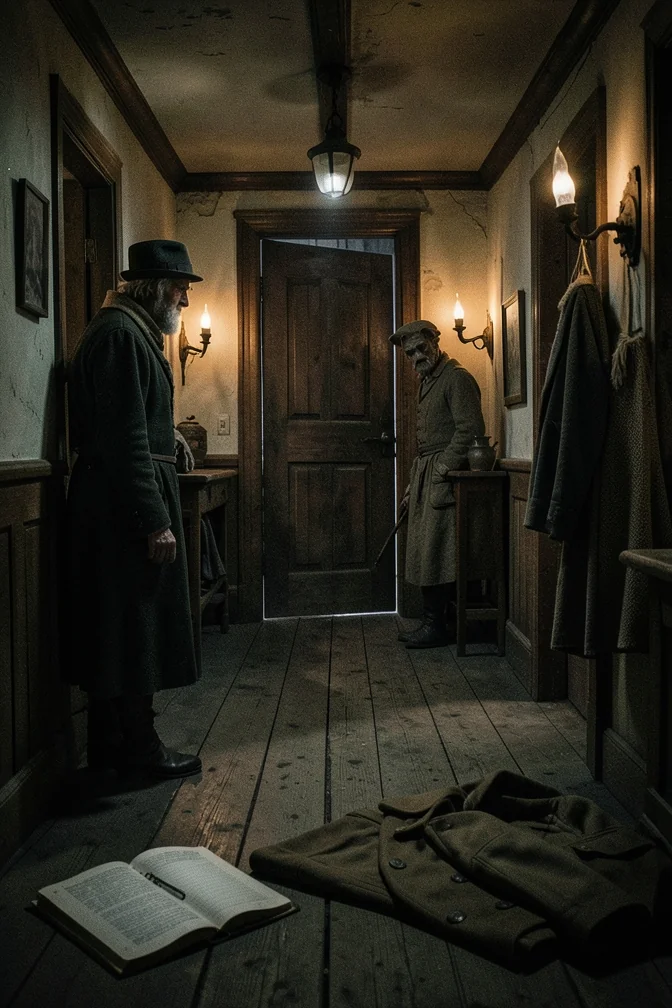
To run down and secure it was the work of a moment, and, as the passages were by no means dark, it was not difficult for him to find his way back to his own door. So, at least, he thought; but when he arrived there, and turned the handle, the door entirely refused to open, and he caught the sound of a hasty movement towards it from within. He had tried the wrong door, of course. Was his own room to the right or to the left? He glanced at the number: it was 13. His room would be on the left; and so it was. And not before he had been in bed for some minutes, had read his wonted three or four pages of his book, blown out his light, and turned over to go to sleep, did it occur to him that, whereas on the blackboard of the hotel there had been no Number 13, there was undoubtedly a room numbered 13 in the hotel. He felt rather sorry he had not chosen it for his own. Perhaps he might have done the landlord a little service by occupying it, and given him the chance of saying that a well-born English gentleman had lived in it for three weeks and liked it very much. But probably it was used as a servant’s room or something of the kind. After all, it was most likely not so large or good a room as his own. And he looked drowsily about the room, which was fairly perceptible in the half-light from the street-lamp. It was a curious effect, he thought. Rooms usually look larger in a dim light than a full one, but this seemed to have contracted in length and grown proportionately higher. Well, well! sleep was more important than these vague ruminations—and to sleep he went.
On the day after his arrival Anderson attacked the Rigsarkiv of Viborg. He was, as one might expect in Denmark, kindly received, and access to all that he wished to see was made as easy for him as possible. The documents laid before him were far more numerous and interesting than he had at all anticipated. Besides official papers, there was a large bundle of correspondence relating to Bishop Jörgen Friis, the last Roman Catholic who held the see, and in these there cropped up many amusing and what are called “intimate” details of private life and individual character. There was much talk of a house owned by the Bishop, but not inhabited by him, in the town. Its tenant was apparently somewhat of a scandal and a stumbling-block to the reforming party. He was a disgrace, they wrote, to the city; he practised secret and wicked arts, and had sold his soul to the enemy. It was of a piece with the gross corruption and superstition of the Babylonish Church that such a viper and blood-sucking Troldmand should be patronized and harboured by the Bishop. The Bishop met these reproaches boldly; he protested his own abhorrence of all such things as secret arts, and required his antagonists to bring the matter before the proper court—of course, the spiritual court—and sift it to the bottom. No one could be more ready and willing than himself to condemn Mag Nicolas Francken if the evidence showed him to have been guilty of any of the crimes informally alleged against him.
Anderson had not time to do more than glance at the next letter of the Protestant leader, Rasmus Nielsen, before the record office was closed for the day, but he gathered its general tenor, which was to the effect that Christian men were now no longer bound by the decisions of Bishops of Rome, and that the Bishop’s Court was not, and could not be, a fit or competent tribunal to judge so grave and weighty a cause.
On leaving the office, Mr Anderson was accompanied by the old gentleman who presided over it, and, as they walked, the conversation very naturally turned to the papers of which I have just been speaking.
Herr Scavenius, the Archivist of Viborg, though very well informed as to the general run of the documents under his charge, was not a specialist in those of the Reformation period. He was much interested in what Anderson had to tell him about them. He looked forward with great pleasure, he said, to seeing the publication in which Mr Anderson spoke of embodying their contents. “This house of the Bishop Friis,” he added, “it is a great puzzle to me where it can have stood. I have studied carefully the topography of old Viborg, but it is most unlucky—of the old terrier of the Bishop’s property which was made in 1560, and of which we have the greater part in the Arkiv, just the piece which had the list of the town property is missing. Never mind. Perhaps I shall some day succeed to find him.”
After taking some exercise—I forget exactly how or where—Anderson went back to the Golden Lion, his supper, his game of patience, and his bed. On the way to his room it occurred to him that he had forgotten to talk to the landlord about the omission of Number 13 from the hotel board, and also that he might as well make sure that Number 13 did actually exist before he made any reference to the matter.
The decision was not difficult to arrive at. There was the door with its number as plain as could be, and work of some kind was evidently going on inside it, for as he neared the door he could hear footsteps and voices, or a voice, within. During the few seconds in which he halted to make sure of the number, the footsteps ceased, seemingly very near the door, and he was a little startled at hearing a quick hissing breathing as of a person in strong excitement. He went on to his own room, and again he was surprised to find how much smaller it seemed now than it had when he selected it. It was a slight disappointment, but only slight. If he found it really not large enough, he could very easily shift to another. In the meantime he wanted something—as far as I remember it was a pocket-handkerchief—out of his portmanteau, which had been placed by the porter on a very inadequate trestle or stool against the wall at the farthest end of the room from his bed. Here was a very curious thing: the portmanteau was not to be seen. It had been moved by officious servants; doubtless the contents had been put in the wardrobe. No, none of them were there. This was vexatious. The idea of a theft he dismissed at once. Such things rarely happen in Denmark, but some piece of stupidity had certainly been performed (which is not so uncommon), and the stuepige must be severely spoken to. Whatever it was that he wanted, it was not so necessary to his comfort that he could not wait till the morning for it, and he therefore settled not to ring the bell and disturb the servants. He went to the window—the right-hand window it was—and looked out on the quiet street. There was a tall building opposite, with large spaces of dead wall; no passers-by; a dark night; and very little to be seen of any kind.
The light was behind him, and he could see his own shadow clearly cast on the wall opposite. Also the shadow of the bearded man in Number 11 on the left, who passed to and fro in shirtsleeves once or twice, and was seen first brushing his hair, and later on in a nightgown. Also the shadow of the occupant of Number 13 on the right. This might be more interesting. Number 13 was, like himself, leaning on his elbows on the window-sill looking out into the street. He seemed to be a tall thin man—or was it by any chance a woman?—at least, it was someone who covered his or her head with some kind of drapery before going to bed, and, he thought, must be possessed of a red lamp-shade—and the lamp must be flickering very much. There was a distinct playing up and down of a dull red light on the opposite wall. He craned out a little to see if he could make any more of the figure, but beyond a fold of some light, perhaps white, material on the window-sill he could see nothing.
Now came a distant step in the street, and its approach seemed to recall Number 13 to a sense of his exposed position, for very swiftly and suddenly he swept aside from the window, and his red light went out. Anderson, who had been smoking a cigarette, laid the end of it on the window-sill and went to bed.
Next morning he was woken by the stuepige with hot water, etc. He roused himself, and after thinking out the correct Danish words, said as distinctly as he could:
“You must not move my portmanteau. Where is it?”
As is not uncommon, the maid laughed, and went away without making any distinct answer.
Anderson, rather irritated, sat up in bed, intending to call her back, but he remained sitting up, staring straight in front of him. There was his portmanteau on its trestle, exactly where he had seen the porter put it when he first arrived. This was a rude shock for a man who prided himself on his accuracy of observation. How it could possibly have escaped him the night before he did not pretend to understand; at any rate, there it was now.
The daylight showed more than the portmanteau; it let the true proportions of the room with its three windows appear, and satisfied its tenant that his choice after all had not been a bad one. When he was almost dressed he walked to the middle one of the three windows to look out at the weather. Another shock awaited him. Strangely unobservant he must have been last night. He could have sworn ten times over that he had been smoking at the right-hand window the last thing before he went to bed, and here was his cigarette-end on the sill of the middle window.
He started to go down to breakfast. Rather late, but Number 13 was later: here were his boots still outside his door—a gentleman’s boots. So then Number 13 was a man, not a woman. Just then he caught sight of the number on the door. It was 14. He thought he must have passed Number 13 without noticing it. Three stupid mistakes in twelve hours were too much for a methodical, accurate-minded man, so he turned back to make sure. The next number to 14 was number 12, his own room. There was no Number 13 at all.
After some minutes devoted to a careful consideration of everything he had had to eat and drink during the last twenty-four hours, Anderson decided to give the question up. If his eyes or his brain were giving way he would have plenty of opportunities for ascertaining that fact; if not, then he was evidently being treated to a very interesting experience. In either case the development of events would certainly be worth watching.
During the day he continued his examination of the episcopal correspondence which I have already summarized. To his disappointment, it was incomplete. Only one other letter could be found which referred to the affair of Mag Nicolas Francken. It was from the Bishop Jörgen Friis to Rasmus Nielsen. He said:
“Although we are not in the least degree inclined to assent to your judgement concerning our court, and shall be prepared if need be to withstand you to the uttermost in that behalf, yet forasmuch as our trusty and well-beloved Mag Nicolas Francken, against whom you have dared to allege certain false and malicious charges, hath been suddenly removed from among us, it is apparent that the question for this time falls. But forasmuch as you further allege that the Apostle and Evangelist St John in his heavenly Apocalypse describes the Holy Roman Church under the guise and symbol of the Scarlet Woman, be it known to you,” etc.
Search as he might, Anderson could find no sequel to this letter nor any clue to the cause or manner of the “removal” of the casus belli. He could only suppose that Francken had died suddenly; and as there were only two days between the date of Nielsen’s last letter—when Francken was evidently still in being—and that of the Bishop’s letter, the death must have been completely unexpected.
In the afternoon he paid a short visit to Hald, and took his tea at Baekkelund; nor could he notice, though he was in a somewhat nervous frame of mind, that there was any indication of such a failure of eye or brain as his experiences of the morning had led him to fear.
At supper he found himself next to the landlord.
“What,” he asked him, after some indifferent conversation, “is the reason why in most of the hotels one visits in this country the number thirteen is left out of the list of rooms? I see you have none here.”
The landlord seemed amused.
“To think that you should have noticed a thing like that! I’ve thought about it once or twice myself, to tell the truth. An educated man, I’ve said, has no business with these superstitious notions. I was brought up myself here in the high school of Viborg, and our old master was always a man to set his face against anything of that kind. He’s been dead now this many years—a fine upstanding man he was, and ready with his hands as well as his head. I recollect us boys, one snowy day—”
Here he plunged into reminiscence.
“Then you don’t think there is any particular objection to having a Number 13?” said Anderson.
“Ah! to be sure. Well, you understand, I was brought up to the business by my poor old father. He kept an hotel in Aarhuus first, and then, when we were born, he moved to Viborg here, which was his native place, and had the Phœnix here until he died. That was in 1876. Then I started business in Silkeborg, and only the year before last I moved into this house.”
Then followed more details as to the state of the house and business when first taken over.
“And when you came here, was there a Number 13?”
“No, no. I was going to tell you about that. You see, in a place like this, the commercial class—the travellers—are what we have to provide for in general. And put them in Number 13? Why, they’d as soon sleep in the street, or sooner. As far as I’m concerned myself, it wouldn’t make a penny difference to me what the number of my room was, and so I’ve often said to them; but they stick to it that it brings them bad luck. Quantities of stories they have among them of men that have slept in a Number 13 and never been the same again, or lost their best customers, or—one thing and another,” said the landlord, after searching for a more graphic phrase.
“Then, what do you use your Number 13 for?” said Anderson, conscious as he said the words of a curious anxiety quite disproportionate to the importance of the question.
“My Number 13? Why, don’t I tell you that there isn’t such a thing in the house? I thought you might have noticed that. If there was it would be next door to your own room.”
“Well, yes; only I happened to think—that is, I fancied last night that I had seen a door numbered thirteen in that passage; and, really, I am almost certain I must have been right, for I saw it the night before as well.”
Of course, Herr Kristensen laughed this notion to scorn, as Anderson had expected, and emphasized with much iteration the fact that no Number 13 existed or had existed before him in that hotel.
Anderson was in some ways relieved by his certainty, but still puzzled, and he began to think that the best way to make sure whether he had indeed been subject to an illusion or not was to invite the landlord to his room to smoke a cigar later on in the evening. Some photographs of English towns which he had with him formed a sufficiently good excuse.
Herr Kristensen was flattered by the invitation, and most willingly accepted it. At about ten o’clock he was to make his appearance, but before that Anderson had some letters to write, and retired for the purpose of writing them. He almost blushed to himself at confessing it, but he could not deny that it was the fact that he was becoming quite nervous about the question of the existence of Number 13; so much so that he approached his room by way of Number 11, in order that he might not be obliged to pass the door, or the place where the door ought to be. He looked quickly and suspiciously about the room when he entered it, but there was nothing, beyond that indefinable air of being smaller than usual, to warrant any misgivings. There was no question of the presence or absence of his portmanteau tonight. He had himself emptied it of its contents and lodged it under his bed. With a certain effort he dismissed the thought of Number 13 from his mind, and sat down to his writing.
His neighbours were quiet enough. Occasionally a door opened in the passage and a pair of boots was thrown out, or a bagman walked past humming to himself, and outside, from time to time, a cart thundered over the atrocious cobble-stones, or a quick step hurried along the flags.
Anderson finished his letters, ordered in whisky and soda, and then went to the window and studied the dead wall opposite and the shadows upon it.
As far as he could remember, Number 14 had been occupied by the lawyer, a staid man, who said little at meals, being generally engaged in studying a small bundle of papers beside his plate. Apparently, however, he was in the habit of giving vent to his animal spirits when alone. Why else should he be dancing? The shadow from the next room evidently showed that he was. Again and again his thin form crossed the window, his arms waved, and a gaunt leg was kicked up with surprising agility. He seemed to be barefooted, and the floor must be well laid, for no sound betrayed his movements. Sagförer Herr Anders Jensen, dancing at ten o’clock at night in a hotel bedroom, seemed a fitting subject for a historical painting in the grand style; and Anderson’s thoughts, like those of Emily in the “Mysteries of Udolpho”, began to “arrange themselves in the following lines”:
“When I return to my hotel, At ten o’clock p.m., The waiters think I am unwell; I do not care for them. But when I’ve locked my chamber door, And put my boots outside, I dance all night upon the floor. And even if my neighbours swore, I’d go on dancing all the more, For I’m acquainted with the law, And in despite of all their jaw, Their protests I deride.”
Had not the landlord at this moment knocked at the door, it is probable that quite a long poem might have been laid before the reader. To judge from his look of surprise when he found himself in the room, Herr Kristensen was struck, as Anderson had been, by something unusual in its aspect. But he made no remark. Anderson’s photographs interested him mightily, and formed the text of many autobiographical discourses. Nor is it quite clear how the conversation could have been diverted into the desired channel of Number 13, had not the lawyer at this moment begun to sing, and to sing in a manner which could leave no doubt in anyone’s mind that he was either exceedingly drunk or raving mad. It was a high, thin voice that they heard, and it seemed dry, as if from long disuse. Of words or tune there was no question. It went sailing up to a surprising height, and was carried down with a despairing moan as of a winter wind in a hollow chimney, or an organ whose wind fails suddenly. It was a really horrible sound, and Anderson felt that if he had been alone he must have fled for refuge and society to some neighbour bagman’s room.
The landlord sat open-mouthed.
“I don’t understand it,” he said at last, wiping his forehead. “It is dreadful. I have heard it once before, but I made sure it was a cat.”
“Is he mad?” said Anderson.
“He must be; and what a sad thing! Such a good customer, too, and so successful in his business, by what I hear, and a young family to bring up.”
Just then came an impatient knock at the door, and the knocker entered, without waiting to be asked. It was the lawyer, in déshabille and very rough-haired; and very angry he looked.
“I beg pardon, sir,” he said, “but I should be much obliged if you would kindly desist—”
Here he stopped, for it was evident that neither of the persons before him was responsible for the disturbance; and after a moment’s lull it swelled forth again more wildly than before.
“But what in the name of Heaven does it mean?” broke out the lawyer. “Where is it? Who is it? Am I going out of my mind?”
“Surely, Herr Jensen, it comes from your room next door? Isn’t there a cat or something stuck in the chimney?”
This was the best that occurred to Anderson to say, and he realized its futility as he spoke; but anything was better than to stand and listen to that horrible voice, and look at the broad, white face of the landlord, all perspiring and quivering as he clutched the arms of his chair.
“Impossible,” said the lawyer, “impossible. There is no chimney. I came here because I was convinced the noise was going on here. It was certainly in the next room to mine.”
“Was there no door between yours and mine?” said Anderson eagerly.
“No, sir,” said Herr Jensen, rather sharply. “At least, not this morning.”
“Ah!” said Anderson. “Nor tonight?”
“I am not sure,” said the lawyer with some hesitation.
Suddenly the crying or singing voice in the next room died away, and the singer was heard seemingly to laugh to himself in a crooning manner. The three men actually shivered at the sound. Then there was a silence.
“Come,” said the lawyer, “what have you to say, Herr Kristensen? What does this mean?”
“Good Heaven!” said Kristensen. “How should I tell! I know no more than you, gentlemen. I pray I may never hear such a noise again.”
“So do I,” said Herr Jensen, and he added something under his breath. Anderson thought it sounded like the last words of the Psalter, “omnis spiritus laudet Dominum,” but he could not be sure.
“But we must do something,” said Anderson—“the three of us. Shall we go and investigate in the next room?”
“But that is Herr Jensen’s room,” wailed the landlord. “It is no use; he has come from there himself.”
“I am not so sure,” said Jensen. “I think this gentleman is right: we must go and see.”
The only weapons of defence that could be mustered on the spot were a stick and umbrella. The expedition went out into the passage, not without quakings. There was a deadly quiet outside, but a light shone from under the next door. Anderson and Jensen approached it. The latter turned the handle, and gave a sudden vigorous push. No use. The door stood fast.
“Herr Kristensen,” said Jensen, “will you go and fetch the strongest servant you have in the place? We must see this through.”
The landlord nodded, and hurried off, glad to be away from the scene of action. Jensen and Anderson remained outside looking at the door.
“It is Number 13, you see,” said the latter.
“Yes; there is your door, and there is mine,” said Jensen.
“My room has three windows in the daytime,” said Anderson, with difficulty suppressing a nervous laugh.
“By George, so has mine!” said the lawyer, turning and looking at Anderson. His back was now to the door. In that moment the door opened, and an arm came out and clawed at his shoulder. It was clad in ragged, yellowish linen, and the bare skin, where it could be seen, had long grey hair upon it.
Anderson was just in time to pull Jensen out of its reach with a cry of disgust and fright, when the door shut again, and a low laugh was heard.
Jensen had seen nothing, but when Anderson hurriedly told him what a risk he had run, he fell into a great state of agitation, and suggested that they should retire from the enterprise and lock themselves up in one or other of their rooms.
However, while he was developing this plan, the landlord and two able-bodied men arrived on the scene, all looking rather serious and alarmed. Jensen met them with a torrent of description and explanation, which did not at all tend to encourage them for the fray.
The men dropped the crowbars they had brought, and said flatly that they were not going to risk their throats in that devil’s den. The landlord was miserably nervous and undecided, conscious that if the danger were not faced his hotel was ruined, and very loth to face it himself. Luckily Anderson hit upon a way of rallying the demoralized force.
“Is this,” he said, “the Danish courage I have heard so much of? It isn’t a German in there, and if it was, we are five to one.”
The two servants and Jensen were stung into action by this, and made a dash at the door.
“Stop!” said Anderson. “Don’t lose your heads. You stay out here with the light, landlord, and one of you two men break in the door, and don’t go in when it gives way.”
The men nodded, and the younger stepped forward, raised his crowbar, and dealt a tremendous blow on the upper panel. The result was not in the least what any of them anticipated. There was no cracking or rending of wood—only a dull sound, as if the solid wall had been struck. The man dropped his tool with a shout, and began rubbing his elbow. His cry drew their eyes upon him for a moment; then Anderson looked at the door again. It was gone; the plaster wall of the passage stared him in the face, with a considerable gash in it where the crowbar had struck it. Number 13 had passed out of existence.
For a brief space they stood perfectly still, gazing at the blank wall. An early cock in the yard beneath was heard to crow; and as Anderson glanced in the direction of the sound, he saw through the window at the end of the long passage that the eastern sky was paling to the dawn.
“Perhaps,” said the landlord, with hesitation, “you gentlemen would like another room for tonight—a double-bedded one?”
Neither Jensen nor Anderson was averse to the suggestion. They felt inclined to hunt in couples after their late experience. It was found convenient, when each of them went to his room to collect the articles he wanted for the night, that the other should go with him and hold the candle. They noticed that both Number 12 and Number 14 had three windows.
Next morning the same party reassembled in Number 12. The landlord was naturally anxious to avoid engaging outside help, and yet it was imperative that the mystery attaching to that part of the house should be cleared up. Accordingly the two servants had been induced to take upon them the function of carpenters. The furniture was cleared away, and, at the cost of a good many irretrievably damaged planks, that portion of the floor was taken up which lay nearest to Number 14.
You will naturally suppose that a skeleton—say that of Mag Nicolas Francken—was discovered. That was not so. What they did find lying between the beams which supported the flooring was a small copper box. In it was a neatly-folded vellum document, with about twenty lines of writing. Both Anderson and Jensen (who proved to be something of a palæographer) were much excited by this discovery, which promised to afford the key to these extraordinary phenomena.
I possess a copy of an astrological work which I have never read. It has, by way of frontispiece, a woodcut by Hans Sebald Beham, representing a number of sages seated round a table. This detail may enable connoisseurs to identify the book. I cannot myself recollect its title, and it is not at this moment within reach; but the fly-leaves of it are covered with writing, and, during the ten years in which I have owned the volume, I have not been able to determine which way up this writing ought to be read, much less in what language it is. Not dissimilar was the position of Anderson and Jensen after the protracted examination to which they submitted the document in the copper box.
After two days’ contemplation of it, Jensen, who was the bolder spirit of the two, hazarded the conjecture that the language was either Latin or Old Danish.
Anderson ventured upon no surmises, and was very willing to surrender the box and the parchment to the Historical Society of Viborg to be placed in their museum.
I had the whole story from him a few months later, as we sat in a wood near Upsala, after a visit to the library there, where we—or, rather, I—had laughed over the contract by which Daniel Salthenius (in later life Professor of Hebrew at Königsberg) sold himself to Satan. Anderson was not really amused.
“Young idiot!” he said, meaning Salthenius, who was only an undergraduate when he committed that indiscretion, “how did he know what company he was courting?”
And when I suggested the usual considerations he only grunted. That same afternoon he told me what you have read; but he refused to draw any inferences from it, and to assent to any that I drew for him.
Source and edition terms: https://www.gutenberg.org/ebooks/8486 · Project Gutenberg License. Original-language text; original publisher illustrations are not reproduced.
Source acknowledgements and license
START: FULL LICENSE
THE FULL PROJECT GUTENBERG™ LICENSE
PLEASE READ THIS BEFORE YOU DISTRIBUTE OR USE THIS WORK
To protect the Project Gutenberg™ mission of promoting the free distribution of electronic works, by using or distributing this work (or any other work associated in any way with the phrase “Project Gutenberg”), you agree to comply with all the terms of the Full Project Gutenberg License available with this file or online at www.gutenberg.org/license.
Section 1. General Terms of Use and Redistributing Project Gutenberg electronic works
1.A. By reading or using any part of this Project Gutenberg electronic work, you indicate that you have read, understand, agree to and accept all the terms of this license and intellectual property (trademark/copyright) agreement. If you do not agree to abide by all the terms of this agreement, you must cease using and return or destroy all copies of Project Gutenberg electronic works in your possession. If you paid a fee for obtaining a copy of or access to a Project Gutenberg electronic work and you do not agree to be bound by the terms of this agreement, you may obtain a refund from the person or entity to whom you paid the fee as set forth in paragraph 1.E.8.
1.B. “Project Gutenberg” is a registered trademark. It may only be used on or associated in any way with an electronic work by people who agree to be bound by the terms of this agreement. There are a few things that you can do with most Project Gutenberg electronic works even without complying with the full terms of this agreement. See paragraph 1.C below. There are a lot of things you can do with Project Gutenberg electronic works if you follow the terms of this agreement and help preserve free future access to Project Gutenberg electronic works. See paragraph 1.E below.
1.C. The Project Gutenberg Literary Archive Foundation (“the Foundation” or PGLAF), owns a compilation copyright in the collection of Project Gutenberg electronic works. Nearly all the individual works in the collection are in the public domain in the United States. If an individual work is unprotected by copyright law in the United States and you are located in the United States, we do not claim a right to prevent you from copying, distributing, performing, displaying or creating derivative works based on the work as long as all references to Project Gutenberg are removed. Of course, we hope that you will support the Project Gutenberg mission of promoting free access to electronic works by freely sharing Project Gutenberg works in compliance with the terms of this agreement for keeping the Project Gutenberg name associated with the work. You can easily comply with the terms of this agreement by keeping this work in the same format with its attached full Project Gutenberg License when you share it without charge with others.
1.D. The copyright laws of the place where you are located also govern what you can do with this work. Copyright laws in most countries are in a constant state of change. If you are outside the United States, check the laws of your country in addition to the terms of this agreement before downloading, copying, displaying, performing, distributing or creating derivative works based on this work or any other Project Gutenberg work. The Foundation makes no representations concerning the copyright status of any work in any country other than the United States.
1.E. Unless you have removed all references to Project Gutenberg:
1.E.1. The following sentence, with active links to, or other immediate access to, the full Project Gutenberg License must appear prominently whenever any copy of a Project Gutenberg work (any work on which the phrase “Project Gutenberg” appears, or with which the phrase “Project Gutenberg” is associated) is accessed, displayed, performed, viewed, copied or distributed:
This eBook is for the use of anyone anywhere in the United States and most
other parts of the world at no cost and with almost no restrictions
whatsoever. You may copy it, give it away or re-use it under the terms
of the Project Gutenberg™ License included with this eBook or online
at www.gutenberg.org. If you
are not located in the United States, you will have to check the laws
of the country where you are located before using this eBook.
1.E.2. If an individual Project Gutenberg electronic work is derived from texts not protected by U.S. copyright law (does not contain a notice indicating that it is posted with permission of the copyright holder), the work can be copied and distributed to anyone in the United States without paying any fees or charges. If you are redistributing or providing access to a work with the phrase “Project Gutenberg” associated with or appearing on the work, you must comply either with the requirements of paragraphs 1.E.1 through 1.E.7 or obtain permission for the use of the work and the Project Gutenberg trademark as set forth in paragraphs 1.E.8 or 1.E.9.
1.E.3. If an individual Project Gutenberg electronic work is posted with the permission of the copyright holder, your use and distribution must comply with both paragraphs 1.E.1 through 1.E.7 and any additional terms imposed by the copyright holder. Additional terms will be linked to the Project Gutenberg License for all works posted with the permission of the copyright holder found at the beginning of this work.
1.E.4. Do not unlink or detach or remove the full Project Gutenberg License terms from this work, or any files containing a part of this work or any other work associated with Project Gutenberg.
1.E.5. Do not copy, display, perform, distribute or redistribute this electronic work, or any part of this electronic work, without prominently displaying the sentence set forth in paragraph 1.E.1 with active links or immediate access to the full terms of the Project Gutenberg License.
1.E.6. You may convert to and distribute this work in any binary, compressed, marked up, nonproprietary or proprietary form, including any word processing or hypertext form. However, if you provide access to or distribute copies of a Project Gutenberg work in a format other than “Plain Vanilla ASCII” or other format used in the official version posted on the official Project Gutenberg website (www.gutenberg.org), you must, at no additional cost, fee or expense to the user, provide a copy, a means of exporting a copy, or a means of obtaining a copy upon request, of the work in its original “Plain Vanilla ASCII” or other form. Any alternate format must include the full Project Gutenberg License as specified in paragraph 1.E.1.
1.E.7. Do not charge a fee for access to, viewing, displaying, performing, copying or distributing any Project Gutenberg works unless you comply with paragraph 1.E.8 or 1.E.9.
1.E.8. You may charge a reasonable fee for copies of or providing access to or distributing Project Gutenberg electronic works provided that:
• You pay a royalty fee of 20% of the gross profits you derive from
    the use of Project Gutenberg works calculated using the method
    you already use to calculate your applicable taxes. The fee is owed
    to the owner of the Project Gutenberg trademark, but he has
    agreed to donate royalties under this paragraph to the Project
    Gutenberg Literary Archive Foundation. Royalty payments must be paid
    within 60 days following each date on which you prepare (or are
    legally required to prepare) your periodic tax returns. Royalty
    payments should be clearly marked as such and sent to the Project
    Gutenberg Literary Archive Foundation at the address specified in
    Section 4, “Information about donations to the Project Gutenberg
    Literary Archive Foundation.”

• You provide a full refund of any money paid by a user who notifies
    you in writing (or by e-mail) within 30 days of receipt that s/he
    does not agree to the terms of the full Project Gutenberg™
    License. You must require such a user to return or destroy all
    copies of the works possessed in a physical medium and discontinue
    all use of and all access to other copies of Project Gutenberg™
    works.

• You provide, in accordance with paragraph 1.F.3, a full refund of
    any money paid for a work or a replacement copy, if a defect in the
    electronic work is discovered and reported to you within 90 days of
    receipt of the work.

• You comply with all other terms of this agreement for free
    distribution of Project Gutenberg™ works.
1.E.9. If you wish to charge a fee or distribute a Project Gutenberg™ electronic work or group of works on different terms than are set forth in this agreement, you must obtain permission in writing from the Project Gutenberg Literary Archive Foundation, the manager of the Project Gutenberg™ trademark. Contact the Foundation as set forth in Section 3 below.
1.F.
1.F.1. Project Gutenberg volunteers and employees expend considerable effort to identify, do copyright research on, transcribe and proofread works not protected by U.S. copyright law in creating the Project Gutenberg™ collection. Despite these efforts, Project Gutenberg™ electronic works, and the medium on which they may be stored, may contain “Defects,” such as, but not limited to, incomplete, inaccurate or corrupt data, transcription errors, a copyright or other intellectual property infringement, a defective or damaged disk or other medium, a computer virus, or computer codes that damage or cannot be read by your equipment.
1.F.2. LIMITED WARRANTY, DISCLAIMER OF DAMAGES - Except for the “Right of Replacement or Refund” described in paragraph 1.F.3, the Project Gutenberg Literary Archive Foundation, the owner of the Project Gutenberg™ trademark, and any other party distributing a Project Gutenberg™ electronic work under this agreement, disclaim all liability to you for damages, costs and expenses, including legal fees. YOU AGREE THAT YOU HAVE NO REMEDIES FOR NEGLIGENCE, STRICT LIABILITY, BREACH OF WARRANTY OR BREACH OF CONTRACT EXCEPT THOSE PROVIDED IN PARAGRAPH 1.F.3. YOU AGREE THAT THE FOUNDATION, THE TRADEMARK OWNER, AND ANY DISTRIBUTOR UNDER THIS AGREEMENT WILL NOT BE LIABLE TO YOU FOR ACTUAL, DIRECT, INDIRECT, CONSEQUENTIAL, PUNITIVE OR INCIDENTAL DAMAGES EVEN IF YOU GIVE NOTICE OF THE POSSIBILITY OF SUCH DAMAGE.
1.F.3. LIMITED RIGHT OF REPLACEMENT OR REFUND - If you discover a defect in this electronic work within 90 days of receiving it, you can receive a refund of the money (if any) you paid for it by sending a written explanation to the person you received the work from. If you received the work on a physical medium, you must return the medium with your written explanation. The person or entity that provided you with the defective work may elect to provide a replacement copy in lieu of a refund. If you received the work electronically, the person or entity providing it to you may choose to give you a second opportunity to receive the work electronically in lieu of a refund. If the second copy is also defective, you may demand a refund in writing without further opportunities to fix the problem.
1.F.4. Except for the limited right of replacement or refund set forth in paragraph 1.F.3, this work is provided to you ‘AS-IS’, WITH NO OTHER WARRANTIES OF ANY KIND, EXPRESS OR IMPLIED, INCLUDING BUT NOT LIMITED TO WARRANTIES OF MERCHANTABILITY OR FITNESS FOR ANY PURPOSE.
1.F.5. Some states do not allow disclaimers of certain implied warranties or the exclusion or limitation of certain types of damages. If any disclaimer or limitation set forth in this agreement violates the law of the state applicable to this agreement, the agreement shall be interpreted to make the maximum disclaimer or limitation permitted by the applicable state law. The invalidity or unenforceability of any provision of this agreement shall not void the remaining provisions.
1.F.6. INDEMNITY - You agree to indemnify and hold the Foundation, the trademark owner, any agent or employee of the Foundation, anyone providing copies of Project Gutenberg™ electronic works in accordance with this agreement, and any volunteers associated with the production, promotion and distribution of Project Gutenberg™ electronic works, harmless from all liability, costs and expenses, including legal fees, that arise directly or indirectly from any of the following which you do or cause to occur: (a) distribution of this or any Project Gutenberg work, (b) alteration, modification, or additions or deletions to any Project Gutenberg work, and (c) any Defect you cause.
Section 2. Information about the Mission of Project Gutenberg
Project Gutenberg is synonymous with the free distribution of electronic works in formats readable by the widest variety of computers including obsolete, old, middle-aged and new computers. It exists because of the efforts of hundreds of volunteers and donations from people in all walks of life.
Volunteers and financial support to provide volunteers with the assistance they need are critical to reaching Project Gutenberg’s goals and ensuring that the Project Gutenberg collection will remain freely available for generations to come. In 2001, the Project Gutenberg Literary Archive Foundation was created to provide a secure and permanent future for Project Gutenberg and future generations. To learn more about the Project Gutenberg Literary Archive Foundation and how your efforts and donations can help, see Sections 3 and 4 and the Foundation information page at www.gutenberg.org.
Section 3. Information about the Project Gutenberg Literary Archive Foundation
The Project Gutenberg Literary Archive Foundation is a non-profit 501(c)(3) educational corporation organized under the laws of the state of Mississippi and granted tax exempt status by the Internal Revenue Service. The Foundation’s EIN or federal tax identification number is 64-6221541. Contributions to the Project Gutenberg Literary Archive Foundation are tax deductible to the full extent permitted by U.S. federal laws and your state’s laws.
The Foundation’s business office is located at 41 Watchung Plaza #516, Montclair NJ 07042, USA, +1 (862) 621-9288. Email contact links and up to date contact information can be found at the Foundation’s website and official page at www.gutenberg.org/contact
Section 4. Information about Donations to the Project Gutenberg Literary Archive Foundation
Project Gutenberg™ depends upon and cannot survive without widespread public support and donations to carry out its mission of increasing the number of public domain and licensed works that can be freely distributed in machine-readable form accessible by the widest array of equipment including outdated equipment. Many small donations ($1 to $5,000) are particularly important to maintaining tax exempt status with the IRS.
The Foundation is committed to complying with the laws regulating charities and charitable donations in all 50 states of the United States. Compliance requirements are not uniform and it takes a considerable effort, much paperwork and many fees to meet and keep up with these requirements. We do not solicit donations in locations where we have not received written confirmation of compliance. To SEND DONATIONS or determine the status of compliance for any particular state visit www.gutenberg.org/donate.
While we cannot and do not solicit contributions from states where we have not met the solicitation requirements, we know of no prohibition against accepting unsolicited donations from donors in such states who approach us with offers to donate.
International donations are gratefully accepted, but we cannot make any statements concerning tax treatment of donations received from outside the United States. U.S. laws alone swamp our small staff.
Please check the Project Gutenberg web pages for current donation methods and addresses. Donations are accepted in a number of other ways including checks, online payments and credit card donations. To donate, please visit: www.gutenberg.org/donate.
Section 5. General Information About Project Gutenberg electronic works
Professor Michael S. Hart was the originator of the Project Gutenberg concept of a library of electronic works that could be freely shared with anyone. For forty years, he produced and distributed Project Gutenberg eBooks with only a loose network of volunteer support.
Project Gutenberg eBooks are often created from several printed editions, all of which are confirmed as not protected by copyright in the U.S. unless a copyright notice is included. Thus, we do not necessarily keep eBooks in compliance with any particular paper edition.
Most people start at our website which has the main PG search facility: www.gutenberg.org.
This website includes information about Project Gutenberg, including how to make donations to the Project Gutenberg Literary Archive Foundation, how to help produce our new eBooks, and how to subscribe to our email newsletter to hear about new eBooks.


