
Outside the Door
Read Outside the Door, the complete 1912 story by E. F. Benson. A complete original English tale of the uncanny from a 1912 collection of Edwardian supernatural stories.
By E. F. Benson
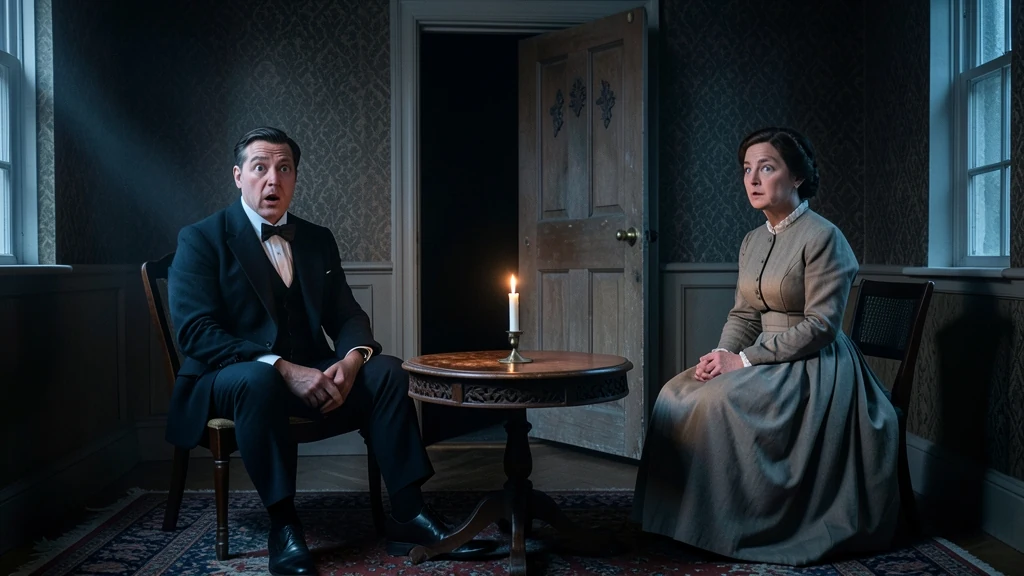
Edition and rights: Complete original English text from Project Gutenberg ebook #72421. This edition is identified as public domain in the USA; the original author died in 1940, satisfying the ordinary Pakistan copyright term. This is the original work, not an AI retelling.
OUTSIDE THE DOOR


The rest of the small party staying with my friend Geoffrey Aldwych in
the charming old house which he had lately bought at a little village
north of Sheringham on the Norfolk coast had drifted away soon after
dinner to bridge and billiards, and Mrs Aldwych and myself had for the
time been left alone in the drawing-room, seated one on each side of a
small round table which we had very patiently and unsuccessfully been
trying to turn. But such pressure, psychical or physical, as we had put
upon it, though of the friendliest and most encouraging nature had not
overcome in the smallest degree the very slight inertia which so small
an object might have been supposed to possess, and it had remained as
fixed as the most constant of the stars. No tremor even had passed
through its slight and spindle-like legs. In consequence we had, after a
really considerable period of patient endeavour, left it to its wooden
repose, and proceeded to theorise about psychical matters instead, with
no stupid table to contradict in practice all our ideas on the subject.

This I had added with a certain bitterness born of failure, for if we
could not move so insignificant an object, we might as well give up all
idea of moving anything. But hardly were the words out of my mouth when
there came from the abandoned table, a single peremptory rap, loud and
rather startling.

“What’s that?” I asked.

“Only a rap,” said she. “I thought something would happen before long.”

“And do you really think that is a spirit rapping?” I asked.

“Oh dear no. I don’t think it has anything whatever to do with spirits.”

“More perhaps with the very dry weather we have been having. Furniture
often cracks like that in the summer.”

Now this, in point of fact, was not quite the case. Neither in summer
nor in winter have I heard ever furniture crack as the table had
cracked, for the sound, whatever it was, did not at all resemble the
husky creak of contracting wood. It was a loud sharp crack like the
smart concussion of one hard object with another.

“No, I don’t think it had much to do with dry weather either,” said she
smiling. “I think, if you wish to know, that it was the direct result of
our attempt to turn the table. Does that sound nonsense?”

“At present, yes,” said I, “though I have no doubt that if you tried you
could make it sound sense. There is, I notice, a certain plausibility
about you and your theories----”

“Now you are being merely personal,” she observed.

“For the good motive, to goad you into explanations and enlargements.
Please go on.”

“Let us stroll outside, then,” said she, “and sit in the garden, if you
are sure you prefer my plausibilities to bridge. It is deliciously warm,
and----”

“And the darkness will be more suitable for the propagation of psychical
phenomena. As at séances,” said I.

“Oh, there is nothing psychical about my plausibilities,” said she. “The
phenomena I mean are purely physical, according to my theory.”

So we wandered out into the transparent half light of multitudinous
stars. The last crimson feather of sunset, which had hovered long in the
West, had been blown away with the breath of the night wind, and the
moon, which would presently rise, had not yet cut the dim horizon of the
sea, which lay very quiet, breathing gently in its sleep with stir of
whispering ripples. Across the dark velvet of the close-cropped lawn,
which stretched seawards from the house, blew a little breeze full of
the savour of salt and the freshness of night, with, every now and then,
a hint so subtly conveyed as to be scarcely perceptible of its travel
across the sleeping fragrance of drowsy garden-beds, over which the
white moths hovered seeking their night-honey. The house itself, with
its two battlemented towers of Elizabethan times, gleamed with many
windows, and we passed out of sight of it, and into the shadow of a
box-hedge, clipped into shapes and monstrous fantasies, and found chairs
by the striped tent at the top of the sheltered bowling-alley.

“And this is all very plausible,” said I. “Theories, if you please, at
length, and, if possible, a full length illustration also.”

“By which you mean a ghost-story, or something to that effect?”

“Precisely: and, without presuming to dictate, if possible, first-hand.”

“Oddly enough, I can supply that also,” said she. “So first I will tell
you my general theory, and follow it by a story that seems to bear it
out. It happened to me, and it happened here.”

“I am sure it will fill the bill,” said I.

She paused a moment while I lit a cigarette, and then began in her very
clear, pleasant voice. She has the most lucid voice I know, and to me
sitting there in the deep-dyed dusk, the words seemed the very
incarnation of clarity, for they dropped into the still quiet of the
darkness, undisturbed by impressions conveyed to other senses.

       *       *       *       *       *

“We are only just beginning to conjecture,” she said, “how inextricable
is the interweaving between mind, soul, life, call it what you
will--and the purely material part of the created world. That such
interweaving existed has, of course, been known for centuries; doctors,
for instance, knew that a cheerful optimistic spirit on the part of
their patients conduced towards recovery; that fear, the mere emotion,
had a definite effect on the beat of the heart, that anger produced
chemical changes in the blood, that anxiety led to indigestion, that
under the influence of strong passion a man can do things which in his
normal state he is physically incapable of performing. Here we have
mind, in a simple and familiar manner, producing changes and effects in
tissue, in that which is purely material. By an extension of
this--though, indeed, it is scarcely an extension--we may expect to find
that mind can have an effect, not only on what we call living tissue,
but on dead things, on pieces of wood or stone. At least it is hard to
see why that should not be so.”

“Table-turning, for instance?” I asked.

“That is one instance of how some force, out of that innumerable cohort
of obscure mysterious forces with which we human beings are garrisoned,
can pass, as it is constantly doing, into material things. The laws of
its passing we do not know; sometimes we wish it to pass and it does
not. Just now, for instance, when you and I tried to turn the table,
there was some impediment in the path, though I put down that rap which
followed as an effect of our efforts. But nothing seems more natural to
my mind than that these forces should be transmissible to inanimate
things. Of the manner of its passing we know next to nothing, any more
than we know the manner of the actual process by which fear accelerates
the beating of the heart, but as surely as a Marconi message leaps along
the air by no visible or tangible bridge, so through some subtle gateway
of the body these forces can march from the citadel of the spirit into
material forms, whether that material is a living part of ourselves or
that which we choose to call inanimate nature.”

She paused a moment.

“Under certain circumstances,” she went on, “it seems that the force
which has passed from us into inanimate things can manifest its presence
there. The force that passes into a table can show itself in movements
or in noises coming from the table. The table has been charged with
physical energy. Often and often I have seen a table or a chair move
apparently of its own accord, but only when some outpouring of force,
animal magnetism--call it what you will--has been received by it. A
parallel phenomenon to my mind is exhibited in what we know as haunted
houses, houses in which, as a rule, some crime or act of extreme emotion
or passion has been committed, and in which some echo or re-enactment of
the deed is periodically made visible or audible. A murder has been
committed, let us say, and the room where it took place is haunted. The
figure of the murdered, or less commonly of the murderer, is seen there
by sensitives, and cries are heard, or steps run to and fro. The
atmosphere has somehow been charged with the scene, and the scene in
whole or part repeats itself, though under what laws we do not know,
just as a phonograph will repeat, when properly handled, what has been
said into it.”

“This is all theory,” I remarked.

“But it appears to me to cover a curious set of facts, which is all we
ask of a theory. Otherwise, we must frankly state our disbelief in
haunted houses altogether, or suppose that the spirit of the murdered,
poor wretch, is bound under certain circumstances to re-enact the horror
of its body’s tragedy. It was not enough that its body was killed there,
its soul has to be dragged back and live through it all again with such
vividness that its anguish becomes visible or audible to the eyes or
ears of the sensitive. That to me is unthinkable, whereas my theory is
not. Do I make it at all clear?”

“It is clear enough,” said I, “but I want support for it, the full-sized
illustration.”

“I promised you that, a ghost-story of my own experience.”

Mrs Aldwych paused again, and then began the story which was to
illustrate her theory.

“It is just a year,” she said, “since Jack bought this house from old
Mrs Denison. We had both heard, both he and I, that it was supposed to
be haunted, but neither of us knew any particulars of the haunt
whatever. A month ago I heard what I believe to have been the ghost,
and, when Mrs Denison was staying with us last week, I asked her exactly
what it was, and found it tallied completely with my experience. I will
tell you my experience first, and give her account of the haunt
afterwards.

“A month ago Jack was away for a few days and I remained here alone. One
Sunday evening, I, in my usual health and spirits, as far as I am aware,
both of which are serenely excellent, went up to bed about eleven. My
room is on the first floor, just at the foot of the staircase that leads
to the floor above. There are four more rooms on my passage, all of
which that night were empty, and at the far end of it a door leads into
the landing at the top of the front staircase. On the other side of
that, as you know, are more bedrooms, all of which that night were also
unoccupied; I, in fact, was the only sleeper on the first floor.

“The head of my bed is close behind my door, and there is an electric
light over it. This is controlled by a switch at the bed-head, and
another switch there turns on a light in the passage just outside my
room. That was Jack’s plan: if by chance you want to leave your room
when the house is dark, you can light up the passage before you go out,
and not grope blindly for a switch outside.

“Usually I sleep solidly: it is very rarely indeed that I wake, when
once I have gone to sleep, before I am called. But that night I woke,
which was rare; what was rarer was that I woke in a state of shuddering
and unaccountable terror; I tried to localise my panic, to run it to
earth and reason it away, but without any success. Terror of something I
could not guess at stared me in the face, white, shaking terror. So, as
there was no use in lying quaking in the dark, I lit my lamp, and, with
the view of composing this strange disorder of my fear, began to read
again in the book I had brought up with me. The volume happened to be
‘The Green Carnation,’ a work one would have thought to be full of tonic
to twittering nerves. But it failed of success, even as my reasoning had
done, and after reading a few pages, and finding that the heart-hammer
in my throat grew no quieter, and that the grip of terror was in no way
relaxed, I put out my light and lay down again. I looked at my watch,
however, before doing this, and remember that the time was ten minutes
to two.

“Still matters did not mend: terror, that was slowly becoming a little
more definite, terror of some dark and violent deed that was momently
drawing nearer to me held me in its vice. Something was coming, the
advent of which was perceived by the sub-conscious sense, and was
already conveyed to my conscious mind. And then the clock struck two
jingling chimes, and the stable-clock outside clanged the hour more
sonorously.

“I still lay there, abject and palpitating. Then I heard a sound just
outside my room on the stairs that lead, as I have said, to the second
story, a sound which was perfectly commonplace and unmistakable. Feet
feeling their way in the dark were coming downstairs to my passage: I
could hear also the groping hand slip and slide along the bannisters.
The footfalls came along the few yards of passage between the bottom of
the stairs and my door, and then against my door itself came the brush
of drapery, and on the panels the blind groping of fingers. The handle
rattled as they passed over it, and my terror nearly rose to screaming
point.

“Then a sensible hope struck me. The midnight wanderer might be one of
the servants, ill or in want of something, and yet--why the shuffling
feet and the groping hand? But on the instant of the dawning of that
hope (for I knew that it was of the step and that which was moving in
the dark passage of which I was afraid) I turned on both the light at my
bed-head, and the light of the passage outside, and, opening the door,
looked out. The passage was quite bright from end to end, but it was
perfectly empty. Yet as I looked, seeing nothing of the walker, I still
heard. Down the bright boards I heard the shuffle growing fainter as it
receded, until, judging by the ear, it turned into the gallery at the
end and died away. And with it there died also all my sense of terror.
It was It of which I had been afraid: now It and my terror had passed.
And I went back to bed and slept till morning.”

       *       *       *       *       *

Again Mrs Aldwych paused, and I was silent. Somehow it was in the
extreme simplicity of her experience that the horror lay. She went on
almost immediately.

“Now for the sequel,” she said, “or what I choose to call the
explanation. Mrs Denison, as I told you, came down to stay with us not
long ago, and I mentioned that we had heard, though only vaguely, that
the house was supposed to be haunted, and asked for an account of it.
This is what she told me:

“‘In the year 1610 the heiress to the property was a girl Helen Denison,
who was engaged to be married to young Lord Southern. In case therefore
of her having children, the property would pass away from Denisons. In
case of her death, childless, it would pass to her first cousin. A week
before the marriage took place, he and a brother of his entered the
house, riding here from thirty miles away, after dark, and made their
way to her room on the second storey. There they gagged her and
attempted to kill her, but she escaped from them, groped her way along
this passage, and into the room at the end of the gallery. They followed
her there, and killed her. The facts were known by the younger brother
turning king’s evidence.’

“Now Mrs Denison told me that the ghost had never been seen, but that it
was occasionally heard coming downstairs or going along the passage. She
told me that it was never heard except between the hours of two and
three in the morning, the hour during which the murder took place.”

“And since then have you heard it again?” I asked.

“Yes, more than once. But it has never frightened me again. I feared, as
we all do, what was unknown.”

“I feel that I should fear the known, if I knew it was that,” said I.

“I don’t think you would for long. Whatever theory you adopt about it,
the sounds of the steps and the groping hand, I cannot see that there is
anything to shock or frighten one. My own theory you know----”

“Please apply it to what you heard,” I asked.

“Simply enough. The poor girl felt her way along this passage in the
despair of her agonised terror, hearing no doubt the soft footsteps of
her murderers gaining on her, as she groped along her lost way. The
waves of that terrible brain-storm raging within her, impressed
themselves in some subtle yet physical manner on the place. It would
only be by those people whom we call sensitives that the wrinkles, so
to speak, made by those breaking waves on the sands would be perceived,
and by them not always. But they are there, even as when a Marconi
apparatus is working the waves are there, though they can only be
perceived by a receiver that is in tune. If you believe in brain-waves
at all, the explanation is not so difficult.”

“Then the brain-wave is permanent?”

“Every wave of whatever kind leaves its mark, does it not? If you
disbelieve the whole thing, shall I give you a room on the route of that
poor murdered harmless walker?”

I got up.

“I am very comfortable, thanks, where I am,” I said.
1 / 1


