
The Ash-tree
Read The Ash-tree by M. R. James in the original English.
By M. R. James
Edition: Complete story in the original English, from Project Gutenberg #8486. No translation or AI rewriting of the literary text. Original spelling retained.
This eBook is for the use of anyone anywhere in the United States and most other parts of the world at no cost and with almost no restrictions whatsoever. You may copy it, give it away or re-use it under the terms of the Project Gutenberg License included with this eBook or online at www.gutenberg.org. If you are not located in the United States, you will have to check the laws of the country where you are located before using this eBook.
Everyone who has travelled over Eastern England knows the smaller country-houses with which it is studded—the rather dank little buildings, usually in the Italian style, surrounded with parks of some eighty to a hundred acres. For me they have always had a very strong attraction: with the grey paling of split oak, the noble trees, the meres with their reed-beds, and the line of distant woods. Then, I like the pillared portico—perhaps stuck on to a red-brick Queen Anne house which has been faced with stucco to bring it into line with the “Grecian” taste of the end of the eighteenth century; the hall inside, going up to the roof, which hall ought always to be provided with a gallery and a small organ. I like the library, too, where you may find anything from a Psalter of the thirteenth century to a Shakespeare quarto. I like the pictures, of course; and perhaps most of all I like fancying what life in such a house was when it was first built, and in the piping times of landlords’ prosperity, and not least now, when, if money is not so plentiful, taste is more varied and life quite as interesting. I wish to have one of these houses, and enough money to keep it together and entertain my friends in it modestly.
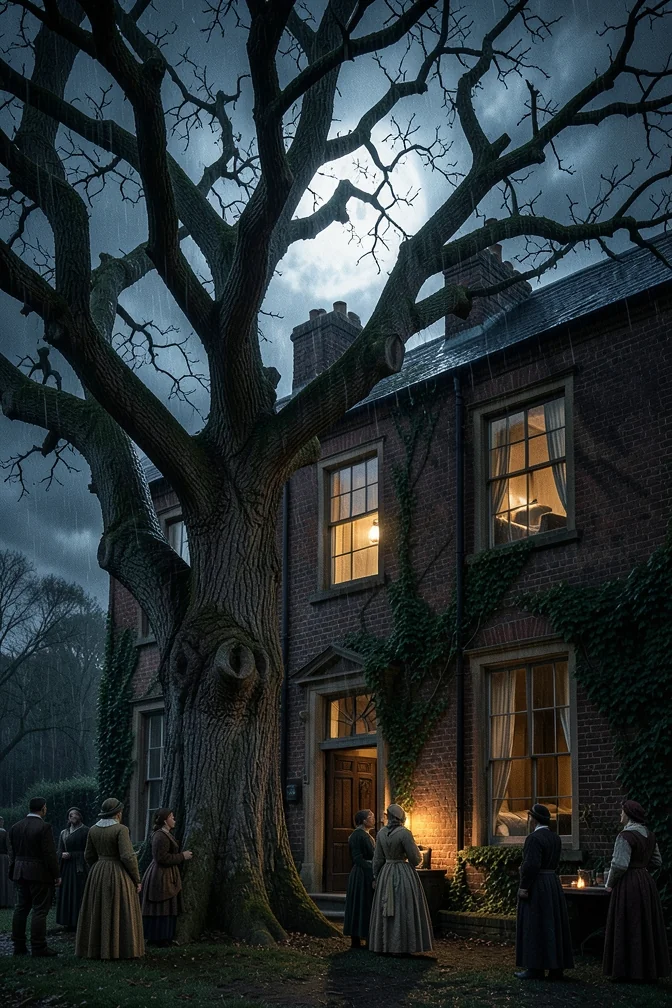
But this is a digression. I have to tell you of a curious series of events which happened in such a house as I have tried to describe. It is Castringham Hall in Suffolk. I think a good deal has been done to the building since the period of my story, but the essential features I have sketched are still there—Italian portico, square block of white house, older inside than out, park with fringe of woods, and mere. The one feature that marked out the house from a score of others is gone. As you looked at it from the park, you saw on the right a great old ash-tree growing within half a dozen yards of the wall, and almost or quite touching the building with its branches. I suppose it had stood there ever since Castringham ceased to be a fortified place, and since the moat was filled in and the Elizabethan dwelling-house built. At any rate, it had well-nigh attained its full dimensions in the year 1690.
In that year the district in which the Hall is situated was the scene of a number of witch-trials. It will be long, I think, before we arrive at a just estimate of the amount of solid reason—if there was any—which lay at the root of the universal fear of witches in old times. Whether the persons accused of this offence really did imagine that they were possessed of unusual power of any kind; or whether they had the will at least, if not the power, of doing mischief to their neighbours; or whether all the confessions, of which there are so many, were extorted by the mere cruelty of the witch-finders—these are questions which are not, I fancy, yet solved. And the present narrative gives me pause. I cannot altogether sweep it away as mere invention. The reader must judge for himself.
Castringham contributed a victim to the auto-da-fé. Mrs Mothersole was her name, and she differed from the ordinary run of village witches only in being rather better off and in a more influential position. Efforts were made to save her by several reputable farmers of the parish. They did their best to testify to her character, and showed considerable anxiety as to the verdict of the jury.
But what seems to have been fatal to the woman was the evidence of the then proprietor of Castringham Hall—Sir Matthew Fell. He deposed to having watched her on three different occasions from his window, at the full of the moon, gathering sprigs “from the ash-tree near my house”. She had climbed into the branches, clad only in her shift, and was cutting off small twigs with a peculiarly curved knife, and as she did so she seemed to be talking to herself. On each occasion Sir Matthew had done his best to capture the woman, but she had always taken alarm at some accidental noise he had made, and all he could see when he got down to the garden was a hare running across the path in the direction of the village.
On the third night he had been at the pains to follow at his best speed, and had gone straight to Mrs Mothersole’s house; but he had had to wait a quarter of an hour battering at her door, and then she had come out very cross, and apparently very sleepy, as if just out of bed; and he had no good explanation to offer of his visit.
Mainly on this evidence, though there was much more of a less striking and unusual kind from other parishioners, Mrs Mothersole was found guilty and condemned to die. She was hanged a week after the trial, with five or six more unhappy creatures, at Bury St Edmunds.
Sir Matthew Fell, then Deputy-Sheriff, was present at the execution. It was a damp, drizzly March morning when the cart made its way up the rough grass hill outside Northgate, where the gallows stood. The other victims were apathetic or broken down with misery; but Mrs Mothersole was, as in life so in death, of a very different temper. Her “poysonous Rage”, as a reporter of the time puts it, “did so work upon the Bystanders—yea, even upon the Hangman—that it was constantly affirmed of all that saw her that she presented the living Aspect of a mad Divell. Yet she offer’d no Resistance to the Officers of the Law; onely she looked upon those that laid Hands upon her with so direfull and venomous an Aspect that—as one of them afterwards assured me—the meer Thought of it preyed inwardly upon his Mind for six Months after.”
However, all that she is reported to have said was the seemingly meaningless words: “There will be guests at the Hall.” Which she repeated more than once in an undertone.
Sir Matthew Fell was not unimpressed by the bearing of the woman. He had some talk upon the matter with the Vicar of his parish, with whom he travelled home after the assize business was over. His evidence at the trial had not been very willingly given; he was not specially infected with the witch-finding mania, but he declared, then and afterwards, that he could not give any other account of the matter than that he had given, and that he could not possibly have been mistaken as to what he saw. The whole transaction had been repugnant to him, for he was a man who liked to be on pleasant terms with those about him; but he saw a duty to be done in this business, and he had done it. That seems to have been the gist of his sentiments, and the Vicar applauded it, as any reasonable man must have done.
A few weeks after, when the moon of May was at the full, Vicar and Squire met again in the park, and walked to the Hall together. Lady Fell was with her mother, who was dangerously ill, and Sir Matthew was alone at home; so the Vicar, Mr Crome, was easily persuaded to take a late supper at the Hall.
Sir Matthew was not very good company this evening. The talk ran chiefly on family and parish matters, and, as luck would have it, Sir Matthew made a memorandum in writing of certain wishes or intentions of his regarding his estates, which afterwards proved exceedingly useful.
When Mr Crome thought of starting for home, about half past nine o’clock, Sir Matthew and he took a preliminary turn on the gravelled walk at the back of the house. The only incident that struck Mr Crome was this: they were in sight of the ash-tree which I described as growing near the windows of the building, when Sir Matthew stopped and said:
“What is that that runs up and down the stem of the ash? It is never a squirrel? They will all be in their nests by now.”
The Vicar looked and saw the moving creature, but he could make nothing of its colour in the moonlight. The sharp outline, however, seen for an instant, was imprinted on his brain, and he could have sworn, he said, though it sounded foolish, that, squirrel or not, it had more than four legs.
Still, not much was to be made of the momentary vision, and the two men parted. They may have met since then, but it was not for a score of years.
Next day Sir Matthew Fell was not downstairs at six in the morning, as was his custom, nor at seven, nor yet at eight. Hereupon the servants went and knocked at his chamber door. I need not prolong the description of their anxious listenings and renewed batterings on the panels. The door was opened at last from the outside, and they found their master dead and black. So much you have guessed. That there were any marks of violence did not at the moment appear; but the window was open.
One of the men went to fetch the parson, and then by his directions rode on to give notice to the coroner. Mr Crome himself went as quick as he might to the Hall, and was shown to the room where the dead man lay. He has left some notes among his papers which show how genuine a respect and sorrow was felt for Sir Matthew, and there is also this passage, which I transcribe for the sake of the light it throws upon the course of events, and also upon the common beliefs of the time:
“There was not any the least Trace of an Entrance having been forc’d to the Chamber: but the Casement stood open, as my poor Friend would always have it in this Season. He had his Evening Drink of small Ale in a silver vessel of about a pint measure, and tonight had not drunk it out. This Drink was examined by the Physician from Bury, a Mr Hodgkins, who could not, however, as he afterwards declar’d upon his Oath, before the Coroner’s quest, discover that any matter of a venomous kind was present in it. For, as was natural, in the great Swelling and Blackness of the Corpse, there was talk made among the Neighbours of Poyson. The Body was very much Disorder’d as it laid in the Bed, being twisted after so extream a sort as gave too probable Conjecture that my worthy Friend and Patron had expir’d in great Pain and Agony. And what is as yet unexplain’d, and to myself the Argument of some Horrid and Artfull Designe in the Perpetrators of this Barbarous Murther, was this, that the Women which were entrusted with the laying-out of the Corpse and washing it, being both sad Persons and very well Respected in their Mournfull Profession, came to me in a great Pain and Distress both of Mind and Body, saying, what was indeed confirmed upon the first View, that they had no sooner touch’d the Breast of the Corpse with their naked Hands than they were sensible of a more than ordinary violent Smart and Acheing in their Palms, which, with their whole Forearms, in no long time swell’d so immoderately, the Pain still continuing, that, as afterwards proved, during many weeks they were forc’d to lay by the exercise of their Calling; and yet no mark seen on the Skin.
“Upon hearing this, I sent for the Physician, who was still in the House, and we made as carefull a Proof as we were able by the Help of a small Magnifying Lens of Crystal of the condition of the Skinn on this Part of the Body: but could not detect with the Instrument we had any Matter of Importance beyond a couple of small Punctures or Pricks, which we then concluded were the Spotts by which the Poyson might be introduced, remembering that Ring of Pope Borgia, with other known Specimens of the Horrid Art of the Italian Poysoners of the last age.
“So much is to be said of the Symptoms seen on the Corpse. As to what I am to add, it is meerly my own Experiment, and to be left to Posterity to judge whether there be anything of Value therein. There was on the Table by the Beddside a Bible of the small size, in which my Friend—punctuall as in Matters of less Moment, so in this more weighty one—used nightly, and upon his First Rising, to read a sett Portion. And I taking it up—not without a Tear duly paid to him wich from the Study of this poorer Adumbration was now pass’d to the contemplation of its great Originall—it came into my Thoughts, as at such moments of Helplessness we are prone to catch at any the least Glimmer that makes promise of Light, to make trial of that old and by many accounted Superstitious Practice of drawing the Sortes; of which a Principall Instance, in the case of his late Sacred Majesty the Blessed Martyr King Charles and my Lord Falkland, was now much talked of. I must needs admit that by my Trial not much Assistance was afforded me: yet, as the Cause and Origin of these Dreadfull Events may hereafter be search’d out, I set down the Results, in the case it may be found that they pointed the true Quarter of the Mischief to a quicker Intelligence than my own.
“I made, then, three trials, opening the Book and placing my Finger upon certain Words: which gave in the first these words, from Luke xiii. 7, Cut it down; in the second, Isaiah xiii. 20, It shall never be inhabited; and upon the third Experiment, Job xxxix. 30, Her young ones also suck up blood.”
This is all that need be quoted from Mr Crome’s papers. Sir Matthew Fell was duly coffined and laid into the earth, and his funeral sermon, preached by Mr Crome on the following Sunday, has been printed under the title of “The Unsearchable Way; or, England’s Danger and the Malicious Dealings of Antichrist”, it being the Vicar’s view, as well as that most commonly held in the neighbourhood, that the Squire was the victim of a recrudescence of the Popish Plot.
His son, Sir Matthew the second, succeeded to the title and estates. And so ends the first act of the Castringham tragedy. It is to be mentioned, though the fact is not surprising, that the new Baronet did not occupy the room in which his father had died. Nor, indeed, was it slept in by anyone but an occasional visitor during the whole of his occupation. He died in 1735, and I do not find that anything particular marked his reign, save a curiously constant mortality among his cattle and live-stock in general, which showed a tendency to increase slightly as time went on.
Those who are interested in the details will find a statistical account in a letter to the Gentleman’s Magazine of 1772, which draws the facts from the Baronet’s own papers. He put an end to it at last by a very simple expedient, that of shutting up all his beasts in sheds at night, and keeping no sheep in his park. For he had noticed that nothing was ever attacked that spent the night indoors. After that the disorder confined itself to wild birds, and beasts of chase. But as we have no good account of the symptoms, and as all-night watching was quite unproductive of any clue, I do not dwell on what the Suffolk farmers called the “Castringham sickness”.
The second Sir Matthew died in 1735, as I said, and was duly succeeded by his son, Sir Richard. It was in his time that the great family pew was built out on the north side of the parish church. So large were the Squire’s ideas that several of the graves on that unhallowed side of the building had to be disturbed to satisfy his requirements. Among them was that of Mrs Mothersole, the position of which was accurately known, thanks to a note on a plan of the church and yard, both made by Mr Crome.
A certain amount of interest was excited in the village when it was known that the famous witch, who was still remembered by a few, was to be exhumed. And the feeling of surprise, and indeed disquiet, was very strong when it was found that, though her coffin was fairly sound and unbroken, there was no trace whatever inside it of body, bones, or dust. Indeed, it is a curious phenomenon, for at the time of her burying no such things were dreamt of as resurrection-men, and it is difficult to conceive any rational motive for stealing a body otherwise than for the uses of the dissecting-room.
The incident revived for a time all the stories of witch-trials and of the exploits of the witches, dormant for forty years, and Sir Richard’s orders that the coffin should be burnt were thought by a good many to be rather foolhardy, though they were duly carried out.
Sir Richard was a pestilent innovator, it is certain. Before his time the Hall had been a fine block of the mellowest red brick; but Sir Richard had travelled in Italy and become infected with the Italian taste, and, having more money than his predecessors, he determined to leave an Italian palace where he had found an English house. So stucco and ashlar masked the brick; some indifferent Roman marbles were planted about in the entrance-hall and gardens; a reproduction of the Sibyl’s temple at Tivoli was erected on the opposite bank of the mere; and Castringham took on an entirely new, and, I must say, a less engaging, aspect. But it was much admired, and served as a model to a good many of the neighbouring gentry in after-years.
One morning (it was in 1754) Sir Richard woke after a night of discomfort. It had been windy, and his chimney had smoked persistently, and yet it was so cold that he must keep up a fire. Also something had so rattled about the window that no man could get a moment’s peace. Further, there was the prospect of several guests of position arriving in the course of the day, who would expect sport of some kind, and the inroads of the distemper (which continued among his game) had been lately so serious that he was afraid for his reputation as a game-preserver. But what really touched him most nearly was the other matter of his sleepless night. He could certainly not sleep in that room again.
That was the chief subject of his meditations at breakfast, and after it he began a systematic examination of the rooms to see which would suit his notions best. It was long before he found one. This had a window with an eastern aspect and that with a northern; this door the servants would be always passing, and he did not like the bedstead in that. No, he must have a room with a western look-out, so that the sun could not wake him early, and it must be out of the way of the business of the house. The housekeeper was at the end of her resources.
“Well, Sir Richard,” she said, “you know that there is but the one room like that in the house.”
“Which may that be?” said Sir Richard.
“And that is Sir Matthew’s—the West Chamber.”
“Well, put me in there, for there I’ll lie tonight,” said her master. “Which way is it? Here, to be sure;” and he hurried off.
“Oh, Sir Richard, but no one has slept there these forty years. The air has hardly been changed since Sir Matthew died there.”
Thus she spoke, and rustled after him.
“Come, open the door, Mrs Chiddock. I’ll see the chamber, at least.”
So it was opened, and, indeed, the smell was very close and earthy. Sir Richard crossed to the window, and, impatiently, as was his wont, threw the shutters back, and flung open the casement. For this end of the house was one which the alterations had barely touched, grown up as it was with the great ash-tree, and being otherwise concealed from view.
“Air it, Mrs Chiddock, all today, and move my bed-furniture in in the afternoon. Put the Bishop of Kilmore in my old room.”
“Pray, Sir Richard,” said a new voice, breaking in on this speech, “might I have the favour of a moment’s interview?”
Sir Richard turned round and saw a man in black in the doorway, who bowed.
“I must ask your indulgence for this intrusion, Sir Richard. You will, perhaps, hardly remember me. My name is William Crome, and my grandfather was Vicar here in your grandfather’s time.”
“Well, sir,” said Sir Richard, “the name of Crome is always a passport to Castringham. I am glad to renew a friendship of two generations” standing. In what can I serve you? for your hour of calling—and, if I do not mistake you, your bearing—shows you to be in some haste.”
“That is no more than the truth, sir. I am riding from Norwich to Bury St Edmunds with what haste I can make, and I have called in on my way to leave with you some papers which we have but just come upon in looking over what my grandfather left at his death. It is thought you may find some matters of family interest in them.”
“You are mighty obliging, Mr Crome, and, if you will be so good as to follow me to the parlour, and drink a glass of wine, we will take a first look at these same papers together. And you, Mrs Chiddock, as I said, be about airing this chamber…. Yes, it is here my grandfather died…. Yes, the tree, perhaps, does make the place a little dampish…. No; I do not wish to listen to any more. Make no difficulties, I beg. You have your orders—go. Will you follow me, sir?”
They went to the study. The packet which young Mr Crome had brought—he was then just become a Fellow of Clare Hall in Cambridge, I may say, and subsequently brought out a respectable edition of Polyaenus—contained among other things the notes which the old Vicar had made upon the occasion of Sir Matthew Fell’s death. And for the first time Sir Richard was confronted with the enigmatical Sortes Biblicæ which you have heard. They amused him a good deal.
“Well,” he said, “my grandfather’s Bible gave one prudent piece of advice—Cut it down. If that stands for the ash-tree, he may rest assured I shall not neglect it. Such a nest of catarrhs and agues was never seen.”
The parlour contained the family books, which, pending the arrival of a collection which Sir Richard had made in Italy, and the building of a proper room to receive them, were not many in number.
Sir Richard looked up from the paper to the bookcase.
“I wonder,” says he, “whether the old prophet is there yet? I fancy I see him.”
Crossing the room, he took out a dumpy Bible, which, sure enough, bore on the flyleaf the inscription: “To Matthew Fell, from his Loving Godmother, Anne Aldous, 2 September, 1659.”
“It would be no bad plan to test him again, Mr Crome. I will wager we get a couple of names in the Chronicles. H’m! what have we here? ‘Thou shalt seek me in the morning, and I shall not be.’ Well, well! Your grandfather would have made a fine omen of that, hey? No more prophets for me! They are all in a tale. And now, Mr Crome, I am infinitely obliged to you for your packet. You will, I fear, be impatient to get on. Pray allow me—another glass.”
So with offers of hospitality, which were genuinely meant (for Sir Richard thought well of the young man’s address and manner), they parted.
In the afternoon came the guests—the Bishop of Kilmore, Lady Mary Hervey, Sir William Kentfield, etc. Dinner at five, wine, cards, supper, and dispersal to bed.
Next morning Sir Richard is disinclined to take his gun with the rest. He talks with the Bishop of Kilmore. This prelate, unlike a good many of the Irish Bishops of his day, had visited his see, and, indeed, resided there, for some considerable time. This morning, as the two were walking along the terrace and talking over the alterations and improvements in the house, the Bishop said, pointing to the window of the West Room:
“You could never get one of my Irish flock to occupy that room, Sir Richard.”
“Why is that, my lord? It is, in fact, my own.”
“Well, our Irish peasantry will always have it that it brings the worst of luck to sleep near an ash-tree, and you have a fine growth of ash not two yards from your chamber window. Perhaps,” the Bishop went on, with a smile, “it has given you a touch of its quality already, for you do not seem, if I may say it, so much the fresher for your night’s rest as your friends would like to see you.”
“That, or something else, it is true, cost me my sleep from twelve to four, my lord. But the tree is to come down tomorrow, so I shall not hear much more from it.”
“I applaud your determination. It can hardly be wholesome to have the air you breathe strained, as it were, through all that leafage.”
“Your lordship is right there, I think. But I had not my window open last night. It was rather the noise that went on—no doubt from the twigs sweeping the glass—that kept me open-eyed.”
“I think that can hardly be, Sir Richard. Here—you see it from this point. None of these nearest branches even can touch your casement unless there were a gale, and there was none of that last night. They miss the panes by a foot.”
“No, sir, true. What, then, will it be, I wonder, that scratched and rustled so—ay, and covered the dust on my sill with lines and marks?”
At last they agreed that the rats must have come up through the ivy. That was the Bishop’s idea, and Sir Richard jumped at it.
So the day passed quietly, and night came, and the party dispersed to their rooms, and wished Sir Richard a better night.
And now we are in his bedroom, with the light out and the Squire in bed. The room is over the kitchen, and the night outside still and warm, so the window stands open.
There is very little light about the bedstead, but there is a strange movement there; it seems as if Sir Richard were moving his head rapidly to and fro with only the slightest possible sound. And now you would guess, so deceptive is the half-darkness, that he had several heads, round and brownish, which move back and forward, even as low as his chest. It is a horrible illusion. Is it nothing more? There! something drops off the bed with a soft plump, like a kitten, and is out of the window in a flash; another—four—and after that there is quiet again.
“Thou shalt seek me in the morning, and I shall not be.”
As with Sir Matthew, so with Sir Richard—dead and black in his bed!
A pale and silent party of guests and servants gathered under the window when the news was known. Italian poisoners, Popish emissaries, infected air—all these and more guesses were hazarded, and the Bishop of Kilmore looked at the tree, in the fork of whose lower boughs a white tom-cat was crouching, looking down the hollow which years had gnawed in the trunk. It was watching something inside the tree with great interest.
Suddenly it got up and craned over the hole. Then a bit of the edge on which it stood gave way, and it went slithering in. Everyone looked up at the noise of the fall.
It is known to most of us that a cat can cry; but few of us have heard, I hope, such a yell as came out of the trunk of the great ash. Two or three screams there were—the witnesses are not sure which—and then a slight and muffled noise of some commotion or struggling was all that came. But Lady Mary Hervey fainted outright, and the housekeeper stopped her ears and fled till she fell on the terrace.
The Bishop of Kilmore and Sir William Kentfield stayed. Yet even they were daunted, though it was only at the cry of a cat; and Sir William swallowed once or twice before he could say:
“There is something more than we know of in that tree, my lord. I am for an instant search.”
And this was agreed upon. A ladder was brought, and one of the gardeners went up, and, looking down the hollow, could detect nothing but a few dim indications of something moving. They got a lantern, and let it down by a rope.
“We must get at the bottom of this. My life upon it, my lord, but the secret of these terrible deaths is there.”
Up went the gardener again with the lantern, and let it down the hole cautiously. They saw the yellow light upon his face as he bent over, and saw his face struck with an incredulous terror and loathing before he cried out in a dreadful voice and fell back from the ladder—where, happily, he was caught by two of the men—letting the lantern fall inside the tree.
He was in a dead faint, and it was some time before any word could be got from him.
By then they had something else to look at. The lantern must have broken at the bottom, and the light in it caught upon dry leaves and rubbish that lay there, for in a few minutes a dense smoke began to come up, and then flame; and, to be short, the tree was in a blaze.
The bystanders made a ring at some yards’ distance, and Sir William and the Bishop sent men to get what weapons and tools they could; for, clearly, whatever might be using the tree as its lair would be forced out by the fire.
So it was. First, at the fork, they saw a round body covered with fire—the size of a man’s head—appear very suddenly, then seem to collapse and fall back. This, five or six times; then a similar ball leapt into the air and fell on the grass, where after a moment it lay still. The Bishop went as near as he dared to it, and saw—what but the remains of an enormous spider, veinous and seared! And, as the fire burned lower down, more terrible bodies like this began to break out from the trunk, and it was seen that these were covered with greyish hair.
All that day the ash burned, and until it fell to pieces the men stood about it, and from time to time killed the brutes as they darted out. At last there was a long interval when none appeared, and they cautiously closed in and examined the roots of the tree.
“They found,” says the Bishop of Kilmore, “below it a rounded hollow place in the earth, wherein were two or three bodies of these creatures that had plainly been smothered by the smoke; and, what is to me more curious, at the side of this den, against the wall, was crouching the anatomy or skeleton of a human being, with the skin dried upon the bones, having some remains of black hair, which was pronounced by those that examined it to be undoubtedly the body of a woman, and clearly dead for a period of fifty years.”
Source and edition terms: https://www.gutenberg.org/ebooks/8486 · Project Gutenberg License. Original-language text; original publisher illustrations are not reproduced.
Source acknowledgements and license
START: FULL LICENSE
THE FULL PROJECT GUTENBERG™ LICENSE
PLEASE READ THIS BEFORE YOU DISTRIBUTE OR USE THIS WORK
To protect the Project Gutenberg™ mission of promoting the free distribution of electronic works, by using or distributing this work (or any other work associated in any way with the phrase “Project Gutenberg”), you agree to comply with all the terms of the Full Project Gutenberg License available with this file or online at www.gutenberg.org/license.
Section 1. General Terms of Use and Redistributing Project Gutenberg electronic works
1.A. By reading or using any part of this Project Gutenberg electronic work, you indicate that you have read, understand, agree to and accept all the terms of this license and intellectual property (trademark/copyright) agreement. If you do not agree to abide by all the terms of this agreement, you must cease using and return or destroy all copies of Project Gutenberg electronic works in your possession. If you paid a fee for obtaining a copy of or access to a Project Gutenberg electronic work and you do not agree to be bound by the terms of this agreement, you may obtain a refund from the person or entity to whom you paid the fee as set forth in paragraph 1.E.8.
1.B. “Project Gutenberg” is a registered trademark. It may only be used on or associated in any way with an electronic work by people who agree to be bound by the terms of this agreement. There are a few things that you can do with most Project Gutenberg electronic works even without complying with the full terms of this agreement. See paragraph 1.C below. There are a lot of things you can do with Project Gutenberg electronic works if you follow the terms of this agreement and help preserve free future access to Project Gutenberg electronic works. See paragraph 1.E below.
1.C. The Project Gutenberg Literary Archive Foundation (“the Foundation” or PGLAF), owns a compilation copyright in the collection of Project Gutenberg electronic works. Nearly all the individual works in the collection are in the public domain in the United States. If an individual work is unprotected by copyright law in the United States and you are located in the United States, we do not claim a right to prevent you from copying, distributing, performing, displaying or creating derivative works based on the work as long as all references to Project Gutenberg are removed. Of course, we hope that you will support the Project Gutenberg mission of promoting free access to electronic works by freely sharing Project Gutenberg works in compliance with the terms of this agreement for keeping the Project Gutenberg name associated with the work. You can easily comply with the terms of this agreement by keeping this work in the same format with its attached full Project Gutenberg License when you share it without charge with others.
1.D. The copyright laws of the place where you are located also govern what you can do with this work. Copyright laws in most countries are in a constant state of change. If you are outside the United States, check the laws of your country in addition to the terms of this agreement before downloading, copying, displaying, performing, distributing or creating derivative works based on this work or any other Project Gutenberg work. The Foundation makes no representations concerning the copyright status of any work in any country other than the United States.
1.E. Unless you have removed all references to Project Gutenberg:
1.E.1. The following sentence, with active links to, or other immediate access to, the full Project Gutenberg License must appear prominently whenever any copy of a Project Gutenberg work (any work on which the phrase “Project Gutenberg” appears, or with which the phrase “Project Gutenberg” is associated) is accessed, displayed, performed, viewed, copied or distributed:
This eBook is for the use of anyone anywhere in the United States and most
other parts of the world at no cost and with almost no restrictions
whatsoever. You may copy it, give it away or re-use it under the terms
of the Project Gutenberg™ License included with this eBook or online
at www.gutenberg.org. If you
are not located in the United States, you will have to check the laws
of the country where you are located before using this eBook.
1.E.2. If an individual Project Gutenberg electronic work is derived from texts not protected by U.S. copyright law (does not contain a notice indicating that it is posted with permission of the copyright holder), the work can be copied and distributed to anyone in the United States without paying any fees or charges. If you are redistributing or providing access to a work with the phrase “Project Gutenberg” associated with or appearing on the work, you must comply either with the requirements of paragraphs 1.E.1 through 1.E.7 or obtain permission for the use of the work and the Project Gutenberg trademark as set forth in paragraphs 1.E.8 or 1.E.9.
1.E.3. If an individual Project Gutenberg electronic work is posted with the permission of the copyright holder, your use and distribution must comply with both paragraphs 1.E.1 through 1.E.7 and any additional terms imposed by the copyright holder. Additional terms will be linked to the Project Gutenberg License for all works posted with the permission of the copyright holder found at the beginning of this work.
1.E.4. Do not unlink or detach or remove the full Project Gutenberg License terms from this work, or any files containing a part of this work or any other work associated with Project Gutenberg.
1.E.5. Do not copy, display, perform, distribute or redistribute this electronic work, or any part of this electronic work, without prominently displaying the sentence set forth in paragraph 1.E.1 with active links or immediate access to the full terms of the Project Gutenberg License.
1.E.6. You may convert to and distribute this work in any binary, compressed, marked up, nonproprietary or proprietary form, including any word processing or hypertext form. However, if you provide access to or distribute copies of a Project Gutenberg work in a format other than “Plain Vanilla ASCII” or other format used in the official version posted on the official Project Gutenberg website (www.gutenberg.org), you must, at no additional cost, fee or expense to the user, provide a copy, a means of exporting a copy, or a means of obtaining a copy upon request, of the work in its original “Plain Vanilla ASCII” or other form. Any alternate format must include the full Project Gutenberg License as specified in paragraph 1.E.1.
1.E.7. Do not charge a fee for access to, viewing, displaying, performing, copying or distributing any Project Gutenberg works unless you comply with paragraph 1.E.8 or 1.E.9.
1.E.8. You may charge a reasonable fee for copies of or providing access to or distributing Project Gutenberg electronic works provided that:
• You pay a royalty fee of 20% of the gross profits you derive from
    the use of Project Gutenberg works calculated using the method
    you already use to calculate your applicable taxes. The fee is owed
    to the owner of the Project Gutenberg trademark, but he has
    agreed to donate royalties under this paragraph to the Project
    Gutenberg Literary Archive Foundation. Royalty payments must be paid
    within 60 days following each date on which you prepare (or are
    legally required to prepare) your periodic tax returns. Royalty
    payments should be clearly marked as such and sent to the Project
    Gutenberg Literary Archive Foundation at the address specified in
    Section 4, “Information about donations to the Project Gutenberg
    Literary Archive Foundation.”

• You provide a full refund of any money paid by a user who notifies
    you in writing (or by e-mail) within 30 days of receipt that s/he
    does not agree to the terms of the full Project Gutenberg™
    License. You must require such a user to return or destroy all
    copies of the works possessed in a physical medium and discontinue
    all use of and all access to other copies of Project Gutenberg™
    works.

• You provide, in accordance with paragraph 1.F.3, a full refund of
    any money paid for a work or a replacement copy, if a defect in the
    electronic work is discovered and reported to you within 90 days of
    receipt of the work.

• You comply with all other terms of this agreement for free
    distribution of Project Gutenberg™ works.
1.E.9. If you wish to charge a fee or distribute a Project Gutenberg™ electronic work or group of works on different terms than are set forth in this agreement, you must obtain permission in writing from the Project Gutenberg Literary Archive Foundation, the manager of the Project Gutenberg™ trademark. Contact the Foundation as set forth in Section 3 below.
1.F.
1.F.1. Project Gutenberg volunteers and employees expend considerable effort to identify, do copyright research on, transcribe and proofread works not protected by U.S. copyright law in creating the Project Gutenberg™ collection. Despite these efforts, Project Gutenberg™ electronic works, and the medium on which they may be stored, may contain “Defects,” such as, but not limited to, incomplete, inaccurate or corrupt data, transcription errors, a copyright or other intellectual property infringement, a defective or damaged disk or other medium, a computer virus, or computer codes that damage or cannot be read by your equipment.
1.F.2. LIMITED WARRANTY, DISCLAIMER OF DAMAGES - Except for the “Right of Replacement or Refund” described in paragraph 1.F.3, the Project Gutenberg Literary Archive Foundation, the owner of the Project Gutenberg™ trademark, and any other party distributing a Project Gutenberg™ electronic work under this agreement, disclaim all liability to you for damages, costs and expenses, including legal fees. YOU AGREE THAT YOU HAVE NO REMEDIES FOR NEGLIGENCE, STRICT LIABILITY, BREACH OF WARRANTY OR BREACH OF CONTRACT EXCEPT THOSE PROVIDED IN PARAGRAPH 1.F.3. YOU AGREE THAT THE FOUNDATION, THE TRADEMARK OWNER, AND ANY DISTRIBUTOR UNDER THIS AGREEMENT WILL NOT BE LIABLE TO YOU FOR ACTUAL, DIRECT, INDIRECT, CONSEQUENTIAL, PUNITIVE OR INCIDENTAL DAMAGES EVEN IF YOU GIVE NOTICE OF THE POSSIBILITY OF SUCH DAMAGE.
1.F.3. LIMITED RIGHT OF REPLACEMENT OR REFUND - If you discover a defect in this electronic work within 90 days of receiving it, you can receive a refund of the money (if any) you paid for it by sending a written explanation to the person you received the work from. If you received the work on a physical medium, you must return the medium with your written explanation. The person or entity that provided you with the defective work may elect to provide a replacement copy in lieu of a refund. If you received the work electronically, the person or entity providing it to you may choose to give you a second opportunity to receive the work electronically in lieu of a refund. If the second copy is also defective, you may demand a refund in writing without further opportunities to fix the problem.
1.F.4. Except for the limited right of replacement or refund set forth in paragraph 1.F.3, this work is provided to you ‘AS-IS’, WITH NO OTHER WARRANTIES OF ANY KIND, EXPRESS OR IMPLIED, INCLUDING BUT NOT LIMITED TO WARRANTIES OF MERCHANTABILITY OR FITNESS FOR ANY PURPOSE.
1.F.5. Some states do not allow disclaimers of certain implied warranties or the exclusion or limitation of certain types of damages. If any disclaimer or limitation set forth in this agreement violates the law of the state applicable to this agreement, the agreement shall be interpreted to make the maximum disclaimer or limitation permitted by the applicable state law. The invalidity or unenforceability of any provision of this agreement shall not void the remaining provisions.
1.F.6. INDEMNITY - You agree to indemnify and hold the Foundation, the trademark owner, any agent or employee of the Foundation, anyone providing copies of Project Gutenberg™ electronic works in accordance with this agreement, and any volunteers associated with the production, promotion and distribution of Project Gutenberg™ electronic works, harmless from all liability, costs and expenses, including legal fees, that arise directly or indirectly from any of the following which you do or cause to occur: (a) distribution of this or any Project Gutenberg work, (b) alteration, modification, or additions or deletions to any Project Gutenberg work, and (c) any Defect you cause.
Section 2. Information about the Mission of Project Gutenberg
Project Gutenberg is synonymous with the free distribution of electronic works in formats readable by the widest variety of computers including obsolete, old, middle-aged and new computers. It exists because of the efforts of hundreds of volunteers and donations from people in all walks of life.
Volunteers and financial support to provide volunteers with the assistance they need are critical to reaching Project Gutenberg’s goals and ensuring that the Project Gutenberg collection will remain freely available for generations to come. In 2001, the Project Gutenberg Literary Archive Foundation was created to provide a secure and permanent future for Project Gutenberg and future generations. To learn more about the Project Gutenberg Literary Archive Foundation and how your efforts and donations can help, see Sections 3 and 4 and the Foundation information page at www.gutenberg.org.
Section 3. Information about the Project Gutenberg Literary Archive Foundation
The Project Gutenberg Literary Archive Foundation is a non-profit 501(c)(3) educational corporation organized under the laws of the state of Mississippi and granted tax exempt status by the Internal Revenue Service. The Foundation’s EIN or federal tax identification number is 64-6221541. Contributions to the Project Gutenberg Literary Archive Foundation are tax deductible to the full extent permitted by U.S. federal laws and your state’s laws.
The Foundation’s business office is located at 41 Watchung Plaza #516, Montclair NJ 07042, USA, +1 (862) 621-9288. Email contact links and up to date contact information can be found at the Foundation’s website and official page at www.gutenberg.org/contact
Section 4. Information about Donations to the Project Gutenberg Literary Archive Foundation
Project Gutenberg™ depends upon and cannot survive without widespread public support and donations to carry out its mission of increasing the number of public domain and licensed works that can be freely distributed in machine-readable form accessible by the widest array of equipment including outdated equipment. Many small donations ($1 to $5,000) are particularly important to maintaining tax exempt status with the IRS.
The Foundation is committed to complying with the laws regulating charities and charitable donations in all 50 states of the United States. Compliance requirements are not uniform and it takes a considerable effort, much paperwork and many fees to meet and keep up with these requirements. We do not solicit donations in locations where we have not received written confirmation of compliance. To SEND DONATIONS or determine the status of compliance for any particular state visit www.gutenberg.org/donate.
While we cannot and do not solicit contributions from states where we have not met the solicitation requirements, we know of no prohibition against accepting unsolicited donations from donors in such states who approach us with offers to donate.
International donations are gratefully accepted, but we cannot make any statements concerning tax treatment of donations received from outside the United States. U.S. laws alone swamp our small staff.
Please check the Project Gutenberg web pages for current donation methods and addresses. Donations are accepted in a number of other ways including checks, online payments and credit card donations. To donate, please visit: www.gutenberg.org/donate.
Section 5. General Information About Project Gutenberg electronic works
Professor Michael S. Hart was the originator of the Project Gutenberg concept of a library of electronic works that could be freely shared with anyone. For forty years, he produced and distributed Project Gutenberg eBooks with only a loose network of volunteer support.
Project Gutenberg eBooks are often created from several printed editions, all of which are confirmed as not protected by copyright in the U.S. unless a copyright notice is included. Thus, we do not necessarily keep eBooks in compliance with any particular paper edition.
Most people start at our website which has the main PG search facility: www.gutenberg.org.
This website includes information about Project Gutenberg, including how to make donations to the Project Gutenberg Literary Archive Foundation, how to help produce our new eBooks, and how to subscribe to our email newsletter to hear about new eBooks.


