
The Bus-Conductor
Read The Bus-Conductor, the complete 1912 story by E. F. Benson. A complete original English tale of the uncanny from a 1912 collection of Edwardian supernatural stories.
By E. F. Benson
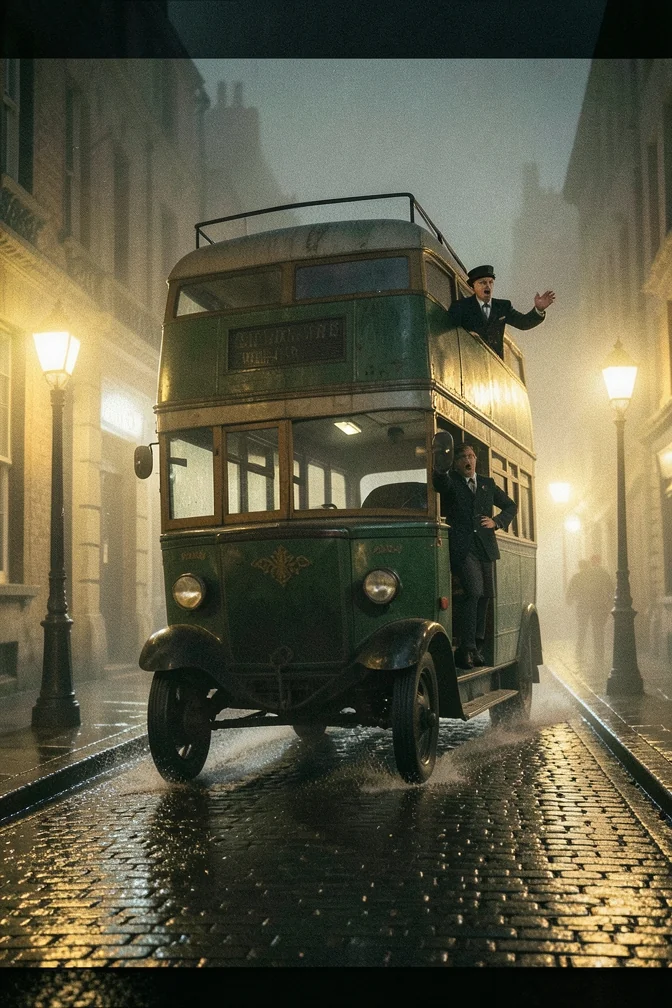
Edition and rights: Complete original English text from Project Gutenberg ebook #72421. This edition is identified as public domain in the USA; the original author died in 1940, satisfying the ordinary Pakistan copyright term. This is the original work, not an AI retelling.
THE BUS-CONDUCTOR


My friend, Hugh Grainger, and I had just returned from a two days’ visit
in the country, where we had been staying in a house of sinister repute
which was supposed to be haunted by ghosts of a peculiarly fearsome and
truculent sort. The house itself was all that such a house should be,
Jacobean and oak-panelled, with long dark passages and high vaulted
rooms. It stood, also, very remote, and was encompassed by a wood of
sombre pines that muttered and whispered in the dark, and all the time
that we were there a south-westerly gale with torrents of scolding rain
had prevailed, so that by day and night weird voices moaned and fluted
in the chimneys, a company of uneasy spirits held colloquy among the
trees, and sudden tattoes and tappings beckoned from the window-panes.
But in spite of these surroundings, which were sufficient in themselves,
one would almost say, to spontaneously generate occult phenomena,
nothing of any description had occurred. I am bound to add, also, that
my own state of mind was peculiarly well adapted to receive or even to
invent the sights and sounds we had gone to seek, for I was, I confess,
during the whole time that we were there, in a state of abject
apprehension, and lay awake both nights through hours of terrified
unrest, afraid of the dark, yet more afraid of what a lighted candle
might show me.

Hugh Grainger, on the evening after our return to town, had dined with
me, and after dinner our conversation, as was natural, soon came back to
these entrancing topics.

“But why you go ghost-seeking I cannot imagine,” he said, “because your
teeth were chattering and your eyes starting out of your head all the
time you were there, from sheer fright. Or do you like being
frightened?”

Hugh, though generally intelligent, is dense in certain ways; this is
one of them.

“Why, of course, I like being frightened,” I said. “I want to be made to
creep and creep and creep. Fear is the most absorbing and luxurious of
emotions. One forgets all else if one is afraid.”

“Well, the fact that neither of us saw anything,” he said, “confirms
what I have always believed.”

“And what have you always believed?”

“That these phenomena are purely objective, not subjective, and that
one’s state of mind has nothing to do with the perception that perceives
them, nor have circumstances or surroundings anything to do with them
either. Look at Osburton. It has had the reputation of being a haunted
house for years, and it certainly has all the accessories of one. Look
at yourself, too, with all your nerves on edge, afraid to look round or
light a candle for fear of seeing something! Surely there was the right
man in the right place then, if ghosts are subjective.”

He got up and lit a cigarette, and looking at him--Hugh is about six
feet high, and as broad as he is long--I felt a retort on my lips, for I
could not help my mind going back to a certain period in his life, when,
from some cause which, as far as I knew, he had never told anybody, he
had become a mere quivering mass of disordered nerves. Oddly enough, at
the same moment and for the first time, he began, to speak of it
himself.

“You may reply that it was not worth my while to go either,” he said,
“because I was so clearly the wrong man in the wrong place. But I
wasn’t. You for all your apprehensions and expectancy have never seen a
ghost. But I have, though I am the last person in the world you would
have thought likely to do so, and, though my nerves are steady enough
again now, it knocked me all to bits.”

He sat down again in his chair.

“No doubt you remember my going to bits,” he said, “and since I believe
that I am sound again now, I should rather like to tell you about it.
But before I couldn’t; I couldn’t speak of it at all to anybody. Yet
there ought to have been nothing frightening about it; what I saw was
certainly a most useful and friendly ghost. But it came from the shaded
side of things; it looked suddenly out of the night and the mystery with
which life is surrounded.”

“I want first to tell you quite shortly my theory about ghost-seeing,”
he continued, “and I can explain it best by a simile, an image. Imagine
then that you and I and everybody in the world are like people whose eye
is directly opposite a little tiny hole in a sheet of cardboard which is
continually shifting and revolving and moving about. Back to back with
that sheet of cardboard is another, which also, by laws of its own, is
in perpetual but independent motion. In it too there is another hole,
and when, fortuitously it would seem, these two holes, the one through
which we are always looking, and the other in the spiritual plane, come
opposite one another, we see through, and then only do the sights and
sounds of the spiritual world become visible or audible to us. With most
people these holes never come opposite each other during their life. But
at the hour of death they do, and then they remain stationary. That, I
fancy, is how we ‘pass over.’

“Now, in some natures, these holes are comparatively large, and are
constantly coming into opposition. Clairvoyants, mediums are like that.
But, as far as I knew, I had no clairvoyant or mediumistic powers at
all. I therefore am the sort of person who long ago made up his mind
that he never would see a ghost. It was, so to speak, an incalculable
chance that my minute spy-hole should come into opposition with the
other. But it did: and it knocked me out of time.”

I had heard some such theory before, and though Hugh put it rather
picturesquely, there was nothing in the least convincing or practical
about it. It might be so, or again it might not.

“I hope your ghost was more original than your theory,” said I, in order
to bring him to the point.

“Yes, I think it was. You shall judge.”

I put on more coal and poked up the fire. Hugh has got, so I have always
considered, a great talent for telling stories, and that sense of drama
which is so necessary for the narrator. Indeed before now, I have
suggested to him that he should take this up as a profession, sit by the
fountain in Piccadilly Circus, when times are, as usual, bad, and tell
stories to the passers-by in the street, Arabian fashion, for reward.
The most part of mankind, I am aware, do not like long stories, but to
the few, among whom I number myself, who really like to listen to
lengthy accounts of experiences, Hugh is an ideal narrator. I do not
care for his theories, or for his similes, but when it comes to facts,
to things that happened, I like him to be lengthy.

“Go on, please, and slowly,” I said. “Brevity may be the soul of wit,
but it is the ruin of storytelling. I want to hear when and where and
how it all was, and what you had for lunch and where you had dined and
what----”

Hugh began:

“It was the 24th of June, just eighteen months ago,” he said. “I had let
my flat, you may remember, and came up from the country to stay with you
for a week. We had dined alone here----”

I could not help interrupting.

“Did you see the ghost here?” I asked. “In this square little box of a
house in a modern street?”

“I was in the house when I saw it.”

I hugged myself in silence.

“We had dined alone here in Graeme Street,” he said, “and after dinner I
went out to some party, and you stopped at home. At dinner your man did
not wait, and when I asked where he was, you told me he was ill, and, I
thought, changed the subject rather abruptly. You gave me your latch-key
when I went out, and on coming back, I found you had gone to bed. There
were, however, several letters for me, which required answers. I wrote
them there and then, and posted them at the pillar-box opposite. So I
suppose it was rather late when I went upstairs.

“You had put me in the front room, on the third floor, overlooking the
street, a room which I thought you generally occupied yourself. It was a
very hot night, and though there had been a moon when I started to my
party, on my return the whole sky was cloud-covered, and it both looked
and felt as if we might have a thunderstorm before morning. I was
feeling very sleepy and heavy, and it was not till after I had got into
bed that I noticed by the shadows of the window-frames on the blind that
only one of the windows was open. But it did not seem worth while to get
out of bed in order to open it, though I felt rather airless and
uncomfortable, and I went to sleep.

“What time it was when I awoke I do not know, but it was certainly not
yet dawn, and I never remember being conscious of such an extraordinary
stillness as prevailed. There was no sound either of foot-passengers or
wheeled traffic; the music of life appeared to be absolutely mute. But
now instead of being sleepy and heavy, I felt, though I must have slept
an hour or two at most, since it was not yet dawn, perfectly fresh and
wide-awake, and the effort which had seemed not worth making before,
that of getting out of bed and opening the other window, was quite easy
now, and I pulled up the blind, threw it wide open, and leaned out, for
somehow I parched and pined for air. Even outside the oppression was
very noticeable, and though, as you know, I am not easily given to feel
the mental effects of climate, I was aware of an awful creepiness coming
over me. I tried to analyse it away, but without success; the past day
had been pleasant, I looked forward to another pleasant day to-morrow,
and yet I was full of some nameless apprehension. I felt, too,
dreadfully lonely in this stillness before the dawn.

“Then I heard suddenly and not very far away the sound of some
approaching vehicle; I could distinguish the tread of two horses walking
at a slow foot’s pace. They were, though yet invisible, coming up the
street, and yet this indication of life did not abate that dreadful
sense of loneliness which I have spoken of. Also in some dim
unformulated way that which was coming seemed to me to have something to
do with the cause of my oppression.

“Then the vehicle came into sight. At first I could not distinguish what
it was. Then I saw that the horses were black and had long tails, and
that what they dragged was made of glass, but had a black frame. It was
a hearse. Empty.

“It was moving up this side of the street. It stopped at your door.

“Then the obvious solution struck me. You had said at dinner that your
man was ill, and you were, I thought, unwilling to speak more about his
illness. No doubt, so I imagined now, he was dead, and for some reason,
perhaps because you did not want me to know anything about it, you were
having the body removed at night. This, I must tell you, passed through
my mind quite instantaneously, and it did not occur to me how unlikely
it really was, before the next thing happened.

“I was still leaning out of the window, and I remember also wondering,
yet only momentarily, how odd it was that I saw things--or rather the
one thing I was looking at--so very distinctly. Of course, there was a
moon behind the clouds, but it was curious how every detail of the
hearse and the horses was visible. There was only one man, the driver,
with it, and the street was otherwise absolutely empty. It was at him I
was looking now. I could see every detail of his clothes, but from where
I was, so high above him, I could not see his face. He had on grey
trousers, brown boots, a black coat buttoned all the way up, and a straw
hat. Over his shoulder there was a strap, which seemed to support some
sort of little bag. He looked exactly like--well, from my description
what did he look exactly like?”

“Why--a bus-conductor,” I said instantly.

“So I thought, and even while I was thinking this, he looked up at me.
He had a rather long thin face, and on his left cheek there was a mole
with a growth of dark hair on it. All this was as distinct as if it had
been noonday, and as if I was within a yard of him. But--so
instantaneous was all that takes so long in the telling--I had not time
to think it strange that the driver of a hearse should be so
unfunereally dressed.

“Then he touched his hat to me, and jerked his thumb over his shoulder.”

“‘Just room for one inside, sir,’ he said.

“There was something so odious, so coarse, so unfeeling about this that
I instantly drew my head in, pulled the blind down again, and then, for
what reason I do not know, turned on the electric light in order to see
what time it was. The hands of my watch pointed to half-past eleven.

“It was then for the first time, I think, that a doubt crossed my mind
as to the nature of what I had just seen. But I put out the light again,
got into bed, and began to think. We had dined; I had gone to a party, I
had come back and written letters, had gone to bed and had slept. So how
could it be half-past eleven?... Or--_what_ half-past eleven was it?

“Then another easy solution struck me; my watch must have stopped. But
it had not; I could hear it ticking.

“There was stillness and silence again. I expected every moment to hear
muffled footsteps on the stairs, footsteps moving slowly and smally
under the weight of a heavy burden, but from inside the house there was
no sound whatever. Outside, too, there was the same dead silence, while
the hearse waited at the door. And the minutes ticked on and ticked on,
and at length I began to see a difference in the light in the room, and
knew that the dawn was beginning to break outside. But how had it
happened then that if the corpse was to be removed at night it had not
gone, and that the hearse still waited, when morning was already coming?

“Presently I got out of bed again, and with the sense of strong physical
shrinking I went to the window and pulled back the blind. The dawn was
coming fast; the whole street was lit by that silver hueless light of
morning. But there was no hearse there.

“Once again I looked at my watch. It was just a quarter-past four. But I
would swear that not half an hour had passed since it had told me that
it was half-past eleven.

“Then a curious double sense, as if I was living in the present and at
the same moment had been living in some other time, came over me. It was
dawn on June 25th, and the street, as natural, was empty. But a little
while ago the driver of a hearse had spoken to me, and it was half-past
eleven. What was that driver, to what plane did he belong? And again
_what_ half-past eleven was it that I had seen recorded on the dial of
my watch?

“And then I told myself that the whole thing had been a dream. But if
you ask me whether I believed what I told myself, I must confess that I
did not.

“Your man did not appear at breakfast next morning, nor did I see him
again before I left that afternoon. I think if I had, I should have told
you about all this, but it was still possible, you see, that what I had
seen was a real hearse, driven by a real driver, for all the ghastly
gaiety of the face that had looked up to mine, and the levity of his
pointing hand. I might possibly have fallen asleep soon after seeing
him, and slumbered through the removal of the body and the departure of
the hearse. So I did not speak of it to you.”

       *       *       *       *       *

There was something wonderfully straightforward and prosaic in all this;
here were no Jacobean houses oak-panelled and surrounded by weeping
pine-trees, and somehow the very absence of suitable surroundings made
the story more impressive. But for a moment a doubt assailed me.

“Don’t tell me it was all a dream,” I said.

“I don’t know whether it was or not. I can only say that I believe
myself to have been wide awake. In any case the rest of the story
is--odd.”

“I went out of town again that afternoon,” he continued, “and I may say
that I don’t think that even for a moment did I get the haunting sense
of what I had seen or dreamed that night out of my mind. It was present
to me always as some vision unfulfilled. It was as if some clock had
struck the four quarters, and I was still waiting to hear what the hour
would be.

“Exactly a month afterwards I was in London again, but only for the day.
I arrived at Victoria about eleven, and took the underground to Sloane
Square in order to see if you were in town and would give me lunch. It
was a baking hot morning, and I intended to take a bus from the King’s
Road as far as Graeme Street. There was one standing at the corner just
as I came out of the station, but I saw that the top was full, and the
inside appeared to be full also. Just as I came up to it the conductor
who, I suppose, had been inside, collecting fares or what not, came out
on to the step within a few feet of me. He wore grey trousers, brown
boots, a black coat buttoned, a straw hat, and over his shoulder was a
strap on which hung his little machine for punching tickets. I saw his
face, too; it was the face of the driver of the hearse, with a mole on
the left cheek. Then he spoke to me, jerking his thumb over his
shoulder.

“‘Just room for one inside, sir,’ he said.

“At that a sort of panic-terror took possession of me, and I knew I
gesticulated wildly with my arms, and cried, ‘No, no!’ But at that
moment I was living not in the hour that was then passing, but in that
hour which had passed a month ago, when I leaned from the window of your
bedroom here just before the dawn broke. At this moment too I knew that
my spy-hole had been opposite the spy-hole into the spiritual world.
What I had seen there had some significance, now being fulfilled, beyond
the significance of the trivial happenings of to-day and to-morrow. The
Powers of which we know so little were visibly working before me. And I
stood there on the pavement shaking and trembling.

“I was opposite the post-office at the corner, and just as the bus
started my eye fell on the clock in the window there. I need not tell
you what the time was.

“Perhaps I need not tell you the rest, for you probably conjecture it,
since you will not have forgotten what happened at the corner of Sloane
Square at the end of July, the summer before last. The bus pulled out
from the pavement into the street in order to get round a van that was
standing in front of it. At the moment there came down the King’s Road a
big motor going at a hideously dangerous pace. It crashed full into the
bus, burrowing into it as a gimlet burrows into a board.”

He paused.

“And that’s my story,” he said.
1 / 1


