
The Cat
Read The Cat, the complete 1912 story by E. F. Benson. A complete original English tale of the uncanny from a 1912 collection of Edwardian supernatural stories.
By E. F. Benson
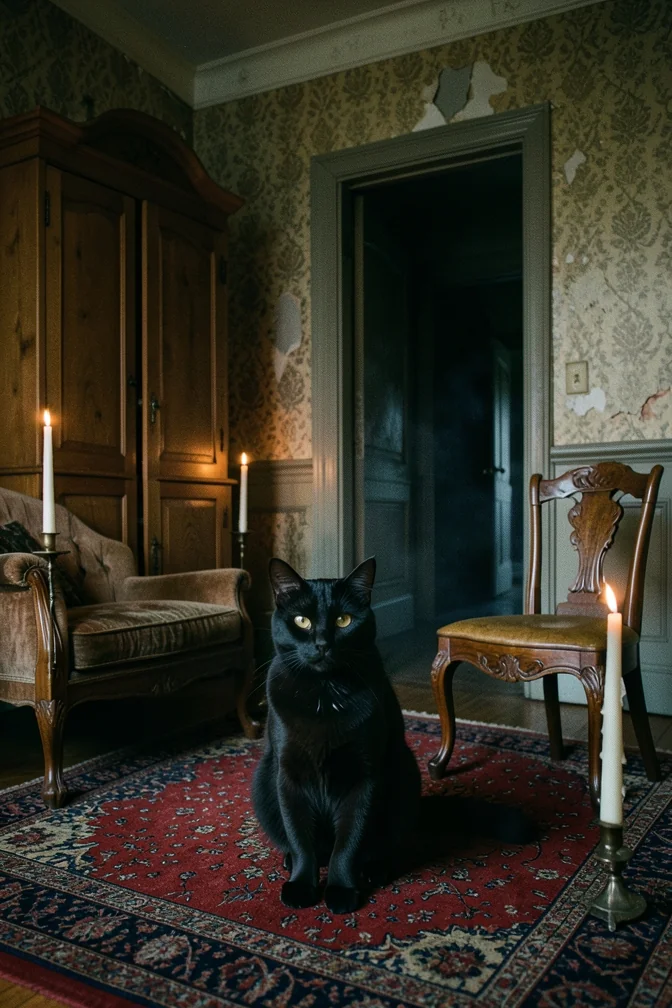
Edition and rights: Complete original English text from Project Gutenberg ebook #72421. This edition is identified as public domain in the USA; the original author died in 1940, satisfying the ordinary Pakistan copyright term. This is the original work, not an AI retelling.
THE CAT


Many people will, doubtless, remember that exhibition at the Royal
Academy, not so many seasons ago, which came to be known as Alingham’s
year, when Dick Alingham vaulted, with one bound, as it were, out of the
crowd of strugglers and seated himself with admirably certain poise on
the very topmost pinnacle of contemporary fame. He exhibited three
portraits, each a master-piece, which killed every picture within range.
But since that year nobody cared anything for pictures whether in or out
of range except those three, it did not signify so greatly. The
phenomenon of his appearance was as sudden as that of the meteor, coming
from nowhere and sliding large and luminous across the remote and
star-sown sky, as inexplicable as the bursting of a spring on some
dust-ridden rocky hillside. Some fairy godmother, one might conjecture,
had bethought herself of her forgotten godson, and with a wave of her
wand bestowed on him this transcendant gift. But, as the Irish say, she
held her wand in her left hand, for her gift had another side to it. Or
perhaps, again, Jim Merwick is right, and the theory he propounds in his
monograph, “On certain obscure lesions of the nerve centres,” says the
final word on the subject.

Dick Alingham himself, as was indeed natural, was delighted with his
fairy godmother or his obscure lesion (whichever was responsible), and
(the monograph spoken of above was written after Dick’s death) confessed
frankly to his friend Merwick, who was still struggling through the
crowd of rising young medical practitioners, that it was all quite as
inexplicable to himself as it was to anyone else.

“All I know about it,” he said, “is that last autumn I went through two
months of mental depression so hideous that I thought again and again
that I must go off my head. For hours daily, I sat here, waiting for
something to crack, which as far as I am concerned would end everything.
Yes, there was a cause; you know it.”

He paused a moment and poured into his glass a fairly liberal allowance
of whisky, filled it half up from a syphon, and lit a cigarette. The
cause, indeed, had no need to be enlarged on, for Merwick quite well
remembered how the girl Dick had been engaged to, threw him over with an
abruptness that was almost superb, when a more eligible suitor made his
appearance. The latter was certainly very eligible indeed with his
good looks, his title, and his million of money, and Lady
Madingley--ex-future Mrs Alingham--was perfectly content with what she
had done. She was one of those blonde, lithe, silken girls who, happily
for the peace of men’s minds, are rather rare, and who remind one of
some humanised yet celestial and bestial cat.

“I needn’t speak of the cause,” Dick continued, “but, as I say, for
those two months I soberly thought that the only end to it would be
madness. Then one evening when I was sitting here alone--I was always
sitting alone--something did snap in my head. I know I wondered, without
caring at all, whether this was the madness which I had been expecting,
or whether (which would be preferable) some more fatal breakage had
happened. And even while I wondered, I was aware that I was not
depressed or unhappy any longer.”

He paused for so long in a smiling retrospect that Merwick indicated to
him that he had a listener.

“Well?” he said.

“It was well indeed. I haven’t been unhappy since. I have been riotously
happy instead. Some divine doctor, I suppose, just wiped off that stain
on my brain that hurt so. Heavens, how it hurt! Have a drink, by the
way?”

“No, thanks,” said Merwick. “But what has all this got to do with your
painting?”

“Why, everything. For I had hardly realised the fact that I was happy
again, when I was aware that everything looked different. The colours of
all I saw were twice as vivid as they had been, shape and outline were
intensified too. The whole visible world had been dusty and blurred
before, and seen in a half light. But now the lights were turned up, and
there was a new heaven and a new earth. And in the same flash, I knew
that I could paint things as I saw them. Which,” he concluded, “I have
done.”

There was something rather sublime about this, and Merwick laughed.

“I wish something would snap in my brain, if it kindles the perceptions
in that way,” said he, “but it is just possible that the snapping of
things in one’s brain does not always produce just that effect.”

“That is possible. Also, as I gather, things don’t snap unless you have
gone through some such hideous period as I have been through. And I tell
you frankly that I wouldn’t go through that again even to ensure a snap
that would make me see things like Titian.”

“What did the snapping feel like?” asked Merwick.

Dick considered a moment.

“Do you know when a parcel comes, tied up with string, and you can’t
find a knife,” he said, “and therefore you burn the string through,
holding it taut? Well, it was like that: quite painless, only something
got weaker and weaker, and then parted, softly without effort. Not very
lucid, I’m afraid, but it was just like that. It had been burning a
couple of months, you see.”

He turned away and hunted among the letters and papers which littered
his writing-table till he found an envelope with a coronet on it. He
chuckled to himself as he took it up.

“Commend me to Lady Madingley,” he said, “for a brazen impudence in
comparison with which brass is softer than putty. She wrote to me
yesterday, asking me if I would finish the portrait I had begun of her
last year, and let her have it at my own price.”

“Then I think you have had a lucky escape,” remarked Merwick, “I suppose
you didn’t even answer her.”

“Oh, yes, I did: why not? I said the price would be two thousand pounds,
and I was ready to go on at once. She has agreed, and sent me a cheque
for a thousand this evening.”

Merwick stared at him in blank astonishment. “Are you mad?” he asked.

“I hope not, though one can never be sure about little points like that.
Even doctors like you don’t know exactly what constitutes madness.”

Merwick got up.

“But is it possible that you don’t see what a terrible risk you run?” he
asked. “To see her again, to be with her like that, having to look at
her--I saw her this afternoon by the way, hardly human--may not that so
easily revive again all that you felt before? It is too dangerous: much
too dangerous.”

Dick shook his head.

“There is not the slightest risk,” he said, “everything within me is
utterly and absolutely indifferent to her. I don’t even hate her: if I
hated her there might be a possibility of my again loving her. As it is,
the thought of her does not arouse in me any emotion of any kind. And
really such stupendous calmness deserves to be rewarded. I respect
colossal things like that.”

He finished his whisky as he spoke, and instantly poured himself out
another glass.

“That’s the fourth,” said his friend.

“Is it? I never count. It shows a sordid attention to uninteresting
detail. Funnily enough too, alcohol does not have the smallest effect on
me now.”

“Why drink then?”

“Because if I give it up this entrancing vividness of colour and clarity
of outline is a little diminished.”

“Can’t be good for you,” said the doctor.

Dick laughed.

“My dear fellow, look at me carefully,” he said, “and then if you can
conscientiously declare that I show any signs of indulging in
stimulants, I’ll give them up altogether.”

Certainly it would have been hard to find a point in which Dick did not
present the appearance of perfect health. He had paused, and stood still
a moment, his glass in one hand, the whisky-bottle in the other, black
against the front of his shirt, and not a tremor of unsteadiness was
there. His face of wholesome sun-burnt hue was neither puffy nor
emaciated, but firm of flesh and of a wonderful clearness of skin. Clear
too was his eye, with eyelids neither baggy nor puckered; he looked
indeed a model of condition, hard and fit, as if he was in training for
some athletic event. Lithe and active too was his figure, his movements
were quick and precise, and even Merwick, with his doctor’s eye, trained
to detect any symptom, however slight, in which the drinker must betray
himself, was bound to confess that no such was here present. His
appearance contradicted it authoritatively, so also did his manner; he
met the eye of the man he was talking to without sideway glances; he
showed no signs however small, of any disorder of the nerves. Yet Dick
was altogether an abnormal fellow; the history he had just been
recounting was abnormal, those weeks of depression, followed by the
sudden snap in his brain which had apparently removed, as a wet cloth
removes a stain, all the memory of his love, and of the cruel bitterness
that resulted from it. Abnormal too was his sudden leap into high
artistic achievement from a past of very mediocre performance. Why
should there then not be a similar abnormality here?

“Yes, I confess you show no sign of taking excessive stimulant,” said
Merwick, “but if I attended you professionally--ah, I’m not touting--I
should make you give up all stimulant, and go to bed for a month.”

“Why in the name of goodness?” asked Dick.

“Because, theoretically, it must be the best thing you could do. You had
a shock, how severe, the misery of those weeks of depression tells you.
Well, common-sense says, ‘Go slow after a shock; recoup.’ Instead of
which you go very fast indeed and produce. I grant it seems to suit you;
you also became suddenly capable of feats which--oh, it’s sheer
nonsense, man.”

“What’s sheer nonsense?”

“You are. Professionally, I detest you, because you appear to be an
exception to a theory that I am sure must be right. Therefore I have got
to explain you away, and at present I can’t.”

“What’s the theory?” asked Dick.

“Well, the treatment of shock first of all. And secondly, that in order
to do good work, one ought to eat and drink very little and sleep a lot.
How long do you sleep by the way?”

Dick considered.

“Oh, I go to bed about three usually,” he said; “I suppose I sleep for
about four hours.”

“And live on whisky, and eat like a Strasburg goose, and are prepared to
run a race to-morrow. Go away, or at least I will. Perhaps you’ll break
down, though. That would satisfy me. But even if you don’t, it still
remains quite interesting.”

Merwick found it more than quite interesting in fact, and when he got
home that night he searched in his shelves for a certain dusky volume in
which he turned up a chapter called “Shock.” The book was a treatise on
obscure diseases and abnormal conditions of the nervous system. He had
often read it before, for in his profession he was a special student of
the rare and curious. And the following paragraph which had interested
him much before, interested him more than ever this evening.

“The nervous system also can act in a way that must always even to the
most advanced student be totally unexpected. Cases are known, and
well-authenticated ones, when a paralytic person has jumped out of bed
on the cry of ‘Fire.’ Cases too are known when a great shock, which
produces depression so profound as to amount to lethargy, is followed by
abnormal activity, and the calling into use of powers which were
previously unknown to exist, or at any rate existed in a quite ordinary
degree. Such a hyper-sensitised state, especially since the desire for
sleep or rest is very often much diminished, demands much stimulant in
the way of food and alcohol. It would appear also that the patient
suffering from this rare form of the after-consequences of shock has
sooner or later some sudden and complete break-down. It is impossible,
however, to conjecture what form this will take. The digestion, however,
may become suddenly atrophied, delirium tremens may, without warning,
supervene, or he may go completely off his head....”

       *       *       *       *       *

But the weeks passed on, the July suns made London reel in a haze of
heat, and yet Alingham remained busy, brilliant and altogether
exceptional. Merwick, unknown to him, was watching him closely, and at
present was completely puzzled. He held Dick to his word that if he
could detect the slightest sign of over-indulgence in stimulant, he
would cut it off altogether, but he could see absolutely none. Lady
Madingley meantime had given him several sittings, and in this
connection again Merwick was utterly mistaken in the view he had
expressed to Dick as to the risks he ran. For, strangely enough, the two
had become great friends. Yet Dick was quite right, all emotion with
regard to her on his part was dead, it might have been a piece of
still-life that he was painting, instead of a woman he had wildly
worshipped.

One morning in mid-July she had been sitting to him in his studio, and
contrary to custom he had been rather silent, biting the ends of his
brushes, frowning at his canvas, frowning too at her. Suddenly he gave a
little impatient exclamation.

“It’s so like you,” he said, “but it just isn’t you. There’s a lot of
difference! I can’t help making you look as if you were listening to a
hymn, one of those in four sharps, don’t you know, written by an
organist, probably after eating muffins. And that’s not characteristic
of you!”

She laughed.

“You must be rather ingenious to put all that in,” she said.

“I am.”

“Where do I show it all?”

Dick sighed.

“Oh, in your eyes of course,” he said. “You show everything by your
eyes, you know. It is entirely characteristic of you. You are a
throw-back; don’t you remember we settled that ever so long ago, to the
brute creation, who likewise show everything by their eyes.”

“Oh-h. I should have thought that dogs growled at you, and cats
scratched.”

“Those are practical measures, but short of that you and animals use
their eyes only, whereas people use their mouths and foreheads and other
things. A pleased dog, an expectant dog, a hungry dog, a jealous dog, a
disappointed dog--one gathers all that from a dog’s eyes. Their mouths
are comparatively immobile, and a cat’s is even more so.”

“You have often told me that I belong to the genus cat,” said Lady
Madingley, with complete composure.

“By Jove, yes,” said he. “Perhaps looking at the eyes of a cat would
help me to see what I miss. Many thanks for the hint.”

He put down his palette and went to a side table on which stood bottles
and ice and syphons.

“No drink of any kind on this Sahara of a morning?” he asked.

“No, thanks. Now when will you give me the final sitting? You said you
only wanted one more.”

Dick helped himself.

“Well, I go down to the country with this,” he said, “to put in the
background I told you of. With luck it will take me three days hard
painting, without luck a week or more. Oh, my mouth waters at the
thought of the background. So shall we say to-morrow week?”

Lady Madingley made a note of this in a minute gold and jewelled
memorandum book.

“And I am to be prepared to see cat’s eyes painted there instead of my
own when I see it next?” she asked, passing by the canvas.

Dick laughed.

“Oh, you will hardly notice the difference,” he said. “How odd it is
that I always have detested cats so--they make me feel actually faint,
although you always reminded me of a cat.”

“You must ask your friend Mr Merwick about these metaphysical
mysteries,” said she.

       *       *       *       *       *

The background to the picture was at present only indicated by a few
vague splashes close to the side of the head of brilliant purple and
brilliant green, and the artist’s mouth might well water at the thought
of the few days painting that lay before him. For behind the figure in
the long panel-shaped canvas was to be painted a green trellis, over
which, almost hiding the woodwork, there was to sprawl a great purple
clematis in full flaunting glory of varnished leaf and starry flower. At
the top would be just a strip of pale summer sky, at her feet just a
strip of grey-green grass, but all the rest of the background, greatly
daring, would be this diaper of green and purple. For the purpose of
putting this in, he was going down to a small cottage of his near
Godalming, where he had built in the garden a sort of outdoor studio, an
erection betwixt a room and a mere shelter, with the side to the north
entirely open, and flanked by this green trellis which was now one
immense constellation of purple stars. Framed in this, he well knew how
the strange pale beauty of his sitter would glow on the canvas, how she
would start out of the background, she and her huge grey hat, and
shining grey dress, and yellow hair and ivory white skin and pale eyes,
now blue, now grey, now green. This was indeed a thing to look forward
to, for there is probably no such unadulterated rapture known to men as
creation, and it was small wonder that Dick’s mood, as he travelled down
to Godalming, was buoyant and effervescent. For he was going, so to
speak, to realise his creation: every purple star of clematis, every
green leaf and piece of trellis-work that he put in, would cause what he
had painted to live and shine, just as it is the layers of dusk that
fall over the sky at evening which make the stars to sparkle there,
jewel-like. His scheme was assured, he had hung his constellation--the
figure of Lady Madingley--in the sky: and now he had to surround it with
the green and purple night, so that it might shine.

His garden was but a circumscribed plot, but walls of old brick
circumscribed it, and he had dealt with the space at his command with a
certain originality. At no time had his grass plot (you could scarcely
call it “lawn”) been spacious; now the outdoor studio, twenty-five feet
by thirty, took up the greater part of it. He had a solid wooden wall on
one side and two trellis walls to the south and east, which creepers
were beginning to clothe and which were faced internally by hangings of
Syrian and Oriental work. Here in the summer he passed the greater part
of the day, painting or idling, and living an outdoor existence. The
floor, which had once been grass, which had withered completely under
the roof, was covered with Persian rugs; a writing-table, and a
dining-table were there, a bookcase full of familiar friends and a
half-dozen of basket chairs. One corner, too, was frankly given up to
the affairs of the garden, and a mowing machine, a hose for watering,
shears, and spade stood there. For like many excitable persons, Dick
found that in gardening, that incessant process of plannings and
designings to suit the likings of plants, and make them gorgeous in
colour and high of growth, there was a wonderful calm haven of refuge
for the brain that had been tossing on emotional seas. Plants, too, were
receptive, so responsive to kindness; thought given to them was never
thought wasted, and to come back now after a month’s absence in London
was to be assured of fresh surprise and pleasure in each foot of
garden-bed. And here, with how regal a generosity was the purple
clematis to repay him for the care lavished on it. Every flower would
show its practical gratitude by standing model for the background of his
picture.

The evening was very warm, warm not with any sultry premonition of
thunder, but with the clear, clean heat of summer, and he dined alone in
his shelter, with the after-flames of the sunset for his lamp. These
slowly faded into a sky of velvet blue, but he lingered long over his
coffee looking northwards across the garden towards the row of trees
that screened him from the house beyond. These were acacias, most
graceful and feminine of all green things that grow, summer-plumaged
now, yet still fresh of leaf. Below them ran a little raised terrace of
turf and nearer the beds of the beloved garden; clumps of sweet peas
made an inimitable fragrance, and the rose-beds were pink with _Baroness
Rothschild_ and _La France_, and copper-coloured with _Beauté
inconstante_, and the _Richardson_ rose. Then, nearer at hand, was the
green trellis foaming with purple.

He was sitting there, hardly looking, but unconsciously drinking in this
great festival of colour, when his eye was arrested by a dark slinking
form that appeared among the roses, and suddenly turned two shining
luminous orbs on him. At this he started up, but his movement caused no
perturbation in the animal, which continued with back arched for
stroking, and poker-like tail, to advance towards him, purring. As it
came closer Dick felt that shuddering faintness, which often affected
him in the presence of cats, come over him, and he stamped and clapped
his hands. At this it turned tail quickly: a sort of dark shadow
streaked the garden-wall for a moment, and it vanished. But its
appearance had spoiled for him the sweet spell of the evening, and he
went indoors.

The next morning was pellucid summer: a faint north wind blew, and a sun
worthy to illumine the isles of Greece flooded the sky. Dick’s dreamless
and (for him) long sleep had banished from his mind that rather
disquieting incident of the cat, and he set up his canvas facing the
trellis-work and purple clematis with a huge sense of imminent ecstasy.
Also the garden, which at present he had only seen in the magic of
sunset, was gloriously rewarding, and glowed with colour, and though
life--this was present to his mind for the first time for months--in
the shape of Lady Madingley had not been very propitious, yet a man, he
argued to himself, must be a very poor hand at living if, with a passion
for plants and a passion for art, he cannot fashion a life that shall be
full of content. So breakfast being finished, and his model ready and
glowing with beauty, he quickly sketched in the broad lines of flowers
and foliage and began to paint.

Purple and green, green and purple: was there ever such a feast for the
eye? Gourmet like and greedy as well, he was utterly absorbed in it. He
was right too: as soon as he put on the first brush of colour he knew he
was right. It was just those divine and violent colours which would
cause his figure to step out from the picture, it was just that pale
strip of sky above which would focus her again, it was just that strip
of grey-green grass below her feet that would prevent her, so it seemed,
from actually leaving the canvas. And with swift eager sweeps of the
brush which never paused and never hurried, he lost himself in his work.

He stopped at length with a sense of breathlessness, feeling too as if
he had been suddenly called back from some immense distance off. He must
have been working some three hours, for his man was already laying the
table for lunch, yet it seemed to him that the morning had gone by in
one flash. The progress he had made was extraordinary, and he looked
long at his picture. Then his eye wandered from the brightness of the
canvas to the brightness of the garden-beds. There, just in front of the
bed of sweet-peas, not two yards from him, stood a very large grey cat,
watching him.

Now the presence of a cat was a thing that usually produced in Dick a
feeling of deadly faintness, yet, at this moment, as he looked at the
cat and the cat at him, he was conscious of no such feeling, and put
down the absence of it, in so far as he consciously thought about it, to
the fact that he was in the open air, not in the atmosphere of a closed
room. Yet, last night out here, the cat had made him feel faint. But he
hardly gave a thought to this, for what filled his mind was that he saw
in the rather friendly interested look of the beast that expression in
the eye which had so baffled him in his portrait of Lady Madingley. So,
slowly, and without any sudden movement that might startle the cat, he
reached out his hand for the palette he had just put down, and in a
corner of the canvas not yet painted over, recorded in half a dozen
swift intuitive touches, what he wanted. Even in the broad sunlight
where the animal stood, its eyes looked as if they were internally
smouldering as well as being lit from without: it was just so that Lady
Madingley looked. He would have to lay colour very thinly over white....

For five minutes or so he painted them with quiet eager strokes,
drawing the colour thinly over the background of white, and then looked
long at that sketch of the eye to see if he had got what he wanted. Then
he looked back at the cat which had stood so charmingly for him. But
there was no cat there. That, however, since he detested them, and this
one had served his purpose, was no matter for regret, and he merely
wondered a little at the suddenness of its disappearance. But the legacy
it had left on the canvas could not vanish thus, it was his own, a
possession, an achievement. Truly this was to be a portrait which would
altogether out-distance all he had ever done before. A woman, real,
alive, wearing her soul in her eyes, should stand there, and summer riot
round her.

An extraordinary clearness of vision was his all day, and towards sunset
an empty whisky-bottle. But this evening he was conscious for the first
time of two feelings, one physical, one mental, altogether strange to
him: the first an impression that he had drunk as much as was good for
him, the second a sort of echo in his mind of those tortures he had
undergone in the autumn, when he had been tossed aside by the girl, to
whom he had given his soul, like a soiled glove. Neither were at all
acutely felt, but both were present to him.

The evening altogether belied the brilliance of the day, and about six
o’clock thick clouds had driven up over the sky, and the clear heat of
summer had given place to a heat no less intense, but full of the
menace of storm. A few big hot drops, too, of rain warned him further,
and he pulled his easel into shelter, and gave orders that he would dine
indoors. As was usual with him when he was at work, he shunned the
distracting influence of any companionship, and he dined alone. Dinner
finished, he went into his sitting-room prepared to enjoy his solitary
evening. His servant had brought him in the tray, and till he went to
bed he would be undisturbed. Outside the storm was moving nearer, the
reverberation of the thunder, though not yet close, kept up a continual
growl: any moment it might move up and burst above in riot of fire and
sound.

Dick read a book for a while, but his thoughts wandered. The poignancy
of his trouble last autumn, which he thought had passed away from him
for ever, grew suddenly and strangely more acute, also his head was
heavy, perhaps with the storm, but possibly with what he had drunk. So,
intending to go to bed and sleep off his disquietude, he closed his
book, and went across to the window to close that also. But, half-way
towards it, he stopped. There on the sofa below it sat a large grey cat
with yellow gleaming eyes. In its mouth it held a young thrush, still
alive.

Then horror woke in him: his feeling of sick-faintness was there, and he
loathed and was terrified at this dreadful feline glee in the torture of
its prey, a glee so great that it preferred the postponement of its
meal to a shortening of the other. More than all, the resemblance of the
eyes of this cat to those of his portrait suddenly struck him as
something hellish. For one moment this all held him bound, as if with
paralysis, the next his physical shuddering could be withstood no
longer, and he threw the glass he carried at the cat, missing it. For
one second the animal paused there glaring at him with an intense and
dreadful hostility, then it made one spring of it out of the open
window. Dick shut it with a bang that startled himself, and then
searched on the sofa and the floor for the bird which he thought the cat
had dropped. Once or twice he thought he heard it feebly fluttering, but
this must have been an illusion, for he could not find it.

All this was rather shaky business, so before going to bed he steadied
himself, as his unspoken phrase ran, with a final drink. Outside the
thunder had ceased, but the rain beat hissing on to the grass. Then
another sound mingled with it, the mewing of a cat, not the long drawn
screeches and cries that are usual, but the plaintive calls of the beast
that wants to be admitted into its own home. The blind was down, but
after a while he could not resist peeping out. There on the window-sill
was seated the large grey cat. Though it was raining heavily its fur
seemed dry, for it was standing stiffly away from its body. But when it
saw him it spat at him, scratching angrily at the glass, and vanished.

Lady Madingley ... heavens, how he had loved her! And, infernally as she
had treated him, how passionately he wanted her now. Was all his trouble
then to begin over again? Had that nightmare dawned anew on him? It was
the cat’s fault: the eyes of the cat had done it. Yet just now all his
desire was blurred by this dullness of brain that was as unaccountable
as the re-awakening of his desire. For months now he had drunk far more
than he had drunk to-day, yet evening had seen him clear-headed, acute,
master of himself, and revelling in the liberty that had come to him,
and in the cool joy of creative vision. But to-night he stumbled and
groped across the room.

The neutral-coloured light of dawn awoke him, and he got up at once,
feeling still very drowsy, but in answer to some silent imperative call.
The storm had altogether passed away, and a jewel of a morning star hung
in a pale heaven. His room looked strangely unfamiliar to him, his own
sensations were unfamiliar, there was a vagueness about things, a
barrier between him and the world. One desire alone possessed him, to
finish the portrait. All else, so he felt, he left to chance, or
whatever laws regulate the world, those laws which choose that a certain
thrush shall be caught by a certain cat, and choose one scapegoat out of
a thousand, and let the rest go free.

Two hours later his servant called him, and found him gone from his
room. So as the morning was so fair, he went out to lay breakfast in the
shelter. The portrait was there, it had been dragged back into position
by the clematis, but it was covered with strange scratches, as if the
claws of some enraged animal or the nails perhaps of a man had furiously
attacked it. Dick Alingham was there, too, lying very still in front of
the disfigured canvas. Claws, also, or nails had attacked him, his
throat was horribly mangled by them. But his hands were covered with
paint, the nails of his fingers too were choked with it.
1 / 1


