
The Mezzotint
Read The Mezzotint by M. R. James in the original English.
By M. R. James
Edition: Complete story in the original English, from Project Gutenberg #8486. No translation or AI rewriting of the literary text. Original spelling retained.
This eBook is for the use of anyone anywhere in the United States and most other parts of the world at no cost and with almost no restrictions whatsoever. You may copy it, give it away or re-use it under the terms of the Project Gutenberg License included with this eBook or online at www.gutenberg.org. If you are not located in the United States, you will have to check the laws of the country where you are located before using this eBook.
Some time ago I believe I had the pleasure of telling you the story of an adventure which happened to a friend of mine by the name of Dennistoun, during his pursuit of objects of art for the museum at Cambridge.
He did not publish his experiences very widely upon his return to England; but they could not fail to become known to a good many of his friends, and among others to the gentleman who at that time presided over an art museum at another University. It was to be expected that the story should make a considerable impression on the mind of a man whose vocation lay in lines similar to Dennistoun’s, and that he should be eager to catch at any explanation of the matter which tended to make it seem improbable that he should ever be called upon to deal with so agitating an emergency. It was, indeed, somewhat consoling to him to reflect that he was not expected to acquire ancient MSS. for his institution; that was the business of the Shelburnian Library. The authorities of that institution might, if they pleased, ransack obscure corners of the Continent for such matters. He was glad to be obliged at the moment to confine his attention to enlarging the already unsurpassed collection of English topographical drawings and engravings possessed by his museum. Yet, as it turned out, even a department so homely and familiar as this may have its dark corners, and to one of these Mr Williams was unexpectedly introduced.
Those who have taken even the most limited interest in the acquisition of topographical pictures are aware that there is one London dealer whose aid is indispensable to their researches. Mr J. W. Britnell publishes at short intervals very admirable catalogues of a large and constantly changing stock of engravings, plans, and old sketches of mansions, churches, and towns in England and Wales. These catalogues were, of course, the ABC of his subject to Mr Williams: but as his museum already contained an enormous accumulation of topographical pictures, he was a regular, rather than a copious, buyer; and he rather looked to Mr Britnell to fill up gaps in the rank and file of his collection than to supply him with rarities.
Now, in February of last year there appeared upon Mr Williams’s desk at the museum a catalogue from Mr Britnell’s emporium, and accompanying it was a typewritten communication from the dealer himself. This latter ran as follows:
DEAR SIR, We beg to call your attention to No. 978 in our accompanying catalogue, which we shall be glad to send on approval.
Yours faithfully, J. W. BRITNELL.
To turn to No. 978 in the accompanying catalogue was with Mr. Williams (as he observed to himself) the work of a moment, and in the place indicated he found the following entry:
978.—Unknown. Interesting mezzotint: View of a manor-house, early part of the century. 15 by 10 inches; black frame. £2 2s.
It was not specially exciting, and the price seemed high. However, as Mr Britnell, who knew his business and his customer, seemed to set store by it, Mr Williams wrote a postcard asking for the article to be sent on approval, along with some other engravings and sketches which appeared in the same catalogue. And so he passed without much excitement of anticipation to the ordinary labours of the day.
A parcel of any kind always arrives a day later than you expect it, and that of Mr Britnell proved, as I believe the right phrase goes, no exception to the rule. It was delivered at the museum by the afternoon post of Saturday, after Mr Williams had left his work, and it was accordingly brought round to his rooms in college by the attendant, in order that he might not have to wait over Sunday before looking through it and returning such of the contents as he did not propose to keep. And here he found it when he came in to tea, with a friend.
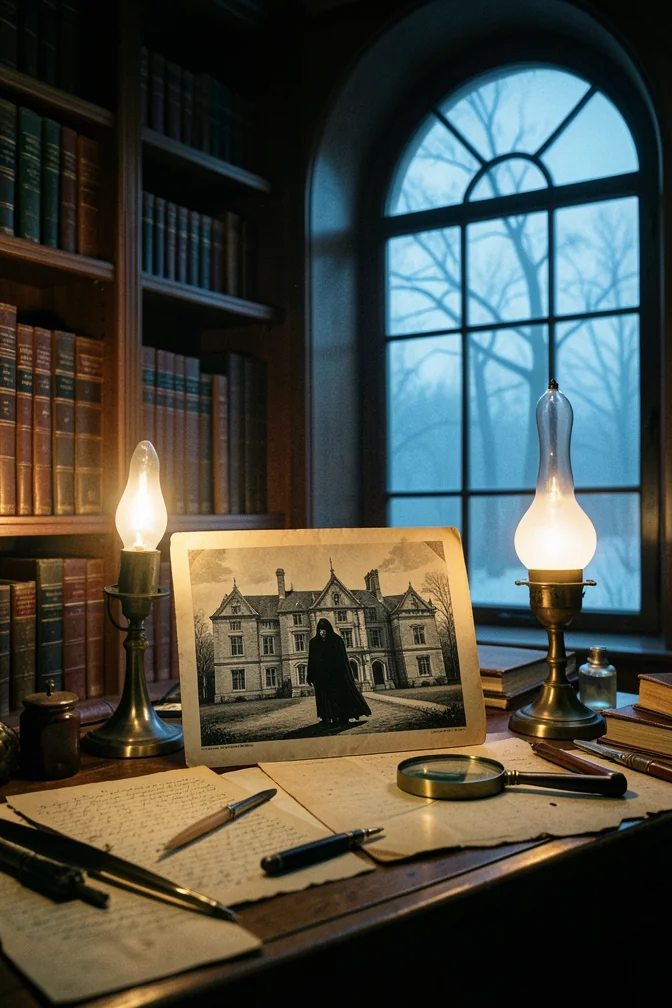
The only item with which I am concerned was the rather large, black-framed mezzotint of which I have already quoted the short description given in Mr Britnell’s catalogue. Some more details of it will have to be given, though I cannot hope to put before you the look of the picture as clearly as it is present to my own eye. Very nearly the exact duplicate of it may be seen in a good many old inn parlours, or in the passages of undisturbed country mansions at the present moment. It was a rather indifferent mezzotint, and an indifferent mezzotint is, perhaps, the worst form of engraving known. It presented a full-face view of a not very large manor-house of the last century, with three rows of plain sashed windows with rusticated masonry about them, a parapet with balls or vases at the angles, and a small portico in the centre. On either side were trees, and in front a considerable expanse of lawn. The legend A. W. F. sculpsit was engraved on the narrow margin; and there was no further inscription. The whole thing gave the impression that it was the work of an amateur. What in the world Mr Britnell could mean by affixing the price of £2 2s. to such an object was more than Mr Williams could imagine. He turned it over with a good deal of contempt; upon the back was a paper label, the left-hand half of which had been torn off. All that remained were the ends of two lines of writing: the first had the letters—ngley Hall; the second,—ssex.
It would, perhaps, be just worth while to identify the place represented, which he could easily do with the help of a gazetteer, and then he would send it back to Mr Britnell, with some remarks reflecting upon the judgement of that gentleman.
He lighted the candles, for it was now dark, made the tea, and supplied the friend with whom he had been playing golf (for I believe the authorities of the University I write of indulge in that pursuit by way of relaxation); and tea was taken to the accompaniment of a discussion which golfing persons can imagine for themselves, but which the conscientious writer has no right to inflict upon any non-golfing persons.
The conclusion arrived at was that certain strokes might have been better, and that in certain emergencies neither player had experienced that amount of luck which a human being has a right to expect. It was now that the friend—let us call him Professor Binks—took up the framed engraving, and said:
“What’s this place, Williams?”
“Just what I am going to try to find out,” said Williams, going to the shelf for a gazetteer. “Look at the back. Somethingley Hall, either in Sussex or Essex. Half the name’s gone, you see. You don’t happen to know it, I suppose?”
“It’s from that man Britnell, I suppose, isn’t it?” said Binks. “Is it for the museum?”
“Well, I think I should buy it if the price was five shillings,” said Williams; “but for some unearthly reason he wants two guineas for it. I can’t conceive why. It’s a wretched engraving, and there aren’t even any figures to give it life.”
“It’s not worth two guineas, I should think,” said Binks; “but I don’t think it’s so badly done. The moonlight seems rather good to me; and I should have thought there were figures, or at least a figure, just on the edge in front.”
“Let’s look,” said Williams. “Well, it’s true the light is rather cleverly given. Where’s your figure? Oh yes! Just the head, in the very front of the picture.”
And indeed there was—hardly more than a black blot on the extreme edge of the engraving—the head of a man or woman, a good deal muffled up, the back turned to the spectator, and looking towards the house.
Williams had not noticed it before.
“Still,” he said, “though it’s a cleverer thing than I thought, I can’t spend two guineas of museum money on a picture of a place I don’t know.”
Professor Binks had his work to do, and soon went; and very nearly up to Hall time Williams was engaged in a vain attempt to identify the subject of his picture. “If the vowel before the ng had only been left, it would have been easy enough,” he thought; “but as it is, the name may be anything from Guestingley to Langley, and there are many more names ending like this than I thought; and this rotten book has no index of terminations.”
Hall in Mr Williams’s college was at seven. It need not be dwelt upon; the less so as he met there colleagues who had been playing golf during the afternoon, and words with which we have no concern were freely bandied across the table—merely golfing words, I would hasten to explain.
I suppose an hour or more to have been spent in what is called common-room after dinner. Later in the evening some few retired to Williams’s rooms, and I have little doubt that whist was played and tobacco smoked. During a lull in these operations Williams picked up the mezzotint from the table without looking at it, and handed it to a person mildly interested in art, telling him where it had come from, and the other particulars which we already know.
The gentleman took it carelessly, looked at it, then said, in a tone of some interest:
“It’s really a very good piece of work, Williams; it has quite a feeling of the romantic period. The light is admirably managed, it seems to me, and the figure, though it’s rather too grotesque, is somehow very impressive.”
“Yes, isn’t it?” said Williams, who was just then busy giving whisky-and-soda to others of the company, and was unable to come across the room to look at the view again.
It was by this time rather late in the evening, and the visitors were on the move. After they went Williams was obliged to write a letter or two and clear up some odd bits of work. At last, some time past midnight, he was disposed to turn in, and he put out his lamp after lighting his bedroom candle. The picture lay face upwards on the table where the last man who looked at it had put it, and it caught his eye as he turned the lamp down. What he saw made him very nearly drop the candle on the floor, and he declares now that if he had been left in the dark at that moment he would have had a fit. But, as that did not happen, he was able to put down the light on the table and take a good look at the picture. It was indubitable—rankly impossible, no doubt, but absolutely certain. In the middle of the lawn in front of the unknown house there was a figure where no figure had been at five o’clock that afternoon. It was crawling on all-fours towards the house, and it was muffled in a strange black garment with a white cross on the back.
I do not know what is the ideal course to pursue in a situation of this kind. I can only tell you what Mr Williams did. He took the picture by one corner and carried it across the passage to a second set of rooms which he possessed. There he locked it up in a drawer, sported the doors of both sets of rooms, and retired to bed; but first he wrote out and signed an account of the extraordinary change which the picture had undergone since it had come into his possession.
Sleep visited him rather late; but it was consoling to reflect that the behaviour of the picture did not depend upon his own unsupported testimony. Evidently the man who had looked at it the night before had seen something of the same kind as he had, otherwise he might have been tempted to think that something gravely wrong was happening either to his eyes or his mind. This possibility being fortunately precluded, two matters awaited him on the morrow. He must take stock of the picture very carefully, and call in a witness for the purpose, and he must make a determined effort to ascertain what house it was that was represented. He would therefore ask his neighbour Nisbet to breakfast with him, and he would subsequently spend a morning over the gazetteer.
Nisbet was disengaged, and arrived about 9.30. His host was not quite dressed, I am sorry to say, even at this late hour. During breakfast nothing was said about the mezzotint by Williams, save that he had a picture on which he wished for Nisbet’s opinion. But those who are familiar with University life can picture for themselves the wide and delightful range of subjects over which the conversation of two Fellows of Canterbury College is likely to extend during a Sunday morning breakfast. Hardly a topic was left unchallenged, from golf to lawn-tennis. Yet I am bound to say that Williams was rather distraught; for his interest naturally centred in that very strange picture which was now reposing, face downwards, in the drawer in the room opposite.
The morning pipe was at last lighted, and the moment had arrived for which he looked. With very considerable—almost tremulous—excitement he ran across, unlocked the drawer, and, extracting the picture—still face downwards—ran back, and put it into Nisbet’s hands.
“Now,” he said, “Nisbet, I want you to tell me exactly what you see in that picture. Describe it, if you don’t mind, rather minutely. I’ll tell you why afterwards.”
“Well,” said Nisbet, “I have here a view of a country-house—English, I presume—by moonlight.”
“Moonlight? You’re sure of that?”
“Certainly. The moon appears to be on the wane, if you wish for details, and there are clouds in the sky.”
“All right. Go on. I’ll swear,” added Williams in an aside, “there was no moon when I saw it first.”
“Well, there’s not much more to be said,” Nisbet continued. “The house has one—two—three rows of windows, five in each row, except at the bottom, where there’s a porch instead of the middle one, and—”
“But what about figures?” said Williams, with marked interest.
“There aren’t any,” said Nisbet; “but—”
“What! No figure on the grass in front?”
“Not a thing.”
“You’ll swear to that?”
“Certainly I will. But there’s just one other thing.”
“What?”
“Why, one of the windows on the ground-floor—left of the door—is open.”
“Is it really so? My goodness! he must have got in,” said Williams, with great excitement; and he hurried to the back of the sofa on which Nisbet was sitting, and, catching the picture from him, verified the matter for himself.
It was quite true. There was no figure, and there was the open window. Williams, after a moment of speechless surprise, went to the writing-table and scribbled for a short time. Then he brought two papers to Nisbet, and asked him first to sign one—it was his own description of the picture, which you have just heard—and then to read the other which was Williams’s statement written the night before.
“What can it all mean?” said Nisbet.
“Exactly,” said Williams. “Well, one thing I must do—or three things, now I think of it. I must find out from Garwood”—this was his last night’s visitor—“what he saw, and then I must get the thing photographed before it goes further, and then I must find out what the place is.”
“I can do the photographing myself,” said Nisbet, “and I will. But, you know, it looks very much as if we were assisting at the working out of a tragedy somewhere. The question is, has it happened already, or is it going to come off? You must find out what the place is. Yes,” he said, looking at the picture again, “I expect you’re right: he has got in. And if I don’t mistake there’ll be the devil to pay in one of the rooms upstairs.”
“I’ll tell you what,” said Williams: “I’ll take the picture across to old Green” (this was the senior Fellow of the College, who had been Bursar for many years). “It’s quite likely he’ll know it. We have property in Essex and Sussex, and he must have been over the two counties a lot in his time.”
“Quite likely he will,” said Nisbet; “but just let me take my photograph first. But look here, I rather think Green isn’t up today. He wasn’t in Hall last night, and I think I heard him say he was going down for the Sunday.”
“That’s true, too,” said Williams; “I know he’s gone to Brighton. Well, if you’ll photograph it now, I’ll go across to Garwood and get his statement, and you keep an eye on it while I’m gone. I’m beginning to think two guineas is not a very exorbitant price for it now.”
In a short time he had returned, and brought Mr Garwood with him. Garwood’s statement was to the effect that the figure, when he had seen it, was clear of the edge of the picture, but had not got far across the lawn. He remembered a white mark on the back of its drapery, but could not have been sure it was a cross. A document to this effect was then drawn up and signed, and Nisbet proceeded to photograph the picture.
“Now what do you mean to do?” he said. “Are you going to sit and watch it all day?”
“Well, no, I think not,” said Williams. “I rather imagine we’re meant to see the whole thing. You see, between the time I saw it last night and this morning there was time for lots of things to happen, but the creature only got into the house. It could easily have got through its business in the time and gone to its own place again; but the fact of the window being open, I think, must mean that it’s in there now. So I feel quite easy about leaving it. And, besides, I have a kind of idea that it wouldn’t change much, if at all, in the daytime. We might go out for a walk this afternoon, and come in to tea, or whenever it gets dark. I shall leave it out on the table here, and sport the door. My skip can get in, but no one else.”
The three agreed that this would be a good plan; and, further, that if they spent the afternoon together they would be less likely to talk about the business to other people; for any rumour of such a transaction as was going on would bring the whole of the Phasmatological Society about their ears.
We may give them a respite until five o’clock.
At or near that hour the three were entering Williams’s staircase. They were at first slightly annoyed to see that the door of his rooms was unsported; but in a moment it was remembered that on Sunday the skips came for orders an hour or so earlier than on weekdays. However, a surprise was awaiting them. The first thing they saw was the picture leaning up against a pile of books on the table, as it had been left, and the next thing was Williams’s skip, seated on a chair opposite, gazing at it with undisguised horror. How was this? Mr Filcher (the name is not my own invention) was a servant of considerable standing, and set the standard of etiquette to all his own college and to several neighbouring ones, and nothing could be more alien to his practice than to be found sitting on his master’s chair, or appearing to take any particular notice of his master’s furniture or pictures. Indeed, he seemed to feel this himself. He started violently when the three men were in the room, and got up with a marked effort. Then he said:
“I ask your pardon, sir, for taking such a freedom as to set down.”
“Not at all, Robert,” interposed Mr Williams. “I was meaning to ask you some time what you thought of that picture.”
“Well, sir, of course I don’t set up my opinion again yours, but it ain’t the pictur I should ’ang where my little girl could see it, sir.”
“Wouldn’t you, Robert? Why not?”
“No, sir. Why, the pore child, I recollect once she see a Door Bible, with pictures not ’alf what that is, and we ’ad to set up with her three or four nights afterwards, if you’ll believe me; and if she was to ketch a sight of this skelinton here, or whatever it is, carrying off the pore baby, she would be in a taking. You know ’ow it is with children; ’ow nervish they git with a little thing and all. But what I should say, it don’t seem a right pictur to be laying about, sir, not where anyone that’s liable to be startled could come on it. Should you be wanting anything this evening, sir? Thank you, sir.”
With these words the excellent man went to continue the round of his masters, and you may be sure the gentlemen whom he left lost no time in gathering round the engraving. There was the house, as before, under the waning moon and the drifting clouds. The window that had been open was shut, and the figure was once more on the lawn: but not this time crawling cautiously on hands and knees. Now it was erect and stepping swiftly, with long strides, towards the front of the picture. The moon was behind it, and the black drapery hung down over its face so that only hints of that could be seen, and what was visible made the spectators profoundly thankful that they could see no more than a white dome-like forehead and a few straggling hairs. The head was bent down, and the arms were tightly clasped over an object which could be dimly seen and identified as a child, whether dead or living it was not possible to say. The legs of the appearance alone could be plainly discerned, and they were horribly thin.
From five to seven the three companions sat and watched the picture by turns. But it never changed. They agreed at last that it would be safe to leave it, and that they would return after Hall and await further developments.
When they assembled again, at the earliest possible moment, the engraving was there, but the figure was gone, and the house was quiet under the moonbeams. There was nothing for it but to spend the evening over gazetteers and guide-books. Williams was the lucky one at last, and perhaps he deserved it. At 11.30 p.m. he read from Murray’s Guide to Essex the following lines:
16½ miles, Anningley. The church has been an interesting building of Norman date, but was extensively classicized in the last century. It contains the tomb of the family of Francis, whose mansion, Anningley Hall, a solid Queen Anne house, stands immediately beyond the churchyard in a park of about 80 acres. The family is now extinct, the last heir having disappeared mysteriously in infancy in the year 1802. The father, Mr Arthur Francis, was locally known as a talented amateur engraver in mezzotint. After his son’s disappearance he lived in complete retirement at the Hall, and was found dead in his studio on the third anniversary of the disaster, having just completed an engraving of the house, impressions of which are of considerable rarity.
This looked like business, and, indeed, Mr Green on his return at once identified the house as Anningley Hall.
“Is there any kind of explanation of the figure, Green?” was the question which Williams naturally asked.
“I don’t know, I’m sure, Williams. What used to be said in the place when I first knew it, which was before I came up here, was just this: old Francis was always very much down on these poaching fellows, and whenever he got a chance he used to get a man whom he suspected of it turned off the estate, and by degrees he got rid of them all but one. Squires could do a lot of things then that they daren’t think of now. Well, this man that was left was what you find pretty often in that country—the last remains of a very old family. I believe they were Lords of the Manor at one time. I recollect just the same thing in my own parish.”
“What, like the man in Tess o’ the Durbervilles?” Williams put in.
“Yes, I dare say; it’s not a book I could ever read myself. But this fellow could show a row of tombs in the church there that belonged to his ancestors, and all that went to sour him a bit; but Francis, they said, could never get at him—he always kept just on the right side of the law—until one night the keepers found him at it in a wood right at the end of the estate. I could show you the place now; it marches with some land that used to belong to an uncle of mine. And you can imagine there was a row; and this man Gawdy (that was the name, to be sure—Gawdy; I thought I should get it—Gawdy), he was unlucky enough, poor chap! to shoot a keeper. Well, that was what Francis wanted, and grand juries—you know what they would have been then—and poor Gawdy was strung up in double-quick time; and I’ve been shown the place he was buried in, on the north side of the church—you know the way in that part of the world: anyone that’s been hanged or made away with themselves, they bury them that side. And the idea was that some friend of Gawdy’s—not a relation, because he had none, poor devil! he was the last of his line: kind of spes ultima gentis—must have planned to get hold of Francis’s boy and put an end to his line, too. I don’t know—it’s rather an out-of-the-way thing for an Essex poacher to think of—but, you know, I should say now it looks more as if old Gawdy had managed the job himself. Booh! I hate to think of it! have some whisky, Williams!”
The facts were communicated by Williams to Dennistoun, and by him to a mixed company, of which I was one, and the Sadducean Professor of Ophiology another. I am sorry to say that the latter, when asked what he thought of it, only remarked: “Oh, those Bridgeford people will say anything”—a sentiment which met with the reception it deserved.
I have only to add that the picture is now in the Ashleian Museum; that it has been treated with a view to discovering whether sympathetic ink has been used in it, but without effect; that Mr Britnell knew nothing of it save that he was sure it was uncommon; and that, though carefully watched, it has never been known to change again.
Source and edition terms: https://www.gutenberg.org/ebooks/8486 · Project Gutenberg License. Original-language text; original publisher illustrations are not reproduced.
Source acknowledgements and license
START: FULL LICENSE
THE FULL PROJECT GUTENBERG™ LICENSE
PLEASE READ THIS BEFORE YOU DISTRIBUTE OR USE THIS WORK
To protect the Project Gutenberg™ mission of promoting the free distribution of electronic works, by using or distributing this work (or any other work associated in any way with the phrase “Project Gutenberg”), you agree to comply with all the terms of the Full Project Gutenberg License available with this file or online at www.gutenberg.org/license.
Section 1. General Terms of Use and Redistributing Project Gutenberg electronic works
1.A. By reading or using any part of this Project Gutenberg electronic work, you indicate that you have read, understand, agree to and accept all the terms of this license and intellectual property (trademark/copyright) agreement. If you do not agree to abide by all the terms of this agreement, you must cease using and return or destroy all copies of Project Gutenberg electronic works in your possession. If you paid a fee for obtaining a copy of or access to a Project Gutenberg electronic work and you do not agree to be bound by the terms of this agreement, you may obtain a refund from the person or entity to whom you paid the fee as set forth in paragraph 1.E.8.
1.B. “Project Gutenberg” is a registered trademark. It may only be used on or associated in any way with an electronic work by people who agree to be bound by the terms of this agreement. There are a few things that you can do with most Project Gutenberg electronic works even without complying with the full terms of this agreement. See paragraph 1.C below. There are a lot of things you can do with Project Gutenberg electronic works if you follow the terms of this agreement and help preserve free future access to Project Gutenberg electronic works. See paragraph 1.E below.
1.C. The Project Gutenberg Literary Archive Foundation (“the Foundation” or PGLAF), owns a compilation copyright in the collection of Project Gutenberg electronic works. Nearly all the individual works in the collection are in the public domain in the United States. If an individual work is unprotected by copyright law in the United States and you are located in the United States, we do not claim a right to prevent you from copying, distributing, performing, displaying or creating derivative works based on the work as long as all references to Project Gutenberg are removed. Of course, we hope that you will support the Project Gutenberg mission of promoting free access to electronic works by freely sharing Project Gutenberg works in compliance with the terms of this agreement for keeping the Project Gutenberg name associated with the work. You can easily comply with the terms of this agreement by keeping this work in the same format with its attached full Project Gutenberg License when you share it without charge with others.
1.D. The copyright laws of the place where you are located also govern what you can do with this work. Copyright laws in most countries are in a constant state of change. If you are outside the United States, check the laws of your country in addition to the terms of this agreement before downloading, copying, displaying, performing, distributing or creating derivative works based on this work or any other Project Gutenberg work. The Foundation makes no representations concerning the copyright status of any work in any country other than the United States.
1.E. Unless you have removed all references to Project Gutenberg:
1.E.1. The following sentence, with active links to, or other immediate access to, the full Project Gutenberg License must appear prominently whenever any copy of a Project Gutenberg work (any work on which the phrase “Project Gutenberg” appears, or with which the phrase “Project Gutenberg” is associated) is accessed, displayed, performed, viewed, copied or distributed:
This eBook is for the use of anyone anywhere in the United States and most
other parts of the world at no cost and with almost no restrictions
whatsoever. You may copy it, give it away or re-use it under the terms
of the Project Gutenberg™ License included with this eBook or online
at www.gutenberg.org. If you
are not located in the United States, you will have to check the laws
of the country where you are located before using this eBook.
1.E.2. If an individual Project Gutenberg electronic work is derived from texts not protected by U.S. copyright law (does not contain a notice indicating that it is posted with permission of the copyright holder), the work can be copied and distributed to anyone in the United States without paying any fees or charges. If you are redistributing or providing access to a work with the phrase “Project Gutenberg” associated with or appearing on the work, you must comply either with the requirements of paragraphs 1.E.1 through 1.E.7 or obtain permission for the use of the work and the Project Gutenberg trademark as set forth in paragraphs 1.E.8 or 1.E.9.
1.E.3. If an individual Project Gutenberg electronic work is posted with the permission of the copyright holder, your use and distribution must comply with both paragraphs 1.E.1 through 1.E.7 and any additional terms imposed by the copyright holder. Additional terms will be linked to the Project Gutenberg License for all works posted with the permission of the copyright holder found at the beginning of this work.
1.E.4. Do not unlink or detach or remove the full Project Gutenberg License terms from this work, or any files containing a part of this work or any other work associated with Project Gutenberg.
1.E.5. Do not copy, display, perform, distribute or redistribute this electronic work, or any part of this electronic work, without prominently displaying the sentence set forth in paragraph 1.E.1 with active links or immediate access to the full terms of the Project Gutenberg License.
1.E.6. You may convert to and distribute this work in any binary, compressed, marked up, nonproprietary or proprietary form, including any word processing or hypertext form. However, if you provide access to or distribute copies of a Project Gutenberg work in a format other than “Plain Vanilla ASCII” or other format used in the official version posted on the official Project Gutenberg website (www.gutenberg.org), you must, at no additional cost, fee or expense to the user, provide a copy, a means of exporting a copy, or a means of obtaining a copy upon request, of the work in its original “Plain Vanilla ASCII” or other form. Any alternate format must include the full Project Gutenberg License as specified in paragraph 1.E.1.
1.E.7. Do not charge a fee for access to, viewing, displaying, performing, copying or distributing any Project Gutenberg works unless you comply with paragraph 1.E.8 or 1.E.9.
1.E.8. You may charge a reasonable fee for copies of or providing access to or distributing Project Gutenberg electronic works provided that:
• You pay a royalty fee of 20% of the gross profits you derive from
    the use of Project Gutenberg works calculated using the method
    you already use to calculate your applicable taxes. The fee is owed
    to the owner of the Project Gutenberg trademark, but he has
    agreed to donate royalties under this paragraph to the Project
    Gutenberg Literary Archive Foundation. Royalty payments must be paid
    within 60 days following each date on which you prepare (or are
    legally required to prepare) your periodic tax returns. Royalty
    payments should be clearly marked as such and sent to the Project
    Gutenberg Literary Archive Foundation at the address specified in
    Section 4, “Information about donations to the Project Gutenberg
    Literary Archive Foundation.”

• You provide a full refund of any money paid by a user who notifies
    you in writing (or by e-mail) within 30 days of receipt that s/he
    does not agree to the terms of the full Project Gutenberg™
    License. You must require such a user to return or destroy all
    copies of the works possessed in a physical medium and discontinue
    all use of and all access to other copies of Project Gutenberg™
    works.

• You provide, in accordance with paragraph 1.F.3, a full refund of
    any money paid for a work or a replacement copy, if a defect in the
    electronic work is discovered and reported to you within 90 days of
    receipt of the work.

• You comply with all other terms of this agreement for free
    distribution of Project Gutenberg™ works.
1.E.9. If you wish to charge a fee or distribute a Project Gutenberg™ electronic work or group of works on different terms than are set forth in this agreement, you must obtain permission in writing from the Project Gutenberg Literary Archive Foundation, the manager of the Project Gutenberg™ trademark. Contact the Foundation as set forth in Section 3 below.
1.F.
1.F.1. Project Gutenberg volunteers and employees expend considerable effort to identify, do copyright research on, transcribe and proofread works not protected by U.S. copyright law in creating the Project Gutenberg™ collection. Despite these efforts, Project Gutenberg™ electronic works, and the medium on which they may be stored, may contain “Defects,” such as, but not limited to, incomplete, inaccurate or corrupt data, transcription errors, a copyright or other intellectual property infringement, a defective or damaged disk or other medium, a computer virus, or computer codes that damage or cannot be read by your equipment.
1.F.2. LIMITED WARRANTY, DISCLAIMER OF DAMAGES - Except for the “Right of Replacement or Refund” described in paragraph 1.F.3, the Project Gutenberg Literary Archive Foundation, the owner of the Project Gutenberg™ trademark, and any other party distributing a Project Gutenberg™ electronic work under this agreement, disclaim all liability to you for damages, costs and expenses, including legal fees. YOU AGREE THAT YOU HAVE NO REMEDIES FOR NEGLIGENCE, STRICT LIABILITY, BREACH OF WARRANTY OR BREACH OF CONTRACT EXCEPT THOSE PROVIDED IN PARAGRAPH 1.F.3. YOU AGREE THAT THE FOUNDATION, THE TRADEMARK OWNER, AND ANY DISTRIBUTOR UNDER THIS AGREEMENT WILL NOT BE LIABLE TO YOU FOR ACTUAL, DIRECT, INDIRECT, CONSEQUENTIAL, PUNITIVE OR INCIDENTAL DAMAGES EVEN IF YOU GIVE NOTICE OF THE POSSIBILITY OF SUCH DAMAGE.
1.F.3. LIMITED RIGHT OF REPLACEMENT OR REFUND - If you discover a defect in this electronic work within 90 days of receiving it, you can receive a refund of the money (if any) you paid for it by sending a written explanation to the person you received the work from. If you received the work on a physical medium, you must return the medium with your written explanation. The person or entity that provided you with the defective work may elect to provide a replacement copy in lieu of a refund. If you received the work electronically, the person or entity providing it to you may choose to give you a second opportunity to receive the work electronically in lieu of a refund. If the second copy is also defective, you may demand a refund in writing without further opportunities to fix the problem.
1.F.4. Except for the limited right of replacement or refund set forth in paragraph 1.F.3, this work is provided to you ‘AS-IS’, WITH NO OTHER WARRANTIES OF ANY KIND, EXPRESS OR IMPLIED, INCLUDING BUT NOT LIMITED TO WARRANTIES OF MERCHANTABILITY OR FITNESS FOR ANY PURPOSE.
1.F.5. Some states do not allow disclaimers of certain implied warranties or the exclusion or limitation of certain types of damages. If any disclaimer or limitation set forth in this agreement violates the law of the state applicable to this agreement, the agreement shall be interpreted to make the maximum disclaimer or limitation permitted by the applicable state law. The invalidity or unenforceability of any provision of this agreement shall not void the remaining provisions.
1.F.6. INDEMNITY - You agree to indemnify and hold the Foundation, the trademark owner, any agent or employee of the Foundation, anyone providing copies of Project Gutenberg™ electronic works in accordance with this agreement, and any volunteers associated with the production, promotion and distribution of Project Gutenberg™ electronic works, harmless from all liability, costs and expenses, including legal fees, that arise directly or indirectly from any of the following which you do or cause to occur: (a) distribution of this or any Project Gutenberg work, (b) alteration, modification, or additions or deletions to any Project Gutenberg work, and (c) any Defect you cause.
Section 2. Information about the Mission of Project Gutenberg
Project Gutenberg is synonymous with the free distribution of electronic works in formats readable by the widest variety of computers including obsolete, old, middle-aged and new computers. It exists because of the efforts of hundreds of volunteers and donations from people in all walks of life.
Volunteers and financial support to provide volunteers with the assistance they need are critical to reaching Project Gutenberg’s goals and ensuring that the Project Gutenberg collection will remain freely available for generations to come. In 2001, the Project Gutenberg Literary Archive Foundation was created to provide a secure and permanent future for Project Gutenberg and future generations. To learn more about the Project Gutenberg Literary Archive Foundation and how your efforts and donations can help, see Sections 3 and 4 and the Foundation information page at www.gutenberg.org.
Section 3. Information about the Project Gutenberg Literary Archive Foundation
The Project Gutenberg Literary Archive Foundation is a non-profit 501(c)(3) educational corporation organized under the laws of the state of Mississippi and granted tax exempt status by the Internal Revenue Service. The Foundation’s EIN or federal tax identification number is 64-6221541. Contributions to the Project Gutenberg Literary Archive Foundation are tax deductible to the full extent permitted by U.S. federal laws and your state’s laws.
The Foundation’s business office is located at 41 Watchung Plaza #516, Montclair NJ 07042, USA, +1 (862) 621-9288. Email contact links and up to date contact information can be found at the Foundation’s website and official page at www.gutenberg.org/contact
Section 4. Information about Donations to the Project Gutenberg Literary Archive Foundation
Project Gutenberg™ depends upon and cannot survive without widespread public support and donations to carry out its mission of increasing the number of public domain and licensed works that can be freely distributed in machine-readable form accessible by the widest array of equipment including outdated equipment. Many small donations ($1 to $5,000) are particularly important to maintaining tax exempt status with the IRS.
The Foundation is committed to complying with the laws regulating charities and charitable donations in all 50 states of the United States. Compliance requirements are not uniform and it takes a considerable effort, much paperwork and many fees to meet and keep up with these requirements. We do not solicit donations in locations where we have not received written confirmation of compliance. To SEND DONATIONS or determine the status of compliance for any particular state visit www.gutenberg.org/donate.
While we cannot and do not solicit contributions from states where we have not met the solicitation requirements, we know of no prohibition against accepting unsolicited donations from donors in such states who approach us with offers to donate.
International donations are gratefully accepted, but we cannot make any statements concerning tax treatment of donations received from outside the United States. U.S. laws alone swamp our small staff.
Please check the Project Gutenberg web pages for current donation methods and addresses. Donations are accepted in a number of other ways including checks, online payments and credit card donations. To donate, please visit: www.gutenberg.org/donate.
Section 5. General Information About Project Gutenberg electronic works
Professor Michael S. Hart was the originator of the Project Gutenberg concept of a library of electronic works that could be freely shared with anyone. For forty years, he produced and distributed Project Gutenberg eBooks with only a loose network of volunteer support.
Project Gutenberg eBooks are often created from several printed editions, all of which are confirmed as not protected by copyright in the U.S. unless a copyright notice is included. Thus, we do not necessarily keep eBooks in compliance with any particular paper edition.
Most people start at our website which has the main PG search facility: www.gutenberg.org.
This website includes information about Project Gutenberg, including how to make donations to the Project Gutenberg Literary Archive Foundation, how to help produce our new eBooks, and how to subscribe to our email newsletter to hear about new eBooks.


