
1918 vs 2026: War, Pandemic, Fear and the Search for Peace
A careful 1918 vs 2026 comparison of war, pandemic fear, misinformation and the difficult search for peace—without myths about a 100-year cycle.
By Wajeeha Iqbal
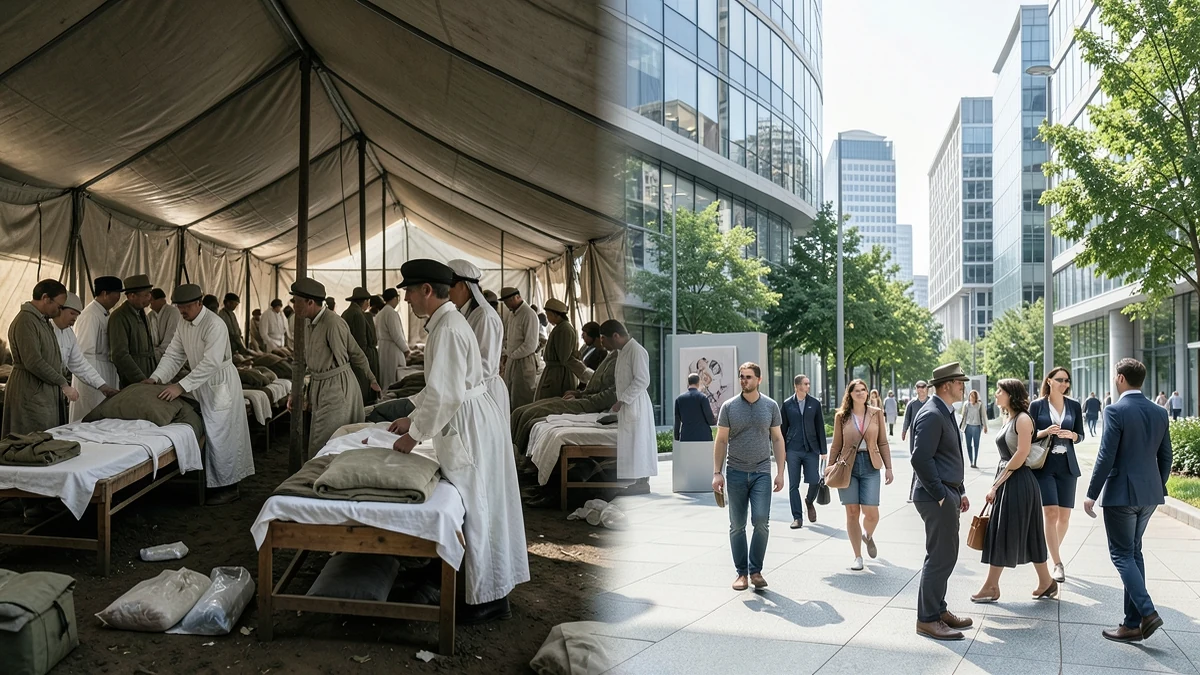
The comparison 1918 vs 2026 is tempting because both dates sit inside periods of war, disease, displacement, economic anxiety and arguments about what can still hold the world together. The resemblance can feel uncanny. In 1918, a devastating industrial war overlapped with an influenza pandemic. In the years around COVID-19, a global health emergency was followed by inflation, sharpened geopolitical rivalry, renewed wars and a profound struggle over information.
Yet a resemblance is not a cycle. There is no sound historical evidence that civilization is programmed to repeat a combined war-and-pandemic crisis every hundred years. Dates do not possess motives; people, states and institutions do. The useful question is therefore not whether 2026 is secretly reenacting 1918, but why societies under pressure often produce recognizable patterns—and which lessons might prevent suffering from becoming destiny.
The world at the edge in 1918
By the beginning of 1918, the First World War had lasted more than three years. Millions of soldiers had been killed or wounded. The Western Front had turned landscapes into mud, trenches and shattered towns, while fighting, occupation and blockade affected populations far beyond France and Belgium. The conflict stretched across Europe, the Middle East, Africa and the oceans. Empires mobilized soldiers and laborers from colonies and dominions, making the war global in both geography and consequence.
Civilian life was reorganized around the conflict. Governments directed industry, rationed goods and controlled transportation. Families lived with separation and bereavement; food and fuel shortages varied sharply by place; refugees and uprooted communities carried the consequences of collapsing fronts and changing borders. In many countries, the public received news through systems shaped by wartime censorship and propaganda. Authorities feared that honest accounts of military failure, suffering or disease could weaken morale.
The year was also politically unstable. Russia had left the war after revolution. Germany launched a major spring offensive before increasing numbers of American troops could decisively strengthen the Allied side. When that offensive failed and the Allies advanced, the military balance changed quickly. The armistice of 11 November stopped the fighting on the Western Front, but it did not instantly repair hunger, grief, revolution, communal violence or the wreckage of empires.
Influenza moved through a mobilized world
The influenza pandemic of 1918–1919 did not spread simply because there was a war, and its precise origin remains debated. War nevertheless created exceptionally efficient channels for transmission. Huge numbers of people lived in crowded barracks, camps, ships, trains, hospitals and factories. Troops crossed oceans and continents. Malnutrition, exhaustion and damaged public-health systems made many populations more vulnerable, while medical services were already carrying the burden of mass casualties.
The pandemic came in waves and did not affect every place in the same way. A severe wave in the latter part of 1918 killed rapidly and reached communities that had seemed distant from the front. The familiar label “Spanish flu” is misleading: Spain did not necessarily originate the disease. As a neutral country with less restrictive wartime reporting, it published news about influenza more openly than some belligerent states, making the outbreak appear unusually Spanish to outside readers.
That information environment mattered. Some officials minimized danger, newspapers were constrained, and public gatherings sometimes continued even as infections rose. Communities also improvised. Cities closed schools or theaters, volunteers delivered food, nurses worked through impossible conditions, and people used masks with varying rules and compliance. The science of viruses and the tools of modern epidemiology were not yet available in their present form. Antibiotics, which can treat secondary bacterial infections but not influenza itself, were not part of routine medicine.
Fear was domestic as well as military
War is often remembered through armies, and pandemics through death totals, but crisis is also made of ordinary uncertainty. A letter failed to arrive. A wage disappeared. A child developed a fever. A train brought strangers into a town already afraid of infection. Rumor occupied the space where trustworthy information was absent.
People in 1918 could face several forms of loss at once: a relative at the front, another sick at home, savings weakened by rising prices, and a political order suddenly collapsing. Grief rituals were disrupted by the scale and speed of death. The end of fighting brought relief, but also millions of demobilized soldiers, disabled veterans, widowed families and societies struggling to name what they had experienced.
This layered fear helps explain why dramatic comparisons with the present are emotionally powerful. Human beings rarely experience “a pandemic” or “a war” as separate textbook chapters. Crises overlap inside households. Health, rent, food, work, safety and news become one problem because each can destabilize the others.
Peace after the armistice was not the same as recovery
The armistice ended major combat, but peace had to be constructed through political choices. The Paris Peace Conference and the treaties that followed redrew borders, assigned obligations and created new states while leaving many national aspirations unresolved. Victors, defeated powers, colonized peoples and minority communities did not experience the settlement in the same way.
The League of Nations, established in 1919 under the Treaty of Versailles, expressed a significant idea: international cooperation and collective security might prevent another catastrophe. It developed useful work in areas such as health, refugees and international administration. But it lacked universal membership, dependable enforcement and the political commitment necessary to restrain aggressive states. The United States never joined. Great powers often defended narrow interests, while peoples living under imperial rule found the language of self-determination applied unevenly.
The lesson is not that international institutions are pointless. It is that institutions cannot substitute for the will to use them fairly. A peace agreement that suspends gunfire but leaves humiliation, insecurity, exclusion and economic desperation untreated may create an interval rather than a durable peace.
1918 flu vs COVID: similarities with limits
The COVID-19 pandemic revived memories of 1918 because both involved a dangerous respiratory disease, repeated waves, public-health restrictions, overwhelmed medical systems and disputes over collective responsibility. Both revealed that an outbreak is never only biological. Employment, housing, transport, education, trust and inequality influence who can avoid exposure, obtain care or recover financially.
The differences are just as important. Scientists identified the novel coronavirus quickly, sequenced its genome and developed vaccines at a speed unimaginable in 1918. Intensive care, oxygen therapy, global surveillance and instantaneous scientific collaboration changed what medicine could do. Governments could communicate directly with millions of people, and remote work or schooling was possible for some.
Those same networks created new vulnerabilities. Digital platforms allowed useful guidance to travel rapidly, but also enabled false cures, conspiracy narratives and manipulated content to cross borders within minutes. The World Health Organization described this overload of accurate and misleading material as an “infodemic.” In 1918, scarcity, censorship and slow reporting distorted understanding; during COVID-19, abundance, speed and algorithmic amplification often did so. The information problems were related, but not identical.
Nor should the pandemics be treated as interchangeable in severity, demography or context. Influenza in 1918 caused unusually high mortality among many young adults and struck societies already damaged by world war. COVID-19 produced its own unequal patterns, with age, health, occupation and access to care shaping risk. Comparison becomes useful only when it respects such differences.
The global crises of 2026
In August 2026, COVID-19 is no longer organizing daily life everywhere as it did during the emergency years, but its losses and institutional effects remain. Health workers and families carry memories of prolonged stress. Interrupted education, delayed care, bereavement and economic disruption did not vanish when restrictions ended.
Meanwhile, wars and political violence have again placed civilians at the center of destruction. Modern conflict displaces people across and within borders, interrupts food and energy systems, and travels through screens in nearly real time. According to a March 2026 World Health Organization summary, more than 117 million people were forcibly displaced worldwide, although such totals change as crises evolve. The scale is not evidence of a century-long clock. It is evidence that insecurity in one region can become a humanitarian, economic and political concern far beyond it.
Economic uncertainty also changes how crisis feels. Households do not experience inflation, disrupted trade or insecure employment as abstract charts. They experience the shrinking distance between income and necessities. When public trust is already fragile, economic pain makes simplistic explanations and scapegoating easier to sell.
Why prolonged crisis changes the mind
People are capable of remarkable adaptation, but adaptation has a cost. A short emergency can produce intense solidarity and concentration. A prolonged emergency often brings fatigue, irritability, numbness and withdrawal. The mind cannot remain indefinitely at full alarm without changing how it evaluates risk.
The psychological effects are not uniform and should not be casually diagnosed. Many people recover through family, community, faith, routine and practical security. Others live with grief, anxiety or trauma, especially when danger is repeated or when support is unavailable. The WHO has emphasized that emergencies disrupt both social networks and mental-health services precisely when demand rises.
This helps explain a recurring historical pattern: populations may initially accept shared sacrifice, then become divided over who pays, who decides and whose suffering counts. Trust survives when leaders communicate uncertainty honestly, distribute burdens visibly and correct mistakes. It deteriorates when institutions conceal information, punish inconvenient facts or treat some lives as expendable.
What is genuinely similar—and what is not
The strongest parallel between 1918 and 2026 is not a matching list of events. It is the way systems interact. War damages health and transport. Disease weakens economies and institutions. Scarcity increases political tension. Bad information turns uncertainty into suspicion. Displacement separates people from protection. Each pressure can intensify the next.
But the worlds are fundamentally different. The international system now includes the United Nations, global health agencies, humanitarian law, instantaneous communication and scientific networks that did not exist in 1918. Many states have far greater administrative and medical capacity. Citizens can document abuses and organize across borders. At the same time, nuclear weapons, cyber operations, globally connected supply chains and industrial-scale digital persuasion create risks that people in 1918 could not have imagined.
Technology therefore does not make the present automatically safer or wiser. It expands both capacity and consequence. A laboratory can share a genome globally; a false claim can reach the same audience. Satellites can document destruction; precision weapons can still destroy civilian lives. The moral problem remains human even when the tools are new.
Do humans repeat patterns rather than dates?
The belief that history repeats every hundred years offers emotional order. It turns bewildering events into a pattern and implies that someone can see what comes next. Yet it also encourages fatalism. If catastrophe is scheduled, responsibility becomes blurred.
A better explanation is that human beings repeatedly confront the same structural temptations: leaders hide bad news; institutions protect prestige; communities search for scapegoats; fear narrows sympathy; temporary emergency powers become attractive; peace is confused with victory. These patterns recur because incentives and emotions recur, not because the calendar commands them.
Other patterns recur too. Nurses, neighbors and volunteers organize care. Scientists share knowledge. journalists challenge censorship. Refugees rebuild communities. Enemies negotiate because continued destruction becomes intolerable. History contains warning, but it also contains usable courage.
Lessons for the search for peace
Peace is more than the absence of battle. It requires credible security, public health, food and economic stability, rights that do not depend on identity, and institutions able to resolve disputes before violence becomes the easiest language. The aftermath of 1918 shows the danger of building settlements around punishment, selective principles and exhausted publics. The COVID years show that preparedness cannot begin after a crisis has already exposed every weak point.
The practical lessons are unromantic: protect truthful reporting, invest in health systems before emergencies, support displaced people, preserve channels for diplomacy, and judge policies by their effects on civilians. International rules matter most when powerful states accept that they apply even when inconvenient. Public trust matters most before leaders urgently need it.
The deepest difference between 1918 and 2026 is that people today can study 1918. We possess its records, arguments, failures and unfinished hopes. That knowledge does not guarantee wisdom. It does remove the excuse that no warning existed.
History does not repeat like a clock striking the same hour. It offers doors that human beings have opened before. Some lead toward secrecy, humiliation and widening war; others toward cooperation, honest memory and a peace strong enough to survive fear. The date cannot choose. We can.
Sources & Further Reading
- The 1918 influenza pandemic overview, U.S. Centers for Disease Control and Prevention
- The League of Nations, predecessor to the United Nations, United Nations
- The COVID-19 infodemic, World Health Organization
- Mental health in emergencies, World Health Organization
- Refugee and migrant health, World Health Organization


