
The World's Greatest Libraries—and the Treasures Hidden Inside Them
Explore ten of the world's greatest libraries, from the Library of Congress to the BnF, and the rare books, maps and memories they preserve today.
By Wajeeha Iqbal
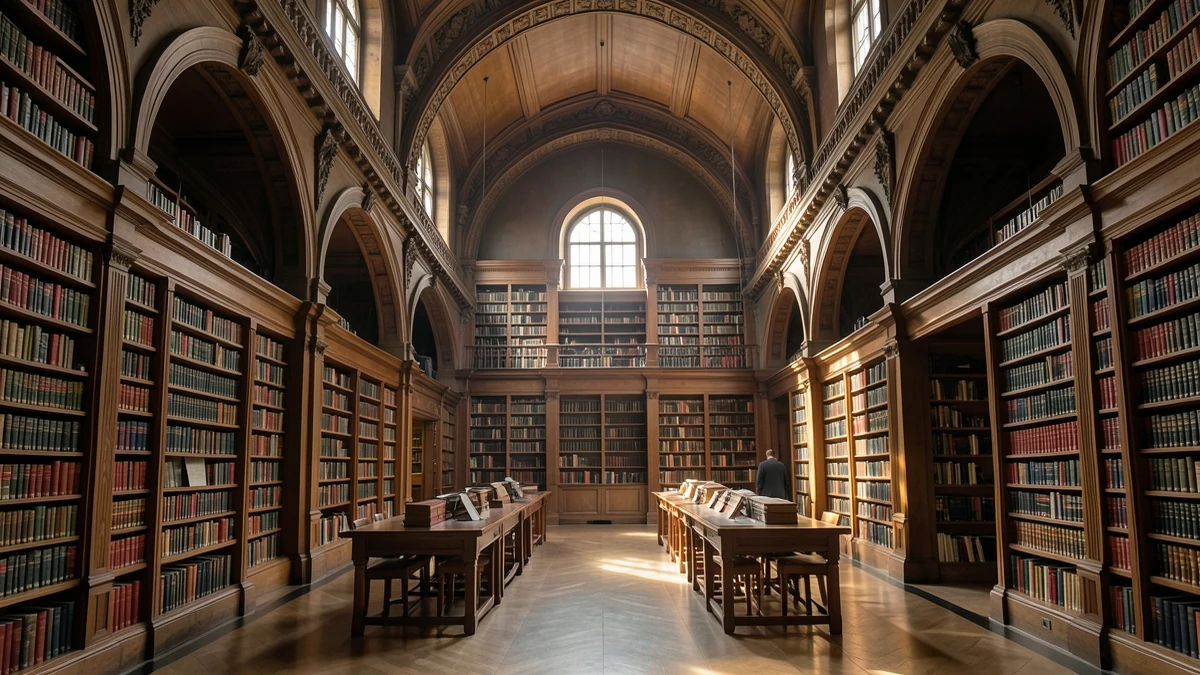
The greatest libraries in the world cannot be arranged honestly into one simple ranking. The Library of Congress describes itself as the world’s largest library, and by total recorded items its claim is formidable. The British Library holds more than 170 million items. Other institutions may be smaller by count yet unrivaled in medieval manuscripts, Chinese texts, papyri, music, legal deposit, maps or the documentary memory of a nation.
“Largest” can mean catalogued books, total physical items, shelf length, digital objects, manuscripts or buildings. Counting methods differ. A newspaper issue, photograph, web archive and multi-volume work may be recorded in different ways. The more interesting question is what these institutions preserve—and how they keep fragile evidence available after the world that created it has changed.
Here are ten libraries whose collections, architecture and public roles make them great in different senses. This is a journey, not a league table.
1. Library of Congress, Washington, D.C.
Established in 1800 to serve the U.S. Congress, the Library of Congress grew from a legislative collection into an enormous world resource. Its holdings extend far beyond books: manuscripts, photographs, films, sound recordings, maps, newspapers, sheet music and legal materials occupy specialized divisions and preservation facilities.
The library reported more than 178 million items in its collections for fiscal year 2023, including roughly 25.8 million catalogued books and tens of millions of manuscripts and images. Such a total should not be compared casually with another institution’s “book” count. It reflects the breadth of formats the library collects.
Among its famous treasures are Thomas Jefferson’s library, acquired after British forces burned the congressional library in 1814; one of the surviving Gutenberg Bibles printed on vellum; and the 1507 Waldseemüller map often called “America’s birth certificate” because it is the earliest known map to use the name America. The Packard Campus preserves audiovisual memory ranging from early recordings to films whose original materials demand controlled storage and restoration.
2. British Library, London and Yorkshire
The British Library is the national library of the United Kingdom. It states that its shelves hold more than 170 million items and grow daily through legal deposit and acquisition. Books are only part of the collection: newspapers, patents, maps, manuscripts, prints, sound recordings and digital publications all belong to the national record.
Its Treasures Gallery has brought together objects that would define smaller institutions: Magna Carta manuscripts, notebooks associated with Leonardo da Vinci, handwritten lyrics, illuminated religious texts and literary manuscripts. The King’s Library—a glass tower containing the collection of George III—stands at the center of the St Pancras building as both storage and architectural symbol.
3. Bibliothèque nationale de France, Paris
The Bibliothèque nationale de France, or BnF, carries centuries of French royal and national collecting into several modern sites. Its Richelieu complex contains historic reading rooms and specialized collections; the François-Mitterrand site is marked by four towers shaped like open books.
The BnF’s strength is diversity: printed books, manuscripts, maps, coins, medals, prints, photographs, music, costumes, performance archives and audiovisual material. Its treasures include medieval illuminated manuscripts, writers’ papers and one of the world’s most important map collections. The institution also preserves material from France’s long imperial and global history, collections that invite both scholarship and debate about provenance.
Gallica, the BnF’s digital library, now offers free access to millions of documents from the BnF and partner institutions. Digitization does not replace the original—the texture, binding, corrections and material history still matter—but it lets a fragile item be studied without repeated handling and makes French collections visible far beyond Paris.
4. National Library of China, Beijing
The National Library of China is one of the world’s major national collections and the largest library in Asia by commonly cited holdings. Its roots include the Metropolitan Library founded near the end of the Qing dynasty, while its collections reach far deeper into Chinese written history.
The library is renowned for ancient and rare material: oracle bones, Dunhuang manuscripts, stone and bronze rubbings, old maps, genealogies and editions printed with woodblocks. Such objects remind us that “a book” has never meant one technology. Text can be cut into wood, brushed onto paper, impressed from stone or encoded digitally.
5. Vatican Apostolic Library, Vatican City
The Vatican Library is not among the world’s largest by raw item count, but few libraries can rival the quality and chronological depth of its manuscript collections. Its manuscript department describes around 80,000 manuscript volumes alongside vast archival, printed, graphic and numismatic holdings.
The materials range across Latin, Greek and many Eastern languages. They include biblical papyri, late antique manuscripts of classical authors, palimpsests, Byzantine illumination, Renaissance works, music and family archives. A palimpsest—a manuscript whose original writing was scraped or washed away and overwritten—can preserve a lost work beneath the visible text. Multispectral imaging has made some erased writing readable without physically stripping the page.
Contrary to popular fantasy, the library’s value does not depend on a secret chamber of forbidden truth. It is a research institution with access rules designed to protect rare materials. Its digital platform uses international image standards to share manuscripts at high resolution, turning controlled preservation into broader scholarly access.
6. Bodleian Libraries, Oxford
The Bodleian at the University of Oxford is not one library room but a network of libraries with a history reaching back more than four centuries. Its historic core—the Old Bodleian, Duke Humfrey’s Library and the Radcliffe Camera—has shaped the visual idea of an academic library.
As a legal-deposit library, the Bodleian has the right to receive works published in the United Kingdom and Ireland under relevant arrangements. Its special collections contain medieval manuscripts, early printed books, maps, archives and papers from science, politics and literature.
One of its symbolic treasures is a Gutenberg Bible. It also holds important manuscripts from multiple religious and linguistic traditions. Yet the Bodleian’s greatness lies as much in continuity of use as in individual objects. Students and researchers still work within buildings whose architecture records changing ideas about who could study and how knowledge should be ordered.
7. New York Public Library, New York City
The New York Public Library demonstrates that a great research collection can belong to a public library system. Its Stephen A. Schwarzman Building on Fifth Avenue—with the stone lions Patience and Fortitude outside—contains research rooms and special collections, while neighborhood branches extend service across the city.
The library preserves manuscripts, maps, photographs, performing-arts archives, rare books and records of New York’s many communities. The Schomburg Center for Research in Black Culture is internationally important in its own right, showing how a library system can contain institutions built around histories once neglected by mainstream collecting.
8. Library of Alexandria, Alexandria
The modern Bibliotheca Alexandrina opened in 2002 near the site traditionally associated with the ancient Library of Alexandria. It is not a surviving continuation of the ancient collection; no complete catalogue or clear account of a single dramatic destruction exists. Its significance is instead an intentional revival of Alexandria as a meeting place for knowledge.
The building’s vast tilted disk faces the Mediterranean, while its granite wall carries scripts from around the world. Inside are reading areas, museums, exhibitions, archives and cultural programs. The architecture makes a contemporary claim: a library can be both storehouse and civic forum.
The institution’s digital and preservation projects address Arabic and regional heritage while participating in international research. Its greatest “treasure” may be symbolic—the decision to answer the loss associated with the ancient library by building a new center rather than manufacturing certainty about the old one.
9. Trinity College Library, Dublin
The Old Library at Trinity College Dublin is famous for the Long Room, a high gallery of books and marble busts. Its best-known treasure is the Book of Kells, an illuminated manuscript of the four Gospels created around the ninth century. Its intricate pages make text, image, devotion and craft inseparable.
The library also holds the Brian Boru harp, a national symbol of Ireland, and an extensive collection built through legal deposit and scholarship. The fame of one manuscript can obscure the larger work of cataloguing, conservation and access that keeps a research library alive.
The Old Library’s redevelopment project has required the removal, cleaning and documentation of large numbers of books while the historic building is protected against fire and environmental risk. The operation reveals a truth hidden by beautiful photographs: heritage survives through engineering, dust control, barcodes, climate systems and patient labor.
10. Austrian National Library, Vienna
The Austrian National Library occupies the magnificent State Hall of the former imperial court library, where frescoes, statues, globes and carved shelves turn a collection into Baroque spectacle. Its origins and holdings reflect the Habsburg monarchy’s reach across languages and regions.
The library preserves papyri, manuscripts, maps, music, portraits, photographs, planned languages and archives as well as printed books. Its Papyrus Collection contains material spanning many centuries of writing in Egypt, while its globe and map collections show how knowledge of the world was measured, imagined and used by power.
The treasures not displayed
Visitors naturally focus on illuminated pages, first editions and dramatic halls. Most library work occurs elsewhere. Conservators test ink and repair bindings. Cataloguers identify languages and former owners. Technicians migrate files before storage media fail. Staff retrieve boxes for researchers and return them to climate-controlled darkness.
Some of the most valuable holdings look ordinary: a worker’s diary, an election leaflet, a local newspaper, a field recording, a map annotated by hand. Rarity is not the same as significance. An object becomes historically powerful when it answers a question that no other evidence can.
Libraries also preserve silences. Collections reflect who had the means to write, publish, donate and be collected. Contemporary institutions increasingly document oral histories, community archives and digital culture to reduce those gaps, though no archive can be complete.
Preservation versus access
Every use of a fragile object creates risk, but preservation without access defeats the purpose of a library. Institutions balance these duties through reading-room rules, supports that protect bindings, controlled lighting, high-quality facsimiles and digitization.
Digital copies expand access dramatically, yet they create their own preservation burden. Files require metadata, storage, backups and migration. A scan without a reliable description can become invisible. Copyright and privacy may limit online availability even when physical access is possible.
The best libraries do not treat digital and physical worlds as enemies. A digital image lets millions discover an object; the original retains evidence of scale, material, sequence and alteration that a screen cannot fully reproduce.
Why great libraries still matter
In an age of instant search, a library’s value can seem reduced to information retrieval. But search engines answer from what is available, indexed and commercially visible. Libraries preserve what the present does not yet know it will need.
They also create public space for attention. A reading room places a person among others engaged in quiet work. The architecture may be grand or plain; the democratic promise is that knowledge can be approached without purchasing every book.
The renewed popularity of classic books depends on this continuity. Adaptations and trends draw attention, but libraries keep many editions, translations and scholarly records available after the trend passes. They allow readers to compare rather than accept the newest version as the only one.
The world’s greatest libraries are therefore not vaults where treasure hides from life. They are systems that keep the past usable. Their real achievement is not possession but transmission: paper, parchment, film, sound and data carried safely into the questions of people not yet born.


